 By Marcus Reeve
How Seven Stocks Came to Drive a Third of the S&P 500
Quick answer: The Magnificent 7 made up 34.8% of the S&P 500 as of October 14, 2026, led by Nvidia at 8.05% of the index ($5.28 trillion market cap). Through October 15, the seven were up 9.7% on average in 2026, versus 13.2% for the S&P 500. The seven Magnificent 7 stocks are Nvidia (NVDA), Apple (AAPL), Microsoft (MSFT), Alphabet (GOOGL), Amazon (AMZN), Meta Platforms (META) and Tesla (TSLA), worth a combined $24.5 trillion.
Updated October 2026: weights, market caps and 2026 returns refreshed.
Seven companies now decide which way the US stock market moves. The Magnificent 7 — Nvidia, Apple, Microsoft, Alphabet, Amazon, Meta, and Tesla — account for 34.8% of the entire S&P 500 as of October 14, 2026. That concentration means a passive investor who thinks they own 500 diversified companies actually has one-third of their money riding on seven AI-and-platform mega-caps.
This is a complete 2026 reference on the Magnificent 7: what each stock weighs in the S&P 500, how large they have become by market cap, how the group's dominance was built over the last decade, and — most importantly — the concentration risk that comes baked into every index fund because of them. If you hold an S&P 500 ETF, a target-date fund, or a US total-market tracker, this is your real portfolio.
What Are the Magnificent 7 Stocks?
The term "Magnificent Seven" was coined in 2023 to describe the seven mega-cap technology and platform companies that drove the bulk of US equity returns. The members are:
- Nvidia (NVDA) — AI accelerators and data-center GPUs
- Apple (AAPL) — consumer hardware, services, and an installed base of ~2.3 billion devices
- Microsoft (MSFT) — cloud (Azure), enterprise software, and OpenAI exposure
- Alphabet (GOOGL) — Google Search, YouTube, Cloud, and Gemini
- Amazon (AMZN) — e-commerce plus AWS, the largest cloud provider
- Meta Platforms (META) — Facebook, Instagram, WhatsApp, and AI/Reality Labs
- Tesla (TSLA) — electric vehicles, energy storage, and autonomy/robotics
What unites them is not a sector — they span semiconductors, hardware, software, advertising, retail, and autos. What unites them is scale, cash generation, and a credible claim on the AI build-out. Every one of the seven is now worth more than $1 trillion, a club that did not exist at all a decade ago.
The Magnificent 7 in 2026: Weight & Market Cap Reference Table
Here is the snapshot as of mid-October 2026. Weights are each company's share of the index as held by the SPDR S&P 500 ETF (SPY) holdings file dated October 14, 2026 (Alphabet combines its GOOGL and GOOG share classes). Market caps are company-level values at the October 15, 2026 close, and 2026 returns are price changes from the December 31, 2025 close. Figures move daily; check the live stock pages for the current number.
| Rank | Company | Ticker | Market Cap (Oct 15, 2026) | S&P 500 Weight (Oct 14, 2026) | 2026 Return (to Oct 15) |
|---|---|---|---|---|---|
| 1 | Nvidia | NVDA | $5.28T | 8.05% | +16.5% |
| 2 | Apple | AAPL | $4.99T | 7.53% | +25.8% |
| 3 | Microsoft | MSFT | $4.01T | 5.96% | +11.5% |
| 4 | Alphabet | GOOGL | $4.27T | 5.52% | +11.6% |
| 5 | Amazon | AMZN | $2.75T | 3.75% | +10.4% |
| 6 | Meta Platforms | META | $1.88T | 2.45% | +11.6% |
| 7 | Tesla | TSLA | $1.36T | 1.56% | −19.4% |
| — | Magnificent 7 total | — | $24.5T | 34.8% | +9.7% (average) |
| — | S&P 500 (SPY) | — | — | 100% | +13.2% |
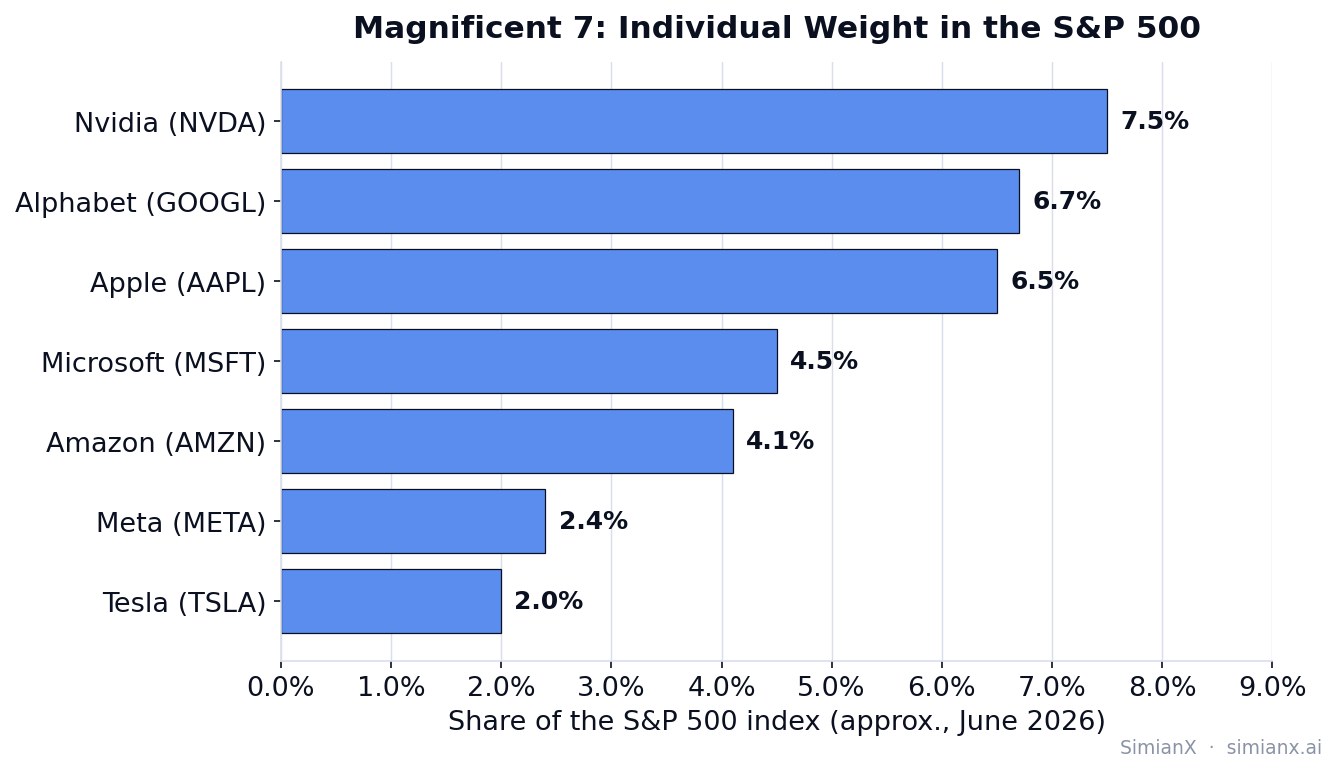
Four facts stand out. First, Nvidia is the single largest weight in the index at 8.05%, up from about 7.5% in June 2026. Second, Alphabet is the third-largest of the seven by market cap ($4.27T) but fourth by index weight (5.52%), behind Microsoft: S&P weights count only shares available to the public, and Alphabet's founder-held Class B shares are excluded. Third, the gap inside the group is large: Nvidia ($5.28T) is worth more than Meta and Tesla combined ($3.24T). Fourth, Broadcom (AVGO), at 2.48% of the index, now outweighs both Meta (2.45%) and Tesla (1.56%). An independent market-cap tally for the October 15 close (Slickcharts) gives the same 34.8% combined weight for the seven.
The chart below is the June 2026 snapshot; the table above is the current one.
The Magnificent 7 in 2026, Stock by Stock
Nvidia (NVDA) remains the engine of the AI trade. Demand for data-center GPUs and the Blackwell/Rubin accelerator roadmap has kept revenue compounding, and the stock has carried the largest share of the group's market cap into mid-2026. It is also the name most exposed if AI capex expectations cool — when Nvidia sneezes, the index catches a cold.
Alphabet (GOOGL) has been one of 2026's relative winners inside the group, with Gemini adoption and Google Cloud margins reassuring investors that the company is an AI beneficiary rather than a search-disruption victim. It ranks No. 3 by market cap in October 2026, behind Nvidia and Apple.
Apple (AAPL) is the best performer of the seven in 2026, up 25.8% through October 15. Its services business and installed base provide ballast, though its AI story has been the slowest to land of the seven, and 2026 has seen it trade more like a quality compounder than a momentum name.
Microsoft (MSFT) sits at the center of the enterprise-AI thesis through Azure and its OpenAI relationship. At 5.96% of the index, it is the third-largest weight in the S&P 500.
Amazon (AMZN) is a two-engine story: AWS reaccelerating on AI workloads, and a retail business throwing off improving margins. It remains the fifth-largest US company.
Meta (META) has been monetizing AI across its ad stack while spending heavily on infrastructure. At 2.45% of the index it is a smaller weight than the top five, and slightly below Broadcom.
Tesla (TSLA) is the most volatile of the seven and the only one down in 2026 (−19.4% through October 15). Its 2026 narrative is less about car deliveries and more about autonomy, robotaxi, and Optimus — a high-beta bet that trades on the future, not the present quarter.
For real-time, AI-generated analysis on any of these names, our agents cover US stocks live on the stock analysis platform and rank how different AI models read them on the model leaderboard.
How the Magnificent 7 Took Over the S&P 500
The concentration did not happen overnight. In 2015, the seven names that would later be called the Magnificent 7 made up roughly 11% of the S&P 500. By the 2021 mega-cap peak they were near 24%. After the 2022 bear market knocked them back to about 20%, the launch of the modern AI cycle in 2023 sent their combined weight vertical: ~28% in 2023, ~32% in 2024, and a peak above 34% in 2025, then about 33.8% in June 2026 and 34.8% in October 2026.
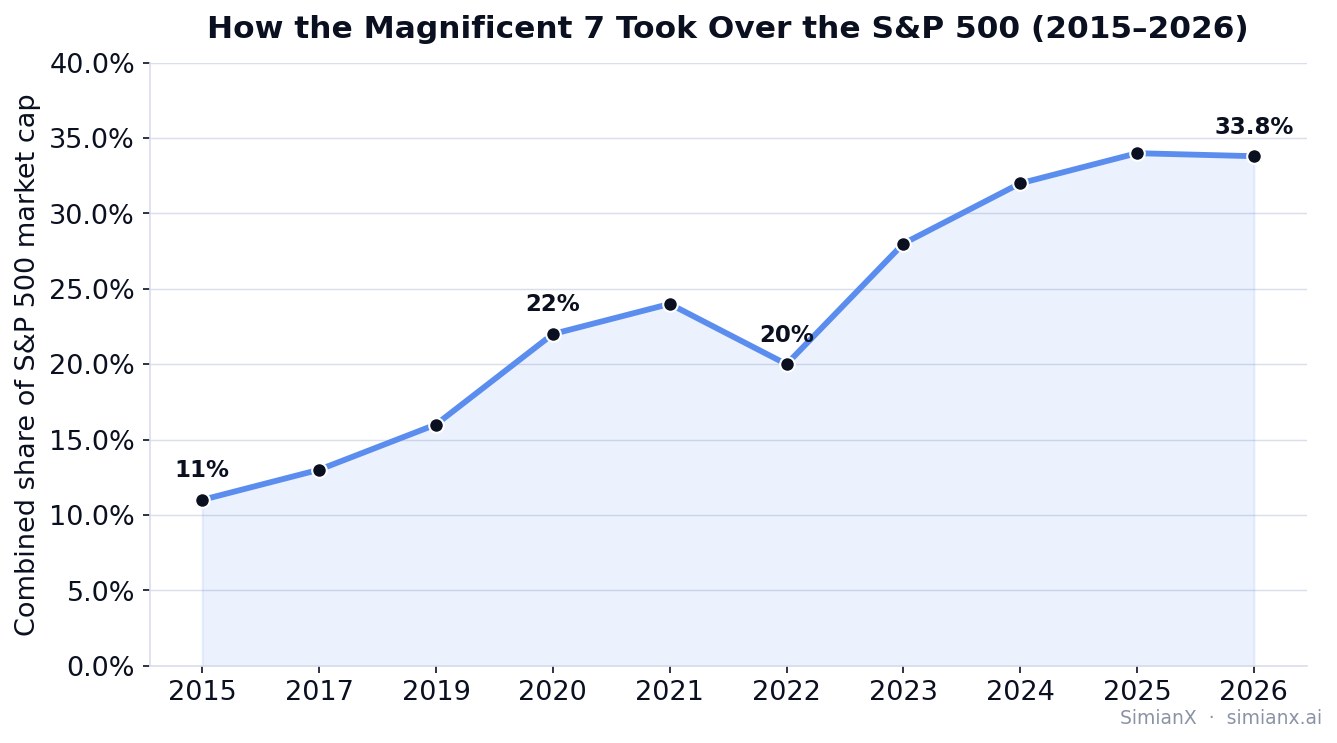
That climb tracks three structural shifts: the move from on-premise software to cloud, the global advertising duopoly maturing, and — the accelerant — generative AI turning compute into the single most valuable input in technology. Each shift funneled capital and earnings toward the same handful of balance sheets. The S&P 500 is market-cap weighted, so as these companies grew, the index mechanically tilted further toward them with no decision from any investor.
S&P 500 Concentration Risk: Why It Matters
Concentration cuts both ways. On the way up, it adds return: the Magnificent 7 have delivered the majority of the S&P 500's total return since 2023, and an index fund holder got that performance for free. On the way down, it is the single biggest hidden risk in a "diversified" portfolio.
Consider what 34.8% concentration means in practice:
- A bad day for AI is a bad day for your index fund. If the seven fall 10% together — as they did during the 2022 drawdown and again in episodes of 2025 — the S&P 500 drops about 3.5% from those names alone, before the other 493 companies move at all.
- Correlated risk masquerades as diversification. Six of the seven share a common driver: the AI capital-expenditure cycle. Nvidia sells the chips; Microsoft, Amazon, Alphabet, and Meta buy them; the whole complex re-rates on the same headlines. That is not seven independent bets — it is closer to one big bet with seven tickers.
- Equal-weight is diverging. The equal-weight S&P 500 (where every company is ~0.2%) has at times lagged the cap-weighted index by double digits during the Mag 7 surge — and outperformed sharply whenever the megacaps wobble. The spread between the two is the cleanest live gauge of how much the index is leaning on these seven.
- Index funds are now active bets. Buying "the market" in 2026 is, in practice, an overweight position in large-cap AI. That may be exactly the bet you want — but it should be a choice, not a surprise.
Through the first half of 2026 the Magnificent 7 underperformed the broader index, rising about 5.4% versus the S&P 500's ~7.9%, as money rotated toward small caps and previously-neglected sectors. The gap persisted into the fourth quarter: through October 15, 2026, an equal-weighted basket of the seven was up 9.7% versus 13.2% for the S&P 500 (SPY), with Tesla (−19.4%) the largest drag and Apple (+25.8%) the leader. Whether that is a broadening of the market or a pause is the central debate of the year. The split can show up within a single session: on October 19, 2026, SPY rose 0.42% while the equal-weight RSP fell 0.32% — one of the narrow rally days counted since 2019.
What Could Break the Magnificent 7 Trade
A reference asset should name the risks, not just the records. The most-watched threats to the cohort in 2026:
- AI capex disappointment. The entire complex is priced for sustained, heavy data-center spending. Any credible sign that hyperscaler capex is plateauing — or that AI return-on-investment is lagging the spend — hits Nvidia first and the rest by association.
- Regulation and antitrust. Alphabet, Apple, Amazon, and Meta all face ongoing antitrust and platform-regulation pressure in the US and EU. Forced changes to default-search deals, app-store economics, or ad targeting would dent the highest-margin businesses.
- Valuation gravity. Several of the seven trade at premium multiples that assume years of compounding. Rising long-term yields (the 10-year Treasury yield was 5.10% on October 15, 2026) compress the present value of those far-off earnings.
- Single-name shocks. With Nvidia at about 8% of the index, one disappointing guidance number from a single company can move the entire S&P 500 measurably — the definition of concentration risk.
- Rotation persistence. If 2026's early broadening into small caps and value continues, the cap-weighted index could lag a more balanced portfolio for the first time in years.
How to Track the Magnificent 7 with SimianX
Because seven companies move the market, watching them well matters more than ever. SimianX puts AI agents on these names so you don't have to refresh seven ticker pages by hand:
- Live stock analysis — our agents cover US stocks in real time, including all seven Magnificent 7 names. Start on the stock pages for any ticker.
- The AI model leaderboard — see how dozens of AI models from several providers actually read these stocks, scored on real profit-and-loss, on the leaderboard.
- Autopilots — let an AI strategy monitor and trade a watchlist 24/7 instead of reacting to headlines after the fact: autopilots.
- More market references — browse the full library of data-driven breakdowns in our stories.
For background reading, Investopedia's Magnificent Seven explainer and the S&P Dow Jones Indices methodology cover how the index is constructed and weighted.
Frequently Asked Questions
How much of the S&P 500 is the Magnificent 7?
34.8% as of October 14, 2026, based on the SPDR S&P 500 ETF (SPY) holdings file; an independent market-cap tally for October 15 gives the same figure. In June 2026 the share was about 33.8%.
What is the biggest Magnificent 7 stock?
Nvidia, with a $5.28 trillion market cap and an 8.05% weight in the S&P 500 as of mid-October 2026. Apple ($4.99T, 7.53%) is second.
Which Magnificent 7 stocks are up in 2026?
Six of the seven, through October 15, 2026: Apple +25.8%, Nvidia +16.5%, Alphabet and Meta +11.6%, Microsoft +11.5% and Amazon +10.4%. Tesla is down 19.4%. The S&P 500 (SPY) is up 13.2%.
What stocks are in the Magnificent 7?
Nvidia (NVDA), Apple (AAPL), Microsoft (MSFT), Alphabet (GOOGL/GOOG), Amazon (AMZN), Meta Platforms (META) and Tesla (TSLA). The label dates from 2023.
Are the Magnificent 7 a good investment in 2026?
This page does not give investment advice. The seven are large, cash-generating businesses, but they are tied to the same AI spending cycle and already make up about a third of any S&P 500 index fund. The relevant question is how much extra exposure you want on top of that.
How do I reduce Magnificent 7 concentration risk?
Common approaches include an equal-weight S&P 500 fund (each company about 0.2%), adding small-cap or international exposure, or measuring how much of your portfolio already sits in the seven through index funds.
Is the Magnificent 7 outperformance over?
In 2026 so far, yes: the seven averaged +9.7% through October 15 versus +13.2% for the S&P 500, after lagging in the first half as well. Whether that continues is unresolved; the spread between cap-weighted and equal-weighted indexes is the usual gauge.
The Bottom Line
The Magnificent 7 are the US stock market in 2026 in a way no group has been before — 34.8% of the S&P 500 in October 2026, led by a single $5.28 trillion company. That concentration added large returns on the way up and is the largest single exposure in passive portfolios on the way down. Owning an index fund today means owning this bet whether you intended to or not. The practical step is to know exactly how much of your portfolio they already are — and to watch them with tools built for the job. Track all seven live on the SimianX stock platform and see which AI models read them best on the leaderboard.
Related Reading
- Magnificent 7 Earnings Dates and Results: Q3 2026 Tracker
- Tesla Free Cash Flow by Year: Q3 2026's $1.5B vs AI Capex
- Nasdaq Up, Most Stocks Down: Narrow Rally Days 2019–2026
- Every Tech Bubble Since 1929: How AI in 2026 Compares
- Every S&P 500 Bear Market Since 1929: Duration and Recovery
- How Long Every Bear Market Took to Recover: 1929-2022
- NVDA After Earnings: Every Reaction Since 2016 in One Table
- S&P 500 Seasonality: The Best & Worst Months 1950–2026
- The Presidential Cycle: S&P 500 Returns by Year, 1928-2025
- AI Capex 2026: Big Tech Now Spends 96% of Its Cash Flow
- Amazon Joins the $3 Trillion Club: The Complete Timeline
- When Did Tesla IPO? The Date, Price, and 290x Return
- More reference tables in the AI and markets topic hub