From Bitcoin Miner to AI Landlord: Inside the TeraWulf–Anthropic $19B Lease
TeraWulf Stock 2026 is no longer just a bitcoin mining story. After Anthropic agreed to a long-term AI infrastructure lease with TeraWulf, investors began reassessing WULF as a power-backed AI data center platform rather than a pure crypto-linked miner.
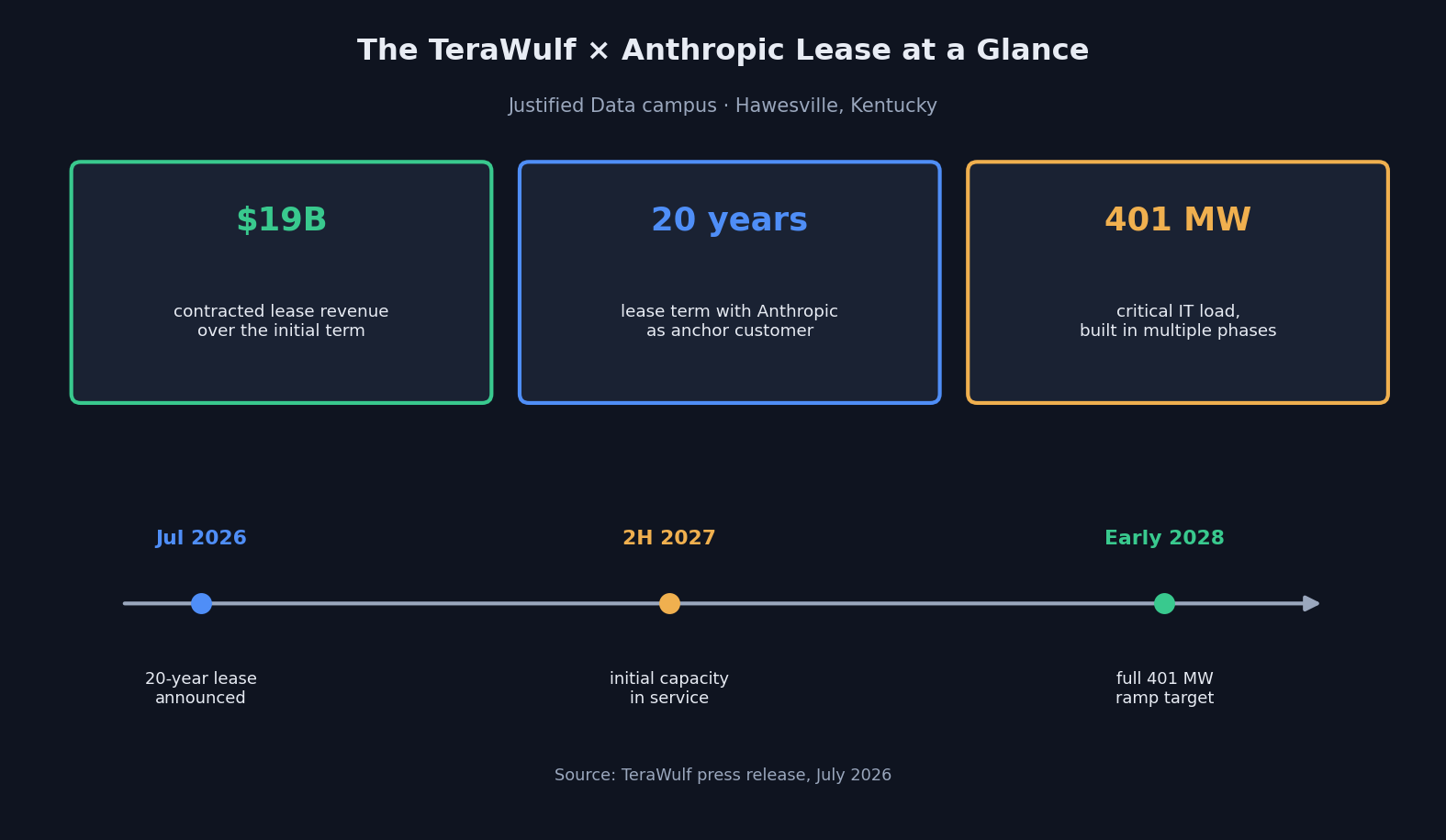
For readers using SimianX AI to track market-moving AI infrastructure stories, this is exactly the kind of event that can change a stock’s category, valuation framework, and risk profile. The headline is large: TeraWulf announced a **20-year lease with Anthropic** at its Justified Data campus in Hawesville, Kentucky, expected to generate about $19 billion of contracted lease revenue over the initial term. The site is planned for roughly 401 MW of critical IT load, with initial capacity expected in the second half of 2027 and full ramp targeted by early 2028.

Key insight: the market is not only buying “AI exposure.” It is repricing access to power, land, grid interconnection, long-term customers, and execution capacity.
Why the Anthropic Lease Matters for TeraWulf Stock 2026
The Anthropic lease matters because it moves TeraWulf from a volatile bitcoin mining revenue model toward a more infrastructure-like model built around contracted, long-duration AI data center revenue.
Historically, public bitcoin miners were valued around variables such as hash rate, bitcoin price, mining cost, energy cost, fleet efficiency, and balance sheet strength. Those still matter, but AI data center demand has created a new investor question:
Can former bitcoin miners convert power-heavy sites into high-value AI compute campuses?
For TeraWulf, the Anthropic agreement is a major validation point. A 20-year lease with a leading AI model company gives investors a reason to compare WULF not only with crypto miners, but also with AI infrastructure developers, neocloud platforms, data center landlords, and power-constrained compute operators.
What changed for WULF?
Before the deal, TeraWulf was already transitioning toward high-performance computing, or HPC. In Q1 2026, the company reported $34.0 million of revenue, including $21.0 million of HPC lease revenue, and said it had 60 MW of operational critical IT HPC capacity at Lake Mariner as of March 31, 2026.
After the Anthropic lease, that transition looks less like an experiment and more like a strategic identity shift.
| Investor Question | Why It Matters for WULF |
|---|---|
| Is the customer credible? | Anthropic is one of the leading AI model developers, making the lease strategically important. |
| Is the contract long term? | A 20-year term gives TeraWulf revenue visibility unusual for a former bitcoin miner. |
| Is there enough power? | The Justified Data campus is planned for roughly 401 MW of critical IT load. |
| Is revenue contracted? | TeraWulf expects about $19B of contracted lease revenue over the initial term. |
| Is execution still a risk? | Yes. Capacity is expected to phase in during 2027 and 2028, so construction and financing remain key. |
What Is the Anthropic $19B AI Data Center Lease?
The Anthropic lease is a long-term agreement for a purpose-built AI infrastructure campus at TeraWulf’s Justified Data site in Hawesville, Kentucky. The project is expected to support approximately 401 MW of critical IT load, be developed in multiple phases, and begin placing initial capacity into service during the second half of 2027. Full ramp is targeted by early 2028.

The strategic importance is bigger than the headline number. AI model companies need massive compute capacity, but the bottleneck is often not GPUs alone. The bottleneck is the full stack:
- Power availability
- Grid interconnection
- Land and permitting
- Cooling infrastructure
- Substation and transmission access
- Construction speed
- Long-term operating reliability
- Creditworthy counterparties
That is why the TeraWulf-Anthropic deal fits into the broader AI infrastructure trade. The market has already learned that Nvidia (NVDA) is central to AI accelerators, but the next layer of opportunity is the physical infrastructure that allows AI workloads to run at scale.
This is where TeraWulf’s prior bitcoin mining DNA becomes important. Bitcoin miners already spent years solving problems around energy sourcing, site development, uptime, power contracts, and high-density electrical infrastructure. Those skills do not automatically make them AI data center winners, but they create a starting point that many traditional real estate operators do not have.
Is TeraWulf Stock 2026 Now an AI Infrastructure Thesis?
Yes, TeraWulf Stock 2026 is now best understood as a hybrid AI infrastructure thesis, not a simple bitcoin mining thesis.
That does not mean bitcoin exposure disappears. It means the investor framework changes. The market may increasingly compare TeraWulf with AI infrastructure and neocloud-adjacent companies rather than only crypto miners.
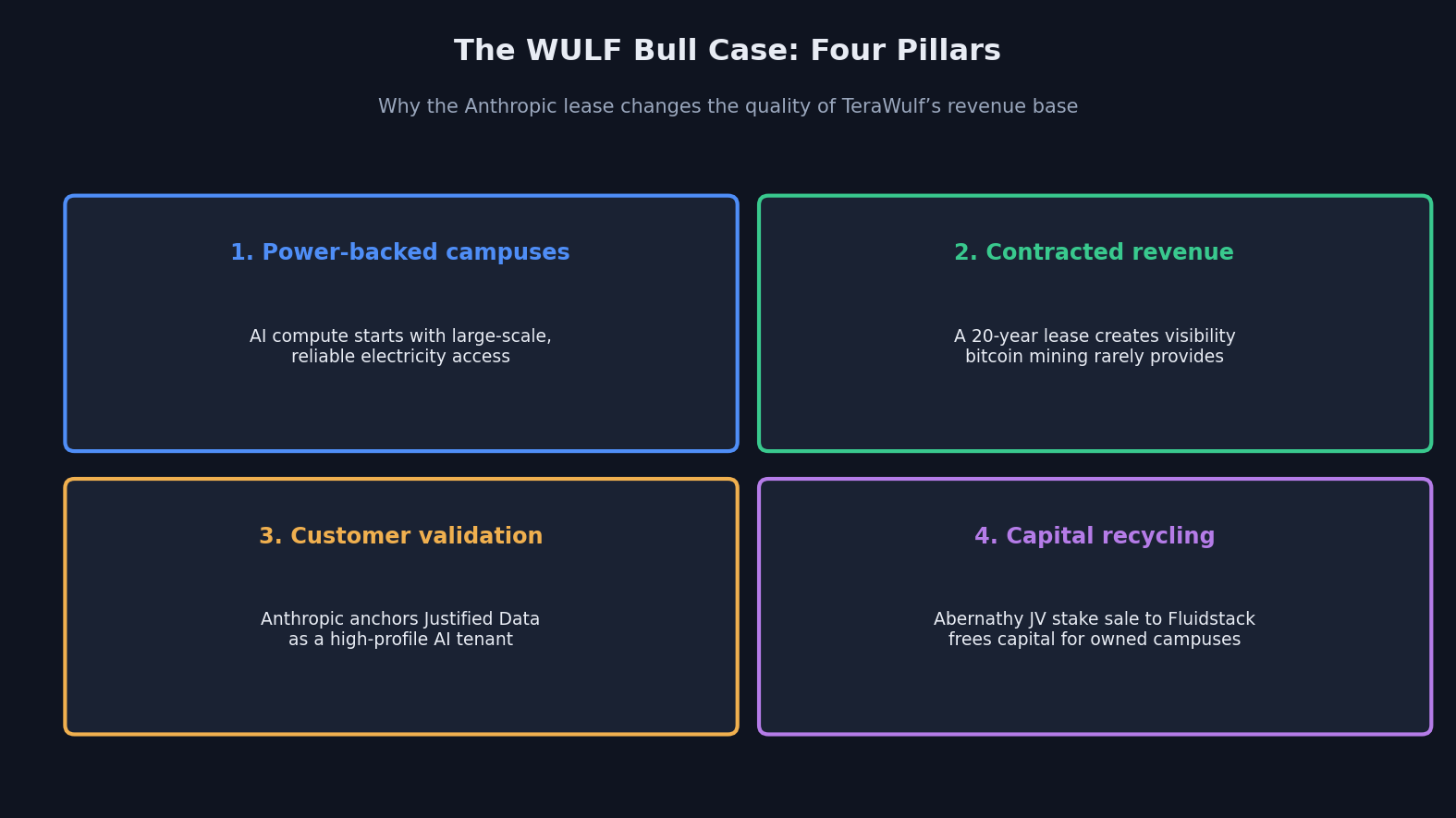
In practical terms, the bull case is now built on four pillars:
- Power-backed campuses
AI compute requires large-scale, reliable electricity. TeraWulf’s value begins with power access.
- Long-duration contracted revenue
A 20-year lease creates visibility that bitcoin mining alone rarely provides.
- Customer validation
Anthropic gives the Justified Data campus a high-profile anchor customer.
- Capital recycling
TeraWulf also announced the planned sale of its majority interest in the Abernathy Joint Venture to a Fluidstack-led investor group, freeing capital for opportunities where the company can focus on direct ownership and operation.
For investors, the key question is not “Is TeraWulf an AI stock?” The better question is: how much of TeraWulf’s future cash flow can come from contracted AI infrastructure instead of bitcoin mining?
Why Bitcoin Miners Are Becoming AI Data Center Operators
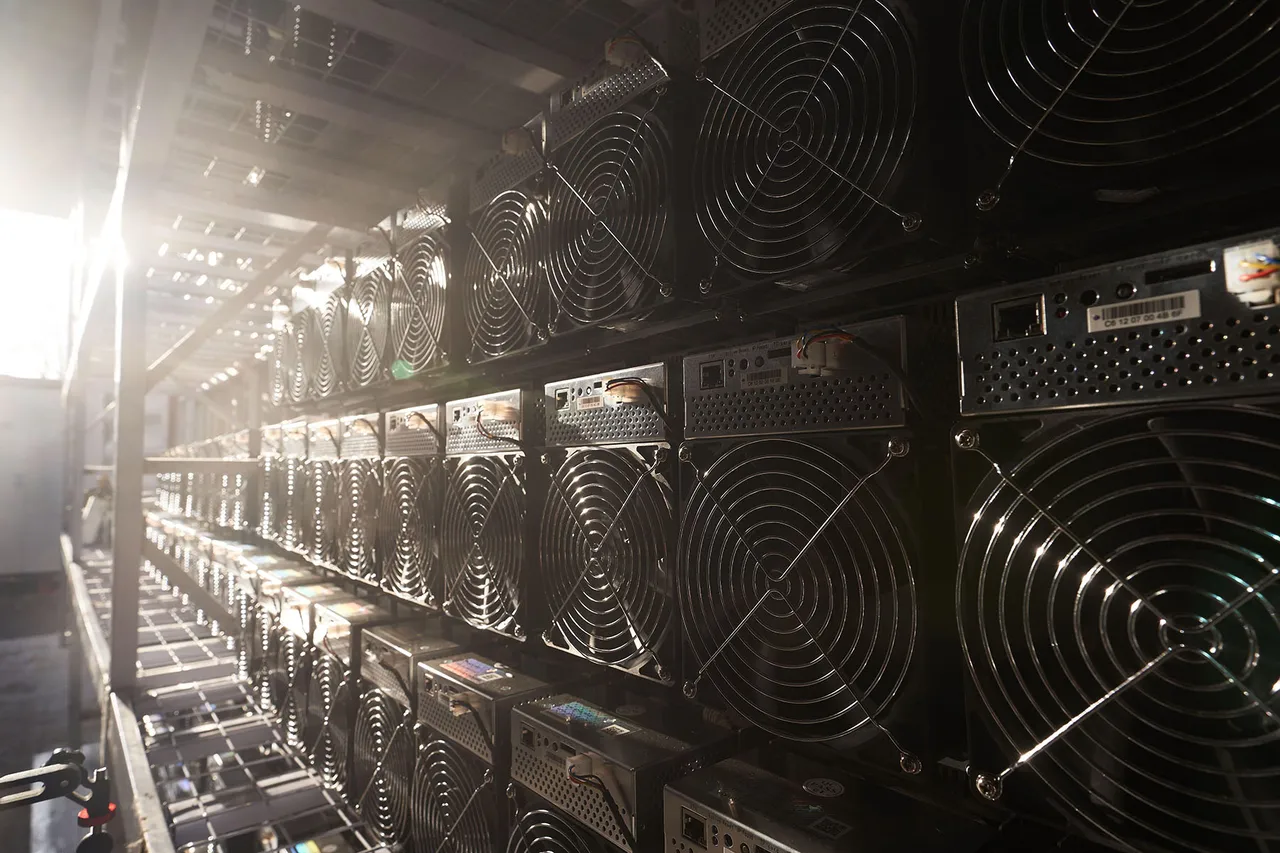
Bitcoin mining and AI infrastructure are different businesses, but they overlap in one crucial area: power-intensive compute.
Bitcoin miners historically optimized for low-cost power and fast deployment of mining machines. AI data centers require higher engineering standards, more complex cooling, stronger reliability requirements, and tighter customer commitments. Still, miners that control large power campuses may have a head start in a constrained market.

The conversion logic
| Bitcoin Mining Asset | AI Infrastructure Use Case |
|---|---|
| Large electrical load | Supports GPU clusters and HPC workloads |
| Industrial-scale land | Enables phased data center expansion |
| Power market expertise | Helps secure competitive electricity supply |
| High-density operations | Supports dense compute design |
| Existing infrastructure | Can reduce time-to-market if upgraded correctly |
This is the core reason TeraWulf matters. The company has been repurposing portions of its legacy bitcoin mining footprint to support higher-value HPC workloads. That transition gives WULF a different story from miners that remain fully tied to bitcoin economics.
For investors tracking this theme through SimianX AI, the opportunity is to compare each former miner across the same framework: power, contracts, financing, build timeline, customer quality, dilution risk, and valuation.
The Bull Case for WULF Stock After the Anthropic Deal
The bullish argument for WULF is that the Anthropic lease changes the quality of TeraWulf’s revenue base.
A bitcoin miner’s earnings can swing heavily with bitcoin price, network difficulty, energy costs, and machine efficiency. A long-term AI infrastructure lease can create more predictable revenue if the project is financed, built, and operated successfully.
Bullish factors to watch
- $19B contracted revenue potential: the lease provides a long-duration revenue target that investors can model.
- 401 MW critical IT load: the scale is meaningful for AI infrastructure demand.
- Investment-grade credit support: stronger counterparty support can improve financing confidence.
- Power-constrained market: AI companies need capacity faster than utilities and traditional data center developers can always provide.
- Portfolio simplification: selling the Abernathy stake may simplify reporting and redirect capital toward wholly owned AI infrastructure opportunities.
- Category shift: TeraWulf may be valued more like an AI infrastructure developer than a crypto miner if execution improves.
The market reaction showed how sensitive WULF is to AI infrastructure headlines. TeraWulf shares jumped sharply after the announcement before settling into a smaller gain, showing both excitement and caution around execution risk.

The Bear Case: What Could Go Wrong?
The bearish case is simple: a signed lease is not the same as completed infrastructure.
The Justified Data campus is expected to ramp over time, with initial capacity in the second half of 2027 and full ramp by early 2028. That leaves a long execution window. Large AI campuses require construction, equipment delivery, interconnection work, cooling systems, financing, customer coordination, and operational readiness.
Key risks for TeraWulf Stock 2026
- Execution risk
TeraWulf must deliver a complex AI infrastructure campus on schedule.
- Financing risk
Large data center projects require substantial capital. Even with contracts, investors need to watch debt, equity issuance, and project-level financing terms.
- Customer concentration risk
A large anchor lease is positive, but it also increases exposure to one major AI customer relationship.
- Valuation risk
If the stock prices in perfect execution too early, any delay could pressure the multiple.
- Technology and cooling risk
AI workloads can require advanced cooling and reliability standards beyond typical bitcoin mining infrastructure.
- Power and grid risk
Power availability is valuable, but grid connection, upgrades, and local constraints can still affect timelines.
- Crypto residual risk
If bitcoin mining remains meaningful, WULF may still trade partly with crypto sentiment.
The practical conclusion is that TeraWulf may deserve a higher-quality AI infrastructure lens, but not a risk-free valuation.
How to Analyze TeraWulf Stock 2026 After the Anthropic Lease
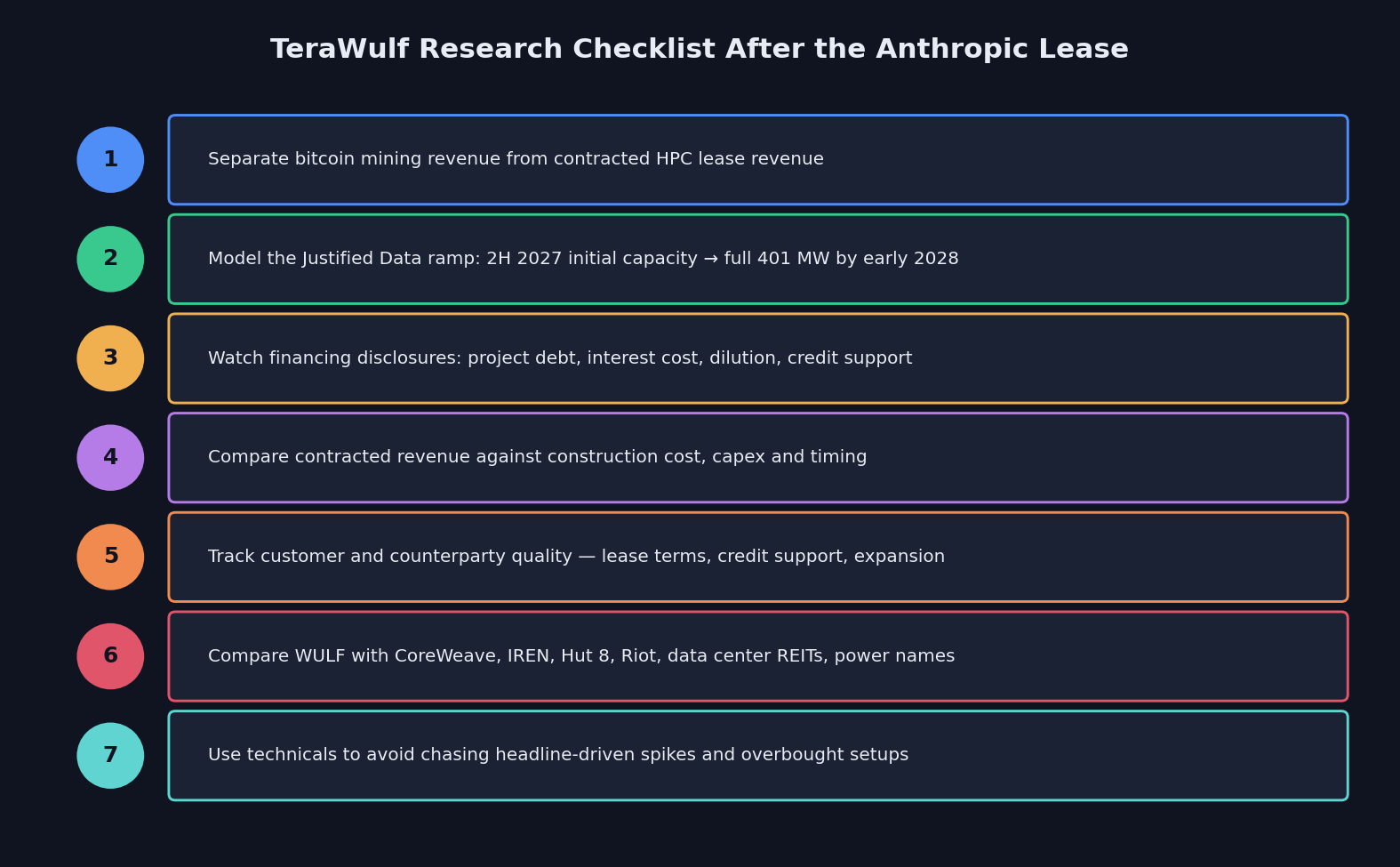
Investors should avoid treating the Anthropic announcement as a simple “buy the headline” event. A better process is to build a research checklist.

Step-by-step research framework
- Separate mining revenue from HPC lease revenue
Track how much revenue comes from bitcoin mining versus contracted HPC leases.
- Model the Justified Data ramp
Use 2H 2027 as the initial capacity milestone and early 2028 as the full-ramp target.
- Watch financing disclosures
Look for project debt terms, interest cost, dilution, credit support, and capital commitments.
- Compare contracted revenue with construction cost
The headline revenue number is large, but returns depend on capex, financing, operating cost, and timing.
- Track customer and counterparty quality
Anthropic is strategically important, but investors should monitor any change in lease terms, credit support, or expansion plans.
- Compare WULF against other AI infrastructure names
Look at CoreWeave, IREN, Hut 8, Riot, data center REITs, power suppliers, and backup power names.
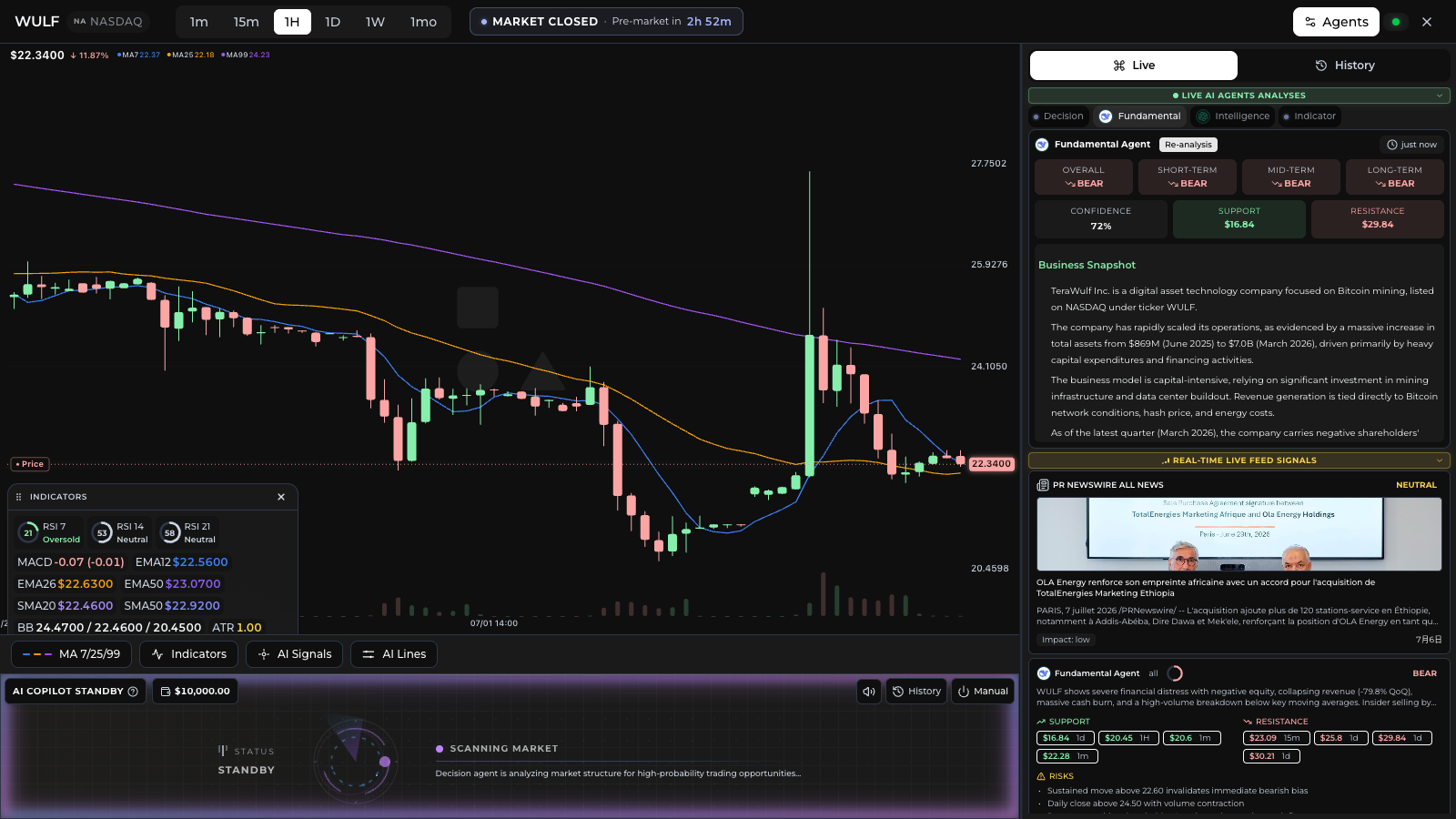
- Use technicals to avoid chasing spikes
A strong fundamental headline can still create overbought conditions.
This is where SimianX AI can help. Instead of reading one headline in isolation, investors can use SimianX to compare news sentiment, technical indicators, fundamentals, and AI-generated market interpretation in one workflow.
Why the TeraWulf Deal Fits the Bigger AI Power Bottleneck Theme
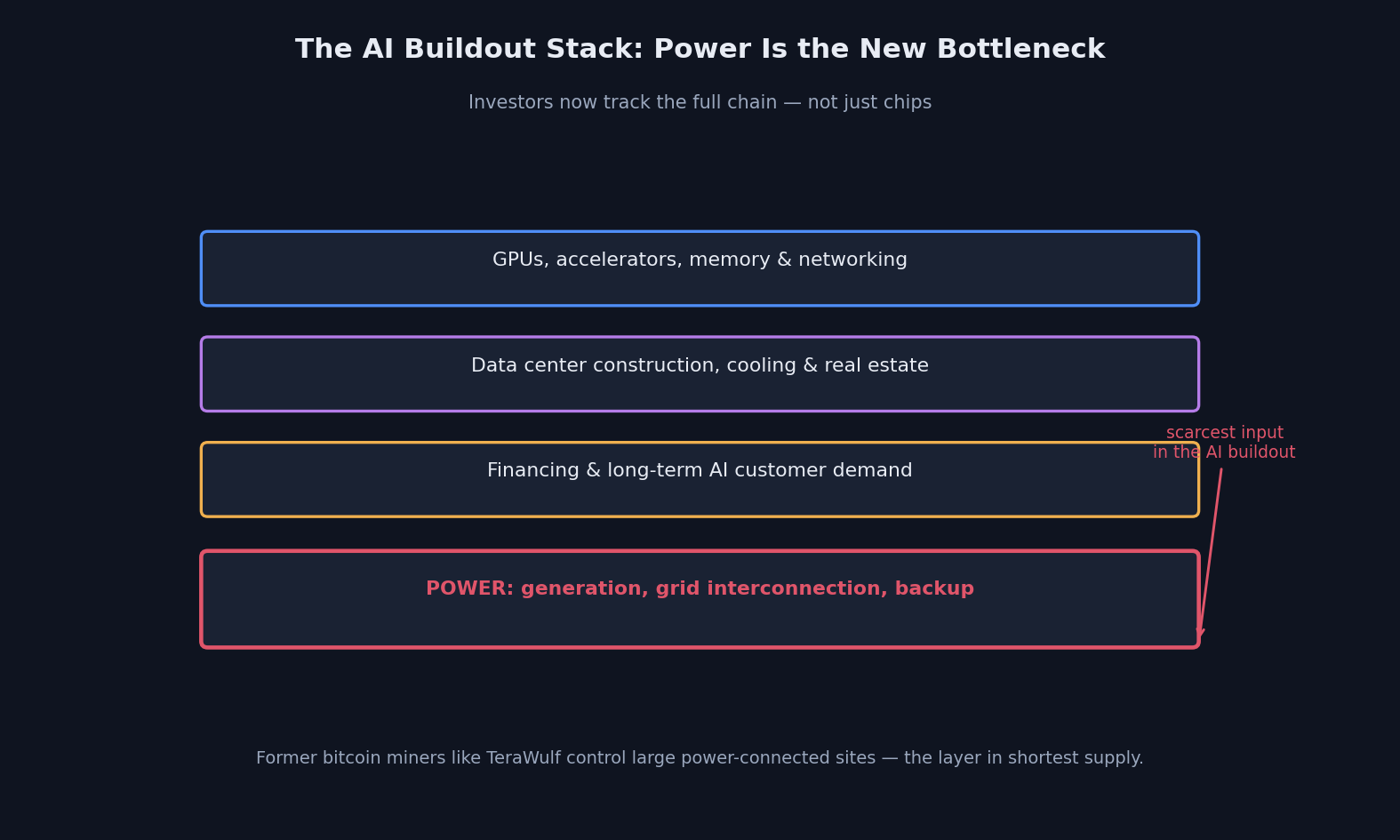
TeraWulf’s Anthropic lease is part of a broader market theme: AI is becoming an energy infrastructure story.
AI demand has moved beyond chips and software. Investors are now tracking the full stack:
- GPUs and accelerators
- Memory and networking
- Data center construction
- Power generation
- Grid interconnection
- Backup power
- Cooling
- Real estate
- Financing
- Long-term cloud and AI model demand
That context matters for TeraWulf. If power access becomes the scarcest input in the AI buildout, companies that control large power-connected sites could become strategically valuable.

For WULF, the lease is not just a customer announcement. It is evidence that AI companies are willing to sign long-duration agreements for capacity tied to real power availability. That is a different kind of demand signal from short-term crypto cycles.
TeraWulf Stock 2026: Bullish, Bearish, and Base Case Scenarios
A clean way to think about WULF is to use scenario analysis.
| Scenario | What Happens | Potential Market Interpretation |
|---|---|---|
| Bull case | TeraWulf delivers Justified Data on time, secures attractive financing, expands the Anthropic relationship, and grows contracted HPC revenue. | WULF rerates as a high-growth AI infrastructure platform. |
| Base case | The project moves forward but faces normal construction and financing complexity. Revenue visibility improves, but valuation remains volatile. | WULF trades as a hybrid AI infrastructure and bitcoin mining stock. |
| Bear case | Financing becomes expensive, timelines slip, dilution rises, or investor expectations exceed execution. | WULF gives back headline-driven gains and trades on risk controls. |
The key is timing. The Anthropic lease may improve long-term visibility, but the cash flow ramp is not immediate. Investors should distinguish between contracted revenue potential and near-term earnings contribution.
Practical Trading Watchlist for WULF
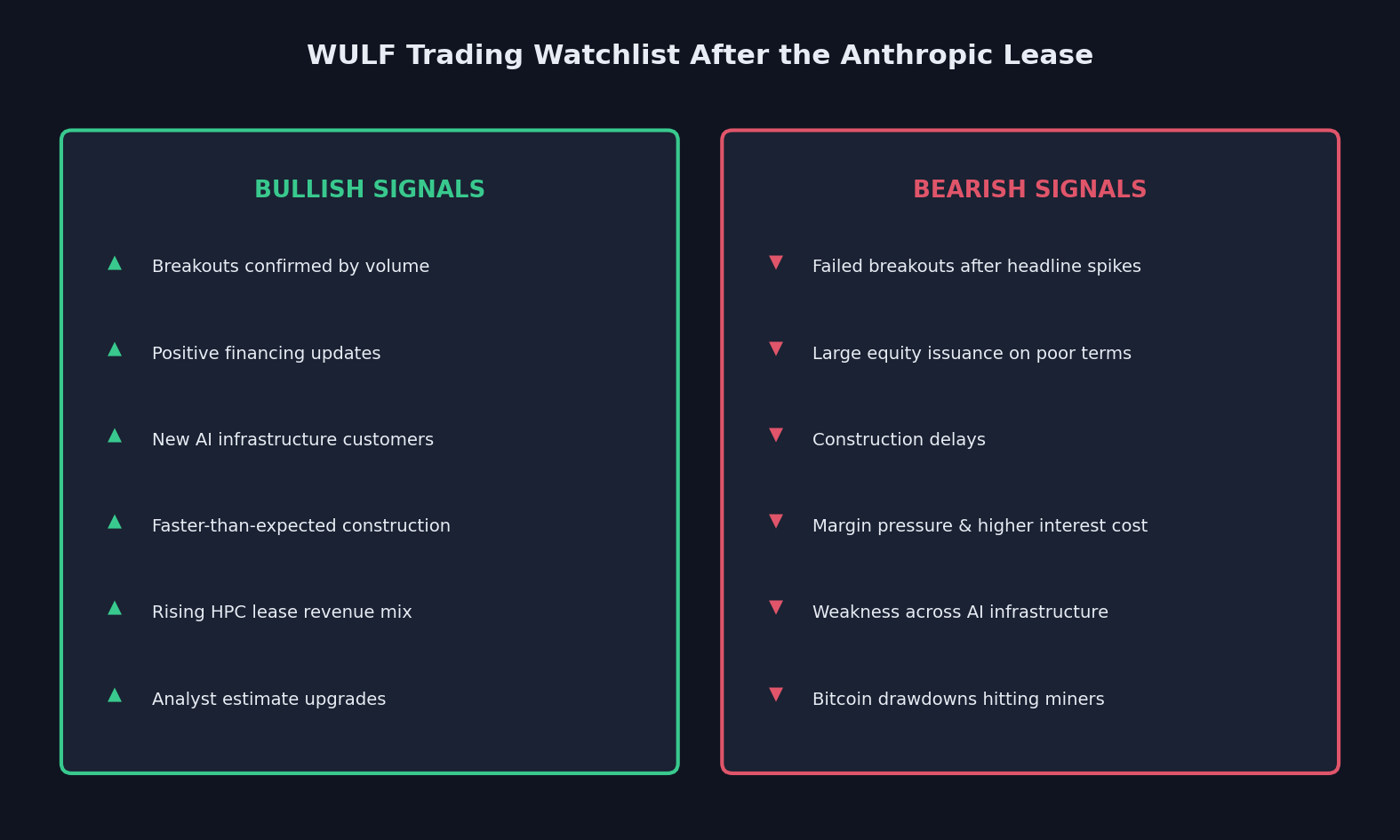
For traders and active investors, the TeraWulf Anthropic lease creates several watchpoints.
Bullish signals:
- Breakouts confirmed by volume
- Positive financing updates
- New AI infrastructure customers
- Faster-than-expected construction milestones
- Rising HPC lease revenue mix
- Analyst estimate upgrades
- Continued strength in AI infrastructure peers
Bearish signals:
- Failed breakouts after headline spikes
- Large equity issuance at unfavorable terms
- Construction delays
- Margin pressure
- Higher interest expense
- Weakness across AI infrastructure stocks
- Bitcoin drawdowns dragging miner sentiment lower
WULF may remain volatile because it sits at the intersection of AI infrastructure, bitcoin mining, energy markets, and high-growth equity speculation. That makes position sizing and risk management especially important.

FAQ About TeraWulf Stock 2026
How does the Anthropic lease affect TeraWulf stock?
The Anthropic lease gives TeraWulf a long-term AI infrastructure revenue framework, with roughly $19 billion of expected contracted lease revenue over 20 years. It may support a higher-quality valuation if TeraWulf executes the buildout, secures financing, and converts the contract into operating cash flow.
Is TeraWulf still a bitcoin mining stock in 2026?
TeraWulf still has bitcoin mining roots, but its investment story is shifting toward HPC and AI data center infrastructure. The company has already reported meaningful HPC lease revenue, showing that the transition was underway before the Anthropic announcement.
What is the TeraWulf Justified Data campus?
Justified Data is TeraWulf’s AI infrastructure campus in Hawesville, Kentucky. The Anthropic lease covers approximately 401 MW of critical IT load, with initial capacity expected in the second half of 2027 and full ramp targeted by early 2028.
Is WULF a good AI infrastructure stock for 2026?
WULF may be one of the more direct public-market ways to track the bitcoin-miner-to-AI-infrastructure conversion theme. However, whether it is a good investment depends on valuation, financing, construction execution, customer concentration, and the investor’s risk tolerance.
What should investors watch after the $19B Anthropic lease?
Investors should watch project financing, construction milestones, lease commencement timing, HPC revenue growth, dilution, balance sheet changes, and additional customer announcements. The most important question is whether TeraWulf can turn a large contract into durable free cash flow.
Conclusion: TeraWulf Stock 2026 Is Now a Power-Backed AI Infrastructure Story
TeraWulf Stock 2026 has become one of the clearest examples of how AI demand is transforming the public bitcoin mining sector. Anthropic’s $19 billion lease does not eliminate execution risk, but it does change the conversation. TeraWulf is now being evaluated as a company that can source power, develop large-scale campuses, secure long-term AI customers, and potentially convert volatile mining infrastructure into contracted AI infrastructure revenue.
The bullish case is powerful: a 20-year lease, a major AI customer, 401 MW of planned critical IT load, and a broader market hungry for AI capacity. The risk case is also real: financing, construction, valuation, and timing still matter.
For investors, the best approach is not to chase the headline blindly. Track the data, compare the scenarios, and watch whether TeraWulf turns AI infrastructure demand into operating results. To follow market-moving AI infrastructure stories like this with structured news, technical, and fundamental context, explore SimianX AI.
Related Reading
- NVIDIA-IREN 2026: The $2.1B 5GW AI Factory Power Trade
- Micron Anthropic Deal 2026: Claude AI Memory Explained
- Meta Compute 2026: Can Excess AI Capacity Drive Revenue?
- Comfort Systems Stock (FIX) 2026: AI Cooling Bottleneck
- AI Momentum Unwind 2026: Why Semiconductor Stocks Fall