
Comfort Systems Stock 2026: AI Data Center Cooling Bottleneck Explained
Comfort Systems Stock 2026: AI Data Center Cooling Bottleneck is no longer a niche infrastructure story. For investors researching FIX, the key question is whether Comfort Systems USA is becoming one of the most important “picks-and-shovels” beneficiaries of the AI buildout. The market already understands that AI needs GPUs, power, and cloud capacity. What is becoming clearer in 2026 is that AI also needs thermal capacity: cooling systems, modular mechanical rooms, electrical integration, controls, and skilled labor.
For readers using SimianX AI, this is exactly the kind of cross-sector stock thesis that benefits from structured research. Comfort Systems sits between construction, HVAC, electrical contracting, modular data centers, AI infrastructure, and industrial labor scarcity. That makes it more complex than a simple “AI stock,” but also potentially more durable than a short-term headline trade.
Why Comfort Systems Stock Matters in the AI Infrastructure Trade
Comfort Systems USA is a national building systems contractor focused on mechanical, electrical, plumbing, modular construction, controls, energy efficiency, and related nonresidential services. The company describes itself as a leading building and service provider for mechanical, electrical, and plumbing systems, with more than 45 operating companies across over 170 U.S. locations.
That footprint matters because AI data centers are not only software assets. They are large industrial facilities with demanding mechanical and electrical requirements. Every new high-density AI cluster creates heat. That heat must be removed reliably. If cooling design fails, the data center cannot safely run expensive GPUs at full utilization.
The market’s AI infrastructure thesis is shifting from “who sells the chip?” to “who can make the facility work?”
Comfort Systems matters because it is exposed to the physical layer of the AI economy:
- HVAC and mechanical systems for thermal control
- Electrical contracting for high-power facilities
- Modular construction that can shorten build timelines
- Building automation and controls for energy efficiency
- Skilled labor execution in a market where qualified contractors are scarce
This is why FIX has attracted attention as a blue-collar AI infrastructure stock. Comfort Systems does not train models or sell accelerators. Instead, it helps build the environments where accelerators can operate.
The AI Data Center Cooling Bottleneck Explained
The AI data center cooling bottleneck comes from a simple physical reality: higher compute density creates higher heat density. Traditional enterprise data centers were often designed around lower rack densities. AI training clusters, by contrast, concentrate massive power draw into fewer racks, forcing operators to rethink airflow, chilled water, liquid cooling, heat rejection, redundancy, and controls.
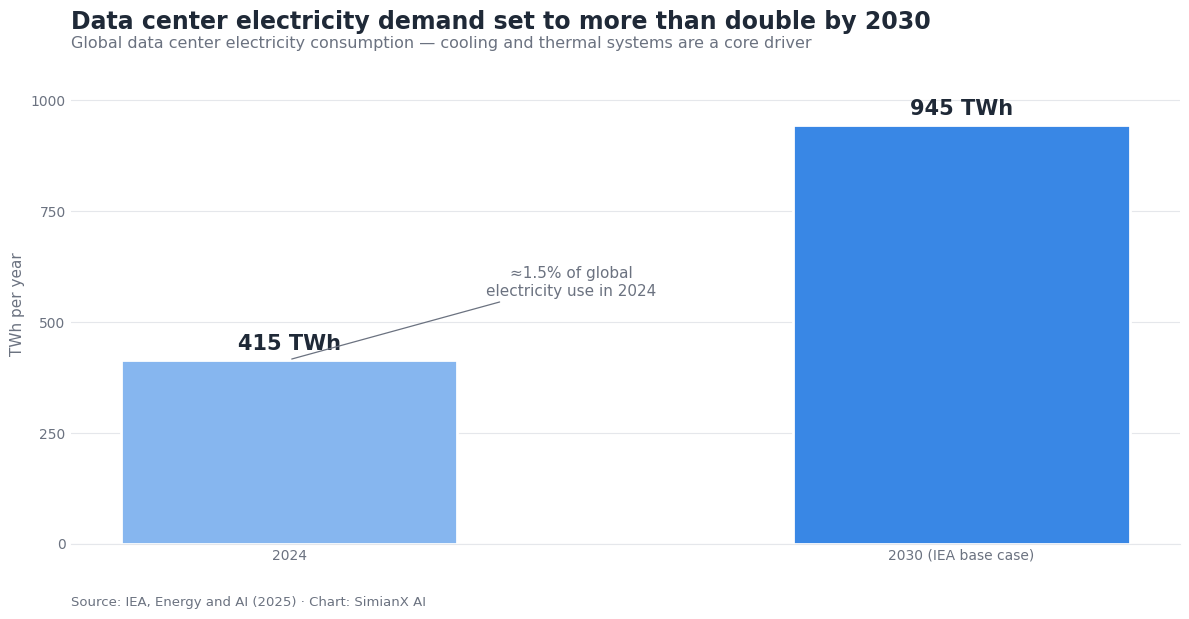
The International Energy Agency estimates that data centers consumed about 415 TWh of electricity in 2024, equal to roughly 1.5% of global electricity consumption, and projects that global data center electricity demand could roughly double to about 945 TWh by 2030 in its base case. The IEA also notes that accelerated servers, largely driven by AI, are expected to grow much faster than conventional servers.
That growth creates two linked bottlenecks:
- Power availability: Can the site secure enough electricity?
- Cooling availability: Can the site reject enough heat without sacrificing reliability?
For Comfort Systems stock, the second bottleneck is central. Cooling is not just a piece of equipment. It is a system-level engineering problem involving:
| Cooling Layer | Why It Matters for AI Data Centers |
|---|---|
| Air handling | Supports lower- and medium-density spaces |
| Chilled water systems | Moves heat away from dense server rooms |
| Liquid cooling | Needed for some high-density AI and HPC environments |
| Modular plants | Can accelerate construction and reduce site labor constraints |
| Controls and automation | Helps optimize cooling load, humidity, airflow, and energy use |
| Electrical integration | Ensures cooling and compute systems remain resilient under load |
Comfort Systems is especially relevant because its modular construction offering includes off-site HVAC and electrical modular solutions built in parallel with site construction. The company says this approach can improve safety, quality, and productivity while reducing schedule risk, and that factory packaging can allow certain central energy plants, electrical rooms, or data centers to be constructed and functional with up to 40% less time spent on preparation and construction.
Comfort Systems Financial Momentum: Backlog, Revenue, and Cash Flow
The bull case for Comfort Systems stock in 2026 is not based only on a narrative. It is supported by unusually strong financial momentum.
For the first quarter of 2026, Comfort Systems reported:
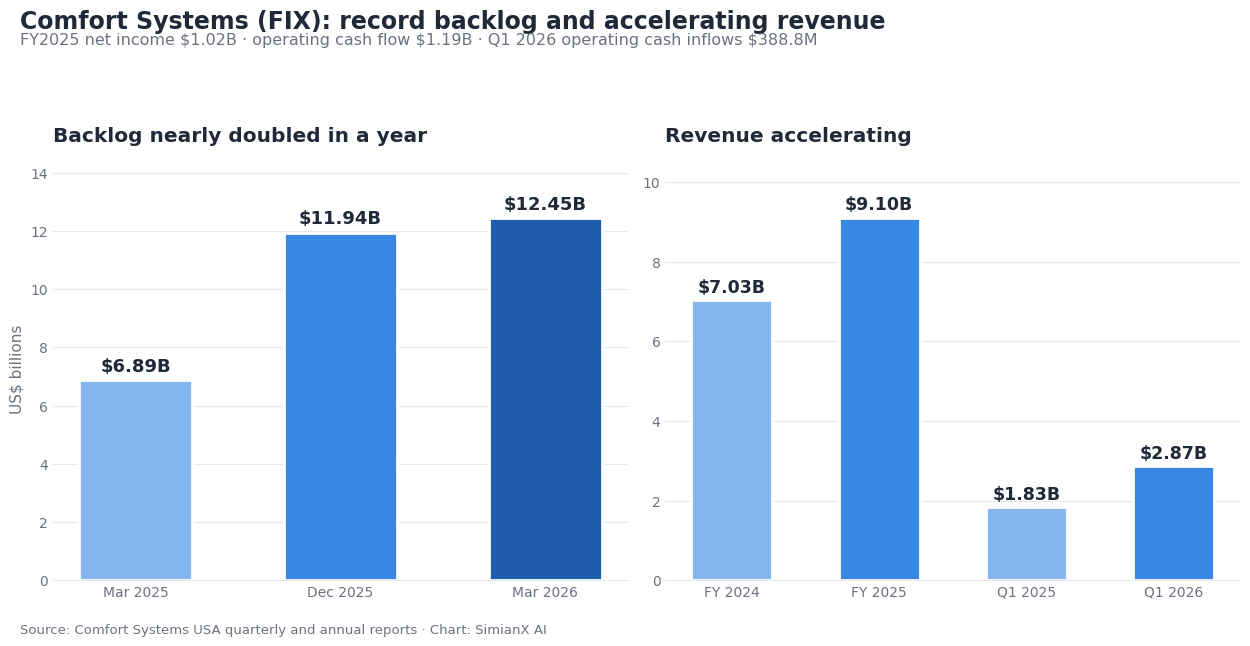
- Revenue of $2.87 billion, up from $1.83 billion in Q1 2025
- Net income of $370.4 million, or $10.51 per diluted share
- Backlog of $12.45 billion as of March 31, 2026
- Backlog up from $11.94 billion at December 31, 2025 and $6.89 billion at March 31, 2025
- Operating cash inflows of $388.8 million in the quarter
Those numbers are important because they show three things at once: demand, execution, and cash conversion. In infrastructure contracting, backlog alone is not enough. Investors need to know whether backlog can become profitable revenue without cost overruns, labor issues, or project delays.
The full-year 2025 results also show how quickly the business scaled. Comfort Systems reported 2025 revenue of $9.10 billion, up from $7.03 billion in 2024, with net income of $1.02 billion and operating cash flow of $1.19 billion. Its backlog reached $11.94 billion at year-end 2025, nearly double the prior year-end backlog.
The key investor signal: Comfort Systems is entering 2026 with both record backlog and strong recent cash generation. That combination makes the AI cooling thesis more credible than a pure concept stock.
Is Comfort Systems an AI Stock or an Infrastructure Stock?
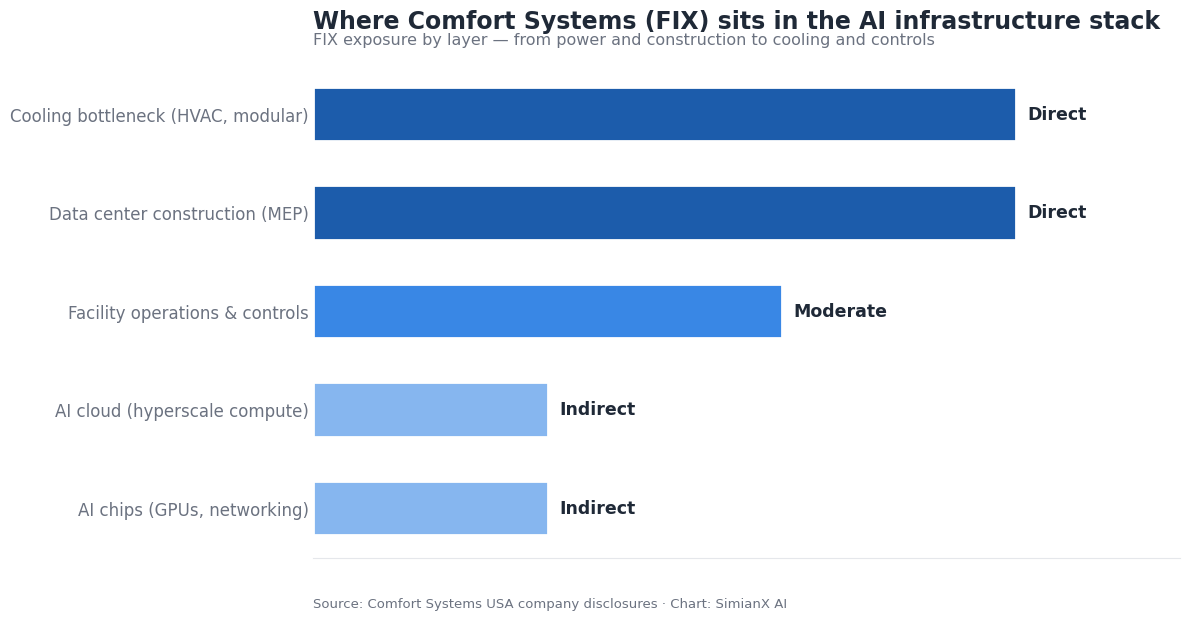
Comfort Systems is best understood as an AI infrastructure stock, not a pure AI stock.
A pure AI stock usually sells AI models, chips, cloud software, or AI applications. Comfort Systems is different. It benefits when AI demand translates into physical construction: data centers, semiconductor facilities, electrical rooms, modular plants, cooling systems, and controls.
This distinction matters because the risk profile is different.
| Category | Example Exposure | Comfort Systems Position |
|---|---|---|
| AI chips | GPUs, accelerators, networking | Indirect |
| AI cloud | Hyperscale compute capacity | Indirect |
| Data center construction | Mechanical, electrical, modular systems | Direct |
| Cooling bottleneck | HVAC, chilled water, modular cooling, controls | Direct |
| Facility operations | Automation, maintenance, energy efficiency | Moderate to direct |
Comfort Systems’ official modular product list includes central energy plants, central utility plants, air handling units, immersion cooling, electrical solutions, data centers, edge data centers, data halls, utility infrastructure, and related systems.
That is why investors should avoid treating FIX like a software multiple story. The better framework is: Can Comfort Systems convert AI-related infrastructure demand into profitable, lower-risk project execution?
What Makes the Cooling Bottleneck Investable?
A bottleneck becomes investable when three conditions are present:
- Demand is structural, not only cyclical.
- Supply is constrained, giving strong operators pricing or selection power.
- Execution quality is measurable, through backlog, margins, cash flow, and customer repeatability.
Comfort Systems appears to be benefiting from all three. AI data center construction is structurally tied to compute growth. Skilled mechanical and electrical labor is constrained. Modular systems can reduce schedule risk. And the company’s recent financial results show strong backlog conversion so far.
However, the cooling bottleneck is not only about liquid cooling. Direct liquid cooling remains concentrated in high-density niches, especially supercomputing and generative AI training, while mainstream mission-critical applications may still face adoption challenges because of resiliency, operations, and maintenance complexity.
That nuance is important for Comfort Systems stock. The opportunity is not simply “liquid cooling everywhere.” The opportunity is broader:
- New AI training data halls need high-density thermal design.
- Conventional cloud and enterprise facilities still need HVAC, controls, and electrical work.
- Existing facilities may need retrofits as rack density rises.
- Modular construction may help customers accelerate build schedules.
- Automation can improve energy efficiency and reduce overcooling.
AI is also increasingly being applied to cooling controls, including dynamic setpoint management, thermal load forecasting, airflow distribution, and fault detection. Comfort Systems’ building automation capabilities could matter here because the company says it provides manufacturer-independent control solutions and can evaluate, design, deliver, finance, monitor, and maintain facility automation systems.
Comfort Systems Stock 2026 Bull Case
The bull case for Comfort Systems stock in 2026 is straightforward: AI infrastructure demand continues to grow, and the market increasingly values companies that can deliver the physical systems required to bring data center capacity online.
Bull Case Drivers
1. Record backlog creates revenue visibility
A $12.45 billion backlog provides a large base of contracted or expected work. For a contractor, this does not guarantee future profits, but it does give investors a clearer view into near-term revenue potential.
2. AI data centers need specialized mechanical and electrical execution
High-density data centers require sophisticated coordination across power, cooling, plumbing, controls, and installation. Comfort Systems’ national footprint and modular capabilities could help it win complex projects that smaller contractors cannot handle.
3. Modular construction can reduce schedule risk
Data center customers value speed. If modular HVAC and electrical systems reduce field work and accelerate deployment, Comfort Systems may gain a practical advantage over traditional construction workflows.
4. Strong cash flow improves strategic flexibility
Comfort Systems generated more than $1 billion in operating cash flow in 2025 and continued with strong operating cash inflows in Q1 2026. Cash generation gives the company flexibility to invest in capacity, labor, acquisitions, and shareholder returns.
5. The AI infrastructure theme is broadening
SimianX has already covered how the AI buildout is expanding from chips into power, grid access, and physical infrastructure through themes such as KKR Helix AI Infrastructure: NVDA, VST Power Trade and Generac Stock 2026: AI Data Center Backup Power Deal. Comfort Systems fits naturally into that same physical AI infrastructure stack.
Comfort Systems Stock 2026 Bear Case and Risks
A strong theme does not remove risk. Comfort Systems stock has already been rewarded for execution, so investors must separate business quality from entry price.
Key Risks to Watch
- Valuation risk: If the stock prices in too much future growth, even good results may not be enough.
- Backlog conversion risk: Backlog must become profitable revenue. Delays, cancellations, or cost overruns can hurt margins.
- Labor availability: Mechanical and electrical contracting depends on skilled workers. Labor shortages can limit growth.
- Customer concentration: Large data center or technology customers can drive growth but may also increase dependence.
- Fixed-price contract risk: Incorrect estimates or cost inflation can pressure profitability.
- AI capex slowdown: If hyperscalers reduce or delay data center spending, new bookings could weaken.
- Execution complexity: High-density cooling, modular construction, and electrical integration require precision.
Comfort Systems itself lists risks including inaccurate fixed-price contract estimates, commitments exceeding labor resources, supply-chain disruptions, backlog not translating into revenue or profits, loss of significant customers, and construction weakness.
The bear case is not that AI data centers do not need cooling. They do. The bear case is that expectations may outrun the speed and profitability of delivery.
How to Analyze FIX Stock Step by Step
Investors researching Comfort Systems stock in 2026 should use a repeatable framework rather than chasing one earnings headline.
Step 1: Track backlog quality
Do not look only at the backlog number. Ask whether backlog is growing in attractive end markets, whether it is diversified, and whether management suggests healthy margins.
Step 2: Watch gross and operating margins
Strong revenue growth is less valuable if margins compress. For FIX, investors should monitor whether large AI infrastructure projects remain profitable as the company scales.
Step 3: Compare revenue growth to cash flow
Cash flow confirms earnings quality. A contractor with rising revenue but weak cash conversion may be taking on project risk.
Step 4: Monitor modular capacity
Comfort Systems’ modular construction capacity is central to the AI cooling thesis. Investors should watch capacity expansion, project timelines, and whether modular work becomes a larger share of revenue.
Step 5: Study data center commentary
Look for management comments about technology customers, data centers, chip manufacturing, cooling systems, and project pipelines.
Step 6: Use technical confirmation
Even strong companies can become overextended. Review moving averages, volume, relative strength, drawdowns, and support levels before forming a trade plan.
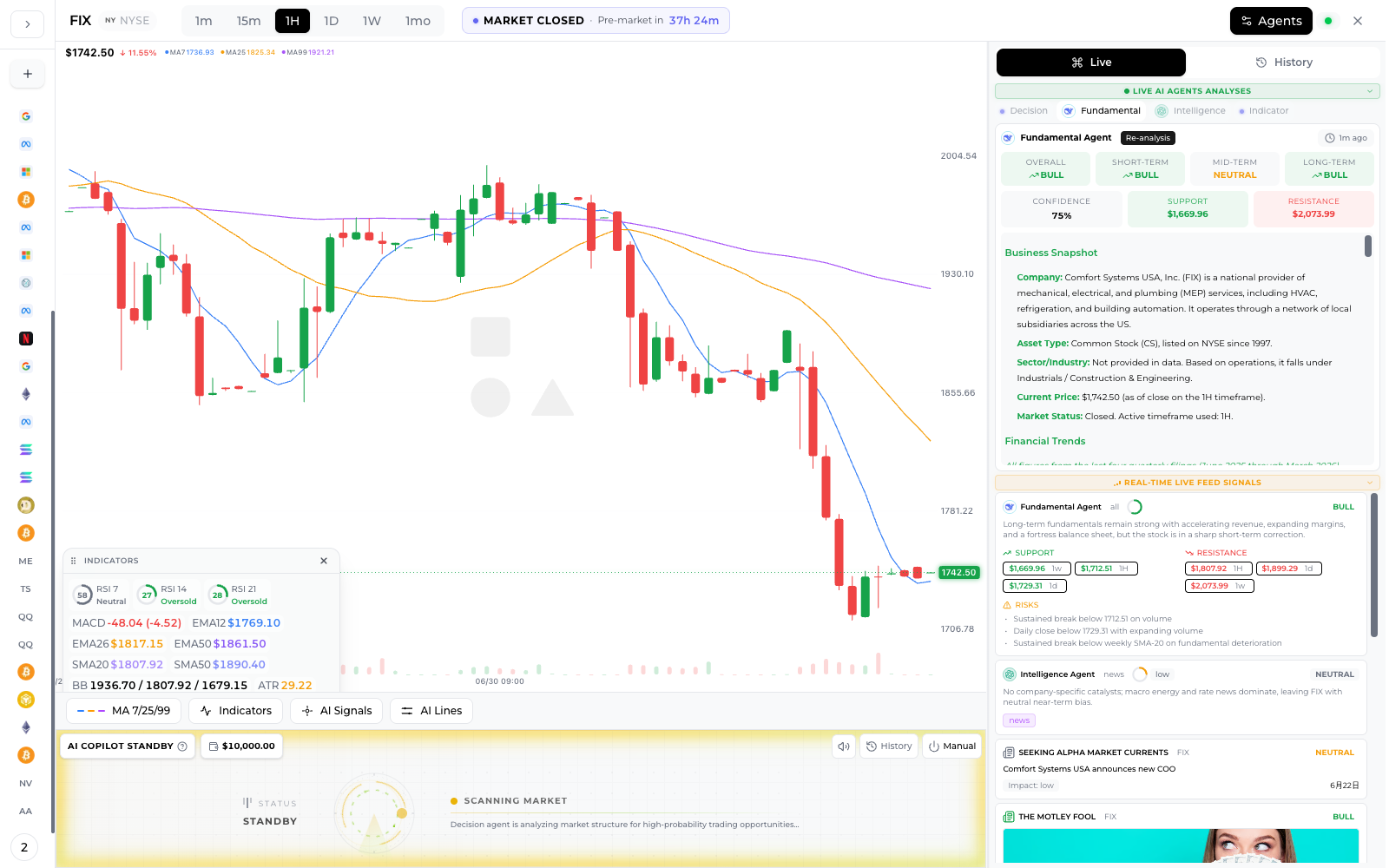
This is where SimianX AI can help. A practical workflow might compare FIX with related AI infrastructure names such as ETN, VRT, NVT, AAON, GNRC, CEG, VST, and data center REITs. SimianX can help organize the research across fundamentals, technicals, news, sentiment, and decision-oriented signals instead of relying on one narrative.
What Metrics Matter Most for Comfort Systems Stock 2026?
The best Comfort Systems stock dashboard should combine company-specific execution metrics with broader AI infrastructure indicators.
| Metric | Why It Matters | Positive Signal |
|---|---|---|
| Backlog | Measures future project visibility | Continued growth without margin warnings |
| Organic revenue growth | Shows core demand strength | Sustained double-digit growth |
| Gross margin | Tracks project profitability | Stable or expanding margin |
| Operating cash flow | Confirms earnings quality | Strong conversion vs. net income |
| Technology/data center exposure | Measures AI infrastructure sensitivity | Higher mix with disciplined margins |
| Modular capacity | Shows ability to scale faster | More capacity, better utilization |
| Labor availability | Determines execution ceiling | Hiring and retention remain strong |
| Capex and acquisitions | Supports growth strategy | Investments without balance sheet stress |
| Valuation | Determines risk/reward | Growth expectations remain realistic |
The simplest research question: Is Comfort Systems becoming a durable AI infrastructure compounder, or has the market already priced in too much cooling-bottleneck upside?
FAQ About Comfort Systems Stock 2026
What is the AI data center cooling bottleneck?
The AI data center cooling bottleneck refers to the difficulty of removing heat from high-density AI computing environments. As GPU clusters consume more power, data centers need more advanced HVAC, chilled water, liquid cooling, modular plants, and automation systems to operate safely and efficiently.
Is Comfort Systems stock an AI stock in 2026?
Comfort Systems is not a pure AI stock, but it is an AI infrastructure stock. Its exposure comes from helping build and maintain the mechanical, electrical, modular, and cooling systems needed for data centers and other mission-critical facilities.
How does Comfort Systems benefit from AI data center demand?
Comfort Systems can benefit when hyperscalers, colocation providers, semiconductor facilities, and industrial customers need mechanical, electrical, HVAC, modular, and control systems. The stronger the AI data center construction cycle, the more demand there may be for contractors with scale and technical expertise.
What should investors watch before buying FIX stock?
Investors should watch backlog conversion, margins, cash flow, valuation, labor capacity, data center commentary, and technical price action. A strong AI theme is useful, but the investment case depends on profitable execution and disciplined entry points.
What are the biggest risks for Comfort Systems stock?
The biggest risks include valuation compression, backlog cancellations, fixed-price project cost overruns, skilled labor shortages, customer concentration, and a slowdown in AI-related capital spending. The business can remain strong while the stock still becomes risky if expectations get too aggressive.
Conclusion
Comfort Systems stock in 2026 is a powerful example of how the AI trade is expanding beyond chips and software. The AI data center cooling bottleneck creates demand for mechanical systems, electrical work, modular construction, controls, automation, and skilled project execution. Comfort Systems has record backlog, strong recent revenue growth, and a business model positioned close to the physical constraints of AI infrastructure.
The balanced takeaway is clear: FIX deserves attention as an AI infrastructure stock, but investors should analyze it through backlog quality, margins, cash flow, valuation, and execution risk. The cooling bottleneck is real, yet the stock still requires discipline.
To research Comfort Systems and compare it with other AI infrastructure names, explore SimianX AI and use a structured, multi-agent workflow to turn complex market narratives into clearer stock analysis.
Related Reading
- KKR Helix AI Infrastructure: NVDA, VST Power Trade
- Generac Stock 2026: AI Data Center Backup Power Deal
- NVIDIA-IREN 2026: The $2.1B 5GW AI Factory Power Trade
- ON Semiconductor Stock 2026: $7B Synaptics Physical AI Bet
- Meta Compute 2026: Can Excess AI Capacity Drive Revenue?