
Inside onsemi's $7B Synaptics Deal: The Edge AI Power Play
ON Semiconductor Stock 2026 has suddenly become one of the most interesting semiconductor stories outside the Nvidia-centered AI trade. The reason is not just another earnings beat or an automotive-chip rebound. It is onsemi’s planned all-stock acquisition of Synaptics, a deal valued at approximately $7 billion that aims to push the company deeper into Physical AI — AI systems that sense, decide, connect, and act in the real world. onsemi announced the definitive agreement on June 25, 2026, with a fixed exchange ratio of 1.350 onsemi shares for each Synaptics share.
For investors, the key question is simple: is this deal a smart expansion into the next phase of AI, or a costly distraction from onsemi’s stronger power-semiconductor recovery?
That is exactly the type of market setup where SimianX AI can help traders break down the story into signals: fundamentals, market reaction, sector narrative, valuation pressure, and execution risk.
Why ON Semiconductor Stock 2026 Is Now a Physical AI Story
Before the Synaptics announcement, onsemi was mainly viewed as a supplier of intelligent power and sensing technologies for automotive, industrial, energy, and AI data center markets. Its Q1 2026 results showed revenue of $1.513 billion, gross margin of 38.5%, and non-GAAP EPS of $0.64. Management also said AI data center revenue grew more than 30% sequentially and more than doubled year over year.
That means onsemi was already participating in AI infrastructure through the power tree: power conversion, silicon carbide, high-efficiency energy management, and data center power systems. But the Synaptics deal changes the narrative from “power supplier to AI infrastructure” to “integrated platform for physical AI systems.”
Physical AI is different from cloud AI. It is not just about GPUs training models in a data center. It is about machines operating in the real world:
- Robots
- Smart factories
- Autonomous vehicles
- Industrial vision systems
- AR/VR devices
- Edge AI cameras
- Smart home and enterprise IoT devices
These systems require more than compute. They need power, sensors, connectivity, embedded processors, software, and control loops. onsemi’s own transaction announcement framed Physical AI around four pillars: Power, Sense, Connected Compute, and Control.
Key insight: the Synaptics acquisition is not simply about buying more chip revenue. It is about filling the missing compute and connectivity layers in onsemi’s physical-world AI stack.
What Is the $7B Synaptics Deal?
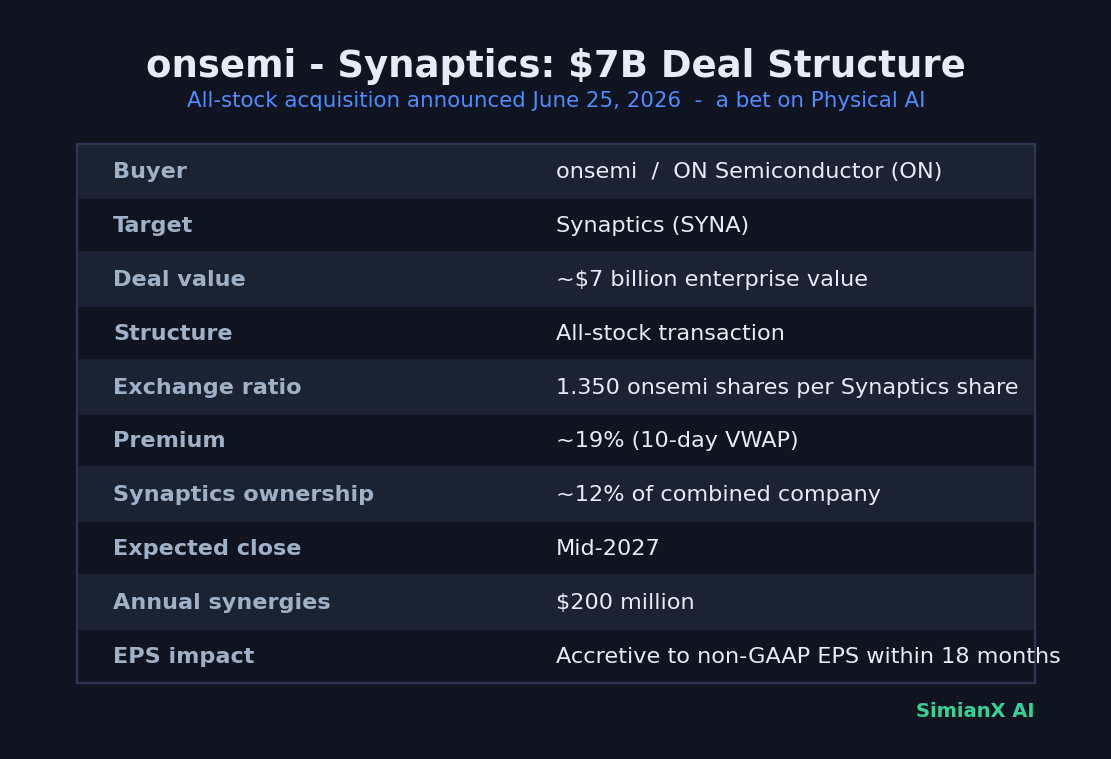
The deal is an all-stock acquisition with an enterprise value of approximately $7 billion. Synaptics shareholders are expected to receive 1.350 shares of onsemi common stock for each Synaptics share, representing an approximately 19% premium based on the companies’ 10-day volume-weighted average closing prices. After the deal closes, Synaptics shareholders are expected to own about 12% of the combined company on a fully diluted basis.
The transaction is expected to close in mid-2027, subject to Synaptics shareholder approval, regulatory approvals, and customary closing conditions.
| Deal Item | Detail |
|---|---|
| Buyer | onsemi / ON Semiconductor |
| Target | Synaptics |
| Deal value | Approximately $7 billion enterprise value |
| Structure | All-stock transaction |
| Exchange ratio | 1.350 onsemi shares per Synaptics share |
| Premium | About 19% based on 10-day VWAP |
| Expected close | Mid-2027 |
| Strategic theme | Physical AI and Edge AI |
| Expected synergies | $200 million annual synergies |
| EPS impact | Expected to be accretive to non-GAAP EPS within 18 months of closing |
onsemi also expects the acquisition to generate $200 million in annual synergies and become accretive to non-GAAP EPS within 18 months after closing.
Why Did ON Semiconductor Buy Synaptics?
The strategic logic is easier to understand if you think of physical AI as a full system rather than a single chip.
onsemi already has strength in:
- Power management
- Silicon carbide and energy efficiency
- Automotive and industrial sensing
- Data center power infrastructure
- Image sensors and intelligent sensing
Synaptics adds capabilities in:
- Edge AI compute
- Embedded processors
- Wireless connectivity
- Human-machine interface chips
- Touch and sensing solutions
- Software and developer ecosystems
Synaptics’ Astra platform is especially important. The company describes Astra as an AI-native embedded compute platform with power-efficient AI MPUs and MCUs, adaptive AI software, wireless connectivity, and developer support for smart IoT devices.
That fills a major gap for onsemi. Without Synaptics, onsemi can power and sense many intelligent systems. With Synaptics, onsemi can potentially offer a more integrated stack: power + sensing + compute + connectivity + software.
How Does Synaptics Help ON Semiconductor Stock 2026?
Synaptics helps the ON Semiconductor Stock 2026 thesis in three ways.
First, it expands onsemi beyond cyclical automotive and industrial chips into a more platform-oriented Edge AI story. Synaptics reported Q3 fiscal 2026 revenue of $294.2 million, up 10% year over year, with Core IoT product sales up 31% year over year. Management also said it was seeing accelerating activity in Physical AI and Edge AI with increasing design wins and customer engagements.
Second, it increases onsemi’s addressable market. The company said the combined platform could expand its total addressable market by $30 billion to $243 billion by 2030.
Third, it gives onsemi a stronger developer and software angle. In AI hardware, software support matters because customers want platforms that reduce engineering friction. A robot maker, factory automation company, or smart-device manufacturer may prefer a more complete solution over stitching together power chips, sensors, processors, connectivity modules, and software from multiple vendors.
Why the Market Sold ON Stock After the Synaptics Deal
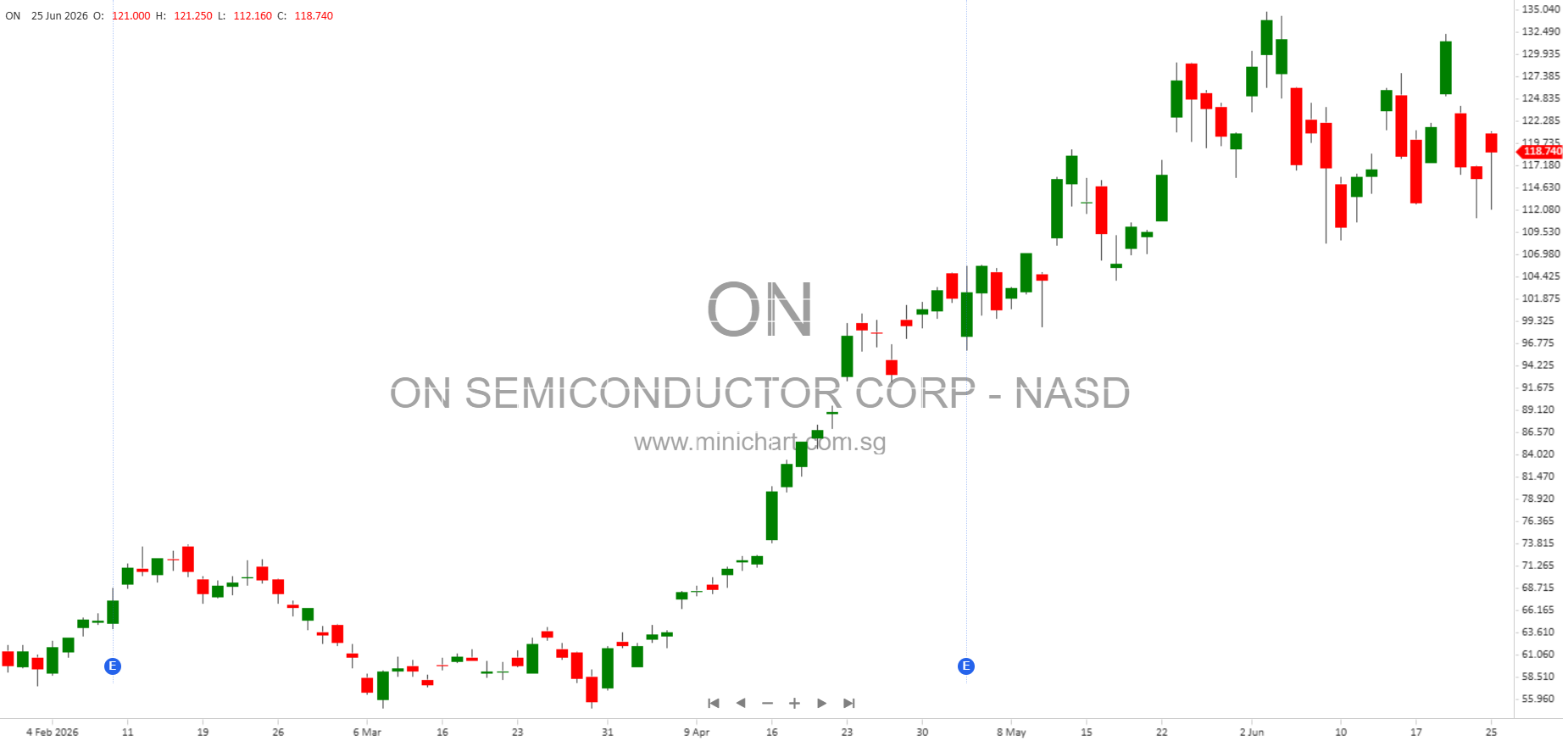
The market reaction was negative. ON stock fell after the announcement as some analysts questioned the deal rationale, especially whether it could dilute onsemi’s data center focus.
That reaction makes sense. Investors had been warming up to onsemi’s recovery story: AI data center revenue was accelerating, automotive demand appeared to be stabilizing, and gross margins were improving. Then management announced a large all-stock acquisition in a different but adjacent market.
The bear case is not that Synaptics has no value. The bear case is that investors now have to price in more complexity:
- Deal execution risk
The transaction still needs shareholder and regulatory approval.
- Integration risk
Combining power semiconductors, sensing, connectivity, embedded compute, and software is strategically attractive but operationally complex.
- Dilution risk
Because the deal is all stock, existing onsemi shareholders are giving up ownership to fund the acquisition.
- Narrative risk
The market may prefer onsemi to stay focused on AI data center power and automotive recovery instead of expanding into a broader Edge AI platform.
- Timing risk
The deal may not close until mid-2027, while the expected financial benefits are targeted after closing.
The Bull Case: onsemi Is Buying the Next AI Layer
The bullish view is that the market is underestimating how AI will move from the cloud into physical systems.
The first wave of the AI stock boom was about data centers: GPUs, memory, networking, power systems, and hyperscaler capex. SimianX has already covered how the broader AI semiconductor supercycle is not just an Nvidia story, but a full infrastructure buildout involving chips, power, data centers, memory, and supply chains.
The next wave could be AI at the edge. That means AI inference happening inside devices rather than only in cloud servers. For example:
- A factory robot detects a defect and adjusts its movement instantly.
- A vehicle processes sensor input locally before sending data to the cloud.
- An AR headset recognizes gestures without relying on remote servers.
- A security camera filters events locally to reduce bandwidth.
- An industrial controller uses local AI to optimize energy usage.
These use cases require low latency, power efficiency, connectivity, and reliability. That is where onsemi and Synaptics could fit together.
Bullish thesis: if physical AI adoption accelerates, onsemi could become a more strategic supplier to customers building intelligent machines, not just a component vendor selling power chips.
The Bear Case: The Deal Could Distract From a Cleaner Recovery
The bearish view is that onsemi may be buying a complex growth story before its own core cycle has fully recovered.
onsemi’s Q1 2026 results showed signs of improvement, including stronger AI data center growth and better-than-expected revenue. But automotive and industrial semiconductors are still cyclical. Investors may worry that management is adding a major integration project just as the core business is trying to regain momentum.
There is also a valuation question. A $7 billion all-stock deal is not small relative to the strategic uncertainty of Physical AI. The concept is powerful, but real revenue adoption may take time. Robotics, AR/VR, and autonomous systems can be long-cycle markets. Customers may evaluate platforms for years before revenue scales.
For ON Semiconductor Stock 2026, this creates a split setup:
| Investor Question | Bullish Interpretation | Bearish Interpretation |
|---|---|---|
| Is Physical AI real? | Yes, AI is moving into machines and edge devices. | Yes, but timing may be slower than expected. |
| Is Synaptics the right asset? | It adds compute, connectivity, HMI, and software. | Integration may be difficult and expensive. |
| Is the deal financially attractive? | $200M synergies and EPS accretion are targeted. | Benefits arrive after close and depend on execution. |
| Is ON stock weakness an opportunity? | The selloff may overprice near-term fear. | The selloff may reflect real dilution and complexity. |
What Investors Should Watch After the Synaptics Acquisition
For investors tracking ON Semiconductor Stock 2026, the key is not to treat the deal as automatically bullish or bearish. Instead, watch for evidence.
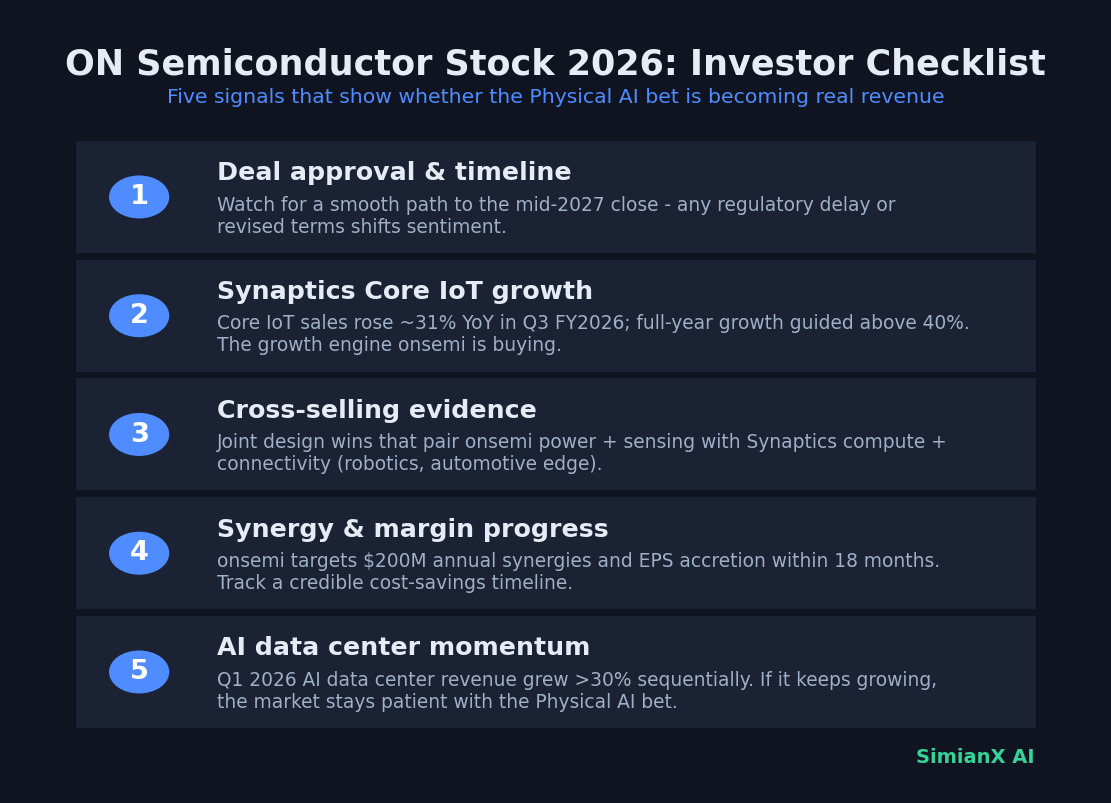
1. Deal Approval and Closing Timeline
The first checkpoint is whether the deal moves smoothly toward a mid-2027 close. Any regulatory delay, shareholder pushback, or revised terms could affect sentiment.
2. Synaptics Core IoT Growth
Synaptics’ Core IoT business is the growth engine onsemi is buying. Its Q3 fiscal 2026 Core IoT product sales grew 31% year over year, and the company expected full-year fiscal 2026 Core IoT revenue to grow more than 40% year over year based on its Q4 midpoint outlook.
If that growth continues, the deal looks more strategic. If it slows, investors may question the price.
3. Cross-Selling Evidence
The strongest proof would be customer wins that combine onsemi power and sensing with Synaptics compute and connectivity.
Watch for language such as:
- “joint platform wins”
- “integrated reference designs”
- “robotics design wins”
- “automotive edge AI platform”
- “industrial AI controller”
- “system-level customer engagement”
4. Margin and Synergy Progress
onsemi expects $200 million in annual synergies. Investors should watch whether management provides a credible timeline for cost savings, revenue synergies, and margin improvement.
5. AI Data Center Momentum
The biggest risk is that the Synaptics deal overshadows onsemi’s existing AI data center growth. If AI data center revenue keeps growing, the market may become more patient with the Physical AI bet.
Is ON Semiconductor Stock a Buy After the Synaptics Deal?
The better question is not simply whether ON stock is a buy. It is what kind of investor the stock now fits.
For short-term traders, the deal creates volatility. The stock reaction shows that the market is not giving management automatic credit for the acquisition. Traders may need to watch technical levels, volume, analyst revisions, and sector rotation.
For long-term investors, the key issue is whether onsemi can become a higher-value intelligent systems company instead of remaining a cyclical chip supplier. If management executes, the Synaptics acquisition could make onsemi more exposed to durable AI edge adoption.
For risk-conscious investors, the deal raises the bar. The company must now prove:
- Synaptics can grow inside onsemi.
- Physical AI demand can scale beyond buzzwords.
- Synergies are real.
- Dilution is justified.
- The core business remains healthy.
This is where a structured signal platform like SimianX AI can be useful. Instead of reacting emotionally to a one-day stock drop, investors can compare multiple layers: price action, earnings quality, AI narrative strength, analyst sentiment, and sector momentum.
How to Analyze ON Semiconductor Stock 2026 With a Physical AI Framework
A practical framework for analyzing ON Semiconductor Stock 2026 should include both traditional semiconductor metrics and AI platform indicators.
Step-by-Step Investor Framework
- Start with the core cycle
Track automotive, industrial, and AI data center demand. If the core cycle weakens, the Synaptics deal may not be enough to support the stock.
- Measure Physical AI credibility
Look for real design wins in robotics, industrial automation, automotive edge systems, and smart devices.
- Watch gross margin trends
onsemi’s Q1 2026 gross margin was 38.5%. Margin expansion would support the argument that the company is improving its mix and cost structure.
- Follow Synaptics revenue quality
Core IoT growth matters more than headline revenue. The market wants proof that Synaptics is not just a mature HMI business, but a growing Edge AI platform.
- Compare ON to other AI chip stocks
ON is not Nvidia. It is not Broadcom. It is not Marvell. Its AI role is more physical-world infrastructure than cloud acceleration. That difference matters for valuation.
- Use scenario analysis
Build bull, base, and bear cases rather than relying on one narrative.
| Scenario | What Happens | ON Stock Implication |
|---|---|---|
| Bull case | AI data center grows, Synaptics Core IoT accelerates, synergies materialize | Multiple expansion possible |
| Base case | Core recovery continues, deal closes, benefits arrive slowly | Stock remains range-bound but improves |
| Bear case | Integration slows, Physical AI revenue disappoints, core cycle weakens | Valuation pressure continues |
FAQ About ON Semiconductor Stock 2026
What is the main reason ON Semiconductor bought Synaptics?
onsemi bought Synaptics to add Edge AI compute, connectivity, human-machine interface, and software capabilities to its existing power and sensing portfolio. The goal is to create a broader platform for Physical AI systems that can sense, decide, connect, and act in real time.
Is the $7B Synaptics deal good for ON Semiconductor Stock 2026?
It depends on execution. The deal could be positive if Synaptics accelerates onsemi’s move into Edge AI and expands customer relationships. But it also adds dilution, integration risk, and uncertainty, which explains why investors reacted cautiously after the announcement.
What is Physical AI in semiconductor investing?
Physical AI refers to artificial intelligence embedded in real-world machines such as robots, vehicles, industrial systems, cameras, and smart devices. In semiconductor investing, it points to demand for chips that combine power efficiency, sensing, local compute, connectivity, and control.
How does Synaptics help onsemi compete in Edge AI?
Synaptics brings embedded processors, wireless connectivity, AI-native platforms, HMI technology, and developer tools. These assets could help onsemi move from selling individual components to offering more complete intelligent-system solutions.
What should investors watch next for ON stock?
Investors should watch deal approval, Synaptics Core IoT growth, AI data center momentum, gross margin trends, synergy updates, and customer wins that combine onsemi and Synaptics technology. These signals will show whether the Physical AI bet is becoming real revenue.
Conclusion: ON Semiconductor Stock 2026 Is Now a Bet on AI Moving Into the Real World
ON Semiconductor Stock 2026 is no longer just a story about automotive chips, silicon carbide, or AI data center power. The $7B Synaptics deal turns ON into a broader bet on Physical AI — the idea that the next stage of AI growth will happen inside machines, devices, vehicles, factories, and robots.
The upside is clear: onsemi could become a more complete intelligent systems supplier by combining Power, Sense, Connected Compute, and Control. The risks are also clear: dilution, integration complexity, uncertain timing, and investor skepticism.
For traders and investors, the best approach is to avoid a simple bullish or bearish label. Instead, track the evidence: Synaptics Core IoT growth, physical AI design wins, AI data center momentum, margin trends, and synergy execution.
To analyze setups like this with a more structured, multi-signal framework, explore SimianX AI and turn fast-moving semiconductor narratives into clearer trading decisions.
Related Reading
- Micron Anthropic Deal 2026: Claude AI Memory Explained
- Why Investors Are Shorting Micron Stock in the AI Boom
- Cerebras Stock 2026: AI Chip Boom vs Gross Margin Risk
- KOSPI Crash 2026: Korea’s AI Chip Reckoning Explained
- Caterpillar Stock 2026: AI Data Center Power Trade
- Broadcom Earnings 2026: AI ASIC Backlog & AVGO Stock
- AI Chip Stocks Stay Strong: AMD, Intel Drive Data Centers
- AI Stock Boom: Nvidia Leads the Chip Supercycle Now
- KKR Helix AI Infrastructure: NVDA, VST Power Trade