
 By Muke
Broadcom Earnings Preview 2026: AI ASIC Backlog and AVGO Stock
The Broadcom Earnings Preview 2026: AI ASIC Backlog and AVGO Stock story is no longer just about whether Broadcom beats quarterly revenue estimates. For investors, the bigger question is whether Broadcom’s custom AI silicon pipeline, AI networking demand, and infrastructure software cash flow can continue supporting one of the market’s most powerful semiconductor narratives. As earnings approach, SimianX AI helps investors frame the debate with structured, multi-agent stock research instead of headline chasing.
Broadcom (AVGO) has become one of the most important “picks-and-shovels” names in the AI infrastructure buildout. Nvidia still dominates the GPU conversation, but Broadcom sits in a different lane: custom AI accelerators, application-specific integrated circuits (ASICs), Ethernet switching, optical components, and software infrastructure. That combination makes the upcoming earnings report especially important for investors trying to understand whether AVGO stock is still pricing in realistic growth—or already discounting perfection.
This research article breaks down the main watch items before Broadcom’s 2026 earnings report: AI ASIC backlog, semiconductor revenue growth, VMware-related software stability, valuation risk, analyst expectations, and the practical checklist investors can use before reacting to the print.
Key idea: Broadcom earnings are now a test of AI revenue visibility, not just quarterly EPS execution.
Why Broadcom Earnings Matter More in 2026
Broadcom’s 2026 setup is unusually important because the market has started treating AVGO as both a semiconductor growth stock and a cash-generating infrastructure software platform. That dual identity gives the company multiple ways to win—but it also raises the bar.
The central investment debate is simple:
- If AI ASIC demand keeps accelerating, AVGO may deserve a premium multiple.
- If AI revenue grows but margins compress, the market may question the quality of growth.
- If backlog visibility weakens, the stock could become vulnerable after a large run.
- If VMware integration remains stable, software cash flow may cushion volatility.
- If management raises guidance, investors may treat Broadcom as a durable AI compounder.
Broadcom’s prior quarter already set a high baseline. Management highlighted strong demand for custom AI accelerators and AI networking, while guiding for another step-up in AI semiconductor revenue. That matters because investors are not just asking, “Did Broadcom beat?” They are asking, “How much of the next 12–24 months is already visible?”
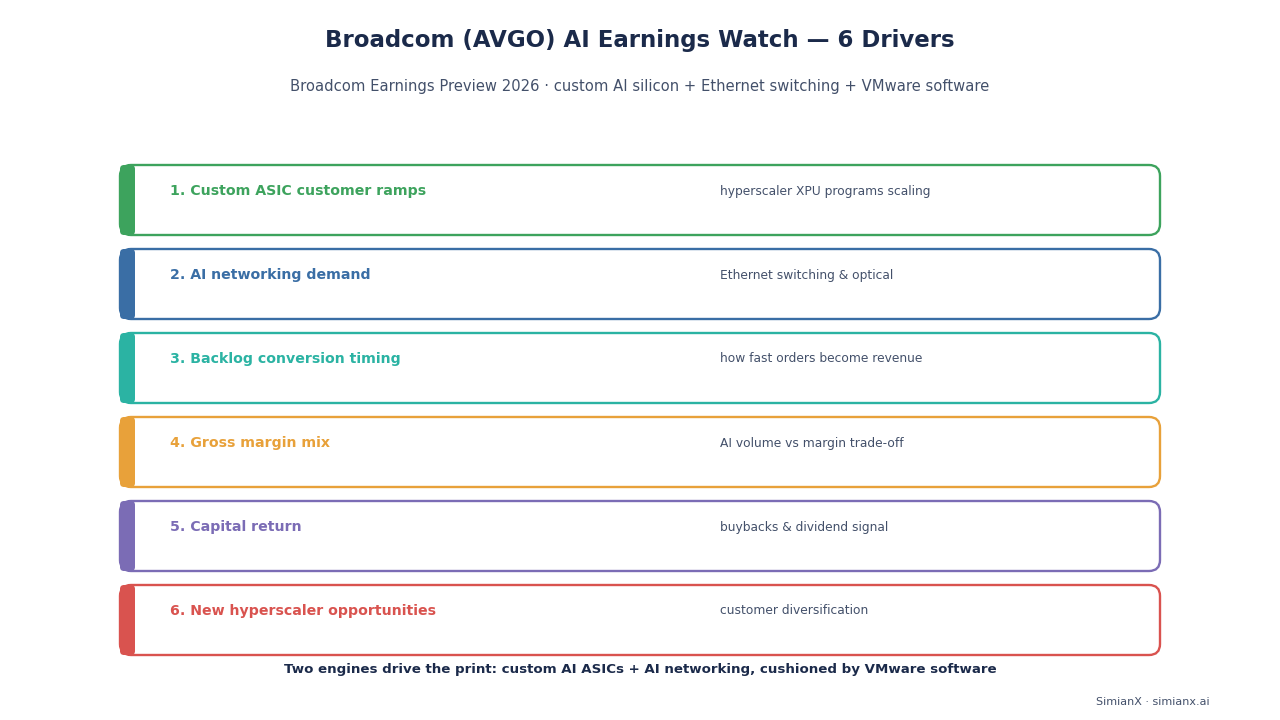
For long-term investors, the most important part of the earnings call may not be the reported revenue number. It may be management commentary around:
- Custom ASIC customer ramps
- AI networking demand
- Backlog conversion timing
- Gross margin mix
- Capital return
- New hyperscaler opportunities
The more precise management can be about these drivers, the easier it becomes to model Broadcom’s long-term earnings power.
Broadcom AI ASIC Backlog: The Core Earnings Question
The phrase Broadcom AI ASIC backlog has become one of the most searched long-tail topics around AVGO stock because it captures the central bull case. Broadcom is not selling a generic AI chip to every buyer. Instead, it works with major cloud and AI companies on custom silicon optimized for specific workloads.
That makes backlog especially valuable. A large AI ASIC backlog can indicate future revenue visibility, customer commitment, and long-term design wins. But investors should avoid treating backlog as the same thing as guaranteed profit. Backlog must still convert into revenue, and revenue must still flow through margins, capacity constraints, supply chain execution, and customer deployment schedules.
What Is Broadcom’s AI ASIC Backlog?
Broadcom’s AI ASIC backlog refers to committed or expected orders tied to AI infrastructure products such as custom accelerators, networking chips, switching silicon, optical components, and related data center hardware. The number matters because custom AI chip programs often involve long design cycles, deep customer integration, and multi-quarter deployment schedules.
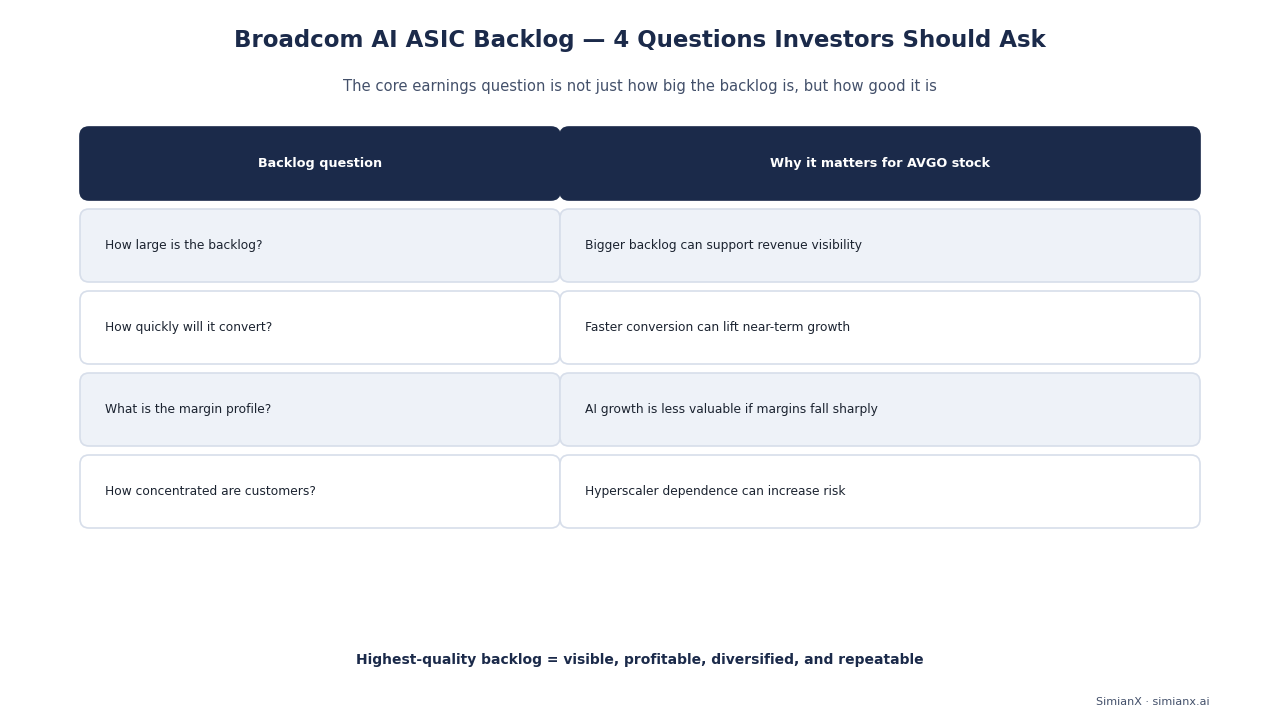
In practical terms, investors should evaluate backlog using four questions:
| Backlog Question | Why It Matters for AVGO Stock |
|---|---|
| How large is the backlog? | Bigger backlog can support revenue visibility. |
| How quickly will it convert? | Faster conversion can lift near-term growth. |
| What is the margin profile? | AI growth is less valuable if margins fall sharply. |
| How concentrated are customers? | Hyperscaler dependence can increase risk. |
The highest-quality backlog is not just large—it is visible, profitable, diversified, and repeatable.
What Should Investors Watch in Broadcom Earnings Preview 2026?
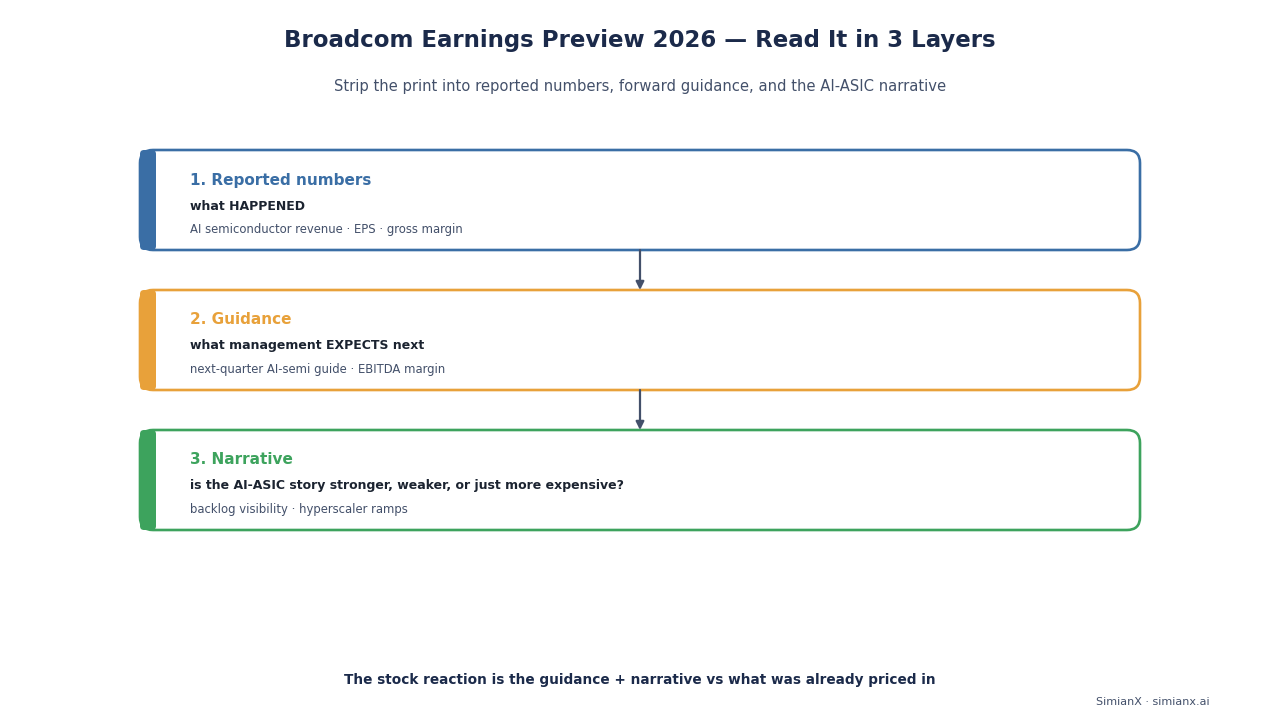
The most useful Broadcom earnings preview 2026 framework is to separate the earnings report into three layers: the reported numbers, the guidance, and the narrative.
The reported numbers answer what happened. Guidance answers what management expects next. The narrative explains whether the AI ASIC story is becoming stronger, weaker, or simply more expensive.
1. AI Semiconductor Revenue
AI semiconductor revenue is the headline metric. Investors will want to know whether AI demand is still accelerating and whether management’s next-quarter guide implies another leg higher. The key is not simply year-over-year growth; the market already expects high growth. The more important issue is whether Broadcom can keep surprising upward.
Watch for language such as:
- “custom AI accelerator demand”
- “Ethernet AI networking”
- “hyperscaler ramps”
- “XPU customer expansion”
- “supply availability”
- “deployment timing”
If management uses confident, specific language around customer ramps, that is usually more constructive than vague optimism.
2. AI ASIC Customer Concentration
Broadcom’s custom chip business is powerful because major technology companies need differentiated silicon. But the same model can create customer concentration risk. A small number of hyperscalers may represent a large portion of AI-related revenue.
Investors should ask:
- Are existing customers expanding programs?
- Are new customers moving from design to deployment?
- Are any programs delayed?
- Is demand broadening beyond one or two anchor clients?
- Are AI networking and optical products growing alongside XPUs?
A strong earnings call would show that Broadcom is not dependent on one customer, one chip cycle, or one deployment window.
3. Gross Margin and Mix
AI revenue growth can create a counterintuitive risk: faster revenue growth but lower blended margins. Custom AI hardware may carry different margin characteristics than Broadcom’s traditional semiconductor and software businesses.
That does not automatically make the growth unattractive. If AI revenue is large, durable, and strategic, slightly lower margins may still create substantial operating profit. But valuation matters. AVGO stock can react negatively if investors believe AI revenue is growing at the expense of earnings quality.
A practical margin checklist:
- Compare semiconductor gross margin with prior quarters.
- Listen for comments on AI product mix.
- Track whether software margins remain stable.
- Watch adjusted EBITDA margin guidance.
- Compare free cash flow growth with revenue growth.
4. VMware and Infrastructure Software
Broadcom’s software segment is not the flashy part of the AI story, but it matters because it can provide recurring revenue, high profitability, and cash flow durability. VMware integration remains important for investors who want AVGO to be more than a cyclical semiconductor stock.
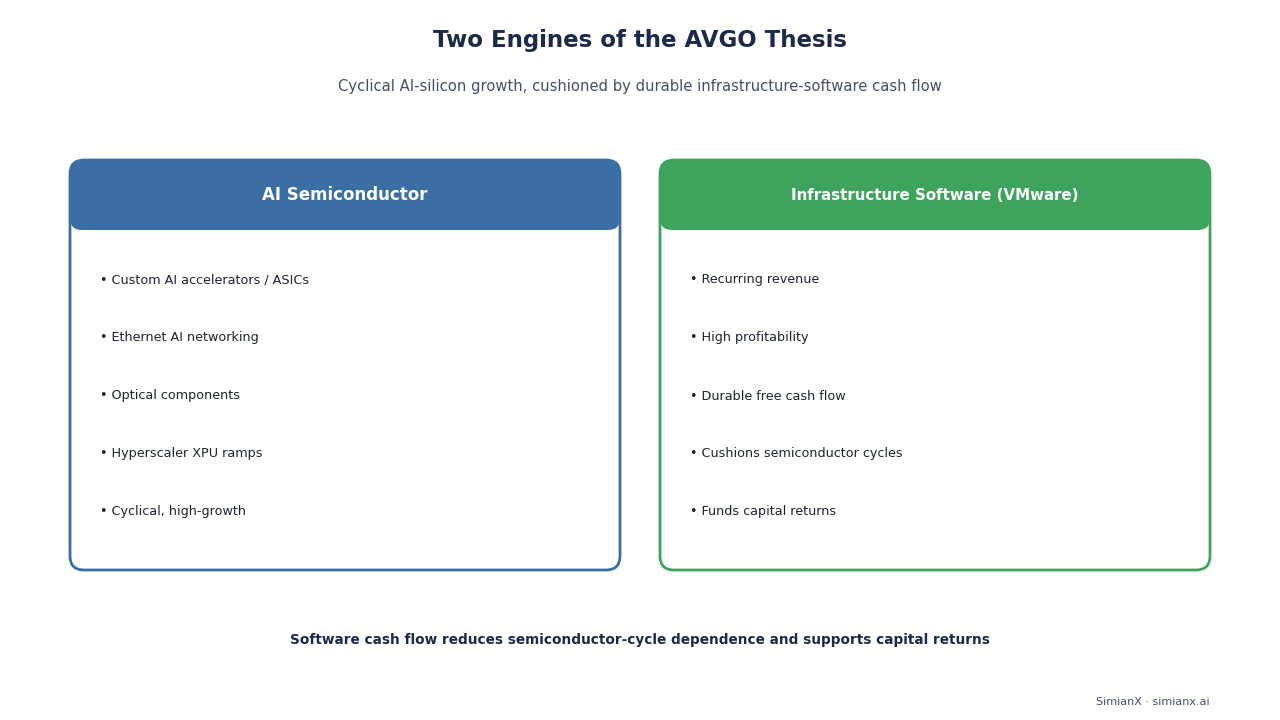
The software business can help Broadcom in three ways:
- It can reduce dependence on semiconductor cycles.
- It can support capital returns through recurring cash flow.
- It can stabilize investor confidence during AI hardware volatility.
SimianX AI’s stock analysis workflow is useful here because it can compare the semiconductor narrative with software fundamentals in one structured research view. Instead of analyzing AI chips and VMware separately, investors can evaluate how both segments contribute to the full AVGO thesis.
AVGO Stock Before Earnings: Bull Case, Bear Case, and Base Case
A useful AVGO stock earnings preview should not start with a price target. It should start with scenarios. Earnings reactions are often driven by the gap between expectations and reality, not by the absolute quality of the company.
Bull Case: AI Backlog Converts Faster Than Expected
The bullish scenario is that Broadcom confirms strong AI revenue visibility, raises or reinforces guidance, and shows that custom AI ASIC demand is expanding across multiple hyperscalers. In this case, investors may look beyond near-term valuation and focus on long-term AI infrastructure share gains.
Bullish signals include:
- Higher AI semiconductor outlook
- Strong backlog conversion commentary
- Additional XPU customer traction
- Better-than-expected adjusted EBITDA margin
- Continued share repurchases or dividend support
- Strong free cash flow conversion
In this scenario, AVGO stock may continue to trade like a strategic AI infrastructure leader rather than a traditional chip supplier.
Bear Case: Expectations Are Too High
The bearish scenario is not necessarily that Broadcom performs badly. The risk is that the company performs well but not well enough. When a stock has already rallied into earnings, investors may demand a larger beat, a stronger guide, and more detailed AI commentary.
Bearish signals include:
- AI revenue guide below elevated expectations
- Margin pressure from AI mix
- Delayed hyperscaler deployments
- Limited backlog detail
- Weak non-AI semiconductor recovery
- Software growth that looks stable but not exciting
The bear case is especially relevant because high-quality companies can still see sharp stock declines when valuation and expectations become stretched.
Base Case: Strong Company, Volatile Stock
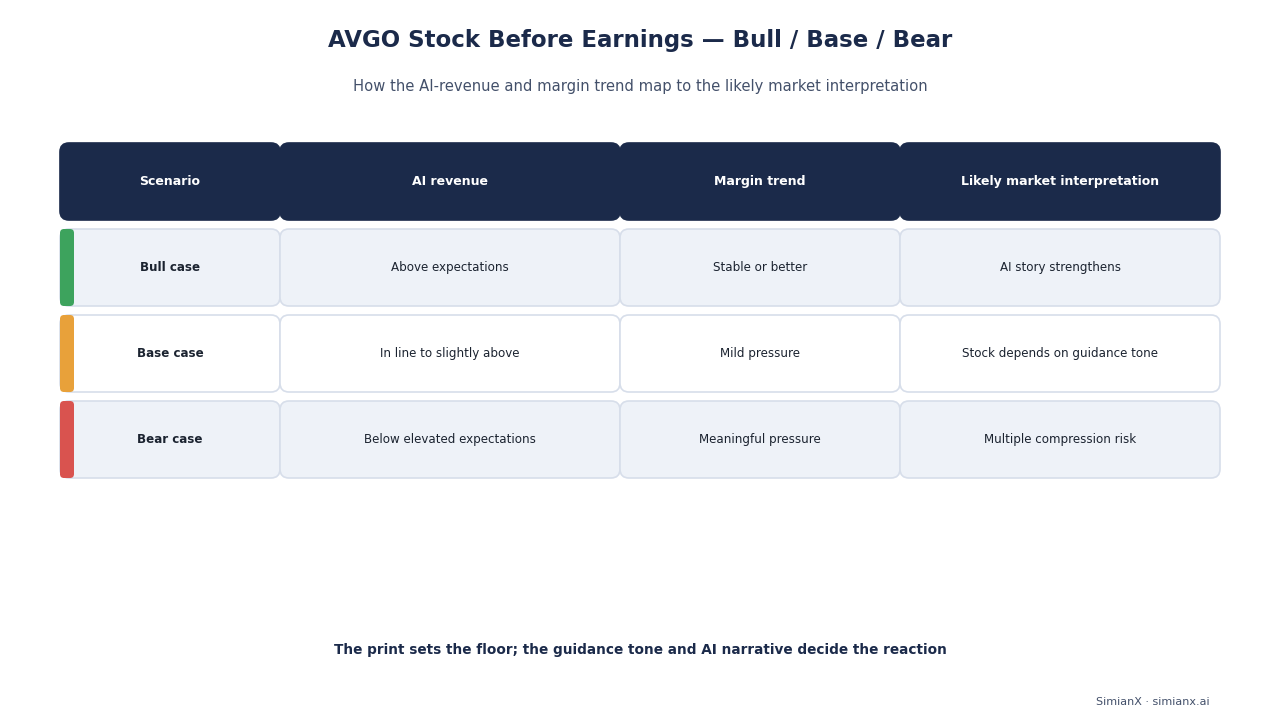
The base case is that Broadcom remains fundamentally strong, but AVGO stock becomes volatile around earnings because investors are debating how much AI growth is already priced in.
| Scenario | AI Revenue | Margin Trend | Likely Market Interpretation |
|---|---|---|---|
| Bull case | Above expectations | Stable or better | AI story strengthens |
| Base case | In line to slightly above | Mild pressure | Stock depends on guidance tone |
| Bear case | Below elevated expectations | Meaningful pressure | Multiple compression risk |
Strong fundamentals do not eliminate earnings risk. They only improve the quality of the long-term debate.
How to Analyze Broadcom Earnings Like a Professional
For investors searching “how to analyze AVGO earnings,” the best answer is to use a repeatable process before the report, during the release, and after the call.
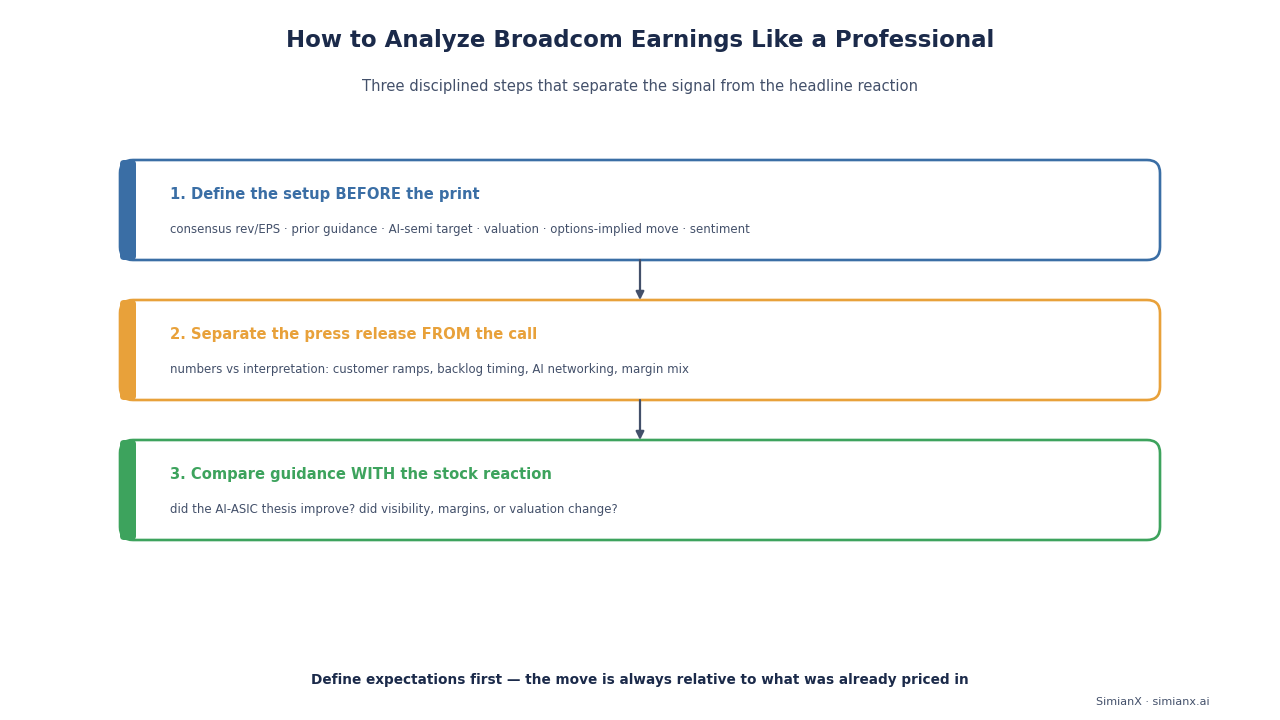
Step 1: Define the Earnings Setup Before the Print
Before the report, write down what the market already expects. This helps prevent emotional decision-making after the headline hits.
Your pre-earnings checklist should include:
- Consensus revenue and EPS expectations
- Broadcom’s prior guidance
- AI semiconductor revenue target
- Recent AVGO stock performance
- Valuation multiples
- Key analyst upgrades or downgrades
- Options-implied move
- Semiconductor sector sentiment
This step is crucial because an earnings beat only matters relative to expectations.
Step 2: Separate the Press Release From the Call
The press release provides numbers. The call provides interpretation. For Broadcom, the call may be more important because management can explain customer ramps, backlog timing, AI networking demand, and margin mix.
Focus on management answers to analyst questions such as:
- “How much visibility do you have into AI demand?”
- “Are custom AI accelerators expanding beyond current customers?”
- “What is the margin profile of AI revenue?”
- “How should investors think about backlog conversion?”
- “Is Ethernet AI networking becoming a larger growth driver?”
Step 3: Compare Guidance With the Stock Reaction
Sometimes a stock falls after good results because guidance fails to exceed expectations. Sometimes a stock rises after mixed results because management clears up uncertainty. The key is to compare the reaction with the updated thesis.
A disciplined investor should ask:
- Did the long-term AI ASIC thesis improve or deteriorate?
- Did management increase visibility?
- Did margins change the quality of the revenue growth?
- Did valuation become more or less reasonable?
- Would I make the same decision if I did not already own the stock?
SimianX can help investors standardize this process by turning earnings data, news sentiment, technical signals, and fundamental metrics into a structured AI stock report. For a complex name like Broadcom, that structure helps reduce bias and keeps attention on the variables that actually move the thesis.
Is Broadcom Stock a Buy Before Earnings?
The question “should investors buy AVGO before earnings” depends on risk tolerance, time horizon, and whether the investor is making a trade or building a long-term position.
A short-term trader is mostly focused on the earnings reaction. That means options pricing, implied volatility, support and resistance levels, and guidance surprise matter most.
A long-term investor should care more about:
- AI infrastructure durability
- ASIC customer relationships
- Software cash flow
- Capital allocation
- Competitive advantage
- Valuation discipline
For long-term investors, buying before earnings can make sense only if the position size already accounts for volatility. For traders, the better setup may be waiting for the post-earnings reaction and then evaluating whether the new information confirms or breaks the prior thesis.
Practical rule: If you cannot tolerate a sharp one-day move, do not let a single earnings event determine your position size.
Broadcom vs Nvidia: Why the AI ASIC Story Is Different
Broadcom and Nvidia are both AI infrastructure beneficiaries, but the investment stories are different.
Nvidia sells widely adopted GPU platforms with a powerful software ecosystem. Broadcom enables custom silicon and networking infrastructure for customers that want specialized performance, efficiency, and control. This means Broadcom is less about replacing Nvidia and more about participating in a parallel AI architecture trend.
| Company | AI Strength | Main Investor Question |
|---|---|---|
| Nvidia | GPUs, CUDA ecosystem, AI servers | Can dominance persist as competition rises? |
| Broadcom | Custom ASICs, networking, optical, software | Can backlog convert into durable high-quality earnings? |
| AMD | GPUs and CPUs | Can it gain share at scale? |
| TSMC | Advanced manufacturing | Can capacity meet AI demand? |
The rise of AI ASICs does not mean GPUs disappear. Instead, hyperscalers may use different chips for different workloads: GPUs for flexible training and accelerated computing, ASICs for optimized internal workloads, and Ethernet-based networking to scale clusters efficiently.
That is why Broadcom’s earnings commentary matters. Investors want evidence that custom AI silicon is moving from a promising side story into a durable revenue engine.
FAQ About Broadcom Earnings Preview 2026
What is the main focus of Broadcom Earnings Preview 2026?
The main focus is whether Broadcom’s AI semiconductor business can keep accelerating while maintaining strong profitability. Investors will pay close attention to AI ASIC backlog, Q2 guidance, adjusted EBITDA margin, and management commentary about hyperscaler demand.
How important is Broadcom’s AI ASIC backlog for AVGO stock?
Broadcom’s AI ASIC backlog is important because it gives investors a window into future revenue visibility. However, backlog alone is not enough; investors should also evaluate conversion timing, customer concentration, margin impact, and whether new AI programs are being added.
Is AVGO stock risky before earnings?
Yes, AVGO stock can be risky before earnings because expectations are high and the stock has become closely tied to the AI infrastructure narrative. Even strong results can trigger volatility if guidance, margins, or backlog commentary disappoint elevated expectations.
How can investors analyze AVGO earnings more effectively?
Investors can analyze AVGO earnings more effectively by separating reported numbers, forward guidance, and management tone. Tools like SimianX AI can help organize financial metrics, news flow, technical signals, and earnings-call language into a structured research process.
What should long-term investors watch after Broadcom reports earnings?
Long-term investors should watch whether Broadcom confirms durable AI demand, expands custom ASIC relationships, protects margins, grows free cash flow, and maintains software stability. The best post-earnings signal would be a stronger long-term thesis, not just a one-quarter beat.
Conclusion
The Broadcom Earnings Preview 2026: AI ASIC Backlog and AVGO Stock debate comes down to one question: can Broadcom turn massive AI infrastructure demand into durable, profitable, multi-year growth? The company has powerful advantages in custom AI accelerators, AI networking, optical components, and infrastructure software, but AVGO stock also carries high expectations.
For investors, the best approach is not to guess the earnings reaction. It is to build a clear framework: track AI semiconductor revenue, backlog conversion, hyperscaler customer expansion, margin quality, VMware cash flow, and valuation risk. Broadcom may remain one of the most important AI infrastructure stocks in 2026, but disciplined analysis is essential when the market has already priced in a strong story.
To research Broadcom and other AI-driven market leaders with a repeatable, structured workflow, explore SimianX AI. SimianX helps investors turn earnings reports, stock data, news sentiment, and multi-agent analysis into clearer decisions before and after major market-moving events.
Related Reading
- Datadog Stock AI Rally Analysis: What Investors Miss
- AI Chip Stocks Stay Strong: AMD, Intel Drive Data Centers
- AI Spending Surges: TSMC Outlook Confirms Nvidia Demand
- Generac Stock 2026: AI Data Center Backup Power Deal