
 By Muke
Reading the Datadog Rally: Growth, Margins, and What Comes Next
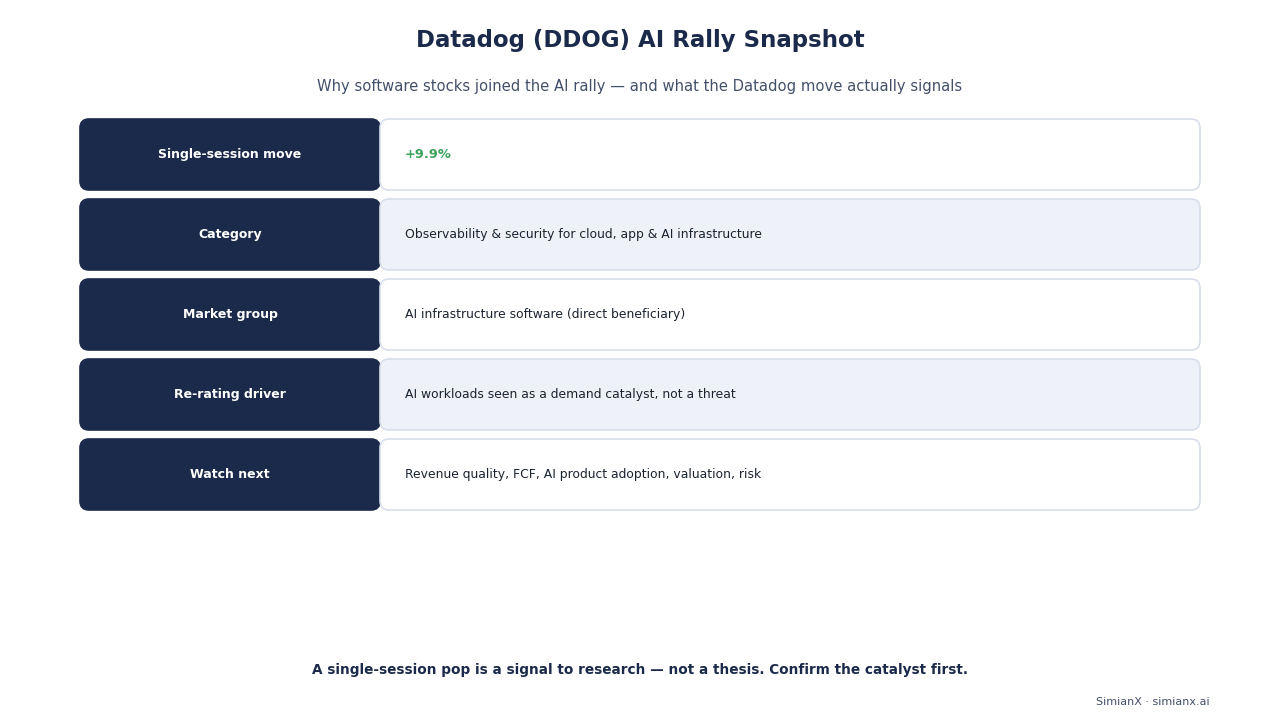
The Datadog stock AI rally analysis starts with one important idea: investors are no longer treating all software companies as potential AI losers. After Datadog (DDOG) jumped about 9.9% in a single session, the broader software sector gained new attention because the market saw evidence that some software platforms may become more valuable as artificial intelligence workloads scale. For investors, the question is not simply “Did Datadog go up?” The better question is: what does Datadog’s rally reveal about the next phase of AI-driven software investing?
That is where a disciplined research process matters. Platforms like SimianX AI help investors move beyond headline reactions by combining market data, fundamentals, technical signals, news sentiment, and risk review through a multi-agent AI research workflow.
Why Datadog’s 9.9% Jump Matters for Software Stocks
Datadog’s rally matters because it arrived at a time when investors were debating whether AI would replace traditional software spending or increase demand for certain software infrastructure categories. Datadog sits in a strategically important category: observability and security for cloud, application, and AI infrastructure.
In plain English, observability tools help companies understand what is happening inside complex software systems. As enterprises deploy AI applications, LLM workflows, GPU clusters, data pipelines, and agentic tools, the systems become harder to monitor. That creates demand for platforms that can help engineering, security, and operations teams see latency, cost, errors, anomalies, model behavior, and production reliability.
Key insight: The AI rally in software is not only about companies that build models. It is also about companies that help enterprises operate, secure, monitor, and govern AI systems at scale.
Datadog’s latest earnings helped reset the narrative. The company reported strong revenue growth, meaningful free cash flow, and growing adoption among larger customers. Investors interpreted that as evidence that AI workloads may be a demand catalyst for certain software platforms, rather than a direct threat.
What changed in investor psychology?
Before the rally, many software stocks were trading under a cloud of concern:
- AI could reduce the need for traditional SaaS seats.
- Enterprises might consolidate vendors to fund AI budgets.
- Infrastructure spending could shift away from application software.
- Valuations looked expensive relative to slowing growth.
- Investors preferred semiconductors and hardware as “cleaner” AI plays.
Datadog challenged that pessimistic view. Its results suggested that software companies connected to AI infrastructure, cloud migration, security, and observability can still grow quickly.
What Is Driving the Software Stocks AI Rally?
The software stocks AI rally is being driven by a combination of earnings surprises, AI infrastructure demand, cloud modernization, and renewed confidence that software can participate in AI monetization.
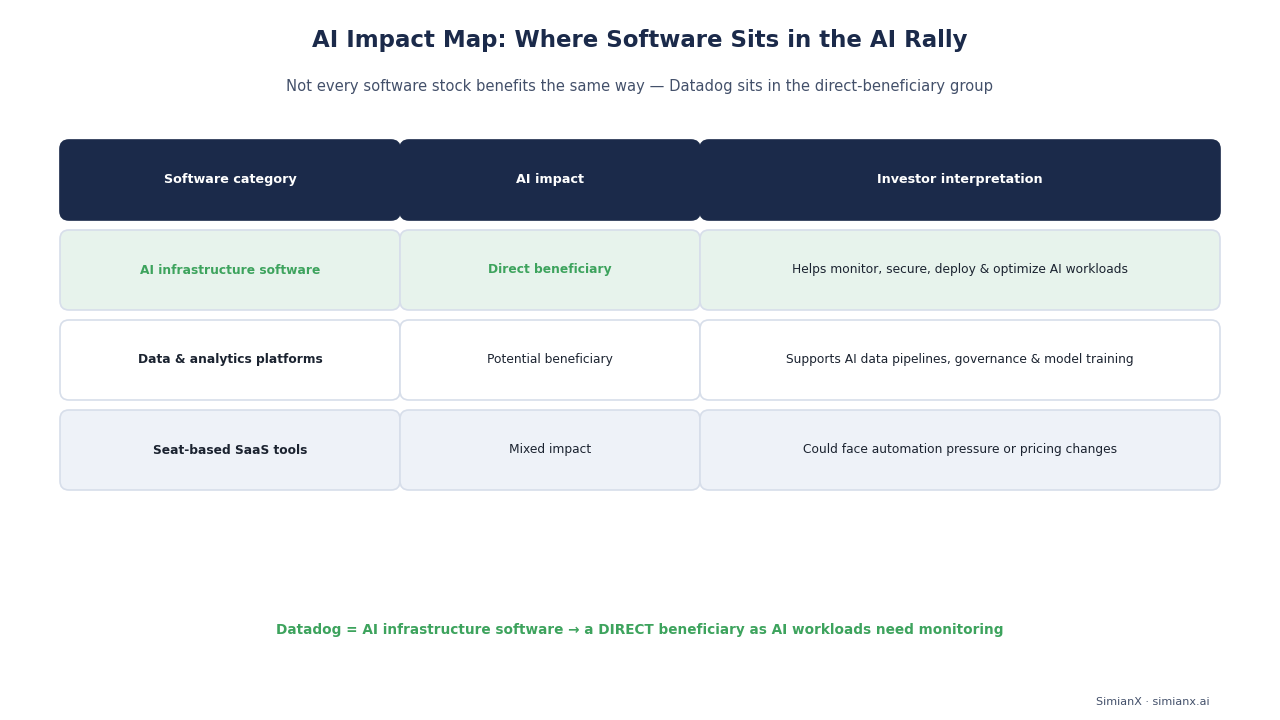
A useful way to understand the rally is to divide the market into three groups:
| Software Category | AI Impact | Investor Interpretation |
|---|---|---|
| AI infrastructure software | Direct beneficiary | Helps monitor, secure, deploy, or optimize AI workloads |
| Data and analytics platforms | Potential beneficiary | Supports AI data pipelines, governance, and model training |
| Seat-based SaaS tools | Mixed impact | Could face automation pressure or pricing changes |
Datadog is in the first group. It benefits when enterprise technology stacks become more complex. AI makes those stacks more complex.
That is the core of the Datadog stock AI rally analysis: AI does not automatically help every software company, but it can create powerful demand for software that becomes essential to running AI safely and efficiently.
How Datadog Became an AI Infrastructure Story
Datadog began as a cloud monitoring and observability company. Over time, it expanded into logs, traces, metrics, application performance monitoring, security, cloud cost management, and developer workflows. The AI era adds a new layer of demand because modern AI systems require visibility across:
- model prompts,
- tool calls,
- retrieval steps,
- GPU usage,
- latency spikes,
- token consumption,
- hallucination risk,
- prompt injection attempts,
- sensitive data exposure,
- agent behavior,
- and production reliability.
For investors, this turns Datadog into more than a “monitoring dashboard” company. It becomes part of the operational backbone for AI-native software.
Why AI observability matters
Traditional software observability answers questions like:
- Is the application online?
- Why is latency rising?
- Which service caused the error?
- Are infrastructure costs increasing?
- What changed before the outage?
AI observability adds harder questions:
- Why did the model produce a bad answer?
- Did a prompt injection attempt affect the output?
- Which retrieval step introduced wrong context?
- Which tool call failed inside an AI agent workflow?
- Did token usage or latency make the workflow uneconomical?
This matters because enterprises cannot scale AI systems they cannot monitor. The more companies deploy AI into customer-facing workflows, internal operations, developer tooling, and decision systems, the more observability becomes a mission-critical layer.
AI increases software complexity. Complexity increases the need for observability. That is the investment logic behind Datadog’s renewed momentum.
How to Analyze Datadog Stock After the AI Rally?
A strong rally can create both opportunity and risk. The right question is not “Should I buy after a 9.9% move?” The better question is how to analyze Datadog stock after the AI rally using a repeatable framework.
Here is a practical five-part framework:
1. Revenue Growth Quality
Look beyond the headline revenue growth number. Ask whether growth is coming from:
- new customers,
- expansion among existing customers,
- larger enterprise accounts,
- product cross-sell,
- AI-specific workloads,
- security adoption,
- cloud migration,
- or pricing changes.
High-quality growth usually comes from broad platform adoption and durable customer expansion, not one-time demand spikes.
2. Free Cash Flow and Operating Leverage
Datadog’s rally was not only about revenue. Investors also care about whether growth is converting into cash. In software, free cash flow is a major signal because it shows whether the company can fund innovation without relying heavily on external capital.
Key metrics to track include:
| Metric | Why It Matters |
|---|---|
| Free cash flow margin | Shows business model efficiency |
| Operating margin | Reveals profitability discipline |
| Sales efficiency | Measures how much growth comes from each sales dollar |
| Net retention | Indicates customer expansion strength |
| Large customer growth | Shows enterprise penetration |
3. Product Expansion Into AI Workloads
For an AI-driven software thesis, product expansion matters. Investors should ask whether Datadog is building tools that directly support enterprise AI operations.
Important areas include:
- LLM observability,
- GPU monitoring,
- AI agent monitoring,
- prompt and model evaluation,
- AI security,
- cloud cost controls,
- and compliance visibility.
The stronger the product connection to AI workflows, the more credible the AI growth thesis becomes.
4. Valuation After the Rally
A stock can have a great business and still be expensive. After a sharp move, investors should compare Datadog’s valuation against:
- expected revenue growth,
- free cash flow growth,
- operating margin expansion,
- peer software multiples,
- AI infrastructure peers,
- and the company’s historical range.
The goal is not to find a “cheap” stock. High-quality software platforms often trade at premiums. The goal is to decide whether the premium is justified by growth durability and execution.
5. Risk Management and Position Sizing
A 9.9% jump can attract momentum buyers, but it can also raise volatility. Investors should define risk before acting.
A basic checklist:
- Identify the earnings catalyst.
- Check whether analyst estimates are moving higher.
- Compare price action with volume.
- Review support and resistance levels.
- Estimate downside if growth expectations cool.
- Decide whether the position is for trading, swing investing, or long-term holding.
- Set a review date after the next major catalyst.
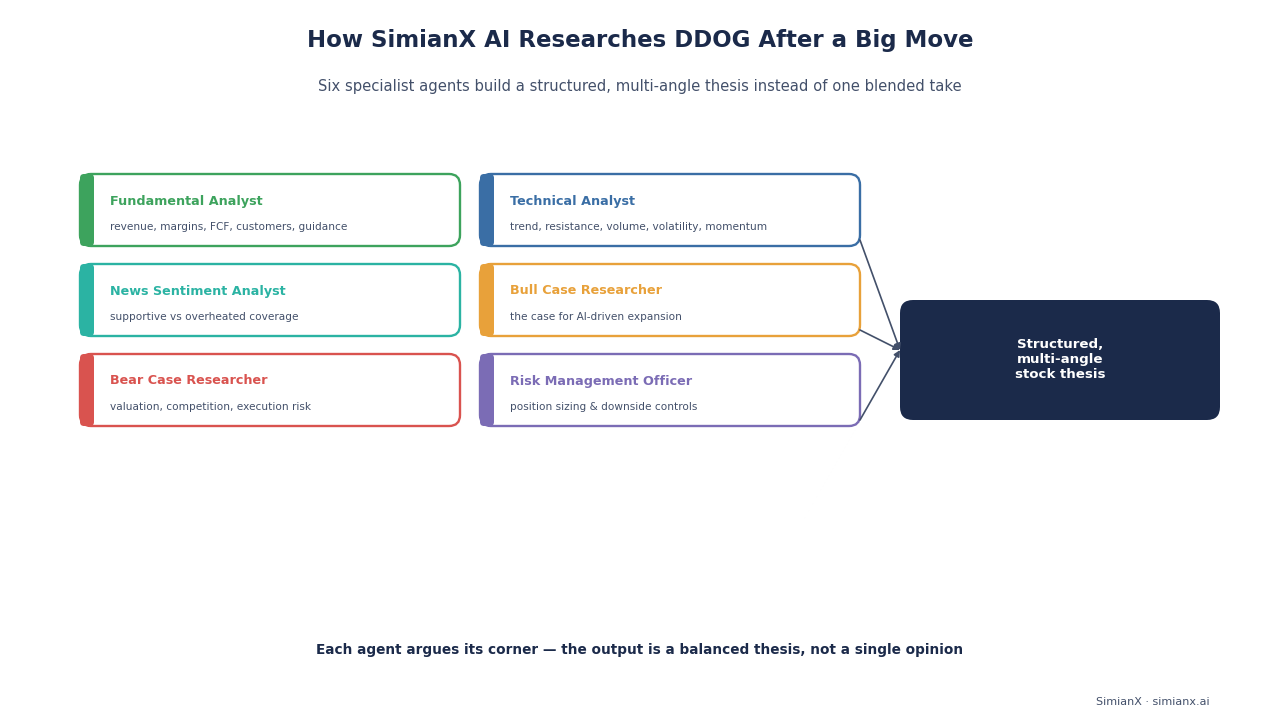
This is where SimianX AI can be especially useful. Its multi-agent workflow can separate the bullish case, bearish case, technical setup, news sentiment, and risk management view instead of relying on one simplified answer.
What Investors Miss About Datadog and the AI Software Trade
Many investors focus only on whether Datadog is “an AI stock.” That is too narrow. The better lens is whether Datadog is becoming an AI operations platform.
AI systems create new operational problems:
- They are probabilistic, not deterministic.
- They can fail in subtle ways.
- They require ongoing evaluation.
- They use expensive infrastructure.
- They introduce new security risks.
- They depend on external models, APIs, tools, and data sources.
- They must be monitored across engineering, compliance, finance, and product teams.
That means AI adoption can increase demand for software that helps enterprises answer one question:
“Can we trust this AI system in production?”
Datadog’s observability tools are relevant because production AI systems need continuous monitoring. That does not guarantee the stock will keep rising, but it explains why investors suddenly became more willing to re-rate the company.
The hidden driver: AI turns observability into governance
In the pre-AI software era, observability was mostly an engineering and reliability function. In the AI era, it becomes part of governance.
Companies now need to monitor:
- model quality,
- safety,
- data leakage,
- prompt attacks,
- output drift,
- customer impact,
- system cost,
- and auditability.
This broadens the buyer base. The decision may involve engineering leaders, security teams, compliance officers, finance teams, and product executives.
That expansion is one reason observability platforms can become strategically valuable in AI-native enterprises.
Datadog vs Other AI Software Stocks
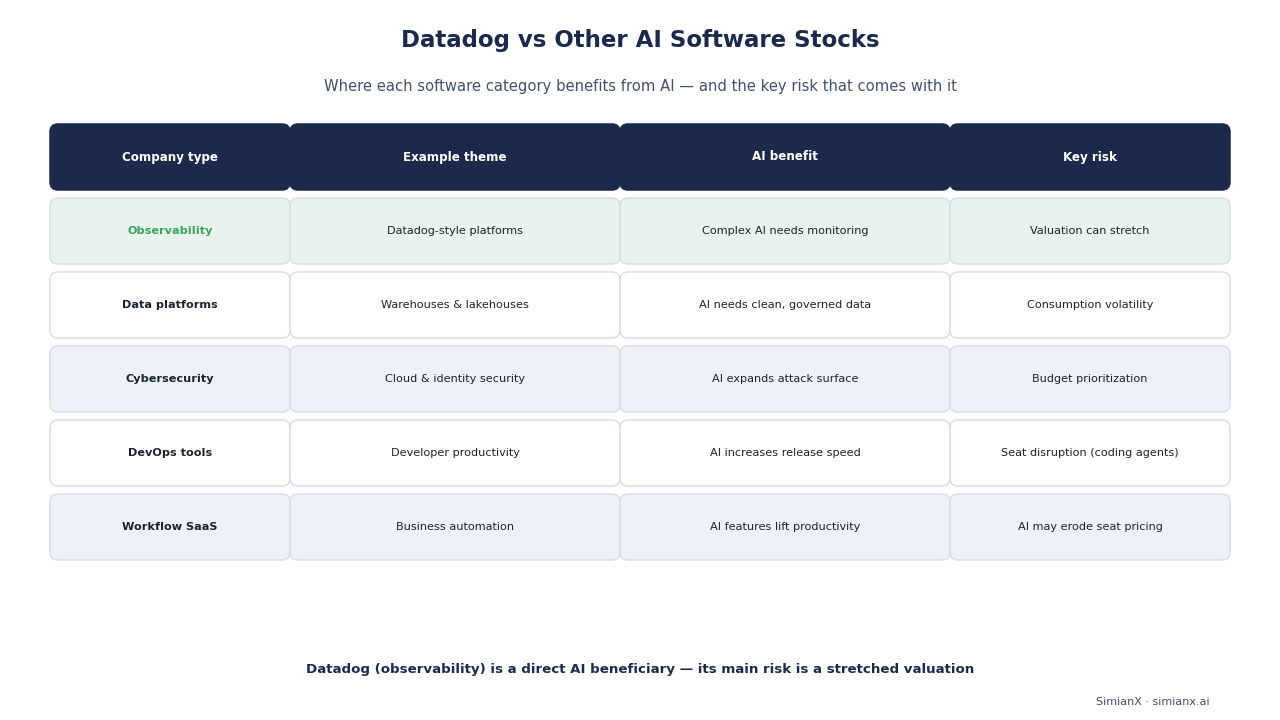
Not every software stock deserves the same AI premium. Investors need to compare Datadog with other AI-related software categories.
| Company Type | Example Theme | AI Benefit | Key Risk |
|---|---|---|---|
| Observability | Datadog-style platforms | More complex AI systems need monitoring | Valuation can become stretched |
| Data platforms | Warehouses and lakehouses | AI needs clean, governed data | Competition and consumption volatility |
| Cybersecurity | Cloud and identity security | AI expands attack surface | Budget prioritization |
| DevOps tools | Developer productivity | AI increases release speed | Seat disruption from coding agents |
| Workflow SaaS | Business automation | AI features can improve productivity | AI may reduce user-based pricing power |
Datadog’s advantage is that AI infrastructure complexity can directly increase demand for monitoring, security, and cost visibility. However, investors should still compare Datadog’s valuation and growth profile against other software names benefiting from the AI theme.
How SimianX AI Helps Research Datadog After a Big Move
A headline like “Software Stocks Join the AI Rally as Datadog Jumps 9.9%” is useful, but it is only the starting point. Serious investors need a process that can handle conflicting signals.
SimianX AI is designed for that type of research. Instead of giving a single generic response, SimianX uses a multi-agent stock analysis approach where different agents evaluate the stock from different angles.
A Datadog research workflow could include:
- Fundamental Analyst: reviews revenue growth, margins, cash flow, customer metrics, and guidance.
- Technical Market Analyst: studies trend strength, resistance levels, volume, volatility, and momentum.
- News Sentiment Analyst: evaluates whether headlines are supportive or overheated.
- Bull Case Researcher: builds the case for continued AI-driven expansion.
- Bear Case Researcher: tests valuation, competitive, and execution risks.
- Risk Management Officer: converts research into position sizing and downside controls.
This structure is valuable because high-growth AI software stocks often contain both powerful upside narratives and meaningful valuation risk.
The goal is not to predict every tick. The goal is to build a better decision process before the next catalyst arrives.
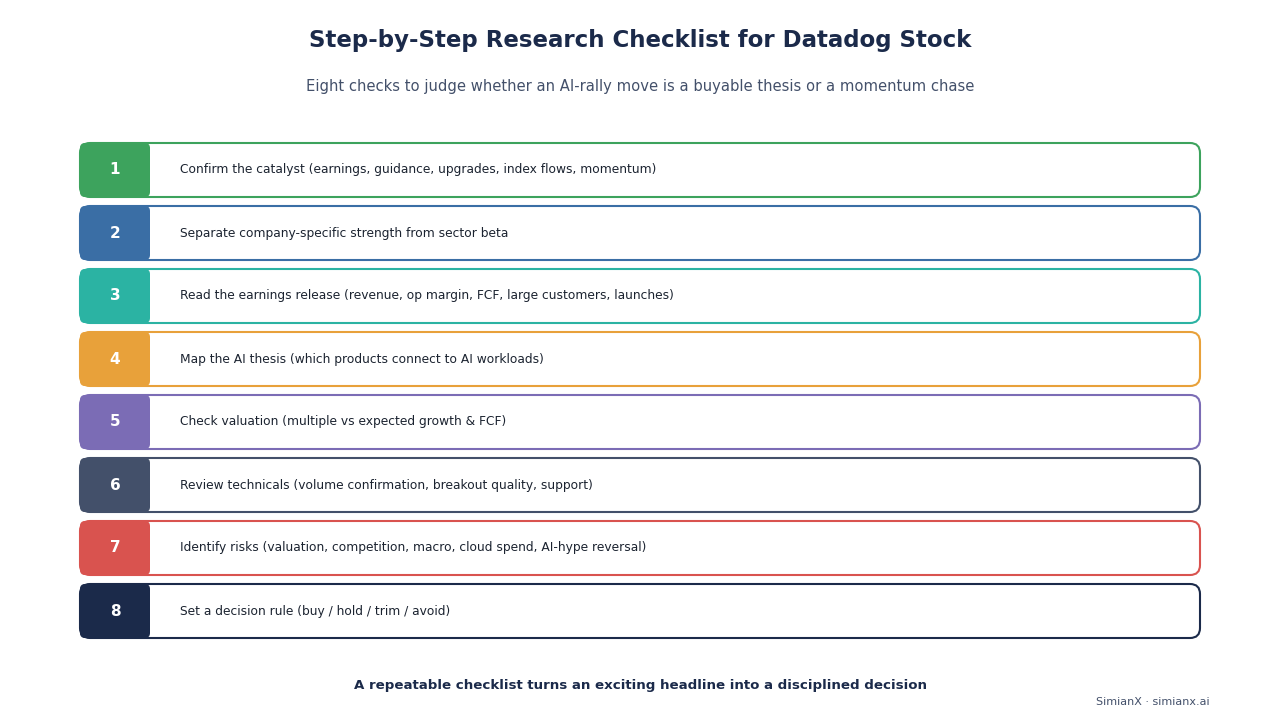
A Step-by-Step Research Checklist for Datadog Stock
Use this checklist when reviewing Datadog after the AI rally:
- Confirm the catalyst. Was the move driven by earnings, guidance, analyst upgrades, index flows, or sector momentum?
- Separate company-specific strength from sector beta. Did Datadog outperform software peers, or did the entire software group rise?
- Read the earnings release. Focus on revenue growth, operating margin, free cash flow, large customers, and product launches.
- Map the AI thesis. Identify which products connect directly to AI workloads.
- Check valuation. Compare the stock’s multiple to expected growth and free cash flow.
- Review technicals. Look for volume confirmation, breakout quality, and potential support zones.
- Identify risks. Include valuation, competition, macro pressure, cloud spending, and AI hype reversal.
- Set a decision rule. Decide what evidence would make you buy, hold, trim, or avoid.
What is the best way to track Datadog stock after an AI rally?
The best way to track Datadog stock after an AI rally is to combine fundamental trend monitoring with real-time market intelligence. Watch earnings revisions, customer growth, AI product adoption, margin trends, and price behavior around key moving averages. Do not rely only on the latest headline or social media narrative.
A platform such as SimianX AI can help by turning scattered signals into a structured research view. That matters because post-earnings rallies often evolve quickly: momentum can continue if estimates rise, but the stock can also reverse if valuation expectations run ahead of fundamentals.
Bull Case for Datadog After the AI Rally
The bullish case for Datadog is straightforward: AI adoption increases the complexity of modern software systems, and Datadog sells tools that help enterprises manage that complexity.
Key bull case points include:
- AI workloads create more telemetry. More data, more logs, more traces, more infrastructure events.
- Enterprises need AI reliability. Production AI failures can affect customers, costs, compliance, and trust.
- Security risk is rising. Prompt injection, data exposure, and AI agent behavior create new monitoring needs.
- Platform adoption can expand. Customers may use more Datadog products over time.
- Large customers can drive durable growth. Enterprise accounts tend to expand if the platform becomes mission-critical.
For long-term investors, the biggest question is whether Datadog can turn AI excitement into sustained revenue growth, higher customer expansion, and durable free cash flow.
Bear Case for Datadog After the AI Rally
The bearish case is not that Datadog is a weak company. The bearish case is that expectations may become too high.
Key risks include:
- Valuation risk: A strong rally can price in too much future growth.
- Competition: Cloud providers and other observability platforms may compete aggressively.
- Cloud spending cycles: If enterprises slow cloud growth, monitoring spend could be affected.
- AI hype risk: Investors may overestimate near-term AI revenue contribution.
- Margin trade-offs: Heavy investment in AI products could pressure profitability.
- Consumption volatility: Usage-based software revenue can be sensitive to customer optimization.
A balanced Datadog stock AI rally analysis should include both sides. The rally may be justified, but risk management becomes more important after a sharp move.
FAQ About Datadog Stock AI Rally Analysis
What is driving Datadog stock higher after the AI rally?
Datadog stock is being driven higher by a mix of strong financial results, renewed confidence in AI infrastructure software, and investor recognition that observability becomes more important as AI workloads scale. The rally also reflects broader interest in software companies that can benefit from cloud, security, and AI operations demand.
Is Datadog an AI stock or a cloud software stock?
Datadog is best understood as a cloud observability and security software company with growing relevance to AI infrastructure. It is not an AI model company, but its tools can help enterprises monitor, evaluate, and secure AI applications in production.
How should investors analyze software stocks during an AI rally?
Investors should separate companies with direct AI infrastructure exposure from companies that are simply adding AI language to their marketing. Look for revenue acceleration, product adoption, customer expansion, free cash flow, and clear evidence that AI is increasing demand.
What are the biggest risks after Datadog jumps 9.9%?
The biggest risks are valuation compression, profit-taking, slower-than-expected AI monetization, and competitive pressure. A sharp move can be bullish if it reflects improving fundamentals, but it also raises the bar for future execution.
What is the best AI stock analysis tool for researching DDOG?
The best AI stock analysis tool for researching DDOG should combine fundamentals, technicals, news sentiment, risk management, and a clear bull-versus-bear debate. SimianX AI is built around that multi-agent research style, helping investors evaluate high-momentum software stocks with more structure.
Conclusion: Datadog’s Rally Signals a New Phase for AI Software Investing
The Datadog stock AI rally analysis points to a larger market shift. Investors are beginning to recognize that AI does not only benefit chipmakers and model providers. It can also benefit software platforms that help enterprises operate, monitor, secure, and govern AI systems in production.
Datadog’s 9.9% jump reflects renewed confidence in software as an AI infrastructure category. But the opportunity comes with risk. After a major rally, investors need to study revenue quality, AI product adoption, valuation, technical strength, and downside scenarios before making a decision.
The key takeaway is simple: AI software winners will be the companies that turn complexity into mission-critical value. Datadog may be one of those names, but investors should use a structured, evidence-based process rather than chase headlines.
To research Datadog and other AI-driven software stocks with a multi-agent framework, explore SimianX AI and build your next stock thesis with real-time market intelligence, expert-style debate, and disciplined risk review.
Related Reading
- Why Dell Stock Jumped 17% in 2026: The AI Server Breakout
- Snowflake Stock Soars 36% on AI Data Cloud and AWS Deal
- AutoZone & Zscaler 2026: Earnings Miss Selloff Playbook
- GPT vs Gemini vs Claude for AI Stock Analysis: 2026 Guide
- Broadcom Earnings 2026: AI ASIC Backlog & AVGO Stock
- Generac Stock 2026: AI Data Center Backup Power Deal
- Why MongoDB Stock Fell 18%: CEO to Meta, 7 Crashes Compared