
 By Muke
Snowflake Stock Soars 36% as AI Data Cloud and AWS Deal Fuel Rally
Snowflake stock soars 36% after a powerful combination of stronger-than-expected earnings, rising enterprise AI demand, and a major AWS partnership reset the market’s view of SNOW. For investors, the rally is not just about one good quarter. It is about whether Snowflake’s AI Data Cloud can become a core layer for governed enterprise AI, agentic workflows, and secure data applications.
At SimianX AI, we look at moves like this through a multi-factor lens: fundamentals, technical momentum, news sentiment, risk, and catalyst durability. This research-style guide breaks down why Snowflake rallied, what the AWS deal means, which metrics matter most, and how investors can evaluate the stock after such a sharp move.
Why Did Snowflake Stock Soar 36%?
Snowflake’s rally came from a rare alignment of financial performance, AI narrative strength, and strategic partnership news. In growth software, investors often reward companies when revenue acceleration, margin discipline, customer expansion, and credible AI positioning all appear at the same time.
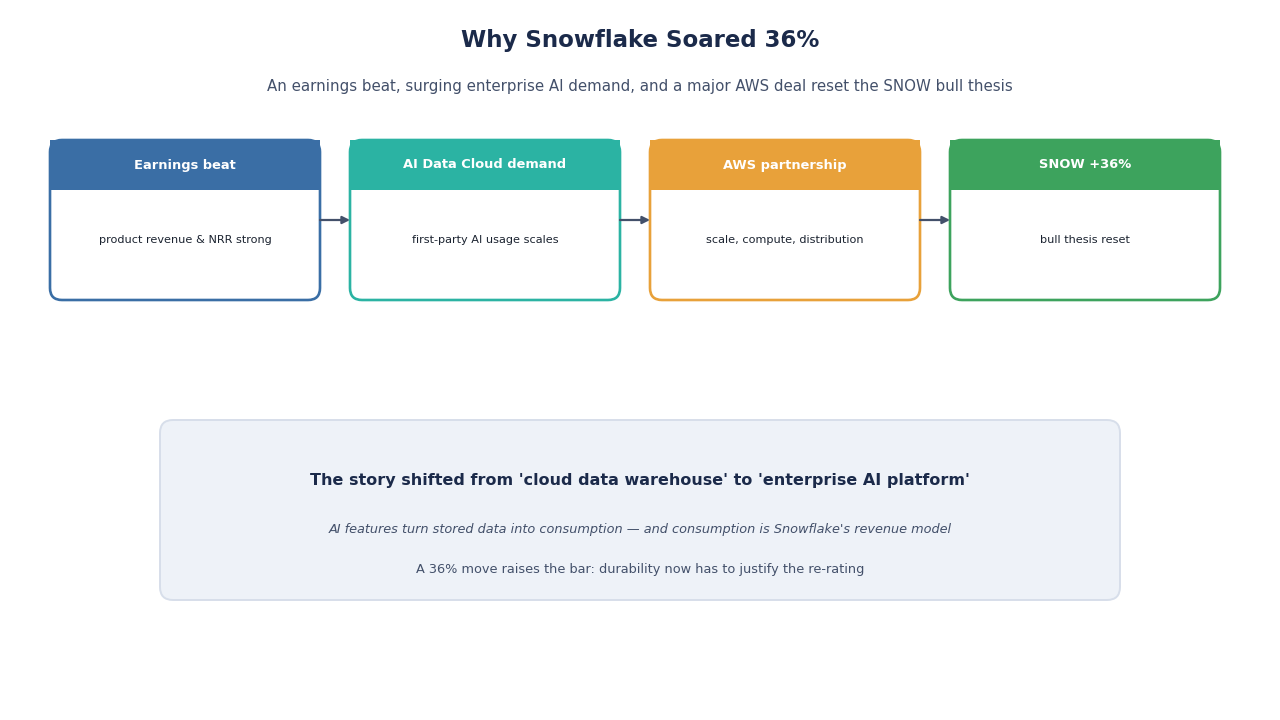
The market reaction can be summarized in four drivers:
- Product revenue growth accelerated, showing demand for Snowflake’s core platform.
- AI usage signals improved, especially around Snowflake Intelligence and Cortex-related products.
- AWS partnership expansion strengthened the infrastructure story, giving Snowflake more credibility as an enterprise AI platform.
- Full-year guidance moved higher, which suggested management saw momentum beyond one quarter.
Key takeaway: Snowflake’s 36% rally was not simply a “headline pop.” It reflected a broader investor reassessment of Snowflake’s role in the enterprise AI stack.
The stock market had previously questioned whether software companies would benefit from AI or be disrupted by it. Snowflake’s results suggested a more constructive possibility: the best data infrastructure companies may become enablers of AI adoption rather than victims of it.
What the AI Data Cloud Means for Investors
Snowflake describes itself as an AI Data Cloud company. For investors, that phrase matters because the AI boom is shifting from model experimentation to production workloads. Enterprises do not only need large language models. They need clean data, governance, security, identity controls, application connectivity, and scalable compute.
That is where Snowflake is trying to position itself.
Instead of forcing companies to move sensitive data into multiple AI tools, Snowflake’s strategy is to bring AI capabilities closer to governed enterprise data. This matters because many organizations still struggle with fragmented data, compliance requirements, and security concerns.
The investment question is simple: Can Snowflake turn its trusted data platform into a control plane for enterprise AI?
If the answer is yes, the company may deserve a higher growth multiple. If the answer is no, the rally could fade as investors refocus on valuation, competition, and consumption volatility.
Core AI Data Cloud components investors should watch
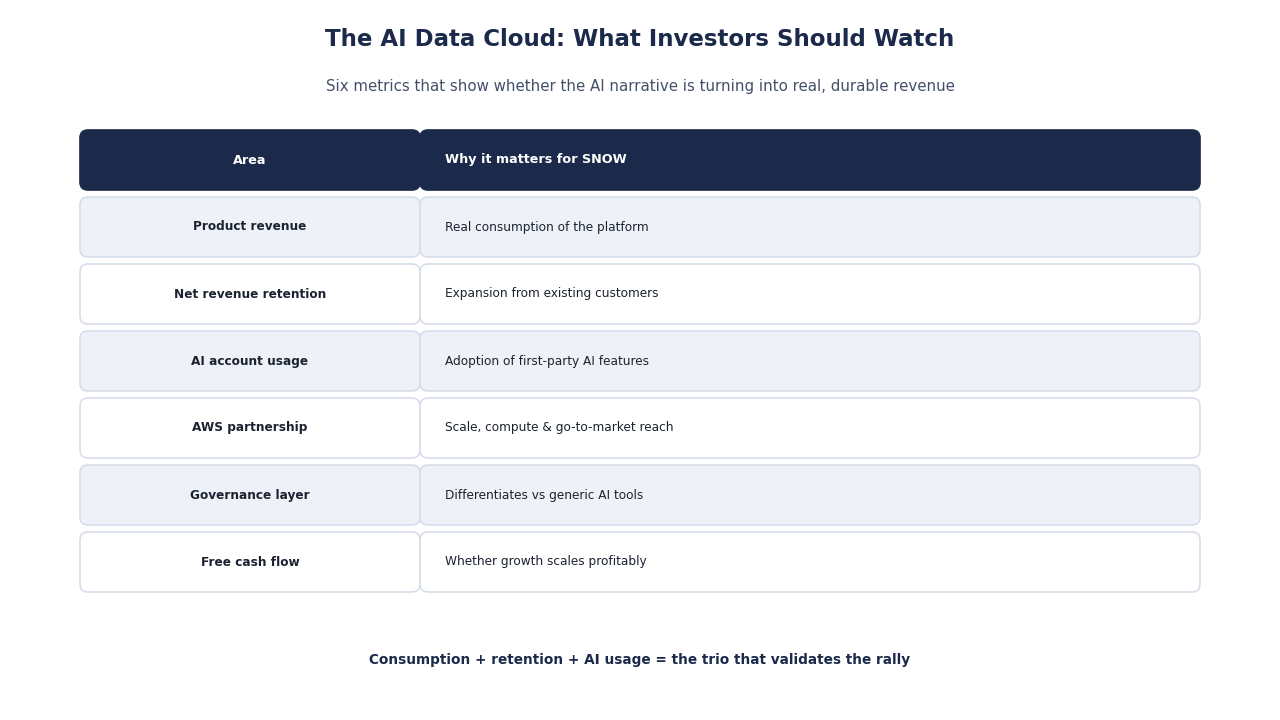
| Area | Why It Matters for SNOW Stock |
|---|---|
| Product revenue | Shows real consumption of Snowflake’s platform |
| Net revenue retention | Indicates expansion from existing customers |
| AI account usage | Signals adoption of first-party AI features |
| AWS partnership | Supports scale, compute, and go-to-market reach |
| Governance layer | Differentiates Snowflake from generic AI tools |
| Free cash flow | Shows whether growth can scale profitably |
The AWS Deal: Why It Fueled the Snowflake Stock Rally
The expanded AWS collaboration was one of the biggest reasons Snowflake stock attracted renewed attention. The deal includes a multi-year infrastructure commitment designed to support enterprise AI and data workloads on AWS.
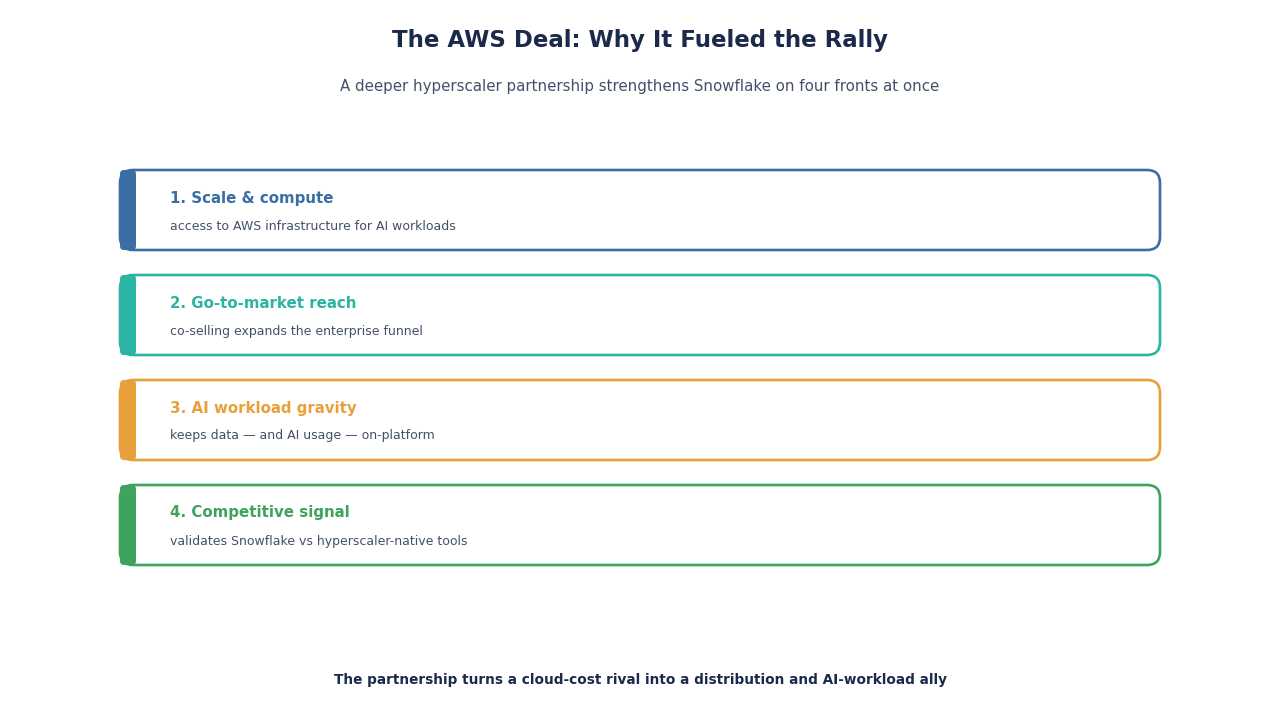
For investors, the AWS partnership matters for three reasons.
First, it reinforces Snowflake’s cloud-native foundation. Snowflake was built for the cloud, and AWS remains a major deployment environment for enterprise customers. A deeper partnership reduces concerns that Snowflake is becoming isolated in a hyperscaler-dominated AI market.
Second, the agreement supports AI workload scaling. Enterprise AI requires large amounts of compute, storage, and secure data access. By expanding its AWS relationship, Snowflake signals that it is preparing for heavier AI-driven demand.
Third, the partnership improves go-to-market leverage. AWS Marketplace and joint customer programs can help Snowflake reach enterprise buyers that already procure software and cloud services through AWS.
The AWS deal does not guarantee long-term upside by itself, but it makes Snowflake’s AI infrastructure story more credible.
For a stock that had faced skepticism earlier in the year, credibility mattered. Investors needed evidence that Snowflake’s AI narrative was more than marketing. A large AWS commitment helped provide that evidence.
Did Earnings Justify the Snowflake Stock Rally?
A 36% one-day move is large, so investors need to ask whether the numbers supported the reaction.
Snowflake’s reported quarter showed strength across several key indicators. Product revenue grew sharply, remaining performance obligations expanded, and the company raised full-year product revenue guidance. The customer base also continued to scale, including high-spending enterprise customers.
The most important signal was not just growth. It was the combination of growth and improved confidence in future demand.
The earnings checklist
Investors should evaluate Snowflake’s quarter using this framework:
- Revenue quality
Was growth driven by durable product consumption or temporary demand?
- Customer expansion
Are large customers spending more over time?
- AI monetization
Are AI features creating incremental usage, or are they mainly promotional?
- Margin discipline
Can Snowflake invest aggressively while improving operating leverage?
- Guidance credibility
Did management raise expectations conservatively or aggressively?
- Competitive positioning
Is Snowflake gaining relevance against hyperscalers and other data platforms?
A strong quarter can justify a rally, but only if it changes forward expectations. In Snowflake’s case, the market appeared to believe the quarter represented an AI-driven inflection point, not a one-time rebound.
How Should Investors Analyze Snowflake Stock After a 36% Move?
Is Snowflake stock still attractive after the AI Data Cloud rally?
The best way to analyze Snowflake stock after the rally is to separate business quality from stock price risk. A company can have improving fundamentals while its stock becomes less attractive in the short term because expectations have moved too far, too fast.
For SNOW, investors should examine three time horizons:
- Short term: Is the rally overextended technically?
- Medium term: Can guidance upgrades continue?
- Long term: Can Snowflake become a durable platform for enterprise AI?
A disciplined investor should avoid chasing the move purely because the stock is up. Instead, focus on whether the new valuation reflects realistic assumptions.
A practical post-rally framework
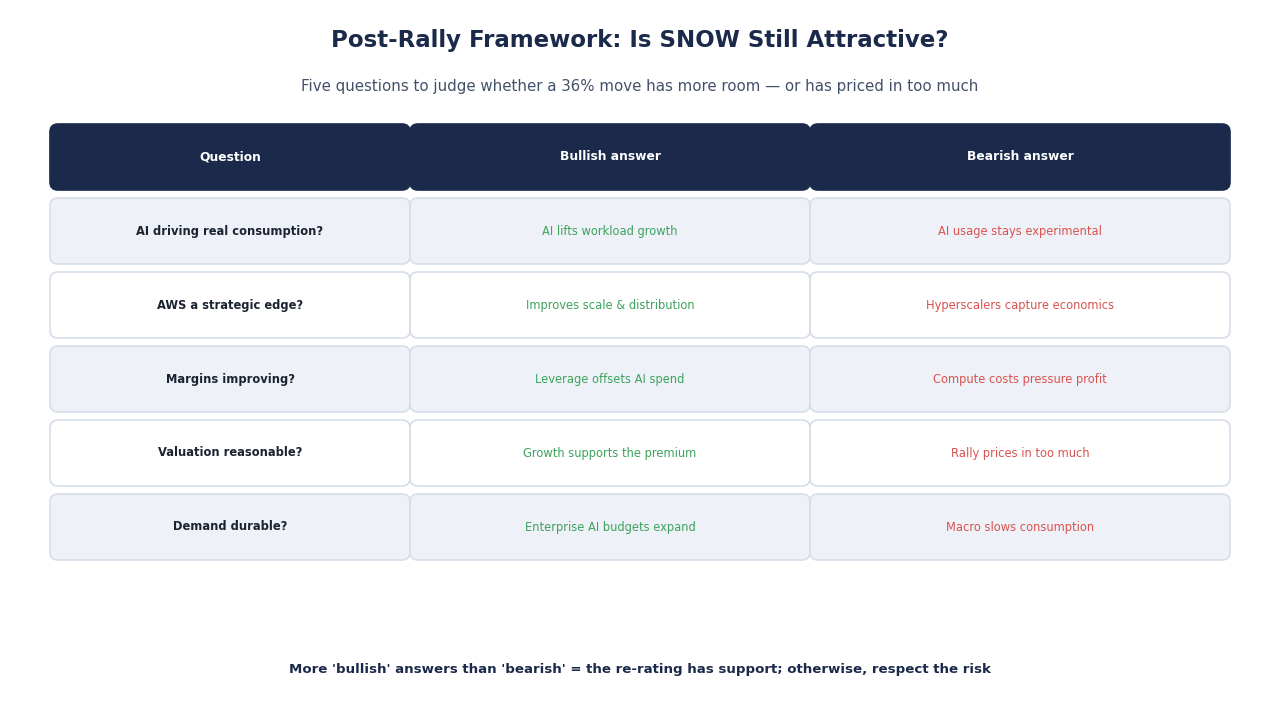
| Question | Bullish Answer | Bearish Answer |
|---|---|---|
| Is AI driving real consumption? | AI features increase workload growth | AI usage remains experimental |
| Is AWS a strategic advantage? | Partnership improves scale and distribution | Hyperscalers capture more economics |
| Are margins improving? | Operating leverage offsets AI investment | Compute costs pressure profitability |
| Is valuation reasonable? | Growth acceleration supports premium multiple | Rally prices in too much optimism |
| Is customer demand durable? | Enterprise AI budgets expand | Macro weakness slows consumption |
The key is not whether Snowflake is “good” or “bad.” The key is whether the stock’s new price properly balances upside catalysts against execution risk.
Snowflake, Natoma, and the Agentic Enterprise Thesis
Another important part of the rally was Snowflake’s plan to acquire Natoma, an enterprise Model Context Protocol platform for AI agents. This matters because the next phase of enterprise AI is not just chatbots. It is agents that can access tools, retrieve context, and take actions across business systems.
That creates opportunity and risk.
For Snowflake, Natoma supports a broader ambition: extending governance from data access to AI-driven actions. If enterprises want agents to operate across email, Slack, CRM systems, internal APIs, and databases, they need identity, permissions, policy controls, and auditability.
This is where Snowflake may find a differentiated role.
Instead of competing only as a database, Snowflake is trying to become a trusted governance layer for agentic AI. That could expand its addressable market beyond analytics and warehousing into AI workflow infrastructure.
However, investors should treat this as an emerging thesis, not a proven outcome. Acquisitions can take time to integrate, and enterprise AI agent adoption remains early.
How SimianX AI Helps Investors Research AI Stock Catalysts
Fast-moving AI stock rallies are difficult to evaluate manually. A headline may look bullish, but price action, valuation, sentiment, technical indicators, and risk signals can diverge. This is where SimianX AI can help investors structure the research process.
SimianX AI is designed for multi-agent market analysis, allowing different AI agents to examine a stock from multiple perspectives: fundamentals, technical indicators, news sentiment, decision logic, and risk management. For a stock like Snowflake, that type of workflow is useful because the investment case involves several moving parts.
For example, an investor researching SNOW after the AWS deal might ask:
- Is the earnings beat strong enough to justify the valuation reset?
- Did volume confirm the breakout?
- Are analysts revising estimates upward?
- Is the AI Data Cloud narrative supported by customer metrics?
- What are the downside risks if AI monetization disappoints?
A single headline rarely answers all of these questions. A structured research platform can help investors move from reaction to analysis.
Practical insight: Use AI tools not to replace judgment, but to organize evidence, compare scenarios, and identify risks you may have missed.
Bull Case for Snowflake Stock
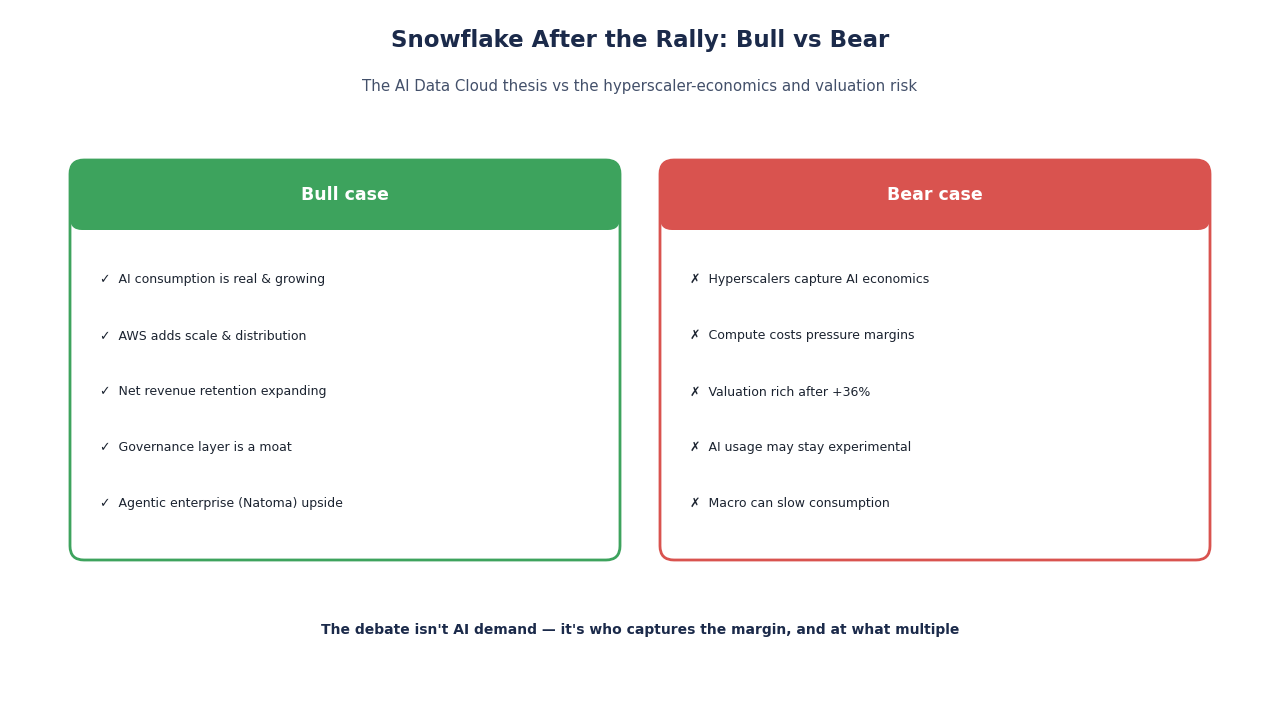
The bull case is that Snowflake becomes one of the most important infrastructure platforms for enterprise AI. Under this view, companies need governed data before they can deploy reliable AI applications. Snowflake already sits close to enterprise data, giving it a strong foundation.
The bullish thesis includes:
- AI workloads increase consumption across the Snowflake platform.
- Snowflake Intelligence and Cortex products gain adoption among enterprise accounts.
- AWS collaboration improves scale and distribution.
- Large customer expansion continues, supporting durable growth.
- Governance becomes a competitive advantage as AI agents enter production.
If Snowflake can execute on this thesis, the company may deserve to trade like a strategic AI infrastructure platform rather than a traditional cloud data warehouse vendor.
Bear Case for Snowflake Stock
The bear case is that the rally overstates how quickly AI can convert into durable revenue. Snowflake may be well positioned, but it still faces competition from hyperscalers, Databricks, legacy data vendors, and emerging AI-native infrastructure companies.
Important risks include:
- Valuation risk after a sharp rally
- Consumption-based revenue volatility
- Cloud infrastructure cost pressure
- Competition from AWS, Microsoft, Google, and Databricks
- Uncertain AI monetization timelines
- Integration risk from acquisitions like Natoma
Investors should also remember that a major stock move can pull forward future returns. Even if Snowflake’s business improves, the stock may need time to digest the rally.
Step-by-Step Research Process for SNOW Stock
Investors who want to analyze Snowflake after the rally can use this process:
- Review the latest earnings release
Focus on product revenue, guidance, RPO, customer growth, and margin metrics.
- Map the AI catalyst
Identify which AI products are being adopted and whether usage is tied to monetization.
- Evaluate the AWS partnership
Determine whether it improves distribution, compute efficiency, or enterprise credibility.
- Check technical confirmation
Look at volume, moving averages, gap levels, support, and resistance after the rally.
- Compare valuation to growth
Avoid treating revenue acceleration as automatically worth any price.
- Build scenarios
Model bullish, base, and bearish cases for revenue growth and margin expansion.
- Use multi-agent analysis tools
Platforms like SimianX AI can help compare technical, fundamental, sentiment, and risk viewpoints before making a decision.
This process creates a more balanced view than simply asking, “Is Snowflake stock a buy?”
FAQ About Snowflake Stock Soars 36%
Why did Snowflake stock soar 36% after earnings?
Snowflake stock soared because investors reacted positively to strong product revenue growth, improved guidance, AI adoption signals, and the expanded AWS partnership. The rally reflected a belief that Snowflake may benefit from enterprise AI spending instead of being disrupted by it.
What is the Snowflake AWS AI deal?
The Snowflake AWS AI deal is an expanded strategic collaboration centered on AI and data workloads. It includes a large multi-year infrastructure commitment and aims to help enterprise customers build AI applications on governed data more securely and efficiently.
Is Snowflake an AI stock now?
Snowflake is increasingly viewed as an AI infrastructure stock because its platform helps enterprises organize, govern, and activate data for AI workloads. However, investors should still evaluate it as a software and data platform company with consumption-based revenue dynamics.
How should investors analyze Snowflake stock after a big rally?
Investors should examine whether the rally is supported by durable revenue growth, improving AI monetization, customer expansion, margin leverage, and reasonable valuation. It is also important to compare the bull case with downside risks such as competition and execution challenges.
Can SimianX AI help research SNOW stock?
Yes. SimianX AI can help investors research SNOW by combining multi-agent analysis across fundamentals, technical indicators, news sentiment, and risk management. This can be useful when a stock is moving quickly after earnings or major AI partnership news.
Conclusion
The phrase “Snowflake stock soars 36%” captures the market reaction, but the deeper story is about Snowflake’s attempt to become a trusted platform for enterprise AI. Strong product revenue growth, higher guidance, AWS collaboration, AI product adoption, and the Natoma acquisition all support the idea that Snowflake is moving beyond traditional data warehousing.
Still, investors should stay disciplined. A 36% rally can signal a real thesis change, but it can also create valuation risk. The right approach is to evaluate Snowflake through fundamentals, AI adoption, technical momentum, competitive positioning, and downside scenarios.
For investors who want a structured way to analyze fast-moving AI stocks like SNOW, explore SimianX AI. SimianX AI helps turn market headlines into multi-agent research, giving you a clearer framework for understanding catalysts, risks, and potential next moves.
Related Reading
- Why Dell Stock Jumped 17% in 2026: The AI Server Breakout
- Micron (MU): Why HBM3e Makes It the 2026 AI Memory Play
- Hype Premium Decay: Why Hot Stocks Often Underperform
- Why MongoDB Stock Fell 18%: CEO to Meta, 7 Crashes Compared