
 By Muke
AutoZone and Zscaler Fall: Revenue Miss, Weak Guidance Explained
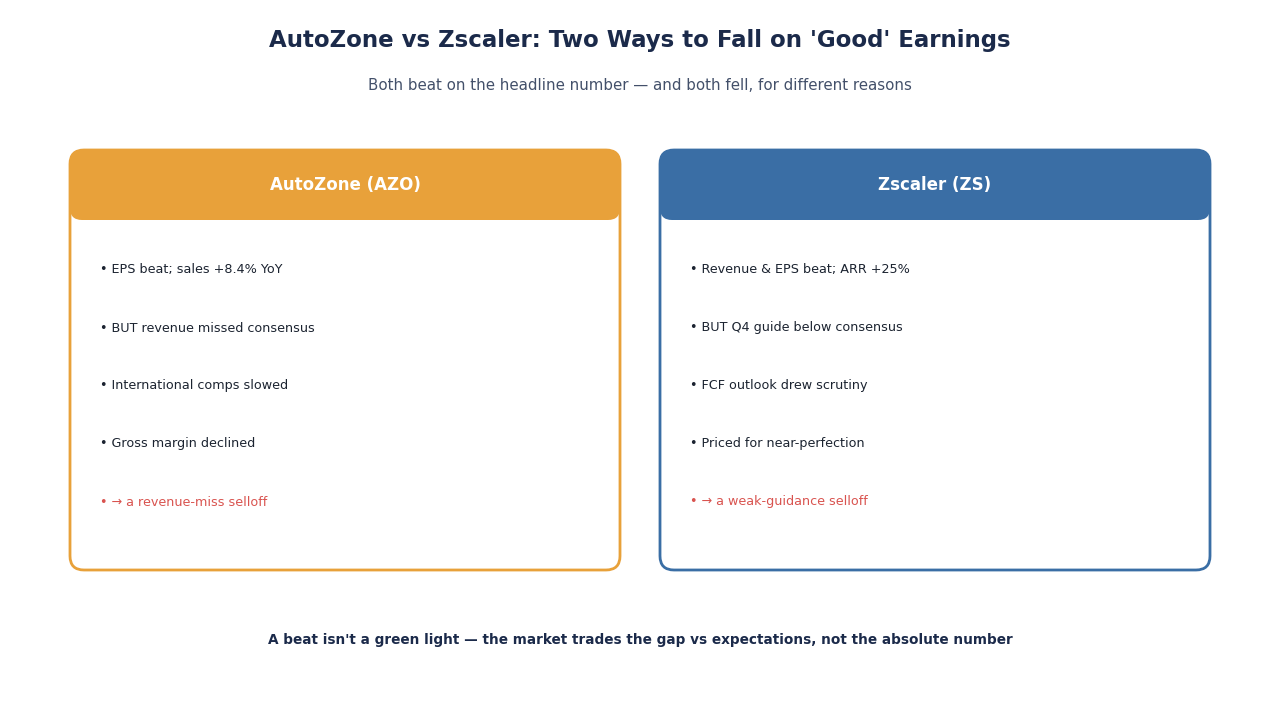
When AutoZone and Zscaler fall revenue miss weak guidance becomes the market’s headline, investors should avoid reducing the story to “bad earnings.” The better question is: which part of the earnings narrative changed expectations? AutoZone’s selloff followed an earnings beat but a slight revenue miss, margin pressure, and weaker international momentum. Zscaler’s drop came after strong reported growth but a near-term guidance setup that investors viewed as too cautious.
For investors using SimianX AI, this is exactly the kind of event where multi-angle research can separate a temporary overreaction from a deeper change in the earnings thesis. The goal is not simply to ask whether AZO or ZS fell. The goal is to understand why expectations changed, what the market may be pricing in next, and how to build a disciplined research framework after a post-earnings selloff.
This research article breaks down the AutoZone revenue miss and Zscaler weak guidance story, compares the key numbers, and gives investors a practical framework for analyzing earnings-driven stock declines. It is written for research and education, not personalized financial advice.
What Happened to AutoZone and Zscaler?
AutoZone and Zscaler both reported results that contained positive headline numbers, yet both stocks came under pressure because markets trade on expectations, not just backward-looking results.
AutoZone reported fiscal third-quarter net sales of about $4.84 billion, up 8.4% year over year. Diluted EPS came in at $38.07, compared with $35.36 a year earlier. Total company same-store sales rose 5.5% on a reported basis and 3.9% in constant currency. Domestic same-store sales rose 4.1%, while international same-store sales rose 1.6% in constant currency.
The issue was not that AutoZone’s business suddenly became weak. The issue was that revenue came in slightly below Wall Street expectations, international performance appeared softer than planned, and gross margin declined year over year. For a company with a reputation for steady execution, even a modest revenue miss can trigger a sharp reassessment.
Zscaler’s story was different. The cybersecurity company reported fiscal third-quarter revenue of $850.5 million, up 25% year over year. Annual recurring revenue, or ARR, also rose 25% to $3.525 billion. Non-GAAP EPS was $1.08, compared with $0.84 a year earlier.
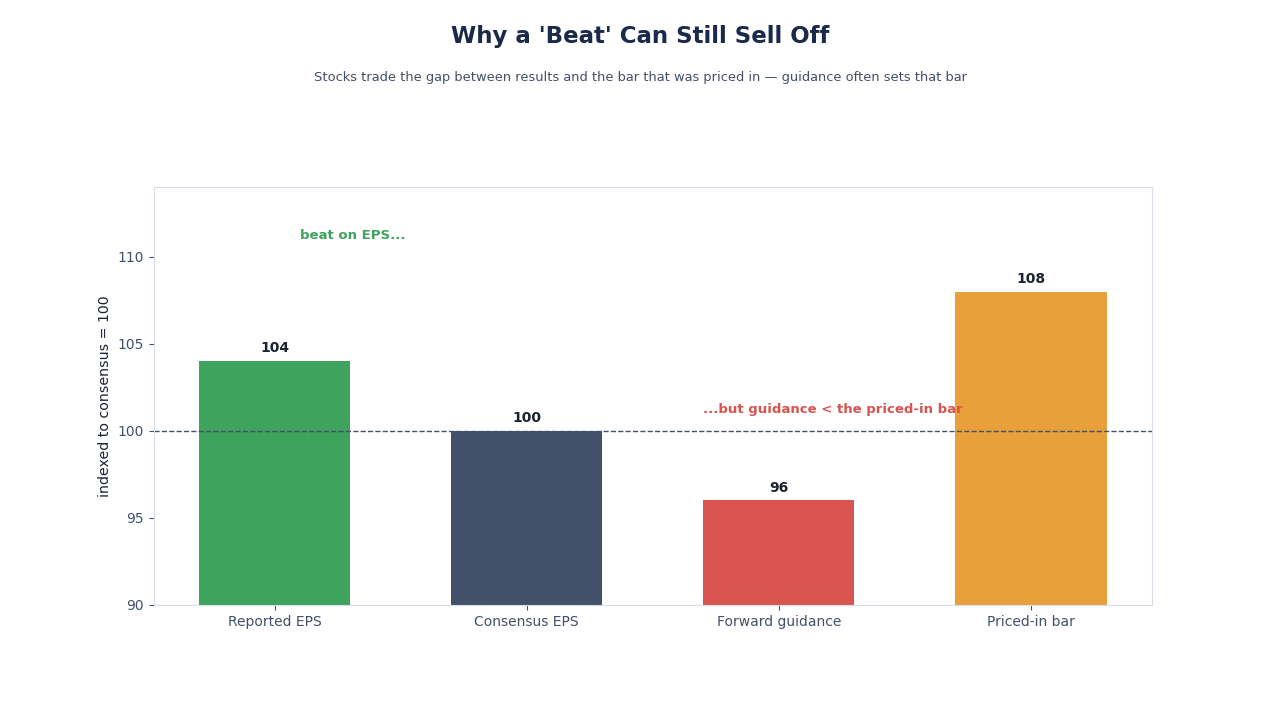
Yet Zscaler’s stock still fell because investors focused on the company’s fiscal fourth-quarter revenue guidance of $875 million to $878 million. That guidance implied continued growth, but it landed slightly below market expectations. For high-growth software stocks, even a small shortfall in forward guidance can matter more than a strong current quarter.
Key takeaway: A stock can fall after “good” earnings when the market expected better future momentum than management was willing to guide.
Quick Comparison: AutoZone Revenue Miss vs. Zscaler Weak Guidance
| Company | Ticker | Reported Result | Investor Concern | Market Interpretation |
|---|---|---|---|---|
| AutoZone | AZO | EPS beat, sales up 8.4% YoY | Revenue slightly missed consensus; international constant-currency comps slowed | Retail growth quality questioned |
| Zscaler | ZS | Revenue and EPS beat; ARR up 25% | Q4 revenue guidance slightly below consensus; free cash flow expectations drew attention | Growth durability questioned |
| Main risk lens | — | Earnings quality | Forward expectations | Valuation sensitivity |
The comparison matters because AutoZone and Zscaler did not fall for the same reason. AutoZone’s problem was more about current-quarter sales quality, margin pressure, and international growth. Zscaler’s problem was more about future growth expectations, cash flow trajectory, and software valuation sensitivity.
Why Did AutoZone Fall After a Revenue Miss?
AutoZone’s headline EPS number looked strong. The company grew sales, increased operating profit, and continued its long-running share repurchase program. On the surface, that does not look like a disastrous quarter.
But markets often punish quality companies when results are merely “good” instead of “excellent.” AutoZone has historically been viewed as a high-quality retailer with strong execution, steady demand, commercial sales momentum, and disciplined capital allocation. That means expectations can be high before earnings.
The selloff reflected several investor concerns:
- Revenue missed expectations, even though sales grew year over year.
- Gross margin declined, partly due to a non-cash LIFO impact.
- Inventory increased faster than sales, raising questions about working capital and demand planning.
- International constant-currency same-store sales slowed, especially in Mexico and Brazil.
- The stock’s premium reputation left less room for disappointment.
AutoZone also opened 82 new stores during the quarter, including stores in the U.S., Mexico, and Brazil. Store growth supports the long-term expansion case, but investors still need to ask whether new-store growth is translating into high-quality same-store sales momentum.
Why Did the Market Punish AutoZone Despite EPS Growth?
The short answer: earnings quality mattered more than EPS alone.
A company can beat EPS through operating discipline, cost control, pricing, or share repurchases. Those are useful, but investors also want to see strong demand. If revenue misses expectations, the market may worry that earnings growth is less durable than it appears.
For AutoZone, the market likely focused on three questions:
- Is domestic demand strong enough to offset international softness?
- Can gross margin stabilize if inventory, inflation, or LIFO pressure remains elevated?
- Does the valuation still make sense if revenue growth is less impressive than expected?
A practical AutoZone earnings checklist should include:
- Compare revenue against consensus, not just last year.
- Separate domestic sales from international sales.
- Track commercial sales growth versus DIY traffic.
- Watch gross margin and LIFO impacts.
- Review inventory growth relative to sales growth.
- Compare store expansion with same-store sales quality.
- Monitor management commentary on Mexico and Brazil.
Bold research rule: For high-quality compounders, small disappointments can cause large stock reactions when the market is priced for consistency.
Why Did Zscaler Fall on Weak Guidance?
Zscaler’s reported quarter was strong on the surface. Revenue grew 25%, ARR grew 25%, and non-GAAP operating margin reached a record level. The company also positioned itself around AI-era cybersecurity, Zero Trust SASE, and enterprise protection against risks created by frontier models and compromised AI agents.
So why did ZS fall?
Because high-growth cybersecurity stocks are priced on future growth slope. Investors care about current revenue, but they care even more about what current results imply for the next four to eight quarters. If guidance suggests growth may slow more than expected, the market can quickly reprice the stock.
Zscaler guided fiscal Q4 revenue to $875 million to $878 million, implying roughly 22% growth. That is still a strong growth rate in absolute terms, but it was slightly below what investors expected. In growth software, the difference between “strong” and “strong enough” can be meaningful.
What Does Weak Guidance Mean for Zscaler Stock?
Weak guidance does not always mean the business is deteriorating. It can mean management is being conservative, demand is becoming harder to forecast, costs are rising, or the stock valuation had already priced in a more aggressive outlook.
For Zscaler, investors should monitor:
- ARR growth and net new ARR.
- Q4 revenue versus the $875 million to $878 million guide.
- Free cash flow margin recovery.
- Large enterprise deal activity.
- AI security product monetization.
- Competitive pressure from Palo Alto Networks, Microsoft, Google-related security assets, and other platforms.
- Sales execution following any leadership or go-to-market changes.
Zscaler’s long-term AI security narrative remains compelling, but the stock’s reaction shows that investors want proof that AI-related demand can convert into durable revenue growth and cash flow.
How to Analyze AutoZone and Zscaler Fall Revenue Miss Weak Guidance Events
A strong research process should separate price reaction, fundamental change, and valuation reset. When a stock falls after earnings, the first move is often emotional. The second move depends on whether analysts revise revenue, margins, growth assumptions, or valuation multiples.
The goal is not to predict every post-earnings move. The goal is to understand what changed in the market’s model.
Here is a practical framework investors can use.
1. Identify the True Source of the Selloff
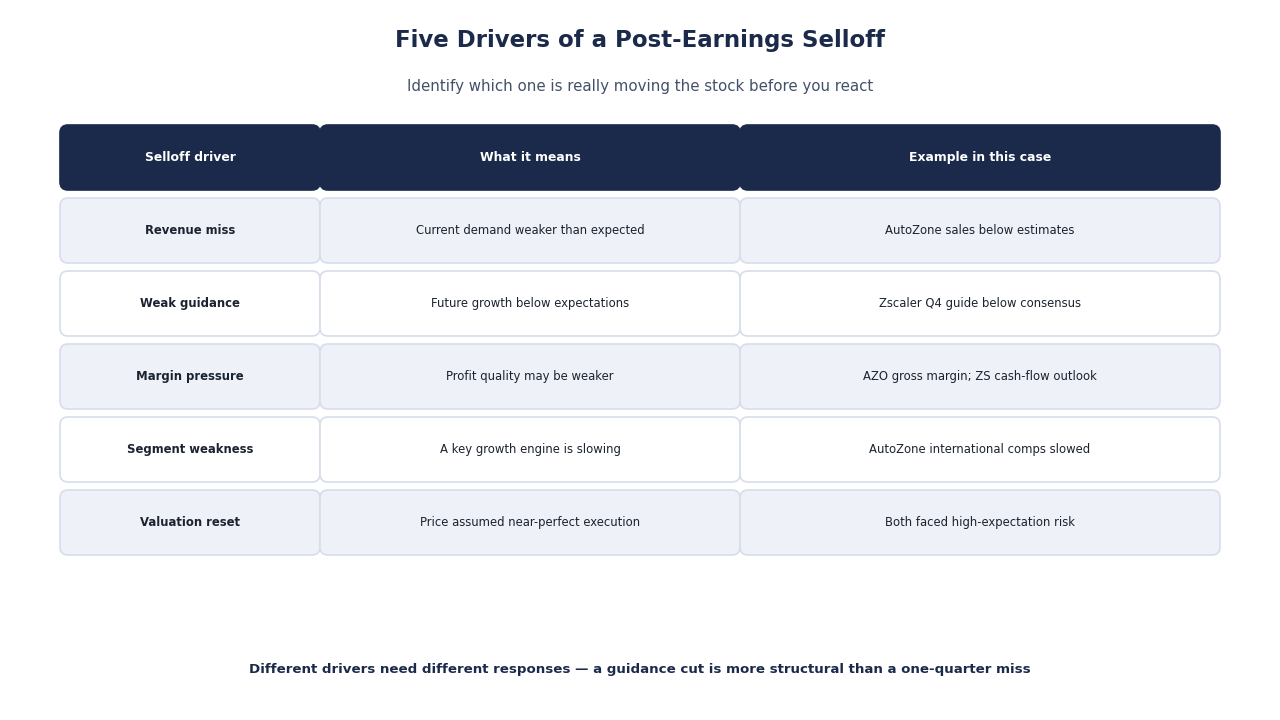
Not every earnings selloff is caused by a bad quarter. Sometimes the selloff is caused by guidance. Sometimes it is caused by valuation. Sometimes it is caused by a single weak segment that changes the market’s view of future growth.
| Selloff Driver | What It Means | Example in This Case |
|---|---|---|
| Revenue miss | Current demand was weaker than expected | AutoZone revenue came in slightly below estimates |
| Weak guidance | Future growth is below expectations | Zscaler Q4 revenue guide was below consensus |
| Margin pressure | Profit quality may be weaker | AutoZone gross margin declined; Zscaler cash flow outlook drew attention |
| Segment weakness | A key growth engine is slowing | AutoZone international comps slowed |
| Valuation reset | Stock price assumed near-perfect execution | Both names faced high expectation risk |
2. Compare Reported Growth With Expected Growth
Year-over-year growth is useful, but consensus expectations drive stock reactions.
AutoZone’s sales grew, but investors expected slightly more. Zscaler’s revenue beat, but investors wanted stronger forward guidance. That distinction is critical.
Research question: Did the company underperform its own history, Wall Street expectations, or investor imagination?
3. Check Whether the Problem Is Temporary or Structural
A temporary issue might include weather, timing, currency, one-time expenses, or conservative guidance. A structural issue could include slowing demand, competitive pressure, margin erosion, weak unit economics, or weaker customer expansion.
For AutoZone, watch whether international constant-currency comps recover. For Zscaler, watch whether ARR growth and free cash flow margins stabilize.
4. Use AI Tools to Speed Up Earnings Review
This is where SimianX AI can be especially useful. SimianX is designed as a multi-agent AI stock and crypto analysis platform. Its agents can work across fundamentals, technical analysis, news sentiment, risk, market trends, earnings, options, and timing. Instead of relying on a single generic answer, investors can use a multi-agent workflow to compare bull cases, bear cases, risk signals, and market reaction.
For an earnings event like AutoZone and Zscaler, an investor could use SimianX AI to:
- Summarize the earnings release.
- Compare reported numbers with expectations.
- Detect sentiment changes in analyst coverage.
- Review technical support and resistance after the gap down.
- Generate a risk-focused post-earnings report.
- Ask follow-up questions by ticker, such as
AZOorZS. - Compare the company’s guidance with historical growth trends.
Investor Read-Through: What the Selloffs Reveal
The AutoZone and Zscaler fall revenue miss weak guidance story reveals a broader market pattern: investors are rewarding companies that beat expectations and raise confidence in future growth. A good quarter is no longer enough if the outlook does not support the valuation.
For AutoZone Investors
The bullish case remains tied to:
- Strong domestic commercial demand.
- Store expansion.
- Share repurchases.
- Pricing power in auto parts.
- Long-term aftermarket resilience.
- Scale advantages in distribution and inventory availability.
The bearish case focuses on:
- Slower international growth.
- Margin pressure.
- Inventory growth.
- DIY traffic softness.
- A premium valuation that leaves less room for disappointment.
AutoZone’s long-term story is not necessarily broken by one revenue miss. But investors should watch whether international softness persists and whether the company can keep growing earnings without relying too heavily on pricing or buybacks.
For Zscaler Investors
The bullish case remains tied to:
- Cybersecurity demand.
- Zero Trust adoption.
- AI security needs.
- ARR growth.
- Operating margin expansion.
- Enterprise platform consolidation.
- Potential upside from AI-native security use cases.
The bearish case focuses on:
- Guidance sensitivity.
- Free cash flow margin pressure.
- AI monetization timing.
- Competitive intensity.
- High-growth software valuation risk.
- The possibility that revenue growth slows faster than expected.
Zscaler still has a strong strategic narrative, but the market is asking whether that narrative can support the current valuation if guidance becomes more cautious.
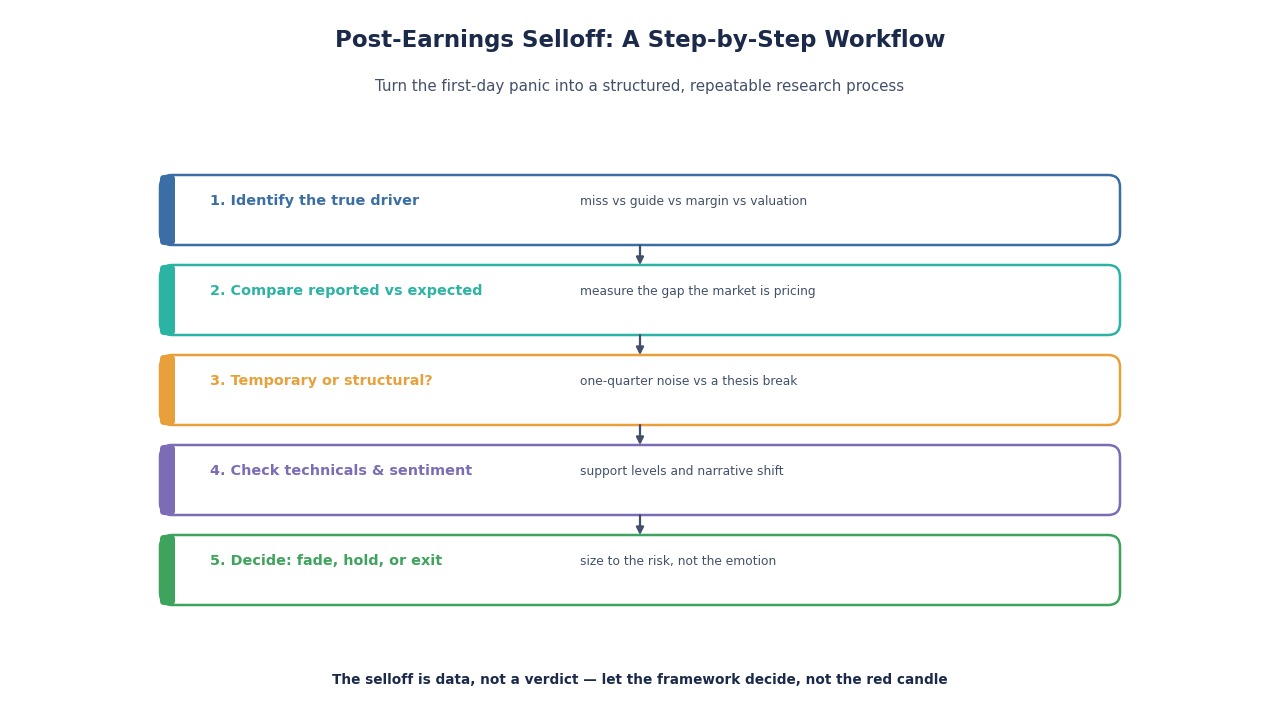
A Step-by-Step Research Workflow for Post-Earnings Selloffs
Use this numbered workflow after any major earnings-driven decline.
- Read the official release first. Start with company-reported revenue, EPS, margins, guidance, and management commentary.
- Compare against consensus. A beat or miss only matters relative to expectations.
- Separate current results from guidance. AutoZone’s issue was more current-quarter revenue quality; Zscaler’s issue was more forward guidance.
- Identify the segment that changed the story. International comps mattered for AutoZone; ARR and free cash flow mattered for Zscaler.
- Check valuation sensitivity. Expensive stocks can fall sharply on small expectation changes.
- Review price action after the first reaction. The first selloff may be emotional; the next few sessions often show institutional conviction.
- Document the thesis. Use a tool like SimianX AI to turn scattered data into a structured research report.
Bold research rule: The bigger the valuation premium, the smaller the earnings disappointment needed to trigger a selloff.
How Can Investors Use SimianX AI for Earnings Selloff Research?
Investors can use SimianX AI to create a more structured workflow around post-earnings volatility. Instead of reading one headline and reacting emotionally, the investor can ask different AI agents to examine different dimensions of the selloff.
For example:
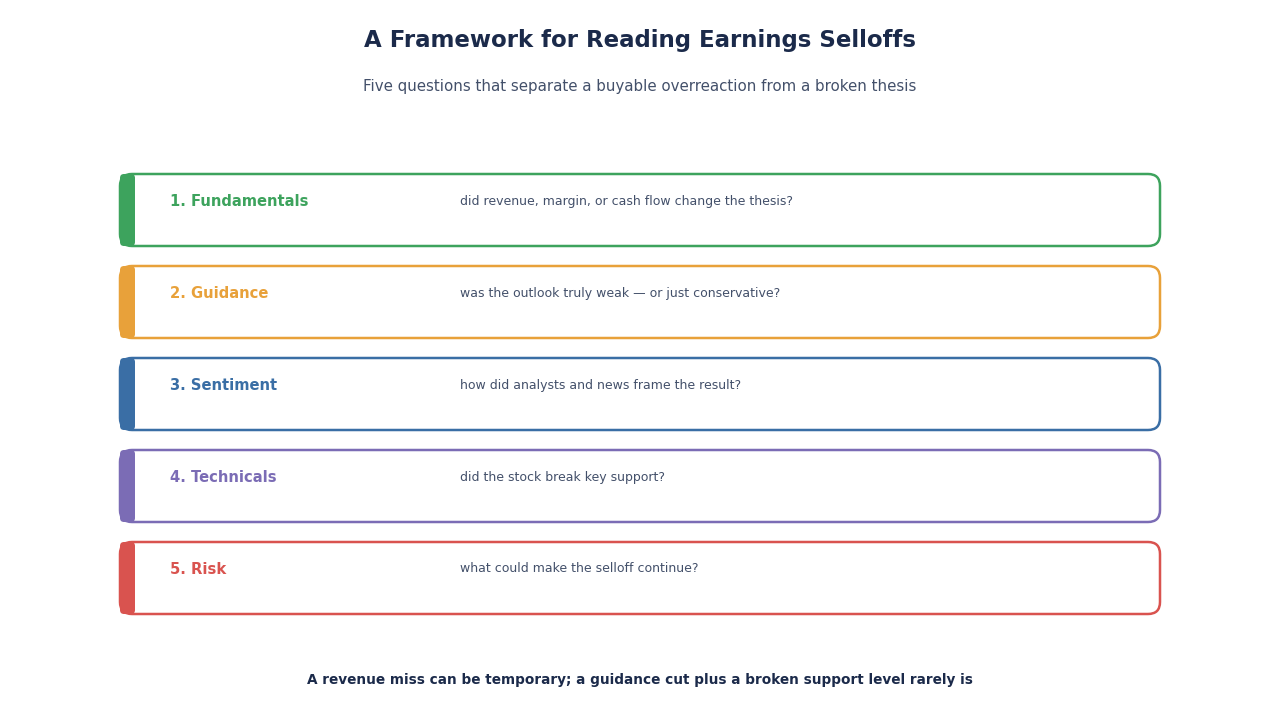
| Research Area | Question to Ask | Why It Matters |
|---|---|---|
| Fundamentals | Did revenue, margin, or cash flow change the thesis? | Shows whether the business outlook changed |
| Guidance | Was the outlook below consensus or just conservative? | Explains the stock reaction |
| Sentiment | How did analysts and news coverage frame the result? | Captures market narrative |
| Technicals | Did the stock break key support? | Helps assess timing and risk |
| Risk | What could make the selloff continue? | Prevents one-sided thinking |
A useful prompt for SimianX AI might be:
Analyze AZO after its Q3 2026 earnings selloff. Compare revenue, EPS, same-store sales, margin, inventory, and international growth. Build bull, bear, and base cases.
Another useful prompt might be:
Analyze ZS after its Q3 2026 earnings and weak Q4 guidance. Focus on ARR growth, free cash flow, AI security demand, valuation risk, and competitive pressure.
This kind of structured research is especially important when two stocks fall for different reasons. AutoZone is a retail execution and margin story. Zscaler is a growth software and guidance story. Treating both selloffs the same would miss the most important details.
FAQ About AutoZone and Zscaler Fall Revenue Miss Weak Guidance
Why did AutoZone stock fall after earnings?
AutoZone stock fell because investors focused on a slight revenue miss, weaker international constant-currency same-store sales, margin pressure, and inventory growth. The company still reported EPS growth and higher sales, but the market expected cleaner execution from a premium retail compounder.
Why did Zscaler stock fall despite beating revenue estimates?
Zscaler fell because its fiscal Q4 revenue guidance was slightly below consensus and investors reacted to the forward growth setup. For high-growth cybersecurity stocks, guidance and future cash flow expectations can matter more than a strong backward-looking quarter.
What does weak guidance mean for investors?
Weak guidance means management’s near-term forecast is below what investors or analysts expected. It does not automatically mean the company is broken, but it can signal slowing growth, conservative assumptions, rising costs, or tougher market conditions.
Is a revenue miss always bad for a stock?
A revenue miss is not always bad if margins, cash flow, and guidance are strong. However, when a stock trades at a premium valuation, even a small revenue miss can trigger a sharp reaction because investors were pricing in near-perfect execution.
How can AI help analyze earnings selloffs?
AI can quickly compare earnings releases, consensus estimates, guidance, sentiment, and technical indicators. SimianX AI is designed for this type of multi-agent stock research by combining fundamentals, technicals, news sentiment, risk analysis, and professional reporting in one workflow.
Conclusion
The AutoZone and Zscaler fall revenue miss weak guidance headline is really a lesson in expectations. AutoZone showed that an EPS beat can be overshadowed by a revenue miss, international softness, margin pressure, and inventory questions. Zscaler showed that strong growth can still disappoint when guidance and future cash flow expectations fall short of what investors priced in.
For serious investors, the right response is not panic. It is structured research: identify what changed, compare reported numbers with expectations, assess whether the issue is temporary or structural, and document the risk-reward setup. To move faster and reduce blind spots, explore SimianX AI and use its multi-agent stock analysis workflow to research earnings shocks like AZO and ZS with more discipline.
Related Reading
- Walmart & Target 2026: Decoding US Consumer Stress Signals
- AI Stocks Pull Back: OpenAI Doubts Hit Big-Tech Earnings
- Why Dell Stock Jumped 17% in 2026: The AI Server Breakout