
AI Stocks Pull Back as OpenAI Growth Concerns Hit Big Tech Earnings Week
The recent AI stocks pull back as OpenAI growth concerns hit big tech earnings week has sparked a major shift in market sentiment. After months of relentless upside driven by artificial intelligence enthusiasm, investors are now questioning whether AI growth — particularly tied to OpenAI and its ecosystem — can sustain current valuations.
This shift is not just about one company. It reflects a broader recalibration across Big Tech, semiconductors, and cloud infrastructure providers. Platforms like SimianX AI are becoming increasingly critical in helping investors interpret these complex, multi-layered signals in real time.
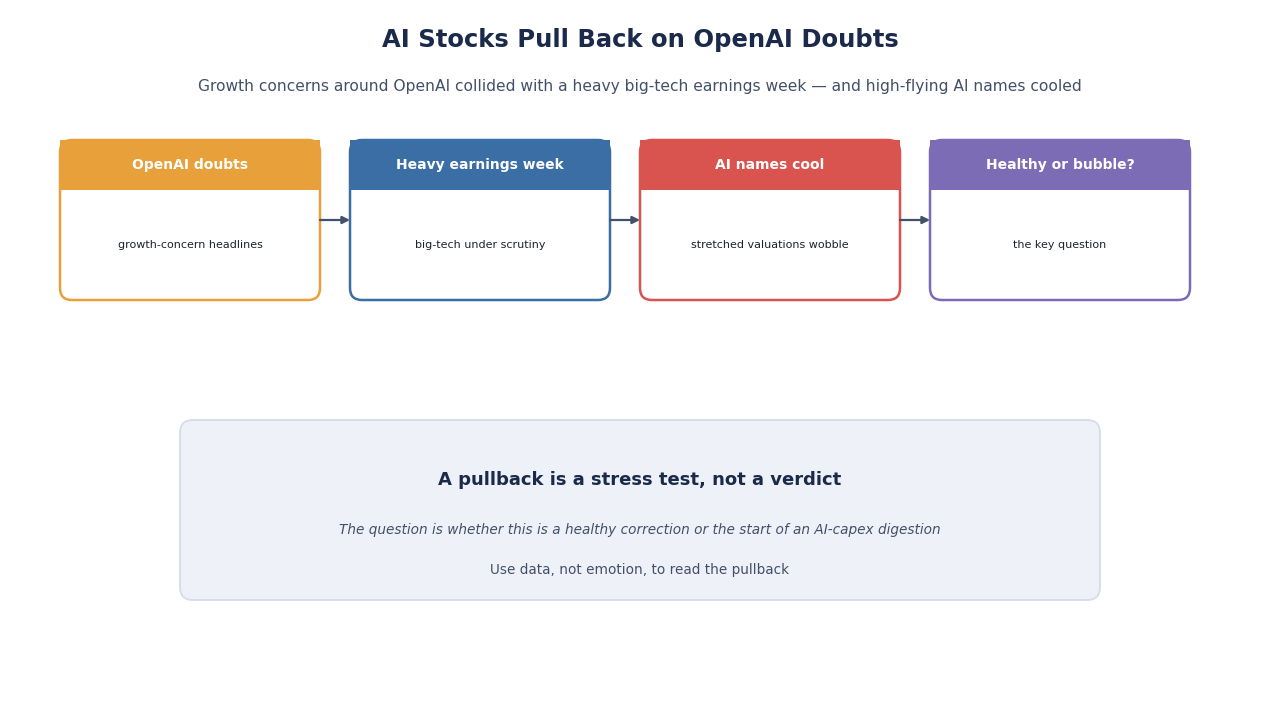
Why Are AI Stocks Pulling Back Right Now?
The pullback in AI stocks is being driven by a combination of fundamental concerns and positioning risks. At the center of the narrative is the growing uncertainty around OpenAI’s growth trajectory.
Markets don’t just price growth — they price accelerating growth. Any slowdown triggers outsized reactions.
Key Drivers Behind the Selloff
1. OpenAI Growth Concerns
- Reports suggest slower-than-expected user growth and monetization
- Questions around enterprise adoption pace
- Concerns about long-term ROI on massive AI investments
2. AI Capex Sustainability
- Big Tech companies like
Microsoft,Google, andAmazonhave committed billions to AI infrastructure - Investors are now asking: When do these investments pay off?
3. Semiconductor Overextension
- Stocks like
Nvidia,AMD, andBroadcomhad priced in near-perfect demand scenarios - Any hint of demand normalization leads to sharp corrections
4. Earnings Week Volatility
- With major tech earnings releases, expectations are extremely high
- Even strong results may not be enough if guidance disappoints
- Rising uncertainty in AI revenue visibility
- Increasing scrutiny on data center spending
- Short-term profit-taking after a strong rally
- AI stocks were heavily crowded trades
- Hedge funds reducing exposure into earnings
- Market rotating into defensive sectors
| Factor | Market Impact |
|---|---|
| OpenAI slowdown fears | Weakens AI narrative |
| High valuations | Amplifies downside risk |
| Earnings expectations | Raises volatility |
| Capital expenditure | Pressures margins |
The OpenAI Effect: Why It Matters for the Entire AI Ecosystem
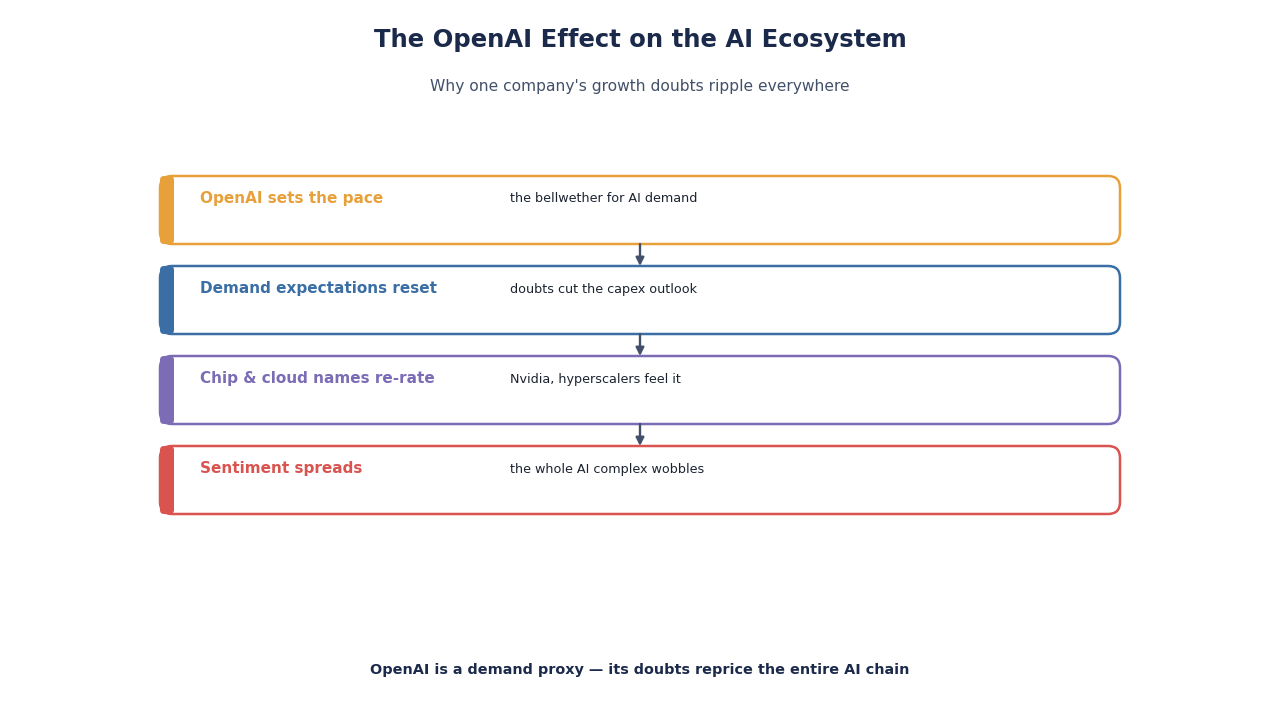
OpenAI is not just another AI company — it sits at the center of the AI value chain.
Its growth directly influences:
- Cloud providers (
Microsoft Azure) - Chipmakers (
Nvidia GPUs) - Data infrastructure companies
- AI application startups
Transmission Mechanism of Risk
When OpenAI growth concerns emerge:
- Cloud demand expectations soften
- GPU demand forecasts get revised
- AI startup funding sentiment weakens
This creates a chain reaction across the entire market.
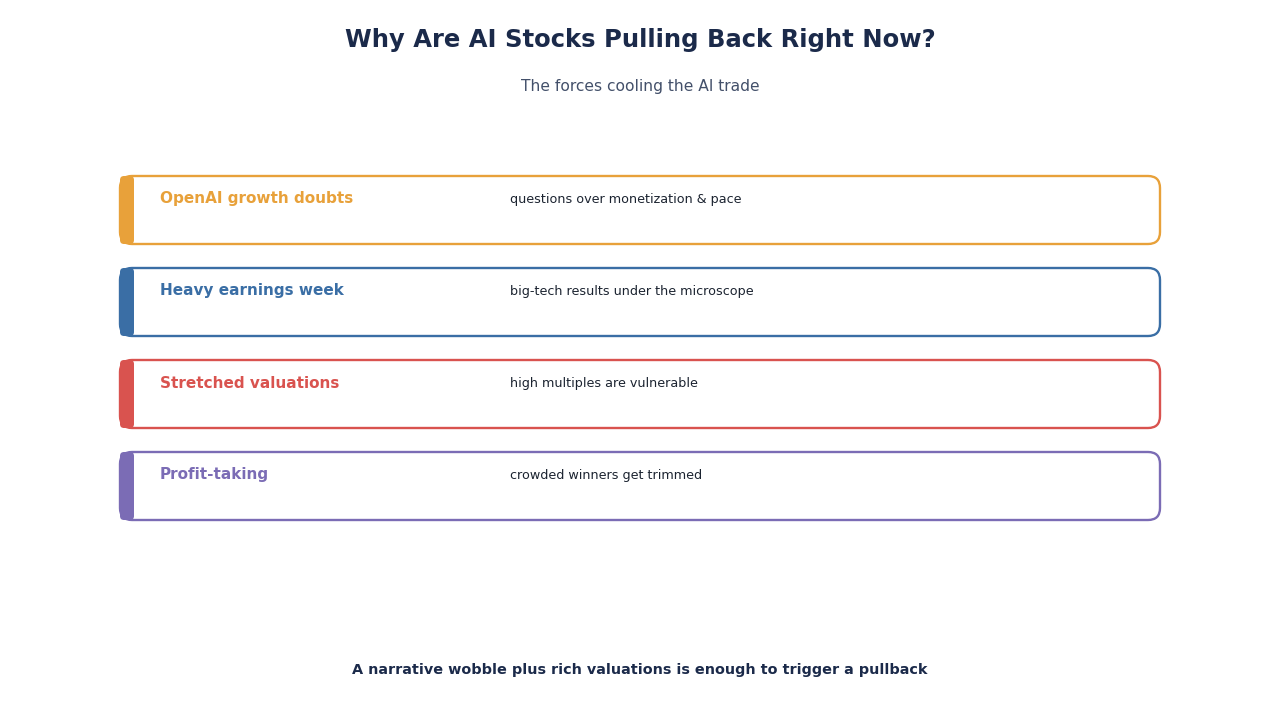
How Big Tech Earnings Are Amplifying the Impact
Earnings season acts as a reality check for AI narratives.
Key Questions Investors Are Asking:
- Are AI investments translating into revenue yet?
- How fast is enterprise adoption scaling?
- Are margins being compressed by AI spending?
Important Insight:
AI is shifting from a story-driven trade to a data-driven trade.
This transition is often where volatility spikes.
How to Analyze AI Stock Pullbacks Using Data (Not Emotion)
This is where tools like SimianX AI become critical.
Instead of reacting to headlines, professional investors rely on multi-agent AI systems to interpret:
- Technical indicators (trend strength, RSI, MACD)
- Market sentiment (news + flows)
- Fundamental signals (earnings revisions, capex trends)
- Risk scenarios (liquidity + macro conditions)
Example Framework Using SimianX AI
| AI Agent | Function |
|---|---|
| Indicator Agent | Tracks price momentum and trend shifts |
| Intelligence Agent | Analyzes news sentiment and abnormal flows |
| Fundamental Agent | Evaluates long-term valuation signals |
| Decision Agent | Combines all inputs into actionable insights |
Step-by-Step Approach
- Identify whether the pullback is technical or fundamental
- Monitor AI-related earnings guidance
- Track capital expenditure trends
- Evaluate market positioning (crowded trades)
- Use AI-driven tools to validate signals
Key Benefit:
SimianX AI helps filter noise and identify whether this is a correction — or the start of a deeper trend reversal.
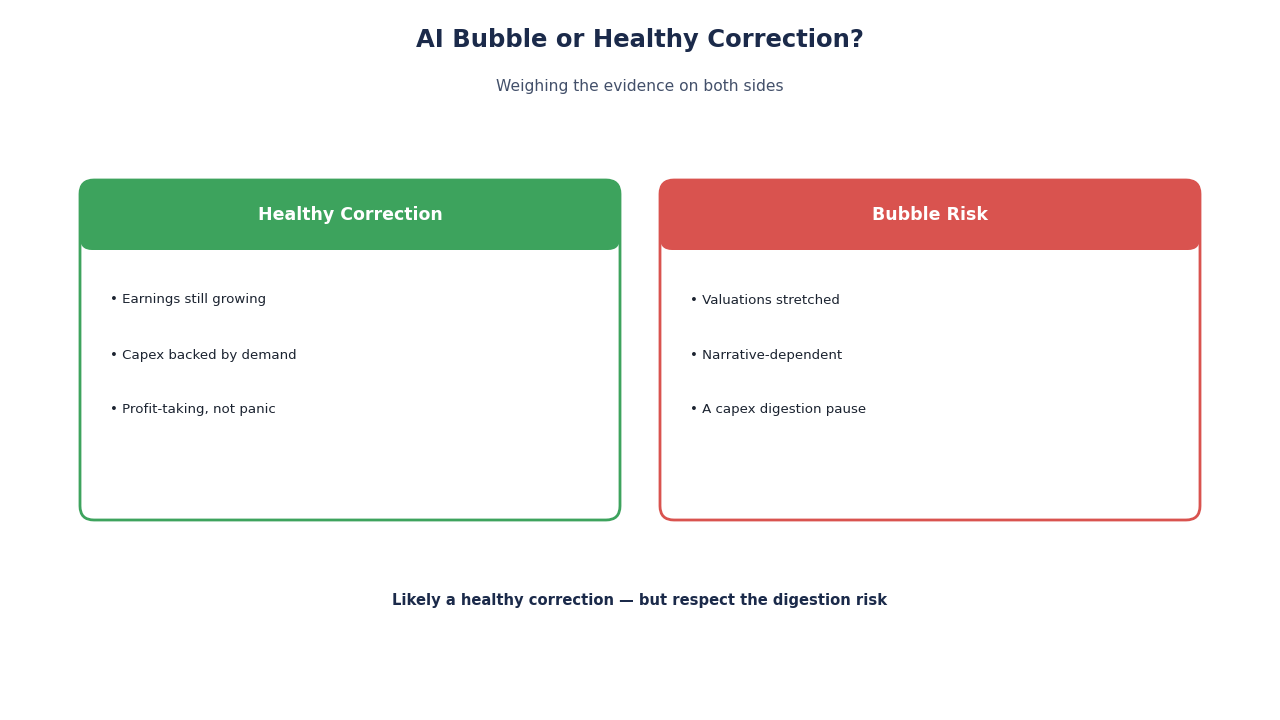
Is This an AI Bubble or a Healthy Correction?
This is the central debate.
Bull Case
- AI adoption is still in early innings
- Enterprise demand continues to grow
- Infrastructure buildout is a long-term trend
Bear Case
- Valuations are ahead of fundamentals
- Monetization timelines remain unclear
- Overinvestment risk in AI infrastructure
Reality: A Hybrid Scenario
The most likely outcome is:
- Short-term correction
- Long-term structural growth
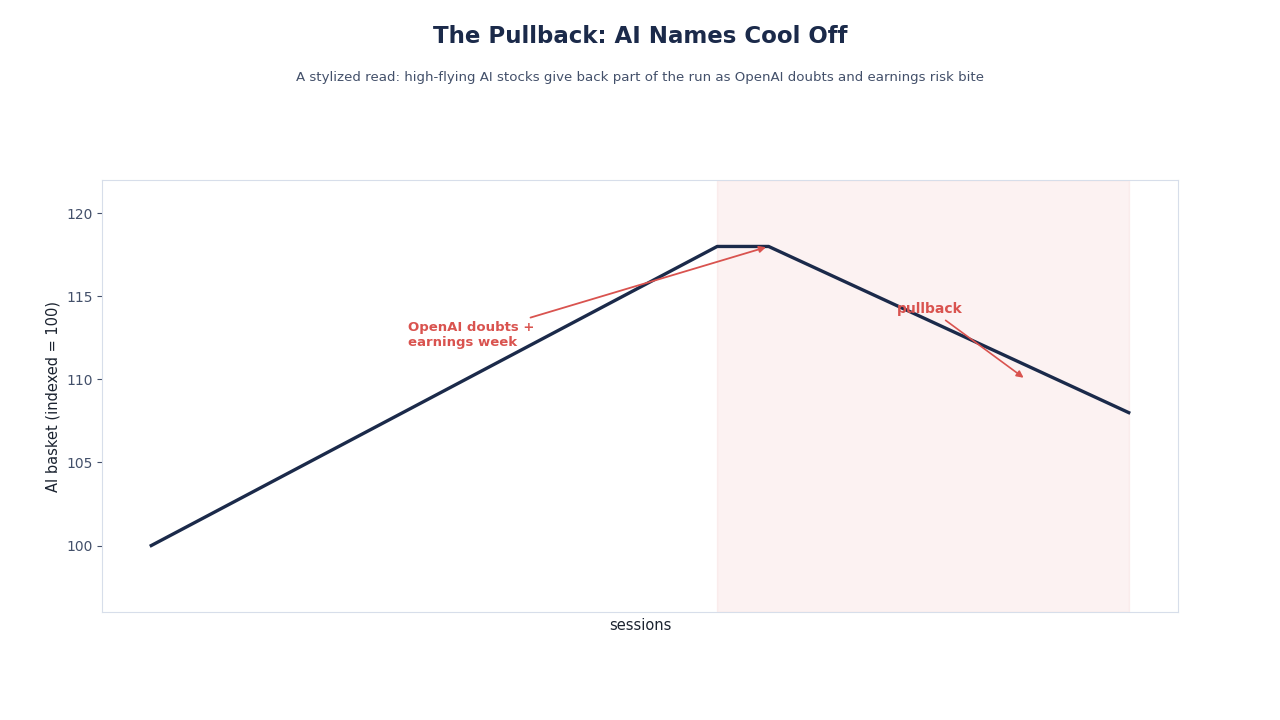
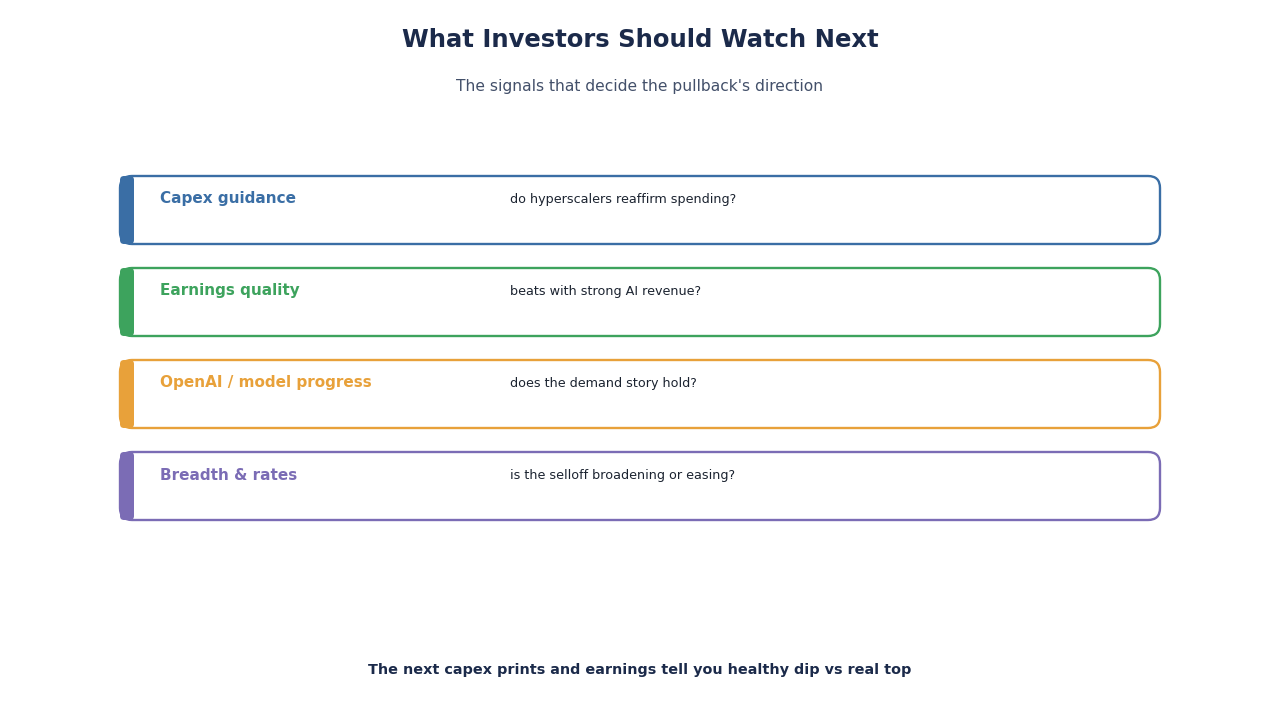
What Should Investors Watch Next?
To understand whether the pullback will deepen, focus on:
1. Big Tech Earnings Guidance
- Especially AI-related revenue segments
2. OpenAI Growth Metrics
- User growth
- Enterprise contracts
- API usage trends
3. Semiconductor Demand Signals
- GPU order backlog
- Data center expansion
4. Market Liquidity Conditions
- Interest rates
- Credit spreads
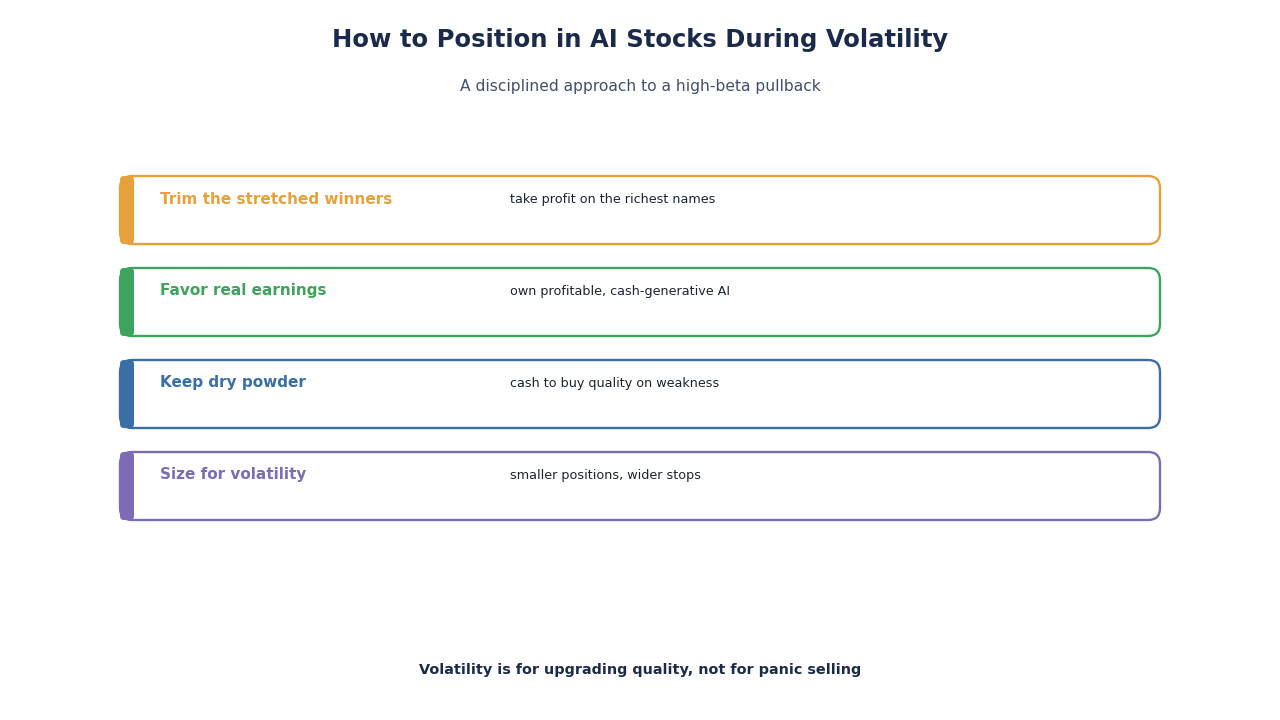
How to Position in AI Stocks During Volatility
Strategic Approaches
- Wait for confirmation instead of catching falling knives
- Focus on companies with real revenue exposure to AI
- Avoid over-leveraged speculative plays
Tactical Checklist
- Is the trend still intact on higher timeframes?
- Are fundamentals deteriorating or just expectations?
- Is the selloff driven by positioning or real data?
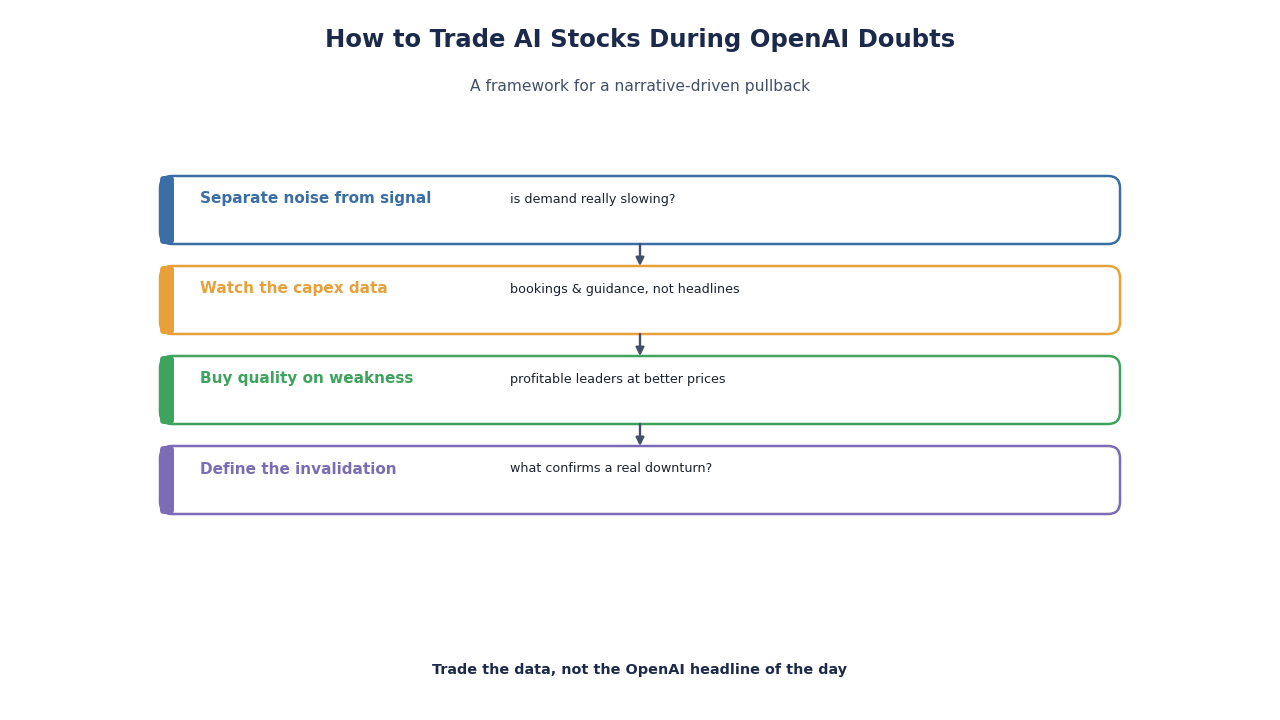
How Can You Trade AI Stocks During OpenAI Growth Concerns?
This is where decision frameworks outperform intuition.
Using platforms like SimianX AI, traders can:
- Switch between short-term (1m–15m) and long-term (1D) AI signals
- Evaluate risk levels and invalidation points
- Compare model performance via AI Leaderboard metrics
Practical Example
- If AI sentiment weakens but long-term trend holds → buy-the-dip strategy
- If both sentiment and fundamentals weaken → trend reversal risk
FAQ About AI Stocks Pull Back OpenAI Growth Concerns
Why are AI stocks falling during big tech earnings week?
AI stocks are falling due to a mix of high expectations, OpenAI growth concerns, and uncertainty around AI monetization. Earnings season amplifies these concerns as companies must justify massive AI investments.
Is the AI stock pullback a buying opportunity?
It depends on the cause. If the pullback is driven by short-term positioning, it may be a buying opportunity. If driven by fundamental weakness, further downside is possible.
How does OpenAI impact Nvidia and other chip stocks?
OpenAI drives demand for GPU infrastructure, which directly benefits companies like Nvidia. Slower OpenAI growth can lead to revised demand expectations, impacting semiconductor stocks.
What is the best way to analyze AI stock volatility?
The best approach is using multi-factor analysis, including technical, fundamental, and sentiment data — ideally through platforms like SimianX AI.
Are AI investments still a long-term trend?
Yes. Despite short-term volatility, AI remains a structural growth theme, driven by enterprise adoption and technological advancement.
Conclusion
The current environment where AI stocks pull back as OpenAI growth concerns hit big tech earnings week represents a critical turning point. Markets are shifting from hype-driven momentum to fundamental validation.
For investors, this is not just a risk — it’s an opportunity to upgrade decision-making frameworks.
By leveraging tools like SimianX AI, you can:
- Cut through market noise
- Analyze real-time multi-dimensional signals
- Make disciplined, data-driven decisions
In a market defined by uncertainty, the edge belongs to those who can interpret complexity — not react to headlines.
Deep Dive: AI Capital Expenditure Cycle and Market Fragility
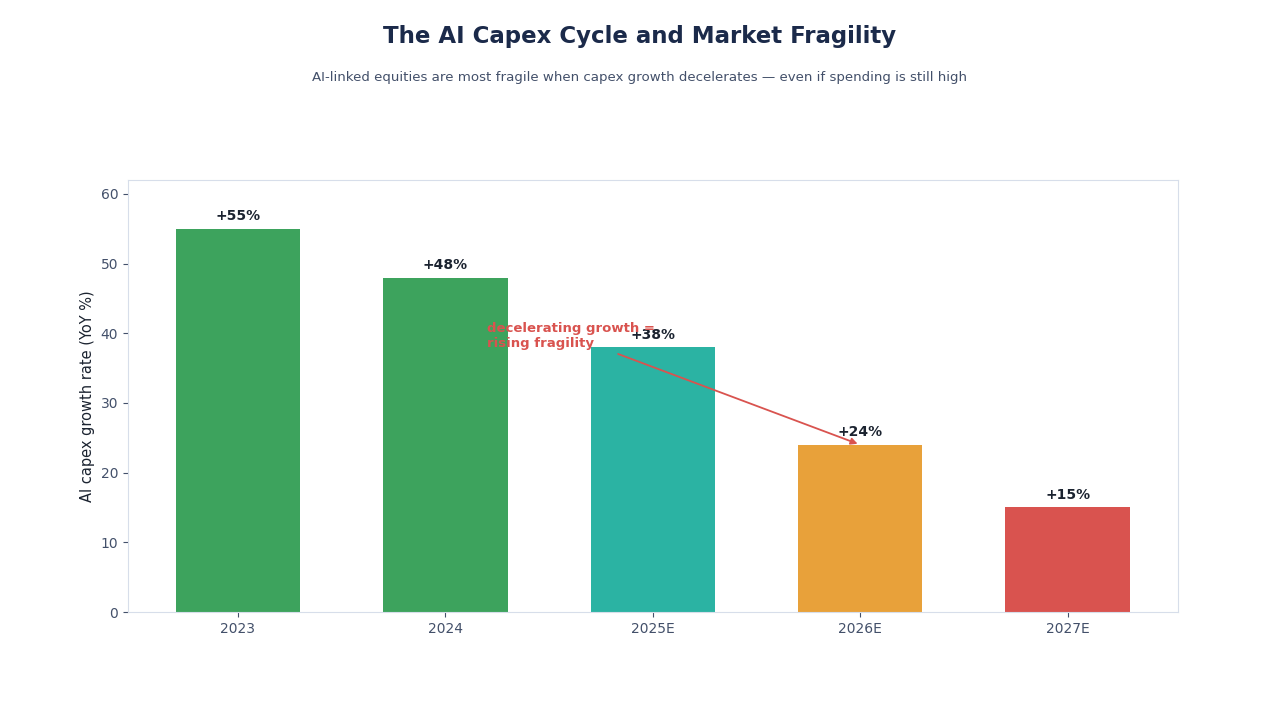
The recent narrative around AI stocks pull back as OpenAI growth concerns hit big tech earnings week cannot be fully understood without examining the AI capital expenditure (CapEx) supercycle.
Over the past 18–24 months, hyperscalers have entered an unprecedented spending phase:
- Microsoft expanding Azure AI infrastructure
- Google scaling TPU and GPU clusters
- Amazon investing heavily in AWS AI services
- Meta rebuilding its AI compute stack
This has led to a supply-chain-wide boom, especially in:
- GPUs (Nvidia dominance)
- Networking (Broadcom, Arista)
- Memory (HBM demand surge)
- Data center construction
The Hidden Risk: CapEx Front-Loading
A critical issue is that AI investment is front-loaded, while returns are uncertain and delayed.
| Stage | Description | Risk |
|---|---|---|
| Phase 1 | Massive infrastructure buildout | High capital burn |
| Phase 2 | Model deployment & scaling | Uncertain monetization |
| Phase 3 | Enterprise adoption | Slow revenue realization |
| Phase 4 | Profitability | Long-term payoff |
The market is beginning to question whether we are stuck between Phase 1 and Phase 2.
Why This Matters for Stocks
When CapEx rises faster than revenue:
- Margins compress
- Free cash flow declines
- Valuations face pressure
This is exactly what we are seeing reflected in recent AI stock volatility.
The Semiconductor Chain Reaction
No sector has benefited more from AI enthusiasm than semiconductors — and none is more exposed to a sentiment reversal.
Key Observations
- Nvidia has been the primary AI proxy trade
- AMD positioned as a secondary challenger
- Broadcom leveraged via networking demand
However, the recent pullback highlights a critical truth:
Semiconductor stocks are pricing future demand, not current reality.
Demand Sensitivity Analysis
| Scenario | Impact on Semiconductors |
|---|---|
| Strong OpenAI growth | Sustained GPU demand |
| Moderate slowdown | Order normalization |
| Severe slowdown | Inventory buildup risk |
Early Warning Signals
Investors should monitor:
- GPU order backlog trends
- Data center utilization rates
- Cloud provider CapEx guidance
- Memory pricing trends
AI Valuation Compression: The Mathematics Behind the Pullback
Valuations in AI stocks expanded rapidly due to:
- Revenue growth expectations
- Market dominance narratives
- Scarcity of AI leaders
The Repricing Mechanism
When growth expectations fall:
- Future earnings estimates decline
- Discount rates remain elevated
- Multiples contract
Result: Double pressure on stock prices
Example Framework
| Factor | Bull Market | Correction Phase |
|---|---|---|
| Growth Rate | Accelerating | Slowing |
| Valuation Multiple | Expanding | Contracting |
| Investor Sentiment | Euphoric | Skeptical |
Liquidity, Rates, and AI Stocks
Another overlooked factor is macro liquidity conditions.
AI stocks are particularly sensitive to:
- Interest rates
- Treasury yields
- Risk appetite
Why?
Because they are:
- High-duration assets
- Dependent on future earnings
- Capital-intensive
Macro Transmission Path
- Rising yields → Higher discount rates
- Higher discount rates → Lower valuations
- Lower valuations → Tech selloff
AI stocks behave like “leveraged duration trades” in a tightening environment.
Market Psychology: From Euphoria to Scrutiny
The AI rally was driven by:
- Fear of missing out (FOMO)
- Narrative dominance
- Passive inflows
Now the market is shifting toward:
- Data validation
- Earnings quality
- Risk management
Sentiment Cycle
- Disbelief
- Acceptance
- Euphoria
- Peak narrative
- Doubt ← We are here
- Correction
- Stabilization
Using SimianX AI to Navigate AI Market Volatility
In this complex environment, SimianX AI provides a structural advantage.
Unlike traditional tools, it combines:
- Multi-timeframe technical analysis
- Real-time sentiment tracking
- Fundamental signal integration
- AI-driven decision synthesis
Practical Use Case
When AI stocks pull back:
- Indicator Agent detects trend weakening
- Intelligence Agent identifies negative news flow
- Fundamental Agent assesses earnings risk
- Decision Agent outputs probability-weighted scenarios
Example Output
| Signal Type | Interpretation |
|---|---|
| RSI divergence | Momentum weakening |
| News sentiment drop | Narrative turning negative |
| CapEx concerns | Fundamental pressure |
| Combined signal | High volatility zone |
Scenario Analysis: What Happens Next?
Scenario 1: Soft Landing (Bullish)
- OpenAI growth stabilizes
- Earnings beat expectations
- AI demand remains strong
Market Impact:
- Pullback becomes buying opportunity
- AI leaders resume uptrend
Scenario 2: Growth Reset (Neutral)
- Growth slows but remains positive
- CapEx moderates
- Valuations adjust
Market Impact:
- Sideways consolidation
- Sector rotation within AI
Scenario 3: Structural Slowdown (Bearish)
- AI monetization disappoints
- CapEx cuts emerge
- Demand expectations reset sharply
Market Impact:
- Deep correction
- Semiconductor sector underperforms
Cross-Market Impact: Beyond Tech Stocks
The AI pullback is not isolated.
Affected Areas
- Crypto markets (AI tokens, risk sentiment)
- Venture capital funding (AI startups)
- Private valuations (down rounds risk)
- Labor market (AI hiring slowdown)
Feedback Loop
- Public market decline → VC caution
- VC caution → Startup slowdown
- Startup slowdown → Lower AI demand
Risk Management Framework for AI Investors
Core Principles
- Avoid overconcentration in single AI themes
- Diversify across value chain
- Monitor real data, not narratives
Tactical Risk Controls
- Position sizing discipline
- Stop-loss frameworks
- Multi-timeframe confirmation
Example Strategy Table
| Strategy | Application |
|---|---|
| Trend following | Stay long in strong trends |
| Mean reversion | Buy oversold conditions |
| Risk hedging | Use options or diversification |
How Institutions Are Positioning Now
Institutional behavior provides critical clues.
Observed Trends
- Reducing overweight in semiconductors
- Rotating into defensive sectors
- Increasing cash allocation
Hedge Fund Behavior
- Deleveraging crowded trades
- Increasing short exposure in overvalued AI names
When institutions shift from accumulation to risk management, volatility increases significantly.
The Future of AI Investing: From Narrative to Infrastructure
Despite short-term volatility, AI remains a multi-decade transformation.
Structural Drivers
- Automation of knowledge work
- Enterprise AI integration
- Data-driven decision systems
Investment Evolution
| Phase | Focus |
|---|---|
| Early | Narrative-driven |
| Mid | Infrastructure buildout |
| Late | Profitability & efficiency |
We are currently transitioning from Phase 1 to Phase 2.
Advanced Framework: AI Market Signal Stack
Using SimianX AI, investors can build a layered signal system:
Layer 1: Price Action
- Trend structure
- Support/resistance
Layer 2: Sentiment
- News flow
- Social signals
Layer 3: Fundamentals
- Earnings revisions
- CapEx trends
Layer 4: Decision Engine
- AI-generated probability scenarios
Strategic Takeaways
- The AI pullback is driven by expectation reset, not collapse
- OpenAI growth concerns act as a sentiment catalyst
- Semiconductor stocks remain the most sensitive segment
- Macro conditions amplify volatility
Final Thought: The New AI Market Reality
The era of easy gains in AI stocks is over.
The next phase requires:
- Discipline
- Data-driven analysis
- Adaptive strategies
This is where platforms like SimianX AI become indispensable.
By integrating:
- Multi-agent intelligence
- Real-time analysis
- Structured decision-making
SimianX AI transforms how investors navigate AI-driven market complexity.
In the AI era, the winners are not those who predict the future — but those who adapt to it fastest.
Related Reading
- AI Stock Boom: Nvidia Leads the Chip Supercycle Now
- AI Spending Surges: TSMC Outlook Confirms Nvidia Demand
- AI vs Predictive AI: Basic Tools Fail in Volatile Markets
- Alphabet Nears Nvidia in Market Value as AI Trade Broadens
- AI Rally Stress Test: Nvidia Earnings vs 5% Yields 2026
- Every S&P 500 Bear Market Since 1929: Duration and Recovery