
 By Muke
Oil Falls as Iran Tensions Ease: Travel Stocks Rally
When oil falls as Iran tensions ease, investors often rotate quickly into sectors that benefit from lower fuel costs, stronger consumer mobility, and improved risk appetite. Airlines, cruise operators, casinos, hotels, and leisure companies can all move sharply when crude prices retreat from geopolitical-risk highs. For traders and long-term investors, the key question is not simply which stocks rallied today, but whether the move is durable, fundamentally justified, and supported by improving earnings expectations.
That is where SimianX AI can help. By combining real-time news sentiment, technical indicators, company fundamentals, and multi-agent market analysis, SimianX AI gives investors a structured way to evaluate fast-moving macro events instead of reacting emotionally to headlines.
Why Oil Falls as Iran Tensions Ease
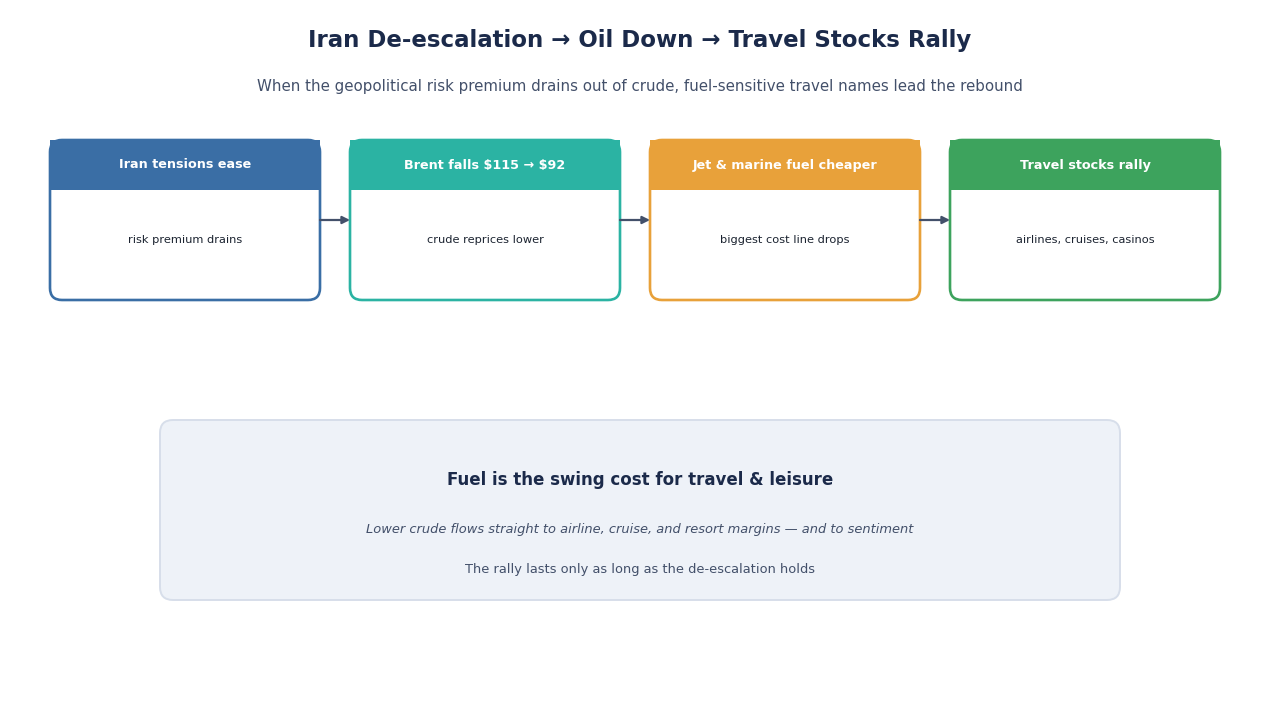
Oil prices are highly sensitive to geopolitical risk, especially when tensions involve the Middle East and shipping routes tied to global energy flows. When traders believe conflict risk is rising, crude prices often include a geopolitical risk premium. When those tensions appear to ease, that premium can unwind quickly.
In this case, the market reaction followed optimism that U.S.-Iran tensions could de-escalate and that energy flows through key shipping corridors might normalize. The result was a sharp move lower in crude oil futures and a broad rally in travel-related equities.
Key takeaway: oil does not need to collapse for travel stocks to rally. Even a credible reduction in geopolitical risk can trigger a powerful repricing.
The reason is simple: oil affects corporate margins, consumer confidence, inflation expectations, and broader equity-market sentiment. When oil prices fall, investors often expect:
- Lower jet fuel costs for airlines
- Improved operating margins for cruise companies
- Reduced inflation pressure on consumers
- Better discretionary spending trends
- Higher risk appetite across cyclical sectors
For companies such as airlines and cruise lines, fuel is not just another expense. It is one of the largest and most volatile cost inputs. A sudden oil decline can immediately improve investor expectations for profitability, even before companies report updated financial results.
Why Airlines Rally When Oil Prices Fall
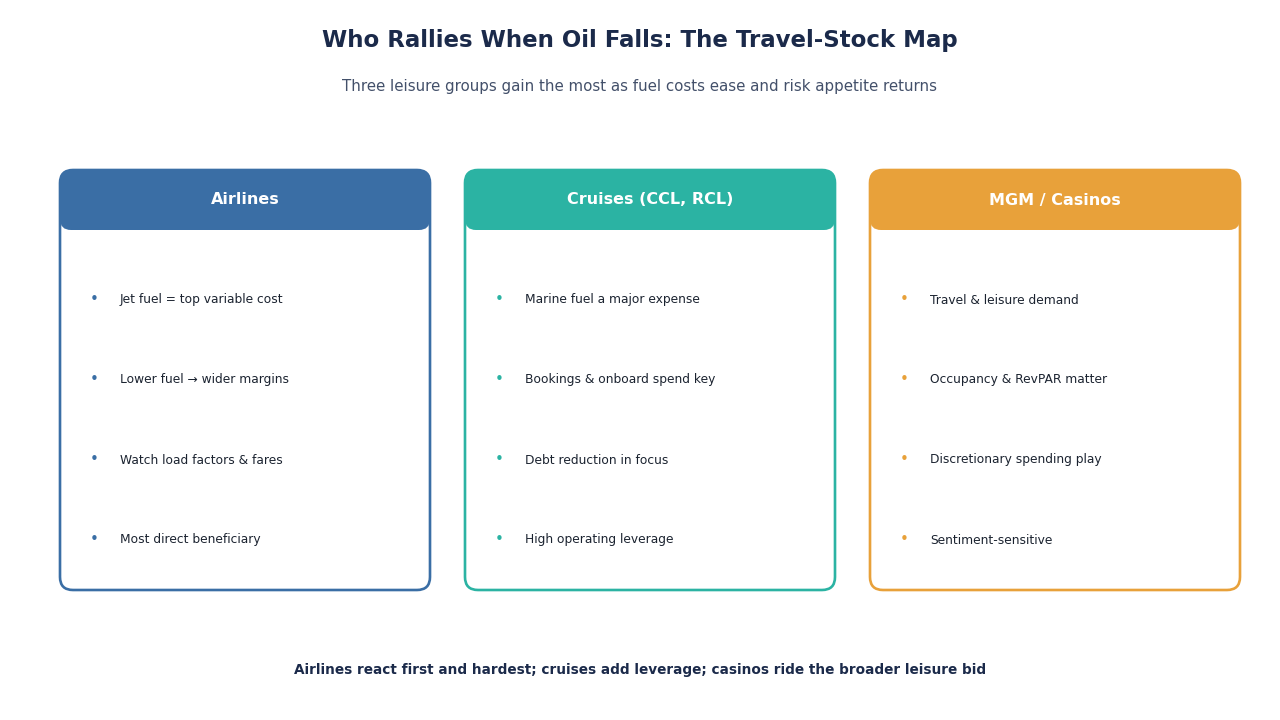
Airlines are among the most direct beneficiaries when crude oil and refined fuel prices decline. Jet fuel costs can materially affect earnings, cash flow, ticket pricing, and capacity planning. When oil prices rise sharply, investors worry that airlines may either absorb higher costs or pass them on to travelers through higher fares. When oil prices fall, the opposite happens: margins can improve, pricing pressure may ease, and demand can look more resilient.
Airline stocks often rally after oil drops because the market quickly reprices expected fuel expense.
For example, major U.S. airline stocks such as UAL, DAL, and other carriers can move higher when oil falls, especially if investors believe travel demand remains stable. The rally is usually strongest when three conditions appear together:
- Oil prices decline meaningfully.
- Travel demand remains healthy.
- The geopolitical catalyst appears to be easing rather than worsening.
| Factor | Why It Matters for Airlines |
|---|---|
| Lower oil prices | Reduces expected jet fuel costs |
| Stable travel demand | Supports revenue and load factors |
| Easing Iran tensions | Lowers geopolitical risk premium |
| Strong technical momentum | Attracts short-term traders |
| Improving sentiment | Helps valuation multiples recover |
A lower oil environment can also support airline balance sheets over time. If fuel prices remain lower for several quarters, airlines may have more flexibility to manage debt, invest in fleet upgrades, improve service, or return capital to shareholders.
However, investors should avoid assuming that every airline rally is automatically sustainable. Airlines still face labor costs, maintenance expenses, aircraft delivery delays, competitive pricing pressure, and macroeconomic demand risks. A fuel-driven rally can fade if the broader business environment weakens.
Why Cruise Stocks Benefit from Lower Oil Prices
Cruise companies are also highly sensitive to fuel costs. While their business models differ from airlines, the basic market logic is similar: lower fuel prices can improve margins and reduce pressure on operating expenses.
Cruise operators such as Norwegian Cruise Line, Carnival, and Royal Caribbean often respond positively to oil-price declines because investors expect lower voyage costs and better profitability. Cruise lines also benefit when geopolitical stress eases because consumers may feel more comfortable booking international travel.
Cruise stocks can rally when oil falls for several reasons:
- Lower bunker fuel and marine fuel costs
- Improved operating margin expectations
- Better consumer travel sentiment
- Reduced concern about itinerary disruptions
- Stronger risk appetite for leveraged travel names
The cruise industry is particularly interesting because many cruise companies carry meaningful debt from prior industry disruptions and fleet investments. When oil prices fall, investors may become more confident that these companies can generate stronger free cash flow.
What Happens to Cruise Stocks When Oil Falls?
When oil falls, cruise stocks often rise because investors expect lower fuel expenses and stronger margins. But the size of the rally depends on whether lower oil is part of a broader risk-on move. If oil falls because demand is collapsing, cruise stocks may not benefit. If oil falls because geopolitical tensions ease while consumer demand remains intact, the setup is much more favorable.
That distinction matters. A bullish move in cruise stocks is more credible when lower oil prices are paired with improving travel confidence, strong booking trends, and stable consumer spending.
Lower oil is most bullish for cruise stocks when it reflects lower supply risk—not weaker demand.
For investors, the practical takeaway is to compare the reason oil is falling with the revenue outlook for travel companies. Falling oil caused by diplomatic progress can support travel equities. Falling oil caused by recession fears may not.
Why MGM Rallies with Travel and Leisure Stocks
MGM Resorts is not a fuel-intensive company in the same way an airline or cruise operator is. Yet MGM can still rally when oil prices fall and geopolitical tensions ease because it sits within the broader travel, leisure, casino, and discretionary spending ecosystem.
When energy prices fall, consumers may have more disposable income for vacations, entertainment, dining, and gaming. Lower oil can also support air travel demand into major leisure destinations such as Las Vegas. For MGM, that can matter because hotel occupancy, room rates, gaming revenue, and entertainment spending are all tied to consumer mobility and confidence.
MGM can benefit from a travel-stock rally through several channels:
- Improved leisure sentiment — investors may expect stronger travel activity.
- Lower inflation pressure — consumers may have more room for discretionary spending.
- Better equity-market risk appetite — cyclical stocks often gain when macro fear fades.
- Las Vegas travel exposure — lower fuel and airfare pressure can support visitor volumes.
- Sector rotation — investors may buy leisure names broadly after geopolitical risk declines.
Oil Falls as Iran Tensions Ease: Is the Travel Stock Rally Sustainable?
The most important investor question is whether the rally in airlines, cruises, and MGM is a short-term reaction or the beginning of a more durable trend. The answer depends on three layers of analysis: macro confirmation, company fundamentals, and market positioning.
1. Macro Confirmation
The first test is whether oil remains lower after the initial headline reaction. If crude prices rebound quickly, the travel-stock rally may lose momentum. Investors should monitor:
- Brent crude and WTI crude prices
- Strait of Hormuz shipping updates
- U.S.-Iran diplomatic developments
- Energy inventory data
- Jet fuel spreads
- Inflation expectations
A single headline can move markets, but a sustainable rally usually requires confirmation from physical flows, policy statements, and price action.
2. Company Fundamentals
The second test is whether lower oil improves expected earnings. For airlines and cruise companies, investors should watch management commentary, fuel hedging disclosures, operating margin guidance, and free cash flow projections.
For MGM, the focus should be different. Investors should evaluate hotel occupancy, Las Vegas demand, Macau exposure, digital gaming growth, and consumer discretionary trends.
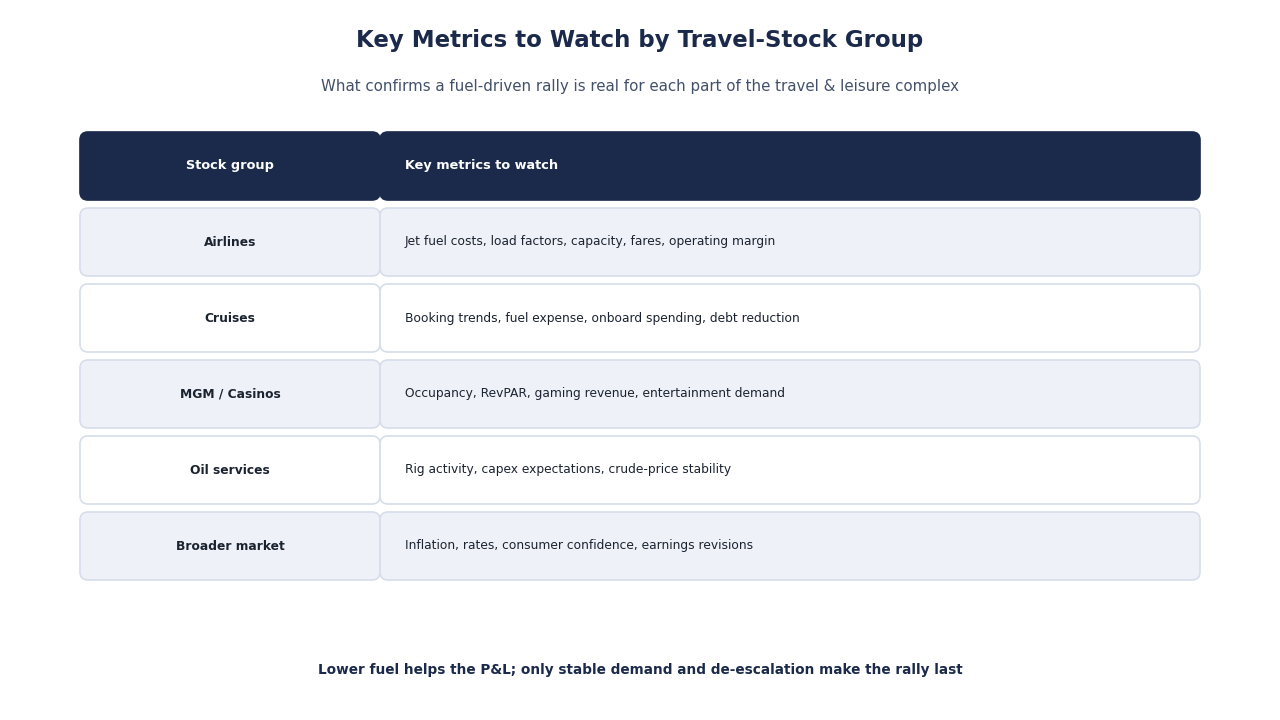
| Stock Group | Key Metrics to Watch |
|---|---|
| Airlines | Jet fuel costs, load factors, capacity, fares, operating margin |
| Cruises | Booking trends, fuel expense, onboard spending, debt reduction |
| MGM / Casinos | Occupancy, RevPAR, gaming revenue, entertainment demand |
| Oil Services | Rig activity, capex expectations, crude-price stability |
| Broader Market | Inflation, rates, consumer confidence, earnings revisions |
3. Market Positioning
The third test is market positioning. If travel stocks were heavily shorted or under-owned before the oil drop, the rally may be amplified by short covering. That can create a strong near-term move, but it does not always imply long-term conviction.
Investors should look for signs that institutional buyers are accumulating shares rather than simply covering bearish bets.
How to Analyze the Oil Drop and Travel Stock Rally with AI
Fast-moving macro events are difficult to analyze manually because investors must connect multiple data streams at once: oil futures, geopolitical news, equity prices, earnings revisions, technical momentum, and sentiment shifts. This is where AI stock analysis tools can become especially useful.
SimianX AI is designed for exactly this type of market environment. Its multi-agent framework can help investors evaluate equities through several lenses, including fundamentals, technical indicators, news sentiment, and decision-oriented trade signals.
A practical AI-assisted workflow might look like this:
- Start with the macro trigger
Identify why oil is falling. Is it supply relief, demand weakness, diplomatic progress, or inventory data?
- Map affected sectors
Separate direct beneficiaries such as airlines and cruise lines from indirect beneficiaries such as hotels, casinos, and consumer discretionary stocks.
- Compare stock reactions
Look at which tickers rallied the most and whether the move is supported by volume.
- Check fundamentals
Review earnings, balance sheets, margins, debt, and forward guidance.
- Validate technical momentum
Use indicators such as RSI, MACD, moving averages, Bollinger Bands, and volume profiles.
- Review sentiment
Analyze whether news coverage and analyst commentary are improving or simply reacting to one headline.
- Build a risk framework
Define what would invalidate the trade, such as oil rebounding, talks failing, or demand weakening.
Best Way to Analyze Geopolitical Oil Risk for Travel Stocks
The best way to analyze geopolitical oil risk is to avoid treating oil prices as a single isolated data point. Instead, investors should build a decision framework that connects energy markets to company-level earnings.
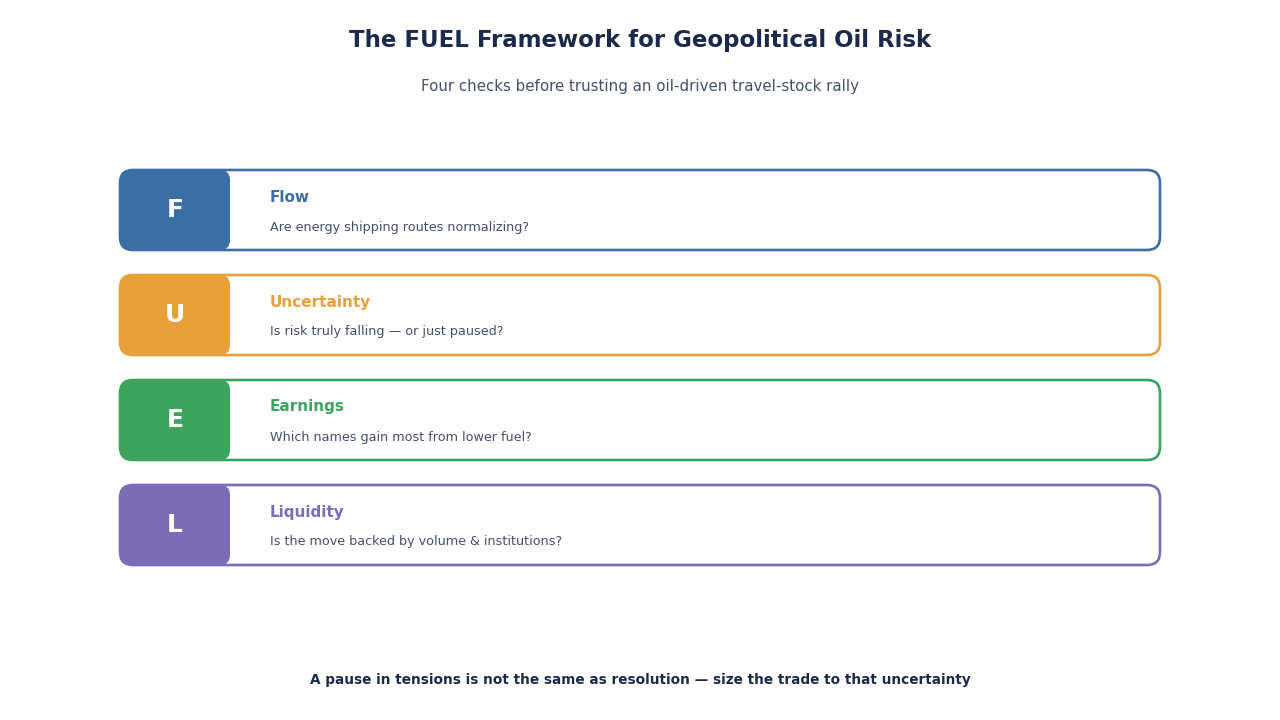
A useful framework is the FUEL model:
| Step | Meaning | Investor Question |
|---|---|---|
| F | Flow | Are energy shipping routes normalizing? |
| U | Uncertainty | Is geopolitical risk truly falling or just temporarily paused? |
| E | Earnings | Which companies gain the most from lower fuel costs? |
| L | Liquidity | Is the stock move supported by volume and institutional buying? |
This model helps investors distinguish between a genuine investment opportunity and a headline-driven bounce.
For example, an airline rally may look attractive if oil falls and booking trends remain strong. But if the rally happens while demand indicators weaken, the move may be less reliable. Similarly, cruise stocks may benefit from lower fuel costs, but investors still need to examine debt levels, pricing power, and forward bookings.
Risks Investors Should Not Ignore
Even when oil falls and travel stocks rally, the setup is not risk-free. Geopolitical markets can reverse quickly, and energy prices can rebound if negotiations stall.
Key risks include:
- Diplomatic breakdown between the U.S. and Iran
- Renewed disruption in Middle East shipping routes
- Oil-price rebound above recent highs
- Weakening consumer demand
- Higher interest rates or inflation pressure
- Airline labor and maintenance cost inflation
- Cruise debt-service pressure
- MGM exposure to discretionary spending cycles
Investors should also remember that lower oil can have mixed effects across the market. While travel stocks may rally, energy producers and oilfield services companies can decline if investors expect lower crude prices to pressure future drilling activity.
That rotation is normal. A lower-oil environment often creates winners and losers at the same time.
Practical Investor Checklist
Before buying airlines, cruise stocks, or MGM after an oil-price decline, investors can use this checklist:
- Has oil fallen because of lower geopolitical risk rather than weaker demand?
- Are travel bookings, fares, or occupancy trends still strong?
- Is the stock rally supported by volume?
- Are earnings estimates likely to improve?
- Does the company have manageable debt and liquidity?
- Are technical indicators confirming momentum?
- Is the risk-reward still attractive after the initial rally?
- What headline or price level would invalidate the thesis?
For investors using SimianX AI, this checklist can be paired with real-time stock analysis, sentiment monitoring, and technical confirmation. Instead of manually jumping between news feeds, financial statements, charts, and analyst commentary, investors can use a centralized AI-assisted workflow to evaluate opportunities more consistently.
FAQ About Oil Falls as Iran Tensions Ease
How do oil prices affect airline stocks?
Oil prices affect airline stocks because jet fuel is one of the largest operating expenses for carriers. When oil prices fall, investors often expect airline margins to improve, especially if passenger demand remains stable. However, the rally is more sustainable when lower fuel costs are supported by strong bookings and disciplined capacity growth.
What happens to cruise stocks when oil falls?
Cruise stocks often rise when oil falls because lower marine fuel costs can improve profitability. The effect is strongest when consumers are still booking vacations and geopolitical risk is declining. If oil falls due to recession fears, cruise stocks may not benefit as much.
Why did MGM rally when oil prices declined?
MGM can rally with travel and leisure stocks because lower oil prices may support consumer discretionary spending and travel demand. Although MGM is not as directly fuel-sensitive as airlines or cruise lines, it benefits from stronger leisure sentiment, Las Vegas visitation, and broader risk appetite.
Is falling oil always good for travel stocks?
No. Falling oil is generally positive for travel stocks when it reflects lower supply risk or easing geopolitical tension. But if oil falls because investors fear a recession or weaker demand, travel stocks may struggle despite lower fuel costs.
What is the best way to analyze travel stocks after an oil drop?
The best approach is to combine macro analysis, company fundamentals, technical indicators, and news sentiment. Tools such as SimianX AI can help investors evaluate multiple signals at once, reducing the risk of overreacting to a single headline.
Conclusion
When oil falls as Iran tensions ease, the market often moves quickly into stocks that benefit from lower fuel costs and stronger travel sentiment. Airlines may gain from lower jet fuel expenses, cruise operators may see margin relief, and MGM may rally as investors rotate into leisure and discretionary names.
But investors should not rely on the headline alone. The real opportunity depends on whether oil stays lower, geopolitical risk continues to decline, and company fundamentals support the move. A disciplined framework should include macro confirmation, earnings analysis, technical validation, and sentiment review.
For investors who want a smarter way to evaluate fast-moving market events, SimianX AI offers AI-powered stock analysis, real-time news sentiment monitoring, technical indicators, and multi-agent decision support. Use SimianX AI to go beyond the headline and analyze whether the travel-stock rally has real staying power.
Related Reading
- Oil -5% on Iran-Hormuz Talks: Brent, WTI & Sector Map 2026
- S&P, Nasdaq Hit New Highs on Iran Ceasefire Extension
- How Oil Volatility Shakes US Stocks: $10 Move Sector Map