
 By Muke
Oil Prices Drop 5% as Iran–Hormuz Talks Ease Supply Risk
Oil prices drop 5% as Iran–Hormuz talks ease supply risk became the defining market headline as crude traders repriced one of the world’s most important geopolitical risk premiums. Brent crude fell back below the psychologically important $100 level after reports of tentative progress toward reopening or normalizing shipping through the Strait of Hormuz, while WTI also dropped sharply.
For investors, analysts, and energy-sensitive businesses, the key question is not simply why oil fell, but whether the move marks the beginning of a durable repricing or only a temporary relief rally in reverse.
For readers using AI-assisted market workflows, SimianX AI offers a useful way to connect news sentiment, macro risk, technical signals, and portfolio exposure into one repeatable research process. Instead of reacting to every headline, market participants can use SimianX AI to organize fast-moving geopolitical developments into structured, actionable research.
Why Oil Prices Dropped 5% After Iran–Hormuz Talks
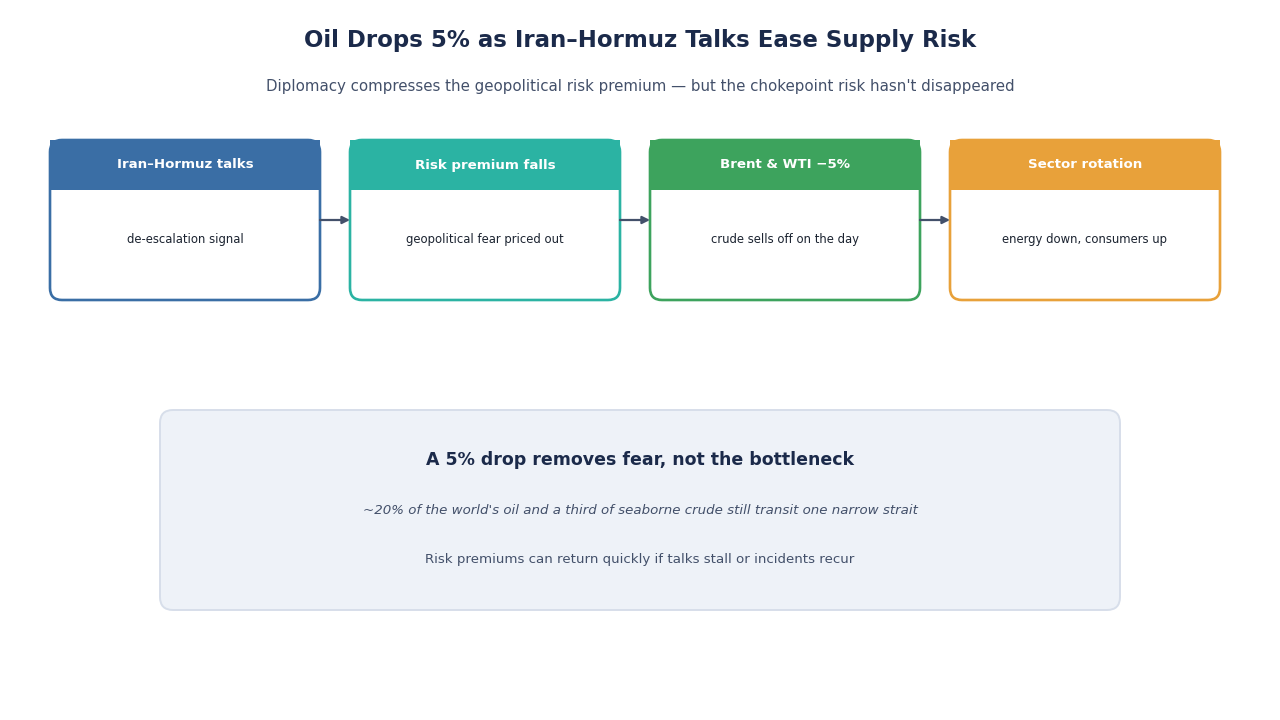
The immediate catalyst was diplomatic optimism. Reports around Iran–Hormuz negotiations suggested that supply disruption risks could ease if shipping through the Strait of Hormuz becomes safer or more predictable. Because oil markets had been pricing in a large geopolitical risk premium, even a modest improvement in diplomatic tone was enough to trigger a sharp move lower.
That matters because oil prices are not only driven by current barrels in storage. They are also shaped by expected future supply, shipping reliability, insurance costs, refinery access, sanctions risk, and geopolitical uncertainty. When traders fear that ships cannot safely move crude through a critical chokepoint, they price in scarcity. When that fear declines, the premium can unwind quickly.
The 5% decline was less about weaker demand and more about a sudden repricing of perceived supply disruption risk.
The Strait of Hormuz is not just another shipping lane. It is one of the most important oil transit routes in the world, connecting the Persian Gulf with global energy markets. Because so much crude and liquefied natural gas moves through this narrow waterway, any sign of disruption can move Brent and WTI futures within hours.
In simple terms, the market asked one question: Is the worst-case supply disruption scenario becoming less likely? When the answer appeared to shift toward yes, oil prices dropped.
What Is the Strait of Hormuz and Why Does It Matter for Oil Prices?
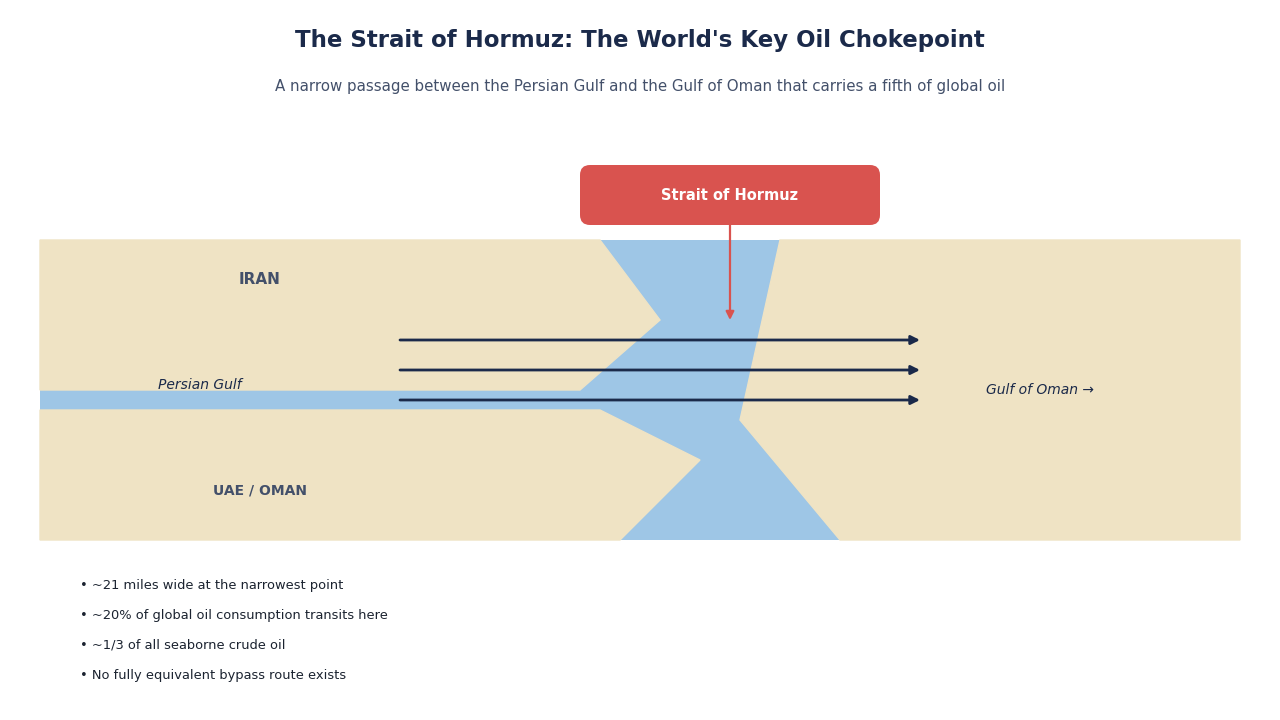
The Strait of Hormuz connects the Persian Gulf with the Gulf of Oman and the Arabian Sea. It is a narrow but strategically essential corridor for crude oil, refined products, and LNG exports from major producers in the Middle East.
For oil markets, the Strait matters because it concentrates several layers of risk:
- Physical supply risk: Tankers may be delayed, rerouted, trapped, or unable to load.
- Insurance and freight risk: War-risk premiums can raise the delivered cost of crude.
- Production risk: Gulf producers may reduce output if storage fills and exports are constrained.
- Spare capacity risk: Much of the world’s spare crude capacity is located in the Gulf region.
- LNG risk: Qatar and the UAE rely heavily on Hormuz-linked LNG routes, adding gas-market spillovers.
| Market Variable | Why Hormuz Matters | Likely Price Effect |
|---|---|---|
| Brent crude | Global benchmark exposed to seaborne supply | Higher risk premium during disruption |
| WTI crude | U.S. benchmark influenced by global arbitrage | Follows Brent direction, often with spread changes |
| LNG | Qatar-linked flows rely on Hormuz | Higher Asian LNG and gas-price risk |
| Shipping insurance | War-risk premiums rise during conflict | Raises delivered energy cost |
| Refining margins | Feedstock availability changes | Regional margin volatility |
How Do Iran–Hormuz Talks Affect Oil Prices?
Iran–Hormuz talks affect oil prices by changing the probability of supply disruption. Oil futures are forward-looking instruments. Traders do not wait for every barrel to physically move; they adjust prices based on expected future availability, risk, storage, and geopolitical outcomes.
A simplified market reaction looks like this:
- Conflict risk rises: Oil buyers worry about unavailable supply.
- Risk premium expands: Brent and WTI trade higher.
- Talks improve: Traders reduce the probability of a prolonged disruption.
- Risk premium compresses: Oil prices fall quickly.
- Physical confirmation is needed: Prices stabilize only if tankers move safely and production resumes.
This is why a diplomatic headline can trigger a sharp decline even before supply fully returns. However, it is also why the move can reverse if talks stall, inspections fail, shipping remains unsafe, or producers cannot restart quickly.
Why the 5% Oil Price Drop Does Not Eliminate Supply Risk
A 5% drop sounds dramatic, but it does not mean the market is back to normal. Energy markets can move faster than physical supply chains. A futures contract can fall within minutes, while shipping routes, insurance policies, port schedules, tanker availability, and production flows can take much longer to normalize.
That is the central tension for investors: the headline risk premium can fall faster than the physical market can heal.
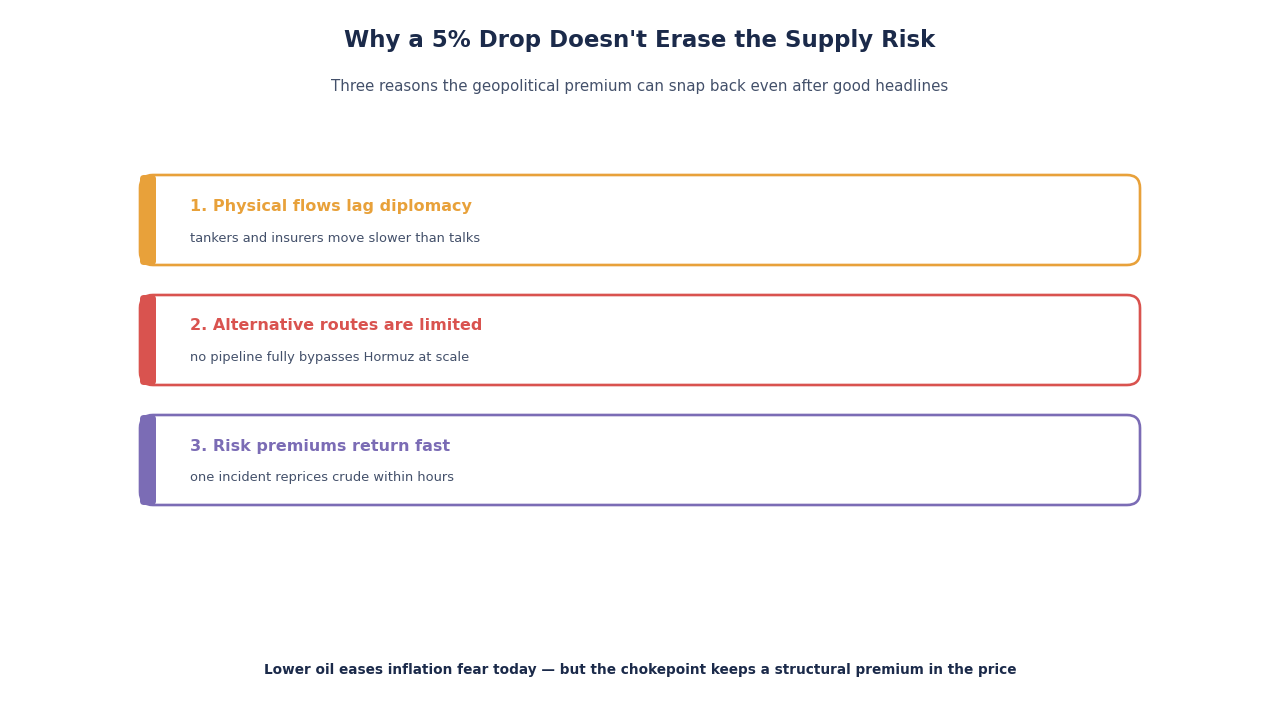
There are three reasons supply risk remains relevant.
1. Physical Flows May Lag Diplomatic Progress
Even if an agreement is announced, shippers need evidence that the waterway is safe. Tanker operators, insurers, charterers, and refiners all assess operational risk independently. A political statement may reduce fear, but it does not instantly clear mines, repair damaged infrastructure, reduce insurance costs, or restart idled production.
2. Alternative Routes Are Limited
Some regional pipelines can bypass the Strait of Hormuz, but most volumes that normally transit the Strait have few practical alternatives. This makes the waterway especially important for the global oil balance.
If the Strait is fully open, crude can move efficiently. If it is partially restricted, the market faces delays, higher costs, and uncertainty. If it is blocked, oil prices can rise sharply because replacement routes are limited.
3. Risk Premiums Can Return Quickly
Oil is especially sensitive to second-order risks. A headline about talks can lower prices, but a headline about stalled negotiations, renewed attacks, sanctions disputes, tanker incidents, or nuclear oversight disagreements can quickly rebuild the premium.
Brent vs WTI: What the Iran–Hormuz Oil Price Drop Means for Benchmarks
When analyzing oil prices drop 5% Iran Hormuz talks headlines, it helps to separate Brent and WTI.
Brent crude is the more globally sensitive benchmark because it reflects seaborne crude pricing. A disruption in the Persian Gulf typically has a direct influence on Brent because the benchmark captures global maritime supply tightness.
WTI crude is landlocked in the U.S. system, but it still responds to global shocks through export economics, refinery demand, currency moves, and arbitrage relationships. When Brent falls sharply because geopolitical supply risk eases, WTI usually follows, though the Brent-WTI spread may widen or narrow depending on U.S. inventories and export flows.
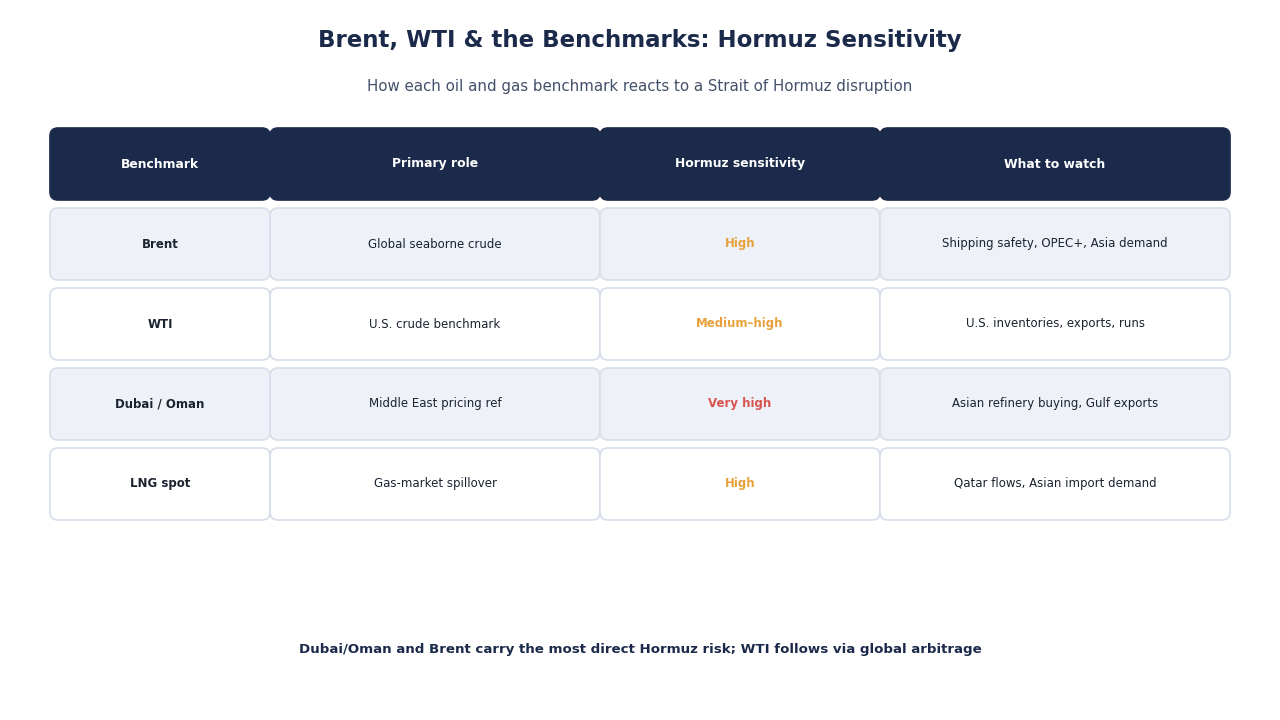
| Benchmark | Primary Role | Hormuz Sensitivity | What to Watch |
|---|---|---|---|
| Brent | Global seaborne crude benchmark | High | Shipping safety, OPEC+ output, Asia demand |
| WTI | U.S. crude benchmark | Medium to high | U.S. inventories, exports, refinery runs |
| Dubai/Oman | Middle East crude pricing reference | Very high | Asian refinery buying and Gulf exports |
| LNG spot prices | Gas-market spillover | High | Qatar flows, Asian import demand |
For investors, the practical takeaway is clear: do not read the 5% drop as a simple bearish oil signal. Read it as a risk-premium compression event.
What Should Investors Watch After Oil Prices Drop 5%?
A single-day move can be noisy. A better approach is to monitor whether the news changes the market’s actual supply-demand balance.
Here is a practical framework:
- Confirm diplomatic milestones
Look for signed agreements, public commitments, third-party verification, and clarity on enforcement.
- Track physical tanker movement
Watch whether crude and product tankers resume normal transit patterns through Hormuz.
- Monitor Brent time spreads
Backwardation can signal tight physical markets even when flat prices fall.
- Check inventory data
Falling inventories may limit downside even if geopolitical headlines improve.
- Follow shipping insurance and freight rates
If war-risk premiums stay elevated, the market may still price logistical stress.
- Evaluate OPEC+ and Gulf production recovery
Output restarts can lag headline diplomacy.
- Watch Asian refinery demand
China, India, Japan, and South Korea are major destinations for crude moving through Hormuz, so Asian demand signals matter.
How SimianX AI Can Help Analyze Oil-Driven Market Volatility
Oil price shocks rarely affect only energy companies. A sharp crude move can influence airlines, shipping, chemicals, utilities, inflation expectations, bond yields, consumer stocks, and even risk assets like crypto. That is why a multi-factor workflow matters.
SimianX AI can fit into this workflow by helping investors compare several lenses at once:
- News sentiment: Is the market reacting to confirmed policy or speculative headlines?
- Technical analysis: Did crude break a key support level, or is it still in a volatile range?
- Risk management: Which portfolio positions are most exposed to energy-price swings?
- Macro trends: Are oil moves feeding inflation, rates, or currency expectations?
- Consensus reasoning: Do multiple analytical perspectives agree, or is the signal mixed?
For an event like oil prices drop 5% as Iran–Hormuz talks ease supply risk, that structure is valuable because the trade is not one-dimensional. A news-sentiment model may see relief, while a risk framework may warn that shipping normalization is not yet confirmed. A technical view may identify downside momentum in crude, while a macro view may highlight inflation relief for energy-importing economies.
The advantage of using AI-assisted research is not that it predicts every market move. The advantage is that it helps analysts process more signals, compare scenarios faster, and avoid overreacting to a single headline.
Scenario Analysis: What Happens Next for Oil Prices?
The most useful research question is not “will oil rise or fall?” but “which scenario is the market pricing now, and what evidence would change it?”
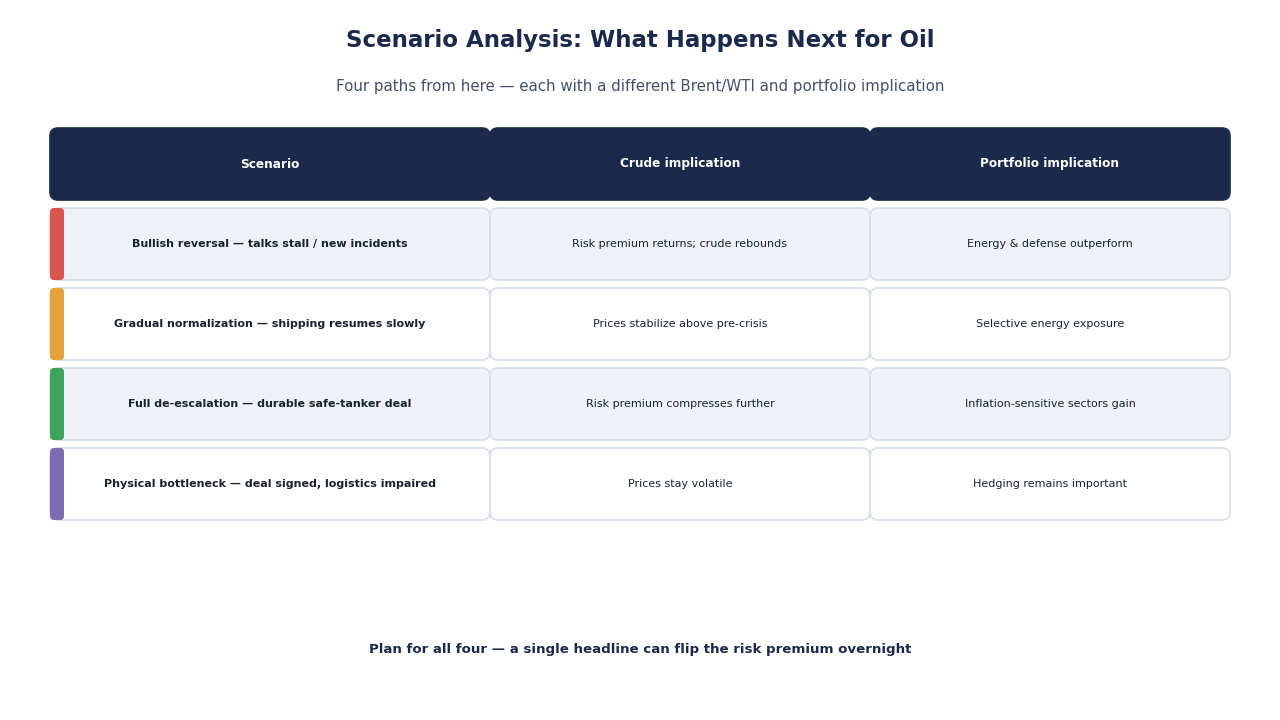
| Scenario | Description | Brent/WTI Implication | Portfolio Implication |
|---|---|---|---|
| Bullish oil reversal | Talks stall or new incidents occur | Risk premium returns; crude rebounds | Energy stocks outperform, airlines pressured |
| Gradual normalization | Talks progress and shipping resumes slowly | Prices stabilize but stay above pre-crisis levels | Selective relief for consumers and transport |
| Full de-escalation | Durable agreement and safe tanker flows | Risk premium compresses further | Inflation-sensitive sectors may benefit |
| Physical bottleneck | Deal signed but logistics remain impaired | Prices remain volatile | Hedging remains important |
A disciplined investor should assign probabilities to each scenario rather than overreacting to one headline.
The best response to geopolitical oil volatility is not prediction. It is structured scenario planning.
Is the Oil Price Drop Bullish or Bearish for Stocks?
The answer depends on sector exposure.
Lower oil prices can be bullish for:
- Airlines and travel companies
- Shipping and logistics firms
- Chemical producers using oil-linked feedstocks
- Consumer discretionary businesses
- Import-heavy economies
- Inflation-sensitive growth stocks
Lower oil prices can be bearish for:
- Exploration and production companies
- Oilfield services
- Energy-heavy high-yield credit
- Some commodity-linked currencies
- Refiners, depending on crack spreads and feedstock dynamics
For broad equity markets, a 5% oil drop caused by easing geopolitical risk is often initially supportive because it reduces inflation pressure and tail risk. But if oil falls because global demand is weakening, the signal would be very different.
In this case, the market narrative points more toward supply-risk relief than demand deterioration.
A Practical Research Checklist for the Iran–Hormuz Oil Market
Use this checklist when updating an oil market view after the 5% drop:
- Headline validation: Has a formal agreement been signed, or are reports still tentative?
- Transit data: Are ships physically moving through the Strait at normal rates?
- Production data: Are Gulf producers restoring output?
- Inventory direction: Are crude and product inventories rebuilding?
- Benchmark spreads: Are Brent time spreads loosening or staying tight?
- Insurance costs: Are shipping premiums declining?
- Equity confirmation: Are energy equities confirming crude weakness?
- Macro confirmation: Are inflation expectations moving lower?
- Risk assets: Are equities and crypto reacting as if tail risk is lower?
For a repeatable process, investors can combine public data, price charts, and AI-generated research summaries. This is where tools like SimianX AI can help convert fast-moving headlines into a structured market thesis rather than a reactive trade.
FAQ About Oil Prices Drop 5% as Iran–Hormuz Talks Ease Supply Risk
Why did oil prices drop 5% after Iran–Hormuz talks?
Oil prices fell because traders reduced the geopolitical risk premium attached to possible supply disruptions through the Strait of Hormuz. Reports of progress in Iran–Hormuz talks suggested that shipping conditions could improve, lowering the probability of a prolonged crude supply shock.
What is the Strait of Hormuz crude oil market impact?
The Strait of Hormuz is one of the world’s most important oil chokepoints. Because a large share of global seaborne crude and LNG flows through the region, any disruption can quickly affect Brent, WTI, shipping costs, LNG markets, and global inflation expectations.
How do Iran talks affect Brent and WTI crude prices?
Iran talks affect crude prices by changing expected supply availability and geopolitical risk. Brent usually reacts more directly because it is tied to global seaborne crude, while WTI follows through arbitrage, exports, refinery economics, and broader risk sentiment.
Is lower oil bullish for the stock market?
Lower oil can be bullish for many stocks if it reflects easing geopolitical risk and lower inflation pressure. However, it can be bearish for energy producers and may be negative for the broader market if the decline is driven by weak demand rather than improved supply conditions.
What is the best way to analyze oil price volatility with AI?
The best way is to combine news sentiment, technical signals, macro context, and portfolio risk rather than relying on one indicator. An AI-assisted workflow can help investors compare competing signals and build a more balanced thesis.
Conclusion
The headline oil prices drop 5% as Iran–Hormuz talks ease supply risk captures a major shift in market psychology. Traders are no longer pricing only worst-case disruption; they are beginning to price the possibility of diplomatic progress, safer shipping, and eventual supply normalization.
But the move should not be mistaken for a complete return to normal. The Strait of Hormuz remains a critical chokepoint, alternative routes are limited, and physical energy flows may take much longer to recover than futures prices.
For investors, the right response is disciplined scenario analysis: track diplomatic milestones, tanker movement, inventories, Brent-WTI spreads, shipping insurance, and sector exposure. To turn fast-moving geopolitical news into structured investment research, explore SimianX AI and use its AI-assisted market analysis workflow to evaluate risk, sentiment, and opportunity with greater clarity.
Related Reading
- How Oil Volatility Shakes US Stocks: $10 Move Sector Map
- S&P, Nasdaq Hit New Highs on Iran Ceasefire Extension
- Iran Tensions: Oil $100 Spike, Energy +3.9%, S&P -1%