
 By Muke
How Oil Market Volatility Is Shaking U.S. Stocks While China’s Energy System Shows Resilience
Oil market volatility is shaking U.S. stocks in ways that go far beyond simple price swings, influencing liquidity, sector rotation, and macro sentiment. At the same time, China’s energy system is demonstrating resilience that is reshaping global risk dynamics. For investors navigating this complex environment, platforms like SimianX AI offer a powerful way to interpret multi-layered signals and turn uncertainty into actionable insights.
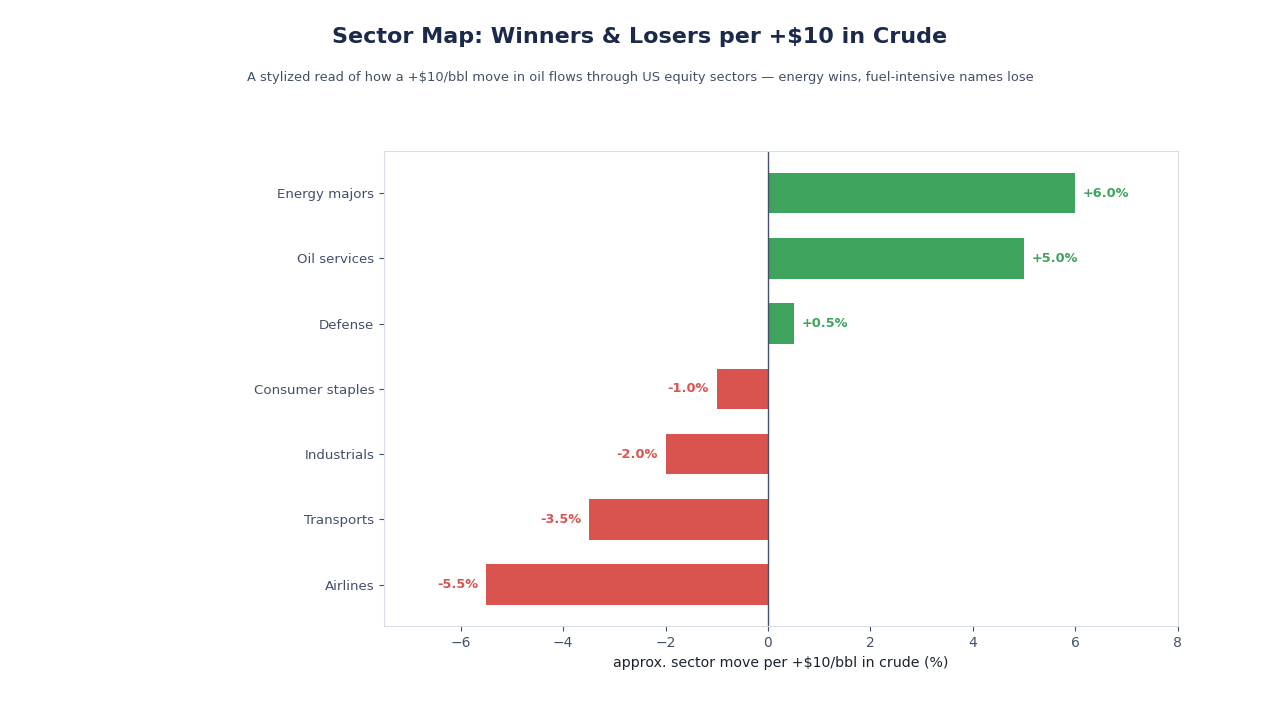
Understanding the Link Between Oil Volatility and U.S. Stocks
Oil is not just a commodity—it is a macro transmission mechanism. When oil prices swing sharply, they influence:
- Inflation expectations
- Corporate margins
- Consumer spending
- Monetary policy outlook
Oil volatility acts as a “macro amplifier,” accelerating both bullish and bearish trends in equities.
Key channels of impact:
- Energy Sector Boost: Rising oil prices often lift energy stocks like
XOMandCVX - Consumer Pressure: Higher fuel costs reduce disposable income
- Fed Policy Reaction: Inflation spikes can delay rate cuts
- Oil prices rise → inflation fears increase
- Inflation rises → Fed stays hawkish
- Hawkish Fed → equity valuations compress
| Transmission Channel | Market Impact |
|---|---|
| Inflation | Higher yields, lower valuations |
| Corporate Costs | Margin compression |
| Consumer Spending | Demand slowdown |
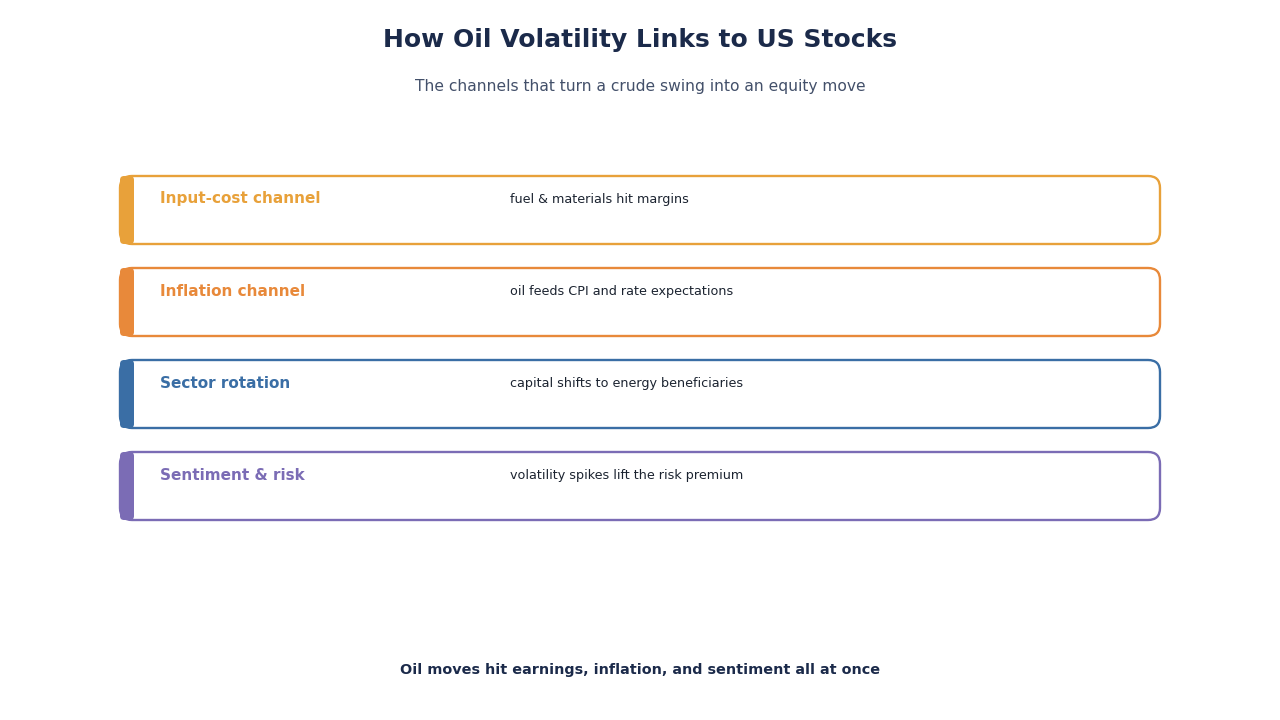
Why Oil Market Volatility Is More Dangerous Today
Today’s oil volatility is driven by multi-factor instability:
- Geopolitical tensions (Middle East, Russia)
- Supply chain disruptions
- OPEC+ production decisions
- Financial speculation in futures markets
Unlike past cycles, cross-asset contagion is stronger.
Structural Differences vs Previous Cycles
| Factor | Past Cycles | Current Cycle |
|---|---|---|
| Market Liquidity | Stable | Fragmented |
| Policy Response | Predictable | Data-dependent |
| Energy Mix | Oil-heavy | Transition phase |
This means oil shocks now trigger:
- Faster equity selloffs
- Higher volatility in tech stocks
- Stronger correlation with bond yields
China’s Energy System: Why It Shows Resilience
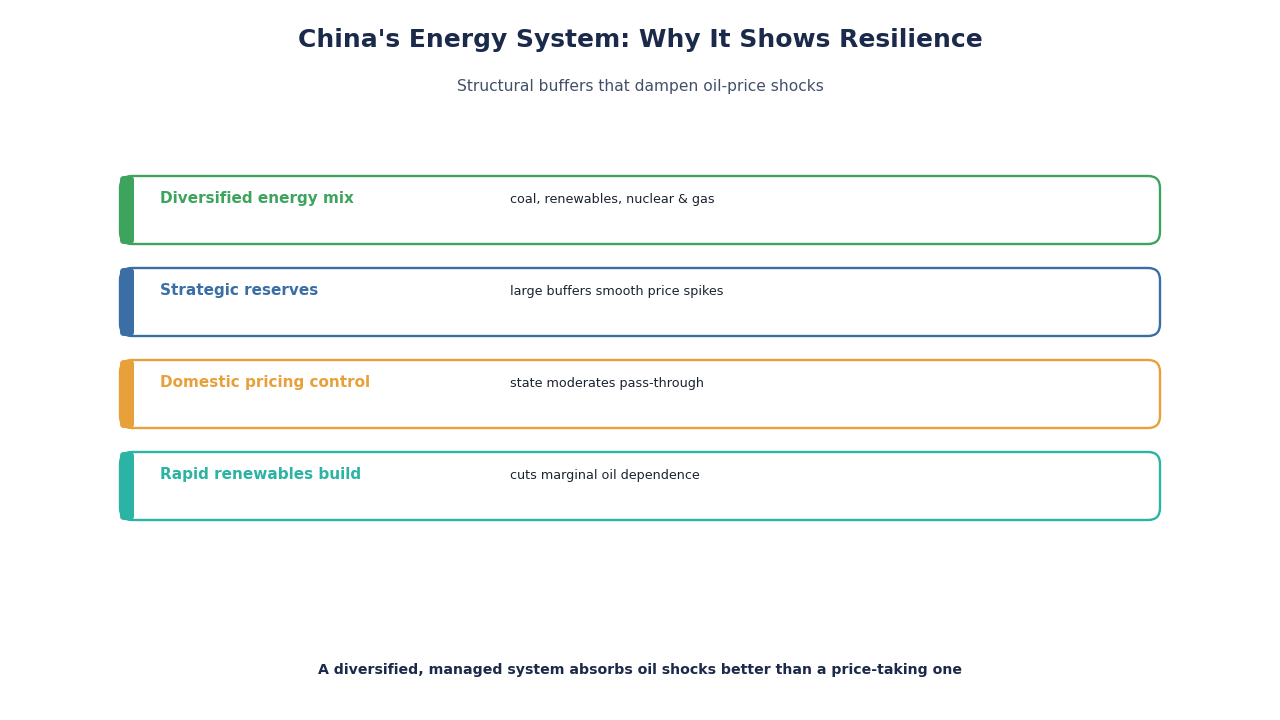
While oil volatility disrupts U.S. markets, China’s energy system is more buffered and diversified.
Key Pillars of China’s Energy Resilience
- Diversified Supply Sources (Russia, Middle East, domestic)
- Strategic Reserves (buffering price shocks)
- Renewable Expansion (solar, wind dominance)
- State-Controlled Pricing Mechanisms
China’s hybrid energy model reduces immediate exposure to global oil price swings.
What This Means for Markets
- Less volatility in domestic industries
- Stable industrial production
- Reduced inflation transmission
| Feature | U.S. System | China System |
|---|---|---|
| Pricing | Market-driven | Controlled |
| Energy Mix | Oil-sensitive | Diversified |
| Shock Absorption | Low | High |
How Investors Can Navigate Oil-Driven Market Volatility
Oil volatility creates both risk and opportunity. The key is structured analysis.
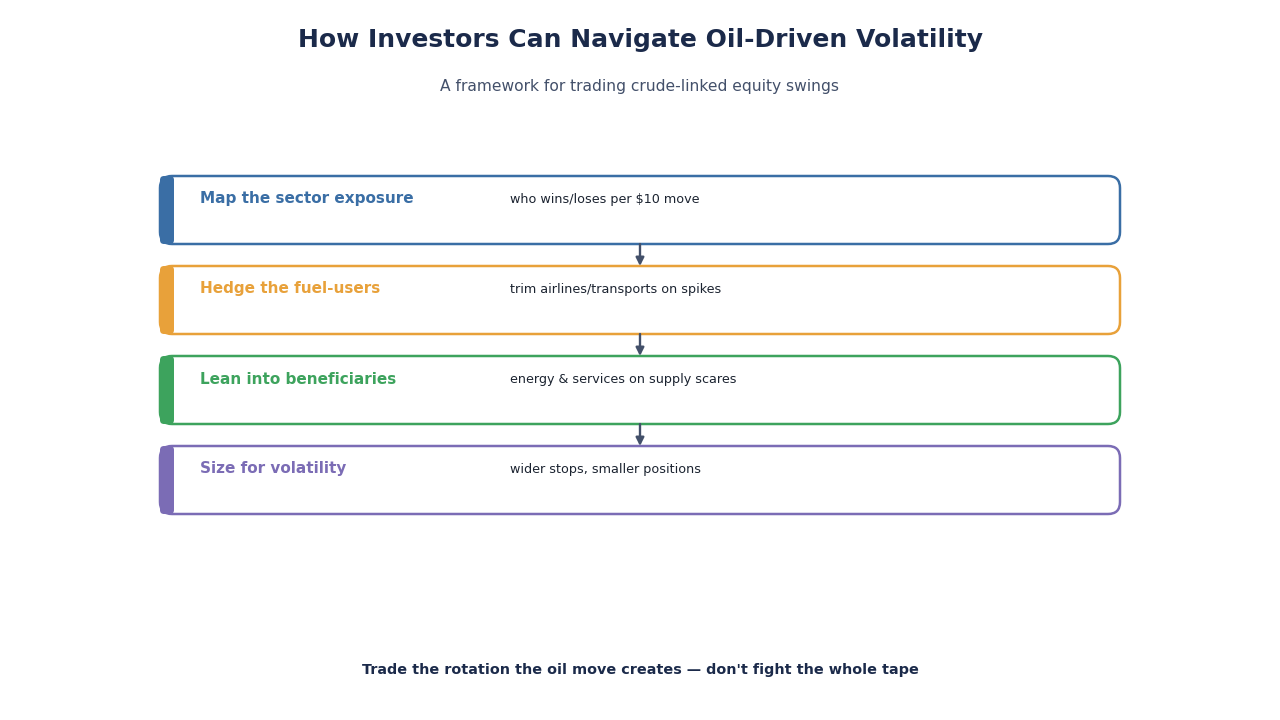
Practical Framework for Traders
- Track oil price trends (
WTI,Brent) - Monitor bond yields and CPI data
- Analyze sector rotation patterns
- Use multi-timeframe signals
- Identify oil trend direction
- Map macro implications (inflation, Fed)
- Adjust sector exposure accordingly
Using AI for Better Decision-Making
This is where SimianX AI becomes critical.
With its multi-agent system, it integrates:
- Technical indicators (RSI, MACD)
- Market sentiment and news flow
- Macro fundamentals
- Cross-market correlations
Instead of guessing, you get:
- Clear support/resistance levels
- Risk scenarios
- Confidence-weighted decisions
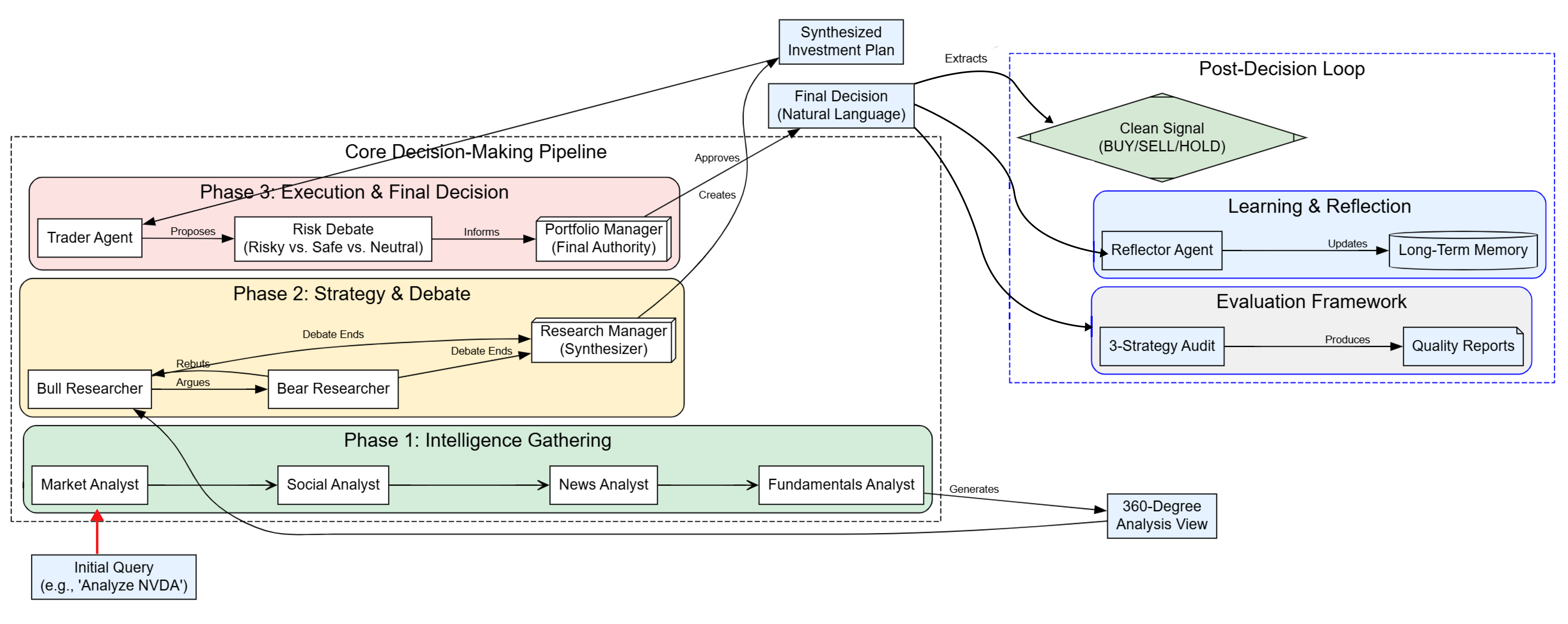
Example Workflow with SimianX AI
| Step | Action |
|---|---|
| 1 | Monitor oil volatility signals |
| 2 | Analyze equity market response |
| 3 | Use AI decision layer for trade setup |
How Is Oil Market Volatility Shaking U.S. Stocks Today?
Oil market volatility is shaking U.S. stocks today through real-time feedback loops between commodities, bonds, and equities.
When oil spikes:
- Tech stocks often drop due to valuation sensitivity
- Energy stocks outperform
- Market volatility (VIX) increases
When oil crashes:
- Inflation fears ease
- Growth stocks rebound
- Risk appetite returns
This dynamic creates short-term trading windows that skilled investors can exploit.
FAQ About Oil Market Volatility Impact on U.S. Stocks
How does oil price volatility affect stock markets?
Oil price volatility impacts inflation, corporate costs, and consumer spending. This affects central bank policy and ultimately stock valuations across sectors.
Why are U.S. stocks sensitive to oil shocks?
The U.S. market is highly financialized and reacts quickly to macro signals. Oil price changes influence interest rates, which directly affect equity pricing.
Why is China less affected by oil volatility?
China uses controlled pricing, diversified energy sources, and large reserves to reduce exposure, making its system more stable during global shocks.
What sectors benefit from oil volatility?
Energy, commodities, and sometimes defense sectors benefit. Technology and consumer sectors often face pressure during oil price spikes.
How can traders profit from oil-driven volatility?
By tracking oil trends, understanding macro linkages, and using AI tools like SimianX AI to identify high-probability trade setups.
Conclusion
Oil market volatility is shaking U.S. stocks through complex macro channels, creating both instability and opportunity. At the same time, China’s energy system highlights how structural resilience can reduce exposure to global shocks.
For investors, the key is not just understanding these dynamics—but acting on them with precision. Platforms like SimianX AI provide a decisive edge by combining real-time data, multi-agent analysis, and actionable insights.
Deep Dive: Cross-Market Transmission Mechanisms of Oil Volatility
Oil market volatility does not operate in isolation—it propagates through a tightly interconnected global financial system. Understanding these transmission mechanisms is essential for investors seeking to anticipate market reactions rather than simply respond to them.
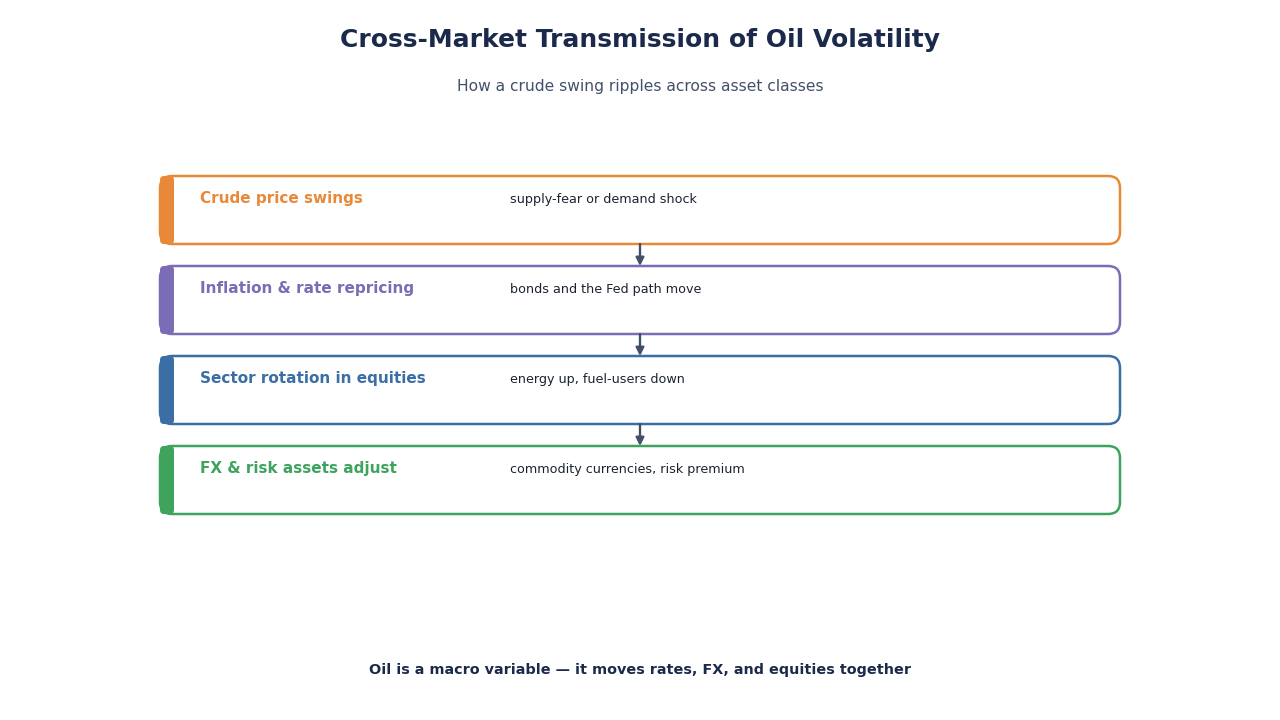
1. Oil → Inflation → Interest Rates → Equities
This is the primary macro transmission chain:
- Rising oil prices increase transportation and production costs
- Higher costs feed into Consumer Price Index (CPI)
- Central banks (especially the Federal Reserve) respond with tighter policy
- Higher interest rates compress equity valuations
In modern markets, oil is effectively a leading indicator of monetary policy expectations.
2. Oil → Currency Markets → Capital Flows
Oil volatility also impacts:
- The U.S. Dollar Index (DXY)
- Emerging market currencies
- Capital allocation between developed and developing markets
When oil rises:
- USD often strengthens (safe-haven demand)
- Emerging markets face capital outflows
- Global risk appetite declines
3. Oil → Sector Rotation → Index Composition
Oil volatility triggers sector-level rebalancing:
| Oil Trend | Winning Sectors | Losing Sectors |
|---|---|---|
| Rising | Energy, Materials | Tech, Consumer |
| Falling | Tech, Growth Stocks | Energy |
This rotation impacts major indices like:
S&P 500NASDAQDow Jones
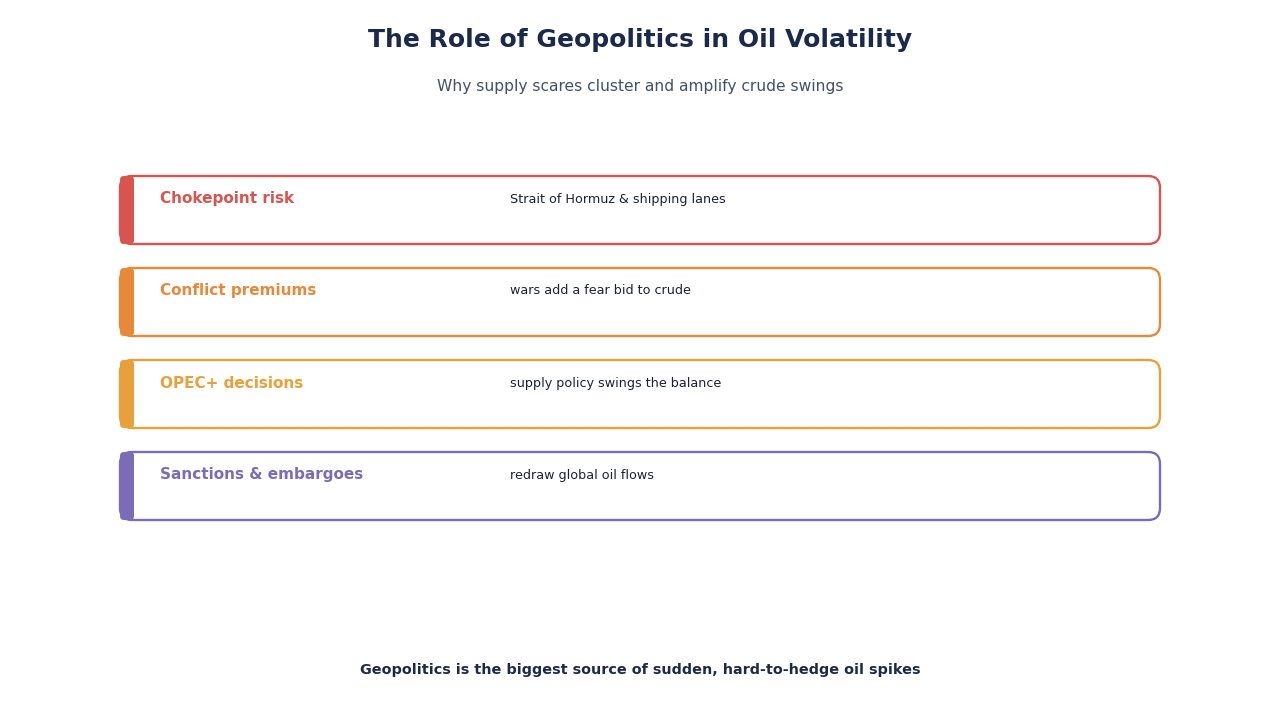
The Role of Geopolitics in Oil Market Volatility
Oil is uniquely sensitive to geopolitical events. Unlike other commodities, its supply chain is highly concentrated in politically unstable regions.
Key Geopolitical Drivers
- Middle East tensions (Iran, Saudi Arabia)
- Russia-Ukraine conflict
- OPEC+ policy coordination
- Maritime chokepoints (Hormuz Strait)
A single geopolitical headline can move oil prices by 3–5% intraday, triggering immediate equity market reactions.
Case Study: Iran Tensions and Oil Shock
When tensions escalate:
- Oil supply fears increase
- Prices spike rapidly
- Equity markets initially sell off
- Defensive sectors outperform
However, if de-escalation occurs:
- Oil prices fall sharply
- Risk assets rebound
- Tech leads recovery
This binary reaction function creates trading opportunities but also increases risk.
China’s Strategic Energy Model: A Structural Advantage
China’s resilience is not accidental—it is the result of long-term strategic planning.
1. Strategic Petroleum Reserves (SPR)
China maintains large reserves that allow it to:
- Smooth domestic price fluctuations
- Reduce dependence on spot markets
- Stabilize industrial production
2. Renewable Energy Dominance
China leads globally in:
- Solar panel production
- Wind energy capacity
- Electric vehicle infrastructure
This reduces its oil intensity per unit of GDP.
3. State-Controlled Energy Pricing
Unlike the U.S.:
- Fuel prices are partially regulated
- Sudden global price spikes are absorbed by the system
This creates a shock absorber effect, preventing immediate economic disruption.
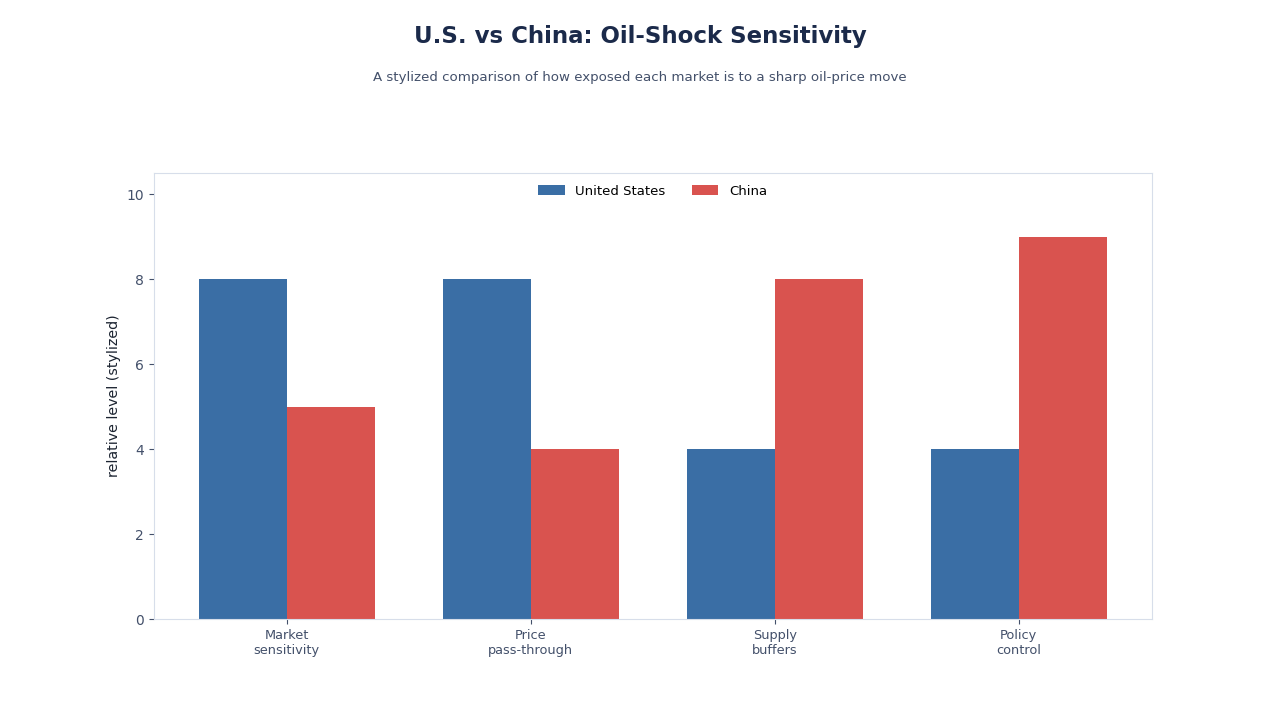
Comparative Analysis: U.S. vs China Energy Sensitivity
| Dimension | United States | China |
|---|---|---|
| Oil Dependency | High | Moderate |
| Market Exposure | Immediate | Buffered |
| Policy Flexibility | Market-driven | Centralized |
| Volatility Impact | High | Controlled |
Key Insight
- The U.S. system is efficient but fragile
- China’s system is less efficient but more resilient
This divergence is critical for global asset allocation strategies.
Advanced Trading Strategies for Oil-Driven Markets
To capitalize on oil volatility, traders must move beyond basic analysis.
Strategy 1: Correlation Mapping
Track relationships between:
- Oil (
WTI,Brent) - Bond yields (
US10Y) - Equity indices (
SPX,NDX)
Strategy 2: Multi-Timeframe Analysis
- Short-term (1m–15m): momentum trades
- Medium-term (1h–4h): trend confirmation
- Long-term (1d): macro positioning
Strategy 3: Event-Driven Trading
Focus on:
- OPEC meetings
- CPI releases
- Geopolitical announcements
- Identify event catalyst
- Predict oil reaction
- Position in correlated assets
Leveraging SimianX AI for Oil Market Intelligence
Traditional analysis is no longer sufficient in today’s high-speed markets. This is where SimianX AI provides a structural advantage.
Multi-Agent Decision Framework
SimianX AI integrates:
- Indicator Agent: RSI, MACD, EMA signals
- Intelligence Agent: News sentiment and abnormal flows
- Fundamental Agent: Macro and energy data
- Decision Agent: Final trade bias with risk parameters
Instead of isolated signals, SimianX delivers coordinated intelligence.
Real-Time Use Case
During an oil spike:
- Intelligence agent detects geopolitical risk
- Indicator agent confirms momentum breakout
- Decision agent outputs high-confidence trade setup
Why This Matters
- Reduces emotional trading
- Improves timing accuracy
- Enhances risk management
Long-Term Implications for Global Markets
Oil volatility is not just a short-term phenomenon—it is reshaping global economic architecture.
1. Energy Transition Acceleration
- Higher oil volatility → faster adoption of renewables
- Increased investment in alternative energy
2. Market Fragmentation
- Divergence between U.S. and China systems
- Regionalization of energy supply chains
3. AI-Driven Trading Dominance
Markets are becoming:
- Faster
- More data-driven
- Less predictable without AI
Scenario Analysis: Future Oil Shock Outcomes
| Scenario | Oil Price | U.S. Stocks | China Economy |
|---|---|---|---|
| Geopolitical Escalation | Surge | Selloff | Mild Impact |
| Supply Expansion | Drop | Rally | Stable |
| Demand Shock | Collapse | Volatility | Slower Growth |
Key Takeaway
Investors must prepare for multiple scenarios simultaneously, not just a single forecast.
How to Build a Resilient Portfolio in Oil-Volatile Markets
Diversification Strategy
- Energy equities
- Tech growth stocks
- Commodities
- Bonds
Risk Management Principles
- Use stop-loss levels
- Monitor volatility indices (
VIX) - Adjust position sizing
AI-Augmented Decision Making
With SimianX AI, investors can:
- Simulate different oil scenarios
- Evaluate risk-adjusted returns
- Execute with higher confidence
FAQ Continued: Advanced Investor Questions
How can oil volatility predict stock market crashes?
Oil spikes often signal inflation shocks, which can trigger aggressive monetary tightening—one of the main causes of market downturns.
What indicators best track oil-driven market risk?
Key indicators include oil futures, CPI data, bond yields, and volatility indices like VIX.
Is oil still the most important commodity for markets?
Yes, despite the rise of renewables, oil remains the core driver of global macro cycles.
How does AI improve oil market trading?
AI systems like SimianX analyze multiple data streams simultaneously, identifying patterns that human traders may miss.
Can China’s energy model be replicated globally?
Partially, but it requires centralized control and long-term planning, which may not suit all economies.
Extended Conclusion: Turning Volatility Into Opportunity
Oil market volatility is shaking U.S. stocks with increasing intensity, reflecting a world where macro, geopolitics, and technology intersect. At the same time, China’s energy resilience demonstrates that structural design can mitigate systemic risk.
For investors, the challenge is clear:
- Understand complex cross-market dynamics
- React quickly to changing conditions
- Maintain disciplined risk management
This is no longer achievable through manual analysis alone.
With SimianX AI, you gain access to:
- Real-time multi-agent insights
- Cross-market intelligence
- Actionable trading decisions
If you want to stay ahead in an oil-driven market landscape, now is the time to leverage AI-powered tools.
👉 Start exploring smarter trading strategies with SimianX AI and turn volatility into your competitive advantage.
Related Reading
- Iran Tensions: Oil $100 Spike, Energy +3.9%, S&P -1%
- Iran War Impact: Stocks Risk-Off, Oil $100-$120, VIX Spike
- Second Lebanon War 2006: Oil $78 Spike, Stocks Resilient
- Oil -5% on Iran-Hormuz Talks: Brent, WTI & Sector Map 2026
- Iran De-escalation 2026: Oil Down, Travel Stocks Rally Map
- 2019 Saudi Aramco Drone Strike: Oil +20%, Stocks -5%