Second Lebanon War 2006 Market Impact: Oil Spike & Stock Resilience
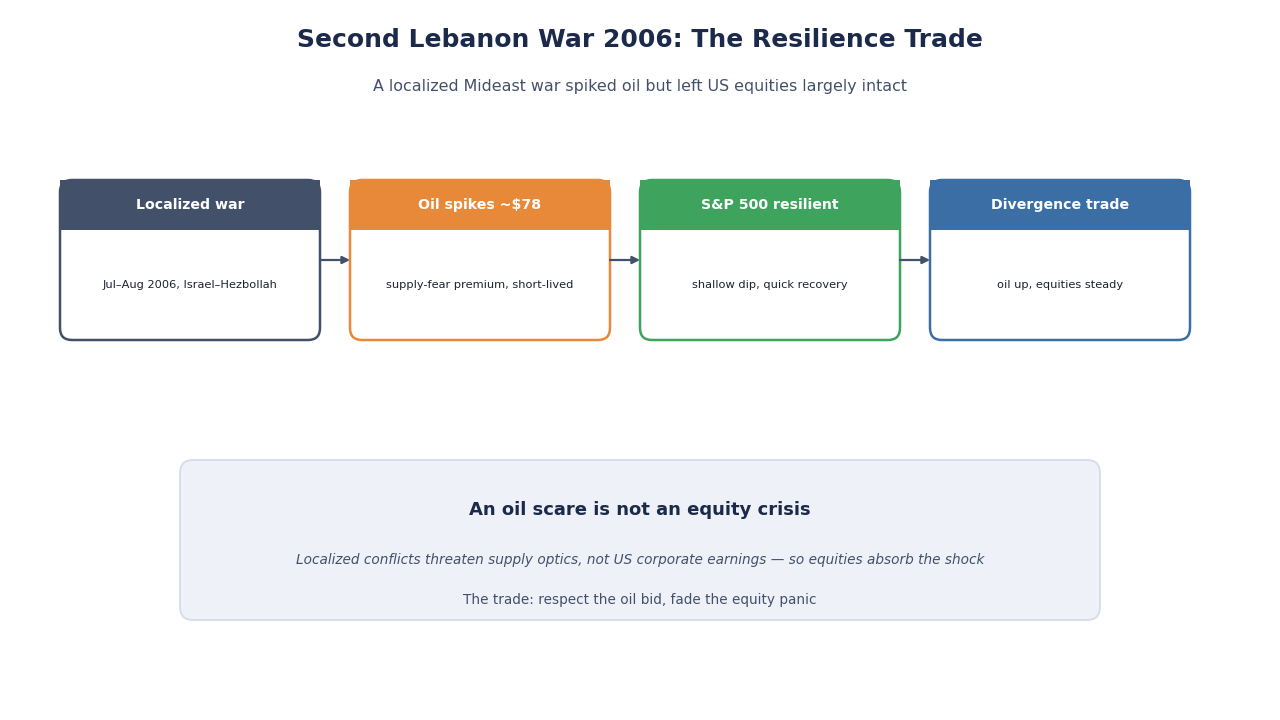
The Second Lebanon War 2006 market impact offers a powerful case study in how modern geopolitical conflicts affect financial markets. Unlike systemic crises such as the 1973 oil shock or the Gulf War, this conflict triggered a short-term oil spike but only limited stock drawdowns, followed by a rapid recovery.
For traders and investors, understanding these dynamics is critical—and tools like SimianX AI make it possible to analyze such events in real time, combining macro signals, sentiment, and technical indicators into actionable insights.
Understanding the Second Lebanon War Market Context
The Second Lebanon War began in July 2006, involving Israel and Hezbollah. While the conflict raised immediate geopolitical concerns, it differed significantly from broader Middle East wars in one key aspect:
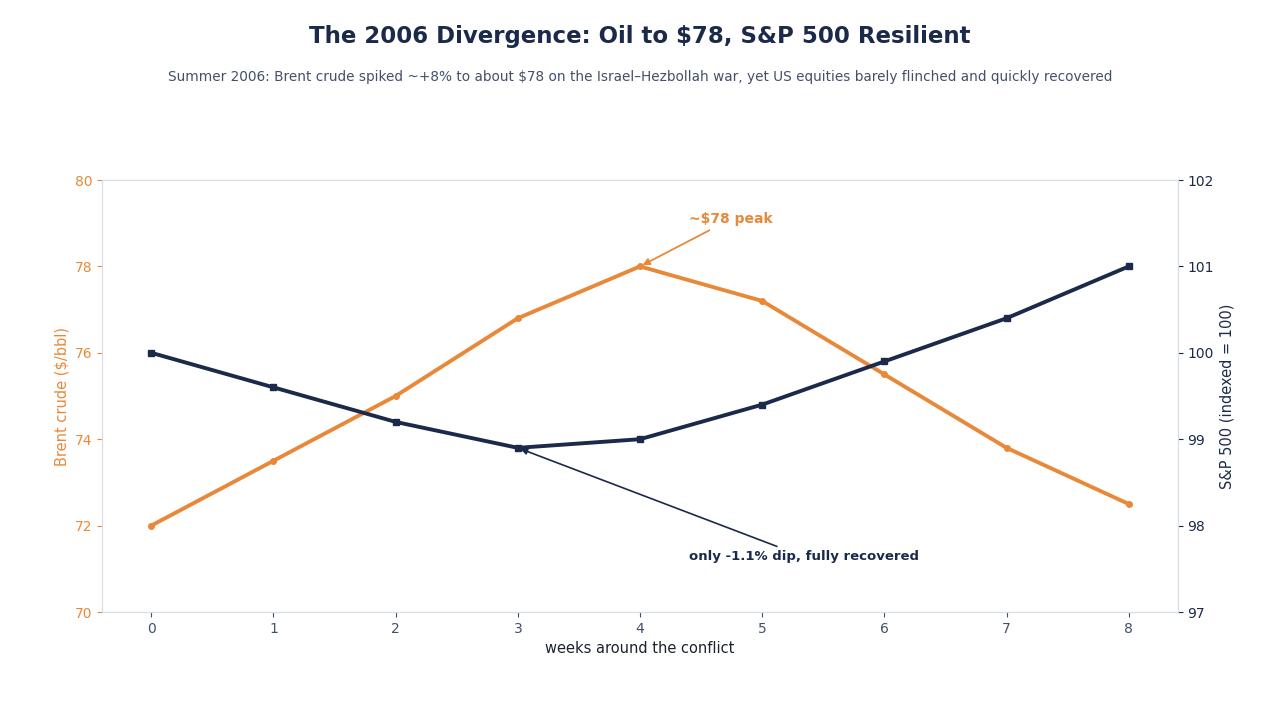
It did not disrupt global oil supply chains, despite triggering short-term fear-driven price spikes.
Key Market Characteristics
- Oil prices surged temporarily due to geopolitical risk premiums
- Global equities showed resilience, with only shallow drawdowns
- Regional economies (Lebanon) suffered severe contraction
- Recovery was fast, reflecting contained systemic risk
| Market Factor | Observed Impact |
|---|---|
| Oil Prices | Short-term spike |
| Global Equities | Limited drawdown |
| Regional Markets | Significant localized damage |
| Recovery Speed | Rapid (weeks, not months) |
This pattern is typical of what traders call “short-duration geopolitical shocks.”
Why Oil Spiked but Stocks Stayed Resilient
One of the most important insights from the Second Lebanon War 2006 market impact is the divergence between commodities and equities.
Oil Market Reaction
Oil markets are extremely sensitive to perceived supply risk, not just actual disruptions. During the war:
- Traders priced in potential escalation
- Risk premiums increased rapidly
- Speculative flows amplified price movement
However:
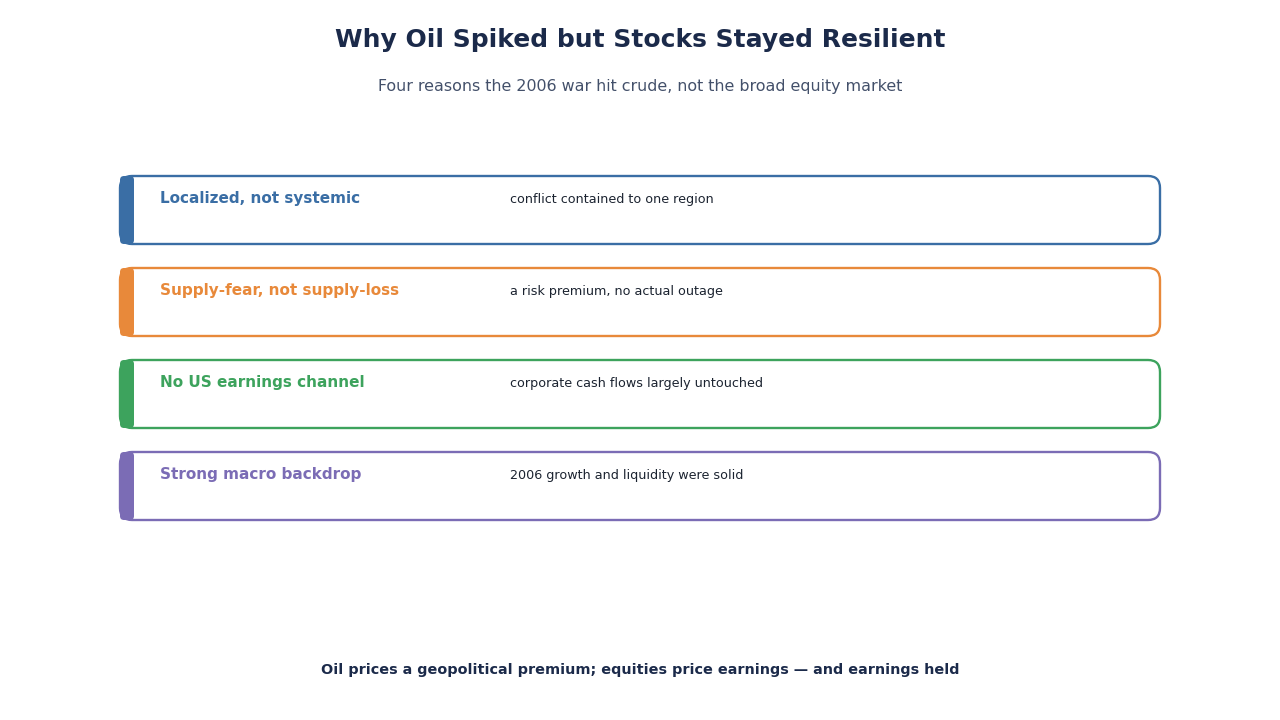
- No major pipelines or production hubs were affected
- Global supply remained stable
Equity Market Behavior
Stocks, especially in the U.S., reacted differently:
- Minimal drawdown due to strong macro backdrop
- Investors recognized the conflict as localized
- Liquidity conditions remained supportive
Markets often overreact initially to geopolitical headlines, then normalize once systemic risks are reassessed.
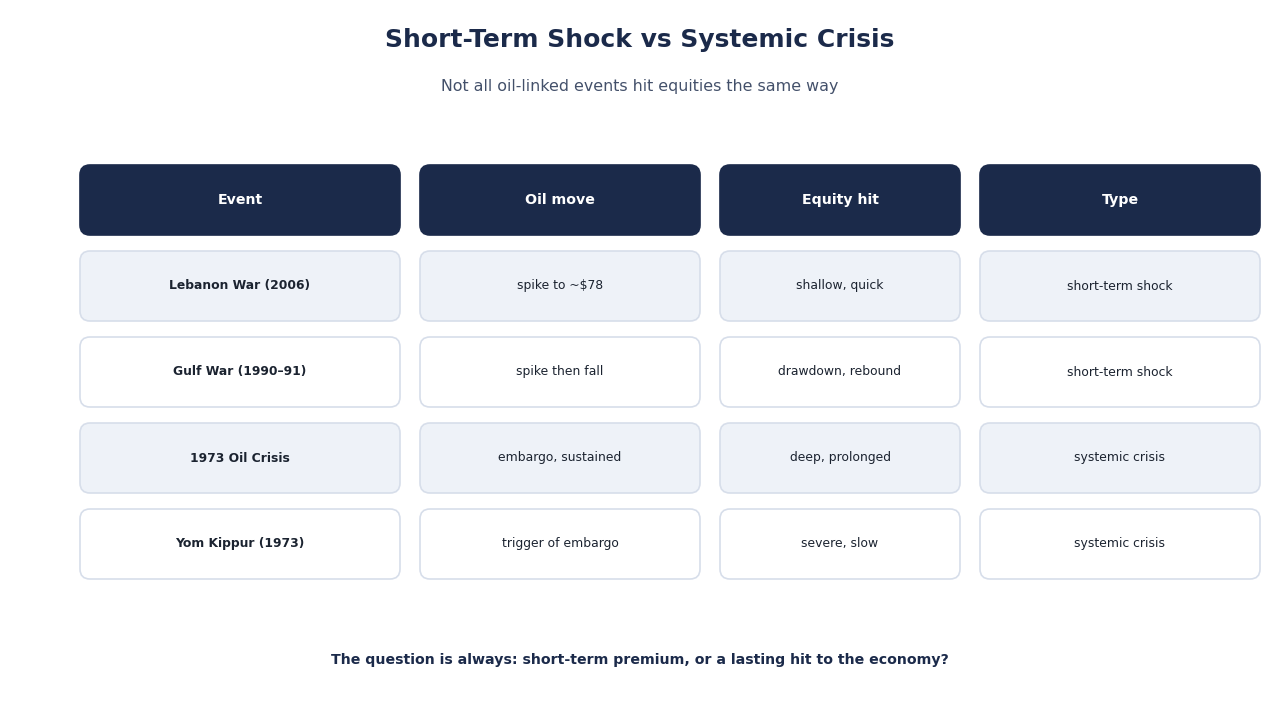
Trading Framework: Short-Term Shock vs Systemic Crisis
To effectively trade events like the Second Lebanon War, investors must distinguish between two types of geopolitical events:
1. Short-Term Shock Events
- Limited geographic scope
- No major economic infrastructure disruption
- Rapid sentiment-driven volatility
2. Systemic Crisis Events
- Global supply chain disruption
- Prolonged military engagement
- Deep and sustained drawdowns
| Event Type | Example | Market Impact |
|---|---|---|
| Short-Term Shock | Lebanon War 2006 | Oil spike, quick recovery |
| Systemic Crisis | Gulf War 1990 | Deep drawdown, long recovery |
Practical Trading Strategy
When facing short-term geopolitical shocks:
- Focus on volatility spikes rather than trend shifts
- Look for mean reversion opportunities
- Monitor oil and energy sector divergence
- Avoid panic selling in broad indices
- Identify initial market reaction
- Assess whether supply chains are affected
- Track sentiment vs fundamentals
- Enter positions during overreaction
How to Trade the Second Lebanon War 2006 Market Impact Using AI
Modern traders don’t rely solely on intuition—they use AI-driven systems like SimianX AI to decode complex signals.
Multi-Agent Analysis Approach
SimianX AI integrates:
- Indicator Agents (EMA, RSI, MACD)
- Sentiment Agents (news, geopolitical signals)
- Fundamental Agents (macro risk, liquidity)
- Decision Agents (final trade bias + risk levels)
Instead of guessing, traders can systematically evaluate whether a geopolitical event is transient or systemic.
Example Workflow
- Real-time detection of war-related news
- Spike in volatility + sentiment shift
- Technical indicators show oversold conditions
- AI suggests short-term rebound probability
| Signal Type | Interpretation |
|---|---|
| RSI Oversold | Potential bounce |
| News Sentiment | Panic-driven reaction |
| Oil Surge | Risk premium, not supply shock |
This structured approach significantly improves decision consistency and win rate.
H3 Subheading as a question with a long-tail keyword
How to trade short-term geopolitical shocks like the Second Lebanon War?
Trading short-term geopolitical shocks like the Second Lebanon War 2006 market impact requires separating emotional market reactions from structural risks. Traders should focus on identifying whether the event affects global supply chains or remains localized.
Using AI tools like SimianX AI helps filter noise, combining real-time sentiment, technical indicators, and macro signals to determine whether markets are likely to revert quickly or enter a prolonged downturn.
Key Lessons for Traders and Investors
1. Not All Wars Are Equal
- Some wars trigger global crises
- Others create temporary volatility only
2. Oil Is the First Mover
- Commodities react faster than equities
- Oil spikes often precede stock stabilization
3. Speed Matters
- Short conflicts → fast recoveries
- Markets price in outcomes quickly
4. Data Beats Emotion
- AI-driven analysis reduces bias
- Structured frameworks outperform intuition
FAQ About Second Lebanon War 2006 Market Impact
What happened to stocks during the Second Lebanon War 2006?
Stocks experienced only limited drawdowns, especially in global markets. The conflict was seen as localized, and investors quickly regained confidence once it became clear that global supply chains were unaffected.
Why did oil prices spike during the Lebanon War?
Oil prices rose due to geopolitical risk premiums, not actual supply disruptions. Traders feared escalation in the Middle East, which temporarily increased speculative demand.
How can traders profit from short-term war events?
Traders can profit by identifying overreactions, focusing on mean reversion strategies, and using tools like AI models to distinguish between panic and real economic impact.
Are geopolitical shocks good buying opportunities?
In many cases, yes—especially when the shock is short-lived and does not affect fundamentals. These situations often create temporary mispricing in the market.
What is the best way to analyze war-related market risks?
The best approach is combining technical indicators, sentiment analysis, and macro data, ideally through AI platforms like SimianX AI that integrate multiple perspectives.
Conclusion
The Second Lebanon War 2006 market impact demonstrates a crucial principle: not all geopolitical conflicts lead to deep market downturns. In this case, we saw a short-term oil spike, limited stock drawdown, and rapid recovery, offering valuable lessons for traders.
Understanding whether an event is a temporary shock or systemic crisis is the key edge. By leveraging structured frameworks and advanced tools like SimianX AI, traders can move beyond emotional reactions and make data-driven, high-confidence decisions.
If you want to navigate future geopolitical events with precision, explore how SimianX AI can transform your trading workflow today.
Deep Dive: Market Microstructure During the 2006 Conflict
To fully understand the Second Lebanon War 2006 market impact, we need to go beyond surface-level price movements and examine market microstructure—how liquidity, order flow, and participant behavior evolved during the conflict.
Liquidity Behavior Under Geopolitical Stress
During short-term geopolitical shocks:
- Liquidity does not disappear—it reprices
- Bid-ask spreads widen temporarily
- Institutional players reduce size, not participation
The key difference between a panic and a shock is not selling—it’s how liquidity providers adjust risk.
In 2006:
- U.S. equities retained strong liquidity
- Energy markets saw increased speculative volume
- Emerging markets experienced selective outflows
Order Flow Dynamics
Short-term shocks often create asymmetric order flow:
| Phase | Order Flow Behavior |
|---|---|
| Initial Shock | Aggressive sell orders (risk-off) |
| Information Phase | Mixed flow, uncertainty |
| Stabilization | Gradual institutional accumulation |
This explains why drawdowns remained shallow—buyers re-entered quickly.
Cross-Asset Reaction: A Multi-Market Perspective
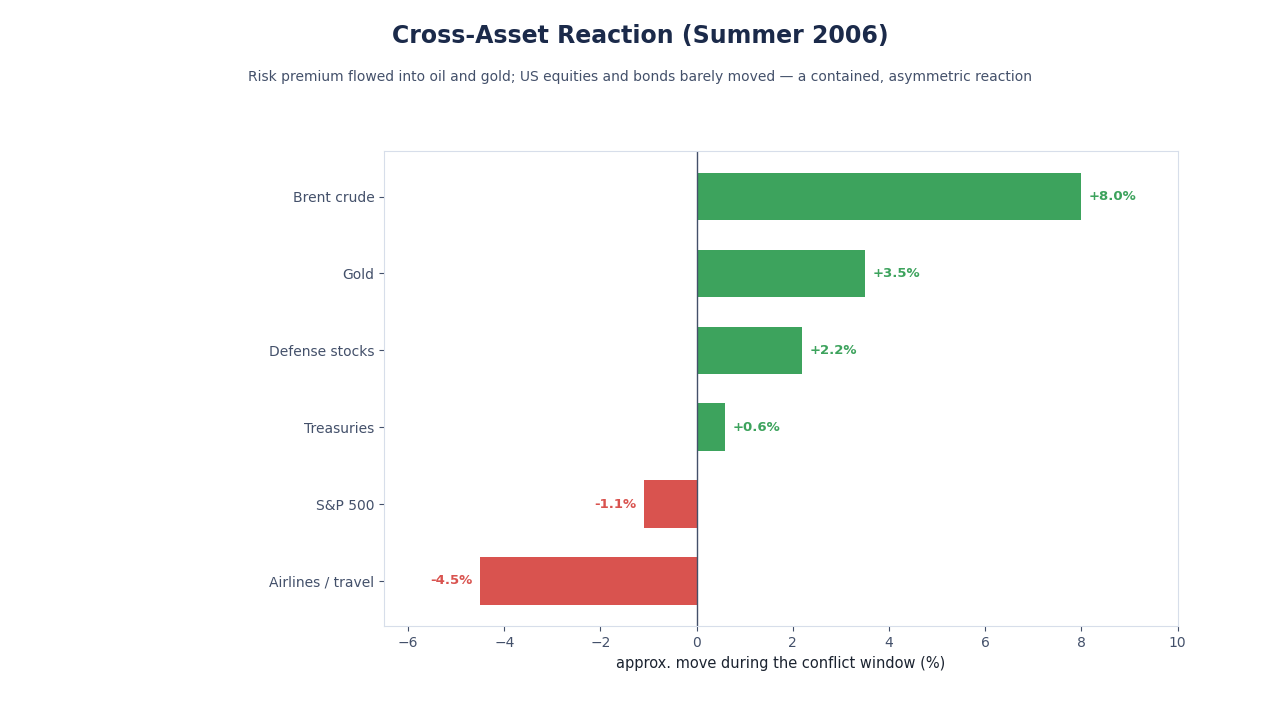
Understanding the Second Lebanon War 2006 market impact requires a cross-asset lens.
Asset Class Breakdown
1. Equities
- Mild declines in global indices
- Sector divergence:
- Energy stocks ↑
- Travel & tourism ↓
2. Commodities
- Oil surged due to geopolitical premium
- Gold saw moderate inflows as a safe haven
3. Bonds
- Slight flight to safety
- Yields dipped briefly
4. FX Markets
- USD remained relatively stable
- Emerging currencies weakened slightly
Key Insight
Cross-asset confirmation is essential—if only one asset reacts strongly, the event is likely non-systemic.
Sector-Level Impact: Winners and Losers
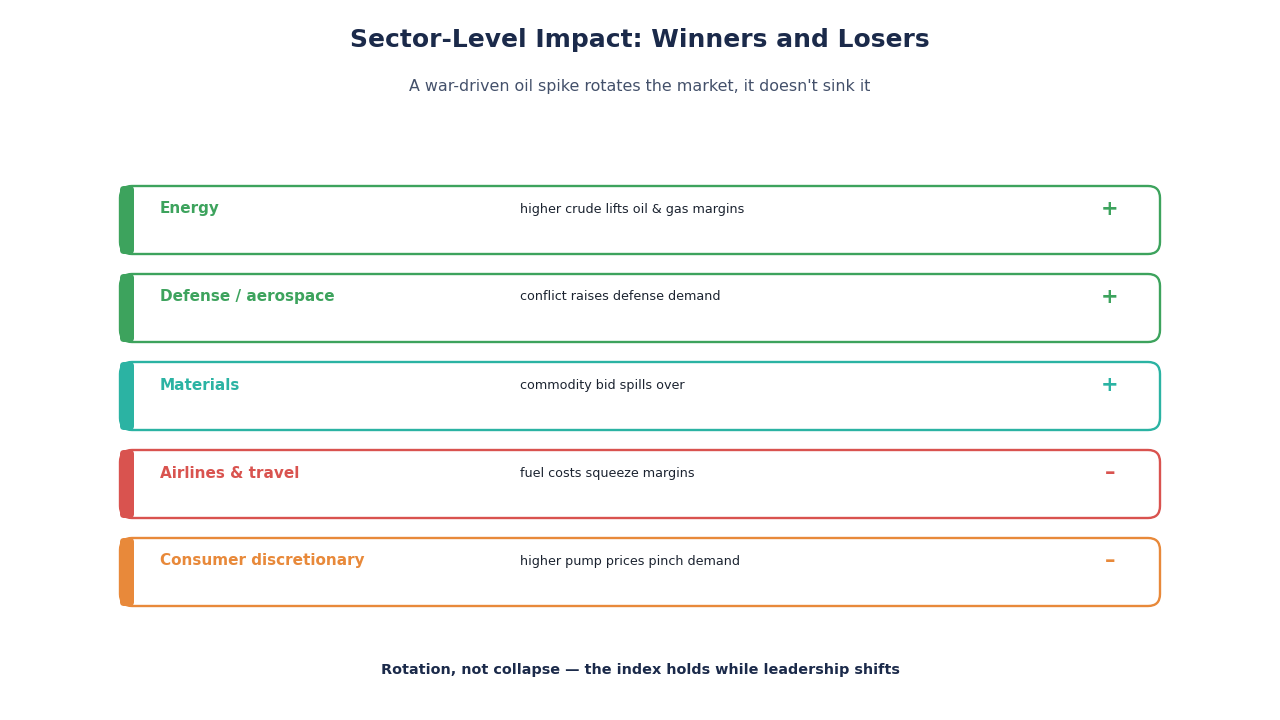
The Second Lebanon War 2006 market impact was uneven across sectors.
Beneficiaries
- Energy companies (oil price tailwind)
- Defense stocks (increased geopolitical risk perception)
Negative Impact
- Airlines (fuel costs + demand concerns)
- Tourism & hospitality (regional exposure)
Neutral / Resilient
- Technology
- Financials (outside affected regions)
| Sector | Impact Level | Reason |
|---|---|---|
| Energy | Positive | Oil price increase |
| Airlines | Negative | Fuel cost + demand shock |
| Tourism | Negative | Regional instability |
| Tech | Neutral | Limited exposure |
Time-Based Analysis: Speed of Recovery
One of the defining features of the Second Lebanon War 2006 market impact was speed.
Timeline Breakdown
- Day 0–3: Shock phase (headline-driven volatility)
- Day 4–10: Stabilization (information clarity improves)
- Week 2–4: Recovery (risk premium fades)
Markets are forward-looking—once escalation risk plateaued, prices normalized quickly.
Why Recovery Was Fast
- No systemic economic disruption
- Strong global liquidity environment (mid-2000s expansion)
- Investor confidence in containment
!market recovery curve:maxbytes(150000):stripicc():format(webp)/dotdashFinalV-ShapedRecoveryMay_2020-01-74805e5c5cf543eaa119180d437da5f4.jpg)
Behavioral Finance: Psychology of War-Driven Markets
Markets during geopolitical conflicts are driven as much by psychology as fundamentals.
Key Behavioral Patterns
- Availability bias → Overweighting recent headlines
- Loss aversion → Panic selling in early phase
- Herd behavior → Amplified volatility
Contrarian Opportunity
Smart money often:
- Buys during peak fear
- Sells into relief rallies
The edge lies in recognizing when fear exceeds fundamental impact.
Quant Framework: Classifying Geopolitical Events
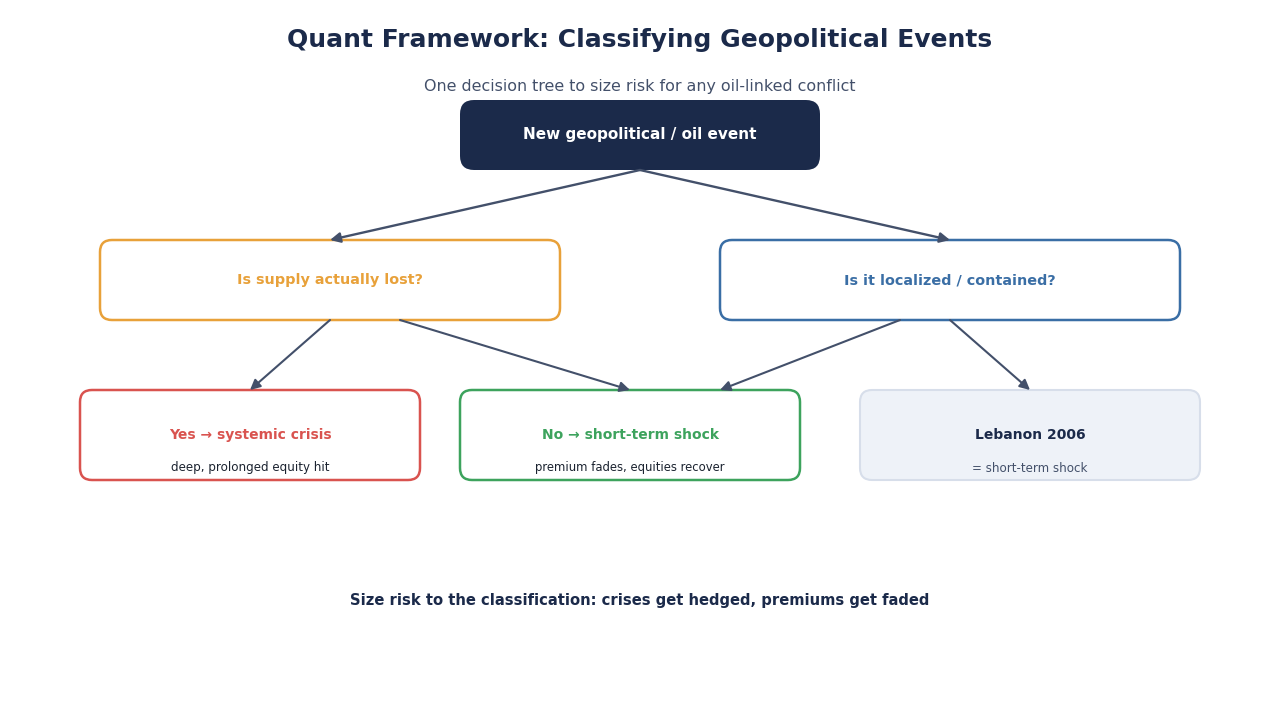
To systematically trade events like the Second Lebanon War, we can build a classification model.
Key Variables
| Variable | Low Impact Signal | High Impact Signal |
|---|---|---|
| Duration | Short | Prolonged |
| Geography | Localized | Multi-region |
| Oil Supply Impact | None | Significant |
| Financial Contagion | Limited | Global |
Scoring Model
Assign scores to each factor:
- Total score < 5 → Short-term shock
- Total score ≥ 5 → Systemic risk
The Lebanon War scores low → explaining limited market damage.
Integrating This Framework into SimianX AI
Modern trading requires automation and discipline—this is where SimianX AI becomes critical.
Real-Time Signal Flow
SimianX provides:
- Indicator signals (EMA, RSI, MACD alignment)
- Sentiment tracking (news + geopolitical events)
- Key levels (support/resistance zones)
- AI decision output (direction + confidence)
Example Use Case
During a Lebanon-style event:
- News agent detects escalation
- Sentiment turns bearish
- RSI drops into oversold territory
- Decision agent signals high-probability rebound setup
This allows traders to act before the recovery becomes obvious.
Advanced Strategy: Volatility Compression Trades
Short-term geopolitical shocks often lead to:
- Initial volatility spike
- Followed by rapid compression
Strategy Setup
- Enter after volatility peak
- Target mean reversion
- Use tight risk controls
Indicators to Watch
- VIX spikes
- RSI divergence
- Volume exhaustion
Volatility is not just risk—it’s an opportunity surface.
!volatility spike chart:maxbytes(150000):stripicc():format(webp)/VolatilitySpikes1-5c05846046e0fb0001eef335)
Comparing 2006 to Other Conflicts
To contextualize the Second Lebanon War 2006 market impact, let’s compare it with other events:
| Event | Drawdown | Bottom Time | Recovery | Type |
|---|---|---|---|---|
| Lebanon War 2006 | Mild | ~Days | Fast | Short-term shock |
| Israel-Hamas 2023 | -4.5% | 14 days | 19 days | Short-term shock |
| Gulf War 1990 | Deep | Months | Slow | Systemic crisis |
| 1973 Oil Crisis | Severe | Long | Very slow | Structural shock |
Key Pattern
- Modern conflicts → less systemic damage
- Markets have become more resilient due to:
- Better information flow
- Stronger monetary frameworks
- Diversified global supply chains
Building a Repeatable Trading Playbook
Here’s a practical playbook derived from the Second Lebanon War 2006 market impact:
Step-by-Step Process
- Event Detection
- Monitor geopolitical headlines
- Use AI sentiment scoring
- Impact Assessment
- Is oil supply affected?
- Is the conflict localized?
- Market Reaction Analysis
- Measure drawdown depth
- Track cross-asset signals
- Execution Strategy
- Fade panic moves
- Focus on high-liquidity assets
- Risk Management
- Define invalidation levels
- Avoid overexposure
Practical Example: Hypothetical Trade Setup
Let’s simulate a Lebanon-style event:
- S&P 500 drops 2% in 2 days
- Oil rises 5%
- RSI hits oversold
Trade Plan
- Entry: Near support level
- Stop: Below recent low
- Target: Pre-event price
| Parameter | Value |
|---|---|
| Entry Signal | RSI < 30 + sentiment extreme |
| Stop Loss | -1.5% below entry |
| Target | +3% rebound |
The Role of Data Latency and Information Flow
In 2006, information moved slower than today.
Now:
- News spreads instantly
- Markets react within seconds
- AI systems can process signals faster than humans
Speed is now a competitive advantage—those who react first capture the edge.
This makes platforms like SimianX AI essential for modern traders.
Future Implications: Are Markets Becoming Immune to War?
A key question:
Are markets desensitized to geopolitical conflicts?
Evidence suggests:
- Yes, for localized conflicts
- No, for systemic disruptions
Why?
- Increased diversification
- Stronger central bank interventions
- Better risk modeling
However:
- Tail risks still exist
- Black swan events remain unpredictable
Extending the Framework to Crypto Markets
Interestingly, the same principles apply to crypto:
- Bitcoin often reacts to geopolitical stress
- Short-term volatility spikes are common
- Recovery depends on liquidity conditions
Using SimianX AI:
- Traders can monitor BTC-USDT perpetual markets
- Combine sentiment + technical signals
- Execute faster than traditional setups
Final Strategic Takeaways
The Second Lebanon War 2006 market impact teaches us:
- Not all geopolitical events are equal
- Oil reacts faster than equities
- Markets recover quickly if fundamentals remain intact
- Volatility creates opportunity, not just risk
The edge belongs to those who can classify events correctly and act decisively.
Conclusion (Extended)
In today’s markets, geopolitical events are inevitable—but confusion is optional. The Second Lebanon War 2006 market impact provides a blueprint for navigating short-term shocks with clarity and precision.
By combining:
- Cross-asset analysis
- Behavioral insights
- Quant frameworks
- AI-powered decision tools
Traders can consistently outperform reactive participants.
Platforms like SimianX AI enable this transformation—turning complex, fast-moving geopolitical events into structured, high-probability trading opportunities.
If you want to stay ahead in an increasingly complex global market, now is the time to integrate AI into your workflow—and let SimianX AI guide your next move.
Related Reading
- Israel-Hamas 2023: S&P -4.5% Drawdown, 14-Day Bottom
- EP-3 Incident 2001: S&P -4.9%, 7-Day Recovery Pattern
- Afghanistan Withdrawal 2021: S&P +0.1%, the Non-Event Trade
- Yom Kippur War 1973: Oil 4x, 2-Year Global Stock Crash
- 1991 Gulf War Countdown: Oil Doubles, Pre-Storm Stock Setup
- 2019 Saudi Aramco Drone Strike: Oil +20%, Stocks -5%