
NextEra-Dominion Deal and the AI Power Bottleneck for Markets
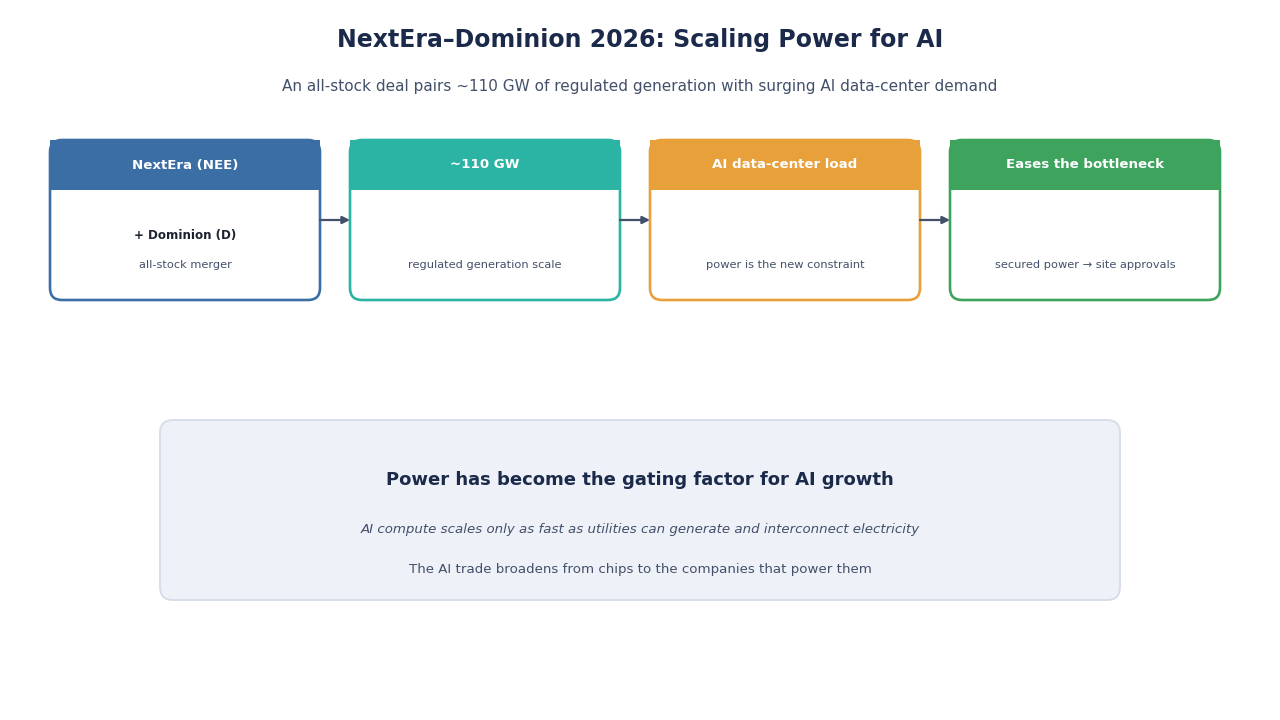
The NextEra-Dominion deal AI power bottleneck story is more than a utility merger headline. It is a market signal that the AI trade is moving from chips and models into electricity, grid capacity, financing, and regulation. On May 18, 2026, NextEra Energy and Dominion Energy announced an all-stock combination that would create the world’s largest regulated electric utility business by market capitalization, serving about 10 million utility customer accounts across Florida, Virginia, North Carolina, and South Carolina.
For investors, this matters because AI infrastructure is becoming a full-stack capital cycle: semiconductors need data centers, data centers need power, and power needs utilities that can build generation, transmission, storage, and grid resilience at scale. That is why platforms such as SimianX AI, which focuses on multi-agent stock analysis across fundamentals, technicals, news, and SEC data, are useful for tracking a story that cuts across sectors rather than staying inside one ticker.
Why the NextEra-Dominion Deal Is a Market Signal
The transaction terms are straightforward but strategically important. Dominion shareholders are set to receive 0.8138 shares of NextEra Energy for each Dominion share, with NextEra shareholders expected to own about 74.5% and Dominion shareholders about 25.5% of the combined company. The company would operate under the NextEra Energy name and trade under ticker NEE.
The official rationale is scale. The companies said the combined entity would be more than 80% regulated, own 110 GW of generation, and have more than 130 GW of large-load opportunities in its pipeline. They also proposed $2.25 billion in bill credits for Dominion customers in Virginia, North Carolina, and South Carolina over two years after closing.
The market is starting to price electricity as a strategic input for AI, not just a commodity cost.
That framing changes how investors should think about the AI ecosystem. A year ago, the dominant AI-market question was: Who sells the GPUs? The next question is: Who can deliver reliable, affordable, permitted, and dispatchable power to the places where GPUs will run?
The Key Market Read-Through
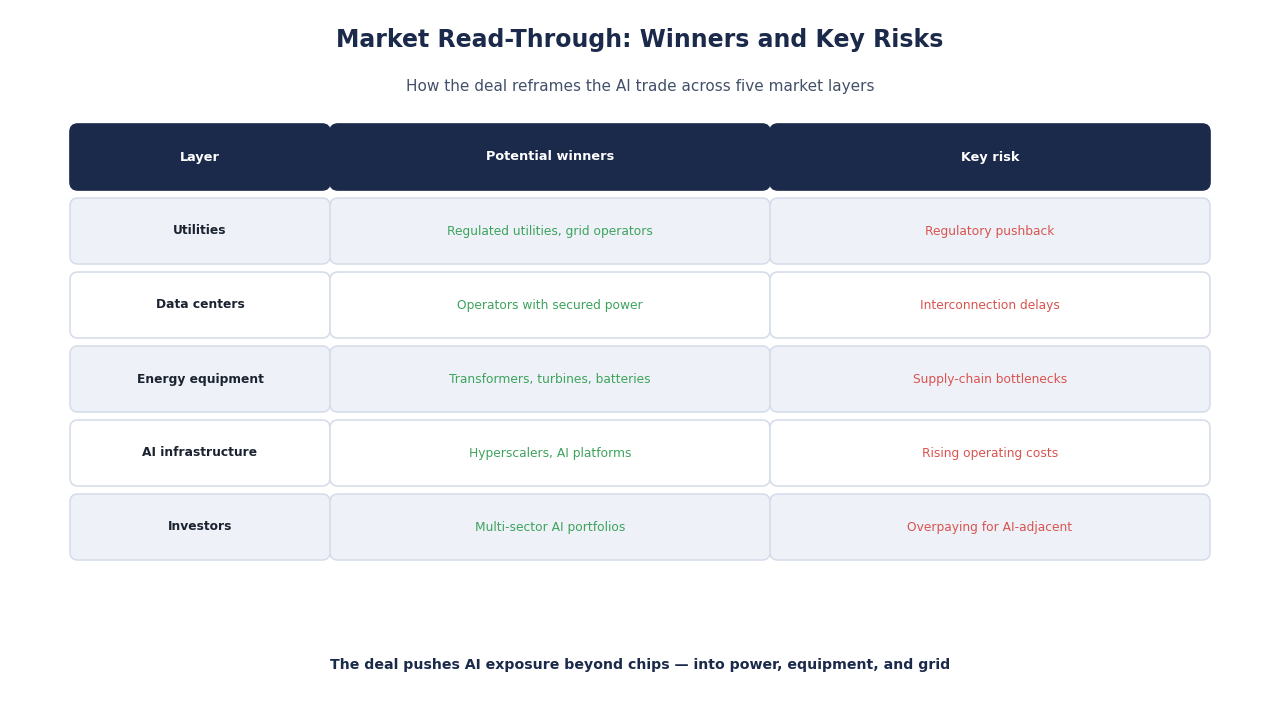
| Market Layer | What the Deal Suggests | Potential Winners | Key Risk |
|---|---|---|---|
| Utilities | Scale matters for large-load customers | Regulated utilities, grid operators | Regulatory pushback |
| Data centers | Power access is a site-selection constraint | Operators with secured power | Interconnection delays |
| Energy equipment | Grid buildout needs hardware | Transformers, turbines, batteries | Supply-chain bottlenecks |
| AI infrastructure | Compute growth depends on electricity | Hyperscalers, AI platforms | Rising operating costs |
| Investors | AI exposure broadens beyond chips | Multi-sector portfolios | Overpaying for “AI-adjacent” assets |
What Is the AI Power Bottleneck?
The AI power bottleneck is the gap between the speed at which companies want to deploy AI compute and the speed at which the power system can deliver electricity, transmission, cooling, and grid interconnection.
AI models need dense compute clusters. Those clusters need large data centers. Large data centers require massive, reliable, always-on power. Unlike software, power infrastructure cannot be scaled instantly. New generation, substations, transmission lines, transformers, and permits often take years.
The International Energy Agency’s Electricity 2026 report says global power demand is rising rapidly as the “Age of Electricity” accelerates, with growth coming from electrification as well as dynamic sectors such as AI and data centres. The IEA also emphasizes that power systems will need more flexibility to integrate changing demand patterns and diverse generation sources.
Why Does the NextEra-Dominion Deal AI Power Bottleneck Matter for Investors?
The NextEra-Dominion deal AI power bottleneck matters because it connects three market themes that investors often analyze separately:
- AI demand growth
- Utility capital expenditure
- Regulated rate-base expansion
Dominion is strategically important because Virginia is home to one of the world’s most important data center regions. Dominion helps power hundreds of data centers across Virginia, while NextEra owns Florida Power & Light and has also expanded a partnership with Google Cloud to build new data center campuses across the U.S.
That combination gives the merged company exposure to both regulated utility growth and large-load infrastructure demand. It also means investors need to evaluate the deal through several lenses:
- Accretion and financing: Can the deal improve earnings growth without creating balance-sheet strain?
- Regulatory approvals: Will state and federal regulators accept the transaction terms?
- Customer affordability: Can bill credits and efficiency claims reduce political resistance?
- AI demand durability: Will data center power demand continue to grow as expected?
- Execution risk: Can a massive utility platform integrate assets without delays?
The central investment question: does the deal create a better platform for AI-era power demand, or does it concentrate too much regulatory and execution risk inside one giant utility?
AI Data Centers Are Rewriting Electricity Demand
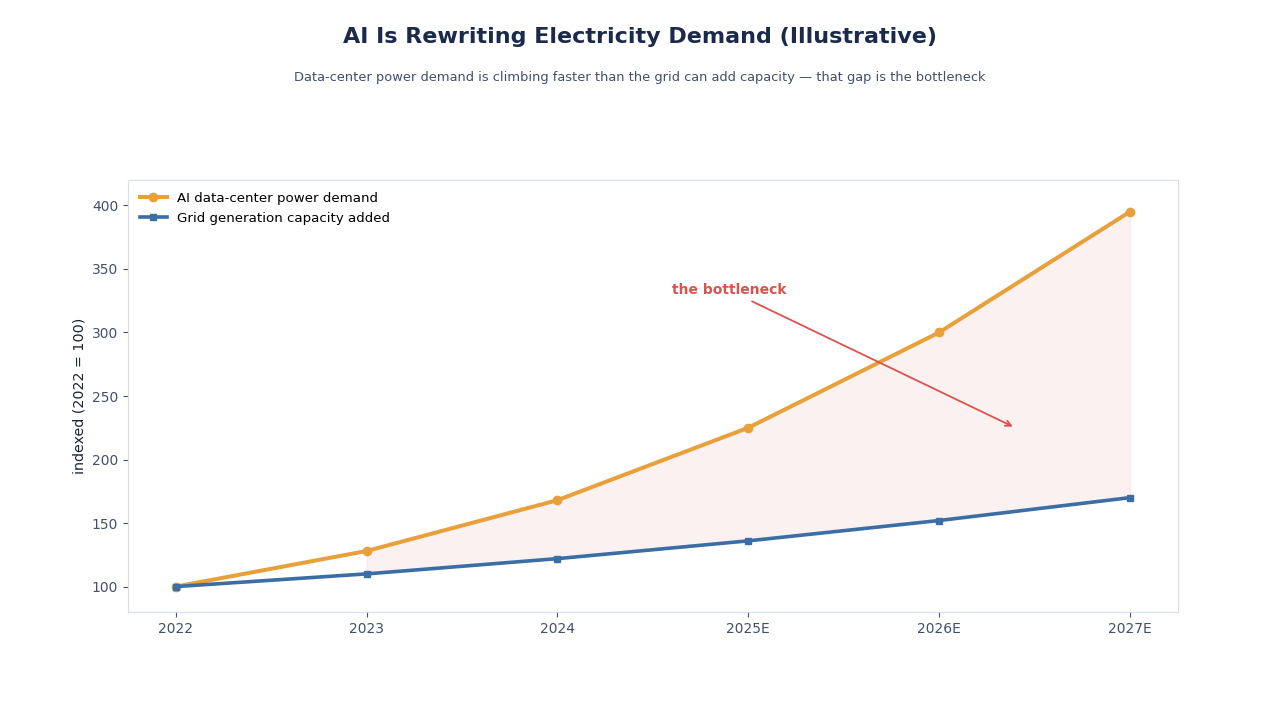
The AI power story is supported by broader electricity demand data. In January 2026, the U.S. Energy Information Administration said it expected U.S. electricity use to grow 1% in 2026 and 3% in 2027, marking the strongest four-year growth period since 2000, driven largely by large computing facilities including data centers.
Goldman Sachs Research has also forecast that global data center power demand could rise 50% by 2027 and as much as 165% by 2030 compared with 2023, with AI growing as a larger share of the total data center workload mix.
That is why the NextEra-Dominion deal should not be viewed as a one-off merger. It is part of a broader repricing of the energy stack behind AI.
The AI Infrastructure Chain
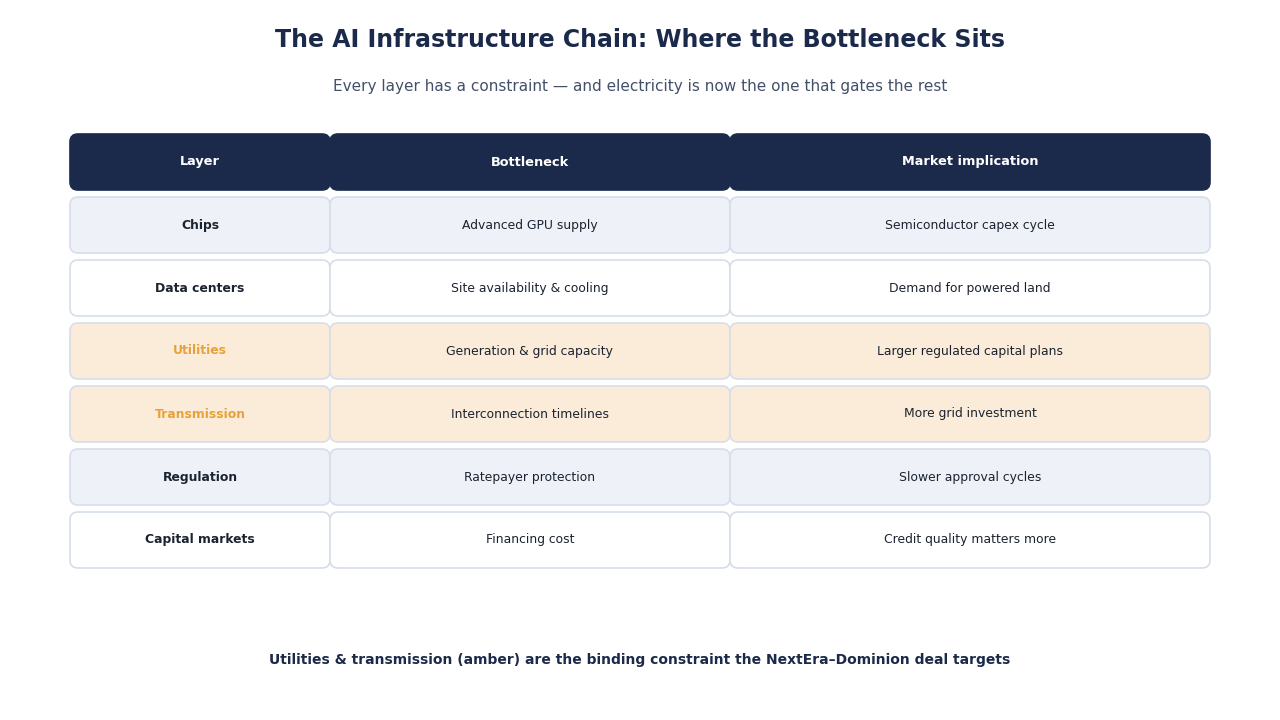
| AI Layer | Bottleneck | Market Implication |
|---|---|---|
| Chips | Advanced GPU supply | Semiconductor capex cycle |
| Data centers | Site availability and cooling | Higher demand for powered land |
| Utilities | Generation and grid capacity | Larger regulated capital plans |
| Transmission | Interconnection timelines | More grid investment |
| Regulation | Ratepayer protection | Slower approval cycles |
| Capital markets | Financing cost | Higher importance of credit quality |
Market Impact: Utilities Become AI Infrastructure Plays
For much of the last decade, utilities were treated as defensive income stocks. Their role was predictable: stable dividends, regulated returns, and lower volatility. The AI buildout changes that narrative.
Utilities that can serve large-load customers may now become AI infrastructure enablers. But this does not mean every utility is suddenly a growth stock. The distinction matters.
Utilities With AI Upside Usually Need Three Things
- Load growth from data centers, industrial reshoring, or electrification
- Constructive regulation that allows capital recovery
- Execution capability in generation, transmission, storage, and procurement
NextEra and Dominion are arguing that their combined scale improves all three. The official announcement says the combined company expects approximately 11% annual growth in regulatory capital employed and 9%+ adjusted EPS growth expectations through 2032, though these are forward-looking targets and depend on approvals, execution, and demand conditions.
For investors using SimianX AI, this is exactly the type of multi-signal setup where a single headline is not enough. A useful workflow would compare the merger news against NEE and D price action, balance-sheet quality, rate-case exposure, technical momentum, and sentiment shifts in related sectors such as data centers, grid equipment, natural gas, nuclear, and renewables.
The Regulatory Risk Is Not a Footnote
The deal may be strategically logical, but it is not automatically approved. The transaction requires approvals from shareholders and regulators, including the Federal Energy Regulatory Commission, the Nuclear Regulatory Commission, and utility regulators in Virginia, North Carolina, and South Carolina. The companies expect closing in 12 to 18 months, subject to customary conditions.
Regulatory scrutiny matters because AI data center growth is already politically sensitive. Officials and lawmakers in several states have pushed back against utility rate increases, with concerns that households could bear costs linked to system upgrades and rising power demand.
AI electricity demand is bullish for infrastructure, but ratepayer politics can cap how quickly that bullishness converts into earnings.
This is why the proposed $2.25 billion in bill credits is strategically important. It is not only a customer benefit; it is also a regulatory argument. The companies are effectively saying: scale will reduce financing and operating costs, and customers will share in those benefits.
How to Analyze the NextEra-Dominion Deal as an Investor
A practical research process should avoid both extremes: dismissing the deal as “just a utility merger” and blindly buying anything connected to AI power.
Use this step-by-step framework:
- Start with transaction math
Review the exchange ratio, ownership split, dividend policy, expected accretion, and financing assumptions.
- Map the load growth
Identify where data center demand is concentrated, especially in Virginia and other fast-growing service territories.
- Check regulatory exposure
Track state-level reactions, customer affordability commitments, rate-case schedules, and merger approval milestones.
- Compare capital plans
Look at rate base, generation mix, transmission needs, storage, nuclear exposure, gas generation, and renewable development.
- Monitor market confirmation
Watch whether utility stocks, independent power producers, grid equipment names, and data center REITs confirm the same theme.
- Stress-test AI demand
Consider what happens if AI inference grows faster than expected, or if model efficiency reduces power growth assumptions.
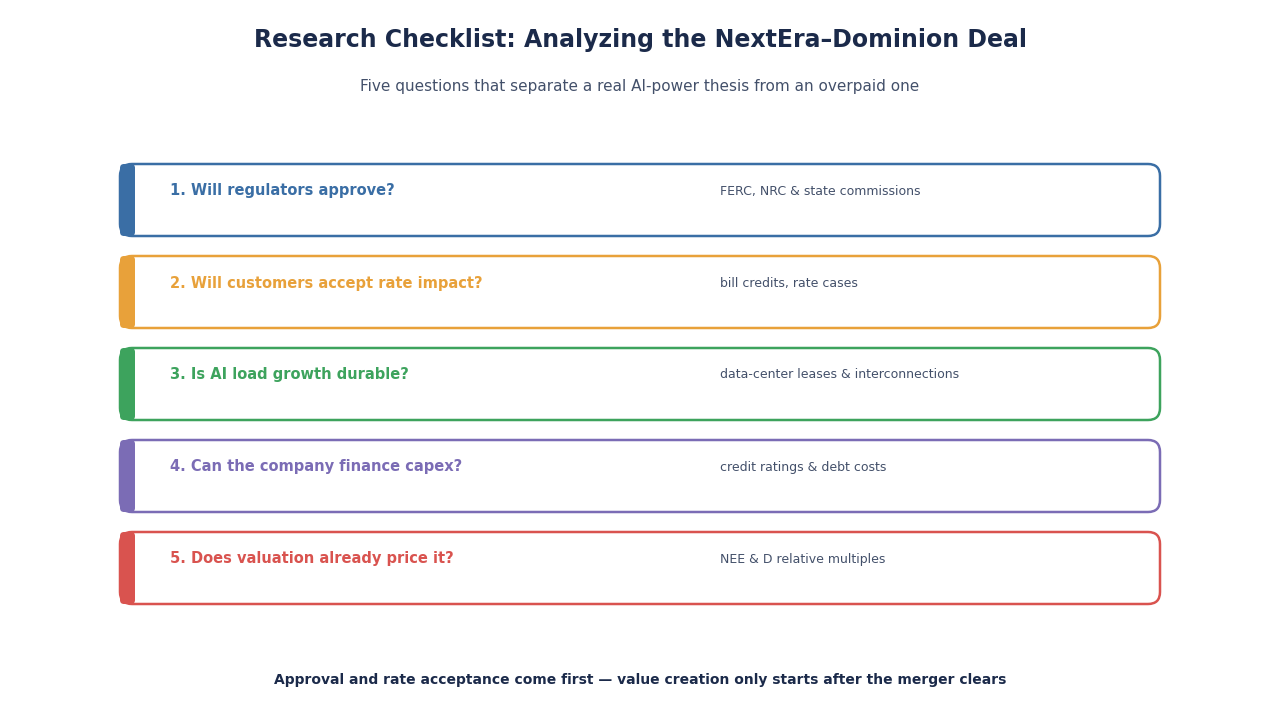
Research Checklist
| Question | Why It Matters | What to Watch |
|---|---|---|
| Will regulators approve the merger? | Approval is required before value creation begins | FERC, NRC, state commissions |
| Will customers accept the rate impact? | Political resistance can slow capex recovery | Bill credits, rate cases |
| Is AI load growth durable? | Demand drives the thesis | Data center leases, interconnections |
| Can the company finance capex? | Utilities depend on capital markets | Credit ratings, debt costs |
| Does valuation already reflect upside? | Good themes can become bad entries | NEE and D relative multiples |
What Sectors Could Benefit From the AI Power Bottleneck?
The NextEra-Dominion deal AI power bottleneck is a useful lens for mapping second-order beneficiaries. The obvious names are utilities, but the broader opportunity set includes companies that support grid expansion and power reliability.
Potentially relevant sectors include:
- Regulated electric utilities with large-load growth
- Independent power producers with dispatchable capacity
- Natural gas infrastructure for reliability and backup generation
- Nuclear operators and uranium-linked supply chains
- Battery storage providers and grid flexibility platforms
- Transformer and electrical equipment manufacturers
- Engineering, procurement, and construction firms
- Data center operators with secured power contracts
The risk is that investors may overgeneralize. Not every “AI power” company has the same economics. Regulated utilities earn returns through approved capital investment, while merchant power producers may benefit more directly from power-price volatility. Equipment suppliers may see order growth but face margin pressure from supply-chain costs.
Where SimianX AI Fits Into AI Power Market Research
AI power investing requires more than reading one press release. The relevant information is spread across merger documents, SEC filings, earnings calls, stock charts, news sentiment, analyst revisions, and macro power-demand forecasts.
That is where SimianX AI can fit naturally into the research workflow. Its stock analysis experience is designed around multiple agents: a fundamental analyst for financials and SEC filings, a technical indicator agent for momentum and market structure, a market intelligence agent for news and sentiment, and a decision engine that synthesizes signals into buy/sell/hold-style outputs with confidence scores.
For a complex theme like AI electricity demand, that multi-agent approach can help investors avoid single-factor thinking. A utility may have strong AI exposure but weak technicals. A grid equipment stock may have strong momentum but stretched valuation. A data center operator may have growth but power procurement risk.
The benefit is synthesis: investors need a way to connect energy, AI, regulation, and price action into one repeatable research process.
FAQ About the NextEra-Dominion Deal AI Power Bottleneck
What is the NextEra-Dominion deal AI power bottleneck?
The term refers to how the NextEra-Dominion merger highlights electricity as a key constraint for AI growth. The deal shows that utility scale, grid investment, and large-load power access are becoming central to the AI infrastructure market.
How does the NextEra-Dominion deal affect utility stocks?
It may push investors to value some utilities as AI infrastructure enablers rather than purely defensive dividend stocks. However, the upside depends on regulatory approval, capital recovery, financing costs, and whether data center electricity demand remains strong.
Why do AI data centers need so much electricity?
AI workloads rely on dense clusters of advanced chips that consume significant power and require cooling. As AI training and inference scale, data centers need more reliable electricity, stronger grid connections, and often new generation or storage resources.
Is the AI power bottleneck good for investors?
It can create opportunities in utilities, grid equipment, power generation, and data center infrastructure. But it also creates risks, including overvaluation, regulatory delays, rising customer bills, and uncertainty around long-term AI demand.
What is the best way to analyze AI energy stocks?
The best way is to combine fundamentals, technicals, news sentiment, regulatory tracking, and power-demand data. Tools such as SimianX AI can help investors structure that process by comparing multiple signals instead of relying on a single headline.
Conclusion
The NextEra-Dominion deal AI power bottleneck marks a turning point in the AI market narrative. The first phase of the AI boom centered on chips, models, and cloud platforms. The next phase is about electricity: who can generate it, transmit it, finance it, regulate it, and deliver it to the data centers where AI actually runs.
The proposed $67 billion NextEra-Dominion transaction signals that utility scale may become a strategic advantage in the AI era. It also reminds investors that the power trade is not risk-free. Regulatory approvals, customer affordability, rate cases, execution timelines, and valuation discipline all matter.
For investors and market researchers, the key takeaway is simple: AI is no longer only a software or semiconductor story. It is now an energy infrastructure story. To track that shift with more discipline, explore SimianX AI and use its multi-agent stock analysis workflow to evaluate how AI power demand is reshaping markets.
Related Reading
- AI Stock Boom: Nvidia Leads the Chip Supercycle Now
- AI Chip Stocks Stay Strong: AMD, Intel Drive Data Centers
- AI Rally Stress Test: Nvidia Earnings vs 5% Yields 2026