GLW Stock 2026: Corning’s AI Data Center Photonics Boom
GLW Stock 2026 has become one of the most interesting AI infrastructure research topics because Corning Incorporated is no longer just a glass, display, and Gorilla Glass story. The company is increasingly positioned as a supplier of the physical optical backbone behind AI data centers: fiber, cable, connectivity, photonics, and next-generation network components. For investors researching GLW, the key question is simple but important: Is Corning’s AI data center photonics boom durable enough to justify the stock’s new growth expectations?
At SimianX AI, stock research is most useful when it combines fundamentals, market context, technical momentum, valuation, news catalysts, and risk debate. This GLW stock 2026 research article applies that multi-signal mindset to Corning’s AI photonics opportunity.
Why GLW Stock 2026 Is Suddenly an AI Infrastructure Story
Corning has historically been associated with glass science, display substrates, ceramics, specialty materials, and optical fiber. The market’s renewed interest in GLW stock in 2026 comes from a specific shift: AI data centers require enormous amounts of high-bandwidth, low-latency connectivity, and Corning’s optical communications portfolio sits directly in that demand chain.
AI clusters are not just collections of GPUs. They are networks of accelerators, switches, racks, storage systems, and data center campuses that need to move data quickly and reliably. As AI models become larger and workloads become more distributed, the bottleneck often moves from compute alone to networking capacity.
That is where Corning’s fiber and photonics thesis matters.
Key takeaway: the GLW stock 2026 bull case depends less on consumer electronics recovery and more on whether AI data center connectivity becomes a multi-year optical infrastructure cycle.
The investment narrative can be summarized in three layers:
- Core business improvement: Optical Communications is growing faster than several of Corning’s legacy segments.
- AI hyperscaler demand: Major cloud and AI infrastructure buyers are signing long-term supply agreements.
- Photonics optionality: Corning is building a new growth platform around photonics, optical scale-up, and advanced connectivity.
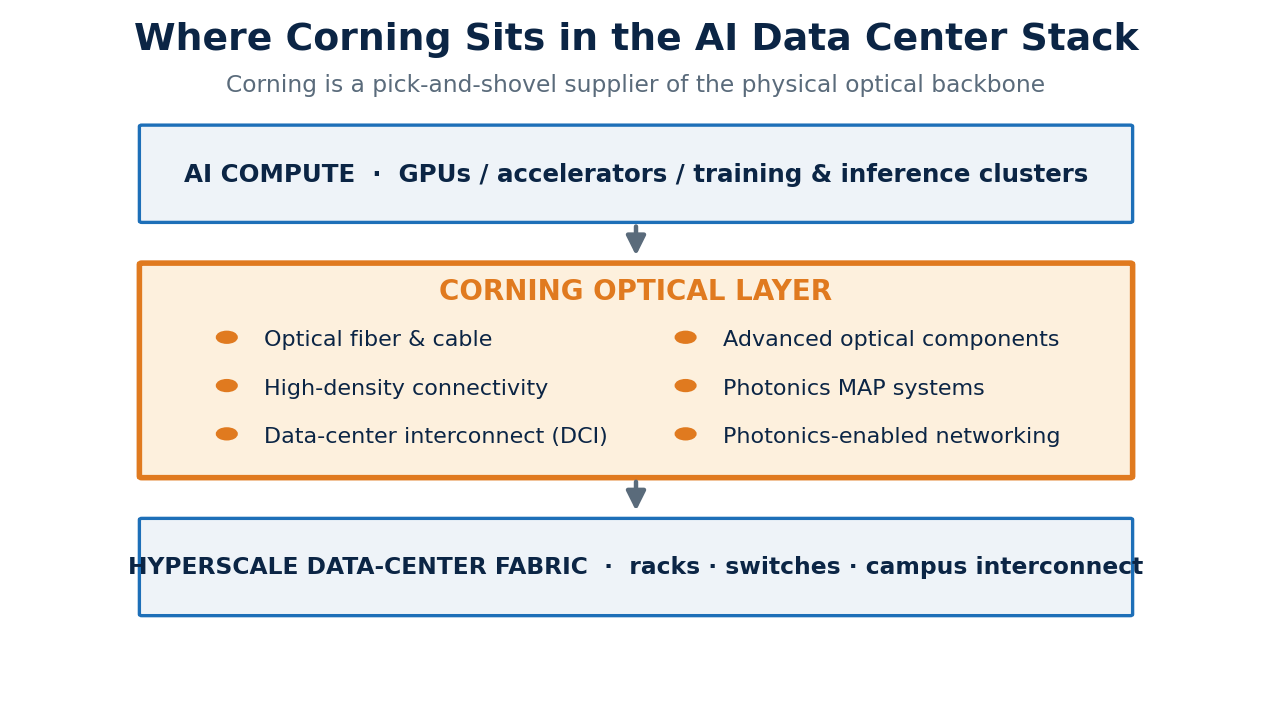
This makes GLW different from many AI stocks. It is not a GPU designer, cloud software company, or model provider. Instead, Corning is a pick-and-shovel AI infrastructure supplier whose products help data move inside and between data centers.
What Is Driving Corning’s AI Data Center Photonics Boom?
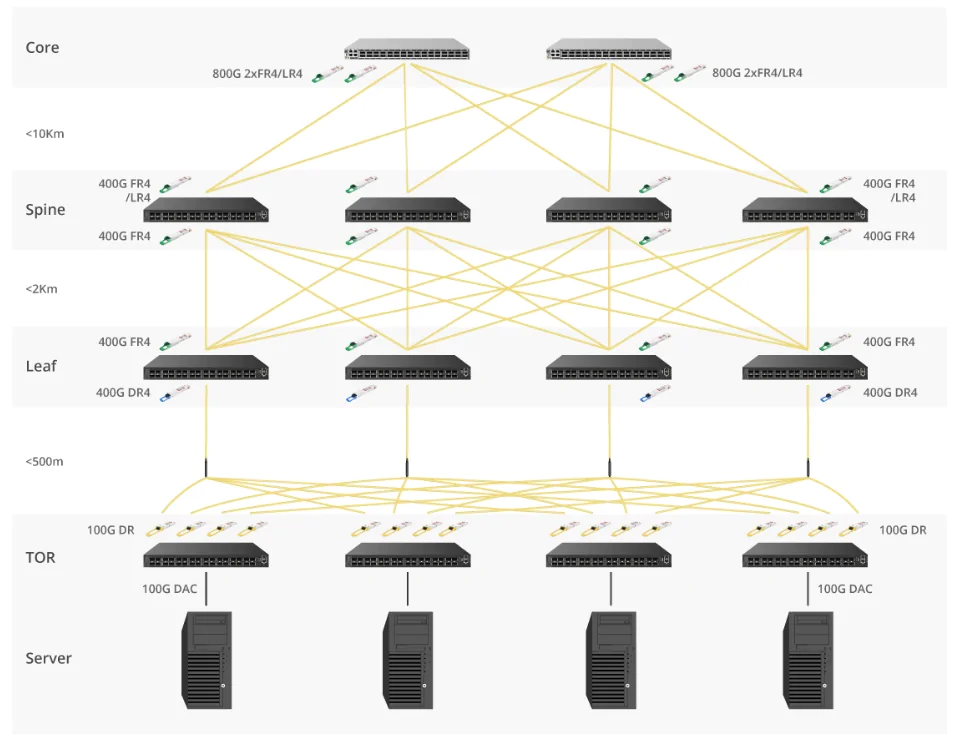
The Corning AI data center photonics boom is being driven by a structural change in how modern compute networks are built. Traditional copper interconnects can be useful over short distances, but AI data centers increasingly require optical links to support scale, density, bandwidth, and energy efficiency.
In practical terms, Corning benefits when customers need more:
- Optical fiber
- Fiber optic cable
- High-density connectivity
- Data center interconnect products
- Advanced optical components
- Photonics-enabled networking systems
The AI Network Problem
AI workloads create a massive communication challenge. GPUs and accelerators must exchange data across training clusters, inference networks, and storage systems. As the number of chips increases, the amount of data moving across the network can rise dramatically.
For investors, the important point is that AI infrastructure spending is not limited to semiconductors. Every new AI factory or hyperscale data center needs power, cooling, buildings, servers, optics, cables, connectors, and operational services. Corning’s opportunity lives in this “physical AI infrastructure” layer.
Corning’s Competitive Angle
Corning has three advantages that make the GLW stock 2026 thesis worth studying:
- Deep manufacturing know-how in glass and optical physics.
- Long-standing optical fiber leadership with enterprise and carrier network products.
- Customer proximity to hyperscale data center builders that need reliable domestic supply.
This does not remove risk, but it gives Corning a clearer AI infrastructure identity than it had during earlier periods when investors mainly viewed GLW through display cycles, smartphone glass, or telecom spending.
GLW Stock 2026 Research Framework: What Investors Should Watch
A strong GLW stock 2026 research process should avoid one-dimensional thinking. The bull case is compelling, but the stock’s upside depends on execution, valuation, capacity expansion, customer concentration, and whether AI infrastructure spending remains strong.
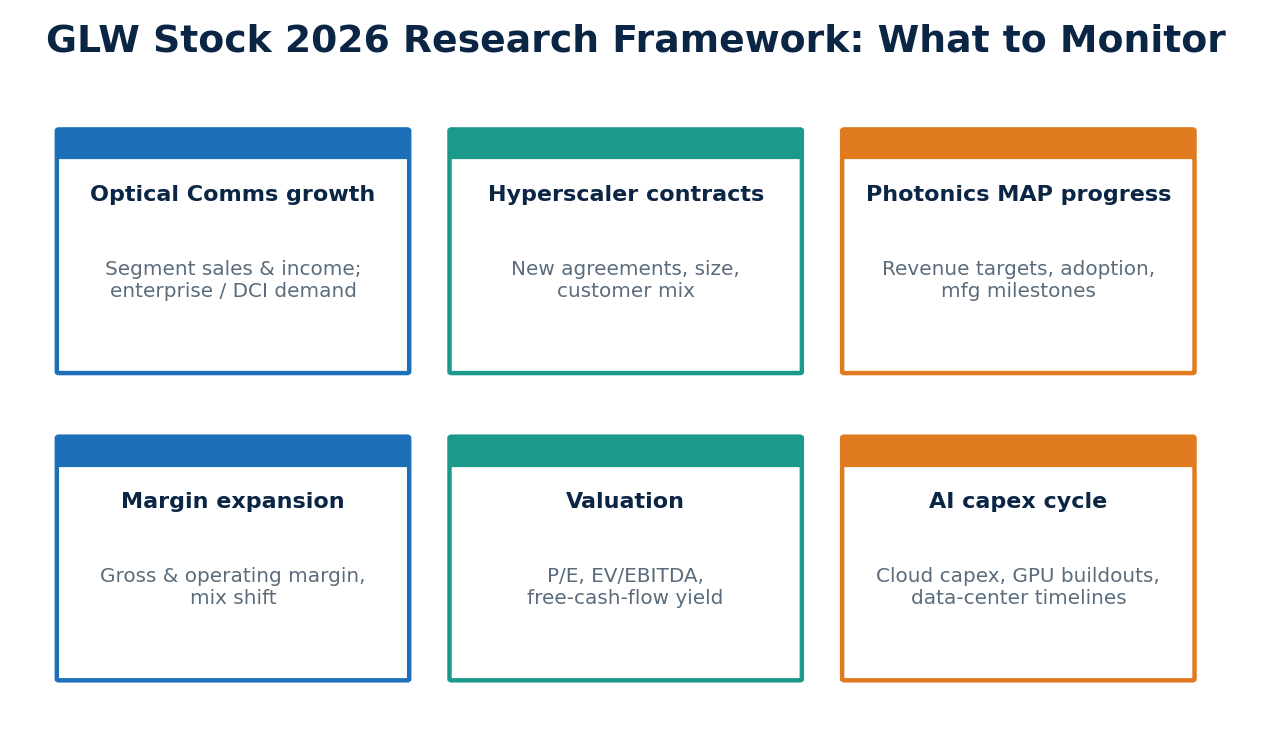
Here is a practical framework investors can use.
| Research Area | Why It Matters for GLW Stock 2026 | What to Monitor |
|---|---|---|
| Optical Communications growth | Shows whether AI demand is translating into revenue | Segment sales, segment income, enterprise network demand |
| Hyperscaler contracts | Validates long-term demand visibility | New agreements, contract size, customer mix |
| Photonics MAP progress | Measures the next growth platform | Revenue targets, product adoption, manufacturing milestones |
| Margin expansion | Determines whether growth becomes earnings power | Gross margin, operating margin, mix shift |
| Valuation | Shows whether optimism is already priced in | P/E, EV/EBITDA, free cash flow yield |
| AI capex cycle | Determines durability of demand | Cloud capex, GPU cluster buildouts, data center delays |
The best GLW stock analysis in 2026 should combine fundamental evidence with catalyst tracking. A rising stock price alone is not enough. Investors need to ask whether Corning’s revenue, margins, and long-term contracts are keeping pace with the market’s expectations.
Is GLW Stock 2026 a Pure AI Data Center Photonics Play?
No. GLW stock 2026 is not a pure AI data center photonics play, and that is both a strength and a weakness.
Corning still operates across multiple businesses, including Optical Communications, Display, Specialty Materials, Automotive, Life Sciences, and emerging growth areas. This diversification can reduce dependence on one end market, but it can also dilute the AI story if slower legacy segments offset optical momentum.
Why Diversification Helps
Diversification gives Corning several ways to generate revenue and cash flow. If one market softens, another may help stabilize the company. For long-term investors, this can make GLW less speculative than a narrow AI hardware supplier.
Benefits include:
- Exposure to multiple end markets
- A long operating history
- Established manufacturing assets
- Potential margin improvement from mix shift
- A dividend and mature capital allocation profile
Why Diversification Can Limit the AI Multiple
The downside is that investors may not value Corning like a high-growth AI company unless optical and photonics revenue becomes large enough to dominate the overall story. If Display or other segments weaken, they could pressure consolidated results even while AI connectivity grows.
That is why the most important GLW stock 2026 question is not simply “Is Corning exposed to AI?” It is:
Can AI-driven Optical Communications and Photonics growth become large enough to change Corning’s consolidated growth rate and valuation range?
Corning’s Photonics MAP: The Center of the Bull Case
Corning’s Photonics Market-Access Platform, or Photonics MAP, is central to the long-term GLW stock 2026 bull case. The concept is straightforward: as AI data center networks scale out and eventually scale up, customers will need more advanced optical connectivity technologies.
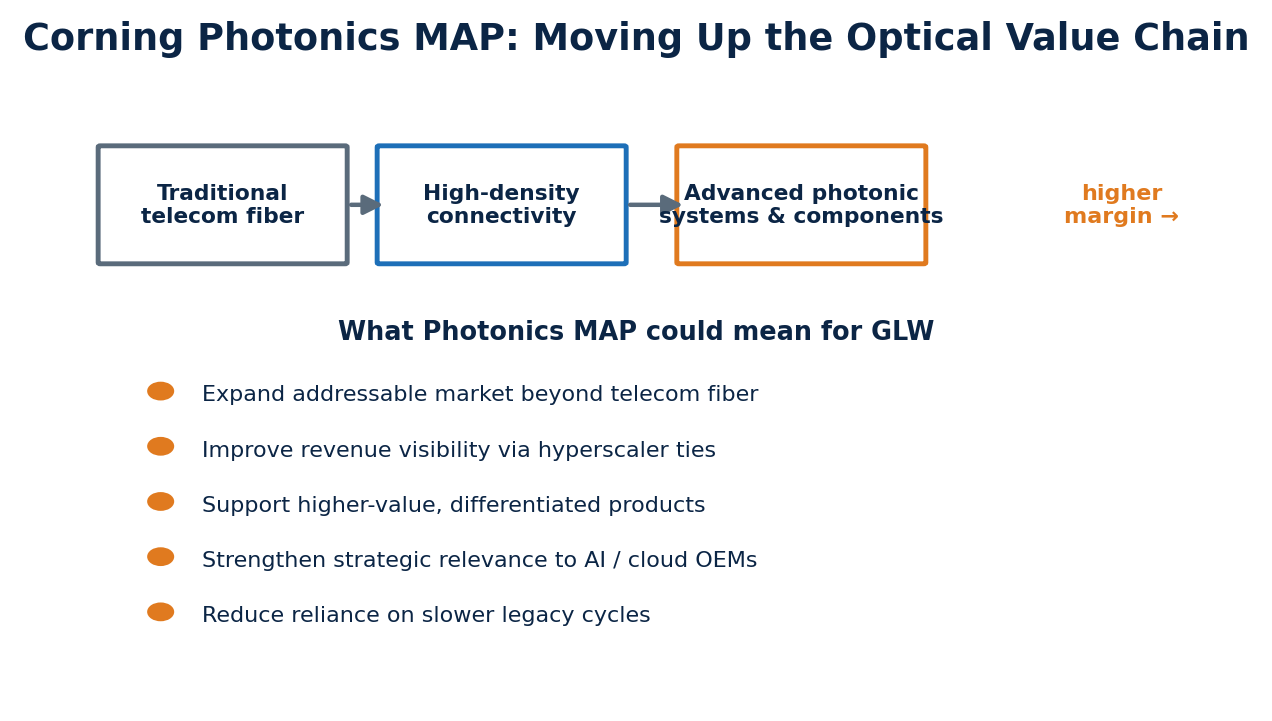
For investors, Photonics MAP matters because it suggests that Corning is not only selling more fiber. It is trying to move up the value chain into advanced photonic systems and components where differentiation, technical know-how, and customer integration could support better growth.
What Photonics MAP Could Mean for GLW
Photonics MAP could help Corning in several ways:
- Expand addressable market size beyond traditional telecom fiber.
- Improve revenue visibility through long-term hyperscaler relationships.
- Support higher-value products if advanced photonics commands better margins.
- Strengthen strategic relevance to AI OEMs and cloud infrastructure buyers.
- Reduce reliance on slower legacy cycles over time.
This is why GLW stock 2026 research should treat Photonics MAP as a strategic indicator, not just a product label.
Step-by-Step: How to Analyze GLW Stock in 2026
Investors researching GLW stock in 2026 should use a repeatable workflow. The goal is not to predict the next tick, but to build a high-conviction view based on evidence.
Step 1: Start With Segment Revenue
Look first at Optical Communications. Is the segment still growing faster than the company overall? Are enterprise networks and data center interconnect demand driving the increase? If optical growth slows, the AI thesis weakens.
Step 2: Check Margin Conversion
Revenue growth is not enough. Investors should ask whether higher optical volume is improving margins and earnings. If capacity expansion creates cost pressure before revenue scales, near-term profits may disappoint.
Step 3: Track Customer Announcements
Large agreements with hyperscalers can validate demand, but they can also create concentration risk. A balanced thesis should track both the size of wins and the diversity of customers.
Step 4: Compare Price to Fundamentals
A strong story can still be overvalued. Use valuation metrics like P/E, EV/EBITDA, free cash flow yield, and forward earnings growth. Compare GLW with other AI infrastructure suppliers, diversified industrial technology companies, and optical networking peers.
Step 5: Watch AI Capex Sentiment
If cloud providers slow AI data center spending, GLW could be affected. Monitor hyperscaler capital expenditure guidance, GPU cluster deployment plans, and data center construction timelines.
A disciplined GLW stock 2026 framework should separate business quality from entry price. A company can be strategically well-positioned while still carrying valuation risk.
Bull Case for GLW Stock 2026
The bull case for GLW stock 2026 rests on the idea that Corning is becoming a critical supplier to the AI infrastructure buildout.
Bullish Drivers
- AI data center demand: Larger AI clusters need more optical connectivity.
- Hyperscaler partnerships: Long-term agreements can improve revenue visibility.
- Photonics growth: Advanced optical products may expand Corning’s addressable market.
- Manufacturing scale: Corning’s domestic capacity expansion could become a competitive advantage.
- Portfolio transformation: Optical growth could shift investor perception away from slower legacy segments.
If these drivers remain intact, Corning could transition from a cyclical materials and display company into a higher-growth AI infrastructure compounder.
What Would Confirm the Bull Case?
The clearest confirmation would be continued growth in Optical Communications, improving margins, more customer wins, and tangible revenue contribution from Photonics MAP. Investors should also look for management commentary showing that AI data center demand is broadening rather than relying on one or two major customers.
Bear Case and Key Risks for GLW Stock 2026
The bear case is not that Corning lacks AI exposure. It clearly has exposure. The bear case is that the market may overestimate the speed, margin impact, or durability of the AI photonics boom.
Main Risks
- Valuation risk: If GLW trades at a high multiple, even good results may not be enough.
- AI capex slowdown: Hyperscaler spending can be cyclical and politically sensitive.
- Execution risk: New plants, capacity expansion, and workforce scaling can create delays.
- Customer concentration: Large contracts can increase dependency on a few buyers.
- Legacy segment drag: Display, consumer electronics, or automotive softness could offset optical strength.
- Technology shifts: Networking architectures can evolve, and Corning must stay aligned with customer roadmaps.
The most important risk is expectation risk. When a stock becomes associated with AI, investors may price in years of future growth quickly. That creates a higher hurdle for earnings, guidance, and contract execution.
GLW Stock 2026 Valuation: What Matters Most?
Valuation is the hardest part of the GLW stock 2026 debate. Corning’s AI data center photonics exposure may justify a higher multiple than in previous cycles, but investors should be cautious about paying too much for a business that still has diversified industrial and materials exposure.
A practical valuation approach should include:
| Valuation Lens | Investor Question |
|---|---|
| Forward P/E | Is the market pricing GLW like a mature industrial or an AI infrastructure growth stock? |
| Revenue growth | Is optical growth large enough to lift total company growth? |
| Margin expansion | Are higher-value products improving profitability? |
| Free cash flow | Is capacity expansion consuming cash or creating long-term value? |
| Scenario analysis | What happens if AI demand remains strong, slows, or accelerates? |
A Simple Scenario Framework
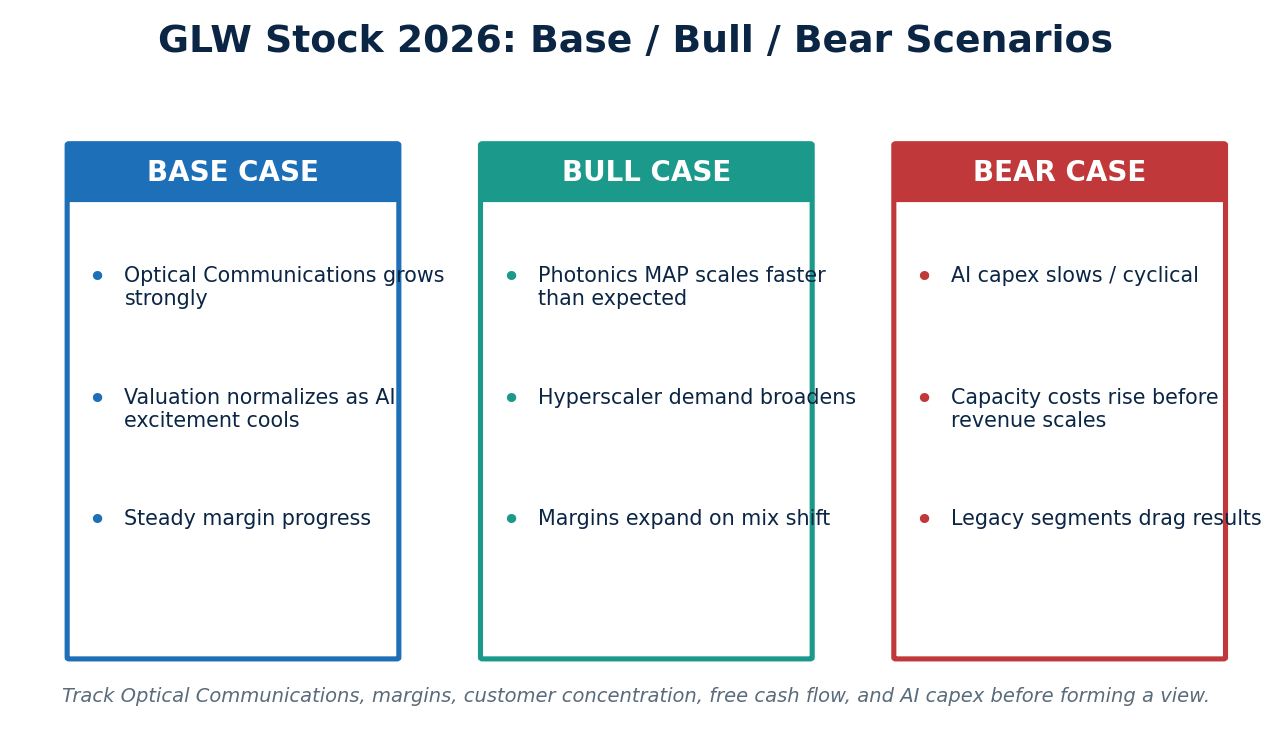
Use three scenarios:
- Base case: Optical Communications grows strongly, but valuation normalizes as AI excitement cools.
- Bull case: Photonics MAP scales faster than expected, hyperscaler demand broadens, and margins expand.
- Bear case: AI capex slows, capacity costs rise, and legacy segments pressure consolidated growth.
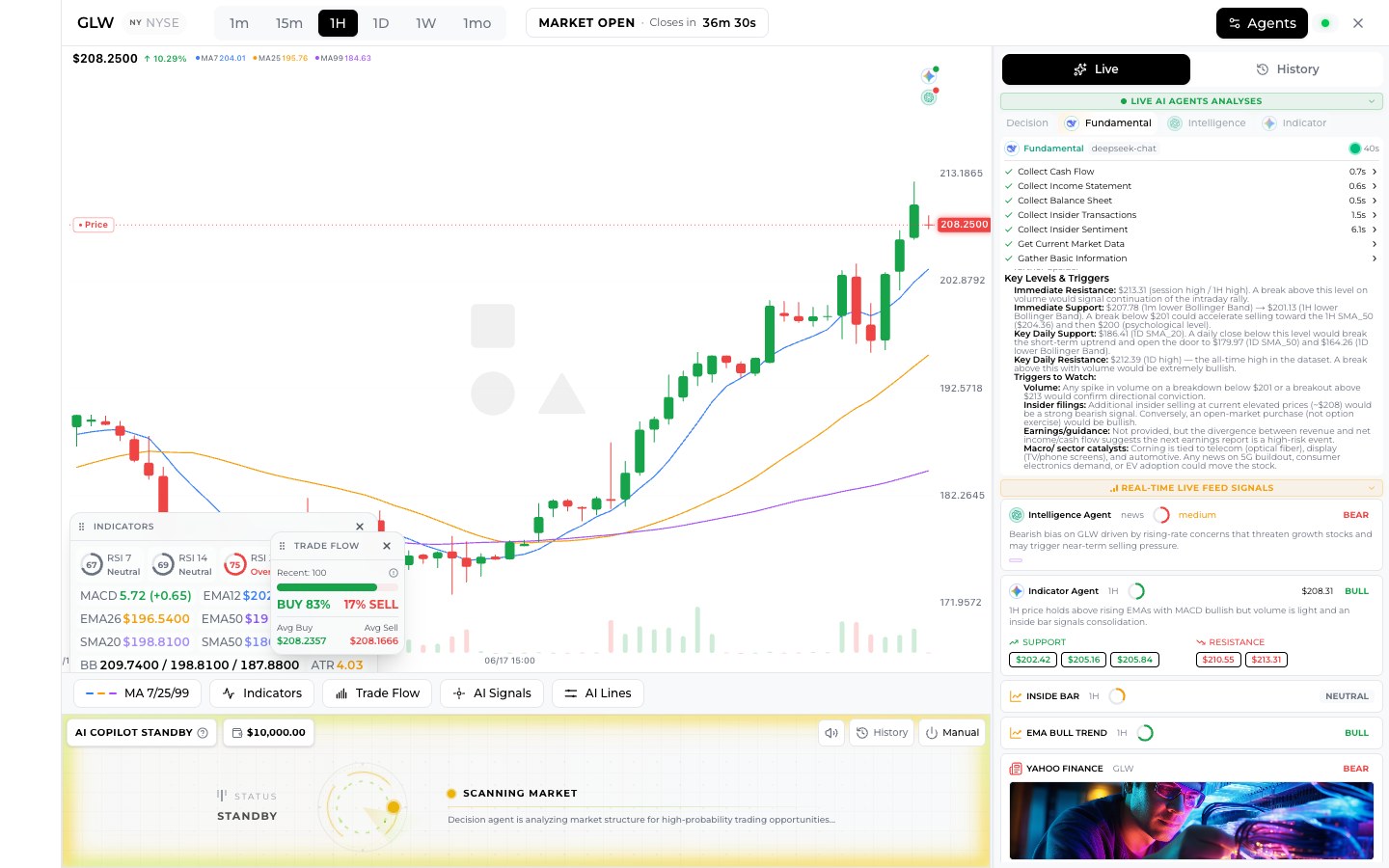
This scenario approach is where practical tools can help. SimianX AI is designed for multi-agent stock analysis, allowing different research agents to examine fundamentals, sentiment, technicals, valuation, and risk from separate angles before forming a consolidated view. For a complex stock like GLW, that kind of structured debate can reduce blind spots.
Practical Investor Checklist for Corning’s AI Photonics Thesis
Before making any decision on GLW stock in 2026, investors can use this checklist:
- Is Optical Communications still accelerating?
- Are hyperscaler agreements turning into recognized revenue?
- Is Photonics MAP showing measurable adoption?
- Are margins improving as product mix shifts?
- Is free cash flow keeping up with capital spending?
- Is the valuation still reasonable under conservative assumptions?
- Are technical indicators confirming or contradicting the fundamental story?
- Is AI infrastructure sentiment improving or weakening?
For a more structured workflow, investors can follow this sequence:
- Review the latest earnings release and segment data.
- Read management commentary on AI data center demand.
- Compare optical growth with total company growth.
- Evaluate valuation against forward earnings expectations.
- Track customer announcements and manufacturing milestones.
- Reassess risk after every major AI capex update.
The goal is not to chase the headline. The goal is to understand whether the headline is becoming durable earnings power.
FAQ About GLW Stock 2026
What is the main GLW stock 2026 AI data center thesis?
The main thesis is that Corning can benefit from rising demand for optical fiber, cable, connectivity, and photonics products used in AI data centers. As AI clusters scale, data movement becomes a major infrastructure challenge, and Corning’s Optical Communications business is positioned to serve that need.
Is Corning stock a good AI infrastructure stock to research?
Yes, Corning is a relevant AI infrastructure stock to research because it supplies physical connectivity components rather than chips or software. That makes GLW a different type of AI exposure, focused on the optical backbone needed to connect advanced compute systems.
What is Corning’s Photonics MAP?
Corning’s Photonics MAP is a strategic growth platform focused on advanced optical and photonic technologies for AI infrastructure and enterprise networks. Investors should watch whether this platform produces measurable revenue growth, customer wins, and margin improvement.
What are the biggest risks for GLW stock in 2026?
The biggest risks include valuation, AI capex cyclicality, customer concentration, manufacturing execution, and weakness in non-AI segments. Investors should also monitor whether the market has already priced in much of the photonics upside.
How can investors analyze GLW stock using AI tools?
Investors can use AI tools to compare financial statements, summarize news catalysts, evaluate sentiment, screen technical indicators, and build bull/base/bear scenarios. SimianX AI is especially relevant for this workflow because it uses multiple specialized agents to debate evidence and produce a structured stock research view.
Conclusion: GLW Stock 2026 Depends on Execution, Not Just AI Hype
GLW Stock 2026: Corning’s AI Data Center Photonics Boom is one of the clearest examples of how the AI trade is expanding beyond semiconductors. Corning’s opportunity sits in the optical layer of AI infrastructure: fiber, cable, connectivity, photonics, and manufacturing scale. The bull case is supported by strong optical demand, hyperscaler agreements, and a strategic push into Photonics MAP.
But the best research must stay balanced. GLW is not a pure AI stock, valuation matters, and the company must execute on capacity expansion while proving that AI data center demand can translate into durable earnings growth. Investors should track Optical Communications performance, margin conversion, customer concentration, free cash flow, and AI capex trends before forming a view.
For investors who want a faster, more structured way to evaluate GLW and other AI infrastructure stocks, explore SimianX AI. SimianX AI helps turn fundamentals, news, technicals, sentiment, and risk scenarios into a clearer research process—so you can move from AI headlines to evidence-based stock analysis.
Related Reading
- SMCI Stock 2026: $7B Capital Raise vs $39B AI Backlog
- Why AVGO Stock Is Bullish: Broadcom AI ASIC Rebound Setup
- KKR Helix AI Infrastructure: NVDA, VST Power Trade
- Oracle Earnings 2026: OCI, Stargate Backlog & ORCL Stock
- The Magnificent 7 in 2026: Weights & Concentration Risk
- June 2026 FOMC Decision: Dot Plot, AI Stocks & Bitcoin