
 Par Muke
Le test du cloud IA d'Oracle : lire le T4 fiscal 2026 pour l'action ORCL
Bénéfices d'Oracle 2026 : OCI, Arriéré de Stargate & Actions ORCL est l'un des thèmes de bénéfices les plus importants en matière d'infrastructure IA pour les investisseurs surveillant le cloud, les semi-conducteurs, les centres de données et les logiciels d'entreprise. Les résultats du quatrième trimestre fiscal 2026 d'Oracle sont prévus pour publication le 10 juin 2026, après la fermeture du marché, faisant de ce rapport un test opportun pour savoir si l'enthousiasme du marché pour l'infrastructure IA peut se traduire par des revenus, des flux de trésorerie et une puissance de bénéfices durable.
Pour les lecteurs construisant une thèse de bénéfices, SimianX AI est pertinent car il aide les investisseurs à structurer des recherches de marché complexes à travers les fondamentaux, les signaux techniques, le sentiment et le risque. Dans un événement de bénéfices comme celui d'Oracle, où OCI, le carnet de commandes IA, l'infrastructure Stargate et l'évaluation des actions ORCL interagissent tous, un flux de travail de recherche multi-agents peut rendre l'analyse plus claire et plus exploitable.
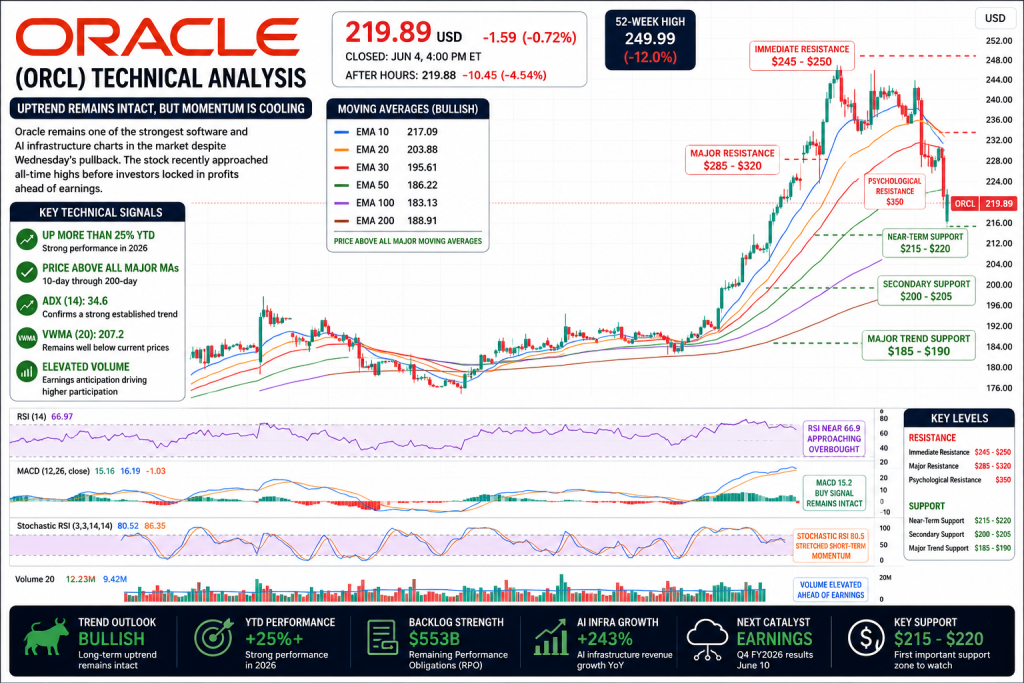
Pourquoi les Bénéfices d'Oracle 2026 Comptent pour les Investisseurs en Infrastructure IA
Oracle n'est plus valorisé uniquement comme une entreprise de bases de données héritées et de logiciels d'entreprise. En 2026, le scénario optimiste dépend de plus en plus de l'infrastructure cloud d'Oracle, ou OCI, devenant une plateforme de calcul IA majeure pour des charges de travail hyperscale.
L'accent du marché est clair : les investisseurs veulent savoir si la croissance d'OCI est simplement impressionnante sur le papier ou suffisamment forte pour justifier l'intensité capitalistique croissante d'Oracle. Les obligations de performance restantes d'Oracle, ou RPO, sont devenues centrales dans le débat sur l'action ORCL car le carnet de commandes représente des revenus futurs contractés qui n'ont pas encore été reconnus.
Point clé : L'histoire des bénéfices d'Oracle pour 2026 concerne moins l'existence de la demande en IA et plus la capacité d'Oracle à convertir un énorme carnet de commandes en IA en revenus cloud rentables et générateurs de liquidités.
La principale question des investisseurs : Oracle peut-elle transformer la demande OCI, la capacité liée à Stargate et les contrats cloud en IA en une croissance des bénéfices durable sans trop étendre le bilan ?
La configuration des bénéfices d'Oracle pour 2026
Avant les résultats du T4, les derniers chiffres publics d'Oracle montraient une entreprise avec une demande cloud en accélération mais aussi des exigences d'infrastructure croissantes. Les investisseurs surveillent une forte croissance dans les services cloud, de base de données et multicloud, en particulier Oracle Cloud Infrastructure.
Cela est important car l'histoire d'IA d'Oracle ne se limite pas à la location de GPU. La thèse plus complète comprend :
- Calcul AI OCI pour les charges de travail d'entraînement et d'inférence.
- Demande de base de données Oracle dans les environnements cloud et multicloud.
- Croissance SaaS d'entreprise grâce à Fusion Cloud ERP et NetSuite.
- Grands contrats d'IA qui élargissent le RPO et la visibilité des revenus futurs.
- Prépaiements des clients ou GPU fournis par les clients, ce qui peut réduire une partie de la pression de financement sur Oracle.
Les commentaires d'Oracle concernant les grands contrats d'IA à grande échelle sont particulièrement importants car ils abordent l'une des plus grandes préoccupations des baissiers : si Oracle doit financer elle-même chaque centre de données lourd en GPU.
| Indicateur Oracle FY2026 à surveiller | Pourquoi c'est important pour l'action ORCL |
|---|---|
| Croissance des revenus OCI | Montre si Oracle gagne des parts de marché dans l'infrastructure cloud en IA |
| RPO / carnet de commandes | Mesure la visibilité des revenus futurs contractés |
| Capex et flux de trésorerie disponible | Montre si la croissance de l'IA est financièrement durable |
| Marge brute du cloud | Indique si l'infrastructure IA peut être rentable |
| Progrès de Stargate | Signale si la demande liée à OpenAI se transforme en capacité |
| Prévisions FY2027 | Détermine si les investisseurs doivent soutenir une croissance pluriannuelle |
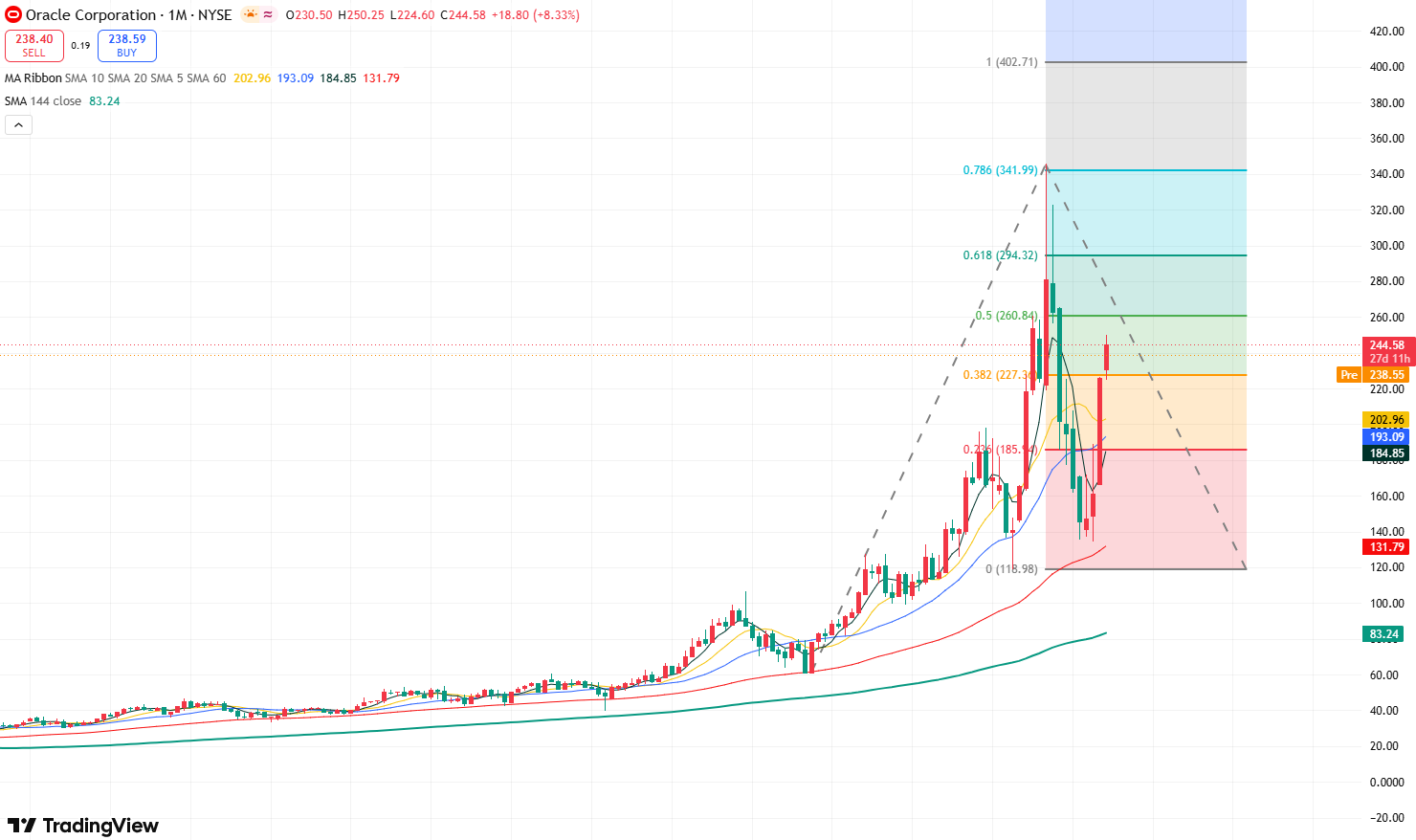
Qu'est-ce que le carnet de commandes Stargate dans les résultats d'Oracle 2026 ?
Le carnet de commandes Stargate fait référence au jargon des investisseurs pour les engagements d'infrastructure IA liés à OpenAI, Oracle et la capacité des centres de données américains à grande échelle. Stargate est devenu un sujet clé car il représente le type de demande massive de calcul IA qui pourrait remodeler la trajectoire de l'infrastructure cloud d'Oracle.
Pour les investisseurs, la question de Stargate a deux volets.
Scénario optimiste :
- Oracle devient un fournisseur de capacité cloud IA critique pour les missions.
- Des contrats de longue durée améliorent la visibilité des revenus.
OCIgagne en crédibilité par rapport à AWS, Azure et Google Cloud.
- De grands clients valident l'architecture cloud à faible latence et haute performance d'Oracle.
Scénario pessimiste :
- Les centres de données IA nécessitent des dépenses en capital énormes.
- La disponibilité de l'énergie et le calendrier de construction peuvent retarder la reconnaissance des revenus.
- Le risque de concentration des clients augmente si la demande liée à OpenAI domine le carnet de commandes.
- La rentabilité peut être en retard par rapport à la croissance des revenus si les coûts d'infrastructure dépassent l'utilisation.
C'est pourquoi les résultats d'Oracle 2026 ne sont pas seulement un événement de revenus. C'est un événement de qualité du carnet de commandes. Les investisseurs doivent savoir si le RPO est diversifié, financé de manière responsable et susceptible de se transformer en revenus cloud à forte marge.
Pourquoi le carnet de commandes Stargate d'Oracle est-il important pour l'action ORCL ?
Le backlog de Stargate d'Oracle est important car l'action ORCL reflète désormais les attentes selon lesquelles Oracle peut devenir un leader durable en infrastructure IA. Un chiffre de backlog n'est précieux que s'il se convertit en revenus reconnus, marges saines et rendements en espèces acceptables sur le capital investi.
Cela n'invalide pas automatiquement le scénario haussier, mais cela prouve que le marché doit analyser Oracle à la fois comme une entreprise de logiciels et comme un financier d'infrastructure IA.

Croissance OCI : La métrique qui peut revaloriser l'action Oracle
Pour l'action ORCL, OCI est le moteur de revalorisation. Historiquement, les investisseurs ont valorisé Oracle pour la durabilité de sa base de données, la maintenance des logiciels et l'adhérence des applications d'entreprise. En 2026, le marché attribue plus de valeur à la capacité d'Oracle à vendre une capacité de calcul IA rare.
La raison pour laquelle OCI est si important est que la demande d'infrastructure IA peut créer un flywheel :
- Les grands clients IA s'engagent sur la capacité.
- Oracle étend les clusters GPU, le réseau et l'empreinte des centres de données.
- Une utilisation plus élevée génère des revenus d'infrastructure cloud.
- La crédibilité d'OCI s'améliore auprès des entreprises et des constructeurs de modèles.
- Les charges de travail de base de données et d'application peuvent se rattacher à l'écosystème cloud d'Oracle.
Cependant, un chiffre de revenus OCI solide à lui seul n'est pas suffisant. Les investisseurs doivent évaluer si la croissance est associée à une visibilité de marge en amélioration, à un déploiement de capacité plus rapide et à des délais de retour sur capital plus clairs.
| Signal OCI haussier | Signal OCI baissier |
|---|---|
| Croissance des revenus supérieure aux attentes | Croissance tirée par un ou deux clients |
| Marges cloud plus élevées | Compression des marges due à la dépréciation des GPU |
| Fortes nouvelles réservations RPO | Croissance du backlog sans calendrier de conversion |
| Matériel financé par les clients | Capex financé par Oracle avec une dette croissante |
| Augmentation des prévisions FY2027 | Prévisions dépendant des centres de données retardés |
Note pratique pour les investisseurs : la croissance de OCI doit être analysée en parallèle avec la conversion du carnet de commandes, et non isolément.
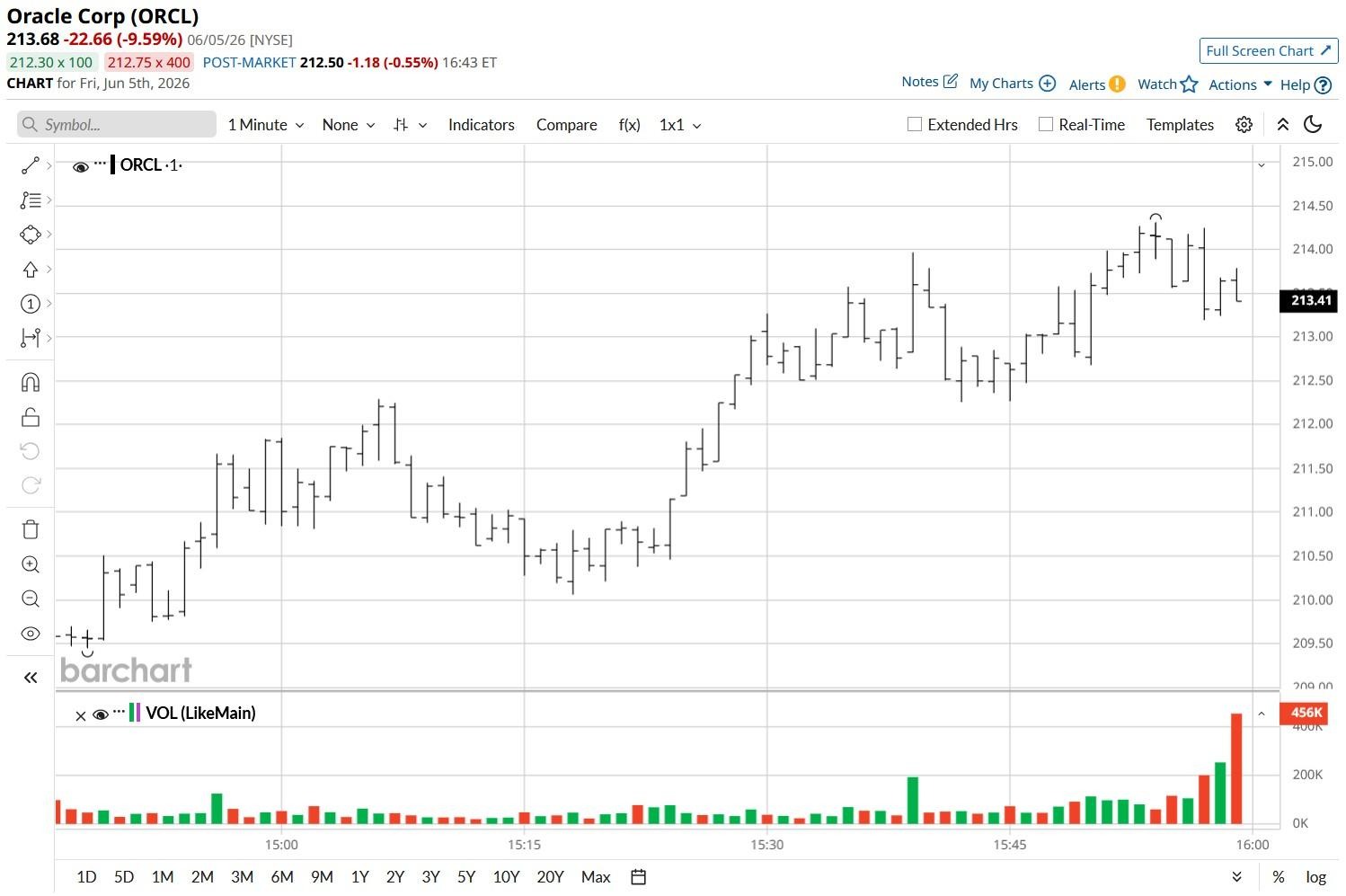
Actions ORCL avant les bénéfices : Ce que le marché anticipe
L'action ORCL est devenue plus volatile car le débat sur l'investissement est désormais lié à l'exécution de l'infrastructure AI. La valorisation de l'action reflète de plus en plus la confiance des investisseurs qu'Oracle peut rivaliser dans l'infrastructure cloud AI tout en maintenant une discipline financière.
Pour les investisseurs à long terme, la question n'est pas simplement de savoir si l'action ORCL va monter ou descendre le lendemain. La meilleure question est de savoir si l'appel aux bénéfices d'Oracle fournit au marché suffisamment de preuves pour soutenir un multiple de valorisation à long terme plus élevé.
Que devraient écouter les investisseurs lors de l'appel aux bénéfices d'Oracle ?
Les investisseurs devraient écouter quatre signaux spécifiques :
- Taux de croissance de l'OCI et commentaires sur la capacité
Oracle est-il toujours contraint par l'offre, et à quelle vitesse une nouvelle capacité peut-elle être mise en ligne ?
- Composition du RPO
Le carnet de commandes est-il concentré sur quelques clients AI, ou s'élargit-il à des clients d'entreprise et de cloud ?
- Modèle de financement des capex
Les clients prépayent-ils, fournissent-ils des GPU, ou exigent-ils qu'Oracle finance plus d'infrastructure directement ?
- Prévisions de revenus et de marges FY2027
La direction fournit-elle suffisamment de confiance pour que la croissance de l'infrastructure AI puisse devenir rentable à grande échelle ?
Scénario optimiste pour les bénéfices d'Oracle 2026
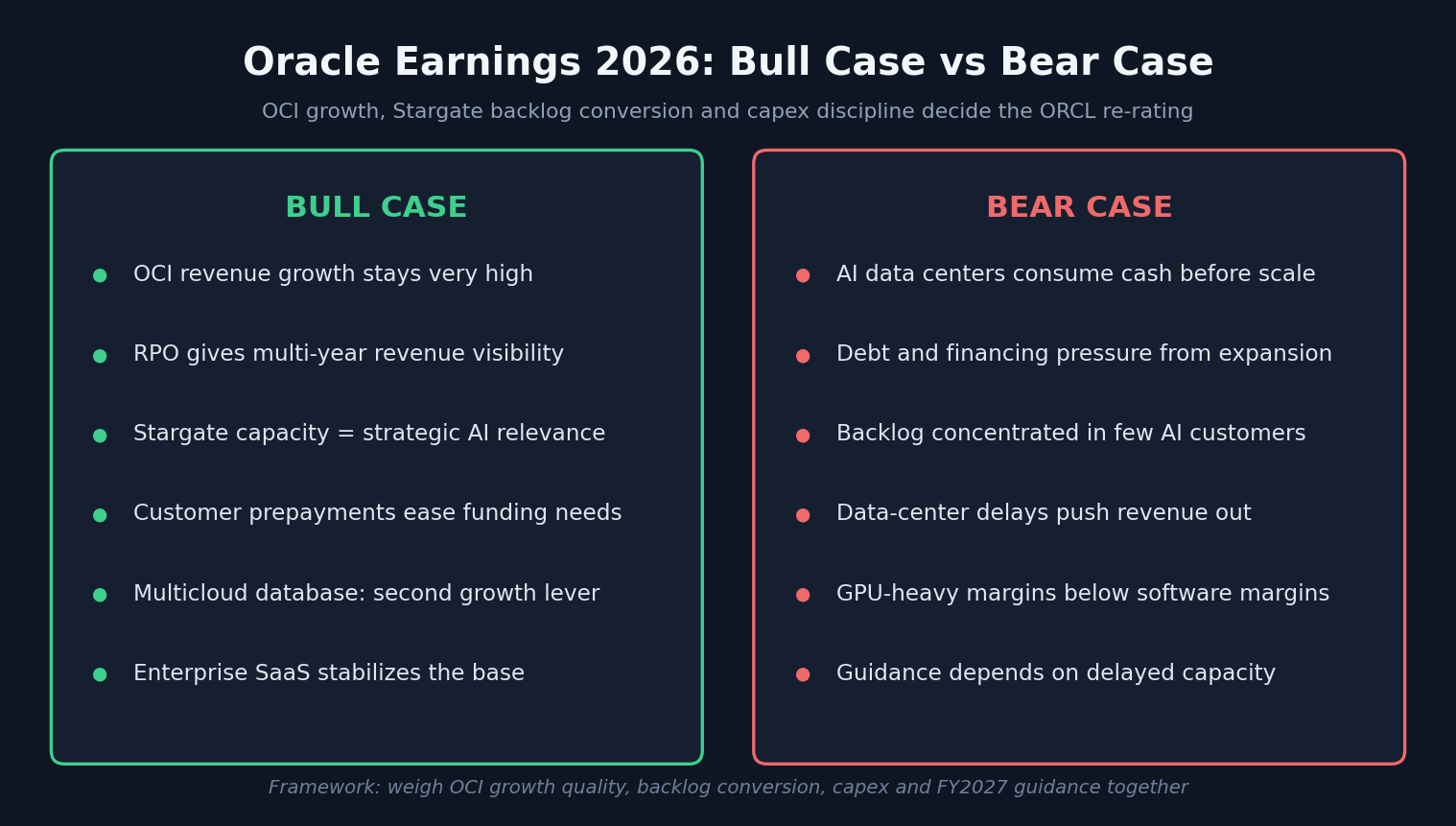
Le scénario optimiste pour les bénéfices d'Oracle 2026 commence avec l'idée que la demande d'infrastructure cloud est structurellement plus grande que l'offre. Les entreprises AI ont besoin de calcul, d'énergie, de mise en réseau et d'infrastructure à faible latence à une vitesse que les hyperscalers traditionnels peuvent ne pas satisfaire pleinement.
L'argument haussier inclut :
- La croissance des revenus
OCIreste très élevée.
- La RPO d'Oracle offre une visibilité des revenus sur plusieurs années.
- La capacité liée à Stargate donne à Oracle une pertinence stratégique dans l'IA.
- Les prépaiements des clients réduisent la pression sur les besoins de financement d'Oracle.
- La croissance des bases de données multicloud donne à Oracle un deuxième levier de croissance dans le cloud.
- Le SaaS d'entreprise reste une base de revenus stabilisante.
Pour les investisseurs qui utilisent des flux de recherche multi-facteurs, c'est ici que SimianX AI peut aider à organiser des signaux concurrents. SimianX AI est conçu pour soutenir l'analyse de marché qui combine fondamentaux, indicateurs techniques, sentiment des nouvelles, recherche de cas haussiers, recherche de cas baissiers et perspectives de gestion des risques.
Cas baissier pour les bénéfices d'Oracle 2026
Le cas baissier n'est pas qu'Oracle manque de demande. Le cas baissier est que la demande peut être coûteuse à satisfaire.
La croissance de l'infrastructure IA d'Oracle nécessite des centres de données, des GPU, de l'énergie, des équipements de mise en réseau et de longs délais de construction. Même lorsque les clients prépayent ou fournissent du matériel, Oracle fait toujours face à un risque d'exécution.
Les principaux risques incluent :
- Intensité capitalistique : L'infrastructure IA peut consommer des liquidités avant que les revenus ne se développent.
- Pression sur la dette et le financement : Oracle peut avoir besoin d'un financement significatif pour soutenir son expansion.
- Concentration des clients : Un carnet de commandes dominé par quelques clients IA peut être moins résilient.
- Timing d'exécution : Les retards dans les centres de données peuvent reporter les revenus à des périodes ultérieures.
- Incertitude des marges : Une infrastructure lourde en GPU peut ne pas avoir les marges traditionnelles des logiciels.
Une façon utile de cadrer le risque est la suivante : l'ancien modèle d'Oracle était axé sur les logiciels, tandis que le nouveau modèle de cloud IA a plus d'exposition à l'infrastructure physique. Cela peut créer une croissance plus rapide, mais cela peut également créer un flux de trésorerie libre plus faible pendant les cycles de construction.
Comment analyser les bénéfices d'Oracle 2026 étape par étape
Un cadre de bénéfices Oracle pratique devrait séparer les chiffres rapportés, les commentaires de la direction, et la réaction du marché.
Étape 1 : Comparer les chiffres du T4 rapportés aux attentes
Se concentrer sur :
- Les revenus par rapport aux attentes du consensus.
- Le BPA ajusté par rapport aux attentes du consensus.
- La croissance de
OCIpar rapport aux attentes élevées des investisseurs.
- Le mélange de revenus cloud et les commentaires sur les marges.
Étape 2 : Suivre la qualité du carnet de commandes, pas seulement la taille du carnet
Un chiffre RPO plus élevé est positif seulement s'il a un calendrier de conversion crédible. Les investisseurs devraient demander :
- Combien de carnet se convertit dans les 12 prochains mois ?
- Combien dépend de la disponibilité d'énergie ?
- Combien est lié à OpenAI ou Stargate ?
- Combien est la demande cloud d'entreprise en dehors des méga-contrats AI ?
Étape 3 : Évaluer la pression sur le flux de trésorerie disponible
Si Oracle augmente ses revenus mais brûle un flux de trésorerie disponible substantiel, le marché peut remettre en question la valeur qui s'accumule pour les actionnaires. Les dépenses d'investissement ne sont pas mauvaises si les rendements sont élevés, mais les investisseurs ont besoin de preuves que la capacité AI générera des rendements attractifs au fil du temps.
Étape 4 : Observer la réaction de l'action ORCL dans son contexte
Un mouvement post-bénéfices peut être trompeur. Une action peut chuter après de bons résultats si les attentes étaient trop élevées, ou augmenter après des chiffres mitigés si les prévisions s'améliorent. Utilisez l'action du prix ORCL comme un des éléments, pas comme l'ensemble de la thèse.
Bénéfices Oracle 2026 et SimianX AI : Un meilleur flux de recherche
Oracle est exactement le type d'action où une analyse unidimensionnelle peut échouer. Une vue purement fondamentale peut manquer le positionnement technique. Une vue purement technique peut manquer la qualité du carnet de commandes. Une vue purement axée sur les nouvelles peut réagir de manière excessive aux gros titres de Stargate sans modéliser les dépenses d'investissement et le flux de trésorerie.
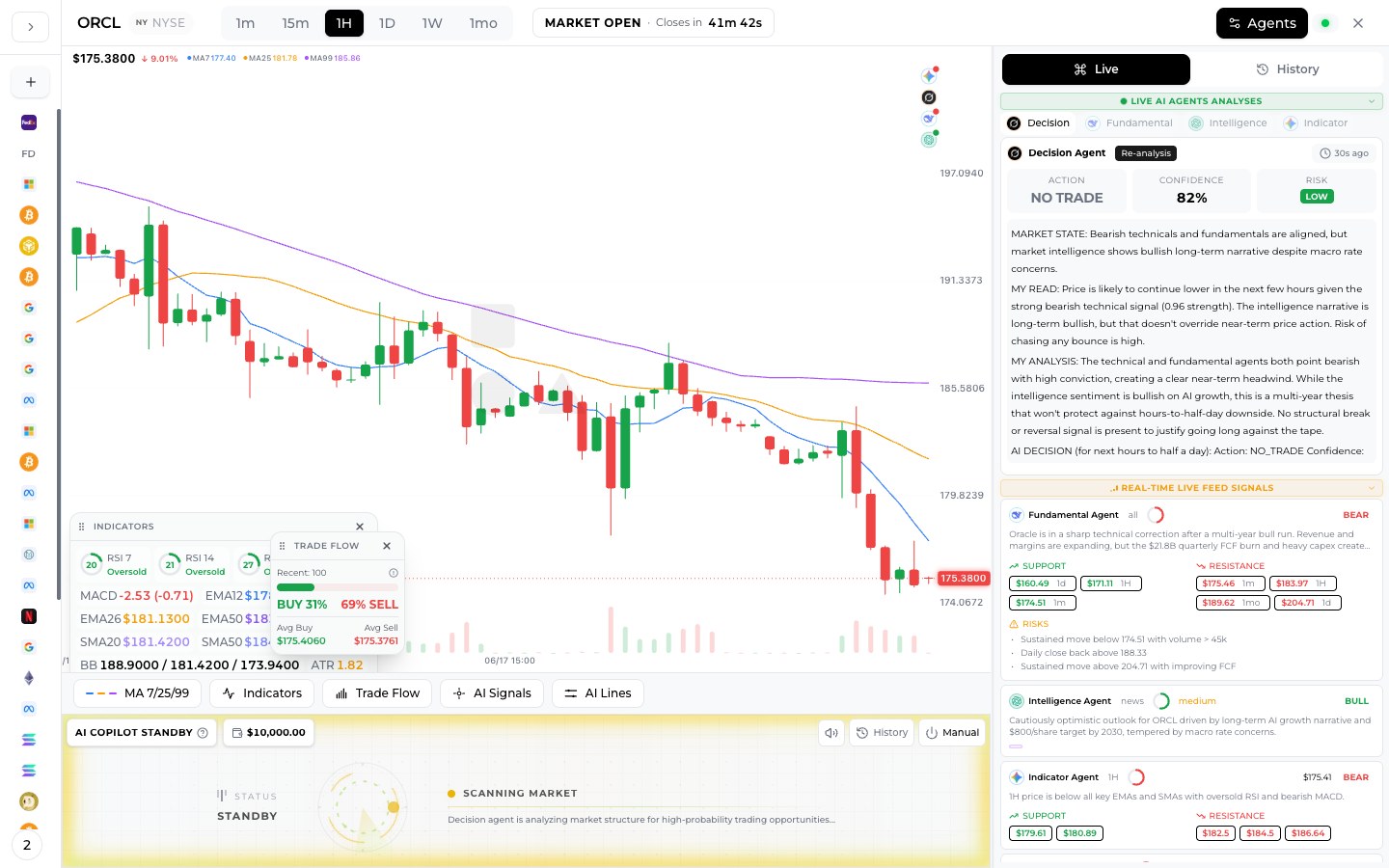
C'est pourquoi le cadre multi-agent de SimianX AI est pertinent pour les investisseurs recherchant les bénéfices d'Oracle. SimianX AI peut aider les investisseurs à organiser le cas haussier, le cas baissier, la configuration technique, le sentiment et les contrôles de risque dans un processus répétable.
Un flux de travail plus solide pour les bénéfices Oracle 2026 pourrait ressembler à ceci :
- Agent fondamental : Examiner les revenus, le BPA, le RPO, les dépenses d'investissement, la dette et le flux de trésorerie libre.
- Agent technique : Identifier les niveaux de support, de résistance, de momentum et de volatilité.
- Agent de sentiment d'actualité : Suivre Stargate, OpenAI, les révisions des analystes et les titres des centres de données.
- Agent de scénario haussier : Modéliser le potentiel de hausse si la croissance de l'OCI s'accélère et que le carnet de commandes se convertit.
- Agent de scénario baissier : Tester la résistance de la dette, la concentration des clients et la compression des marges.
- Agent de risque : Définir la taille de la position, les niveaux d'arrêt et le risque lié aux événements de bénéfices.
L'objectif n'est pas de prédire chaque mouvement après les bénéfices. L'objectif est de prendre une meilleure décision avec une thèse plus claire, des risques définis et moins de biais émotionnel.
FAQ sur les bénéfices d'Oracle 2026 : OCI, carnet de commandes Stargate et actions ORCL
Quel est le carnet de commandes Stargate d'Oracle en 2026 ?
Le carnet de commandes Stargate d'Oracle fait généralement référence à la part de l'opportunité d'infrastructure IA d'Oracle associée aux engagements de centres de données et de calcul cloud liés à OpenAI. Cela compte car cela peut représenter de grandes opportunités de revenus futurs, mais les investisseurs doivent encore évaluer le timing de conversion, la rentabilité et le risque de concentration.
Comment la croissance de l'OCI affecte-t-elle les actions ORCL ?
La croissance de l'OCI affecte les actions ORCL car elle change la façon dont les investisseurs évaluent Oracle. Une forte croissance de l'OCI soutient l'idée qu'Oracle devient un leader de l'infrastructure IA, tandis qu'une croissance faible ou des commentaires sur les marges médiocres pourraient exercer une pression sur le multiple de valorisation de l'action.
Les actions d'Oracle sont-elles maintenant des actions d'infrastructure IA ?
Oracle est toujours une entreprise de logiciels d'entreprise, de bases de données et de cloud, mais en 2026, le marché considère de plus en plus ORCL comme une action d'infrastructure IA. Cela signifie que les investisseurs surveillent désormais le carnet de commandes, la capacité GPU, la puissance des centres de données, les dépenses d'investissement et la demande des clients en IA aux côtés des métriques de logiciels traditionnels.
Que devraient surveiller les investisseurs dans les résultats d'Oracle Q4 FY2026 ?
Les investisseurs devraient surveiller les revenus, le BPA ajusté, la croissance de l'OCI, la croissance des RPO, les dépenses d'investissement, le flux de trésorerie disponible et les prévisions pour l'exercice 2027. Le signal qualitatif le plus important pourrait être l'explication de la direction sur la part de la croissance de l'infrastructure AI financée par les clients par rapport à celle financée par Oracle.
Les investisseurs devraient-ils acheter des actions ORCL après les résultats d'Oracle 2026 ?
Cela dépend de la tolérance au risque, de l'horizon temporel, de l'évaluation et de la qualité de l'appel des résultats du Q4. Une configuration plus solide inclurait une croissance de l'OCI accélérée, un carnet de commandes diversifié, une expansion des marges crédible et une récupération plus claire du flux de trésorerie disponible. Cet article est destiné à la recherche et à l'éducation, et non à des conseils financiers personnalisés.
Conclusion
Résultats d'Oracle 2026 : OCI, Carnet de commandes Stargate & Actions ORCL est un sujet de recherche à enjeux élevés car l'évaluation d'Oracle dépend désormais de plus que de la durabilité des bases de données traditionnelles et des logiciels d'entreprise. Les investisseurs doivent évaluer ensemble la croissance de l'infrastructure cloud, la qualité du carnet de commandes Stargate, la discipline des dépenses d'investissement, la concentration des clients et les prévisions.
La meilleure façon d'analyser les résultats d'Oracle est de regarder au-delà du dépassement ou du manque de prévisions. Les investisseurs devraient se concentrer sur la qualité de la croissance de l'OCI, la conversion du carnet de commandes Stargate, la discipline des dépenses d'investissement, la concentration des clients et les prévisions pour l'exercice 2027. Si Oracle peut convertir la demande en AI en revenus rentables à grande échelle, les actions ORCL pourraient mériter une évaluation plus élevée axée sur l'infrastructure. Si les risques liés aux dépenses d'investissement et à l'exécution dominent, l'action pourrait rester volatile même avec une forte croissance rapportée.
Pour une approche plus structurée des événements de résultats complexes comme Oracle, explorez SimianX AI. SimianX AI aide les investisseurs à évaluer les actions grâce à une analyse multi-agents, une intelligence de marché en temps réel, des indicateurs techniques, des fondamentaux et des flux de décision conscients des risques conçus pour des environnements de résultats rapides.
Lecture Liée
- Les 7 Magnifiques en Bourse : poids et risque en 2026
- Apple WWDC 2026 : Siri AI, Gemini et l'action AAPL
- Pourquoi l action AVGO est haussière : rebond des ASIC IA
- IA Multi-Agent vs ChatGPT pour NVDA: Comparatif 2026
- Analyse Boursière en Direct : Agents IA sur Actions US
- SimianX AI : plateforme multi-agents d'analyse boursière
- Hype Premium Decay : Pourquoi les Actions Hot Décevent
- SimianX AI — analyse multi-agents de l'action ORCL
Références
- Relations investisseurs et résultats d'Oracle — Oracle Investor Relations
- Présentation d'Oracle Cloud Infrastructure (OCI) — Oracle Cloud Infrastructure
- Annonce du projet Stargate — OpenAI
- Dépôts SEC d'Oracle (10-K, 10-Q) — SEC EDGAR
- Cours et données ORCL — Nasdaq
- Les dépenses d'investissement (capex) expliquées — Investopedia