DTCC Tokenized Securities Pilot 2026: Wall Street On-Chain

DTCC Tokenized Securities Pilot 2026: Wall Street On-Chain

DTCC will move Russell 1000 stocks, index ETFs and Treasuries on-chain. July 2026 pilot trades, an October launch, and what it means for market structure.

2026-07-09
·
13 min read
Listen to article

How Wall Street Is Testing On-Chain Stocks, ETFs and Treasuries

The DTCC Tokenized Securities Pilot 2026 is one of the clearest signs that Wall Street’s blockchain phase is moving from isolated experiments into regulated market infrastructure. Instead of treating tokenized assets as crypto-native wrappers, DTCC’s DTC tokenization service is designed around existing custody, book-entry records, investor protections, and institutional workflows.

DTCC plans to facilitate initial limited-production trades in July 2026, followed by a planned service launch in October 2026. The initiative is being developed with input from more than 50 firms across traditional finance and digital assets.

For traders, analysts, asset managers, and fintech builders, the important question is not simply whether stocks will move on-chain. The better question is:

Which parts of the securities lifecycle can become faster, more programmable, and more interoperable without weakening the legal and operational protections that make U.S. markets trusted?

That is where SimianX AI can help investors separate headline hype from market infrastructure, adoption milestones, liquidity evidence, and tradable implications.

SimianX AI DTCC tokenized securities pilot market infrastructure
DTCC tokenized securities pilot market infrastructure

Why the DTCC Tokenized Securities Pilot 2026 Matters

DTCC is not a small blockchain startup testing an experimental product. It is one of the central post-trade infrastructure providers behind U.S. capital markets.

Through subsidiaries such as the Depository Trust Company, DTCC supports the custody, clearing, settlement, and recordkeeping systems used by banks, brokers, asset managers, exchanges, and institutional investors.

DTCC has said that DTC holds assets valued at more than $100 trillion, making its tokenization initiative a market-structure development rather than a niche cryptocurrency story.

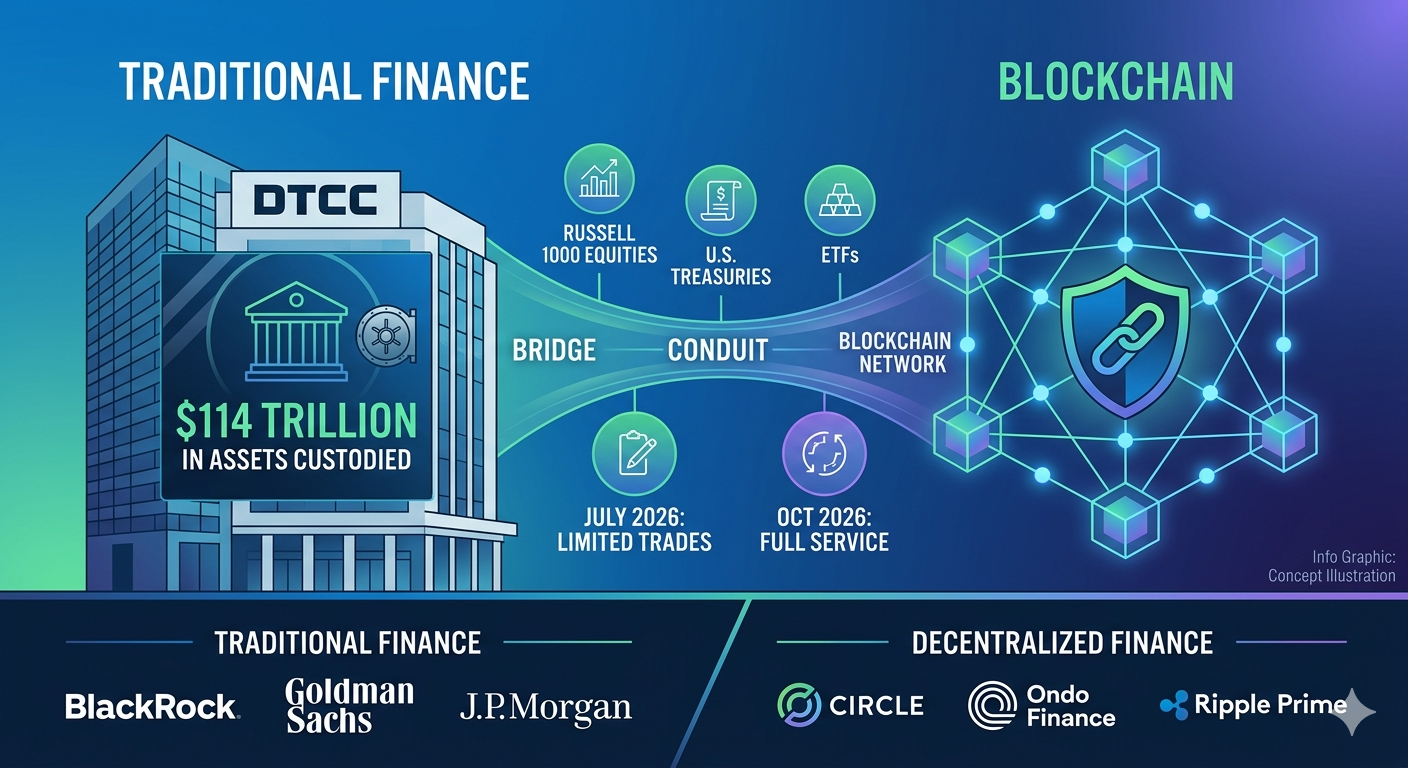
The pilot matters because it attempts to create a regulated bridge between traditional securities and blockchain-based infrastructure.

Under the proposed model, eligible securities would remain connected to DTC’s custody and recordkeeping framework while gaining a tokenized representation that can move across approved blockchain environments.

The initiative is designed to preserve:

  • Existing ownership rights
  • Securities entitlements
  • Investor protections
  • Regulatory controls
  • Institutional custody standards
  • Official books and records

Key takeaway: The DTCC pilot is not about replacing securities law with smart contracts. It is about testing whether blockchain can improve how regulated securities move, settle, interoperate, and become programmable.

This distinction is crucial.

Many tokenized equity products previously introduced in cryptocurrency markets were synthetic, offshore, restricted, or dependent on separate issuers. Some provided price exposure without offering the same rights as direct ownership of the underlying security.

The DTC model is more conservative, but it may also be more scalable because it begins with the existing legal, custody, and entitlement system.

What Assets Are Included in the DTC Tokenization Service?

DTCC’s initial tokenization scope focuses on highly liquid, widely held securities.

The eligible asset categories are expected to include:

  • Russell 1000 stocks
  • ETFs tracking major market indices
  • U.S. Treasury bills
  • U.S. Treasury notes
  • U.S. Treasury bonds
  • Other approved DTC-custodied securities
Asset TypeWhat It RepresentsWhy It Matters
Russell 1000 stocksLarge and mid-cap U.S. public companiesTests tokenization in highly liquid equity markets
Major index ETFsFunds tracking broad benchmarksUseful for institutional allocation and collateral workflows
U.S. Treasury billsShort-term government debtImportant for liquidity and cash management
U.S. Treasury notes and bondsMedium and long-term government debtPotentially valuable for institutional collateral
DTC-custodied securitiesAssets already held within DTC infrastructureReduces legal uncertainty compared with unbacked wrappers

This asset scope explains why the DTCC tokenized securities pilot 2026 is relevant to both equity and fixed-income investors.

Tokenized Treasuries have already emerged as one of the most practical real-world asset categories because they combine:

  • High-quality collateral
  • Government-backed credit exposure
  • Yield generation
  • Institutional familiarity
  • Potential on-chain programmability

However, DTCC’s model could take the market beyond tokenized fund shares and toward a much broader transformation of the securities settlement layer.

SimianX AI Tokenized stocks ETFs and Treasuries workflow
Tokenized stocks ETFs and Treasuries workflow

How Does the DTCC Tokenized Securities Pilot 2026 Work?

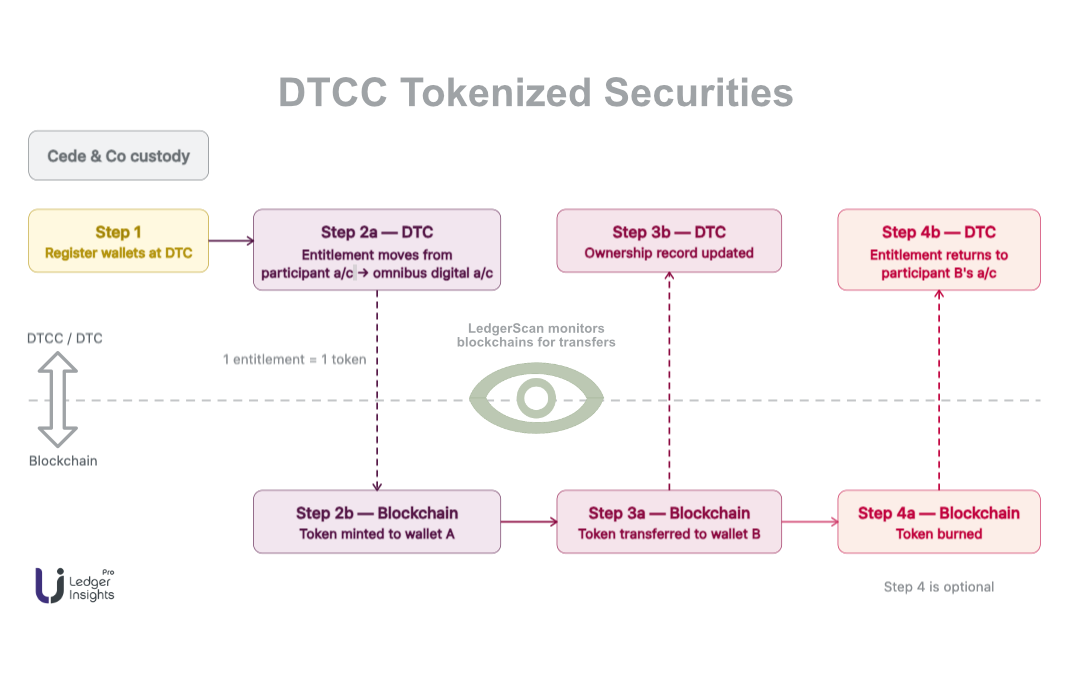
At a high level, DTC’s tokenization service is expected to allow approved DTC participants and their clients to convert eligible assets between traditional book-entry form and tokenized form.

The model is designed to connect traditional financial infrastructure with approved blockchain networks while maintaining existing legal protections.

A simplified transaction could work as follows:

  1. An eligible security is held through DTC custody.
  2. A tokenized representation of the security entitlement is created.
  3. The token is issued to an approved participant wallet.
  4. The tokenized entitlement moves between registered wallets.
  5. DTC tracks the movement in its official books and records.
  6. The token may later be converted back into traditional book-entry form.

The pilot is not the same as placing every U.S. stock on a permissionless blockchain.

It is a controlled institutional environment built around:

  • Registered participants
  • Approved wallets
  • Supported blockchain networks
  • Compliance controls
  • Identity verification
  • Asset eligibility rules
  • Institutional settlement standards

What Is a Tokenized Security Entitlement?

A tokenized security entitlement is a blockchain-based representation of a participant’s legally recognized entitlement to an eligible security held through DTC.

It is not simply a cryptocurrency token using the ticker of a public company.

The purpose is to combine two important characteristics:

  • On-chain transferability: The entitlement can move through blockchain-based infrastructure.
  • Off-chain legal enforceability: The token remains connected to legally recognized ownership rights and custody records.

Without enforceability, tokenization can become little more than a digital interface or synthetic price product.

Without transferability and programmability, it is simply another traditional database entry.

The DTCC model attempts to combine both sides by testing whether regulated securities can gain blockchain-native functionality while preserving institutional safeguards.

DTCC Tokenization Timeline: July Pilot and October Launch

The rollout timeline is one of the most actionable parts of the story.

DTCC announced plans to facilitate initial limited-production transactions involving tokenized real-world assets in July 2026.

A broader launch of the DTC tokenization service is planned for October 2026.

The regulatory foundation began in December 2025, when DTC received regulatory no-action relief allowing it to operate a tokenization service for approved participants on pre-approved blockchain networks.

MilestoneDateMarket Significance
Regulatory no-action reliefDecember 2025Opened a controlled regulatory path for the service
DTCC industry working group updateMay 2026Confirmed participation from more than 50 firms
Limited-production tradesJuly 2026First operational test involving tokenized DTC assets
Planned service launchOctober 2026Potential transition from pilot to broader adoption
Initial authorization periodThree yearsProvides time for testing, refinement, and expansion

For investors, the timeline creates a practical research framework.

The first question is whether the July production transactions occur successfully.

The second is whether the October launch attracts meaningful participation from:

  • Banks
  • Broker-dealers
  • Custodians
  • Asset managers
  • Exchanges
  • Market makers
  • Blockchain providers
  • Digital asset infrastructure companies

A technical pilot is significant, but institutional adoption is what would turn it into a durable market trend.

SimianX AI DTCC tokenization service 2026 timeline
DTCC tokenization service 2026 timeline

Why Wall Street Wants On-Chain Stocks, ETFs and Treasuries

The investment case for Wall Street tokenized stocks, ETFs and Treasuries is not simply that blockchain transactions can be faster.

The larger opportunity involves asset mobility, collateral efficiency, programmability, interoperability, and improved operating processes.

Potential benefits include:

1. Around-the-Clock Asset Mobility

Traditional securities infrastructure is shaped by market hours, banking hours, settlement windows, holidays, and regional operating schedules.

Tokenized securities may allow approved participants to move assets between wallets outside normal trading hours.

This does not necessarily mean public 24/7 stock trading. However, it could enable institutional transfers and collateral movements during nights, weekends, and international market hours.

2. Better Collateral Efficiency

U.S. Treasuries and major ETFs are widely used as institutional collateral.

If these assets can move more efficiently between approved platforms, institutions may be able to:

  • Respond more quickly to margin requirements
  • Reduce idle collateral
  • Improve balance-sheet efficiency
  • Move assets between trading venues
  • Support cross-border transactions
  • Automate collateral substitution

3. Programmable Securities

Tokenized assets can potentially interact with smart contracts and automated financial workflows.

Possible use cases include:

  • Automated portfolio rebalancing
  • Conditional transfers
  • Collateral management
  • Corporate-action processing
  • Dividend distribution
  • Compliance screening
  • Settlement instructions
  • Restrictions based on wallet eligibility

4. Interoperability Between Financial Systems

A major challenge in financial markets is that different institutions use different databases, messaging standards, and settlement systems.

Tokenization may create a common programmable layer through which approved systems can communicate.

However, this benefit will depend heavily on whether the industry adopts compatible technical standards.

5. Improved Auditability

Blockchain records may improve the ability to trace movements of tokenized securities between approved wallets.

This could support:

  • More transparent transaction histories
  • Better operational monitoring
  • Easier reconciliation
  • Faster investigation of failed transactions
  • Improved compliance reporting

Tokenization is valuable when it improves real financial workflows. Creating a token without improving settlement, collateral, liquidity, or ownership processes offers limited economic value.

The Bull Case for DTCC Tokenized Securities

The bullish interpretation of the DTC tokenization service is that DTCC is creating a regulated infrastructure layer the entire market can standardize on, rather than one more venue competing for order flow. If DTC becomes the default tokenization rail, tokenized securities would inherit the legal certainty, custody standards, and network effects that already exist in U.S. markets instead of trying to rebuild them from zero.

Bullish signals to watch:

  • The July 2026 limited-production trades settle cleanly, with no reconciliation breaks between on-chain records and DTC's official books and records.
  • The October 2026 launch arrives with named participants — banks, broker-dealers, custodians, and market makers — rather than unnamed "industry support."
  • The eligible asset list expands beyond Russell 1000 stocks, index ETFs, and Treasuries.
  • Genuine collateral use cases appear: intraday margin, repo, cross-venue transfers, and automated collateral substitution.
  • Tokenized Treasury activity migrates onto DTC rails instead of parallel, crypto-native wrappers.
  • The three-year authorization is widened or extended rather than quietly allowed to lapse.

The Bear Case: How the DTCC Pilot Could Disappoint

The bearish interpretation is not that tokenization fails technically. It is that it succeeds technically and still changes very little.

U.S. equity settlement already moved to T+1 in 2024. For most participants, the marginal benefit of tokenizing a Russell 1000 stock that already settles the next business day is modest, while the cost — new wallets, new controls, new reconciliation, new operational risk — is immediate and concrete.

Key risks include:

  • Pilots are not adoption. More than 50 firms in a working group is not the same as 50 firms committing balance sheet, volume, and operational headcount.
  • Liquidity may never leave the traditional rails. A tokenized asset with a thin secondary market is just a more complicated way to hold the same security.
  • Standards may fragment. If each approved blockchain network implements entitlements differently, interoperability — the main prize — quietly disappears.
  • The relief is time-limited. The initial authorization runs three years. A service built on no-action relief is not the same as a service built on settled rules.
  • Institutional inertia is rational. Post-trade infrastructure is optimized for reliability, not novelty, and the people who run it are not rewarded for experiments that break.
  • The economics are unproven. Tokenization has to reduce cost, unlock collateral, or create yield. A token that does none of those is an expensive database migration.
RiskWhat It Would Look LikeWhy It Matters
Adoption stallsOctober launch slips, or ships with few named participantsThe pilot becomes a press release, not infrastructure
Thin liquidityTokenized assets are created but rarely transferredWithout movement there is no market-structure change
Fragmented standardsEach network handles entitlements differentlyKills interoperability, the core benefit
Regulatory reversalRelief narrowed or not renewed after three yearsRemoves the legal basis for the service
Weak economicsNo measurable collateral or settlement savingsInstitutions have no reason to migrate

What to Watch: A Practical Checklist for the DTC Tokenization Service

SignalWhere to LookWhat It Tells You
July 2026 limited-production tradesDTCC announcementsWhether the plumbing actually works
Named launch participantsBank and custodian disclosuresWhether adoption is real or nominal
Eligible-asset expansionDTC service documentationHow fast the scope is widening
Tokenized Treasury volumesOn-chain data and issuer reportingWhether collateral use cases are forming
Supported blockchain networksDTC approved-network listWhether the model stays genuinely multichain
Reconciliation incidentsRegulatory and industry reportingThe operational credibility of the rails

Issuer-Sponsored Tokenization vs Infrastructure-Level Tokenization

The DTCC pilot is not the only tokenization model being tested in 2026. On July 2, 2026, Securitize began trading on the NYSE under SECZ and launched issuer-sponsored tokenized versions of its own common stock on Solana and Avalanche — an event covered in Securitize NYSE Debut 2026: Tokenized Stocks Hit Wall Street.

The two models attack the same problem from opposite ends.

DimensionIssuer-Sponsored (Securitize model)Infrastructure-Level (DTCC model)
Who sponsors the tokenThe issuing companyThe central securities depository
Legal anchorThe issuer's share registerDTC's official books and records
ScopeOne company at a timeEvery eligible DTC-custodied security
Speed to marketFast — a single issuer can act aloneSlow — requires industry-wide coordination
CeilingLimited by issuer-by-issuer adoptionPotentially the entire U.S. securities market
Main riskFragmentation across issuers and chainsInstitutional inertia and standards drift

Neither model is obviously correct. Issuer-sponsored tokenization can move now but scales one company at a time. Infrastructure-level tokenization scales to the whole market, but only if the market agrees to move together.

How SimianX AI Helps Track the Tokenization Theme

Tokenization is a multi-signal story. A regulatory filing, an on-chain volume number, a custodian announcement, and an equity price reaction can all land in the same week, and none of them is decisive on its own.

A practical SimianX workflow for this theme:

  1. Track the July and October milestones against what was actually promised.
  2. Separate infrastructure announcements from tradable outcomes.
  3. Monitor listed proxies for the theme — exchanges, custodians, brokers, and broad index exposure such as SPY.
  4. Compare tokenized-asset growth against the valuations already pricing it in.
  5. Watch whether tokenized Treasuries gain real collateral use, not just headlines.
  6. Re-check the bear case every quarter, especially liquidity and standards.

SimianX AI provides market research and educational analysis, not investment, legal, or tax advice.

FAQ About the DTCC Tokenized Securities Pilot 2026

What is the DTCC tokenized securities pilot 2026?

It is DTCC's plan to let approved participants convert eligible DTC-custodied securities — Russell 1000 stocks, major index ETFs, and U.S. Treasuries — into tokenized security entitlements that can move across approved blockchain networks, while DTC continues to maintain the official books and records. Limited-production trades are planned for July 2026, with a service launch planned for October 2026.

Which assets are eligible for the DTC tokenization service?

The initial scope focuses on Russell 1000 stocks, ETFs tracking major indices, U.S. Treasury bills, notes and bonds, and other approved DTC-custodied securities.

Are tokenized stocks the same as crypto tokens?

No. A tokenized security entitlement is a blockchain representation of a legally recognized entitlement to a security held through DTC. It stays inside securities law, custody rules, and investor protections. A crypto token that merely tracks a stock's price does not.

How is the DTCC model different from issuer-sponsored tokenized shares?

Issuer-sponsored models — such as Securitize's tokenized SECZ — start with one company tokenizing its own stock. The DTCC model starts with the market's central custody layer and could, in principle, reach every eligible security already held at DTC.

Can retail investors buy tokenized securities directly?

Not through this pilot. The service is built around approved DTC participants, registered wallets, and eligibility checks. For now, retail exposure to the theme runs through listed proxies and the infrastructure companies serving the build-out.

What would prove the pilot worked?

Clean July settlement, a named-participant October launch, an expanding asset scope, and — most importantly — tokenized assets that actually move: used as collateral, transferred between venues, and settled without reconciliation breaks.

Conclusion

The DTCC Tokenized Securities Pilot 2026 matters because of who is running it. When the custodian behind more than $100 trillion in assets tests tokenized stocks, ETFs, and Treasuries, tokenization stops being a crypto narrative and becomes a market-structure question.

The promise is real: faster asset mobility, better collateral efficiency, programmable securities, and cleaner auditability. So is the risk: T+1 settlement already works, standards can fragment, and no-action relief is not permanent.

Watch the July trades, the October participant list, and whether tokenized assets are genuinely used rather than merely issued. To follow the next phase of Wall Street tokenization with clearer market context, explore SimianX AI.

Related Reading

References

Ready to Transform Your Trading?

Join thousands of investors using AI-powered analysis to make smarter investment decisions

Today's most analyzed — click to enter the Live Command Room