Salesforce's 2026 AI Crossroads: Can Agentforce Re-Rate CRM Stock?
Salesforce Stock 2026: Agentforce, Fin Deal & CRM Selloff is one of the most important enterprise software stories for investors watching the AI transition. Salesforce (CRM) is trying to prove that Agentforce, Data 360, Informatica, and the new Fin acquisition can turn the company from a traditional SaaS leader into an agentic AI platform. At the same time, the stock has been under pressure as investors question growth durability, integration risk, AI pricing, and whether the company can defend its core CRM franchise.
For readers using SimianX AI, the key question is not simply whether Salesforce is “cheap” after the selloff. The better question is whether AI-driven revenue, customer automation, and data integration can offset slower SaaS growth and justify a higher multiple.
Salesforce Stock 2026: What Happened to CRM?
Salesforce entered 2026 with a strong strategic narrative: enterprise AI agents, trusted customer data, workflow automation, and a massive installed base. Yet the stock’s performance has reflected a more skeptical market. CRM has traded far below prior highs, and recent pressure intensified after Salesforce agreed to acquire Fin, formerly Intercom, for about $3.6 billion. The deal is designed to strengthen customer service automation and accelerate Agentforce adoption, but it also raised investor concerns about integration complexity and acquisition-heavy AI strategy.
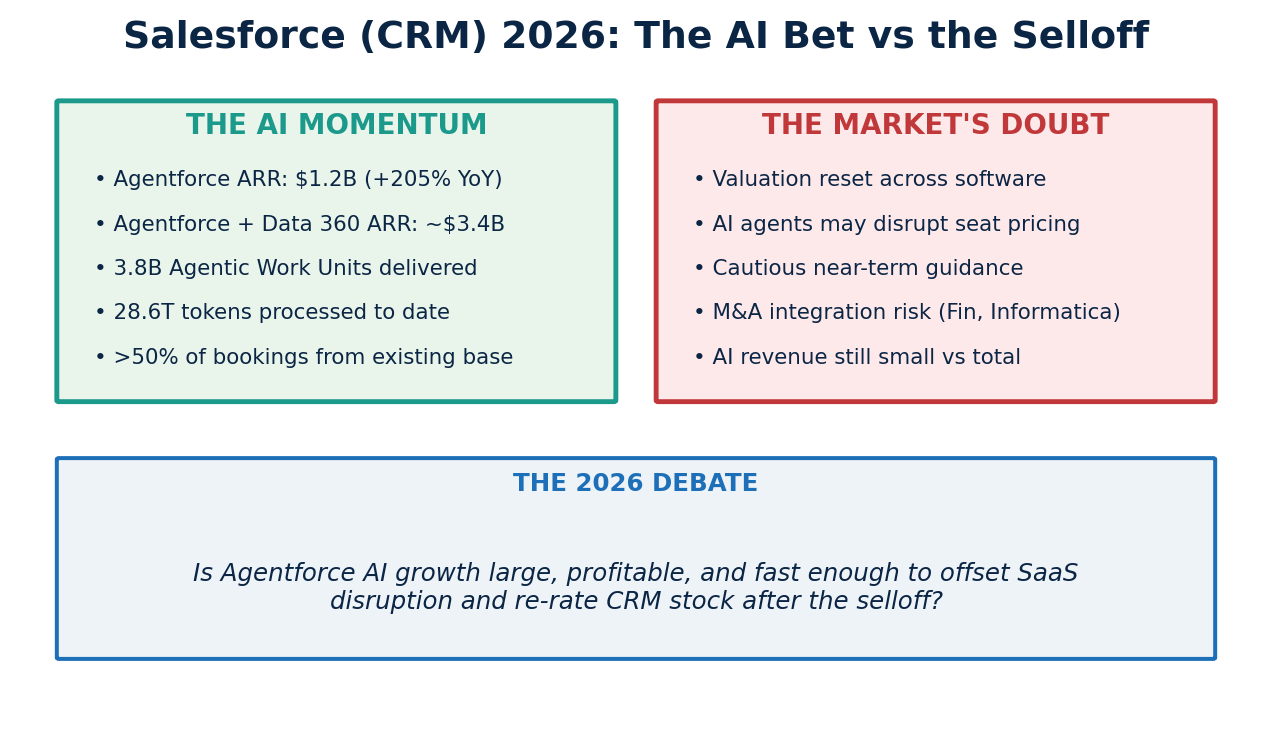
Salesforce’s latest reported quarter showed real AI momentum. The company said Agentforce reached $1.2 billion in annual recurring revenue, up 205% year over year, while Agentforce and Data 360 ARR reached nearly $3.4 billion. Salesforce also reported 3.8 billion Agentic Work Units delivered across Agentforce and Slack and more than 28.6 trillion tokens processed to date. These numbers suggest that customers are using the platform, not just testing it.
Key insight: Salesforce’s 2026 debate is not “AI or no AI.” The debate is whether AI growth is large enough, profitable enough, and fast enough to re-rate CRM stock.
The CRM selloff reflects a familiar software-market tension:
- Bull case: Agentforce becomes the AI operating layer for Salesforce’s installed base.
- Bear case: AI-native competitors compress software value and pressure seat-based pricing.
- Neutral case: Salesforce grows, but not fast enough to regain a premium valuation.
| Investor Question | Why It Matters for CRM Stock |
|---|---|
| Can Agentforce scale beyond early adopters? | Determines whether AI ARR becomes material to total revenue |
| Will Fin improve time-to-value? | Could make Salesforce’s agent strategy easier to sell |
| Can Informatica improve trusted data quality? | Clean data is essential for reliable enterprise AI agents |
| Is the selloff overdone? | Depends on growth, margins, and confidence in execution |
| Will AI disrupt seat-based SaaS pricing? | Could reshape Salesforce’s long-term revenue model |
Why Did Salesforce Stock Sell Off in 2026?
The Salesforce stock selloff in 2026 appears to be driven by a mix of valuation reset, AI disruption fears, cautious guidance, and M&A execution risk. While Salesforce reported strong AI-related metrics, investors have become less willing to reward software companies for AI narratives unless they see clear acceleration in total revenue growth.
A major concern is that traditional SaaS models may be disrupted by AI agents. If AI tools automate tasks previously performed by human users, the market may question whether per-seat pricing can keep expanding. Salesforce is responding with Agentforce and usage-oriented AI products, but investors still want proof that the new model can produce durable, high-margin growth.
Another concern is acquisition complexity. Salesforce has made several AI and data-related moves, including Informatica and Fin. These deals may strengthen the platform, but they also increase the difficulty of product integration, go-to-market alignment, and financial discipline.
What Is Driving the Salesforce Stock 2026 Selloff?
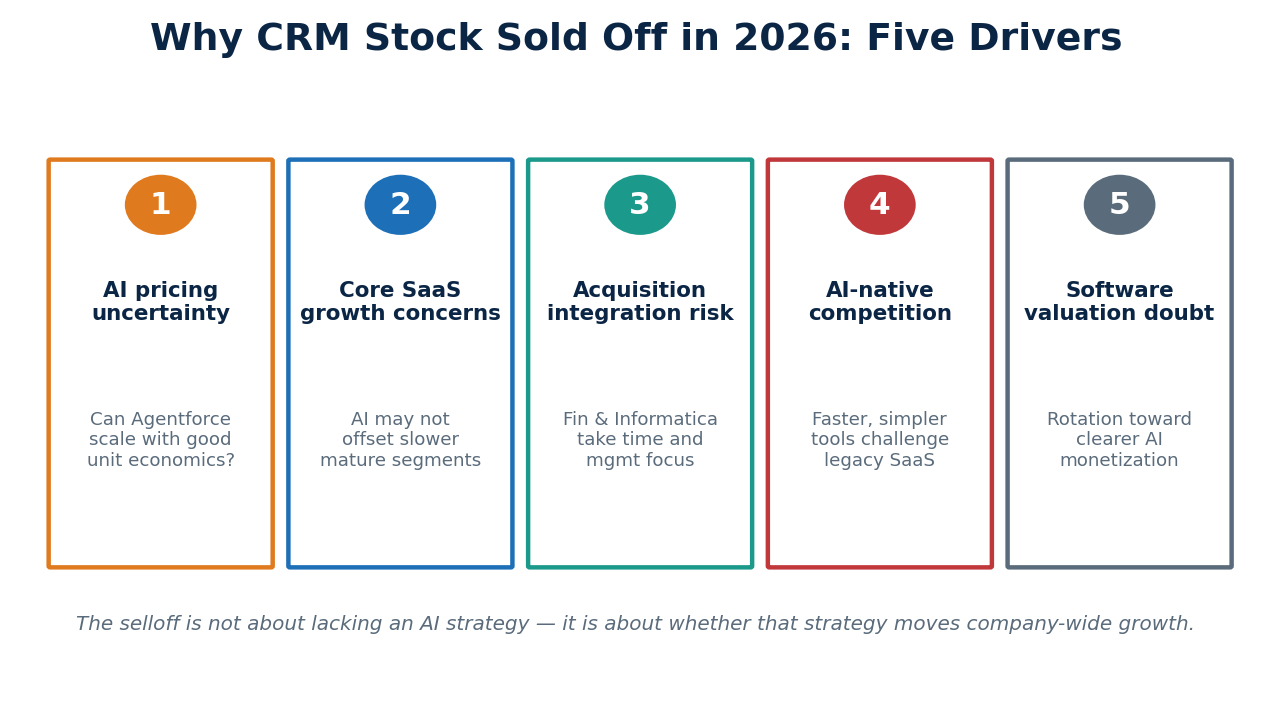
The most important drivers behind the Salesforce Stock 2026 selloff include:
- AI pricing uncertainty
Investors are unsure whether Agentforce and related products can scale with attractive unit economics.
- Core SaaS growth concerns
Even strong AI growth may not immediately offset slower growth in mature software categories.
- Acquisition integration risk
Fin and Informatica may be strategically useful, but integration takes time and management focus.
- Competitive pressure from AI-native firms
AI-native companies can challenge legacy SaaS workflows with faster, simpler, and more automated products.
- Market skepticism toward software valuations
Software stocks have faced pressure as investors rotate toward companies with clearer AI monetization.
The key takeaway: CRM stock is not selling off because Salesforce lacks an AI strategy. It is selling off because investors are debating whether that strategy can create enough incremental growth to matter at Salesforce’s scale.
Agentforce: Salesforce’s AI Growth Engine
Agentforce is Salesforce’s platform for building and deploying autonomous AI agents across sales, service, marketing, commerce, and enterprise workflows. The strategic logic is straightforward: Salesforce already sits close to customer data, workflow history, and business processes. If AI agents can use that context safely, Agentforce could become a powerful automation layer.
Salesforce has reported strong early adoption signals. Agentforce ARR reached $1.2 billion in Q1 FY27, and Agentforce plus Data 360 ARR reached nearly $3.4 billion. More than half of Agentforce and Data 360 bookings came from existing customers, which is important because Salesforce’s installed base is one of its biggest advantages.
For investors, Agentforce matters because it could change the CRM growth model from seat expansion to work automation, usage, and outcome-based value. Instead of selling only software licenses to human users, Salesforce can sell AI agents that complete work across customer support, sales operations, case resolution, and internal service workflows.
| Agentforce Metric | Why Investors Care |
|---|---|
| Agentforce ARR above $1 billion | Shows AI revenue is becoming financially relevant |
| 205% year-over-year Agentforce ARR growth | Indicates rapid adoption from a small but growing base |
| 3.8 billion Agentic Work Units | Suggests real platform usage, not just demos |
| 28.6 trillion tokens processed | Points to large-scale AI workload activity |
| Existing customer bookings above 50% | Supports cross-sell potential within the installed base |
Agentforce is Salesforce’s answer to the SaaS disruption question: if AI reduces the need for traditional seats, Salesforce wants to monetize the work AI performs instead.
The Fin Deal: Why Salesforce Is Buying an AI Customer Agent Company
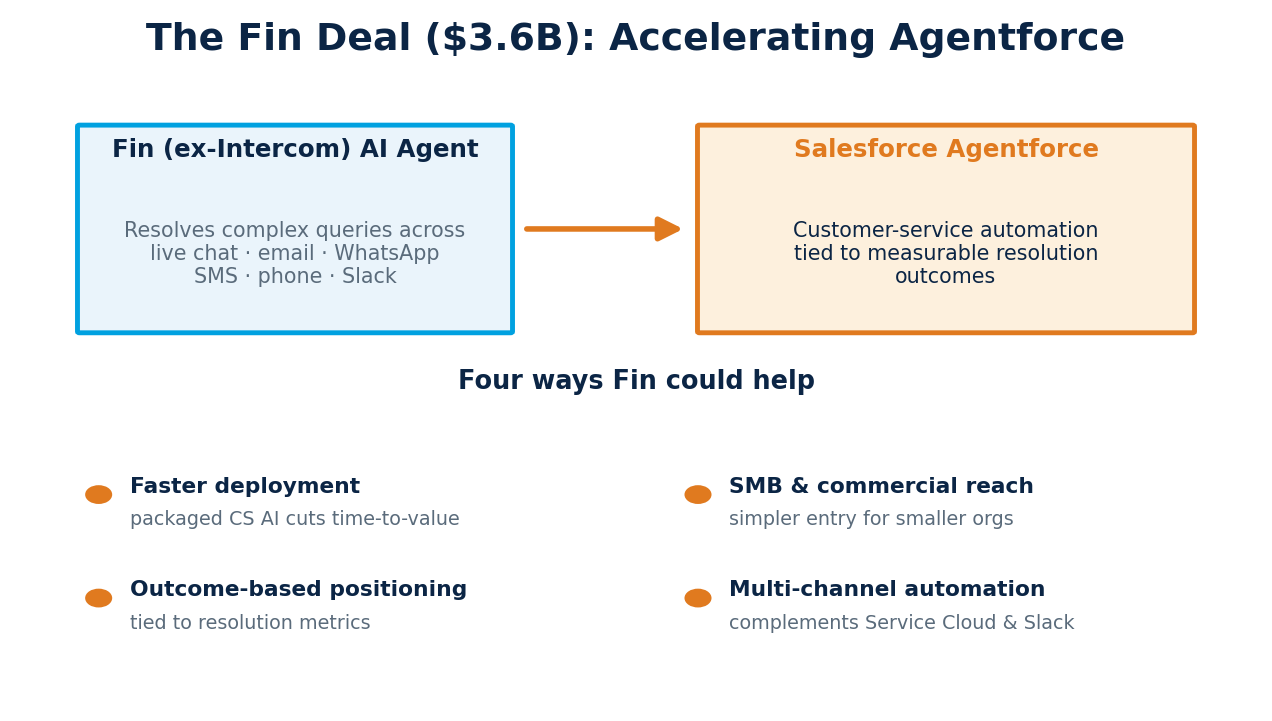
The Fin deal is central to the Salesforce stock 2026 discussion. Salesforce announced a definitive agreement to acquire Fin, formerly Intercom, for approximately $3.6 billion. Fin’s AI Agent is built for customer support and can resolve complex customer queries across channels such as live chat, email, WhatsApp, SMS, phone, and Slack.
This acquisition makes strategic sense because customer service is one of the clearest enterprise AI use cases. Support teams already have measurable workflows: tickets, resolution rates, response times, escalation rates, and customer satisfaction scores. If Fin can improve automation and speed up deployments, Salesforce may be able to show customers faster ROI from Agentforce.
How Could the Fin Acquisition Help Agentforce?
Fin could help Salesforce in four practical ways:
- Faster deployment: Fin’s packaged customer service AI may reduce time-to-value.
- SMB and commercial reach: Fin may bring a simpler entry point for smaller organizations.
- Outcome-based positioning: Customer support automation can be tied to measurable resolution outcomes.
- Multi-channel service automation: Fin’s channel coverage complements Salesforce Service Cloud and Slack.
However, the acquisition also creates risk. Investors may worry that Salesforce is buying growth instead of generating it organically. They may also worry that too many acquisitions can dilute product focus, complicate the platform roadmap, and make margins harder to defend.
The Fin deal is neither automatically bullish nor bearish. It is a strategic acceleration move. Its impact on CRM stock will depend on whether Salesforce can integrate Fin into Agentforce without slowing execution.
Informatica, Data 360, and the Trusted Data Layer
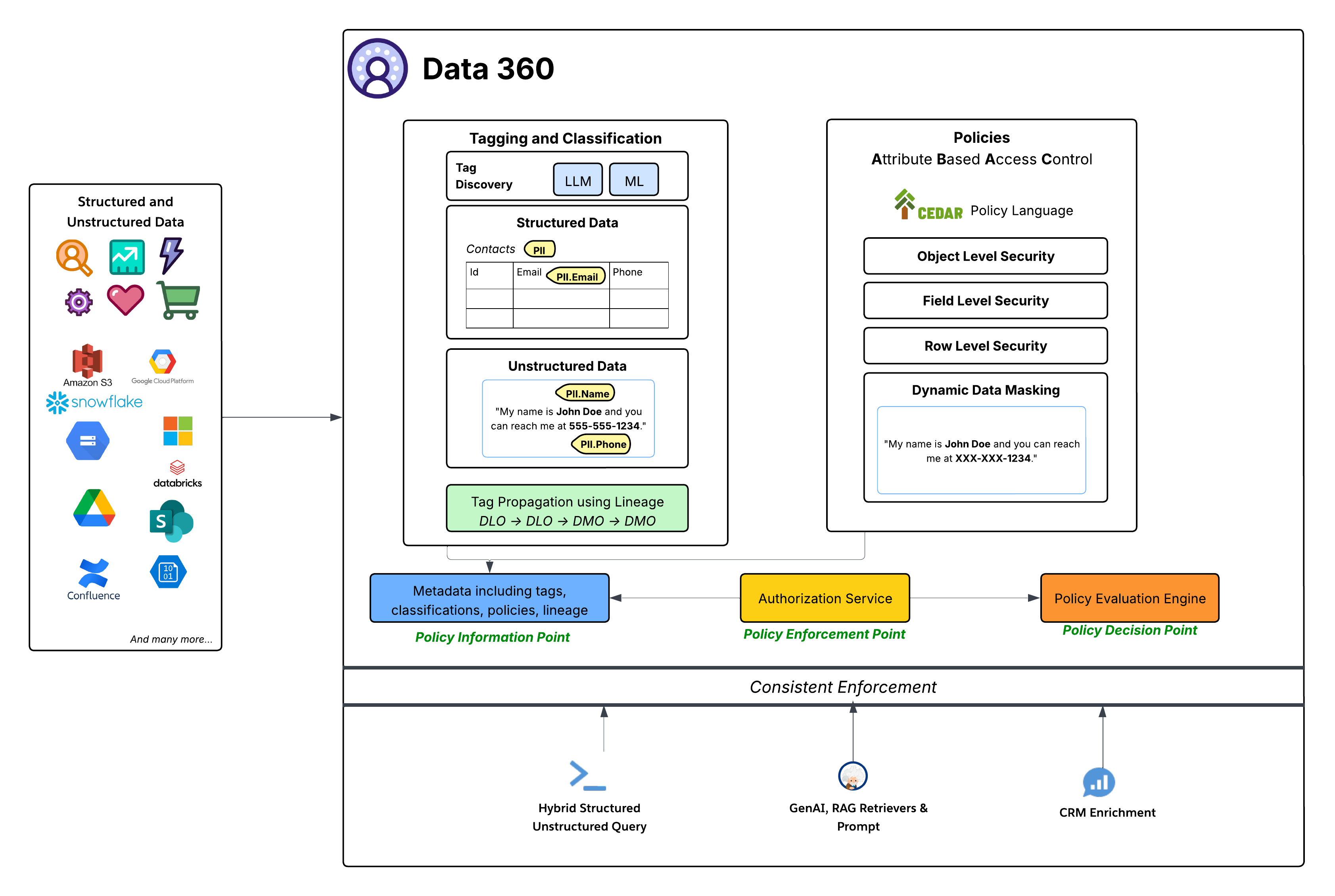
Before Fin, Salesforce completed its acquisition of Informatica, a major enterprise data management company. This matters because enterprise AI agents are only as good as the data they can access, interpret, govern, and trust.
Salesforce has framed Informatica as a way to strengthen Data 360, MuleSoft, metadata management, data quality, governance, and Master Data Management. That matters because hallucination, poor data lineage, and fragmented systems can make enterprise AI unreliable. For regulated industries, trusted data is not optional.
The strategic chain looks like this:
- Data 360 connects and organizes enterprise customer data.
- Informatica improves data quality, governance, metadata, and integration.
- Agentforce uses trusted context to reason and act.
- Fin helps package agentic customer service use cases.
- Salesforce Customer 360 becomes the system where AI agents operate.
| Platform Layer | Strategic Role |
|---|---|
| Customer 360 | Core customer system of record |
| Data 360 | Data activation and unification |
| Informatica | Governance, quality, metadata, and MDM |
| MuleSoft | Integration across applications and APIs |
| Agentforce | Autonomous AI workflow execution |
| Fin | Customer service AI agent acceleration |
For investors, the question is whether this stack becomes a defensible AI platform or a complex bundle of acquired assets. The answer will depend on execution, customer adoption, pricing, and measurable productivity outcomes.
Is Salesforce Stock Cheap After the 2026 CRM Selloff?
Salesforce may look cheaper after the CRM selloff, but “cheap” is not enough. Investors need to evaluate whether the lower valuation reflects temporary fear or a structural reset in software growth expectations.
A practical framework is to separate valuation, fundamentals, sentiment, and catalysts.
| Factor | Bullish Interpretation | Bearish Interpretation |
|---|---|---|
| Valuation | CRM may be undervalued if AI growth accelerates | Lower multiple may reflect slower long-term growth |
| Agentforce | Fast ARR growth supports AI monetization | Still small relative to total Salesforce revenue |
| Fin deal | Adds proven AI support automation | Raises integration and acquisition-dependence concerns |
| Informatica | Strengthens trusted data foundation | Adds complexity and execution risk |
| Buybacks | Support EPS and shareholder returns | May not solve organic growth concerns |
| Guidance | Management expects second-half acceleration | Investors may want stronger near-term revenue growth |
A disciplined investor should not treat the CRM selloff as an automatic buying opportunity. Instead, watch for evidence that Agentforce can drive net new revenue, usage expansion, margin contribution, and customer retention.
Best Way to Analyze CRM Stock After the Salesforce Stock 2026 Selloff
The best way to analyze CRM stock after the selloff is to use a multi-layer process:
- Track AI ARR growth
Watch Agentforce ARR and combined AI/data ARR in each earnings report.
- Compare AI growth to total revenue growth
AI metrics are impressive only if they eventually move the company-wide growth rate.
- Monitor cRPO and bookings
Current remaining performance obligation gives clues about near-term demand.
- Evaluate acquisition integration
Look for clear product packaging around Fin, Informatica, Agentforce, and Data 360.
- Assess pricing model evolution
Determine whether Salesforce can shift from seat-based SaaS to usage-based or outcome-based AI monetization.
- Review technical and sentiment signals
A stock can remain weak even when fundamentals improve if market sentiment stays negative.
This is where a platform like SimianX AI can help. SimianX offers multi-agent stock analysis that lets different AI agents evaluate fundamentals, news sentiment, technical signals, and risk perspectives side by side. For a complex stock like Salesforce, that multi-perspective workflow is useful because the bull and bear cases are both reasonable.
Salesforce Bull Case for 2026 and Beyond
The bull case for Salesforce stock is built on the idea that the market is underestimating the company’s installed base, data advantage, and ability to commercialize enterprise AI.
Salesforce has deep customer relationships, mission-critical workflows, and a broad product ecosystem. If Agentforce becomes embedded across Sales Cloud, Service Cloud, Slack, Data 360, and industry clouds, Salesforce can monetize AI at scale. Fin could make customer service automation faster to deploy, while Informatica could make AI outputs more reliable by improving data quality and governance.
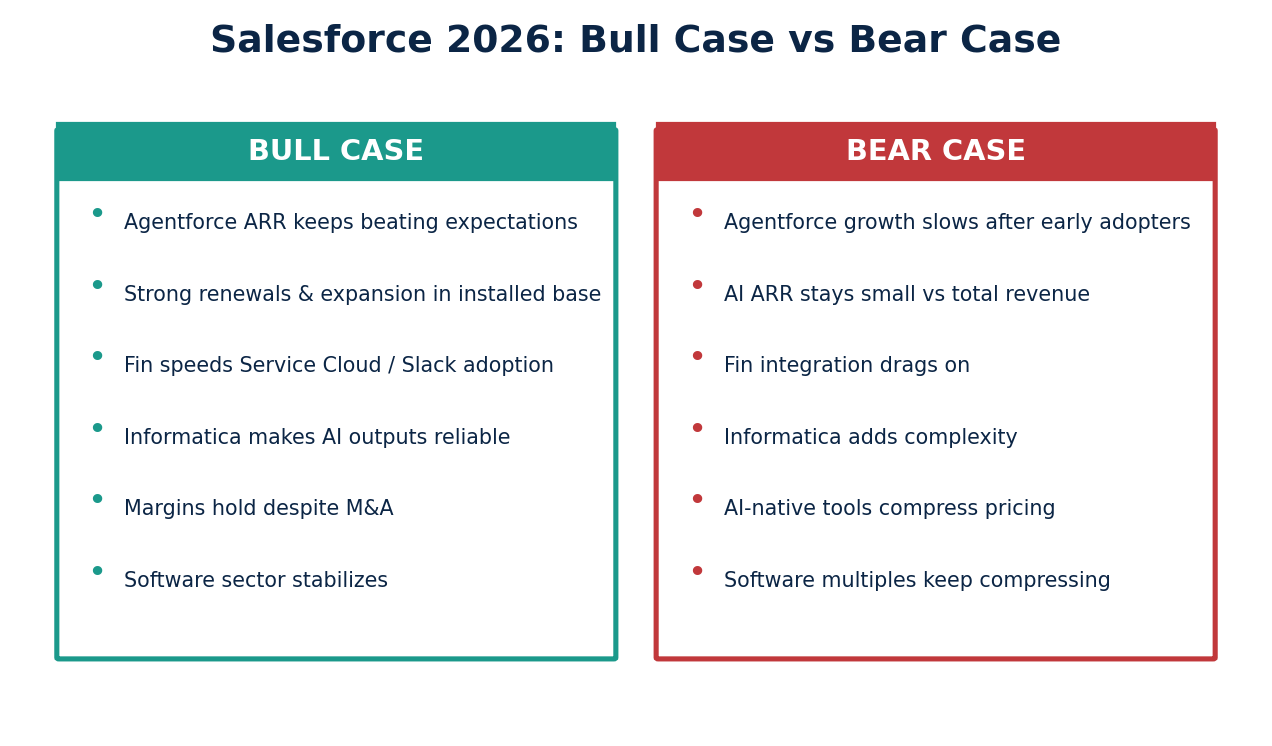
Bullish catalysts include:
- Continued Agentforce ARR growth above expectations
- Strong renewal rates and expansion within existing customers
- Faster adoption of Agentforce in Service Cloud and Slack
- Clear evidence that Fin improves deployment speed
- Better-than-expected margin performance despite M&A
- Stabilization in the broader software sector
- Strong free cash flow and shareholder returns
If Salesforce proves that AI agents expand the value of CRM rather than cannibalize it, the market may re-rate CRM stock.
Salesforce Bear Case for 2026 and Beyond
The bear case is that Salesforce is facing a deeper platform transition than investors expected. AI agents could reduce the need for traditional software seats, compress pricing power, and shift budgets toward AI-native tools. In that scenario, Agentforce may grow quickly but still fail to offset pressure in mature SaaS products.
The Fin deal may also be interpreted as a sign that Salesforce needed to buy a faster-moving AI-native customer service product rather than rely only on internal innovation. While acquisitions can accelerate strategy, they can also create integration drag.
Bearish risks include:
- Agentforce growth slowing after early adoption
- AI ARR remaining too small relative to total revenue
- Fin integration taking longer than expected
- Informatica complexity delaying product simplification
- Competitive pressure from AI-native workflow tools
- Continued multiple compression across software stocks
- Customers delaying large software commitments during AI budget shifts
The bear case does not require Salesforce to fail. It only requires Salesforce to grow more slowly than the market once expected.
What Should Investors Watch Next?
Investors researching Salesforce stock 2026 Agentforce Fin deal CRM selloff should focus on measurable evidence, not headlines. The next phase of the story will depend on whether Salesforce can translate AI adoption into company-wide acceleration.
Watch these indicators:
| What to Watch | Positive Signal | Negative Signal |
|---|---|---|
| Agentforce ARR | Sustained triple-digit growth | Growth slows sharply |
| AI/data ARR | Expands as a larger share of revenue | Stalls below investor expectations |
| cRPO | Shows durable demand | Weakens despite AI narrative |
| Fin integration | Clear packaging and customer wins | Confusing overlap with Agentforce |
| Data 360/Informatica | Better data governance adoption | Integration delays or complexity |
| Margins | Remain resilient | M&A and AI costs pressure profitability |
| Guidance | Revenue acceleration becomes visible | Management remains cautious |
For traders, technical signals may matter in the short term. For long-term investors, the more important question is whether Salesforce can become a leading enterprise AI agent platform without sacrificing its margin profile.
Practical Research Workflow Using SimianX AI
A practical way to research Salesforce is to combine primary data, market sentiment, and multi-agent analysis. SimianX AI is especially relevant for this workflow because it is designed to help investors compare AI-generated perspectives in real time rather than rely on one static opinion.
Here is a simple research workflow:
- Open the Salesforce CRM stock page on SimianX AI.
- Review price action, market cap, sector context, and recent news.
- Run or review multi-agent analysis for fundamental, technical, sentiment, and risk views.
- Compare the bull and bear cases instead of forcing a single conclusion.
- Cross-check AI output against Salesforce earnings releases, deal announcements, and valuation data.
- Build your own watchlist triggers for Agentforce ARR, cRPO, margin guidance, and Fin integration updates.
This approach is useful because Salesforce is not a simple “good company, bad stock” story. It is a transition story, and transition stories require scenario analysis.
FAQ About Salesforce Stock 2026: Agentforce, Fin Deal & CRM Selloff
What is driving Salesforce stock down in 2026?
Salesforce stock has been pressured by concerns about software-sector valuation, AI disruption, cautious growth expectations, and integration risk from acquisitions such as Fin and Informatica. Investors want proof that Agentforce can drive meaningful company-wide revenue acceleration, not just impressive standalone AI metrics.
How does Agentforce affect CRM stock?
Agentforce affects CRM stock because it is Salesforce’s main AI growth engine. If Agentforce turns Salesforce’s customer data and workflows into high-value autonomous agents, it could support faster growth and a higher valuation. If adoption slows or pricing disappoints, the market may remain skeptical.
Is the Salesforce Fin acquisition good for investors?
The Fin acquisition could be good for investors if it accelerates customer service AI adoption and improves Agentforce time-to-value. The risk is that another large acquisition adds complexity and makes Salesforce’s AI strategy look more dependent on M&A.
What role does Informatica play in Salesforce’s AI strategy?
Informatica strengthens Salesforce’s data foundation by improving integration, governance, metadata, quality, and Master Data Management. That matters because enterprise AI agents need clean, connected, and trusted data to operate reliably.
What is the best way to analyze Salesforce stock after the CRM selloff?
The best way is to track Agentforce ARR, AI/data ARR, cRPO, revenue guidance, margins, and acquisition integration milestones. Investors can also use multi-agent research tools like SimianX AI to compare fundamental, technical, sentiment, and risk-based views.
Conclusion
Salesforce Stock 2026: Agentforce, Fin Deal & CRM Selloff is a high-stakes AI transition story. Salesforce has real assets: a massive installed base, strong enterprise relationships, Agentforce momentum, Data 360, Informatica’s trusted data layer, and now Fin’s customer service AI agent capabilities. But the market is asking a harder question: can all of this create enough durable growth to offset SaaS disruption and justify a stronger CRM valuation?
The bull case depends on Agentforce becoming a scaled enterprise AI automation layer. The bear case depends on AI-native competition, pricing disruption, and acquisition complexity limiting Salesforce’s upside. Investors should avoid simplistic conclusions and focus on measurable evidence.
To research CRM with a broader, multi-perspective process, explore SimianX AI and use its multi-agent stock analysis workflow to compare fundamentals, news sentiment, technical signals, and risk factors before making any investment decision.
Related Reading
- Oracle Earnings 2026: OCI, Stargate Backlog & ORCL Stock
- Apple WWDC 2026: Siri AI & Gemini Impact on AAPL Stock
- The Magnificent 7 in 2026: Weights & Concentration Risk
- SMCI Stock 2026: $7B Capital Raise vs $39B AI Backlog
- GLW Stock 2026: Corning's AI Photonics Boom Explained
- June 2026 FOMC Decision: Dot Plot, AI Stocks & Bitcoin