Caterpillar as the Power Layer of the AI Build-Out
The Caterpillar Stock 2026: AI Data Center Power Trade is no longer just a clever market narrative. It is becoming a measurable investment theme built around one simple reality: artificial intelligence needs electricity, and electricity needs heavy equipment, turbines, engines, backup systems, and service networks. For investors using SimianX AI, Caterpillar CAT now deserves analysis not only as a construction and mining bellwether, but also as a potential industrial infrastructure beneficiary of the AI power cycle.
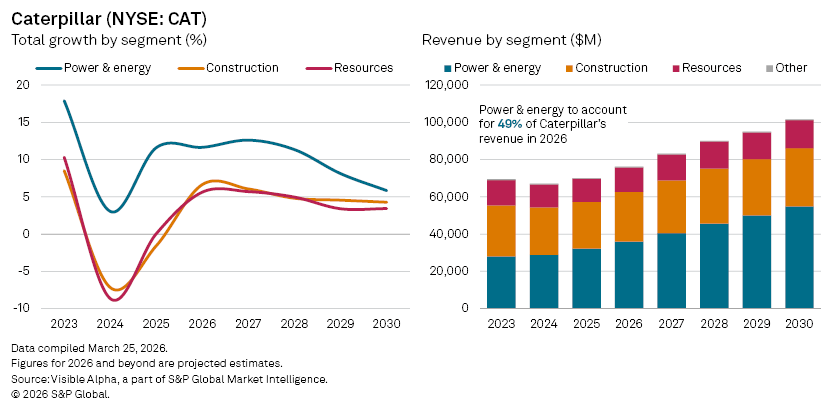
As AI workloads expand, data centers are moving from a real-estate problem to a power availability problem. That shift is important for Caterpillar because the company is not only known for construction and mining equipment; it also has meaningful exposure to engines, turbines, power generation systems, and long-term industrial services.
Key research idea: Caterpillar’s 2026 setup is a “picks-and-shovels” AI trade where the pick is not a GPU — it is power generation.
The investment question is not simply whether Caterpillar has AI exposure. The better question is whether AI data center power demand can become large, durable, and profitable enough to support Caterpillar’s valuation in 2026 and beyond.
Why Caterpillar Stock Is Being Repriced in 2026
Caterpillar has historically been viewed as a cyclical industrial tied to construction, mining, energy, transportation, and global capital spending. That still matters. But in 2026, the market is increasingly treating CAT as a power infrastructure beneficiary because AI data centers require reliable electricity at a scale that many local grids cannot quickly supply.
The AI boom has created a new industrial bottleneck. Compute demand is rising quickly, but data centers cannot run on GPUs alone. They need land, cooling, transformers, switchgear, backup generation, natural gas turbines, grid interconnections, and service teams that can keep uptime high.
That changes the way investors should think about Caterpillar. Instead of analyzing it only as a construction and mining cycle stock, investors can now evaluate it through three overlapping demand curves:
- AI data center buildouts that need dependable on-site and backup power.
- Grid bottlenecks that push hyperscalers toward “bring your own power” models.
- Long-duration service revenue tied to installed engines, turbines, maintenance, and parts.
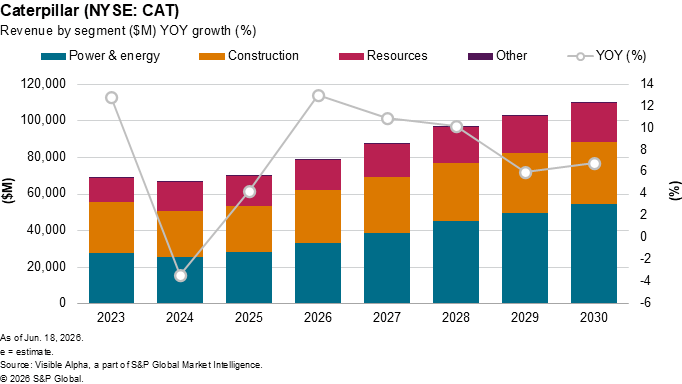
The most important detail in the Caterpillar stock 2026 AI data center power trade is not only revenue growth. It is the quality of that revenue. Equipment sales can be cyclical, but installed power systems can lead to multi-year service, parts, monitoring, and replacement opportunities.
What Is the Caterpillar Stock 2026 AI Data Center Power Trade?
The Caterpillar stock 2026 AI data center power trade is the thesis that Caterpillar can benefit from the physical infrastructure required to power AI workloads. This includes natural gas engines, industrial turbines, backup generation, distributed power systems, and lifecycle services.
AI investors often focus on semiconductors, cloud platforms, and software. But the AI stack has a physical layer:
| AI Infrastructure Layer | Typical Winners | Why It Matters for Caterpillar |
|---|---|---|
| Compute | GPU suppliers, servers, networking | Drives electricity consumption |
| Data center shell | Construction, cooling, electrical contractors | Requires rapid site buildout |
| Power generation | Engines, turbines, backup power | Directly overlaps with Caterpillar’s capabilities |
| Operations and service | Maintenance, monitoring, parts | Creates recurring industrial revenue |
| Grid and microgrid integration | Utilities, power equipment, storage | Supports distributed and on-site generation |
This matters because Caterpillar’s power business sits in the practical middle ground between cloud ambition and grid reality. If a hyperscaler cannot wait years for a grid interconnection, it may need on-site generation, temporary power, backup systems, or co-located energy solutions.
The AI data center power trade is not a short-term headline trade only. It is a potential multi-year infrastructure cycle that could affect order books, backlog quality, pricing power, and service revenue.
Why AI Data Centers Need So Much Power
AI data centers are different from traditional enterprise data centers because AI training and inference workloads can consume enormous amounts of electricity. High-density GPU clusters require not only power for computation, but also cooling, redundancy, and continuous uptime protection.
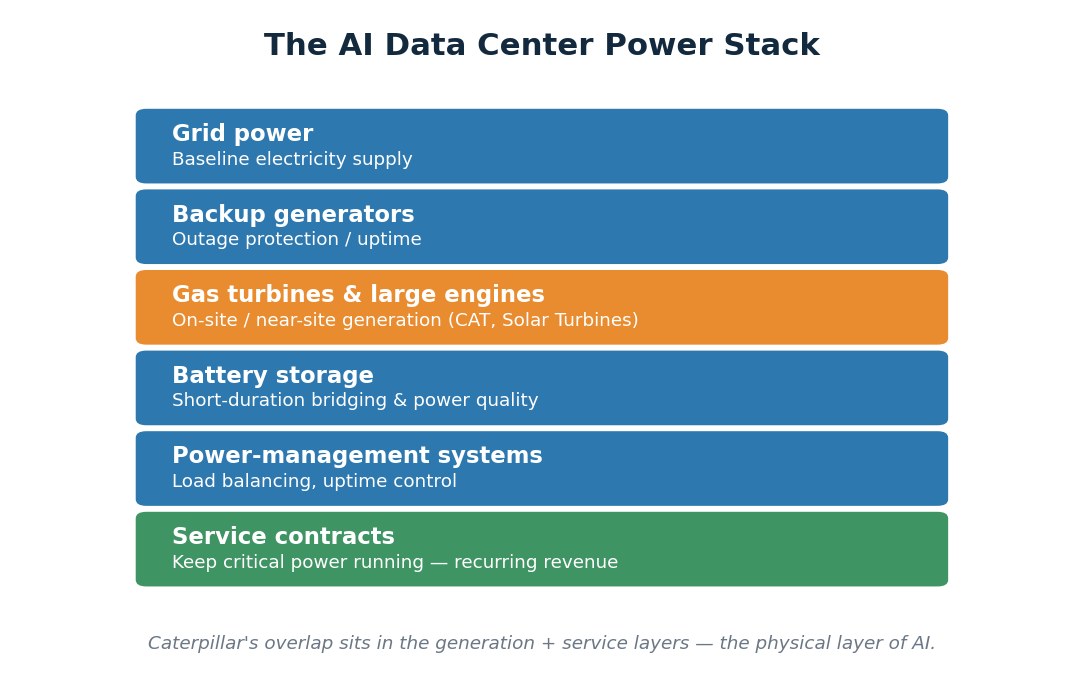
A typical AI data center power stack may include:
- Grid power for baseline electricity supply.
- Backup generators for outage protection.
- Natural gas turbines or engines for on-site or near-site generation.
- Battery storage for short-duration bridging and power quality.
- Power management systems to balance loads and maintain uptime.
- Service contracts to keep critical infrastructure operating reliably.
For Caterpillar, this is important because data center customers are not buying power systems casually. They are buying reliability. Downtime can be extremely expensive, and power availability can determine whether an AI campus launches on schedule.
Investor takeaway: The AI data center trade is not only about demand growth. It is about whether Caterpillar can convert that demand into high-quality backlog, pricing power, and recurring service economics.
Why Caterpillar Fits the AI Power Infrastructure Theme
Caterpillar fits the AI data center power trade because it has several characteristics investors typically want in an infrastructure beneficiary:
- Scale: Caterpillar has global manufacturing and service capabilities.
- Brand trust: Critical infrastructure buyers often prefer established suppliers.
- Dealer and service network: Long-term service support is essential for power systems.
- Product relevance: Engines, turbines, backup power, and power generation are directly relevant to data centers.
- Cash generation: Caterpillar has historically returned capital through dividends and buybacks.
The company is not a pure-play AI power stock. That can be both a benefit and a limitation. The benefit is diversification: Caterpillar also serves construction, mining, energy, transportation, and industrial customers. The limitation is that AI-related power demand may still represent only part of the total business.
For investors, the key is to avoid binary thinking. Caterpillar does not need to become a pure AI company to benefit from AI. It only needs AI infrastructure demand to become large enough to improve growth, backlog visibility, margin durability, or valuation quality.
The Role of Solar Turbines and Distributed Power
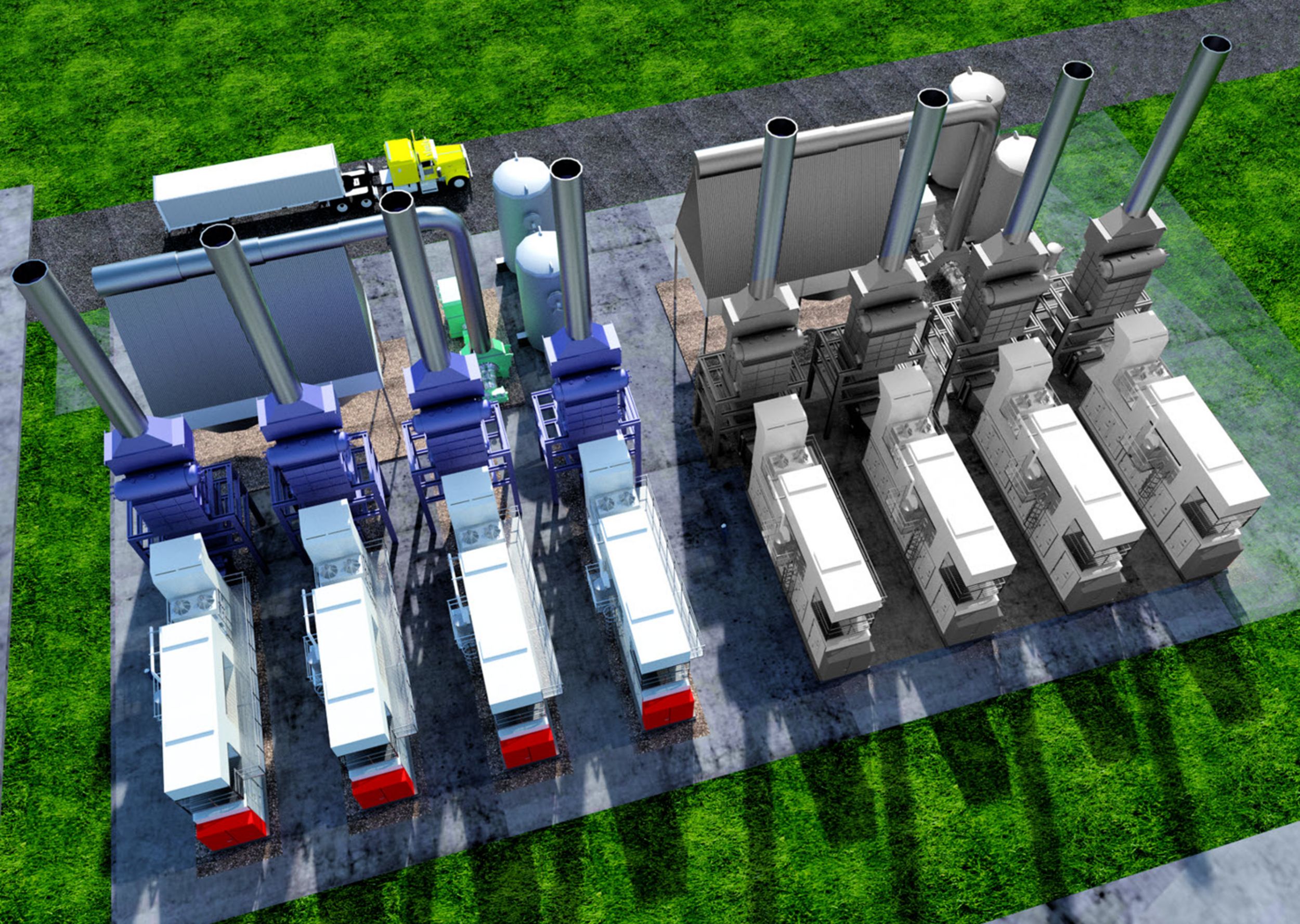
One underappreciated part of the Caterpillar AI power thesis is Solar Turbines, a Caterpillar subsidiary that manufactures industrial gas turbines and related systems. Industrial turbines can be relevant for large-scale power generation, including projects that support energy-intensive data centers.
The broader data center market is increasingly considering distributed power and behind-the-meter generation. These models can help customers secure electricity closer to the point of consumption, reduce dependence on slow grid upgrades, and improve deployment timelines.
For AI data centers, distributed power can be attractive when:
- Local grid capacity is constrained.
- Interconnection queues are too slow.
- Power reliability requirements are extremely high.
- Data center campuses are built near natural gas infrastructure.
- Customers want more control over energy sourcing and uptime.
Caterpillar’s opportunity depends on whether these models move from isolated projects to repeatable market demand. If more hyperscalers, energy companies, and data center developers adopt co-located generation, Caterpillar’s addressable market could expand.
Is Caterpillar Stock an AI Infrastructure Stock Now?
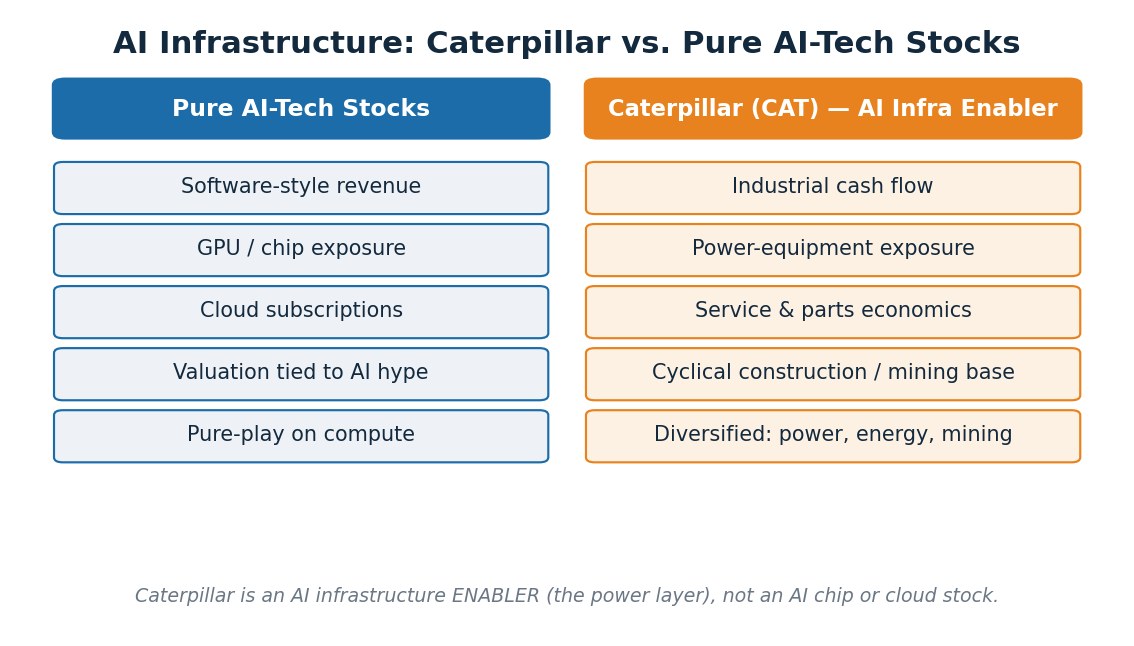
Yes — but with nuance. Caterpillar is not an AI software company, a chip company, or a cloud platform. It is better understood as an AI infrastructure enabler.
That distinction matters for portfolio construction. Compared with pure AI technology stocks, Caterpillar may offer:
- Industrial cash flow rather than software-style revenue.
- Power equipment exposure rather than GPU exposure.
- Service and parts economics rather than cloud subscriptions.
- Cyclical risk from construction, mining, and energy markets.
- Valuation risk if the AI power narrative becomes crowded.
The market’s willingness to value Caterpillar as an AI infrastructure stock depends on evidence. Investors should look for proof in orders, backlog, power generation revenue, margin performance, customer announcements, and management commentary.
A strong narrative is not enough. The Caterpillar stock 2026 AI data center power trade needs to show up in financial results.
How to Analyze Caterpillar Stock in 2026 Using the AI Power Framework
Investors should analyze Caterpillar through a structured framework rather than chasing headlines. The AI data center power trade has real substance, but the stock price may already reflect significant optimism.
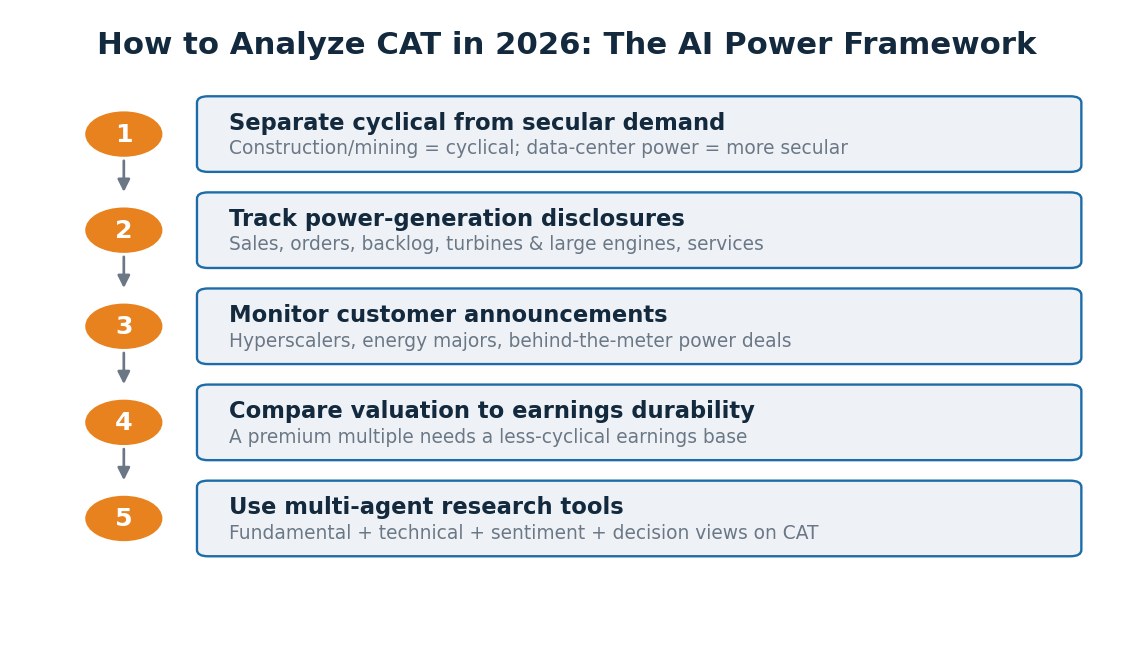
A practical research process looks like this:
- Separate cyclical demand from secular AI demand.
Construction and mining remain cyclical. Power generation tied to data centers may be more secular, but it can still be lumpy.
- Track power generation disclosures.
Focus on sales, order growth, backlog, and commentary around data centers, turbines, large reciprocating engines, and services.
- Monitor customer announcements.
Deals involving hyperscalers, energy majors, data center developers, and behind-the-meter power providers can validate the thesis.
- Compare valuation to earnings durability.
A premium multiple requires evidence that Caterpillar’s earnings base is becoming less cyclical and more infrastructure-like.
- Use multi-agent research tools.
SimianX AI can help investors compare fundamental, technical, news sentiment, and decision-agent views on CAT, especially when the stock is reacting quickly to AI infrastructure headlines.
For practical research, investors can use SimianX AI to build a repeatable workflow around Caterpillar. Instead of manually jumping between price charts, filings, analyst notes, sentiment, and news, SimianX AI can support a more structured view across multiple stock-analysis dimensions.
Key Metrics to Track for CAT in 2026
The Caterpillar stock 2026 AI data center power trade should be evaluated through specific metrics. Investors should not rely only on headlines or broad AI enthusiasm.
| Metric | Why It Matters | Bullish Signal | Bearish Signal |
|---|---|---|---|
| Power Generation sales | Direct AI data center linkage | Sustained double-digit growth | One-quarter spike fades |
| Backlog | Visibility into future revenue | Backlog expands with quality orders | Backlog growth slows sharply |
| Operating margin | Converts demand into earnings | Margins stabilize or rise | Costs absorb revenue growth |
| Capex and capacity | Shows ability to meet demand | Capacity expands without margin damage | Expansion creates execution risk |
| Service revenue | Higher-quality recurring economics | Attach rates improve | Equipment sales dominate with low follow-on revenue |
| Valuation | Determines upside/downside | EPS growth catches up to multiple | Multiple compresses before earnings rise |
The most important combination is backlog plus margin. Backlog without profitability may not create shareholder value. Margin without backlog may not be durable. Investors want both.
Bull Case for Caterpillar Stock in the AI Power Trade
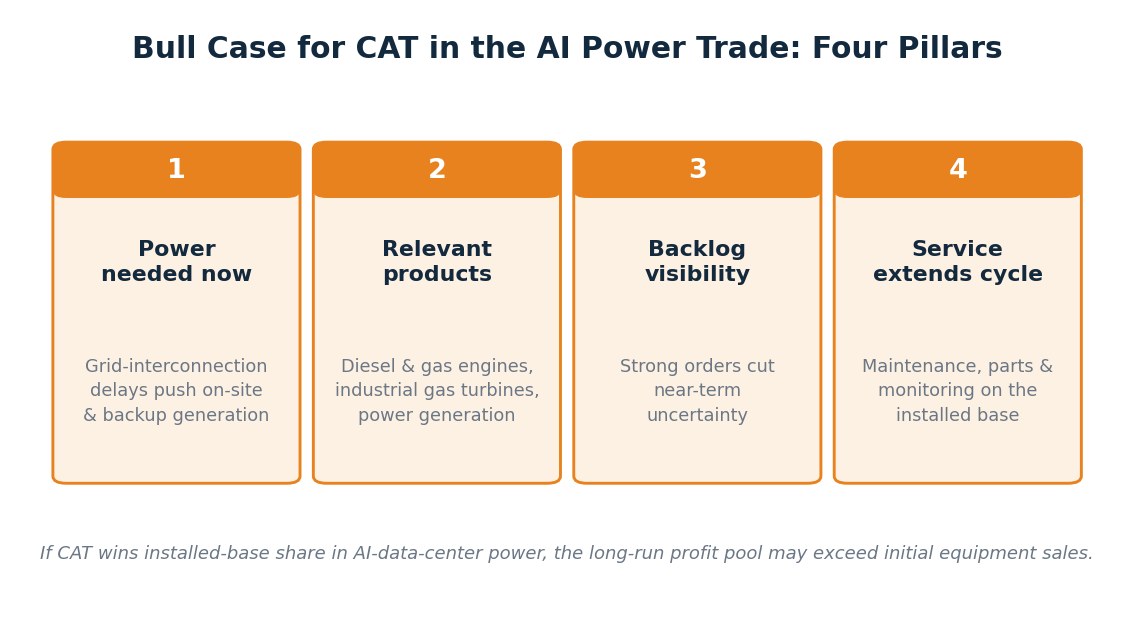
The bull case rests on four pillars.
First, AI data centers need reliable power now. Grid interconnection delays and rising power density make on-site generation more attractive.
Second, Caterpillar has relevant products. The company has exposure to diesel and natural gas engines, industrial gas turbines, power generation, and service infrastructure.
Third, backlog can support visibility. Strong order activity can reduce near-term uncertainty, especially if data center-related demand becomes a larger share of the book.
Fourth, service revenue can extend the cycle. Engines and turbines require maintenance, parts, monitoring, and lifecycle support. If Caterpillar wins installed-base share in AI data center power, the long-term profit pool may be larger than initial equipment sales.
In the bullish scenario, Caterpillar becomes one of the market’s preferred industrial ways to invest in AI infrastructure. The stock may deserve a higher multiple if investors conclude that power generation demand is structurally stronger, less cyclical, and more service-heavy than traditional machinery demand.
Bear Case and Risks Investors Should Not Ignore
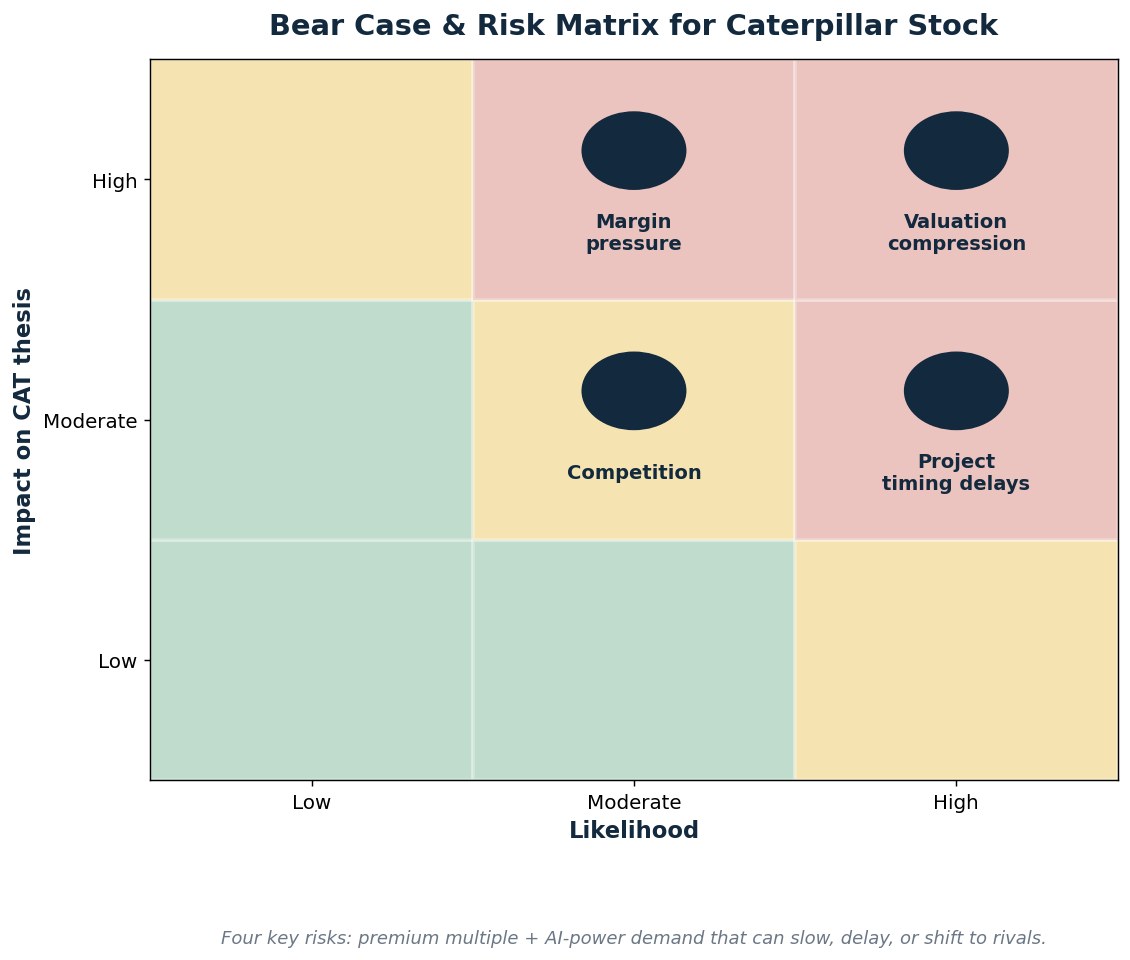
The bear case is equally important because AI infrastructure narratives can become crowded quickly.
The first risk is valuation compression. A stock trading at a premium multiple needs durable earnings growth. If AI power demand slows, delays, or shifts toward competitors, the multiple could fall even if Caterpillar remains a strong company.
The second risk is margin pressure. Rapid growth can require capacity expansion, supply chain investment, labor costs, and execution spending. If costs rise faster than pricing, revenue growth may not fully translate into earnings growth.
The third risk is project timing. Large data center power deals often have long lead times, regulatory hurdles, final investment decisions, and phased deployments. A project announced today may not materially affect near-term earnings.
The fourth risk is competition. Caterpillar is not the only company targeting AI power infrastructure. Other engine, turbine, electrical equipment, grid, cooling, and backup power companies are also competing for pieces of the stack.
Practical Investor Checklist for CAT Stock in 2026
Before making any decision on Caterpillar stock, investors can use this checklist:
- Is Power Generation still accelerating?
- Is backlog growing faster than revenue?
- Are data center orders moving from announcements to shipments?
- Are margins stable despite capacity investment?
- Is service revenue growing with installed equipment?
- Is the stock price already discounting a perfect AI power cycle?
- Are technical signals confirming or contradicting the fundamental story?
A simple scoring model can help:
| Question | Score 0 | Score 1 | Score 2 |
|---|---|---|---|
| Power generation growth | Weak | Stable | Accelerating |
| Backlog | Declining | Flat | Expanding |
| Margins | Compressing | Stable | Improving |
| AI customer visibility | Low | Moderate | High |
| Valuation | Expensive vs growth | Fair | Supported by durable growth |
A total score of 8–10 may support a bullish view, 5–7 may suggest patience, and 0–4 may indicate the AI power trade is not yet strong enough to justify the risk.
How SimianX AI Can Help Investors Research CAT
The Caterpillar stock 2026 AI data center power trade requires ongoing monitoring. This is where SimianX AI can be useful for investors who want a repeatable decision process.
With SimianX AI, investors can approach Caterpillar research through multiple lenses:
- Fundamental analysis: revenue, margins, earnings, cash flow, and valuation.
- Technical analysis: trend strength, support and resistance, momentum, and volatility.
- Sentiment analysis: market reaction to AI infrastructure news and earnings commentary.
- Decision support: comparing bullish, neutral, and bearish signals in one workflow.
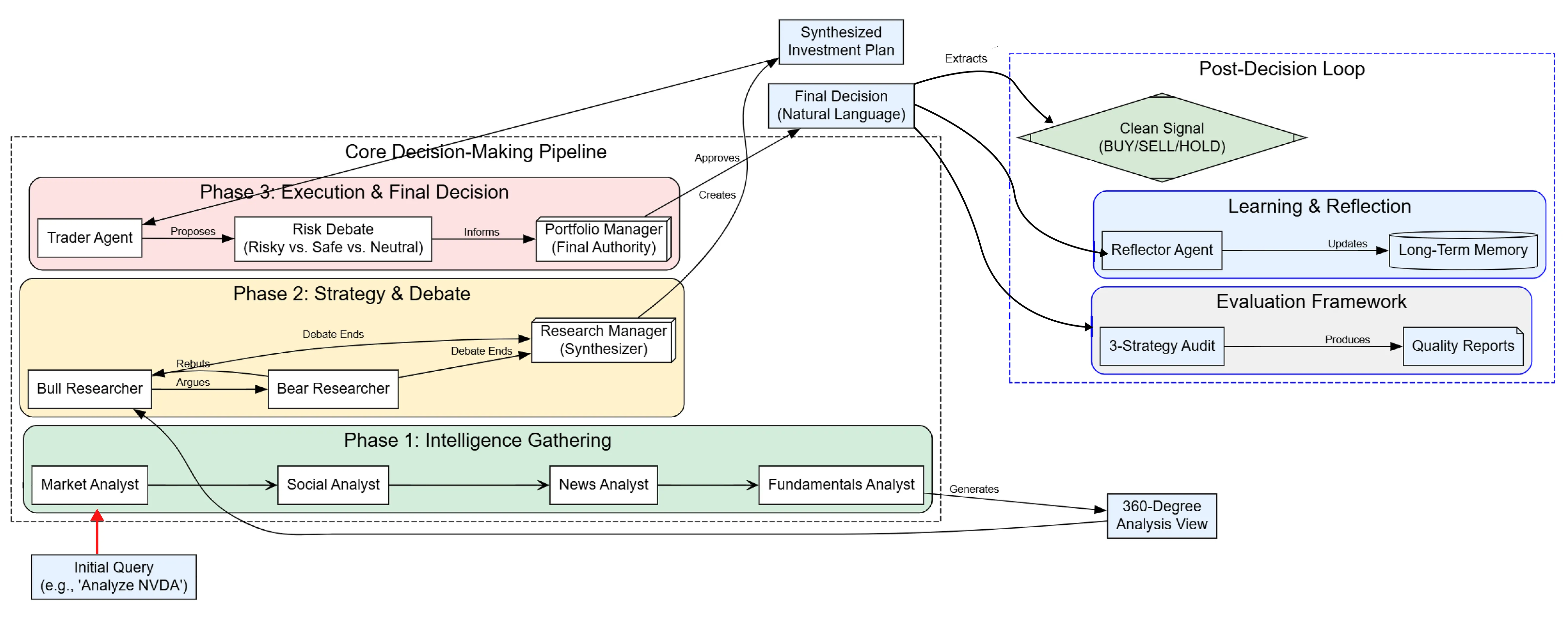
The goal is not to outsource judgment. The goal is to reduce research friction. A stock like Caterpillar can move on earnings, industrial data, AI infrastructure headlines, energy policy, and hyperscaler capex guidance. SimianX AI can help investors organize those signals more efficiently.
FAQ About Caterpillar Stock 2026 AI Data Center Power Trade
What is the AI data center power trade in Caterpillar stock?
The AI data center power trade is the idea that Caterpillar can benefit from rising demand for engines, turbines, backup systems, and on-site generation used by AI data centers. It is a physical infrastructure thesis, not a software or semiconductor thesis.
Is Caterpillar stock a direct AI stock in 2026?
Caterpillar is not a direct AI model, chip, or cloud stock. It is better understood as an AI infrastructure stock because its products can support the electricity needs of data centers and related industrial power systems.
How should investors value Caterpillar’s AI power exposure?
Investors should value the exposure by tracking Power Generation sales, backlog, margins, service attachment, and customer project announcements. The thesis becomes stronger if data center orders convert into profitable revenue and recurring service demand.
What are the biggest risks to the Caterpillar AI data center thesis?
The biggest risks are valuation, margin pressure, project delays, competition, and a potential slowdown in AI data center capital spending. Investors should also remember that Caterpillar still has cyclical exposure to construction, mining, and energy markets.
Can SimianX AI help analyze CAT stock?
Yes. SimianX AI can help investors evaluate US stocks with a structured research workflow across fundamentals, technical indicators, sentiment, and decision support. It can be useful for monitoring fast-changing narratives like Caterpillar’s AI data center power exposure.
Conclusion
The Caterpillar Stock 2026: AI Data Center Power Trade is one of the clearest examples of how the AI boom is spreading beyond chips and software into industrial infrastructure. Caterpillar’s exposure to power generation, turbines, engines, and long-term service gives it a credible role in the physical layer of AI deployment.
For investors, the right question is not simply “Is Caterpillar an AI stock?” A better question is: Can Caterpillar turn AI power demand into durable earnings growth that justifies its valuation?
The answer depends on power generation growth, backlog quality, service revenue, margins, and competitive positioning. To keep tracking that answer with a structured, multi-agent workflow, explore SimianX AI and use it to monitor Caterpillar’s fundamentals, technical signals, news catalysts, and risk profile as the AI data center power trade develops.
Related Reading
- NextEra-Dominion 2026 Deal: 110 GW AI Power Bottleneck
- Nuclear & Uranium Stocks 2026: The AI Power Crunch Bet
- KKR Helix AI Infrastructure: NVDA, VST Power Trade
- CoreWeave Stock 2026: $100B AI Backlog vs Debt Risk
- Broadcom Earnings 2026: AI ASIC Backlog & AVGO Stock