
 By Muke
Alphabet Q2 Earnings 2026: Can Gemini and Google Cloud Justify the AI Capex Surge?
Alphabet Q2 earnings 2026 will be one of the most important tests yet of whether Google’s artificial intelligence strategy is producing returns fast enough to justify an unprecedented infrastructure buildout.
Alphabet will release its second-quarter results after the U.S. market closes on Wednesday, July 22, 2026, followed by its earnings call at 1:30 p.m. Pacific Time. For investors in Singapore, the call begins at approximately 4:30 a.m. on Thursday, July 23.
The central question is no longer whether Alphabet is investing aggressively in AI. That is already clear. Management expects full-year capital expenditures of $180 billion to $190 billion, roughly double the prior year and about six times the amount spent in 2022.
The real debate is whether Gemini, Google Cloud, Search AI, and Alphabet’s custom chips can generate enough revenue, margin expansion, and long-term customer commitments to produce an acceptable return on that spending.
For readers using SimianX AI to analyze earnings events, this report separates the headline numbers from the indicators that may actually determine the post-earnings direction of GOOGL and GOOG.
What Must Alphabet Q2 Earnings 2026 Prove?
Alphabet enters the quarter with unusually strong operating momentum—but also an unusually high burden of proof.
Google Cloud accelerated sharply in the first quarter, Gemini adoption expanded across consumer and enterprise products, and Search revenue remained resilient despite concerns that generative AI could disrupt traditional search behavior.
At the same time, capital expenditures are rising faster than operating cash flow, free cash flow is under pressure, and Alphabet has raised substantial new debt and equity capital to fund AI infrastructure.
The Q2 report must therefore answer three questions:
- Is Google Cloud growth durable enough to support the infrastructure buildout?
- Is Gemini creating measurable revenue rather than only usage growth?
- Can Alphabet preserve margins and cash generation while capex accelerates?
A revenue beat alone may not be sufficient. Investors need evidence that Alphabet’s AI spending is creating profitable, defensible, and recurring revenue.
Public estimates vary slightly, but consensus expectations generally point to another quarter of more than 20% consolidated revenue growth.
| Q2 2026 metric | Market expectation | Why it matters |
|---|---|---|
| Total revenue | Approximately $116.8–$116.9 billion | Tests whether Alphabet can maintain companywide growth above 20% |
| Google Cloud revenue | Approximately $22.2 billion | The clearest direct measure of enterprise AI monetization |
| Google Services revenue | Approximately $94.3 billion | Shows whether Search, YouTube, and subscriptions remain resilient |
| Operating income | Approximately $40.4 billion | Measures whether revenue growth is outrunning infrastructure costs |
| Operating margin | Approximately 35.3% | Indicates whether Cloud leverage can offset AI depreciation |
| Adjusted EPS estimates | Approximately $2.86–$2.90 | Useful, but potentially distorted by investment gains and losses |
The Q1 Baseline: Alphabet Set a Very High Bar
Alphabet’s first quarter established a strong baseline for the Q2 comparison.
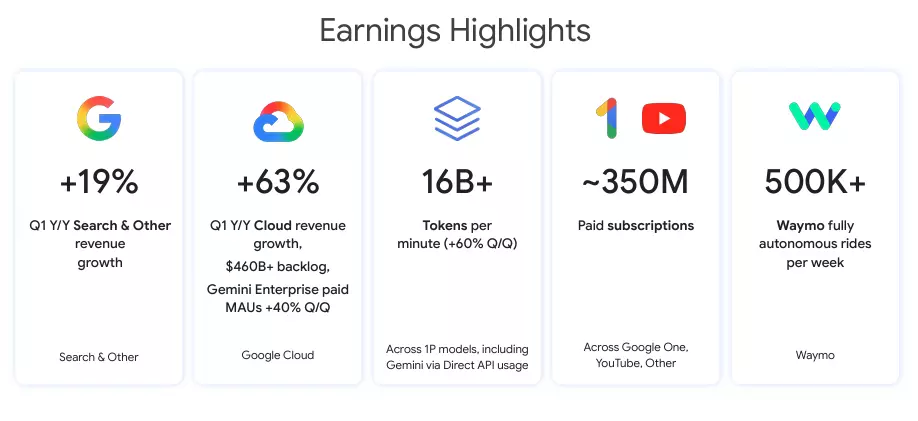
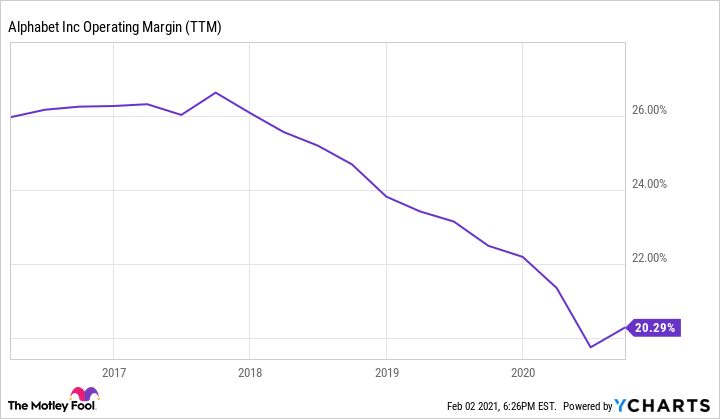
Total revenue increased 22% year over year to $109.9 billion, while operating income rose 30% to $39.7 billion. The consolidated operating margin expanded to 36.1%, up from approximately 34% one year earlier.
Google Services revenue grew 16%, including 19% growth in Search and other revenue.
Google Cloud was the standout:
- Revenue increased 63% to $20.0 billion
- Cloud operating income rose to $6.6 billion
- Cloud operating margin reached approximately 32.9%
- Contracted backlog climbed to roughly $462 billion
- Enterprise AI solutions became Cloud’s largest growth contributor
Alphabet also said approximately half of the Cloud backlog is expected to convert into revenue over the following 24 months.
These results showed that Google Cloud is no longer simply a distant third-place hyperscaler attempting to gain scale. It is becoming one of Alphabet’s most important sources of incremental profit.
However, Q1 net income deserves careful interpretation. Alphabet reported net income of $62.6 billion and diluted EPS of $5.11, but the quarter included a $37.7 billion contribution from other income, primarily unrealized gains on equity investments.
Those gains may reverse in future quarters and should not be treated as recurring operating earnings.
For Q2, investors should therefore prioritize:
- Revenue growth
- Segment operating income
- Cloud margins
- Capital expenditures
- Operating cash flow
- Free cash flow
Core operating earnings matter more than headline GAAP EPS.
Can Gemini Produce Enough Revenue to Justify Alphabet’s AI Spending?
Gemini is already reaching extraordinary scale. The more difficult question is how effectively Alphabet can convert that reach into revenue.
According to Alphabet’s June investor presentation, the Gemini app had surpassed 900 million monthly users, more than doubling over the previous year.
AI Overviews had reached more than 2.5 billion monthly users, while AI Mode had exceeded one billion monthly users. Gemini technology was also powering all 13 Google products with more than one billion users.
Alphabet’s distribution advantage is difficult for standalone AI companies to replicate. Gemini can be integrated into:
- Google Search
- Android
- Chrome
- Gmail
- Google Workspace
- YouTube
- Google Maps
- Google Ads
- Google Cloud
- Google One subscriptions
That ecosystem allows Alphabet to monetize AI through several channels rather than relying entirely on chatbot subscriptions.
Gemini’s Four Main Monetization Channels
1. Consumer Subscriptions
Alphabet reported 350 million total paid subscriptions across its consumer services in Q1, with YouTube and Google One acting as the largest contributors.
Management described Q1 as its strongest quarter to date for consumer AI plans, supported by Gemini.
Investors should listen for updates on:
- Google One AI plan growth
- Gemini premium conversion rates
- Average revenue per subscriber
- Retention following promotional periods
- Bundling of AI with storage and productivity products
A growing user base has limited financial value unless Alphabet can convert a meaningful portion of those users into recurring subscription revenue.
2. Enterprise Software
Gemini Enterprise paid monthly active users grew approximately 40% quarter over quarter in Q1. Alphabet also said 75% of Google Cloud customers were using its AI products.
Enterprise adoption can support revenue through:
- Gemini for Workspace
- Vertex AI
- Gemini Enterprise agents
- Cybersecurity products
- Coding assistants
- Data analytics
- Model customization
- AI infrastructure consumption
Enterprise contracts are particularly valuable because they can combine software subscriptions with high-volume compute consumption.
3. Developer APIs
Alphabet said its models were processing approximately 19 billion API tokens per minute by June, while more than 8.5 million developers were building with Google models each month.
More than 375 Cloud customers had each processed over one trillion tokens during the preceding 12 months.
API token growth is an important leading indicator, but the Q2 call should provide more context about pricing, inference cost, and gross margin.
4. Advertising
Gemini may ultimately create its largest economic value inside Search and Google Ads.
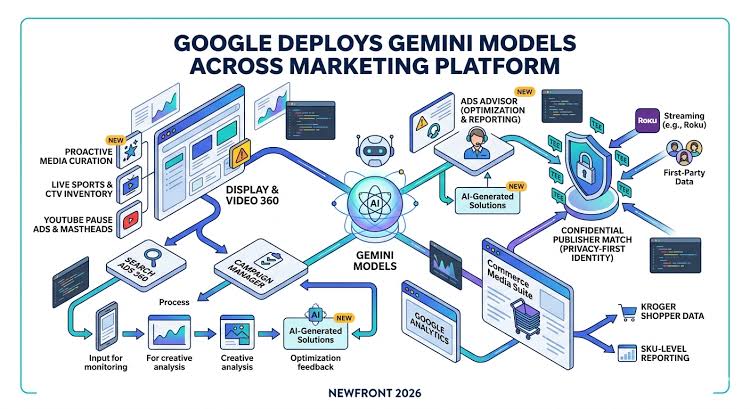
Alphabet says Gemini’s improved understanding of user intent helps Google serve ads against longer and more complex searches.
AI tools are also being used to generate advertising copy, creative assets, targeting recommendations, and automated bidding strategies.
This matters because Alphabet does not necessarily need to charge users directly for every AI interaction. If AI increases query frequency, commercial intent, conversion rates, or advertiser returns, Gemini can reinforce the existing advertising engine.
What Gemini Metrics Should Investors Demand?
A credible Gemini update should include more than a new monthly-user milestone.
Investors should look for:
- Paid-user growth, not only total users
- API revenue or consumption growth
- Enterprise contract expansion
- Lower inference cost per response
- Improved Search monetization
- Evidence of competitive model performance
- Clear timelines for delayed products
Alphabet previously stated that Gemini serving costs fell 78% during 2025 and that the cost of core AI responses had declined by more than 30% following the introduction of Gemini 3.
These efficiency gains are essential because an AI product can produce rapid revenue growth while still generating weak returns if inference costs remain too high.
Google Cloud Is the Most Important Q2 Earnings Variable
Google Cloud is the strongest available evidence that Alphabet’s AI investments are already producing commercial demand.
Consensus calls for Cloud revenue of approximately $22.2 billion, representing growth of roughly 63% from the second quarter of 2025.
Maintaining that rate after Q1’s 63% expansion would be a significant achievement, but it also creates a demanding comparison.
The Cloud result should be evaluated across four dimensions.
Revenue Growth
A reported growth rate above 60% would indicate that enterprise demand for AI infrastructure, Gemini models, data tools, and Workspace products remains exceptionally strong.
A lower growth rate would not automatically invalidate the thesis. As Cloud becomes larger, percentage growth will naturally moderate.
However, a sharp slowdown below the high-50% range—without an explanation involving supply constraints or contract timing—could raise questions about the sustainability of AI demand.
Cloud Operating Margin
Google Cloud’s operating margin increased from approximately 17.8% in Q1 2025 to nearly 33% in Q1 2026. That expansion demonstrated considerable operating leverage.
For Q2, the ideal outcome would combine:
- Revenue growth above 60%
- A Cloud margin near or above 33%
- Continued backlog expansion
- Stable pricing
- Improved infrastructure utilization
If Cloud revenue remains strong but the margin falls materially, investors may conclude that Alphabet is buying growth through aggressive pricing or absorbing higher chip, power, and depreciation expenses.
Backlog Conversion
The $462 billion backlog offers substantial revenue visibility, but investors must determine how quickly and profitably those commitments convert into recognized sales.
Management should clarify:
- Whether backlog increased during Q2
- What percentage will convert within 12 and 24 months
- How much backlog depends on a limited number of major customers
- Whether contracts include minimum consumption commitments
- Whether customer demand still exceeds available capacity
Backlog growth accompanied by improving margins would be a strong signal that Alphabet’s infrastructure spending is tied to contracted demand rather than speculative capacity.
Custom TPU Economics
Alphabet’s custom Tensor Processing Units are strategically important for two reasons.
First, they can lower the cost of training and serving Gemini compared with relying exclusively on third-party accelerators.
Second, Alphabet is expanding the addressable market by making TPU infrastructure available to selected external enterprise customers.
The Q2 call should reveal whether TPU commercialization is beginning to create a separate revenue stream or remains primarily an internal efficiency advantage.
For more context on how Alphabet’s full-stack AI strategy is changing its market position, see the related SimianX analysis: Alphabet Nears Nvidia in Market Value as AI Trade Broadens.
Can Search Remain Strong as AI Changes User Behavior?
Search remains Alphabet’s largest and most profitable business. Even spectacular Cloud growth cannot fully offset a material deterioration in Search advertising.
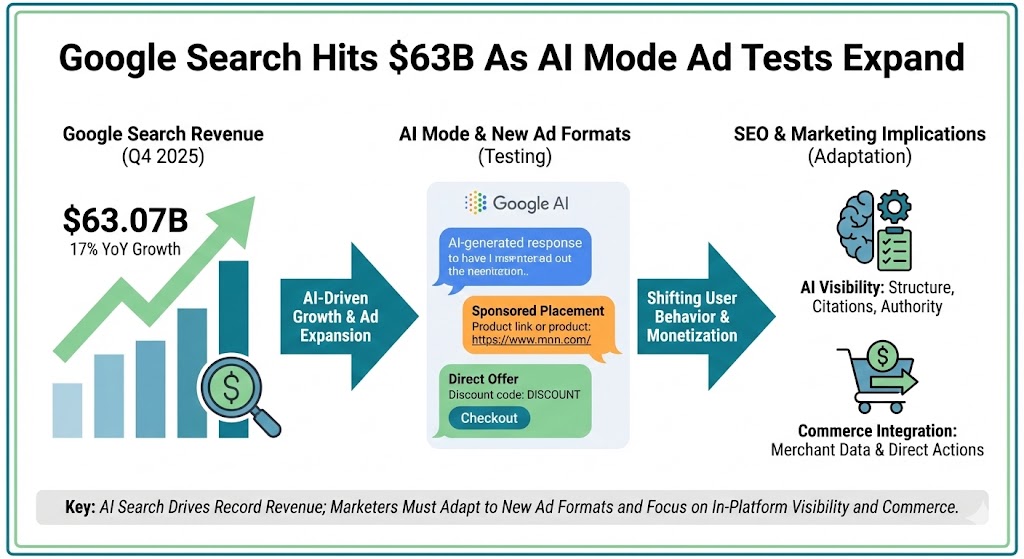
Q1 Search and other revenue rose 19% to $60.4 billion. Alphabet said AI Overviews and AI Mode were increasing engagement, with total Search queries reaching an all-time high.
The bullish interpretation is that generative AI expands Search rather than replacing it. Users can ask longer, more conversational questions, creating new commercial queries that traditional keyword search handled poorly.
The bearish interpretation is that AI-generated answers reduce clicks, provide fewer advertising placements, and shift activity toward competing assistants.
Q2 should help distinguish between those views.
Search Indicators to Watch
- Search revenue growth
- Paid-click or query growth
- Cost per click
- AI Mode engagement
- AI Overview monetization
- Commercial-query conversion rates
- Advertiser adoption of AI Max and Performance Max
- Traffic acquisition costs
Google Services revenue is expected to increase approximately 14% to $94.3 billion.
A result above that estimate, supported by Search rather than hardware or accounting items, would strengthen the argument that AI is expanding Google’s addressable advertising market.
Recent third-party traffic data also suggested that traditional Google usage continued growing even as competing AI products gained users.
Nevertheless, Search monetization—not raw traffic—is the more important earnings variable.
The $180–$190 Billion Capex Question
Alphabet’s spending plan represents the central risk in the earnings story.
Capital expenditures reached $35.7 billion in Q1, up from $17.2 billion one year earlier.
Operating cash flow was $45.8 billion, leaving quarterly free cash flow of approximately $10.1 billion. Trailing-12-month free cash flow was $64.4 billion.
To reach the midpoint of its full-year guidance, Alphabet would need to spend approximately $149 billion during the final three quarters of 2026, or almost $50 billion per quarter on average.
That calculation implies a significant acceleration from the Q1 level.
The majority of the spending is expected to fund:
- Data centers
- TPUs and GPUs
- Networking equipment
- Servers and storage
- Power and cooling infrastructure
- Cloud capacity
- Gemini training and inference
- Technical infrastructure for Search and other products
Alphabet has also expanded its financing capacity. In June, the company described an equity raise expected to total roughly $85 billion after strong demand, alongside additional debt issuance.
Management said the funding would provide greater flexibility to capture AI demand that was exceeding available supply.
When Is High Capex Justified?
High capital spending is not inherently negative. It becomes value-destructive when the return generated by new assets falls below the company’s cost of capital.
Investors can evaluate Alphabet’s AI capex using a simple framework:
| Evidence | Positive interpretation | Negative interpretation |
|---|---|---|
| Cloud growth | New capacity is quickly monetized | Growth slows despite higher spending |
| Cloud margin | Scale offsets infrastructure cost | Depreciation and energy costs overwhelm leverage |
| Backlog | Spending is supported by contracts | Backlog stops growing or converts slowly |
| Gemini revenue | AI creates subscriptions and API sales | Usage grows without paid conversion |
| Search growth | AI protects and expands advertising | AI reduces monetization per query |
| Free cash flow | Temporary compression funds durable growth | Cash generation deteriorates structurally |
| Capex guidance | Spending matches visible demand | Guidance rises without clearer revenue visibility |
Alphabet does not need immediate payback on every data center, but it must demonstrate a credible line between investment, utilization, revenue, and future cash flow.
The most reassuring Q2 combination would be stronger Cloud revenue, stable Cloud margins, increasing backlog, and unchanged capex guidance.
The most concerning combination would be slowing Cloud growth, weaker margins, and another capex increase.
Gemini Execution Risk Has Returned
Despite strong adoption statistics, Alphabet faces renewed questions about AI product execution.
In June, management said Gemini 3.5 Pro was expected to arrive later that month. As of mid-July, reports indicated that the model remained delayed while Google worked to improve its performance.
Alphabet shares fell as investors questioned whether spending was accelerating faster than model development.
One delayed model does not determine the value of the entire Gemini ecosystem. Alphabet’s AI strategy includes infrastructure, Search, Workspace, advertising, security, APIs, and consumer subscriptions.
However, delays matter because frontier-model performance influences:
- Developer adoption
- Enterprise confidence
- API pricing power
- Employee recruitment
- Brand perception
- Competitive positioning
- Demand for Google’s AI infrastructure
Management should directly address the delay, explain the remaining technical work, and provide a realistic deployment timeline.
Avoiding the subject could increase concerns that Alphabet’s infrastructure expansion is running ahead of product readiness.
Alphabet Q2 Earnings 2026 Bull, Base, and Bear Scenarios
The following scenarios are a SimianX analytical framework, not official company guidance or Wall Street consensus.
| Scenario | Potential Q2 signals | Likely market interpretation |
|---|---|---|
| Bull case | Revenue above $118B; Cloud above $22.5B; Cloud margin at least 33%; backlog expands; Search growth remains strong; capex guidance unchanged | AI demand is absorbing new capacity while profitability remains intact |
| Base case | Revenue near $116–117B; Cloud between $21.8B and $22.4B; stable Search; moderate margin pressure; capex guidance maintained | AI thesis remains credible, but valuation upside depends on future execution |
| Bear case | Revenue below $115B; Cloud below $21.5B; Cloud margin below 30%; Search decelerates; capex guidance rises | Spending is accelerating faster than monetization and cash returns |
Options markets were pricing an earnings-related move of approximately 5% to 5.3% shortly before the announcement.
Alphabet has exceeded its implied move during several recent earnings events, meaning the actual reaction could be larger if Cloud growth or capex guidance differs materially from expectations.
A Practical Earnings Scorecard for GOOGL Investors
Rather than reacting only to revenue or EPS, investors can score the report across six categories.
1. Google Cloud
Positive: Growth above 60%, stable margin, expanding backlog
Negative: Sharp deceleration, margin compression, weak forward commentary
2. Gemini Monetization
Positive: Paid-user growth, enterprise adoption, and stronger API consumption
Negative: Only engagement statistics with no revenue or conversion evidence
3. Search
Positive: Mid-teens or better growth with stable monetization
Negative: Slower advertising growth or weaker pricing on AI searches
4. Capital Expenditures
Positive: Guidance remains at $180–$190 billion with demand-based justification
Negative: Another increase without corresponding revenue visibility
5. Free Cash Flow
Positive: Operating cash flow absorbs more of the infrastructure spending
Negative: Free cash flow falls substantially as depreciation and construction accelerate
6. Management Commentary
Positive: Specific metrics, backlog timelines, and Gemini product milestones
Negative: Vague statements about long-term opportunity without measurable returns
SimianX AI users can combine this fundamental scorecard with earnings sentiment, options positioning, and post-call price behavior.
This helps distinguish an initial algorithmic reaction from a more durable change in the investment thesis.
FAQ About Alphabet Q2 Earnings 2026
When will Alphabet report Q2 earnings in 2026?
Alphabet will report on Wednesday, July 22, 2026, after the U.S. market closes. The conference call begins at 1:30 p.m. Pacific Time, equivalent to approximately 4:30 a.m. Singapore time on Thursday, July 23.
What is the Google Cloud Q2 2026 revenue forecast?
Public consensus estimates point to Google Cloud revenue of approximately $22.2 billion, representing growth of roughly 63% year over year. Cloud margin and backlog growth may be just as important as the headline revenue number.
Can Gemini justify Alphabet’s AI capex surge?
Gemini can help justify the spending if rising usage converts into Cloud consumption, paid subscriptions, API revenue, advertising performance, and lower inference costs. User growth alone will not prove an adequate return on capital.
What should investors watch in Alphabet’s earnings call?
The most important topics are Cloud growth, Cloud margin, contracted backlog, Gemini paid adoption, Search monetization, capital-expenditure guidance, free cash flow, and the Gemini 3.5 Pro timeline.
Is Alphabet stock a buy before Q2 earnings?
That depends on an investor’s risk tolerance, time horizon, and expectations for AI returns. The earnings event carries material volatility risk, and a strong headline beat could still produce a negative reaction if capex rises or Cloud guidance disappoints.
Conclusion
Alphabet Q2 earnings 2026 will test whether one of the technology industry’s largest capital programs is generating results quickly enough to satisfy investors.
The company enters the report with powerful evidence in its favor:
- Google Cloud revenue grew 63% in Q1
- Cloud margins reached approximately 33%
- Backlog exceeded $460 billion
- Gemini reached hundreds of millions of users
- AI products expanded across Search, Workspace, and advertising
- Search revenue continued growing despite competitive disruption
But the risks are equally clear:
- Full-year capex may reach $190 billion
- Free cash flow is under pressure
- Equity issuance creates dilution
- AI infrastructure depreciation will rise
- Gemini execution must keep pace with competitors
- Cloud growth must remain exceptional to meet expectations
The best outcome would not simply be an earnings beat. It would be a coordinated set of proof points showing that Gemini adoption drives Cloud demand, Cloud demand produces profitable revenue, and profitable revenue supports the next stage of AI investment.
Use SimianX AI to track Alphabet’s earnings surprise, management language, sentiment shifts, and post-report market signals as the AI capex debate moves from promises to measurable returns.
Related Reading
- Alphabet Nears Nvidia in Market Value as AI Trade Broadens
- Meta Compute 2026: Can Excess AI Capacity Drive Revenue?
- AI Momentum Unwind 2026: Why Semiconductor Stocks Fall
- Semiconductor Bear Markets: Every SOX Crash, 1995–2026
References
- Alphabet Investor Relations
- SEC EDGAR — Alphabet filings
- Nasdaq — GOOGL stock quote
- Google Cloud — official site
- Gemini — official site
This research is for informational purposes and does not constitute investment advice.