AMD Stock 2026: $6.7B Data Center Quarter vs Nvidia’s $75B

AMD Stock 2026: $6.7B Data Center Quarter vs Nvidia’s $75B

AMD’s Data Center revenue doubled to $6.7B; Nvidia booked $75.2B. Compare growth, margins, the Helios customer pipeline and what could break the thesis.

2026-08-16
·
19 min read
Market Pulse
Listen to article

The AMD AI Chip Comeback, Measured Against Nvidia

The AMD stock 2026 AI comeback is no longer just a contrarian semiconductor story. AMD has crossed an important threshold: its Data Center business now generates most of company revenue, Instinct accelerator deployments are scaling, and its first integrated rack-scale AI system is entering production.

That does not mean AMD has caught Nvidia. Nvidia remains dramatically larger, more profitable, and better protected by its CUDA software ecosystem. The more credible thesis is that AMD can become the leading alternative AI infrastructure platform—and capture meaningful growth without displacing Nvidia as the market leader.

Investors can use SimianX AI to monitor the evolving thesis across SEC filings, fundamentals, technical signals, news, and risk scenarios, and can follow the ticker itself from the SimianX stock research hub. This is especially useful for a fast-moving story where customer announcements, product ramps, margins, and valuation expectations can change every quarter.

All figures and announcements in this research are current as of August 17, 2026. This article is educational and is not individualized investment advice.

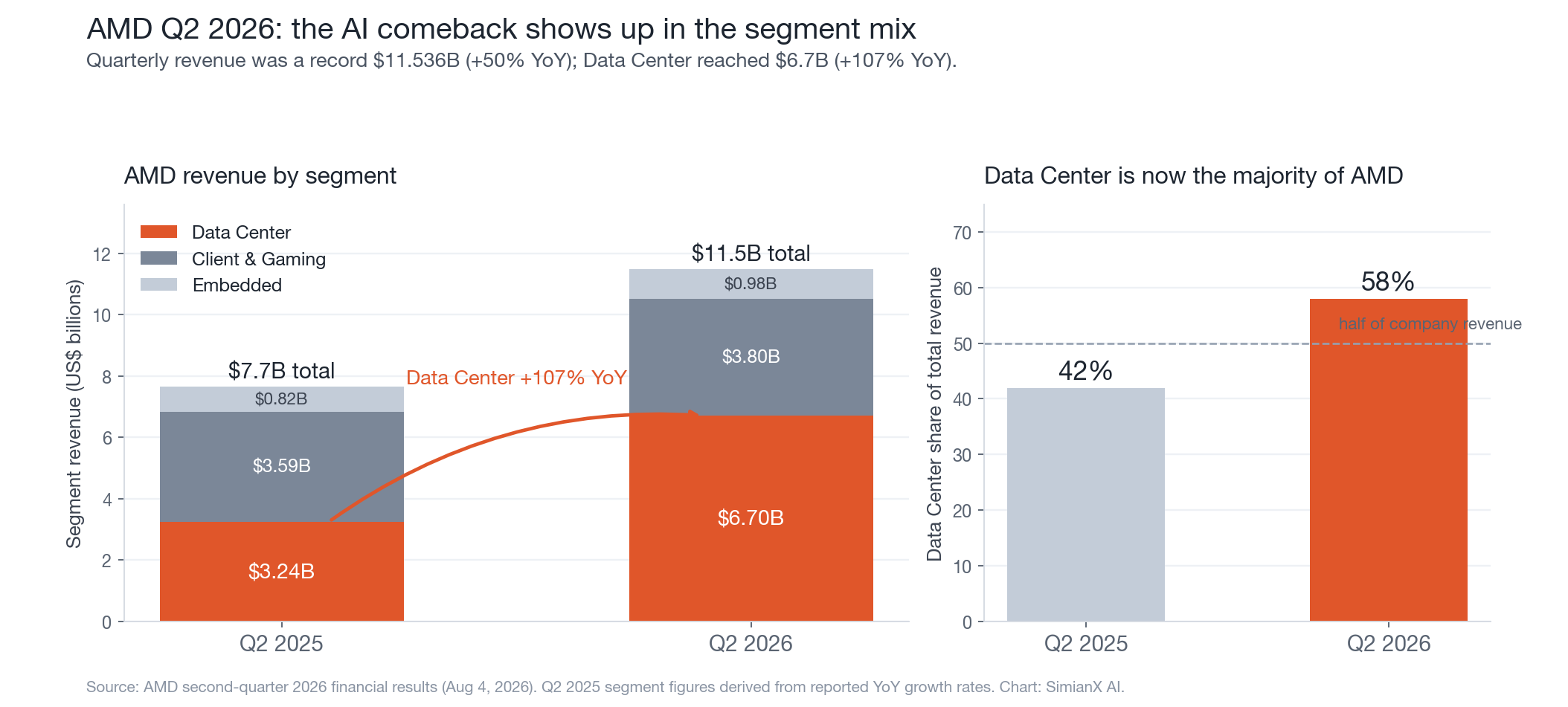
SimianX AI AMD Q2 2026 revenue by segment, with Data Center at 58% of total revenue
AMD Q2 2026 revenue by segment, with Data Center at 58% of total revenue

The AMD Comeback Is Now Visible in the Financial Statements

AMD's second-quarter 2026 results provide the strongest evidence that its AI comeback has moved beyond presentations and product roadmaps.

The company reported:

  • $11.536 billion in quarterly revenue, up 50% year over year.
  • $6.7 billion in Data Center revenue, up 107%.
  • A 54% GAAP gross margin and 56% non-GAAP gross margin.
  • $2.0 billion in GAAP operating income, compared with a loss in the prior-year quarter.
  • $1.66 in non-GAAP diluted EPS, up 246%.
  • Third-quarter revenue guidance of approximately $13 billion, implying 41% year-over-year growth.

Data Center represented approximately 58% of AMD's total revenue, confirming that AMD is increasingly an AI and server-compute company rather than primarily a PC and gaming chip supplier. That shift was already visible a year earlier, when AMD and Intel were driving data-centre demand while accelerator revenue was still a minority of the mix. The figures are available in AMD's official second-quarter 2026 release, and the underlying detail in the company's quarterly SEC filings.

The essential AMD stock thesis is no longer “AI might become material.” AI infrastructure is already reshaping AMD's revenue mix, growth rate, and operating leverage.

The underlying diversification also matters. AMD's Data Center segment includes both EPYC server CPUs and **Instinct GPUs**. AI clusters need host processors, accelerators, networking, and software, so AMD can participate in more than one part of the infrastructure budget.

However, investors should not misread the 107% growth rate. The comparison benefited from a smaller base, while the prior-year period was affected by an $800 million inventory-related charge associated with U.S. export restrictions on MI308 products. AMD is growing quickly, but year-over-year percentages alone do not establish competitive parity.

AMD vs Nvidia AI Chips: What the Numbers Really Say

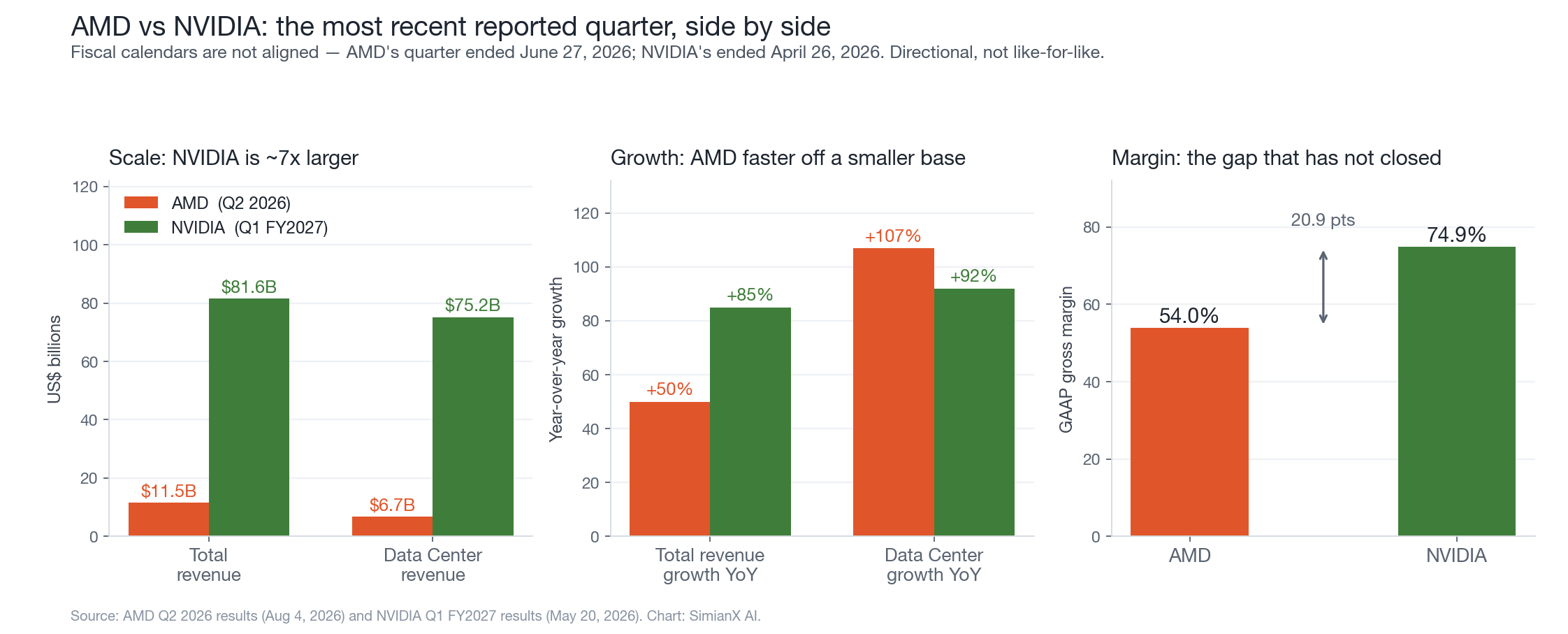
The latest reported periods are not perfectly aligned: AMD's quarter ended June 27, 2026, while Nvidia's most recent reported quarter ended April 26, 2026. The following comparison is therefore directional rather than strictly like-for-like.

MetricAMD Q2 2026Nvidia Q1 FY2027Investment interpretation
Total revenue$11.5B$81.6BNvidia remains more than seven times larger
Data Center revenue$6.7B$75.2BAMD's share opportunity is large, but so is the competitive gap
Total revenue growth50% YoY85% YoYBoth are expanding; Nvidia is not a slow incumbent
Data Center growth107% YoY92% YoYAMD is growing faster from a much smaller base
GAAP gross margin54.0%74.9%Nvidia retains far greater pricing power
Next-quarter revenue outlook~$13.0B~$91.0BAI demand remains strong across both platforms

Nvidia's first-quarter fiscal 2027 results illustrate why the AMD comeback should not be confused with Nvidia's decline. Nvidia generated $75.2 billion of Data Center revenue in one quarter, including $60.4 billion from compute and $14.8 billion from networking. Its Data Center revenue increased 92% year over year, and management guided to approximately $91 billion of total revenue for the following quarter.

Nvidia also reported a 74.9% GAAP gross margin, nearly 21 percentage points above AMD's. That gap represents more than superior GPU pricing. It reflects Nvidia's monetization of a tightly integrated system spanning accelerators, NVLink, networking, CPUs, libraries, inference software, and enterprise tools.

The balanced conclusion is straightforward:

  1. AMD is demonstrating real AI growth.
  2. Nvidia remains the scale, margin, and ecosystem leader.
  3. AMD does not need to overtake Nvidia for AMD shareholders to benefit.
  4. Nvidia investors must watch AMD because even limited share gains can affect pricing, customer bargaining power, and long-term margins.
SimianX AI AMD versus Nvidia revenue, growth and gross margin in the latest reported quarter
AMD versus Nvidia revenue, growth and gross margin in the latest reported quarter

Why Helios and MI450 Could Change AMD's Competitive Position

The central product catalyst is AMD Helios, the company's rack-scale AI platform built around MI450-series accelerators, sixth-generation EPYC “Venice” CPUs, Pensando networking, and ROCm software.

This matters because hyperscale customers increasingly purchase an operational AI system—not an isolated GPU. Performance depends on memory bandwidth, networking, power consumption, cooling, software, cluster reliability, and the number of useful tokens produced per dollar.

At its Advancing AI 2026 event, AMD said Helios had entered production and claimed it could deliver up to 30% more inference tokens per dollar than competing systems. Investors should treat vendor benchmark claims cautiously until customers publish production results, but the shift to rack-level competition is strategically important. Details are available in AMD's Advancing AI 2026 announcement.

Can AMD Compete With Nvidia in AI Without Replacing CUDA?

Yes—but the path is workload-specific.

CUDA remains Nvidia's strongest moat. It is supported by years of developer experience, optimized libraries, tooling, documentation, and production deployments. Moving a complex training or inference workload to another platform can introduce engineering costs that exceed any hardware savings.

AMD is countering this disadvantage through:

  • An open-source ROCm software strategy.
  • Greater support for standard frameworks and open networking.
  • Joint engineering with large customers.
  • High memory capacity and bandwidth for large models.
  • Competitive inference economics.
  • Custom accelerators optimized for hyperscaler workloads.
  • A full stack combining CPUs, GPUs, networking, and rack designs.

AMD's opportunity may be greatest in large, concentrated deployments where a hyperscaler can justify optimization work across thousands of accelerators. A customer spending billions on infrastructure has more incentive than a small enterprise to reduce dependence on one supplier.

This produces an important distinction:

Nvidia offers the lowest-friction default ecosystem. AMD is positioning itself as the high-scale, economically attractive alternative for customers willing to optimize.

The Customer Pipeline Is the Strongest Part of the AMD Stock Thesis

AMD's 2026 announcements show that major AI buyers increasingly want a second full-stack supplier.

Meta: Up to Six Gigawatts

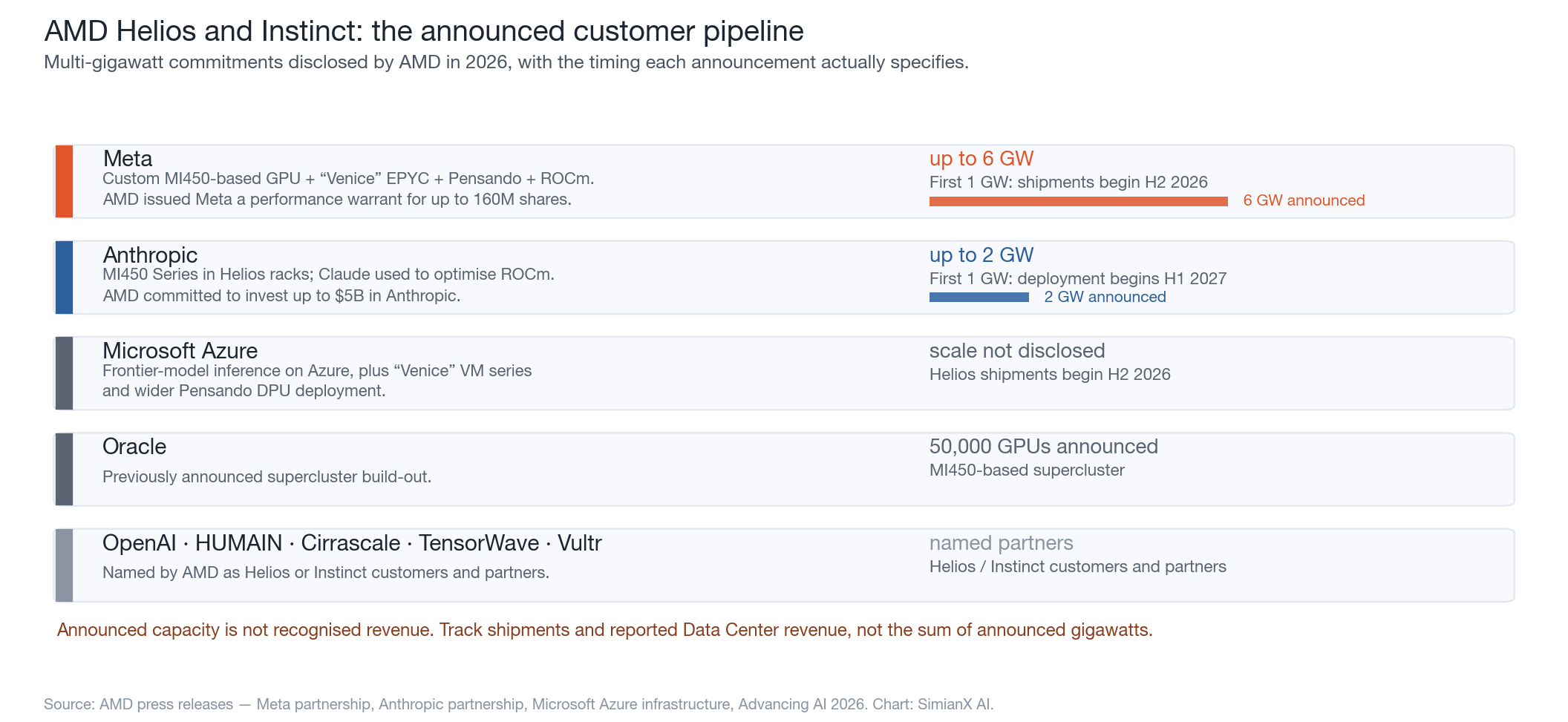
AMD and Meta announced a multi-year agreement covering up to six gigawatts of Instinct GPU deployments. Shipments supporting the first gigawatt are expected to begin in the second half of 2026 using a custom MI450-based accelerator, Venice CPUs, Pensando networking, and ROCm.

Meta already deploys AMD EPYC CPUs and earlier Instinct generations. The expanded agreement therefore represents a deeper technical relationship rather than a speculative trial, and it sits inside a much larger compute build-out examined in Meta Compute 2026: Can Excess AI Capacity Drive Revenue?.

There is an important shareholder caveat: AMD issued Meta a performance-based warrant for up to 160 million AMD shares, with vesting tied to shipment, commercial, and stock-price milestones. The structure aligns the companies around execution, but it can create dilution if the partnership succeeds. Investors should read the terms in AMD's official Meta partnership announcement.

Microsoft: Helios on Azure

Microsoft plans to deploy Helios at scale on Azure for frontier-model inference, Azure AI services, and customer workloads. The partnership also covers Venice-powered virtual machines and Pensando DPUs.

This is strategically valuable because cloud availability reduces the friction for developers who want to test AMD without purchasing an entire cluster. The capital behind that capacity is the subject of Microsoft Q4 Earnings 2026: Azure Growth vs AI Capex Risk. The AMD-Microsoft announcement states that shipments are expected to begin in the second half of 2026.

Anthropic: Up to Two Gigawatts

Anthropic plans to deploy up to two gigawatts of MI450-series GPUs, with the first gigawatt beginning in the first half of 2027. The same laboratory has been contracting directly across the supply chain, as covered in Micron Anthropic Deal 2026: Claude AI Memory Explained. The companies will also use Claude to optimize AMD workloads and accelerate ROCm development.

AMD separately committed to a future strategic investment of up to $5 billion in Anthropic. This could deepen customer alignment and software optimization, but investors must distinguish between organic customer demand and demand supported by strategic financing. The details appear in the AMD-Anthropic partnership release.

Oracle, OpenAI, and Other Deployments

AMD has also identified Oracle, OpenAI, HUMAIN, TensorWave, Vultr, and other AI infrastructure providers as Helios or Instinct customers and partners. Oracle previously announced plans for a 50,000-GPU MI450-based supercluster; how that capacity converts into recognised revenue is the question behind Oracle Earnings 2026: OCI, Stargate Backlog & ORCL Stock.

These commitments establish technical credibility. They do not, by themselves, disclose recognized revenue, pricing, margins, cancellation protections, or deployment timing. Investors should track shipments and reported Data Center revenue rather than adding every announced gigawatt to a valuation model.

SimianX AI Announced AMD Helios and Instinct customer commitments and their disclosed timing
Announced AMD Helios and Instinct customer commitments and their disclosed timing

Why Nvidia Investors Cannot Ignore AMD Stock in 2026

AMD is unlikely to destroy Nvidia's AI franchise. The more realistic risk is that it changes the economics around the edges of that franchise — a franchise whose funding structure and circularity are examined in Is Jensen Huang Fueling an AI Bubble? Nvidia's Boom Examined.

1. Hyperscalers Want Negotiating Leverage

Cloud providers do not want their most important infrastructure roadmap controlled by one supplier. A credible AMD platform gives them leverage on:

  • Accelerator pricing.
  • Delivery schedules.
  • Memory allocation.
  • Networking choices.
  • Software licensing.
  • Custom silicon development.
  • Product roadmap influence.

Even if Nvidia retains most deployments, a credible alternative can pressure future pricing and contract terms.

2. Inference Is More Open to Competition

Frontier-model training prioritizes proven scale, reliability, and software maturity—areas where Nvidia is exceptionally strong. Inference involves a wider variety of models, latency targets, batch sizes, memory requirements, and cost constraints.

That diversity can create openings for AMD, custom ASICs, and specialized inference systems. AMD's emphasis on tokens per dollar is therefore economically relevant, even if it does not win every benchmark.

3. AMD Can Bundle CPUs, GPUs, and Networking

EPYC is an established Data Center franchise. Combining EPYC CPUs with Instinct GPUs and Pensando networking gives AMD multiple ways to enter a customer account. This installed base can lower the commercial barrier to adopting AMD accelerators.

Nvidia is responding aggressively with Vera CPUs, Rubin GPUs, NVLink 6, Spectrum-X, BlueField, and its broader AI software stack. Nvidia says Rubin-based products will become available through major cloud and system partners during the second half of 2026, and its own quarterly reports have become the sector's clearing event — catalogued in NVDA After Earnings: Every Reaction Since 2016 in One Table. Its Rubin platform announcement shows that Nvidia's annual product cadence remains one of AMD's biggest competitive challenges.

The Bull Case, Base Case, and Bear Case for AMD Stock

ScenarioOperating outcomeWhat investors should verify
Bull caseHelios ramps on schedule, ROCm improves rapidly, and AMD wins sustained double-digit accelerator shareData Center growth remains above 60%, margins expand, and deployments diversify beyond a few strategic partners
Base caseAMD becomes the leading second source while Nvidia retains overwhelming ecosystem leadershipRevenue grows strongly, but software costs and customer incentives limit margin expansion
Bear caseHelios delays, software friction, financing-supported deals, or Nvidia's Rubin economics slow adoptionAnnounced gigawatts fail to convert into revenue and inventory or receivables rise faster than sales

A Practical AMD Stock 2026 Monitoring Framework

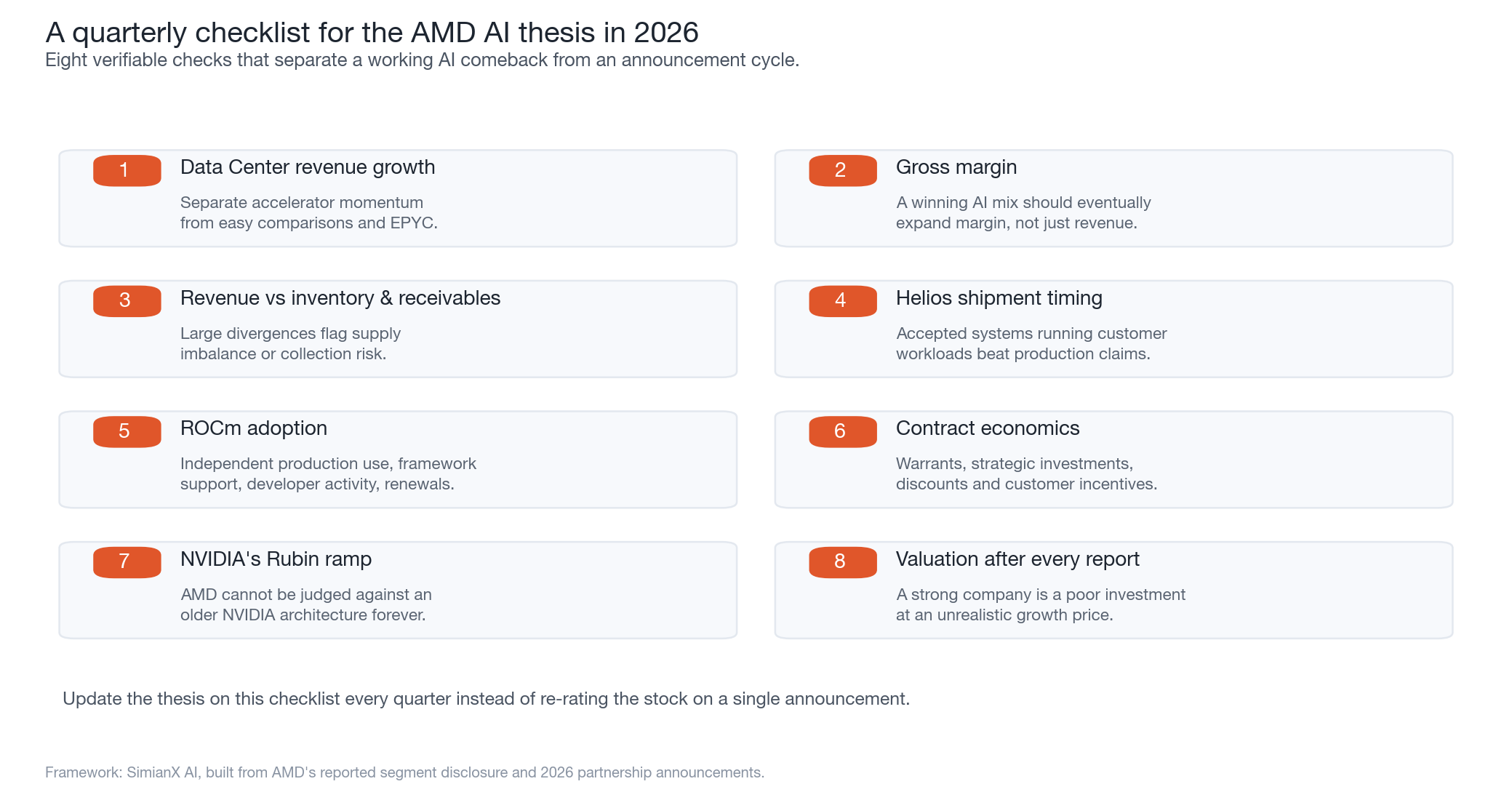
Rather than relying on price targets, investors can update the thesis quarterly:

  1. Track Data Center revenue growth. Separate genuine accelerator momentum from easier comparisons and EPYC CPU strength.
  2. Monitor gross margin. A successful AI mix should eventually create durable margin expansion.
  3. Compare revenue with inventory and receivables. Large divergences can signal supply imbalances or collection risk.
  4. Verify Helios shipment timing. Production announcements matter less than accepted systems generating customer workloads.
  5. Watch ROCm adoption. Look for independent production use, framework support, developer activity, and customer renewal.
  6. Study contract economics. Account for warrants, strategic investments, discounts, and other customer incentives.
  7. Follow Nvidia's Rubin ramp. AMD's product cannot be evaluated against an older Nvidia architecture indefinitely.
  8. Recalculate valuation after every earnings report. A strong company can still be a poor investment if growth expectations become unrealistic.

SimianX AI can support this process by having different agents test the fundamental, valuation, technical, news, and risk cases instead of treating one bullish announcement as a complete investment thesis.

SimianX AI Eight-point quarterly checklist for monitoring the AMD AI thesis
Eight-point quarterly checklist for monitoring the AMD AI thesis

What Could Break the AMD AI Comeback?

The opportunity is substantial, but so are the execution risks.

  • Software disadvantage: ROCm has improved, but CUDA remains the industry default for many production workloads.
  • Nvidia's pace: Nvidia is growing rapidly while launching Rubin and expanding its networking, CPU, storage, and enterprise software platforms.
  • Deployment risk: Rack-scale systems require coordinated manufacturing, HBM supply, advanced packaging, networking, cooling, and software validation.
  • Margin risk: AMD's 54% GAAP gross margin remains far below Nvidia's 74.9%. Winning share through aggressive economics may not produce Nvidia-like profitability — the same tension examined in Cerebras Stock 2026: AI Chip Boom vs Gross Margin Risk.
  • Customer concentration: A small number of hyperscalers and AI laboratories can materially affect quarterly demand.
  • Dilution and capital allocation: The Meta warrant and potential $5 billion Anthropic investment create costs that headline deployment figures do not capture.
  • Export controls: Both companies face restrictions affecting the sale of advanced accelerators to China.
  • Expectation risk: Once investors price in a flawless Helios ramp, merely good execution may not be enough to support the stock.
  • Cyclical exposure: AMD still operates PC, gaming, and embedded businesses that can amplify economic and inventory cycles. Semiconductors have repeatedly given back multi-year gains in months, as the reference table in Semiconductor Bear Markets: Every SOX Crash, 1995–2026 shows.

AMD's second-quarter performance reduces questions about whether demand exists. It does not eliminate questions about sustainable margins, competitive durability, or the price investors should pay for future growth.

FAQ About AMD Stock 2026 and the AI Chip Comeback

Is AMD stock a buy in 2026?

AMD has a credible growth case built on Data Center revenue, EPYC share gains, Instinct accelerators, and Helios deployments. Whether the stock is attractive depends on its current valuation, the investor's risk tolerance, and how much MI450 success is already reflected in the price.

Can AMD compete with Nvidia in AI chips?

AMD can compete in selected training and inference deployments, particularly with hyperscalers that can optimize ROCm and value supplier diversity. Nvidia nevertheless retains major advantages in scale, gross margin, software maturity, networking, and developer adoption.

Will AMD's MI450 beat Nvidia Rubin?

Vendor benchmark claims are insufficient to answer this conclusively. Investors should compare independent production data covering token throughput, power, utilization, software migration costs, reliability, and total cost of ownership.

Why should Nvidia investors watch AMD stock?

AMD can influence Nvidia's pricing and customer relationships even without approaching Nvidia's total revenue. Hyperscalers gain negotiating leverage when AMD provides a viable second rack-scale platform.

What is the biggest risk to the AMD AI investment thesis?

The biggest risk is that announced deployments fail to translate into profitable, repeatable revenue. Investors should focus on shipments, Data Center margins, cash conversion, ROCm adoption, and customer diversification.

Conclusion

The AMD Stock 2026 AI comeback is real, but its most credible form is narrower than the most bullish narrative. AMD is not about to replace Nvidia. It is building the first serious open, full-stack alternative that combines competitive accelerators, EPYC CPUs, Pensando networking, ROCm software, and rack-scale systems.

AMD's record $11.5 billion quarter, 107% Data Center growth, Helios production ramp, and commitments from Meta, Microsoft, Anthropic, Oracle, and other customers make the company impossible for Nvidia investors to dismiss. At the same time, Nvidia's $75.2 billion quarterly Data Center business, roughly 75% gross margin, CUDA ecosystem, networking position, and Rubin roadmap demonstrate how high the competitive bar remains.

The actionable thesis is therefore not “AMD wins and Nvidia loses.” It is that AI infrastructure demand may be large enough for both companies to grow, while AMD gradually captures the economically meaningful second-platform position.

To keep that thesis grounded in current filings, market data, competing scenarios, and risk signals, explore SimianX AI and run an updated multi-agent analysis on AMD and NVDA before making an investment decision.

Related Reading

References

Ready to Transform Your Trading?

Join thousands of investors using AI-powered analysis to make smarter investment decisions

Today's most analyzed — click to enter the Live Command Room