
The Foundry Behind the AI Trade: TSMC’s 2026 Numbers, Verified
TSMC Stock 2026 has become one of the most important semiconductor investment stories because artificial intelligence is no longer only a GPU story. Nvidia designs many of the world’s most valuable AI accelerators, but Taiwan Semiconductor Manufacturing Company makes a large share of the advanced chips, system components, and packaging that allow those accelerators to reach customers.
That distinction matters. Nvidia can design a faster GPU, develop a new networking platform, or build a broader software ecosystem. However, it does not currently operate a comparable leading-edge manufacturing network. Nvidia’s own annual report states that it relies on foundries including TSMC and Samsung to produce semiconductor wafers and uses CoWoS advanced packaging for AI products. Nvidia’s 2025 annual report also describes supply-chain concentration in the Asia-Pacific region.
For investors, the central question is not simply whether AI demand will continue. It is whether TSMC can convert that demand into durable revenue growth, higher earnings, and acceptable returns on enormous capital spending. This research examines the TSMC stock outlook for 2026, the company’s competitive moat, its relationship with Nvidia, valuation scenarios, and the risks that could disrupt the thesis.
SimianX AI can help investors organize this research by combining fundamental analysis, real-time news, technical indicators, and multi-agent market commentary in one workspace. Explore the SimianX AI stock analysis platform or the SimianX stock research hub to monitor TSMC and Nvidia as new data arrives.
Why TSMC Stock 2026 Is an AI Infrastructure Investment
TSMC is the world’s largest dedicated semiconductor foundry. Unlike an integrated chip designer, it does not sell competing branded CPUs or GPUs to end customers. Instead, it manufactures chips for a broad customer base that includes fabless semiconductor companies, smartphone designers, automotive suppliers, networking vendors, and hyperscale computing customers.
That business model creates a strategic advantage:
- TSMC can serve customers that compete with each other.
- It can reinvest cash flow into process technology without funding a consumer brand.
- Its manufacturing knowledge compounds across thousands of chip designs.
- Customers are reluctant to switch after spending years qualifying a process node.
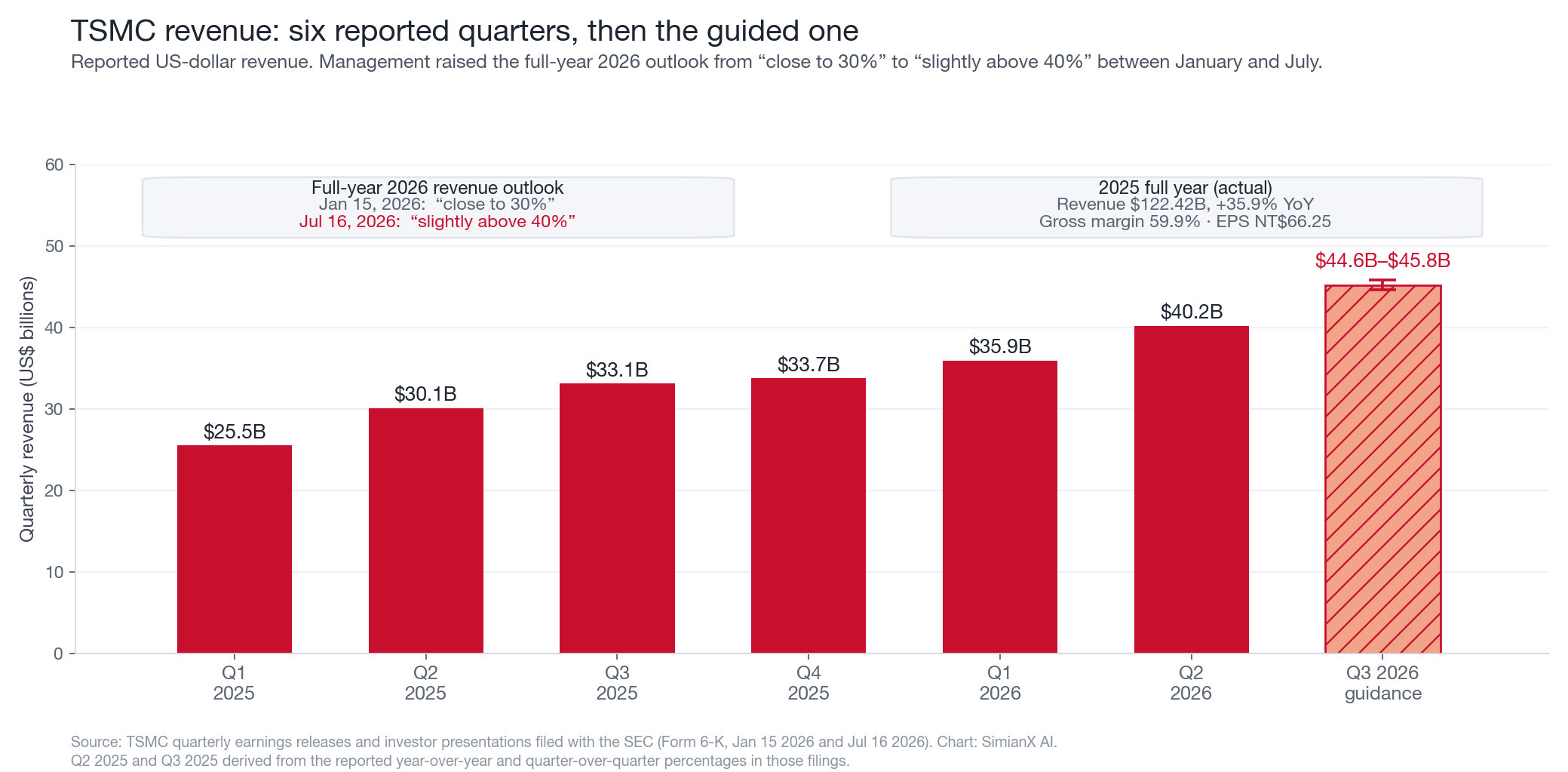
TSMC’s 2025 annual report showed consolidated revenue of NT$3.809 trillion, up 31.6% from 2024. Net income reached NT$1.718 trillion, an increase of 46.4%, while diluted earnings per share rose to NT$66.25. In U.S. dollar terms, revenue reached approximately $122.42 billion, up 35.9% year over year, and net income was about $55.2 billion. TSMC 2025 Annual Report · Q4 2025 results and 2025 financial highlights, filed with the SEC
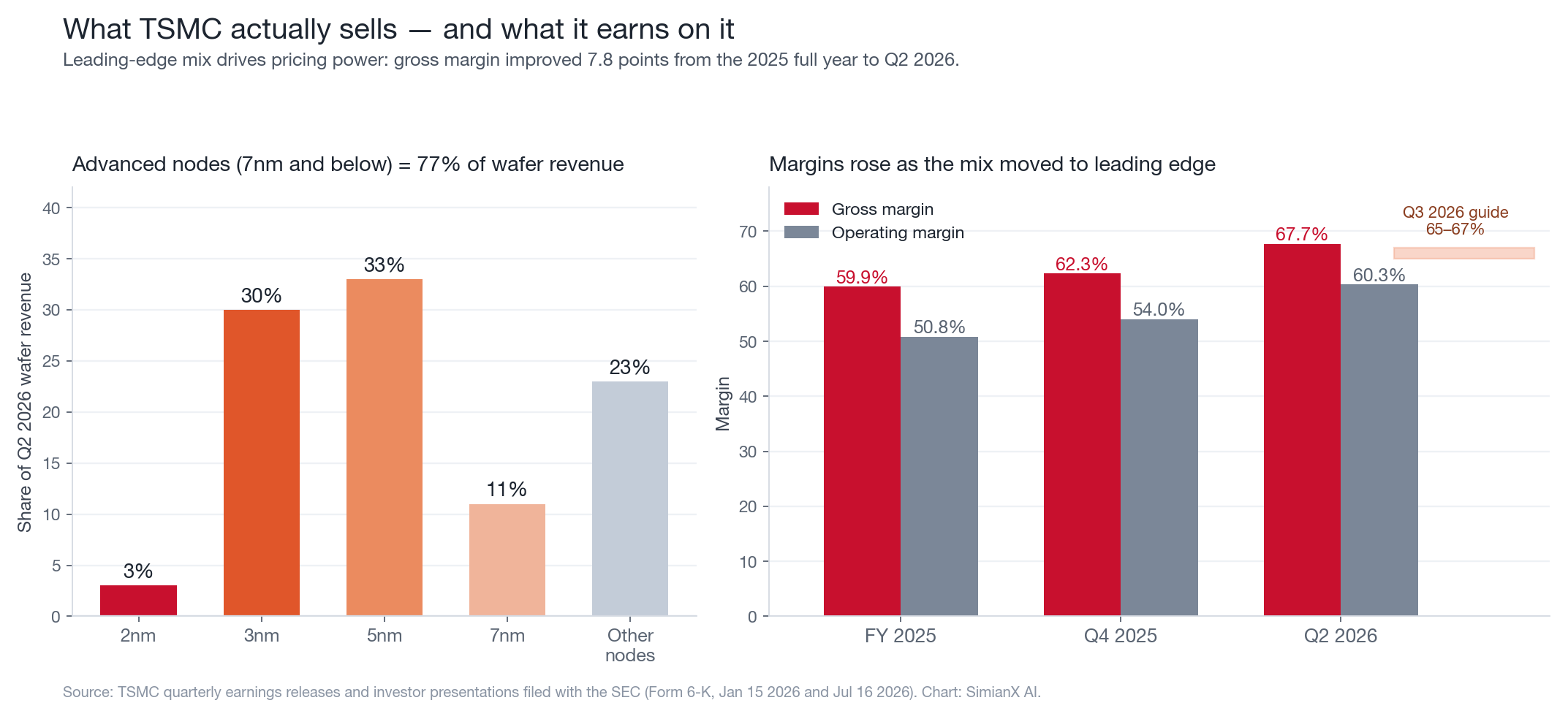
The margin profile is especially important. TSMC reported a 2025 gross margin of approximately 59.9% and an operating margin of about 50.8%. Both kept climbing through 2026: gross margin reached 62.3% in the fourth quarter of 2025 and 67.7% in the second quarter of 2026, with operating margin moving from 54.0% to 60.3% over the same span. Those levels reflect the pricing power of advanced manufacturing, high utilization, favorable product mix, and the value customers place on reliable yields.
The company entered 2026 with several structural growth drivers:
- AI data-center accelerators require leading-edge logic and advanced packaging.
- Custom ASICs are expanding as cloud providers design chips for specific workloads — a shift tracked in Broadcom Earnings 2026: AI ASIC Backlog & AVGO Stock.
- High-performance networking requires advanced process nodes and complex packaging.
- AI-enabled PCs, smartphones, vehicles, and edge devices broaden the market beyond data centers.
- Sovereign AI projects are increasing demand for domestic computing infrastructure.
The strongest TSMC thesis is not that one AI chip will win. It is that many AI architectures require more advanced silicon, and TSMC is positioned to manufacture a large portion of them.
What TSMC’s 2026 Financial Outlook Says
The clearest evidence for the 2026 TSMC stock thesis comes from company guidance and reported results rather than social-media enthusiasm.
TSMC’s fourth-quarter 2025 release guided first-quarter 2026 revenue to approximately $34.6 billion–$35.8 billion, with a gross margin range of 63%–65%, and set the 2026 capital budget at $52 billion–$56 billion. TSMC Q4 2025 results · same release, filed with the SEC
By the second quarter of 2026, revenue had reached $40.20 billion, up 33.7% year over year in U.S. dollars (36.0% in New Taiwan dollars, the currency TSMC reports in). Gross margin was 67.7% and operating margin 60.3%. TSMC’s third-quarter guidance was $44.6 billion–$45.8 billion, with a 65%–67% gross-margin range. TSMC Q2 2026 results · same release, filed with the SEC
The quarter also shows where the money comes from. Two-nanometer wafers were already 3% of wafer revenue in their first full ramp quarter, 3nm was 30%, 5nm 33% and 7nm 11% — meaning advanced technologies, defined as 7nm and below, accounted for 77% of total wafer revenue.
Monthly data also showed strong momentum. TSMC reported June 2026 revenue of NT$442.68 billion, up 67.9% from June 2025, taking first-half 2026 revenue to NT$2,404.48 billion, a 35.6% increase over the same period a year earlier. TSMC June 2026 revenue filing
At the July 2026 earnings update, management raised its full-year revenue-growth expectation to slightly above 40% in U.S. dollar terms. That is an upgrade, not a restatement: in January 2026 the company had guided 2026 revenue to grow “close to 30%.” TSMC Q2 2026 investor presentation
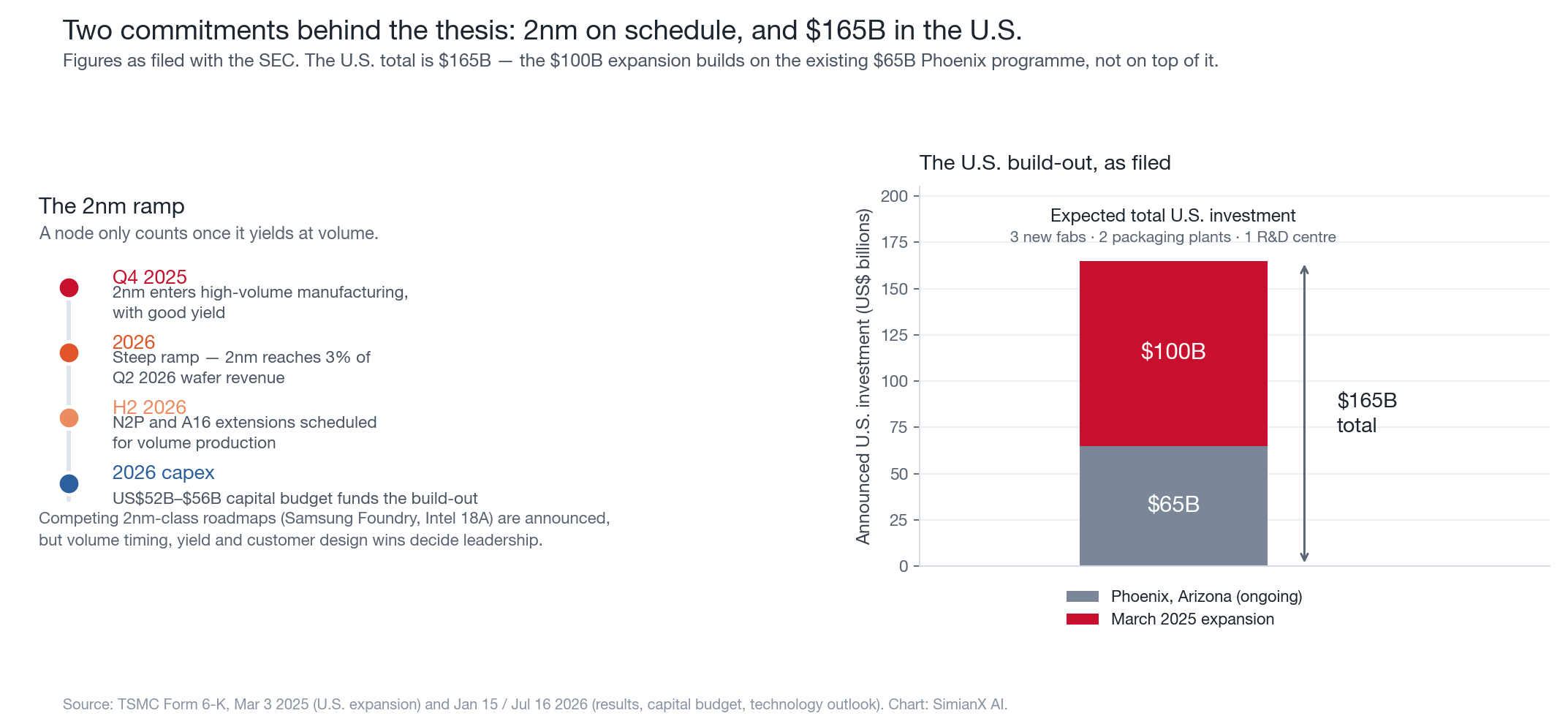
On the manufacturing footprint, TSMC announced in March 2025 that it would expand its U.S. investment by an additional $100 billion, building on the existing $65 billion Phoenix, Arizona programme and bringing its total expected U.S. investment to $165 billion — covering three new fabrication plants, two advanced packaging facilities and an R&D centre. TSMC U.S. expansion announcement
The key figures are summarized below:
| Indicator | 2025 / Earlier 2026 Data | Why It Matters |
|---|---|---|
| 2025 revenue | NT$3.809 trillion | Establishes a record earnings base |
| 2025 net income | NT$1.718 trillion | Shows strong operating leverage |
| Q2 2026 revenue | About $40.2 billion | Confirms continuing AI-related momentum |
| Q3 2026 guidance | $44.6B–$45.8B | Implies another large year-over-year increase |
| 2026 revenue growth target | Slightly above 40% | Raises expectations for earnings growth |
| Q2 2026 gross margin | 67.7% (60.3% operating) | Leading-edge mix is lifting profitability, not just revenue |
| Q2 2026 advanced-node mix | 77% of wafer revenue at 7nm and below | Shows where the pricing power actually sits |
| 2026 capital budget | Initially $52B–$56B | Signals capacity remains strategically constrained |
| U.S. investment commitment | $165B total ($65B Phoenix + $100B expansion) | Expands geographic resilience and customer access |
A high-growth year does not automatically make TSMC stock cheap. It does, however, demonstrate that the company is monetizing the AI buildout rather than merely discussing it — the pattern we first flagged in AI Spending Surges: TSMC Outlook Confirms Nvidia Demand.
Why Nvidia Cannot Easily Replace TSMC
The phrase “Nvidia can’t replace TSMC” needs to be interpreted carefully. Nvidia could theoretically build or acquire manufacturing capacity, but doing so would be extraordinarily expensive, slow, and operationally risky.
1. Manufacturing is a different business
Nvidia’s strengths are chip architecture, software, systems, networking, and developer ecosystems. A leading-edge foundry must manage:
- Process integration
- Lithography and metrology
- Yield learning
- Wafer scheduling
- Chemical and equipment supply
- Customer confidentiality
- Packaging and testing
- Multi-year technology development
These capabilities are not interchangeable with GPU design expertise.
2. TSMC benefits from scale across customers
TSMC spreads research and development costs across Apple, Nvidia, AMD, Broadcom, MediaTek, Qualcomm, and numerous other customers. This scale supports continuous investment in new nodes and packaging. It also means TSMC benefits whichever accelerator wins: AMD’s own AI ramp, examined in AMD Stock 2026: $6.7B Data Center Quarter vs Nvidia’s $75B, runs through the same foundry.
If Nvidia built its own fabs, it would need to finance the equipment, staffing, and process development while also keeping the facilities full. TSMC already has the customer diversity and operating experience to do that.
3. Nvidia needs neutrality
Nvidia competes with companies such as AMD and custom-chip developers. A neutral foundry can manufacture for multiple rivals without using manufacturing access to favor one product line. TSMC’s pure-play foundry model is therefore commercially valuable.
4. Advanced packaging is part of the moat
Modern AI accelerators are not simply single pieces of silicon. They combine compute dies, high-bandwidth memory, interposers, and networking components in complex packages. TSMC describes CoWoS as a 2.5D packaging technology designed for high-performance computing and AI products. TSMC CoWoS technology overview
Nvidia’s annual report also identifies CoWoS as part of its packaging ecosystem. Packaging capacity can become a bottleneck even when wafer capacity is available, which gives TSMC another layer of strategic importance. The memory side of that same package is the subject of Micron (MU): Why HBM3e Makes It the 2026 AI Memory Play.
TSMC’s 2nm and Advanced Packaging Roadmap
A central part of the TSMC stock forecast for 2026 is the transition from 3nm to 2nm manufacturing.
TSMC reported that its 2nm technology entered high-volume manufacturing in the fourth quarter of 2025 with good yield and that it expected a rapid ramp during 2026. The company also scheduled volume production of its N2P and A16 extensions for the second half of 2026. TSMC 2025 Annual Report technology outlook
This roadmap matters for two reasons:
- Performance: Smaller and more advanced nodes can deliver more computing power per watt.
- Economics: Customers generally pay premium prices for leading-edge capacity, supporting revenue and margin growth.
TSMC is also expanding its 3DFabric portfolio, including CoWoS, InFO, SoIC, and newer photonics-related technologies. These technologies allow customers to connect multiple dies, integrate memory more efficiently, and build larger AI systems.
The practical investor takeaway is that TSMC is selling a platform rather than a single manufacturing step. The platform includes:
- Advanced logic wafers
- Specialty processes
- 2.5D and 3D packaging
- Chip stacking
- Silicon photonics-related integration
- Design enablement and ecosystem support
That integration makes substitution more difficult. A competitor would need to match not only transistor density but also yield, packaging, software collaboration, and customer qualification.
Is TSMC’s 2nm lead guaranteed?
No. Samsung Foundry and Intel Foundry continue to invest in gate-all-around transistors, backside power delivery, and advanced nodes. Intel has publicly promoted its 18A process, while Samsung has its own 2nm roadmap.
However, process-node leadership is not determined by announcement dates alone. Investors should track:
- Volume production timing
- Yield rates
- Customer design wins
- Wafer capacity
- Packaging availability
- Power-performance results in commercial products
A node that exists in a presentation but cannot produce high-yield wafers at scale is not a durable competitive threat.
TSMC Stock 2026 Valuation: A Scenario Framework
Investors asking “is TSMC stock a buy in 2026?” should avoid relying on one target price. Semiconductor valuation is highly sensitive to revenue growth, gross margin, capital intensity, currency, and the market multiple.
A useful framework is to build three scenarios.
Bull case
The bull case assumes:
- AI accelerator and custom ASIC demand remains supply constrained.
- 2026 revenue growth stays above 40%.
- 2nm ramps with strong yields.
- CoWoS capacity expands without major delays.
- U.S. fabs eventually improve geographic resilience.
- Gross margins remain near the high end of management guidance.
Under this scenario, earnings estimates may rise faster than the share price, allowing the valuation multiple to remain stable or expand.
Base case
The base case assumes:
- AI spending continues but grows more slowly after a strong 2026.
- TSMC executes its 2nm and packaging ramps with normal manufacturing challenges.
- Overseas fabs carry some initial margin dilution.
- Smartphone and consumer electronics demand recovers modestly.
- Capital spending remains high but produces adequate returns.
In this case, TSMC can still deliver attractive long-term earnings growth, but investors may experience periods of volatility as the market adjusts from explosive growth to more normalized expansion.
Bear case
The bear case assumes:
- Hyperscalers reduce capital spending or delay AI projects.
- Custom chips take share faster than expected but do not offset GPU weakness.
- CoWoS or advanced-node capacity expands ahead of demand.
- Geopolitical tensions disrupt operations or customer shipments.
- U.S. manufacturing costs reduce consolidated margins.
- The market applies a lower multiple to cyclical semiconductor earnings, as it has in every prior downturn catalogued in Semiconductor Bear Markets: Every SOX Crash, 1995–2026.
The bear case does not require TSMC to become a bad company. It only requires expectations to become too optimistic — the question posed directly in Is Jensen Huang Fueling an AI Bubble? Nvidia’s Boom Examined.
| Scenario | Revenue Trend | Margin Risk | Main Share-Price Driver |
|---|---|---|---|
| Bull | AI demand stays exceptionally strong | Limited dilution | Earnings upgrades and multiple expansion |
| Base | Growth remains strong but normalizes | Overseas-fab pressure | Free cash flow and execution |
| Bear | AI cycle slows or supply overshoots | Utilization and pricing pressure | Multiple contraction |
A disciplined investor should update this framework after every quarterly report instead of treating a fixed price target as permanent.
The Main Risks to TSMC Stock in 2026
Geopolitical concentration
TSMC is expanding in Arizona, Japan, and other locations, but Taiwan remains central to its manufacturing footprint. Any military, trade, or diplomatic disruption could affect operations, logistics, insurance, and customer confidence.
Overseas-fab economics
Building fabs outside Taiwan improves resilience but usually increases construction and operating costs. TSMC has warned that overseas fabs can create initial margin dilution before reaching efficient scale.
AI demand concentration
AI-related demand is powerful, but some customers are concentrated in a small number of hyperscalers and accelerator designers. If several large customers reduce orders simultaneously, the impact could be material.
Technology execution
A delayed 2nm ramp, lower-than-expected yields, or packaging constraints could shift customer schedules and pressure margins.
Customer insourcing
Large customers may develop more custom silicon or seek additional foundry partners. Diversification can reduce TSMC’s dependence on one customer, but it can also reduce the percentage of value captured per AI system.
Currency and macroeconomic risk
TSMC reports in Taiwan dollars but is widely analyzed in U.S. dollars. Exchange-rate movements can affect reported growth, while higher interest rates can reduce valuation multiples for high-growth stocks.
How to Research TSMC Stock 2026 Step by Step
Investors can use this five-step process:
- Read the quarterly release. Check revenue, gross margin, operating margin, and guidance.
- Track technology mix. Watch the contribution from 3nm, 2nm, and other advanced nodes.
- Monitor packaging. Look for CoWoS capacity commentary and customer demand signals.
- Compare capex with free cash flow. High spending is acceptable only if it supports future returns.
- Stress-test valuation. Model slower AI growth, lower margins, and a reduced earnings multiple.
SimianX AI can make this workflow faster by combining SEC filings, company announcements, news sentiment, technical charts, and multiple AI-agent viewpoints. Investors can use the platform to compare TSM, NVDA, AMD, and other semiconductor stocks without relying on a single headline.
FAQ About TSMC Stock 2026
Is TSMC stock a buy in 2026?
TSMC has a strong 2026 operating outlook, supported by AI demand, advanced nodes, and packaging. Whether it is a buy depends on the price paid, your risk tolerance, and whether future earnings growth justifies the valuation.
Why does Nvidia depend on TSMC?
Nvidia designs AI processors but relies on external foundries for manufacturing. TSMC provides leading-edge wafers and advanced packaging capabilities that are difficult and expensive for Nvidia to replicate internally.
What drives TSMC revenue growth in 2026?
The primary drivers are AI accelerators, custom data-center chips, networking silicon, 2nm adoption, advanced packaging, and broader AI deployment in PCs, smartphones, vehicles, and enterprise systems.
How important is CoWoS to the TSMC investment thesis?
CoWoS is important because advanced AI systems combine multiple dies and high-bandwidth memory in sophisticated packages. Packaging capacity can limit total system shipments, giving TSMC an additional bottleneck advantage beyond wafer fabrication.
What is the biggest risk to TSMC stock?
The biggest risks are geopolitical disruption, a sharp slowdown in AI capital spending, execution problems in 2nm or packaging, and valuation compression if semiconductor growth normalizes.
Conclusion
The TSMC Stock 2026 thesis rests on more than Nvidia’s continued success. TSMC supplies the manufacturing foundation for Nvidia, AMD, custom ASIC designers, smartphone companies, networking vendors, and future AI architectures. Its advantages include process leadership, manufacturing scale, customer neutrality, advanced packaging, and a large reinvestment budget.
The company’s 2025 results and 2026 updates show that AI demand is already translating into record revenue and profits. The second-quarter 2026 results, third-quarter guidance, 2nm ramp, CoWoS expansion, and increased U.S. investment all support the view that TSMC remains a critical AI infrastructure company.
Still, investors should not ignore risk. The stock can be volatile, capital spending is enormous, overseas fabs may dilute margins, and AI expectations are already high. The best approach is to track execution quarter by quarter, compare valuation with realistic earnings scenarios, and maintain a margin of safety.
For a live workflow that brings together fundamentals, filings, market news, technical signals, and multi-agent analysis, visit SimianX AI. Use it to build a repeatable research process for TSMC stock, Nvidia, and the wider semiconductor market.
Related Reading
- AI Spending Surges: TSMC Outlook Confirms Nvidia Demand
- AMD Stock 2026: $6.7B Data Center Quarter vs Nvidia’s $75B
- Is Jensen Huang Fueling an AI Bubble? Nvidia’s Boom Examined
- NVDA After Earnings: Every Reaction Since 2016 in One Table
- Semiconductor Bear Markets: Every SOX Crash, 1995–2026
- Broadcom Earnings 2026: AI ASIC Backlog & AVGO Stock
- Micron (MU): Why HBM3e Makes It the 2026 AI Memory Play
- Cerebras Stock 2026: AI Chip Boom vs Gross Margin Risk
References
- TSMC — second-quarter 2026 results and third-quarter guidance (SEC Form 6-K)
- TSMC — second-quarter 2026 investor presentation, full-year outlook (SEC Form 6-K)
- TSMC — fourth-quarter 2025 results, Q1 2026 guidance and 2026 capital budget (SEC Form 6-K)
- TSMC — 2025 financial highlights presentation (SEC Form 6-K)
- TSMC — June 2026 monthly revenue report (SEC Form 6-K)
- TSMC — announcement of an additional $100 billion U.S. investment (SEC Form 6-K)
- SEC EDGAR — TSMC filing history
- TSMC — 2025 Annual Report
- TSMC — CoWoS advanced packaging technology
- NVIDIA — fiscal 2025 annual report on Form 10-K
- SimianX AI — stock research hub