Reading Sysco's Own Pro Forma: What the Jetro Numbers Actually Say
On September 15, 2026, Sysco Corporation (NYSE: SYY) priced 12,345,679 shares of common stock at $81.00 each. The Sysco $1B stock sale is the last and smallest piece of the financing for its pending acquisition of Jetro Restaurant Depot, and on its own it is almost trivial: it lifts the share count by 2.57%.
The documents filed alongside it are not trivial. To sell the stock, Sysco had to publish an amended prospectus supplement and, in a Current Report on Form 8-K dated September 14, 2026, three things the market had never seen: Jetro Restaurant Depot's audited combined financial statements, its management's discussion and analysis, and a full unaudited pro forma condensed combined income statement for the merged company.
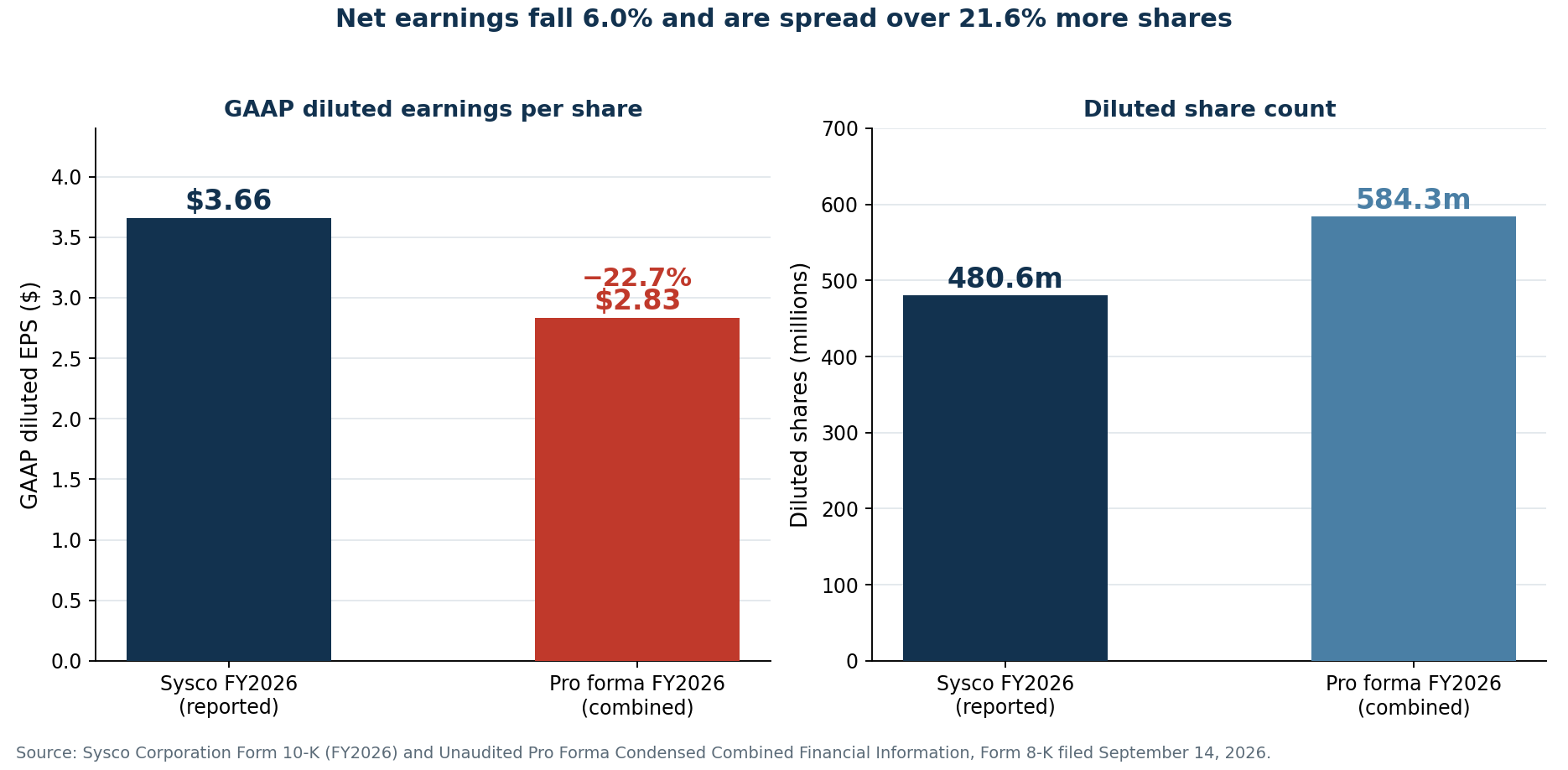
Those filings answer the question the headlines have been guessing at. Sysco's own pro forma statement shows that, had the deal closed at the start of fiscal 2026, combined diluted earnings per share would have been $2.83 instead of the $3.66 Sysco actually reported — a decline of 22.7%. Not a projection by a bearish analyst. The company's own arithmetic, signed off for a securities offering.
This article works through what the filings say, line by line: the exact dilution ladder, the pro forma income statement, the bridge that explains why "adjusted EPS accretion" and a 23% GAAP EPS decline are both true, the audited numbers behind Jetro's marketing figures, where the $29.0 billion purchase price actually lands on the balance sheet, and what the deleveraging plan requires in cash. Investors tracking the deal can monitor SYY filings, price action and regulatory news with SimianX AI.
All figures are drawn from SEC filings and market data through September 16, 2026.
The Offering, Exactly
Sysco announced the offering after the close on September 14 and priced it the following evening. The terms are precise, and precision matters here because most of the dilution commentary has been working from rounded numbers.
| Offering term | Base deal | With full overallotment |
|---|---|---|
| Shares offered | 12,345,679 | 14,197,530 |
| Price to public | $81.00 | $81.00 |
| Gross proceeds | $1,000.0 million | $1,150.0 million |
| Underwriting discount per share | $2.43 | $2.43 |
| Total underwriting discount | $30.0 million | $34.5 million |
| Net proceeds to Sysco | $967.4 million | $1.1 billion |
| Shares outstanding before (Sept 9, 2026) | 479,568,281 | 479,568,281 |
| Shares outstanding after | 491,913,960 | 493,765,811 |
| Increase in share count | 2.574% | 2.960% |
The underwriters' overallotment option is for exactly 1,851,851 additional shares. Goldman Sachs & Co. LLC took 4,444,444 shares and TD Securities (USA) LLC 2,962,962 of the base deal, with thirteen other banks splitting the rest.
Two details deserve emphasis. First, the offering is not contingent on the Jetro acquisition closing. If the deal collapses, the shares stay outstanding and Sysco keeps the cash for general corporate purposes. Second, Sysco also has 33,878,051 shares reserved under its equity compensation plans, which sit outside every share count in the table above.
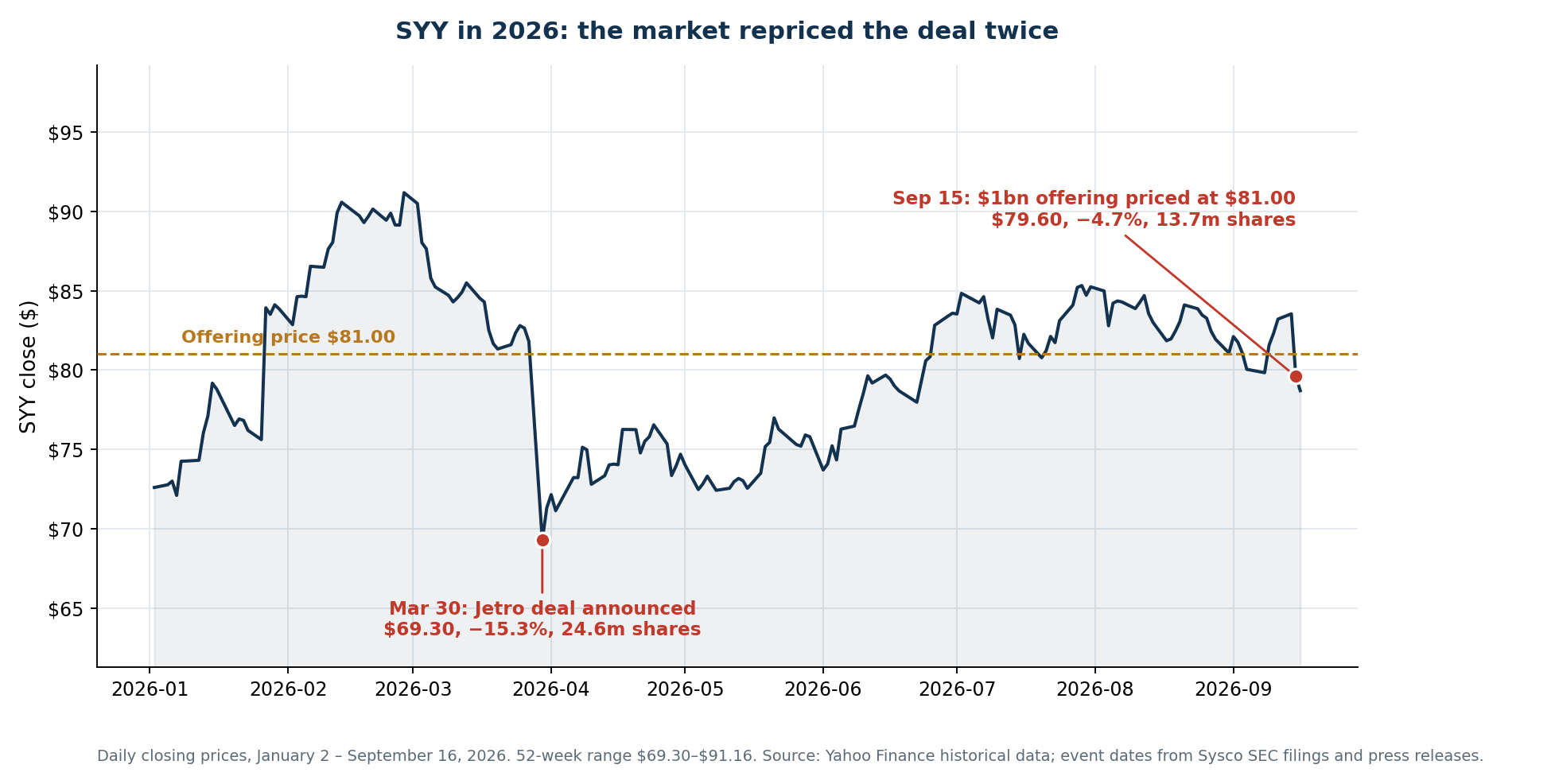
The $81.00 price was a 3.04% discount to the September 14 close of $83.54. That is an unremarkable new-issue concession. What followed was less routine: SYY closed at $79.60 on September 15 and $78.71 on September 16 — 2.8% below the price the new investors paid, on volumes of 13.7 million and 6.3 million shares against a typical 2 to 4 million.
The Dilution Ladder Has Three Rungs, Not One
The $1 billion offering is the smallest of three share-count events. Sysco will also issue 91.5 million shares to Jetro's owners at closing, a block worth $7,514 million in the pro forma at the $82.11 reference price.
| Stage | Shares outstanding | Legacy holders' stake |
|---|---|---|
| Before the offering (Sept 9, 2026) | 479,568,281 | 100.00% |
| After the $1B offering | 491,913,960 | 97.49% |
| After 91.5M shares to Jetro owners | 583,413,960 | 82.20% |
| With full overallotment exercised | 585,265,811 | 81.94% |
The pro forma statement uses 584,290,988 diluted shares, which includes weighting effects and equity-plan dilution.
The equity offering costs legacy shareholders 2.5 percentage points of ownership. The acquisition shares cost them another 15.3. Arguing about the offering is arguing about one-sixth of the dilution.
Stock-funded deals are routinely judged on the headline share issuance rather than the full ladder — the same mistake investors made reading Amazon's Qualcomm chip agreement, where the announced block was only part of the eventual count.
This is why the offering, standing alone, is not the investment question — and why Sysco's decision to fund that last $1 billion with equity rather than debt is defensible. At the roughly 5.6% blended rate implied by the pro forma financing schedule, using stock instead of debt for the final billion avoids about $56 million of annual pre-tax interest and protects the investment-grade ratings that price the other $20.9 billion.
Sysco's Own Pro Forma Income Statement
This is the table that reframes the entire debate. It comes directly from Exhibit 99.3 of the September 14 Form 8-K and shows the combined company as if the transaction had closed on June 29, 2025.
| Fiscal year, $ millions | Pro forma FY2026 | Sysco FY2026 | Sysco FY2025 | Sysco FY2024 |
|---|---|---|---|---|
| Sales | 100,561 | 84,553 | 81,370 | 78,844 |
| Cost of sales | 81,810 | 68,914 | 66,401 | 64,236 |
| Gross profit | 18,751 | 15,639 | 14,969 | 14,608 |
| Operating expenses | 14,594 | 12,544 | 11,881 | 11,406 |
| Operating income | 4,157 | 3,095 | 3,088 | 3,202 |
| Interest expense | 2,008 | 717 | 635 | 607 |
| Other expense (income), net | 75 | 102 | 38 | 30 |
| Earnings before income taxes | 2,074 | 2,276 | 2,415 | 2,565 |
| Income taxes | 423 | 519 | 587 | 610 |
| Net earnings | 1,651 | 1,757 | 1,828 | 1,955 |
| Diluted EPS | $2.83 | $3.66 | — | — |
| Diluted shares | 584,290,988 | 480,612,203 | — | — |
Read the bottom three rows together. Sales rise 18.9%. Operating income rises 34.3%. And net earnings fall 6.0%, because interest expense nearly triples — from $717 million to $2,008 million. Spread across 21.6% more shares, diluted EPS falls from $3.66 to $2.83.
The same filing gives the EBITDA view:
| $ millions | Pro forma FY2026 | Sysco FY2026 |
|---|---|---|
| EBITDA | 5,787 | 3,969 |
| EBITDA adjusted for Certain Items | 6,608 | 4,387 |
| Adjusted EBITDA margin | 6.6% | 5.2% |
| Depreciation and amortization | 1,705 | 976 |
| Net debt | 32,286 | 11,730 |
| Net debt / adjusted EBITDA | 4.89x | 2.67x |
Margins genuinely improve — 5.2% to 6.6% at the adjusted EBITDA line is a real structural gain, and it is the strongest fact in the bull case. The problem is everything below EBITDA.
Why "EPS Accretion" and a 23% EPS Decline Are Both True
Sysco has guided to mid-to-high single-digit adjusted EPS accretion in year one and low-to-mid-teens in year two. Those statements are not misleading. They are also not measuring the same thing as the pro forma above. The filings let us quantify the gap exactly.
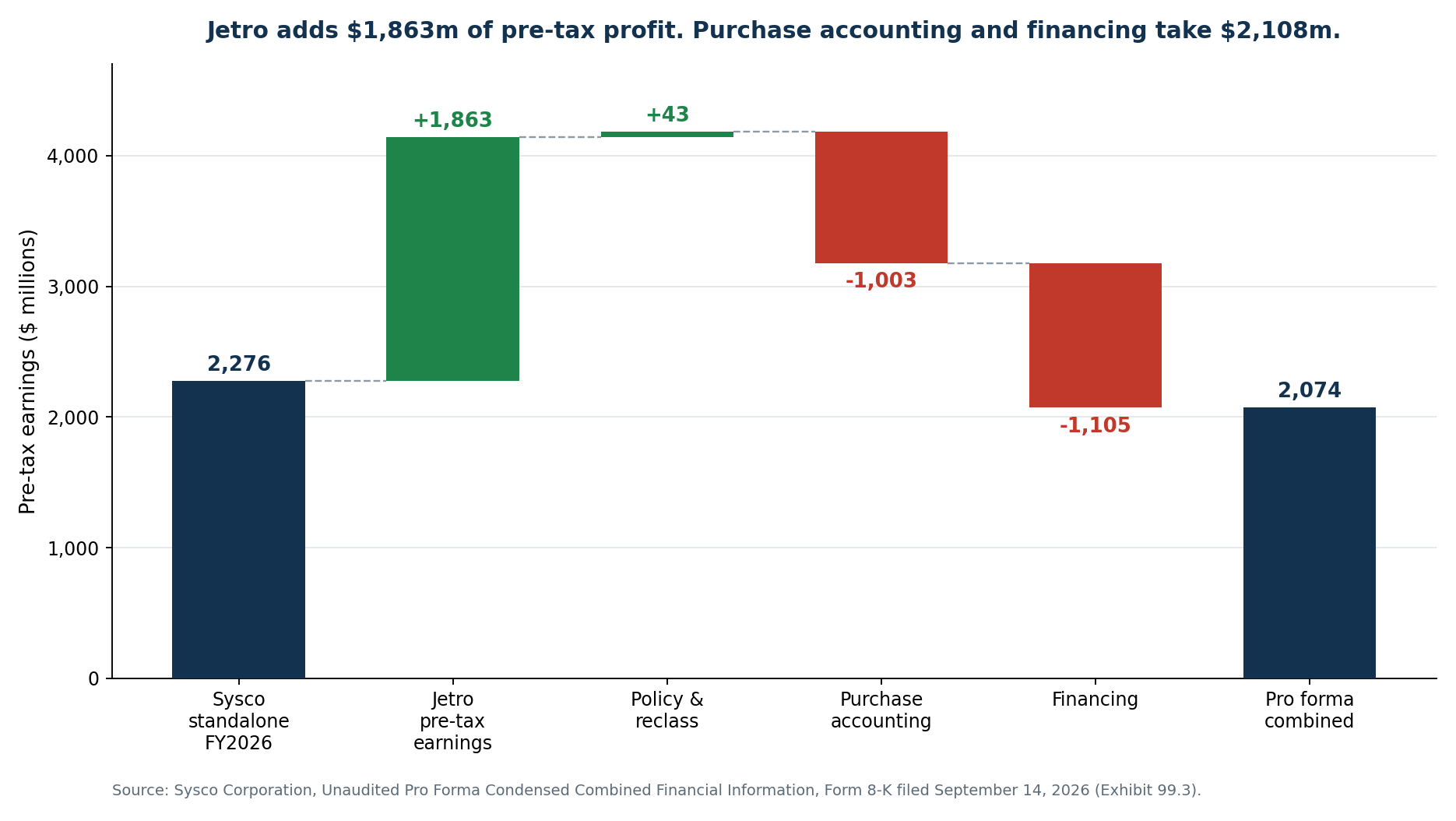
| Pre-tax earnings bridge, $ millions | Amount |
|---|---|
| Sysco standalone FY2026 pre-tax earnings | 2,276 |
| Plus: Jetro pre-tax earnings (12 months to June 27, 2026) | +1,863 |
| Plus: accounting policy and reclassification adjustments | +43 |
| Less: purchase accounting adjustments | −1,003 |
| Less: financing adjustments | −1,105 |
| Pro forma pre-tax earnings | 2,074 |
Jetro brings $1,863 million of pre-tax profit. Purchase accounting and financing together take $2,108 million — $245 million more than the acquired business earns.
The purchase accounting line decomposes further:
| Purchase accounting charges, $ millions | Amount |
|---|---|
| Amortization of purchased identifiable intangible assets | 626 |
| Depreciation of stepped-up plant and equipment | 91 |
| Less: reversal of Jetro's own historical depreciation | −66 |
| Non-recurring transaction costs | 191 |
| Non-recurring retention bonuses | 118 |
| Non-recurring transfer taxes | 49 |
| Less: removal of Jetro interest-rate swap amortization | −6 |
| Total | 1,003 |
Adjusted EPS excludes the $626 million of intangible amortization. That single line — non-cash, real, and running for years — is roughly 32% of Jetro's operating income. Add the $358 million of one-off transaction, retention and transfer-tax costs, which are genuinely non-recurring, and you have the entire distance between "high single-digit accretion" and "GAAP EPS down 23%."
Neither number is wrong. They answer different questions. Adjusted EPS asks whether the cash economics improve. GAAP EPS asks what a share of the combined company owns. For a company whose stated commitment is a dividend paid in cash out of reported earnings, both matter.
What the Audited Jetro Statements Show
Until September 14, Jetro Restaurant Depot was described almost entirely through Sysco's transaction materials: approximately $16 billion of 2025 revenue, approximately $2.1 billion of EBITDA, approximately $1.9 billion of free cash flow. The audited combined financial statements of JRD Unico, Inc. and Affiliates are now public, and they are more interesting than the summary.
| JRD Unico combined, $ millions | FY2025 (to Dec 27) | FY2024 (to Dec 28) | Change |
|---|---|---|---|
| Sales | 15,812.2 | 15,331.3 | +3.14% |
| Gross profit | 2,937.9 | 2,830.0 | +3.81% |
| Gross margin | 18.58% | 18.46% | +12 bp |
| Selling, general and administrative | 997.1 | 968.1 | +2.99% |
| Operating income | 1,940.9 | 1,861.9 | +4.24% |
| Operating margin | 12.28% | 12.14% | +14 bp |
| Interest expense | 186.5 | 165.1 | — |
| Interest expense — related parties | 84.6 | 138.2 | — |
| Pre-tax income | 1,666.7 | 1,603.1 | +3.97% |
| Net income | 1,197.0 | 1,173.1 | +2.04% |
| Net margin | 7.57% | 7.65% | −8 bp |
The margin story is real. A 12.3% operating margin in food distribution is exceptional; Sysco's fiscal 2026 adjusted EBITDA margin was 5.2%. Depreciation and amortization of just $67.4 million on $15.8 billion of sales, and capital expenditure of $137.2 million, describe an unusually asset-light, high-return operation.
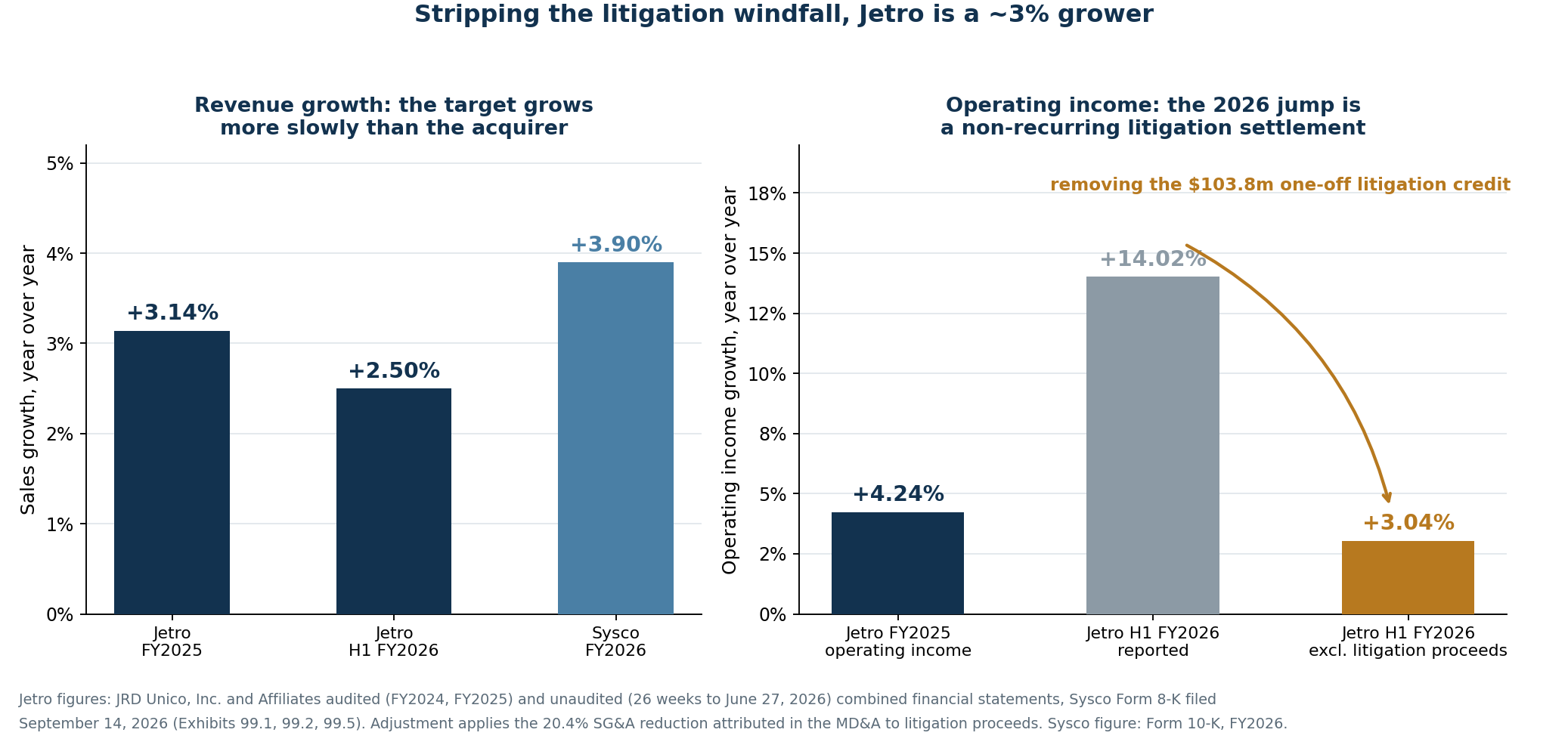
The growth story is where the audited statements and the marketing diverge. Jetro's sales grew 3.14% in 2025. Sysco's own sales grew 3.9% in fiscal 2026. The company being acquired as a growth engine is growing more slowly than the acquirer.
The 2026 acceleration is a litigation settlement
The first half of fiscal 2026 looks dramatically better, and this is the number most likely to be quoted back as evidence the deal is working.
| JRD Unico, 26 weeks to June 27, $ millions | H1 FY2026 | H1 FY2025 | Change |
|---|---|---|---|
| Sales | 8,061.7 | 7,864.7 | +2.50% |
| Gross profit | 1,519.5 | 1,454.0 | +4.50% |
| SG&A | 441.8 | 508.8 | −13.2% |
| Operating income (reported) | 1,077.7 | 945.2 | +14.02% |
| Net income | 708.7 | 567.0 | +25.0% |
Operating income up 14% on sales up 2.5% is a striking result. Jetro's own MD&A explains it: "Proceeds from the settlement of various non-recurring litigation matters resulted in a 20.4% decrease in Selling, general, and administrative expenses."
A 20.4% reduction against the prior-year base of $508.8 million is approximately $103.8 million of one-time litigation proceeds booked as a credit to SG&A.
| Adjusting H1 FY2026 operating income, $ millions | Amount |
|---|---|
| Reported operating income | 1,077.7 |
| Less: estimated litigation settlement proceeds | −103.8 |
| Adjusted operating income | 973.9 |
| H1 FY2025 operating income | 945.2 |
| Adjusted growth | +3.04% |
Strip the windfall and Jetro's operating income grew about 3% — in line with its 2025 result, and consistent with a mature, steadily compounding business rather than an accelerating one. The same MD&A notes Jetro opened five new warehouses in fiscal 2024 and five in fiscal 2025, which is precisely the pace implied by Sysco's "125+ new locations over at least the next two decades."
A balance sheet built by its owners
The audited statements also show what kind of company Jetro has been under Leonard Green & Partners and its co-investors.
| JRD Unico balance sheet, $ millions | Jun 27, 2026 | Dec 27, 2025 | Dec 28, 2024 |
|---|---|---|---|
| Total assets | 3,383.0 | 3,183.9 | 3,059.8 |
| Total debt (incl. related parties) | 5,778.6 | 6,235.3 | 6,844.1 |
| Total liabilities | 7,434.3 | 7,711.7 | 8,326.5 |
| Treasury stock, at cost | (2,614.1) | (2,614.1) | (2,614.1) |
| Total stockholders' deficiency | (4,051.3) | (4,527.8) | (5,266.7) |
Jetro carries a $4.05 billion stockholders' deficiency. That is the signature of a leveraged recapitalization, not distress — the business is highly profitable — but it tells you where the cash has been going.
| Cash returned to Jetro's owners, $ millions | FY2024 | FY2025 | H1 FY2026 | Total |
|---|---|---|---|---|
| Dividends paid | 1,028.9 | 456.0 | 232.3 | 1,717.2 |
| Shareholder note repayments | 750.0 | 309.4 | 385.8 | 1,445.2 |
| Treasury stock note repayment | 933.3 | — | — | 933.3 |
| Total | 2,712.2 | 765.4 | 618.1 | 4,095.7 |
Over the thirty months to June 2026, Jetro's owners extracted approximately $4.1 billion. Sysco is now paying $29.0 billion for what remains. That is not an accusation of anything improper; dividend recapitalizations are ordinary private-equity practice. It is context for the price.
The "$1.9 billion of free cash flow" is EBITDA minus capex
Sysco's transaction materials cite approximately $1.9 billion of Jetro free cash flow and a 90%+ free-cash-flow conversion rate. The investor presentation footnote states the definition plainly: Free Cash Flow calculated as Adj. EBITDA − Capex.
The audited cash flow statement gives the conventional calculation.
| Jetro FY2025 cash generation, $ millions | Amount |
|---|---|
| Marketed "free cash flow" (adj. EBITDA − capex) | ~1,900 |
| Audited EBITDA (operating income + D&A) | 2,008.3 |
| Less: capital expenditures | −137.2 |
| Equals marketed measure | 1,871.1 |
| Less: cash interest (incl. related parties) | −271.1 |
| Less: cash income taxes | −469.7 |
| Audited operating cash flow less capex | 1,081.4 |
The marketed figure is 1.76 times the conventional one, because it is struck before interest and tax. This is the same gap between a marketed cash-flow figure and the cash actually left over that runs through Big Tech's capex cycle. The same definition produces the "$5.5 billion of combined free cash flow" headline: approximately $6.4 billion of combined adjusted EBITDA less roughly $0.9 billion of capital expenditure. Sysco's pro forma statement shows what is left after the items that definition skips — $2,008 million of interest and $423 million of tax.
This is the single most important adjustment in the whole analysis, and it recasts every multiple:
| Valuation test on total purchase price of $28,996m | Multiple |
|---|---|
| Enterprise value / FY2025 sales ($15,812m) | 1.83x |
| Enterprise value / FY2025 EBITDA ($2,008m) | 14.4x |
| Enterprise value / FY2025 operating income ($1,941m) | 14.9x |
| Enterprise value / 12-month operating income to Jun 2026 ($2,073m) | 14.0x |
| Enterprise value / marketed free cash flow ($1,900m) | 15.3x |
| Enterprise value / audited free cash flow ($1,081m) | 26.8x |
| Enterprise value / FY2025 net income ($1,197m) | 24.2x |
| Annual synergies ($250m) as % of purchase price | 0.86% |
Sysco quoted 14.6 times Jetro's operating income, and roughly 13 times after synergies. On operating income that is broadly right. On cash the owners can actually keep, the multiple is closer to 27. Acquirers rarely dispute the arithmetic; they dispute the denominator, which is exactly the argument that ran through Nvidia's $12.9 billion purchase of Hugging Face.
Where $29 Billion Lands on the Balance Sheet
The pro forma allocates the purchase price. The consideration is built as follows:
| Total estimated purchase price, $ millions | Amount |
|---|---|
| Cash transferred at closing | 15,578 |
| Repayment of Jetro's existing debt | 5,812 |
| Jetro equity appreciation units | 92 |
| 91.5 million Sysco Holdings shares at $82.11 | 7,514 |
| Total | 28,996 |
And the allocation:
| Preliminary purchase price allocation, $ millions | Amount |
|---|---|
| Intangible assets | 10,000 |
| Plant and equipment (stepped up from $1,664m) | 2,952 |
| Inventories (stepped up from $599m) | 1,010 |
| Other assets acquired | 670 |
| Total assets acquired | 14,632 |
| Less: liabilities assumed (incl. $2,805m deferred tax) | −4,364 |
| Net assets acquired excluding goodwill | 10,268 |
| Goodwill | 18,728 |
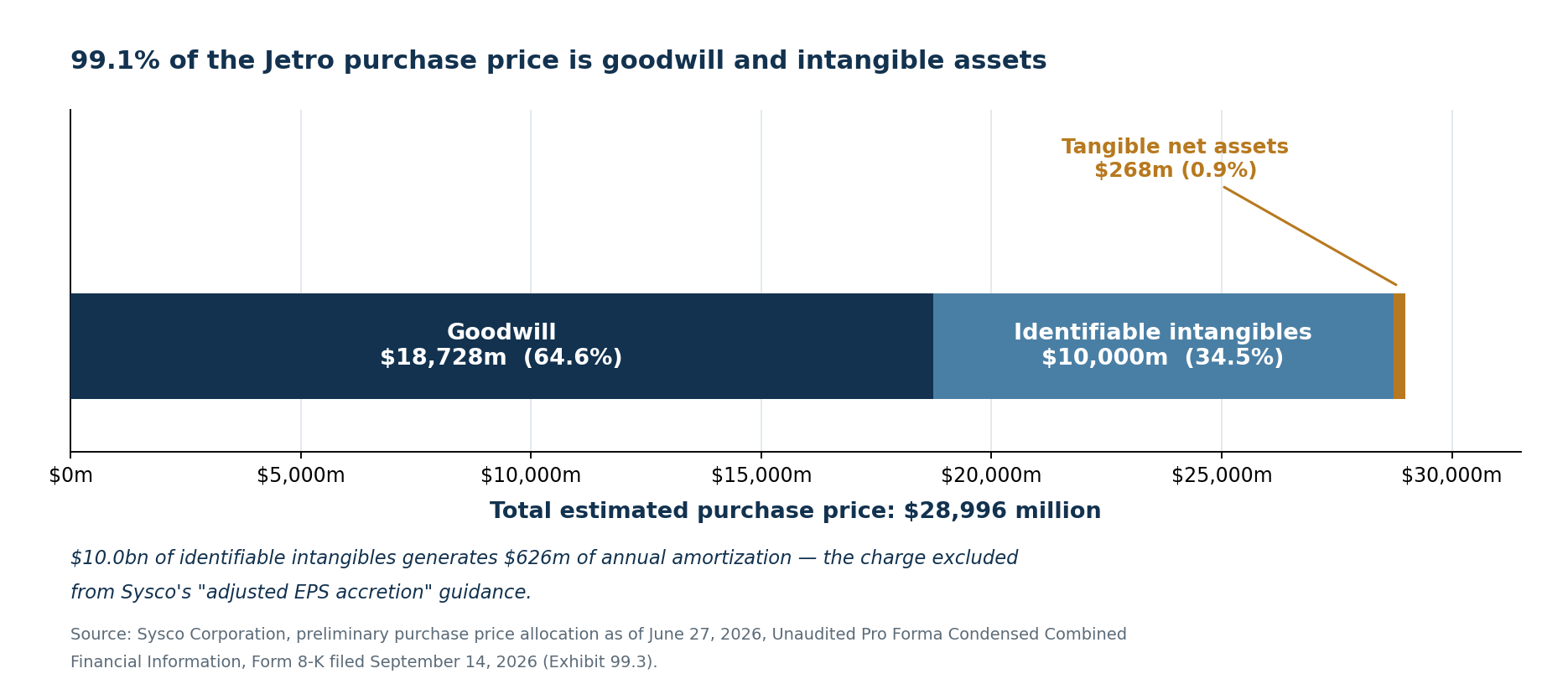
Goodwill is 64.6% of the purchase price. Goodwill plus intangibles is $28,728 million — 99.1%. Net of the $10,000 million of intangibles, the tangible net assets acquired come to $268 million, or nine-tenths of one percent of what Sysco is paying.
That is not automatically damning. Restaurant Depot's value genuinely is its customer relationships, its locations and its brand, and the relief-from-royalty and multi-period excess earnings methods used to value them are standard. But it does mean two things. The $626 million of annual amortization is the accounting consequence of that $10 billion intangible, and it is the number "adjusted EPS" removes. And $18.7 billion of goodwill is $18.7 billion of future impairment risk if restaurant demand or Jetro's margins deteriorate.
The Financing: $20.9 Billion, Assembled in Five Steps
The equity offering is the visible end of a financing package built over five and a half months.
| Date | Step | Effect on bridge commitment |
|---|---|---|
| Mar 30, 2026 | $22.0 billion 364-day senior unsecured bridge facility committed | $22.00 billion |
| Apr 13, 2026 | Joinder adds thirteen banks to the commitment | $22.00 billion |
| Apr 16, 2026 | $3.0 billion term loan credit agreement signed | $19.00 billion |
| Apr 16, 2026 | $3.0 billion revolver replaced (rises to $4.0 billion post-closing) | $19.00 billion |
| Sep 4, 2026 | $750 million CoBank delayed-draw term loan ($375m 6-year + $375m 8-year) | $18.25 billion |
| Sep 15, 2026 | $1.0 billion common equity priced | $18.25 billion |
A $20.9 billion debt package against $6.6 billion of pro forma adjusted EBITDA is a different risk profile than Sysco has ever carried, and the market has become notably less forgiving of borrowed growth — CoreWeave's backlog-versus-debt debate is the current reference case. Still to come are the "Additional Securities Offerings" — senior notes and junior subordinated notes, potentially in US dollars, Canadian dollars or euros — that are intended to take out the bridge.
The pro forma discloses the cost of all of it:
| Pro forma interest adjustment, $ millions | Amount |
|---|---|
| Interest on new debt | 1,063 |
| Term loan facility (assumed 4.81% weighted average) | 69 |
| CoBank facility | 38 |
| Bridge facility commitment fees | 106 |
| Amortization of debt issuance costs | 11 |
| Unused capacity fees on the revolver | 4 |
| Less: removal of Jetro's existing interest expense | −157 |
| Net adjustment | 1,134 |
Two figures stand out. The recurring interest — $1,063 + $69 + $38 = $1,170 million — on $20,883 million of new borrowing implies a blended cost of about 5.60%, above the 4% and 5% scenarios most commentary has assumed. And Sysco is paying $106 million in commitment fees simply to keep the bridge facility available, $48 million of it already in cash.
What Deleveraging Actually Requires
Management has committed to cutting net leverage by at least one full turn within 24 months of closing, en route to a long-term target near 2.75x. Starting from the disclosed pro forma 4.89x, one turn means 3.89x.
| Path to 3.89x net debt / adjusted EBITDA | Required net debt | Debt reduction needed |
|---|---|---|
| Adjusted EBITDA flat at $6,608m | $25,706m | $6,580m |
| Adjusted EBITDA grows 3%/yr for two years | $27,048m | $5,238m |
| Adds $250m synergies and grows 3%/yr | $28,238m | $4,048m |
Against that, here is the cash the combined company would generate on pro forma figures:
| Annual cash available for debt reduction, $ millions | Amount |
|---|---|
| Pro forma EBITDA | 5,787 |
| Less: interest expense | −2,008 |
| Less: income taxes | −423 |
| Less: capital expenditure (Sysco $700m + Jetro ~$150m) | −850 |
| Cash flow before dividends | 2,506 |
| Less: dividends at the current $2.17 rate on 584.3m shares | −1,268 |
| Discretionary cash flow | 1,238 |
Roughly $1.24 billion a year, or $2.5 billion over 24 months, against a $4.0 billion requirement in the most favourable of the three scenarios. The gap has to come from EBITDA growth beyond 3%, synergies arriving early, working capital, asset sales, or a longer timetable. Buybacks are already suspended, and that only frees the $200 million Sysco spent in fiscal 2026 — a fraction of the repurchase capacity that companies like Lululemon have deployed to defend a share count.
Note also that the dividend commitment gets more expensive purely arithmetically. At the fiscal 2026 declared rate of $2.17 per share, 584.3 million shares require about $1,268 million a year against the $1,037 million Sysco actually paid — roughly $231 million of additional annual cash for the same per-share dividend. Measured against pro forma net earnings of $1,651 million, the payout ratio moves from 59% to 77%.
The Tape: Two Sell-Offs, Six Months Apart
The market has already given two verdicts on this transaction, and they were not ambiguous.
| Date | Event | Close | Change | Volume |
|---|---|---|---|---|
| Mar 27, 2026 | Last close before announcement | $81.80 | −1.02% | 2.6m |
| Mar 30, 2026 | Jetro acquisition announced | $69.30 | −15.28% | 24.6m |
| Mar 31, 2026 | Partial rebound | $71.33 | +2.93% | 15.5m |
| Apr 1, 2026 | Continued rebound | $72.17 | +1.18% | 9.7m |
| Sep 11, 2026 | Reference close in the preliminary prospectus | $83.21 | +1.09% | 3.5m |
| Sep 14, 2026 | Offering announced after the close | $83.54 | +0.40% | 2.3m |
| Sep 15, 2026 | Offering priced at $81.00 | $79.60 | −4.72% | 13.7m |
| Sep 16, 2026 | Offering closes | $78.71 | −1.12% | 6.3m |
On announcement day Sysco fell 15.28% on roughly ten times normal volume, taking about $6.0 billion off its market capitalisation — a fifth of the purchase price, erased in a session, before a single share had been issued or a dollar borrowed. The stock reclaimed most of it over the following months, reaching $91.16 at its 52-week high, then gave part of it back around the offering.
At $78.71, SYY trades at 17.1 times fiscal 2026 adjusted EPS of $4.61, 21.5 times GAAP EPS of $3.66 — and 27.8 times the $2.83 pro forma figure the company itself published.
Regulatory Risk Has a Precedent and a Price Tag
The transaction has not closed and may not. Sysco and Jetro filed under the Hart-Scott-Rodino Act on April 27, 2026, and both received a second request from the Federal Trade Commission on May 27, 2026. A second request means the agency wants a deep look, and large-cap deals that turn on a single regulatory gate — the NextEra–Dominion transaction among them — tend to trade on the review calendar rather than the fundamentals until it closes.
Sysco has been here before. In 2015 it agreed to buy US Foods for $8.2 billion. The FTC sued, alleging the combination would control 75% of the national broadline distribution market. On June 23, 2015, Judge Amit Mehta of the US District Court for the District of Columbia granted a preliminary injunction, and Sysco abandoned the deal six days later, paying US Foods a $300 million break fee.
The 2026 deal is structurally different — cash-and-carry warehouses versus delivered broadline is a genuinely weaker overlap than broadline versus broadline — but the political attention is comparable. On August 26, 2026, Senators Cory Booker and Tammy Baldwin wrote to FTC Chairman Andrew Ferguson urging a thorough investigation, arguing that Restaurant Depot's no-contract, no-delivery-fee, no-minimum-order model is "an important source of competition" for independent restaurants operating on three to five percent margins, and explicitly invoking the 2015 precedent.
The price of failure has changed:
| Break-fee comparison | 2015 US Foods | 2026 Jetro Restaurant Depot |
|---|---|---|
| Deal value | $8.2 billion | $29.0 billion |
| Fee payable by Sysco | $300 million | $1,164 million |
| Fee as % of deal value | 3.7% | 4.0% |
If the merger agreement terminates for failure to obtain regulatory clearance, or simply because the deal has not closed by the Termination Date, Sysco owes $1.164 billion. The Termination Date is September 30, 2027, with one automatic extension to March 30, 2028 if regulatory clearance is the only outstanding condition. For investors who trade deal risk directly, the mechanics are the same ones that governed the Copart–ACV Auctions transaction: a fixed price, a regulatory gate, and a spread that pays only if the gate opens.
If the deal fails
Because the offering is not contingent, the 12.35 million new shares remain outstanding regardless. Sysco would hold roughly $967 million of net proceeds, owe a $1.164 billion break fee, and have spent $106 million on bridge commitment fees plus its share of transaction costs. Legacy shareholders would carry 2.5% dilution and no Jetro earnings. The offsetting point is that leverage would stay near 2.67x and the balance sheet would be intact.
Bull, Base and Bear
Bull case. The FTC clears without meaningful remedies. Jetro's 12.3% operating margin holds and the 6.6% combined adjusted EBITDA margin proves durable. The $250 million of synergies lands early. New-store returns match the existing base. Combined cash generation runs ahead of the pro forma because working capital in a $100 billion distributor is a real lever. Net leverage reaches 3.89x inside 24 months, the bridge is termed out at attractive rates, and buybacks resume in fiscal 2029. Adjusted EPS accretion arrives as guided and GAAP EPS crosses back above $3.66 within three to four years as the amortization schedule becomes a known quantity the market looks through.
Base case. Regulatory review consumes most of fiscal 2027. The deal closes with modest or no remedies. Financing costs land near the pro forma 5.6%. Synergies phase in over the full three years. Jetro grows in the 3% range, as the litigation-adjusted numbers suggest. Leverage falls by roughly a turn but closer to 30 months than 24, dividends absorb $1.27 billion a year, and buybacks stay suspended into the end of the decade. Shareholders own a larger, higher-margin, more indebted company whose reported earnings per share take several years to recover. Strategically sound, financially slow.
Bear case. The FTC demands divestitures or litigates. Restaurant demand weakens; independent restaurants are the most cyclical customer segment in foodservice, and menu inflation has already been absorbed by consumers for several years — the stress signals Walmart and Target flagged in 2026 land on Jetro's customer base before they land on Sysco's institutional one. Jetro's margins compress, the 2026 litigation credit does not repeat, and reported comparisons look sharply worse in fiscal 2027. Interest lands above 5.6%. Deleveraging slips, the dividend commitment competes with debt repayment, and some portion of $18.7 billion of goodwill is written down. This is the dilution trap: a smaller ownership share of a more leveraged company whose acquired earnings do not cover the financing.
What to Monitor
- FTC outcome and remedies. Clearance timing, and whether any divestiture touches the store base.
- The Additional Securities Offerings. Weighted-average coupon, tenor and the mix of senior versus junior subordinated notes. Every 100 basis points on $20.9 billion is $209 million of pre-tax income.
- Jetro's pre-closing results. Specifically whether operating income growth reverts toward 3% once the litigation credit annualises out.
- Purchase accounting finalisation. The $10.0 billion intangible and $18.7 billion goodwill are preliminary. A larger intangible allocation means more amortization and a wider GAAP-to-adjusted gap.
- Cash interest, not interest expense. The bridge commitment fees and issuance costs are real cash that never appears in adjusted EBITDA.
- Quarterly net debt. Compare actual reduction against the roughly $2.0 billion a year the one-turn commitment implies.
- Dividend coverage on pro forma shares. Watch free cash flow after interest, tax, capex and the higher dividend cash requirement.
- Return on invested capital. $29.0 billion must earn more than Sysco's blended cost of capital. EPS accretion measured after excluding $626 million of amortization does not establish that.
SimianX AI can assemble this into a repeatable monitoring routine, combining SEC filings, earnings revisions, price action and news sentiment — useful for a merger where the regulatory and financing disclosures will move SYY long before Jetro appears in reported results.
Is SYY Stock a Buy After the $1 Billion Offering?
The honest answer depends on which earnings number an investor is underwriting.
At $78.71, SYY is 17.1 times trailing adjusted earnings — reasonable for a defensive market leader with a 3.9% growing top line, a dividend-increase streak of more than fifty consecutive years and an improving standalone cash flow profile. Sysco's fiscal 2026 was solid: sales of $84.6 billion up 3.9%, adjusted EPS of $4.61 up 3.4%, operating cash flow of $2,638 million, capital expenditure of $700 million, free cash flow of approximately $2.1 billion up 16.3%, and $4.8 billion of total liquidity. Management has guided fiscal 2027 to 6-7% sales growth and 9-11% adjusted EPS growth on a 53-week basis, helped by roughly $100 million of expected AI-driven process efficiencies.
On pro forma GAAP earnings of $2.83, the same price is 27.8 times — and the buyer is funding a $29.0 billion acquisition at a 99% goodwill-and-intangibles allocation with $20.9 billion of new debt at about 5.6%.
The $1 billion offering is the least consequential thing that happened this month. The consequential thing is that Sysco published a pro forma showing GAAP EPS falling 23% and net leverage at 4.89x.
Investors who believe cash-and-carry distribution deserves a premium, that Jetro's 12.3% margin is defensible, and that Sysco can deleverage on schedule have a coherent thesis — the combined business is genuinely more profitable per dollar of sales than Sysco alone. Investors who want to see the final financing terms, the FTC outcome and one quarter of post-litigation-credit Jetro results before committing also have a coherent thesis, and the Termination Date gives them until at least September 2027.
What no one should do is treat "mid-to-high single-digit adjusted EPS accretion" as the whole picture. The filings now available are specific enough that nobody has to.
FAQ About the Sysco $1B Stock Sale
How much will Sysco shareholders be diluted?
The $1 billion offering raises the share count 2.574%, from 479,568,281 shares to 491,913,960. Including the 91.5 million shares going to Jetro's owners, legacy holders drop to approximately 82.20% of a 583.4 million share base — 81.94% if the underwriters exercise their full 1,851,851-share overallotment option.
Will the Jetro acquisition increase Sysco's EPS?
It depends on the measure. Sysco guides to mid-to-high single-digit adjusted EPS accretion in year one and low-to-mid-teens in year two. Its own pro forma statement shows GAAP diluted EPS of $2.83 versus the $3.66 actually reported for fiscal 2026 — a 22.7% decline. The difference is dominated by $626 million of annual amortization of purchased intangibles, which the adjusted measure excludes, plus $358 million of non-recurring transaction, retention and transfer-tax costs.
How much debt is Sysco taking on?
The pro forma balance sheet shows $20,883 million of new borrowing, lifting total debt from $13,516 million to $34,399 million and net debt from $11,730 million to $32,286 million. Net leverage moves from 2.67x to 4.89x adjusted EBITDA on the disclosed pro forma, against management's guidance of approximately 4.5x at closing.
Why is Sysco issuing stock instead of using more debt?
Because it is already borrowing $20.9 billion. Funding the last billion with equity avoids roughly $56 million of annual pre-tax interest at the implied 5.6% blended rate and supports the investment-grade ratings that price the rest of the package. The cost is a permanent 2.57% increase in the share count.
Could the FTC block the Sysco–Jetro transaction?
It is a real risk. Both parties received an FTC second request on May 27, 2026, and the agency successfully blocked Sysco's 2015 acquisition of US Foods. Senators Booker and Baldwin formally requested a thorough investigation in August 2026. If the agreement terminates over regulatory clearance, Sysco owes a $1.164 billion termination fee.
Is Sysco's dividend at risk after the acquisition?
Sysco has committed to maintaining the current dividend and its Dividend Aristocrat status. The arithmetic gets tighter: at the fiscal 2026 declared rate of $2.17 per share, the post-deal share count requires about $1,268 million a year versus $1,037 million paid in fiscal 2026, lifting the payout ratio on pro forma net earnings from 59% to roughly 77%. The dividend is not obviously at risk, but it competes directly with the deleveraging commitment.
What happens to the new shares if the deal collapses?
They stay outstanding. The offering was explicitly not conditioned on the acquisition. Sysco would keep approximately $967 million of net proceeds for general corporate purposes, owe the $1.164 billion break fee, and have paid $106 million in bridge commitment fees — while legacy shareholders carry the 2.57% dilution without any Jetro earnings.
Conclusion
Sysco's $1 billion stock sale is not the story. It is 2.57% dilution, priced at a routine 3% concession, raising the smallest slice of a $29.0 billion transaction.
The story is what Sysco had to disclose in order to sell it. The pro forma statement shows sales rising 18.9% and operating income 34.3%, while interest expense nearly triples and diluted EPS falls from $3.66 to $2.83. The audited Jetro statements show a genuinely excellent business — 12.3% operating margins, minimal capital intensity — that grew 3.1% in 2025, whose 2026 acceleration is largely a litigation settlement, and whose owners extracted $4.1 billion in thirty months. The purchase price allocation puts 99.1% of $29.0 billion into goodwill and intangibles. The financing costs about 5.6% blended, plus $106 million just to hold the bridge open.
None of that makes the deal a mistake. A 5.2% adjusted EBITDA margin becoming 6.6% is a structural improvement that a broadline distributor cannot achieve organically, and cash-and-carry gives Sysco a second way to serve the customers it already sells to. The transaction is strategically legible.
But the margin for error is thin, and it is thin in a specific, measurable way. For SYY shareholders the decisive figure is not the share count. It is pro forma free cash flow per share after cash interest, cash taxes, capital expenditure and the enlarged dividend — roughly $1.24 billion of discretionary cash a year against a deleveraging commitment that needs about $2.0 billion. If that gap closes through EBITDA growth and early synergies, the equity offering will read as prudent financing on a transformational deal. If it does not, the offering will read as the first of several.
Related Reading
- Copart ACV Deal 2026: ACVA Jumps 44%, Leaving a 0.9% Spread
- Amazon Qualcomm AI Chip Deal: 54 Million Shares in Play
- Nvidia Hugging Face Deal 2026: $12.9B at 86x Revenue
- NextEra-Dominion 2026 Deal: 110 GW AI Power Bottleneck
- CoreWeave Stock 2026: $100B AI Backlog vs Debt Risk
- Walmart & Target 2026: Decoding US Consumer Stress Signals
- Lululemon Stock Below $100: Broken Brand or Rare Buy?
- AI Capex 2026: Big Tech Now Spends 96% of Its Cash Flow
References
- Sysco Corporation — Prospectus supplement (Form 424B5), September 16, 2026
- Sysco Corporation — Form 8-K with Jetro audited financials and pro forma statements, September 14, 2026
- JRD Unico, Inc. and Affiliates — Audited combined financial statements, FY2025 and FY2024
- JRD Unico, Inc. and Affiliates — Unaudited combined financial statements, 26 weeks to June 27, 2026
- Sysco Corporation — Unaudited pro forma condensed combined financial information
- JRD Unico, Inc. and Affiliates — Management's discussion and analysis, June 2026
- Sysco Corporation — Annual Report on Form 10-K, fiscal 2026
- Sysco Corporation — Announcement of the Jetro Restaurant Depot acquisition, March 30, 2026
- Sysco Corporation — Fiscal 2026 fourth-quarter and full-year results, August 4, 2026
- Sysco Corporation — Pricing of the common stock offering, September 15, 2026
- Federal Trade Commission — FTC closes its case after Sysco abandons the US Foods merger, 2015
- Federal Trade Commission — Sysco/USF Holding/US Foods case file
- United States Senate — Senators Booker and Baldwin request an FTC investigation, August 26, 2026
- SimianX — SYY stock fundamentals