Nvidia’s Boom, Circular Financing, and the AI Bubble Debate in 2026
Is Jensen Huang fueling an AI bubble—or building the essential infrastructure of a new industrial era? The uncomfortable answer is that both dynamics can exist at once. Nvidia is producing extraordinary revenue, profit, and cash flow, while Huang’s company is also investing in customers, guaranteeing capacity, and promoting a vision that encourages ever-larger AI spending.
This research examines the financial plumbing behind Nvidia’s boom as of August 4, 2026. It separates operating results from narrative, binding obligations from headline-sized intentions, and real demand from demand that Nvidia helps finance. Investors can use SimianX AI to bring filings, fundamentals, news, technical signals, and competing agent perspectives into one auditable workflow—but no tool can remove the need for judgment.
The Short Answer: A Real Boom With Bubble-Like Financing
Jensen Huang is not single-handedly creating an AI bubble. Cloud platforms, model developers, governments, lenders, utilities, and equity investors are all driving the buildout. Nor is Nvidia a dot-com-style business with no earnings: its financial performance is among the strongest ever recorded by a large public company.
However, Nvidia is doing more than passively filling orders. It is shaping expectations, funding parts of the ecosystem, reducing counterparties’ risk, and creating new use cases for its platform. That makes Huang an accelerator of the boom—and makes Nvidia’s capital allocation relevant to the quality of its reported demand.
Our central judgment is therefore:
AI is a genuine general-purpose technology, Nvidia is a genuinely exceptional company, and parts of the AI financing system can still be a bubble. Technological importance does not guarantee that every data center, contract, startup valuation, or stock price will earn an adequate return.
The evidence supports a “selective bubble” diagnosis rather than the claim that all AI demand is fictitious. Nvidia’s current operations are real; the larger risk lies in how much future demand has been pulled forward, cross-financed, or priced as permanent. That framing also matches the record: our dated table of every tech bubble since 1929 contains manias built on genuinely transformative technology that still ended in drawdowns of 78% to 89%.
Nvidia’s Boom Is Backed by Exceptional Financial Results
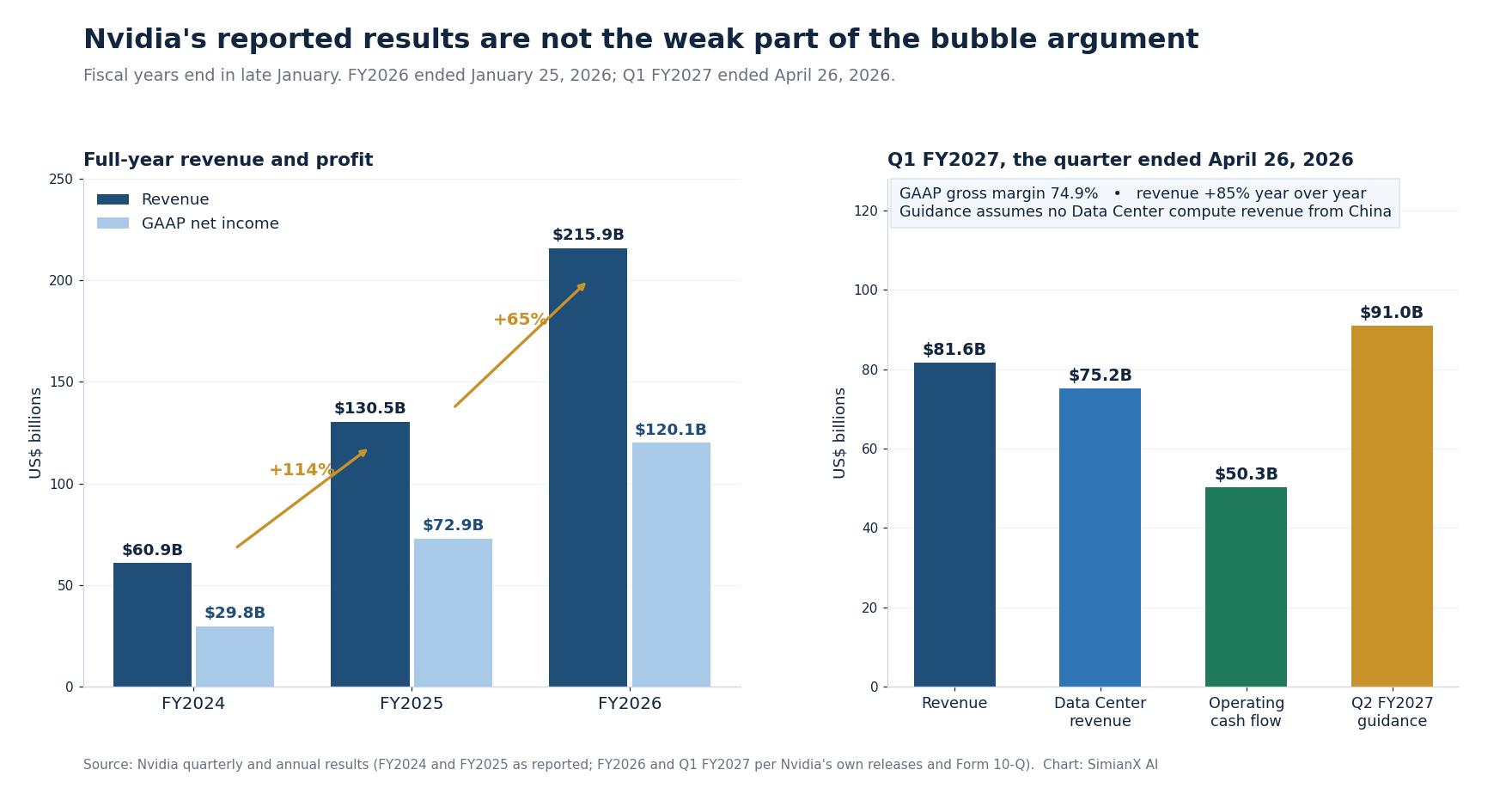
Start with the bull case. For fiscal 2026, Nvidia reported $215.9 billion in revenue, up 65%, and $120.1 billion in GAAP net income. In the quarter ended April 26, 2026, revenue reached $81.6 billion, up 85% year over year; Data Center revenue was $75.2 billion, up 92%; and GAAP gross margin was 74.9%. Nvidia also generated $50.3 billion of operating cash flow in that quarter, according to its first-quarter fiscal 2027 results.
Those are not vanity metrics. They show that customers are taking delivery, Nvidia has formidable pricing power, and its CUDA-centered combination of accelerators, networking, systems, and software remains difficult to displace.
| Metric | FY2026 or Q1 FY2027 result | What it says | What it does not prove |
|---|---|---|---|
| FY2026 revenue | $215.9B | Demand already converted into sales | Every future order will earn the buyer an adequate return |
| FY2026 GAAP net income | $120.1B | Nvidia is highly profitable | Earnings are immune to a capex downturn |
| Q1 FY2027 Data Center revenue | $75.2B | AI infrastructure demand remained powerful | Demand is diversified or fully end-user funded |
| Q1 FY2027 GAAP gross margin | 74.9% | Strong moat and scarcity economics | Today’s margins are the cycle’s permanent floor |
| Q1 FY2027 operating cash flow | $50.3B | Reported profit substantially converted to cash | Equity gains and ecosystem investments are irrelevant |
Nvidia’s near-term guidance was also strong: management expected approximately $91 billion of revenue for Q2 FY2027 while assuming no Data Center compute revenue from China. A company growing at this scale cannot be dismissed merely because its CEO is an accomplished promoter. What the market does with those results is a separate question—our table of every NVDA earnings reaction since 2016 records four consecutive post-earnings declines during the most profitable stretch in the company’s history.
Why Is Jensen Huang Accused of Fueling an AI Bubble?
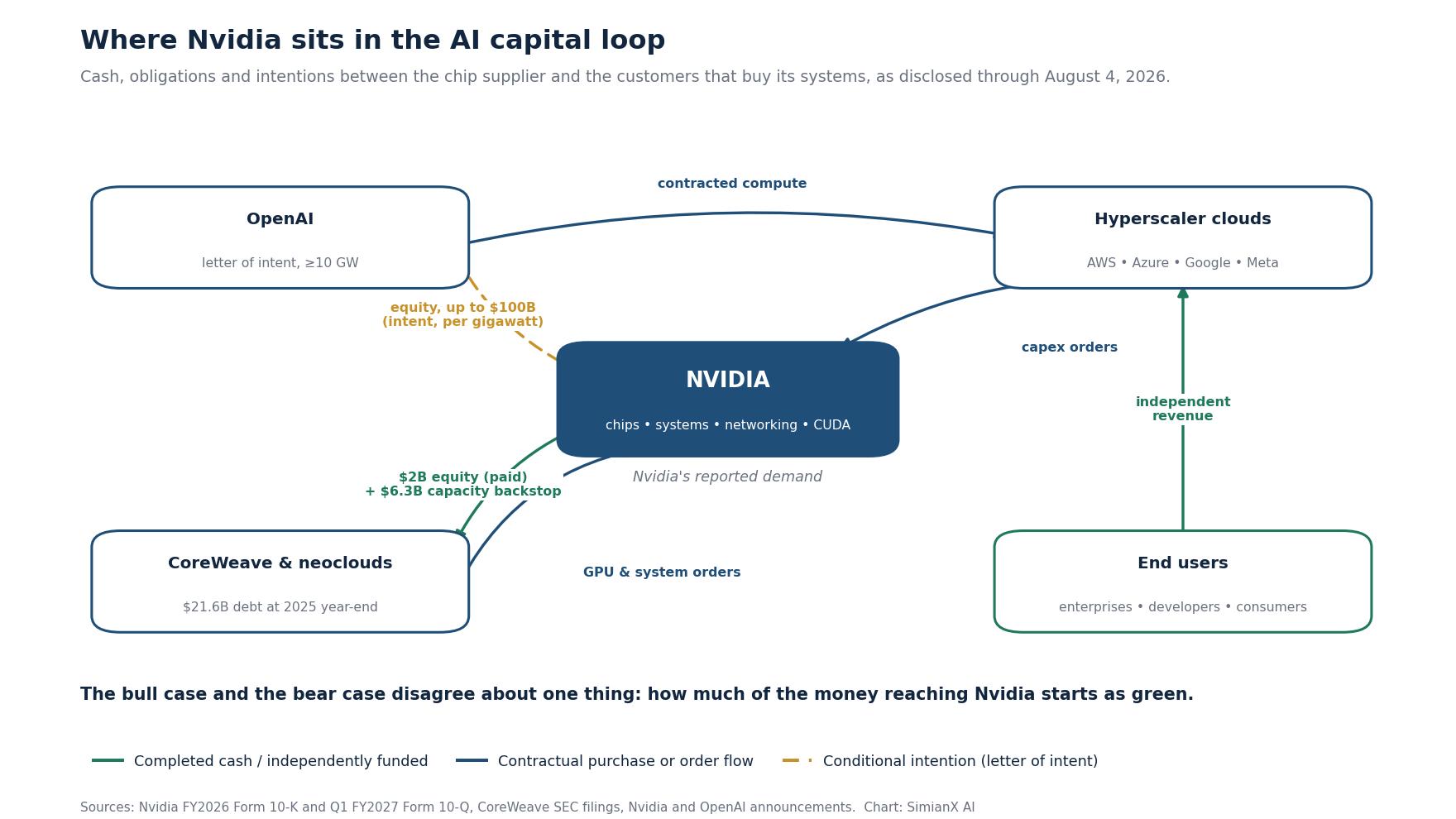
The concern is not simply that Huang speaks enthusiastically about AI. CEOs are paid to sell a strategy. The concern is that Nvidia increasingly sits on several sides of the same transaction: chip supplier, equity investor, ecosystem architect, capacity buyer, and public narrator of future compute demand.
1. The OpenAI arrangement creates an obvious circularity question
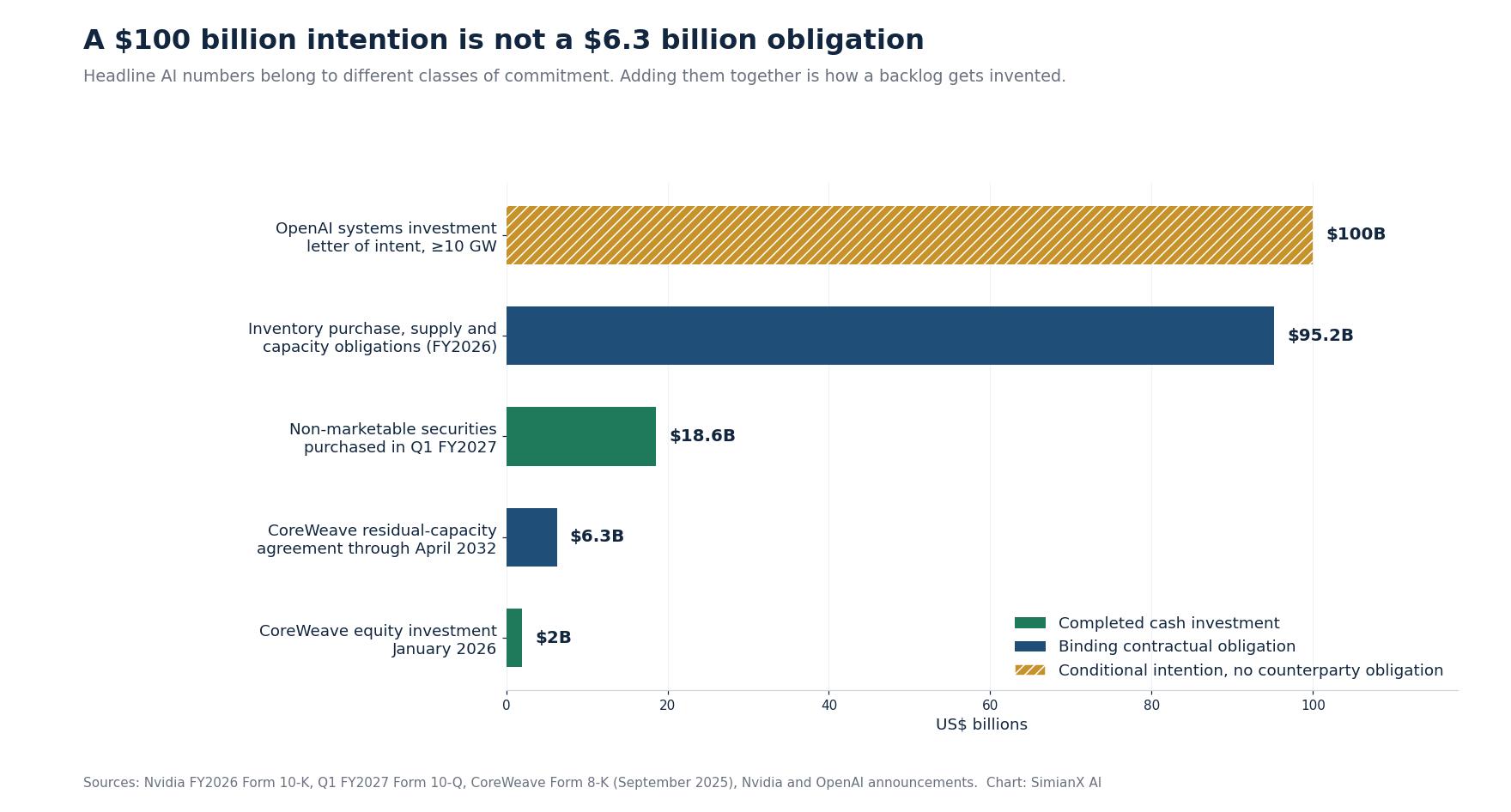
In September 2025, OpenAI and Nvidia announced a letter of intent to deploy at least 10 gigawatts of Nvidia systems. Nvidia said it intended to invest up to $100 billion in OpenAI progressively as each gigawatt was deployed. The first gigawatt was targeted for the second half of 2026, according to OpenAI’s announcement.
The phrase up to matters, as does letter of intent. This was not the same as an immediate $100 billion cash transfer or guaranteed purchase. Yet the economic loop is still clear:
- Nvidia invests in OpenAI as infrastructure is deployed.
- OpenAI uses capital and contracted cloud capacity to run Nvidia-based systems.
- Nvidia and its channel partners benefit from the equipment demand.
- Each deployment can validate higher valuations and support additional fundraising.
That does not make the transaction fraudulent. Strategic supplier financing has legitimate purposes: accelerating adoption, coordinating a new market, and overcoming a customer’s near-term capital constraint. The risk is that financed demand may look identical to independent demand until funding becomes scarce.
2. Nvidia is investor, supplier, and capacity backstop to CoreWeave
The CoreWeave relationship is more concrete. Nvidia invested $2 billion in CoreWeave shares in January 2026 as the companies planned more than 5 gigawatts of AI-factory capacity by 2030, according to Nvidia’s release.
Separately, a CoreWeave SEC filing disclosed an agreement with an initial value of $6.3 billion under which Nvidia is obligated, subject to contractual conditions, to purchase residual unsold CoreWeave capacity through April 2032. CoreWeave’s 2025 annual filing reported $21.6 billion of debt at year-end and warned that substantial indebtedness could impair its financial flexibility. We examined that balance sheet in detail in CoreWeave Stock 2026: $100B AI Backlog vs Debt Risk.
This is the strongest evidence for the bubble argument. Nvidia can help finance a cloud company that buys Nvidia-based infrastructure and then absorb some capacity if other users do not. The arrangement may be strategically rational, but it transfers part of the utilization risk back toward the equipment vendor. The same pattern shows up elsewhere in Nvidia’s power and hosting deals, from the $2.1 billion IREN 5GW partnership to the KKR Helix infrastructure trade.
3. Nvidia’s investment balance has expanded dramatically
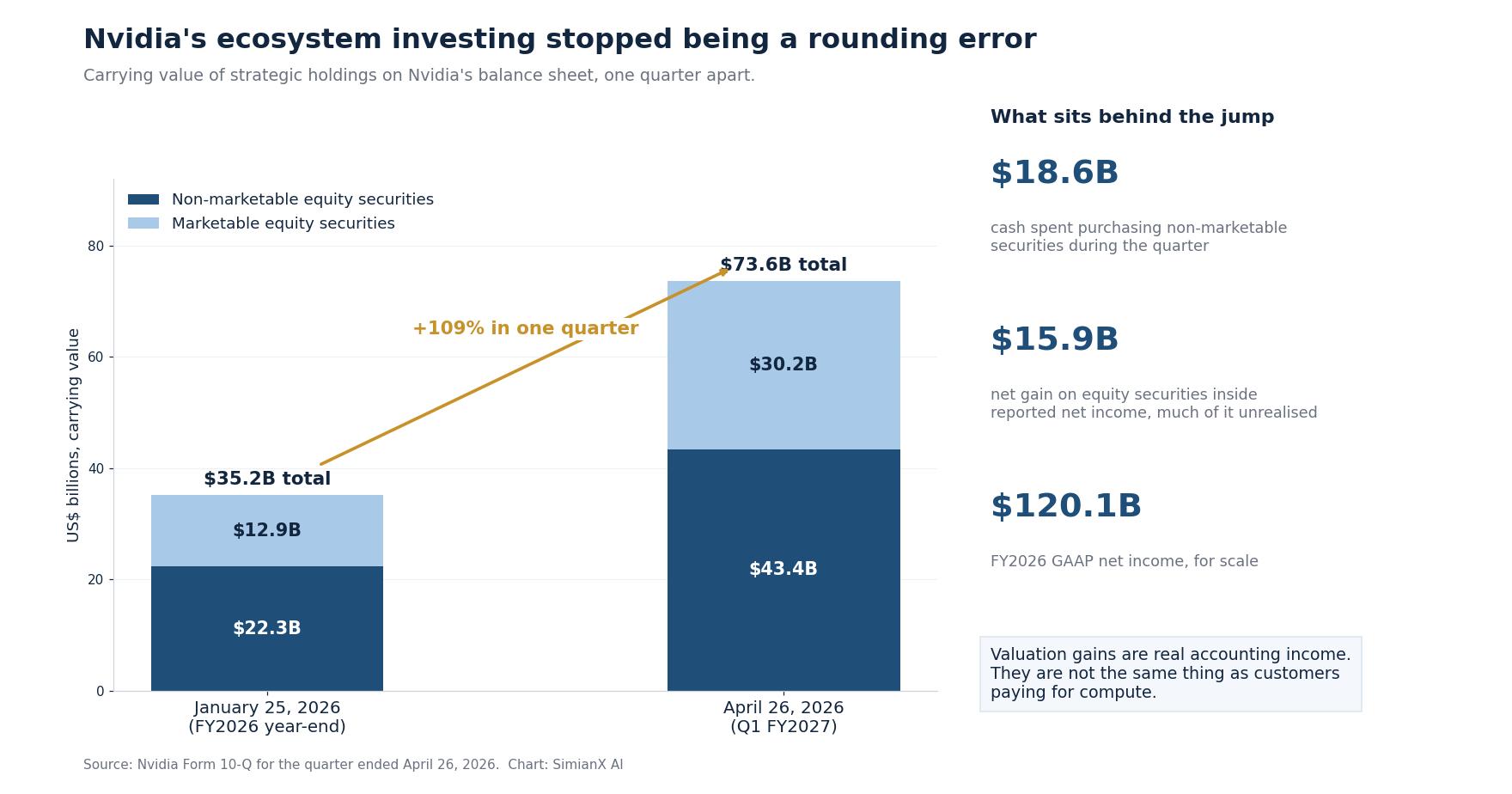
Nvidia’s balance sheet shows that ecosystem investing is no longer peripheral. Between January 25 and April 26, 2026, non-marketable securities rose from $22.3 billion to $43.4 billion, while marketable equity securities rose from $12.9 billion to $30.2 billion. The company spent $18.6 billion purchasing non-marketable securities in the quarter. These figures appear in Nvidia’s Q1 FY2027 Form 10-Q, filed with the SEC.
Not every investment is a customer-financing deal, and it would be wrong to label the entire portfolio circular. Nvidia invests across chips, networking, models, software, energy, and infrastructure. Still, the scale changes the analysis: reported net income in the quarter included a $15.9 billion net gain on equity securities, much of it unrealized. Investors should distinguish:
- Operating earnings from selling platforms and services;
- Mark-to-market or valuation gains on strategic holdings;
- Cash invested to expand the future customer and supplier base;
- Revenue ultimately paid for by unrelated end users rather than ecosystem capital.
4. Customer concentration magnifies a spending reversal
Nvidia’s fiscal 2026 Form 10-K says one direct customer represented 22% of revenue and another represented 14%. Direct customers can include distributors and system builders, so those percentages are not a perfect map of ultimate users. Nevertheless, they demonstrate concentration.
The same filing reported $21.4 billion of inventory and $95.2 billion of outstanding inventory-purchase and long-term supply-and-capacity obligations at fiscal year-end. Nvidia must reserve foundry, packaging, memory, and system capacity long before final sales. That is a strength during shortages and a vulnerability if customers defer orders or a new architecture makes existing inventory less attractive.
The Bull Case: Why This May Be Buildout, Not Bubble
Circular-looking relationships deserve scrutiny, but they do not settle the question. There are at least four strong counterarguments.
First, usage and capability continue to improve. The Stanford 2026 AI Index documents accelerating investment and adoption alongside rapid technical progress. Cheaper inference can reduce revenue per token, but it can also produce far more tokens through new applications—a version of the Jevons paradox.
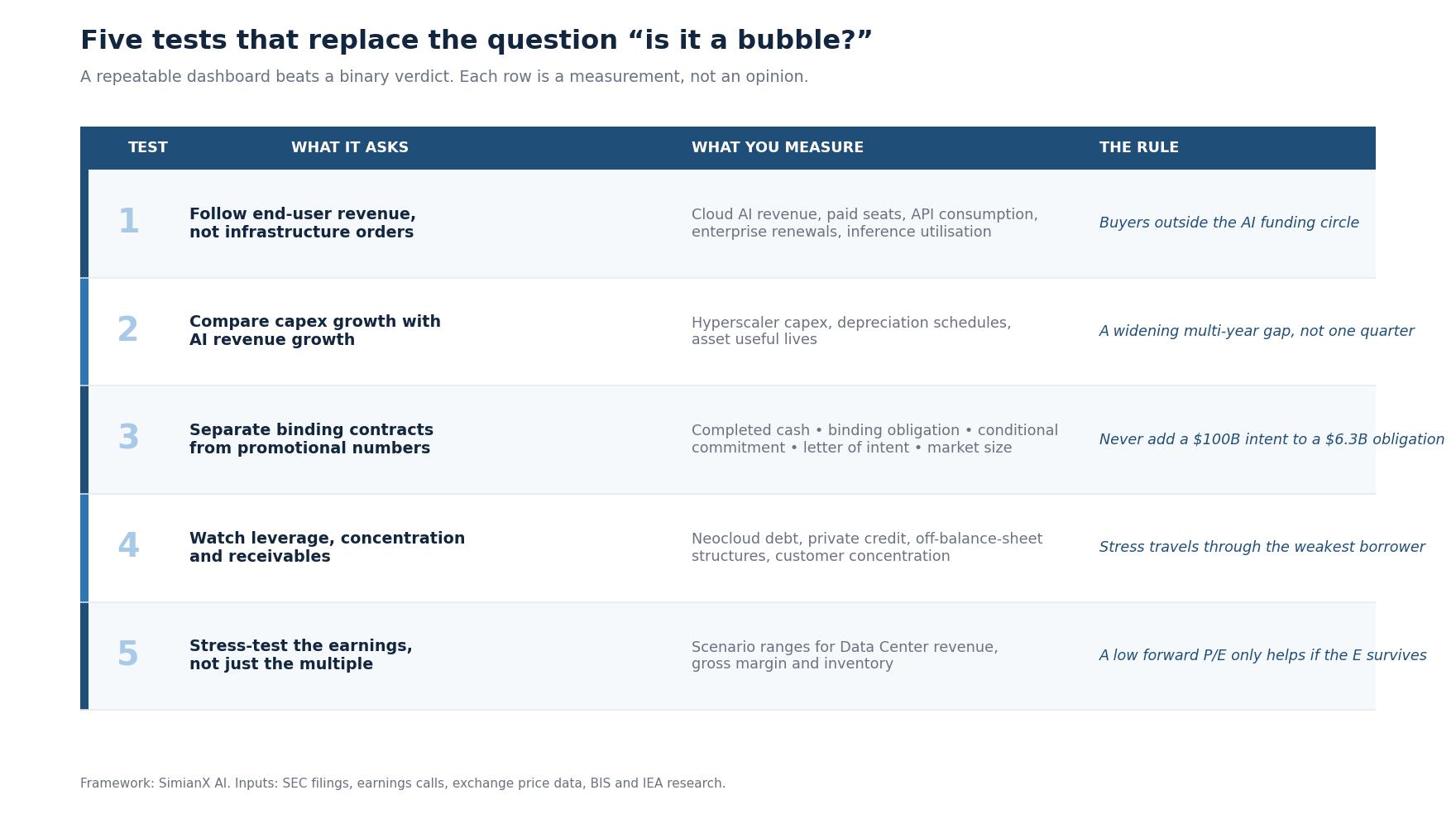
Second, the largest buyers can fund enormous capex from existing operations. Amazon CEO Andy Jassy wrote that Amazon expected roughly $200 billion of 2026 capital expenditure and argued the company was not doing so “on a hunch.” Microsoft told investors it expected roughly $190 billion of calendar-2026 capex. These companies possess profitable cloud, advertising, commerce, and software franchises; they are not dependent solely on speculative equity issuance. We tested both claims against their own numbers in Amazon Q2 Earnings 2026 and Microsoft Q4 Earnings 2026.
Third, monetization signals are visible. Alphabet said in its 2025 Q4 earnings call that revenue from products built on its generative AI models grew nearly 400% year over year, while cloud demand remained capacity-constrained. AI is moving from model training into search, advertising, coding, customer service, science, robotics, and enterprise workflows—a shift we traced in Alphabet Q2 Earnings 2026.
Fourth, physical constraints are real. The International Energy Agency expects global data-center electricity consumption to roughly double from 485 TWh in 2025 to 950 TWh in 2030. Power, grids, transformers, land, cooling, advanced packaging, and high-bandwidth memory—not investor imagination alone—limit supply. Those bottlenecks have become their own investment cases, from nuclear and uranium exposure to data-center cooling.
The best anti-bubble evidence is not a forecast. It is rising, independently funded end-user revenue and sustained utilization after capacity becomes abundant.
Nvidia Versus Cisco in the Dot-Com Bubble
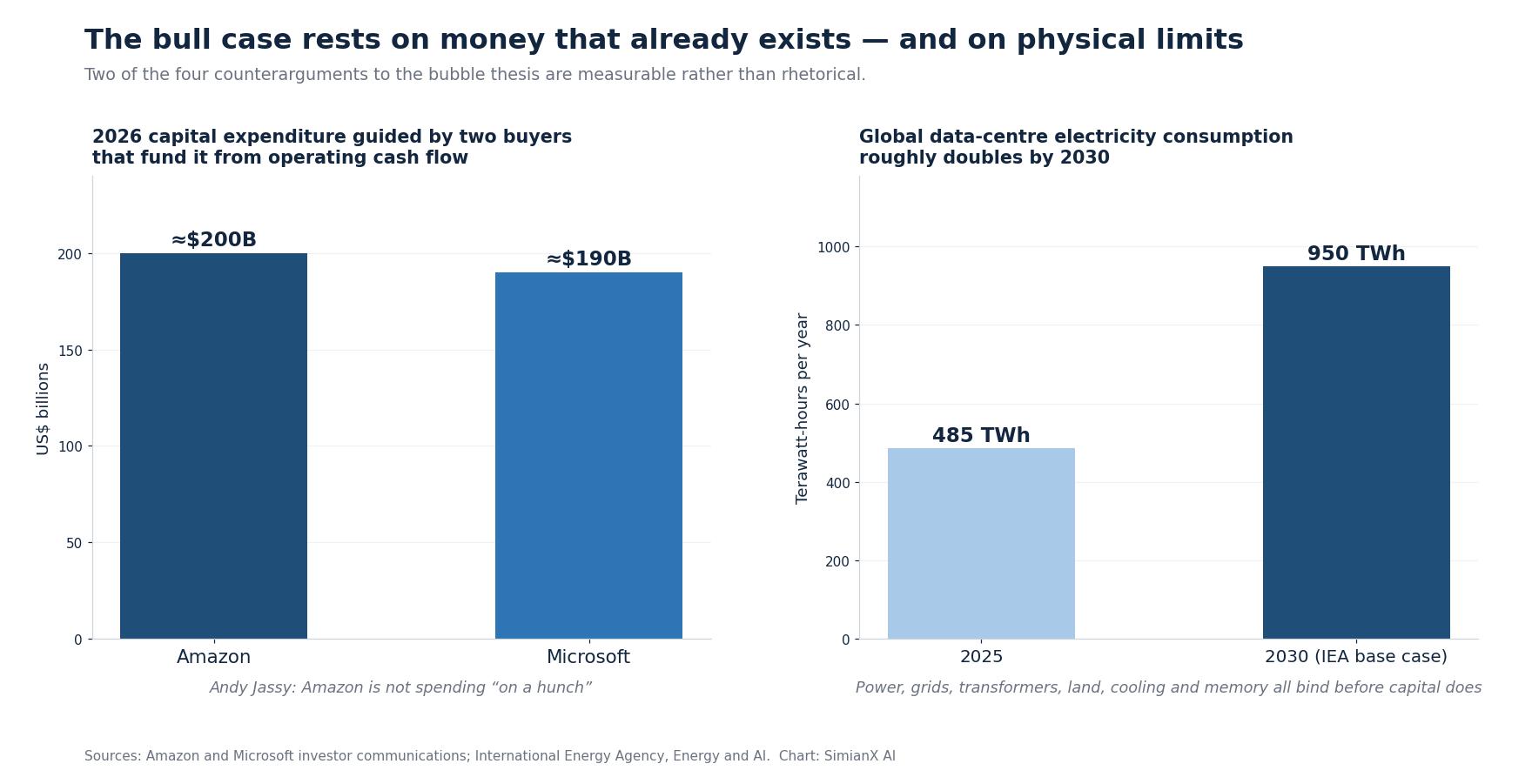
The Cisco analogy is useful but often abused. Cisco became the world’s most valuable company near the March 2000 peak because investors correctly understood that the internet would require networking equipment. They were also wrong about the price, the durability of telecom spending, and how much demand had been pulled forward. The internet changed the world; Cisco shareholders still suffered a severe, prolonged drawdown.
The size of that drawdown is worth stating precisely, because it is usually softened in retelling. On split- and dividend-adjusted monthly closes, Cisco peaked in February 2000 at $49.57 and bottomed in August 2002 at $6.72—a decline of 86%. It did not regain the 2000 level until July 2021, 21.4 years later. Revenue kept growing for most of that period. The business was never the problem; the entry price and the pulled-forward demand were. Our reference table on how long every bear market took to recover shows how unusual a two-decade round trip is even among severe drawdowns.
Nvidia is financially stronger than many dot-com icons. It has extraordinary profit, cash generation, and a broader software ecosystem. Its valuation in mid-2026—roughly $5 trillion and about 32 times trailing earnings, with lower forward estimates—was demanding but nowhere near the most extreme dot-com multiples. A lower forward P/E, however, is only comforting if forward earnings survive the cycle.
| Question | Cisco-era lesson | Nvidia implication |
|---|---|---|
| Was the technology transformative? | Yes, the internet was real | AI can be real even if investment overshoots |
| Was the leader profitable? | Yes, unlike many dot-com firms | Profitability reduces—but does not erase—valuation risk |
| Could customers overbuild? | Telecom and networking capacity overshot demand | AI clouds may order ahead of utilization and monetization |
| Could the leader lose pricing power? | Competition and normalized supply compressed economics | Custom accelerators, AMD, efficiency, and buyer bargaining matter |
| Did buying the winner guarantee a good return? | No; entry price and earnings path mattered | Nvidia’s business quality and stock return are separate questions |
The more relevant historical comparison may be telecom equipment vendor financing, where suppliers helped customers buy networks. Modern AI agreements differ in structure and quality, but the warning is the same: a supplier should not mistake its own capital support for proof of unlimited external demand. Chip cycles also mean-revert violently on their own schedule, as our record of every SOX bear market since 1995 documents.
A Five-Test Framework for Measuring the Nvidia AI Bubble Risk
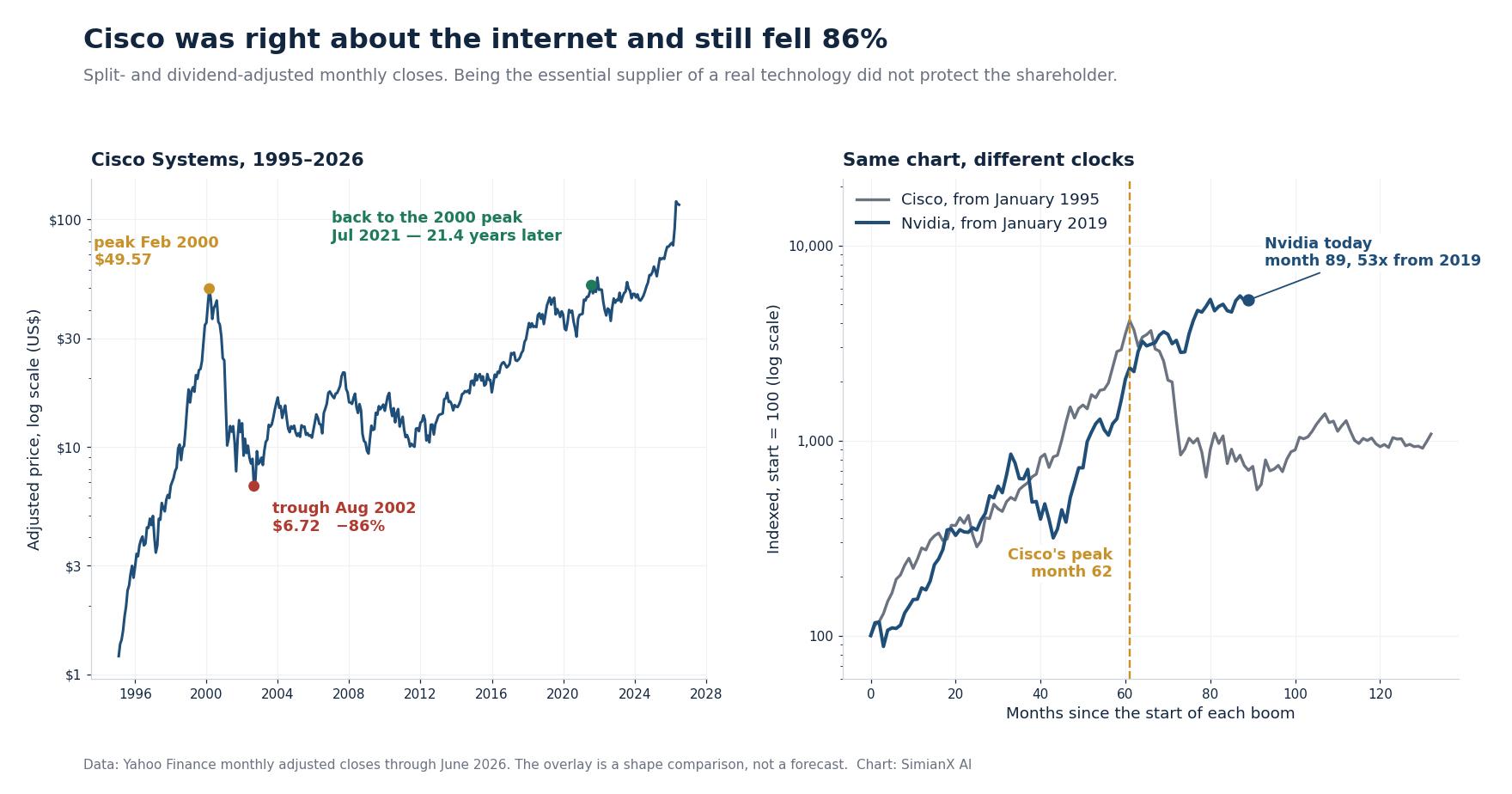
Investors should replace the binary question—bubble or no bubble—with a repeatable dashboard. SimianX AI’s multi-agent workflow can help compare SEC filings, earnings-call claims, price action, risk factors, and news while forcing a bull case and bear case to challenge each other:
- SimianX AI — the multi-agent research platform
- NVDA live analysis — fundamentals, technicals, news and risk on one page
- Live Command Room — run the four-stage agent workflow on any ticker
- Autopilots — scheduled re-analysis when the facts change
- Market Pulse — real-time event detection across stocks and crypto
Test 1: Follow end-user revenue, not just infrastructure orders
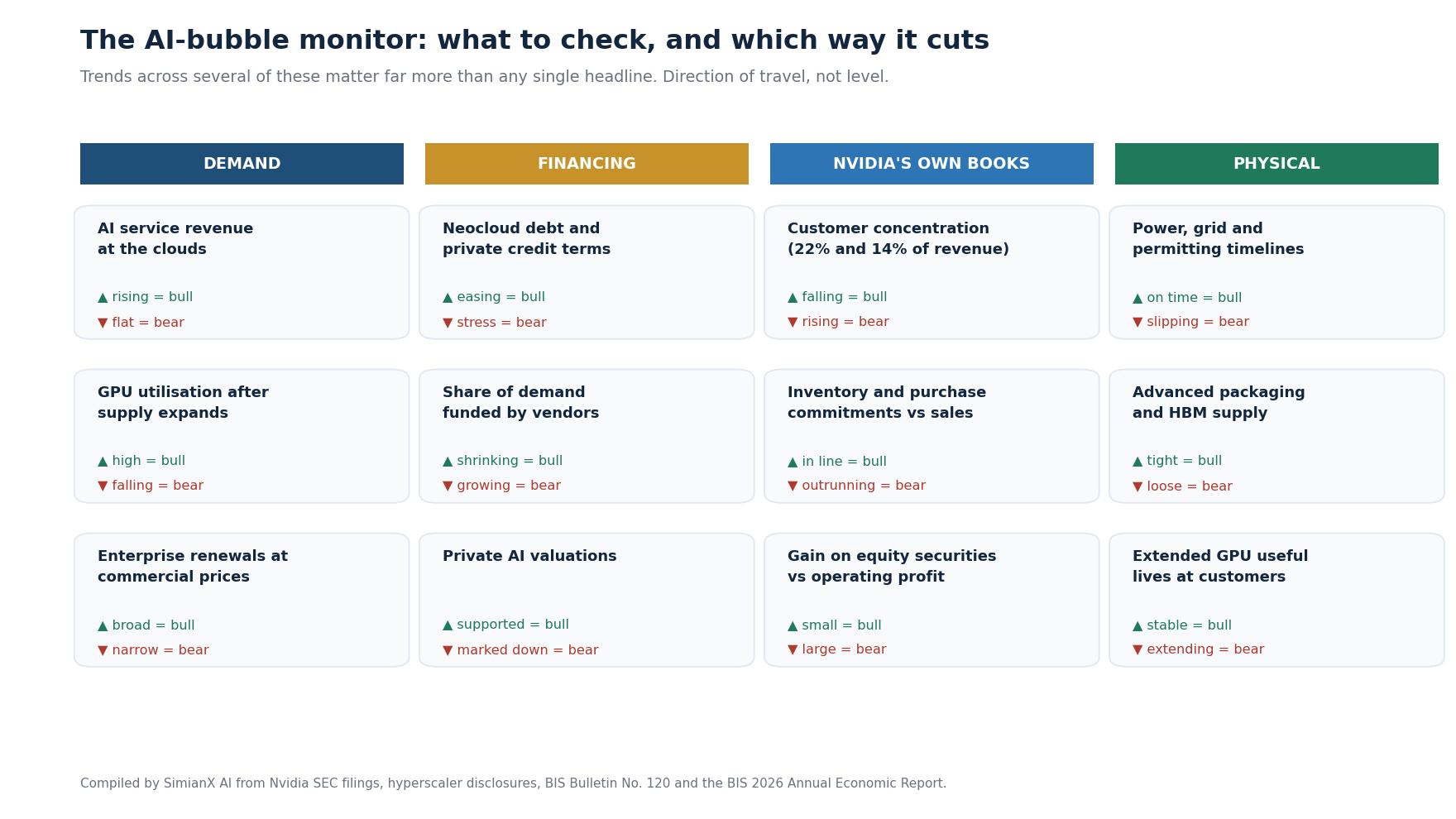
Track cloud AI revenue, paid seats, API consumption, enterprise renewals, and inference utilization. The strongest confirmation comes when customers outside the AI funding circle pay for outcomes at prices that cover compute, energy, software, and capital costs.
Test 2: Compare capex growth with AI-related revenue growth
Capex can lead revenue by years, so a one-quarter mismatch proves little. A widening multi-year gap is more concerning. Monitor depreciation as well: capital spending hits cash immediately but reaches the income statement over asset lives, which can temporarily flatter accounting margins during a rapid buildout. Meta’s excess-capacity strategy is a useful live test of exactly this gap.
Test 3: Separate binding contracts from promotional numbers
Classify each headline as one of the following:
- Completed cash investment;
- Binding purchase or capacity obligation;
- Conditional commitment tied to milestones;
- Letter of intent or memorandum;
- Long-term market opportunity with no counterparty obligation.
A $100 billion intention should not be added to a $6.3 billion obligation as if both were equivalent backlog.
Test 4: Watch leverage, customer concentration, and receivables
The Bank for International Settlements says AI infrastructure financing is shifting from internal cash flows toward debt, including off-balance-sheet structures and private credit. Nvidia’s direct balance sheet is strong, but weaker labs and neoclouds can transmit stress through delayed orders, unused capacity, lower equity valuations, or credit losses. The TeraWulf and Anthropic $19 billion lease shows how large those off-balance-sheet structures have become.
Test 5: Stress-test Nvidia’s earnings, not just its multiple
Use scenarios rather than a single price target:
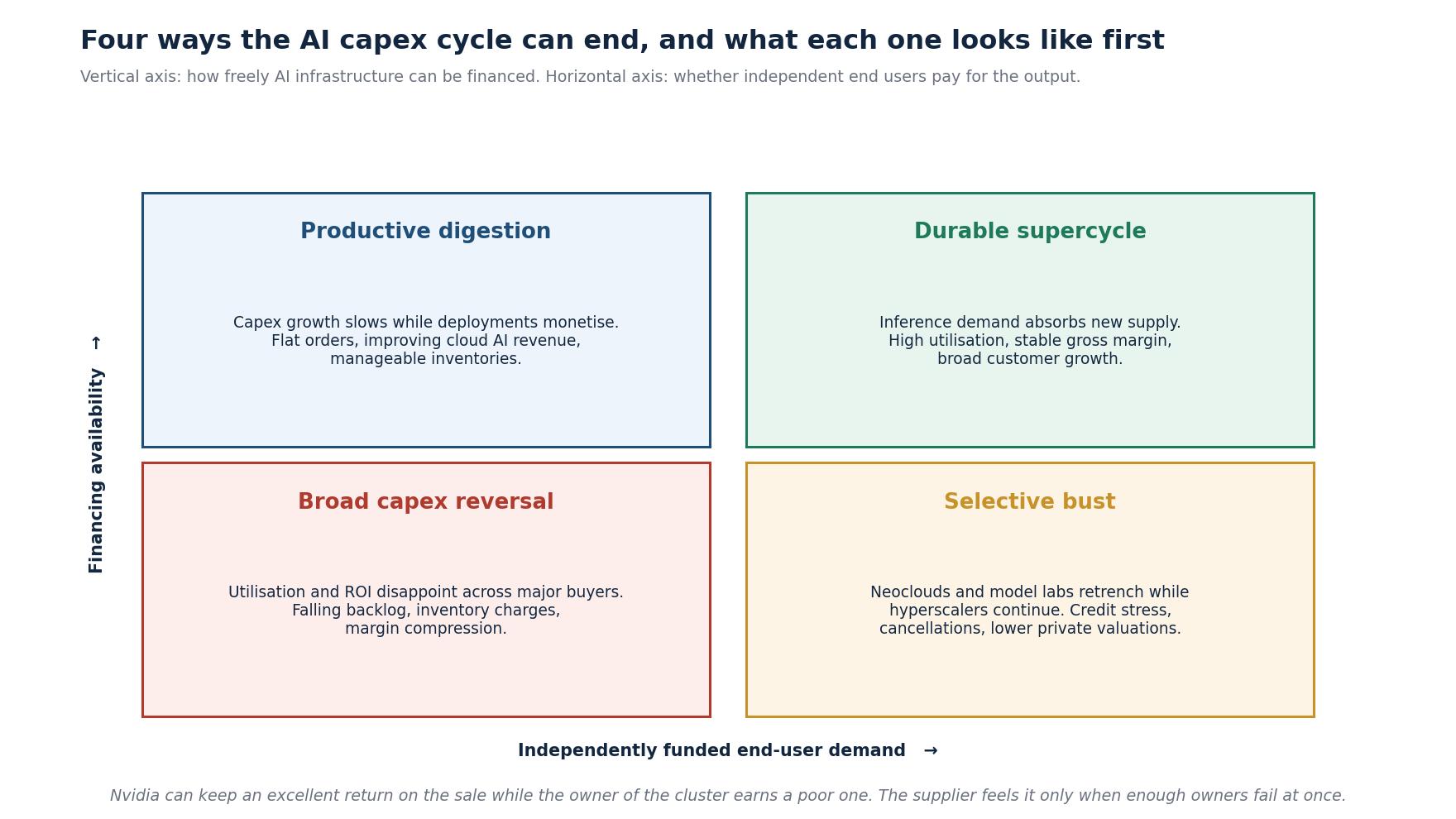
| Scenario | Operating assumption | Signals to monitor |
|---|---|---|
| Durable supercycle | Inference demand absorbs new supply; AI revenue compounds rapidly | High utilization, stable gross margin, broad customer growth |
| Productive digestion | Capex growth slows while deployments monetize | Flat orders, improving cloud AI revenue, manageable inventories |
| Selective bust | Neoclouds and model labs retrench; hyperscalers continue | Credit stress, cancellations, lower private valuations |
| Broad capex reversal | Utilization and ROI disappoint across major buyers | Falling backlog, inventory charges, margin compression |
The U.S. Federal Reserve’s July 2026 work found that the acceleration of equipment and intellectual-property investment relative to GDP was comparable to the 1990s, but from a higher starting level. The BIS 2026 Annual Economic Report also warned that AI financing had become more concentrated and circular. These are risk indicators, not timers: bubbles can expand while data remains excellent.
What Would Prove the Bears—or Bulls—Right?
The bear case would strengthen if several events occur together:
- Nvidia’s Data Center growth slows much faster than cloud AI revenue expands;
- Large customers extend GPU useful lives or cut orders after efficiency gains;
- Neocloud utilization falls and Nvidia absorbs more guaranteed capacity;
- Accounts receivable, inventory, or supply obligations rise faster than sales;
- Strategic-investment losses replace unrealized gains;
- Gross margin compresses as AMD, custom ASICs, and customer bargaining improve;
- Power and permitting delays strand financed equipment or sites.
The bull case would strengthen if:
- Inference becomes the dominant and recurring source of demand;
- Enterprise AI revenue grows across many unrelated industries;
- Customers disclose measurable productivity gains and renew at commercial prices;
- Capacity stays highly utilized even as supply expands;
- Nvidia maintains platform-level differentiation through software, networking, and rapid product cycles;
- Ecosystem investments remain small relative to independently funded customer demand.
The crucial variable is return on the customer’s capital, not Nvidia’s current gross margin. Nvidia can earn an excellent return selling a GPU cluster even if the owner of that cluster later earns a poor one. If too many owners fail simultaneously, the supplier eventually feels the correction. The first tremor usually arrives as a momentum unwind rather than a fundamental break, which is what we documented in AI Momentum Unwind 2026.
FAQ About Jensen Huang and the AI Bubble
Is Jensen Huang fueling an AI bubble through Nvidia investments?
He is accelerating AI infrastructure spending through promotion, strategic investments, partnerships, and limited capacity support. That contributes to bubble risk, but it does not mean Nvidia’s sales are fictitious or that Huang alone controls the cycle.
Is Nvidia overvalued in 2026?
Nvidia’s valuation assumes substantial future earnings, but its explosive profit growth has lowered its forward multiple relative to earlier peaks. Whether it is overvalued depends mainly on the durability of Data Center demand and margins, not on the P/E ratio in isolation.
What is circular financing in the Nvidia AI ecosystem?
Circular financing occurs when a supplier invests in a company that uses the capital—directly or through cloud contracts—to purchase infrastructure built with that supplier’s products. The transaction can be legitimate, but it makes independently financed end demand harder to measure.
Could Nvidia crash even if AI changes the world?
Yes. A transformative technology can attract too much capital, and a great company can be bought at a price that implies unrealistic growth. Cisco during the internet era is the classic reminder that technology adoption and shareholder returns follow different paths: it fell 86% and needed 21.4 years to regain its 2000 peak while its revenue kept growing.
What data should investors monitor for an AI bubble?
Watch AI service revenue, GPU utilization, hyperscaler capex, depreciation, customer concentration, inventories, purchase commitments, private credit, and the terms of Nvidia’s ecosystem deals. Trends across several indicators are more useful than any single headline.
Conclusion
So, is Jensen Huang fueling an AI bubble? He is unquestionably fueling the AI boom. His vision, Nvidia’s product cadence, ecosystem investments, and willingness to share risk help pull infrastructure spending forward. Some arrangements—especially the OpenAI investment intention and the CoreWeave investment-plus-capacity relationship—create genuine circularity concerns.
But the evidence does not support calling Nvidia’s success an illusion. Revenue, operating cash flow, technical demand, and AI adoption are real. The more defensible conclusion is that a productive technological revolution and a capital-allocation bubble may be developing together. Nvidia can remain the leading platform while some customers, projects, financiers, and shareholders earn disappointing returns.
Investors should follow contracts, cash, utilization, and end-user economics—not charisma or fear alone. To examine NVDA with competing fundamental, technical, news, and risk perspectives, explore SimianX AI and turn this framework into a continuously updated research process. Use the platform to supplement independent analysis, not as a substitute for professional financial advice.
Related Reading
- Every Tech Bubble Since 1929: How AI in 2026 Compares
- NVDA After Earnings: Every Reaction Since 2016 in One Table
- CoreWeave Stock 2026: $100B AI Backlog vs Debt Risk
- Semiconductor Bear Markets: Every SOX Crash, 1995–2026
- AI Momentum Unwind 2026: Why Semiconductor Stocks Fall
- Amazon Q2 Earnings 2026: Can AWS Justify $200B AI Capex?
- Microsoft Q4 Earnings 2026: Azure Growth vs AI Capex Risk
- Alphabet Q2 Earnings 2026: Can Gemini, Cloud Justify Capex?
- NVIDIA-IREN 2026: The $2.1B 5GW AI Factory Power Trade
- How Long Every Bear Market Took to Recover: 1929-2022
References
- Nvidia — first-quarter fiscal 2027 results
- Nvidia — Form 10-Q for the quarter ended April 26, 2026
- Nvidia — Form 10-K for fiscal 2026
- CoreWeave — SEC filing on the residual-capacity agreement
- Nvidia and CoreWeave — collaboration announcement
- OpenAI — Nvidia systems partnership announcement
- Stanford HAI — 2026 AI Index Report
- International Energy Agency — Energy and AI
- Alphabet — Q4 2025 earnings remarks
- Microsoft — FY2026 Q4 investor materials
- Bank for International Settlements — Bulletin No. 120 on AI financing
- Bank for International Settlements — 2026 Annual Economic Report
- Federal Reserve — FEDS Notes research series
- Wikipedia — the dot-com bubble
- Wikipedia — the Jevons paradox