The Two Forces Pulling CRWV: AI Backlog and Balance-Sheet Risk
CoreWeave Stock 2026 is one of the clearest examples of the AI infrastructure boom’s central question: can explosive demand justify an aggressively leveraged buildout? CoreWeave has become a pure-play AI cloud name, serving customers that need large-scale GPU capacity for training, inference, and production AI workloads. For investors, the story is compelling—but not simple.
At SimianX AI, the right way to study a stock like CRWV is not to reduce it to one headline. The bullish case is built on backlog, strategic AI customers, GPU scarcity, and operating leverage. The bearish case centers on debt, capital expenditures, interest expense, customer concentration, and the risk that AI infrastructure supply catches up with demand.
CoreWeave Stock 2026: The Quick Investment Context
CoreWeave is not a traditional software company. It is closer to a specialized AI infrastructure platform: capital-intensive, hardware-heavy, power-constrained, and deeply tied to the GPU supply chain. That makes its stock behave differently from a high-margin SaaS company.
The company’s 2026 narrative has three major pillars:
- Massive AI demand from model builders, enterprises, and hyperscalers.
- A revenue backlog near $100 billion, suggesting strong contracted future demand.
- A high-debt, high-capex model that requires execution discipline and continued market confidence.
Key takeaway: CoreWeave is a high-growth AI infrastructure stock, but the same backlog that creates upside also requires heavy financing, data center capacity, GPU procurement, and power access.
The market is effectively asking one question: does CoreWeave’s future cash flow justify the balance-sheet risk required to build the capacity?
That is why a serious CoreWeave stock 2026 analysis must separate demand quality from financing quality. A large backlog is valuable only if it converts into revenue, margins, cash flow, and durable customer relationships.
Why CoreWeave’s $100B AI Backlog Matters
CoreWeave’s reported backlog is the headline number investors cannot ignore. A backlog near $100 billion suggests that customers are not merely experimenting with AI compute—they are contracting for future capacity. In an industry where GPU supply, power availability, and data center readiness are scarce, committed demand can become a competitive advantage.
Backlog matters because it may provide:
- Revenue visibility over multiple years.
- Stronger financing credibility with lenders and strategic partners.
- Better purchasing power for GPUs, networking equipment, and infrastructure.
- Confidence that AI workloads are moving from experiments to production.
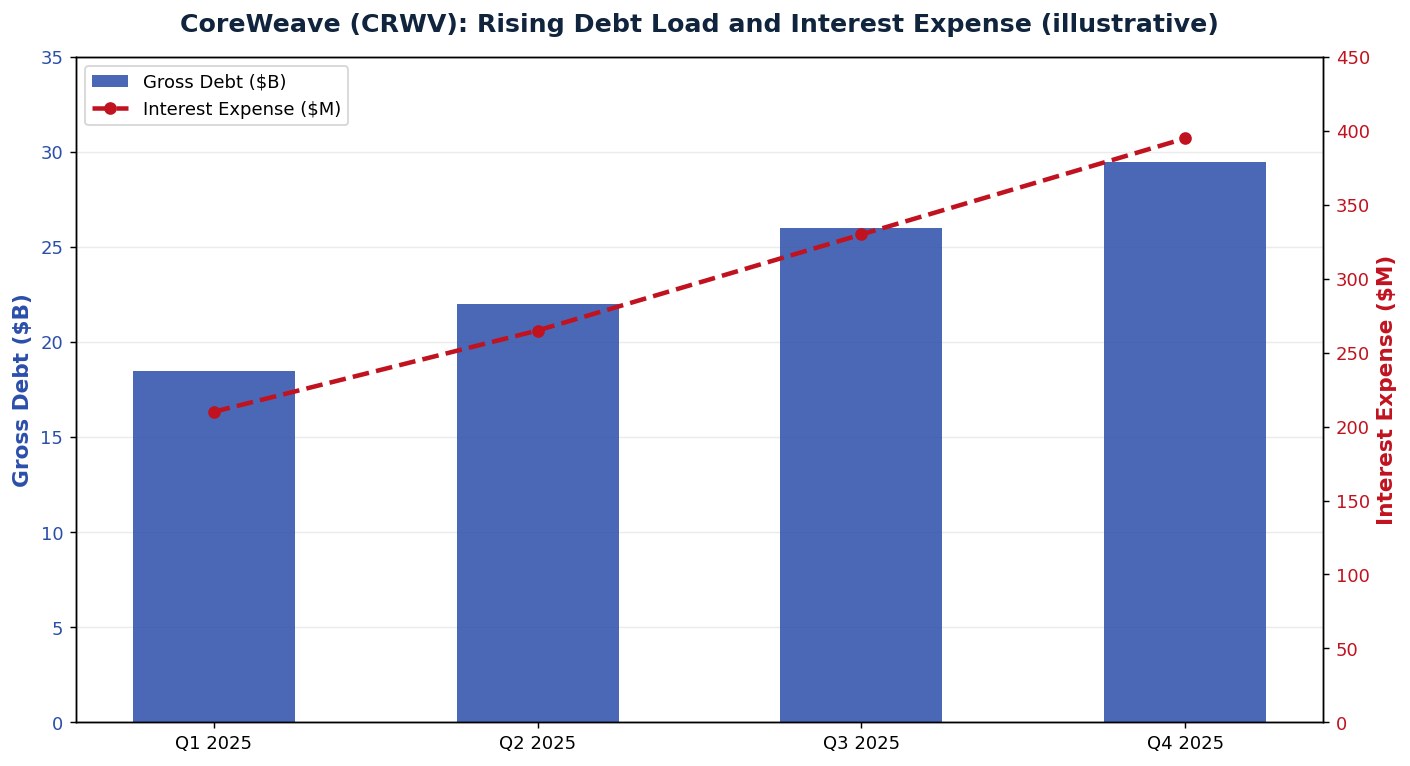
However, backlog is not the same as free cash flow. Investors must ask how quickly backlog converts into revenue, what margins it carries, and whether fulfilling those contracts requires even more borrowing.
| CoreWeave Metric to Watch | Why It Matters for 2026 |
|---|---|
| Revenue backlog | Indicates contracted future demand |
| Capex intensity | Shows how expensive growth is |
| Interest expense | Reveals pressure from leverage |
| Adjusted EBITDA margin | Measures operating profitability before heavy financing costs |
| Customer concentration | Helps assess contract durability |
| Power capacity | Determines how fast CoreWeave can scale supply |
The bullish interpretation is that CoreWeave is locking in scarce AI compute demand before competitors can match its scale.
The bearish interpretation is that the company must spend and borrow aggressively before investors know how durable AI infrastructure margins will be.
What Makes CoreWeave Different From Traditional Cloud Stocks?
CoreWeave is often compared with cloud platforms, but it is not simply “another cloud company.” Its identity is more specific: purpose-built AI cloud infrastructure. That means its economics depend heavily on specialized GPUs, high-performance networking, data center power, and customer workloads that demand extreme compute density.
Traditional cloud platforms such as AWS, Azure, and Google Cloud benefit from diversified workloads: storage, databases, enterprise software, developer tools, analytics, and AI. CoreWeave is more concentrated in AI compute. That concentration can create faster growth when demand is strong, but it also increases exposure if AI compute pricing weakens.
CoreWeave’s Core Advantages
- AI-native infrastructure focus rather than broad general-purpose cloud.
- Deep relationships with AI labs and enterprise AI customers.
- Early access and alignment with the Nvidia ecosystem.
- Ability to serve workloads that require specialized GPU clusters.
- A brand tied directly to the AI infrastructure buildout.
CoreWeave’s Core Risks
- Heavy debt load relative to many software peers.
- High depreciation and equipment replacement needs.
- Reliance on continued AI demand growth.
- Potential customer concentration.
- Sensitivity to power, data center, and financing bottlenecks.
For investors, this means CoreWeave should not be valued like a clean SaaS compounder. It needs a framework closer to infrastructure, leasing, cloud services, and cyclical capital deployment.
Is CoreWeave Stock 2026 a Backlog Story or a Debt Risk Story?
The answer is: both. A balanced CoreWeave Stock 2026 thesis must treat backlog and debt as connected variables.
The backlog creates the business case for expansion. The debt finances the expansion required to serve that backlog. If demand remains strong and utilization stays high, leverage can magnify returns. If demand slows, pricing falls, or buildouts are delayed, leverage can amplify downside.
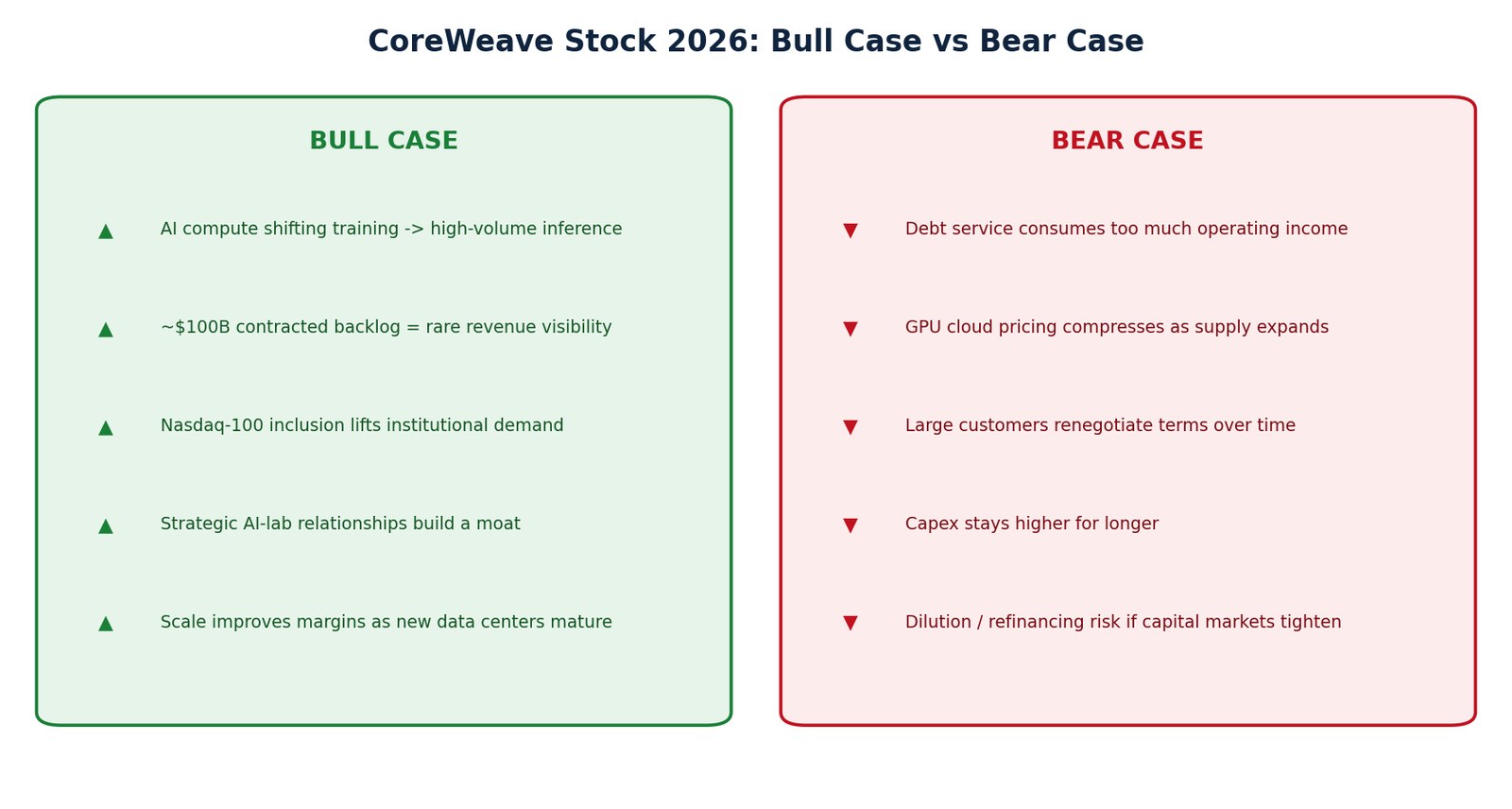
The Bull Case
The bull case for CoreWeave stock in 2026 rests on the idea that AI infrastructure demand is still underestimated. If enterprise AI, agentic workflows, inference workloads, robotics, coding assistants, synthetic data, and model training continue expanding, CoreWeave could remain capacity-constrained rather than demand-constrained.
Bullish investors may argue that:
- AI compute demand is moving from training to high-volume inference.
- CoreWeave’s contracted backlog gives unusual revenue visibility.
- Nasdaq-100 inclusion can improve visibility and institutional demand.
- Strategic customer relationships may create a durable moat.
- Scale can improve margins as new data centers mature.
The Bear Case
The bear case is not that AI disappears. It is that the economics may become less favorable than the current valuation implies.
Bearish investors may worry that:
- Debt service consumes too much operating income.
- GPU cloud pricing could compress as supply expands.
- Large customers may renegotiate terms over time.
- Capex requirements remain higher for longer.
- Equity holders bear dilution or refinancing risk if capital markets tighten.
A strong backlog can support a growth thesis, but it does not eliminate balance-sheet risk. For CoreWeave, the question is whether contracted AI demand becomes durable cash flow quickly enough.
How to Analyze CoreWeave’s Debt Risk in 2026
Debt risk is not just about the absolute amount of debt. It is about debt relative to cash flow, interest expense, asset life, customer contracts, refinancing conditions, and growth efficiency.
A practical CoreWeave debt-risk framework should include the following steps.
1. Compare Debt Growth Against Revenue Growth
Fast debt growth is not automatically bad if revenue and contracted backlog are growing faster. But if debt rises faster than revenue conversion, investors should become more cautious.
Look for:
- Total debt trend.
- Current versus long-term debt.
- Net debt after cash.
- Debt as a percentage of revenue backlog.
- Debt relative to adjusted EBITDA.
2. Watch Interest Expense Closely
Interest expense is critical because CoreWeave’s model is capital-intensive. Even if adjusted EBITDA looks strong, high interest expense can pressure net income and free cash flow.
Investors should ask:
- Is interest expense rising faster than revenue?
- Are new financing facilities cheaper or more expensive?
- Does CoreWeave rely on floating-rate debt?
- Can operating income cover financing costs over time?
3. Separate Accounting Profitability From Cash Flow
A company can show attractive adjusted EBITDA while still consuming significant cash due to capital expenditures. For CoreWeave, capex is not optional—it is the engine of growth.
That means investors should focus on:
- Operating cash flow.
- Purchases of property and equipment.
- Free cash flow after capex.
- Timing between customer commitments and infrastructure spend.
- Depreciation assumptions for GPU assets.
4. Evaluate Refinancing Risk
CoreWeave’s ability to fund future expansion depends partly on investor and lender confidence. If AI infrastructure remains a favored category, capital may remain available. If risk appetite weakens, debt refinancing could become more expensive.
The debt question is not simply “Is debt high?” The better question is: “Can CoreWeave repeatedly finance growth at acceptable terms while turning backlog into cash?”
CoreWeave Backlog vs Debt: A Simple Investor Scorecard
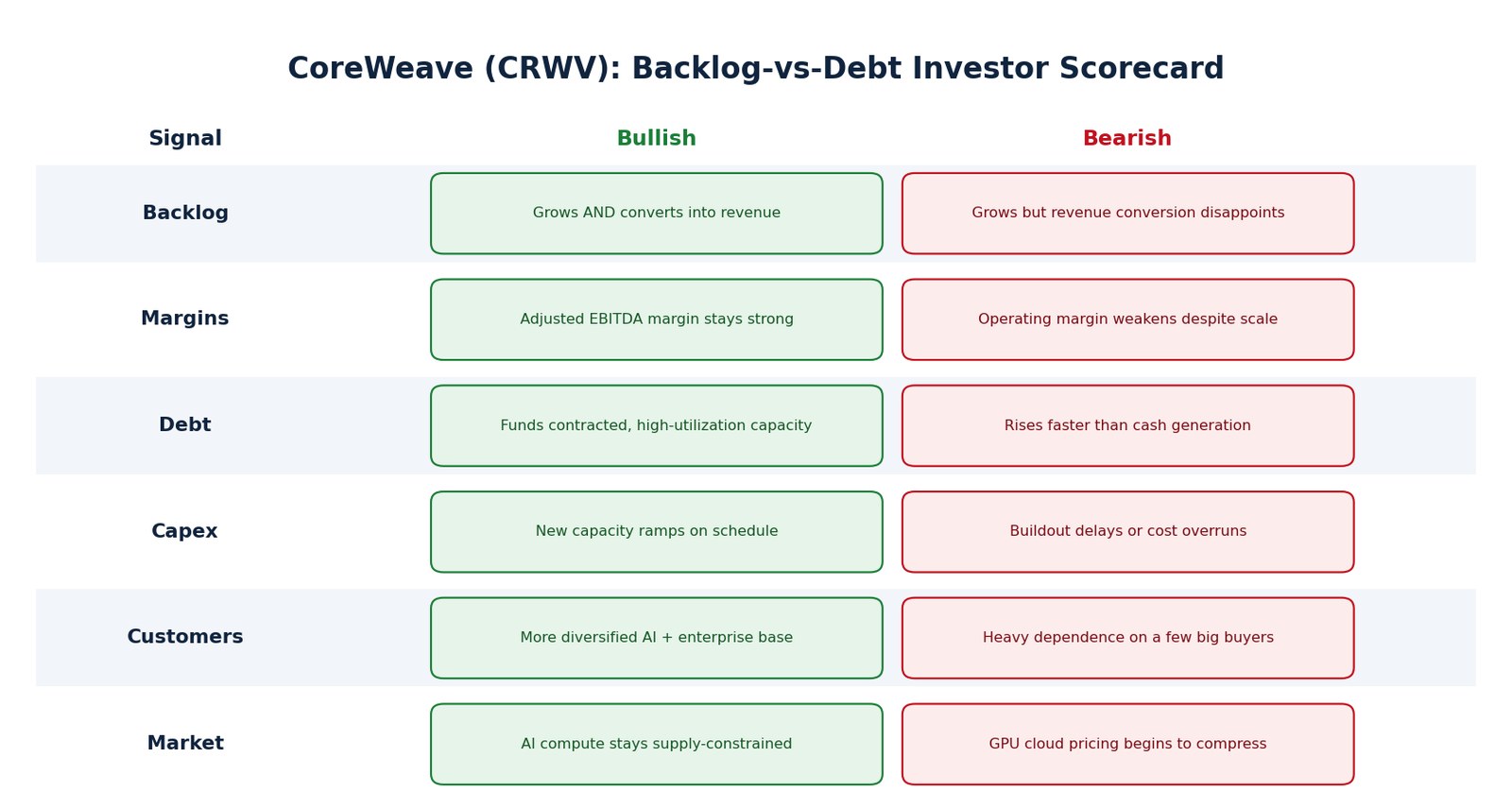
A useful way to study CRWV is to build a scorecard that updates each quarter. This avoids emotional reactions to headlines and keeps the thesis grounded.
| Category | Bullish Signal | Bearish Signal |
|---|---|---|
| Backlog | Backlog grows and converts into revenue | Backlog grows but revenue conversion disappoints |
| Margins | Adjusted EBITDA margin remains strong | Operating margin weakens despite scale |
| Debt | Debt funds contracted, high-utilization capacity | Debt rises faster than cash generation |
| Capex | New capacity ramps on schedule | Buildout delays or cost overruns |
| Customers | More diversified AI and enterprise base | Heavy dependence on a few major buyers |
| Market | AI compute demand remains supply-constrained | GPU cloud pricing begins to compress |
This type of framework is especially useful because CoreWeave’s story is dynamic. The company can look expensive on traditional earnings metrics while still being attractive on future capacity economics. Conversely, it can look cheap compared with backlog while being risky on debt-adjusted cash flow.
What Could Drive CoreWeave Stock Higher in 2026?
Several catalysts could support CoreWeave stock in 2026 if execution remains strong.
1. Continued Backlog Expansion
If CoreWeave continues signing large multi-year AI infrastructure commitments, investors may become more confident that demand is structural rather than cyclical.
2. Higher Utilization
Data center and GPU utilization are crucial. High utilization can improve operating leverage and justify capex. Low utilization would raise concerns that CoreWeave overbuilt capacity.
3. Margin Stabilization
If operating margins improve as new infrastructure ramps, the market may become more comfortable with the debt load.
4. Better Financing Terms
Any evidence that CoreWeave can access capital at attractive terms would reduce concern around the debt model.
5. Index Inclusion and Institutional Visibility
CoreWeave’s expected Nasdaq-100 inclusion can increase visibility among institutional investors and index-linked products. While index inclusion does not change business fundamentals, it can influence liquidity and ownership.
6. AI Inference Growth
Training large models is only one part of AI compute demand. If inference workloads scale across enterprises, consumer apps, robotics, coding tools, and autonomous agents, CoreWeave may benefit from broader recurring demand.
What Could Pressure CoreWeave Stock in 2026?
A strong stock thesis must also define what could go wrong.
1. Debt Concerns Intensify
If investors believe CoreWeave must keep borrowing aggressively to meet commitments, valuation multiples may compress.
2. AI Capex Sentiment Weakens
CoreWeave is tied to the broader AI infrastructure cycle. If markets begin questioning AI capex returns, CoreWeave could be hit harder than more diversified companies.
3. Customer Concentration Becomes a Bigger Issue
Large contracts can be bullish, but dependence on a small number of major customers can create risk. If one customer delays spending, renegotiates, or shifts workloads, the impact may be material.
4. GPU Pricing and Supply Normalize
Scarcity supports pricing power. If GPU capacity becomes more abundant, customers may gain negotiating leverage, reducing returns on invested capital.
5. Free Cash Flow Remains Deeply Negative
If capex continues rising faster than operating cash flow, equity investors may worry about dilution, refinancing, or lower long-term returns.
How SimianX AI Helps Investors Research CoreWeave Stock
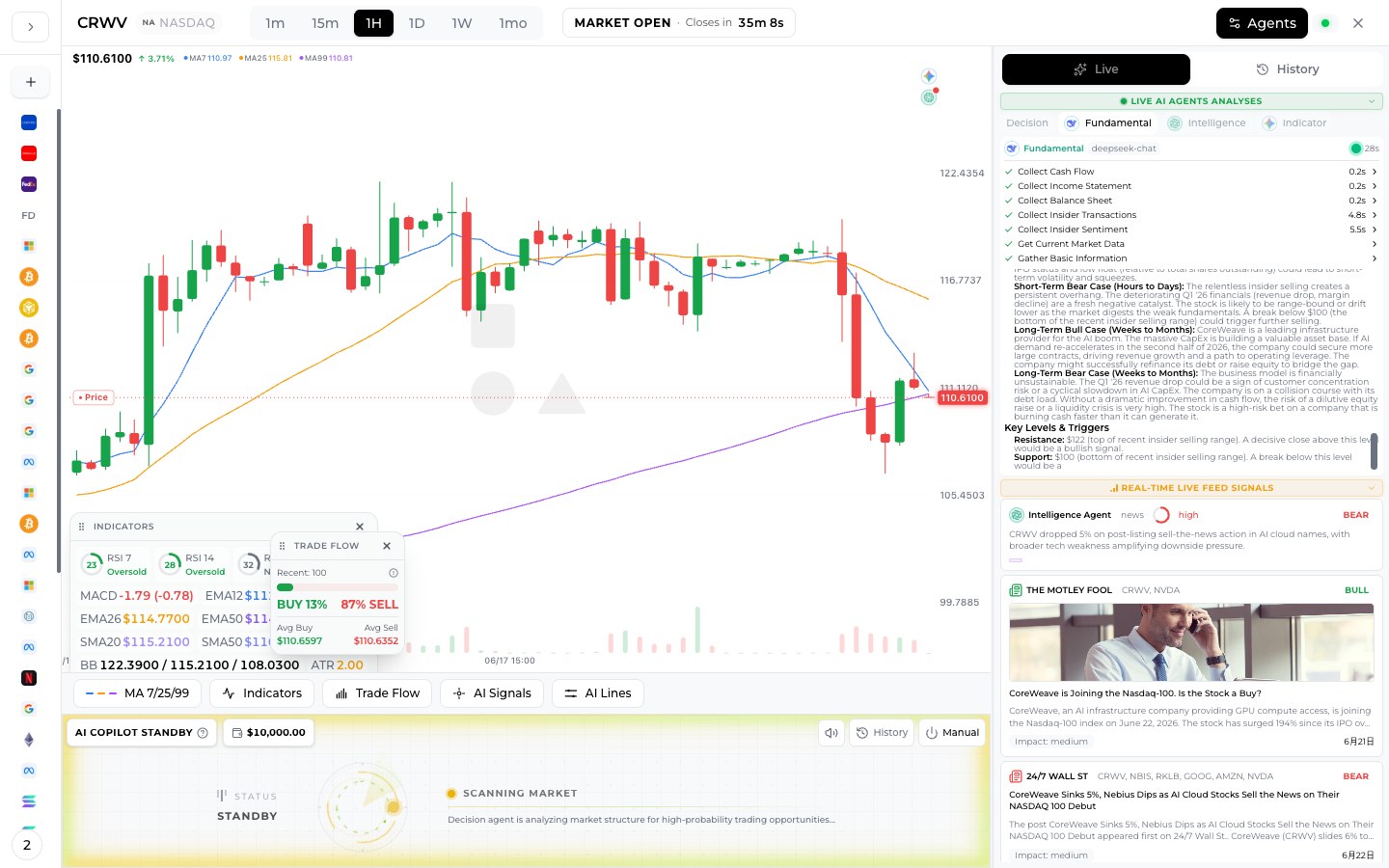
A stock like CoreWeave is exactly the kind of company where a single-model summary can miss important nuance. The bullish case and bearish case are both credible, and the right answer depends on weighing financial statements, market structure, technical trends, news sentiment, and risk scenarios together.
SimianX AI is designed for this kind of multi-angle stock research. Its multi-agent approach can help investors compare:
- Fundamental analysis.
- Technical market structure.
- News and sentiment changes.
- Risk management considerations.
- Bull versus bear case debate.
- Follow-up questions around valuation, debt, and catalysts.
Instead of reading one static report, investors can use SimianX to explore a thesis interactively. For example, a user researching CoreWeave could ask:
- “How much of CoreWeave’s backlog is already reflected in valuation?”
- “What debt metrics should I track next quarter?”
- “What would break the bull case for CRWV?”
- “How does CoreWeave compare with other AI infrastructure stocks?”
- “What technical levels matter after Nasdaq-100 inclusion?”
This is valuable because CoreWeave stock 2026 research is not a one-time answer. It is an evolving thesis that should update as new earnings, financing, customer, and AI infrastructure data appear.
CoreWeave Stock 2026 Valuation: What Should Investors Focus On?
Traditional valuation metrics can be difficult for a company like CoreWeave because net income may remain pressured by depreciation, interest expense, and expansion costs. That does not mean valuation is impossible. It means investors need to use the right lens.
Useful Valuation Angles
| Valuation Lens | Best Use |
|---|---|
| Price-to-sales | Compares market value to current revenue scale |
| Enterprise value to EBITDA | Adjusts for debt and operating profitability |
| Backlog-to-enterprise value | Helps compare contracted demand to valuation |
| Debt-to-EBITDA | Measures leverage pressure |
| Free cash flow yield | Shows whether growth becomes cash-generative |
Investors should be cautious about using only one metric. A high price-to-sales ratio may be justified if revenue growth is durable and margins improve. But a low valuation relative to backlog may still be dangerous if fulfillment requires heavy borrowing and weak cash generation.
The best CoreWeave valuation approach is scenario-based.
Scenario 1: Bullish Execution
CoreWeave converts backlog efficiently, keeps utilization high, stabilizes margins, and refinances debt on acceptable terms. In this scenario, the stock could be valued as a scarce AI infrastructure leader.
Scenario 2: Balanced Growth
CoreWeave grows revenue rapidly, but capex and debt remain heavy. The stock may perform, but upside depends on whether investors accept lower near-term free cash flow.
Scenario 3: Financing Stress
AI demand remains real, but capital markets become less generous. Interest expense, dilution risk, or refinancing pressure weighs on the stock.
Scenario 4: AI Capacity Oversupply
If GPU supply expands faster than demand, pricing weakens. CoreWeave may still grow revenue, but returns on invested capital could disappoint.
Is CoreWeave Stock a Buy in 2026?
This article is not financial advice, but a disciplined answer is: CoreWeave stock may suit investors who believe AI infrastructure demand will remain supply-constrained and who can tolerate high balance-sheet risk.
It may be less suitable for investors who require:
- Consistent positive net income.
- Low leverage.
- Predictable free cash flow.
- Diversified revenue streams.
- Lower volatility.
A practical investor checklist looks like this:
- Define your thesis. Are you buying backlog growth, AI infrastructure scarcity, or long-term cloud disruption?
- Set risk limits. Decide how much debt and volatility you are willing to tolerate.
- Track quarterly conversion. Watch whether backlog becomes revenue and cash flow.
- Monitor financing. Follow debt issuance, refinancing, and interest expense.
- Compare alternatives. Evaluate CoreWeave against Nvidia, hyperscalers, AI data center suppliers, and other cloud infrastructure names.
The best CoreWeave investors in 2026 will not be the ones who only read the bullish headlines. They will be the ones who track whether the company’s backlog can outrun its debt burden.
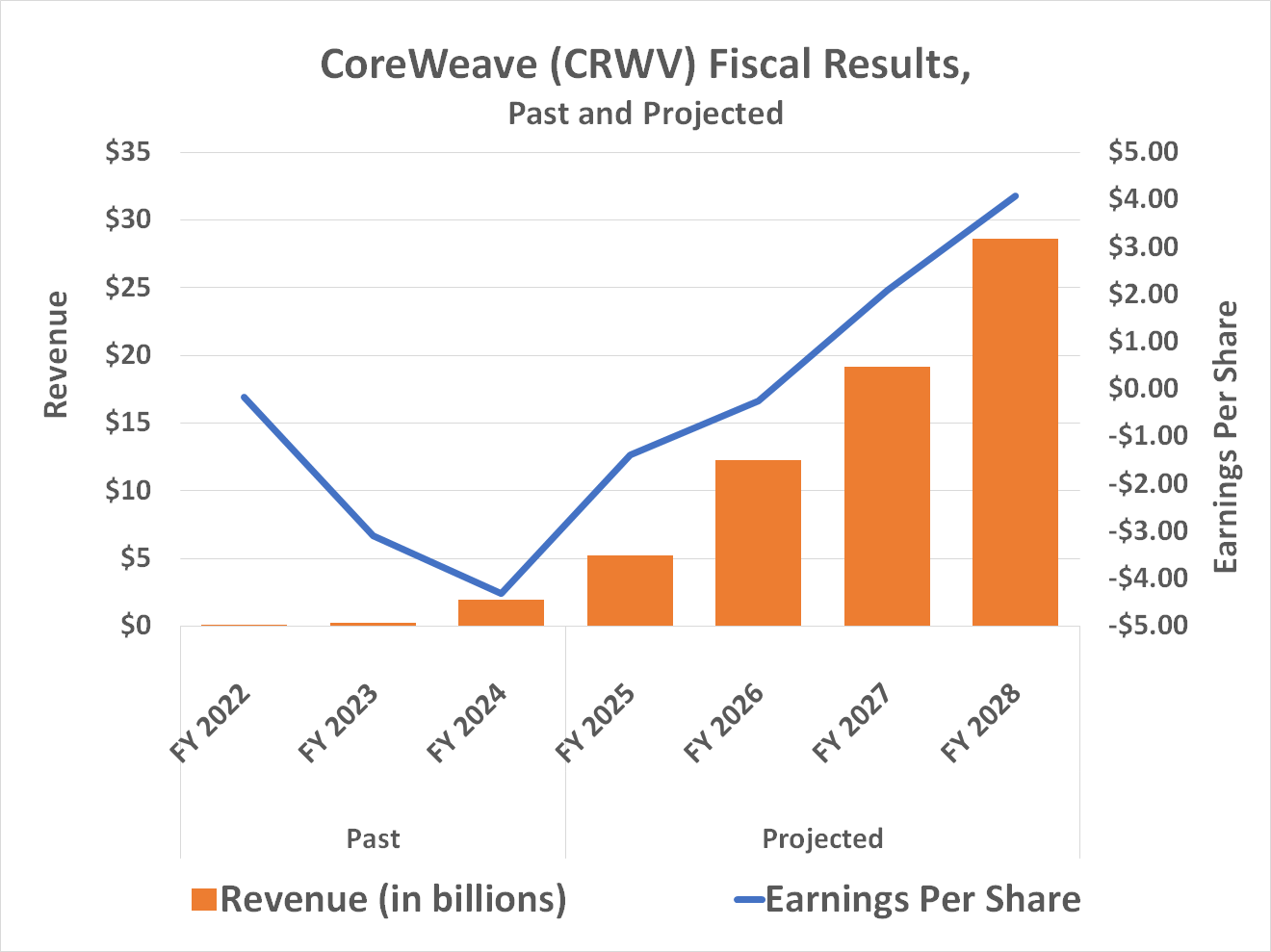
FAQ About CoreWeave Stock 2026
What is the main CoreWeave Stock 2026 thesis?
The main thesis is that CoreWeave could become a major AI infrastructure winner if its large backlog converts into high-utilization revenue and improving cash flow. The risk is that debt, capex, and interest expense may pressure equity returns if growth becomes more expensive than expected.
How risky is CoreWeave debt in 2026?
CoreWeave debt risk is meaningful because the company must finance GPUs, data centers, power access, and infrastructure before fully realizing revenue from long-term demand. Debt can support growth, but it also increases sensitivity to interest rates, refinancing conditions, customer delays, and margin compression.
What is CoreWeave AI backlog and why does it matter?
CoreWeave’s AI backlog represents contracted future revenue commitments from customers needing AI cloud capacity. It matters because it provides visibility into future demand, but investors still need to monitor how quickly that backlog becomes profitable revenue and free cash flow.
Is CoreWeave stock a good AI infrastructure investment?
CoreWeave may be attractive for investors seeking direct exposure to AI compute demand. However, it carries more balance-sheet and execution risk than many software or diversified cloud companies, so it should be analyzed with a debt-adjusted framework.
What should investors watch in CoreWeave earnings reports?
Investors should watch revenue growth, backlog conversion, adjusted EBITDA margin, interest expense, total debt, free cash flow, capex, customer concentration, and power capacity. These metrics show whether the company is scaling efficiently or simply borrowing to grow.
Conclusion
CoreWeave Stock 2026 is a high-conviction, high-risk AI infrastructure story. The nearly $100 billion backlog supports the bullish view that CoreWeave sits at the center of a massive compute shortage. But the debt risk is equally important: fulfilling that demand requires huge capital investment, reliable financing, and disciplined execution.
The most useful takeaway is simple: do not analyze CoreWeave as a normal software company. Analyze it as an AI infrastructure platform where backlog, capex, debt, utilization, and refinancing terms all interact.
For investors who want to go beyond headlines, SimianX AI offers a practical way to examine CoreWeave from multiple angles—fundamentals, technicals, news sentiment, risk, and bull/bear debate. Explore SimianX AI to build a clearer, more defensible CoreWeave stock thesis before making your next research decision.
Related Reading
- SMCI Stock 2026: $7B Capital Raise vs $39B AI Backlog
- Oracle Earnings 2026: OCI, Stargate Backlog & ORCL Stock
- KKR Helix AI Infrastructure: NVDA, VST Power Trade
- Nuclear & Uranium Stocks 2026: The AI Power Crunch Bet
- GLW Stock 2026: Corning's AI Photonics Boom Explained