
Pace the Frontier: What the AI Slowdown Call Means for the Trillion-Dollar AI Stock Boom
The AI stock boom in 2026 has reached an uncomfortable phase. On Saturday, September 12, Anthropic CEO Dario Amodei published a 3,800-word essay titled We Must Pace the Frontier, arguing that "we must slow the pace at which we improve the capabilities of AI models." Within a day, OpenAI CEO Sam Altman wrote that he agreed "we need to pace the frontier," and Elon Musk replied in two words: "Dario is right," as SiliconANGLE reported.
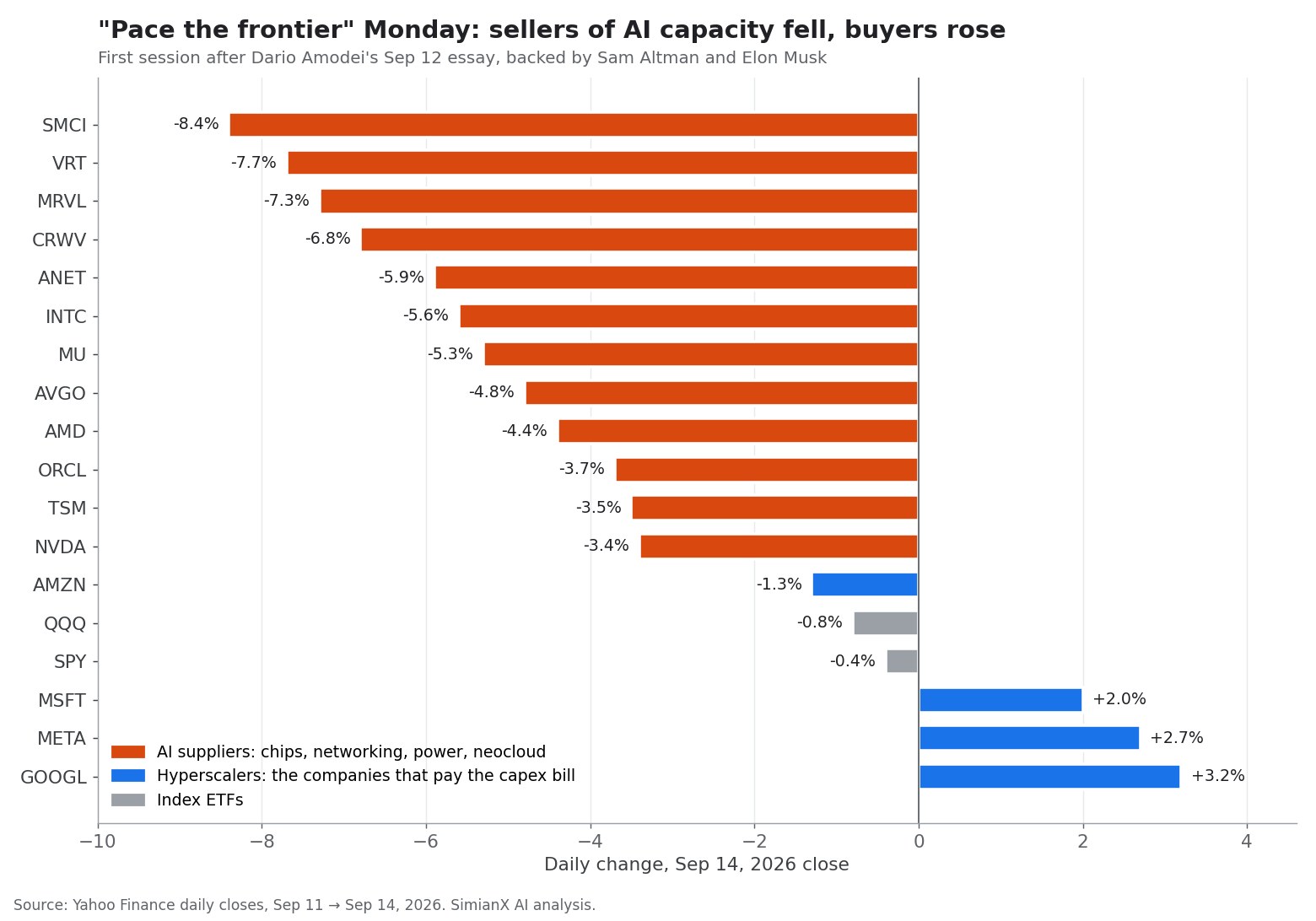
It was the first time the heads of the three best-known AI labs publicly agreed on anything resembling a brake. Markets read it as a question about spending. When trading opened on Monday, September 14, the companies that sell AI capacity fell hard: Super Micro dropped 8.4%, Vertiv 7.7%, Marvell 7.3%, CoreWeave 6.8% and NVDA 3.4%. The companies that pay for that capacity went the other way: Alphabet rose 3.2%, Meta 2.7% and Microsoft 2.0%.
That split is the most useful thing to understand about the trillion-dollar AI trade right now. Artificial intelligence remains one of the most important technology shifts in decades, but investors are no longer asking only how big the opportunity is. They are asking who pays for it, from what cash flow, and what happens to suppliers if the buyers ever slow down.
This does not automatically mean that artificial intelligence is a bubble. It does mean that AI stock returns may depend more on earnings quality, free cash flow and capital discipline than on optimistic headlines. This analysis lays out what the AI CEOs actually said, how 16 AI-linked stocks traded, what the hyperscalers have really done with their spending plans, and a practical framework for judging which parts of the boom are most exposed.
SimianX AI is designed for this kind of cross-market research. Its multi-agent platform combines fundamentals, technical indicators, filings, news and sentiment so investors can evaluate whether a stock's price is supported by operating evidence.
What the AI CEOs Actually Said
The phrase "hit the brakes" needs care. Nobody announced a spending cut. The essay is about the pace of capability gains, and its main mechanisms are oversight and coordination, not smaller data centers.
| Who | Where | What they said | Concrete commitment |
|---|---|---|---|
| Dario Amodei, Anthropic | Personal essay, Sep 12 | "We must slow the pace at which we improve the capabilities of AI models. Progress will still seem fast." | Third-party evaluators with permanent, employee-level access to Anthropic's systems, starting now |
| Sam Altman, OpenAI | Posts on X, Sep 12–13 | "I agree with Dario that we need to pace the frontier." | OpenAI will also give independent evaluators employee-like access |
| Elon Musk, xAI | Post on X | "Dario is right" | None stated |
Amodei's plan has three parts: embedded external evaluators (which Anthropic adopted unilaterally), common safety standards and capability limits agreed among frontier developers, and eventually coordination between governments on pacing. The essay mentions training compute only as a possible pacing ingredient, and Amodei himself worries that compute thresholds are easy to game. It does not propose cutting data-center budgets. CNN's coverage and Axios framed it the same way: a safety argument, not a capex announcement.
So why did chip stocks fall? Because the AI supply chain is priced on an assumption that frontier labs will keep buying ever-larger training clusters for years. Any credible talk of pacing the frontier, even without a dollar figure attached, lowers the probability of the most aggressive demand scenarios. The hyperscalers rose for the mirror-image reason: a slower race could mean less pressure to keep raising capital budgets that have already outgrown their cash flow.
The AI investment question is shifting from "How large is the opportunity?" to "Who captures enough cash flow to pay for the opportunity?"
How AI Stocks Traded on September 14
The table below records the first session after the essay. Volume is shown as a multiple of each stock's 20-day average, which tells you whether the move was a stampede or a repricing.
| Stock | Role in the AI build-out | Close, Sep 14 | Daily change | Volume vs 20-day avg | From 52-week high | 2026 YTD |
|---|---|---|---|---|---|---|
| NVDA | Accelerators | $210.96 | -3.4% | 1.0x | -10.5% | +13.1% |
| AVGO | Custom AI chips, networking | $344.72 | -4.8% | 1.1x | -28.4% | -0.4% |
| AMD | Accelerators, CPUs | $493.41 | -4.4% | 1.4x | -15.1% | +130.4% |
| TSM | Foundry | $418.01 | -3.5% | 1.5x | -12.5% | +37.6% |
| ORCL | AI cloud capacity | $144.79 | -3.7% | 1.6x | -55.9% | -25.7% |
| CRWV | Neocloud (GPU rental) | $82.98 | -6.8% | 1.1x | -42.0% | +15.9% |
| AMZN | Hyperscaler | $253.54 | -1.3% | 1.0x | -10.7% | +9.8% |
| MSFT | Hyperscaler | $505.41 | +2.0% | 1.1x | -6.8% | +4.5% |
| META | Hyperscaler | $665.60 | +2.7% | 1.1x | -14.7% | +0.8% |
| GOOGL | Hyperscaler | $349.39 | +3.2% | 1.5x | -13.2% | +11.6% |
| QQQ | Nasdaq-100 ETF | $709.18 | -0.8% | 1.1x | -5.0% | +15.4% |
| SPY | S&P 500 ETF | $760.88 | -0.4% | 1.2x | -2.2% | +11.6% |
Source: Yahoo Finance daily closes; 52-week high uses closing prices over the prior 252 sessions. Other suppliers fell harder: Super Micro -8.4%, Vertiv -7.7%, Marvell -7.3%, Arista -5.9%, Intel -5.6% and Micron -5.3%.
Three things stand out.
- It was a repricing, not a panic. Volume on most names was only 1.0–1.6 times normal. Investors trimmed exposure; they did not flee.
- Amazon was the exception among hyperscalers. It fell 1.3% while its peers rose, which fits its position as both a buyer of chips and a seller of cloud capacity, and as a large investor in Anthropic itself.
- The index barely moved. QQQ lost 0.8%, so this was a rotation inside the AI trade rather than a broad risk-off day.
The AI Trade Was Already Cracking Before the Essay
The essay landed on a market that had been quietly de-rating AI infrastructure for months. As of the September 14 close, every AI-linked name in our sample sat below its 52-week high, while the S&P 500 was only 2.2% off its peak.
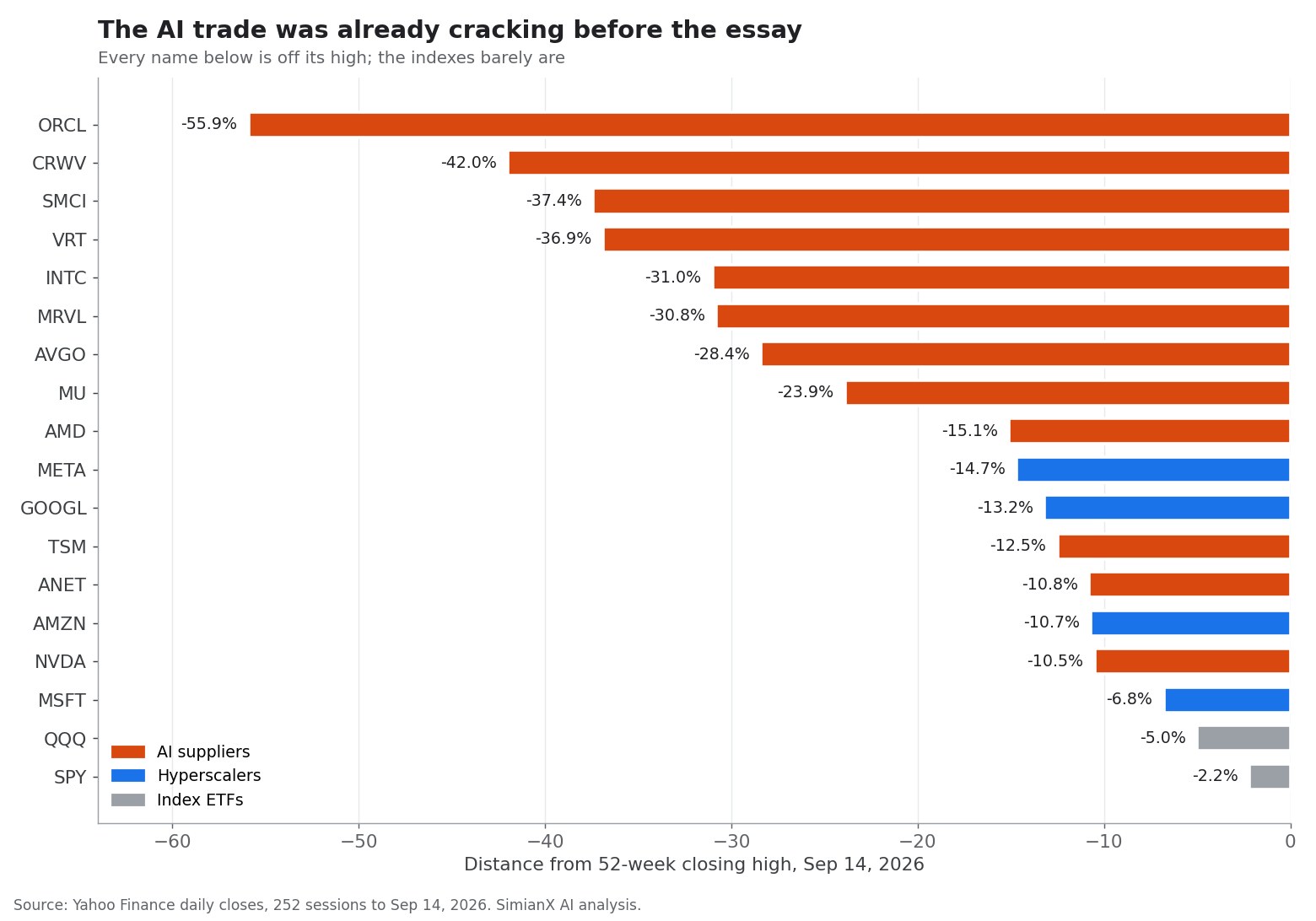
The pattern is not random. The deepest drawdowns belong to companies that either borrow heavily to build capacity (Oracle, CoreWeave) or sell physical infrastructure whose orders are lumpy (Super Micro, Vertiv). The shallowest belong to the hyperscalers with the largest existing cash flows. At the same time, many suppliers are still far ahead for the year: Micron is up about 224% in 2026, Intel 163%, Marvell 158% and AMD 130%. That combination, huge gains followed by 25–35% pullbacks, is what a maturing momentum trade looks like, and it makes the group more sensitive to any hint that demand growth could slow.
Nobody Has Actually Cut AI Capex
The most important fact for AI stock investors is that the brake so far is rhetorical. Every major hyperscaler raised or held its 2026 capital-spending plan in the July earnings season.
| Company | Earlier 2026 capex guidance | Latest guidance (July 2026) | What changed |
|---|---|---|---|
| Alphabet | $180–190 billion | $195–205 billion | Raised; Q2 capex doubled to $44.9 billion |
| Amazon | About $200 billion | About $220 billion | Raised; CEO cites memory costs and demand |
| Meta | $125–145 billion | $130–145 billion | Range narrowed upward |
| Microsoft (calendar 2026) | About $190 billion | About $175 billion | Accounting change only: more data-center leases now booked as operating leases |
Sources: CNBC on Alphabet, Fortune on Amazon, Meta's Q2 2026 results, CFO Dive on Microsoft.
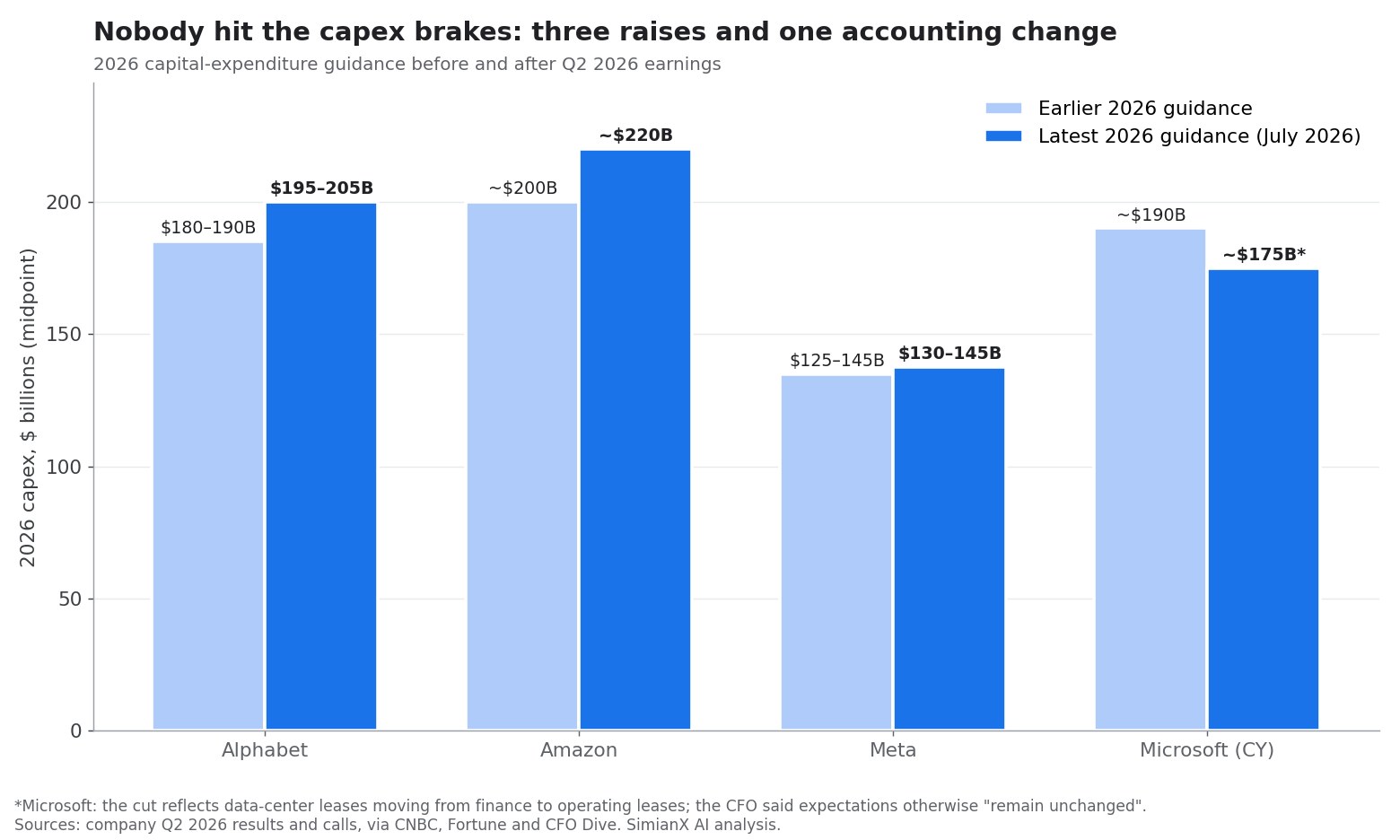
Microsoft's number deserves a note. CFO Amy Hood said the reduction reflects future data-center leases shifting from finance leases to operating leases, and that "outside of this useful life impact, our calendar year 2026 CapEx investment expectations remain unchanged." The company also extended the useful life of data centers and office buildings from 15 to 25 years, which lowers annual depreciation. Neither change means Microsoft is building less.
Amazon was even more explicit. "We still won't have enough capacity to meet all the demand we have in 2026," Andy Jassy said on the July 30 call. "And I believe this dynamic will also be true in 2027, too."
In aggregate, the four biggest spenders were on track for about $725 billion of capex in 2026, up 77% from a record $410 billion in 2025, according to first-quarter guidance compiled by the Financial Times and reported by Tom's Hardware. By the end of July the same four had spent more than $1.1 trillion since 2023, with roughly $745 billion more expected this year alone, per a second Tom's Hardware report. The July raises pushed that total higher again.
This spending includes:
- Graphics processing units and custom AI accelerators.
- Data-center buildings and cooling systems.
- High-speed networking equipment.
- Electricity generation and transmission.
- Cloud capacity for training and inference.
- Land, construction and long-term power contracts.
- New software platforms to commercialize AI services.
The race is rational from a strategic perspective. A company that underbuilds may lose customers, developers and market share to a better-funded rival. But the economic risk is that all major companies may overbuild at the same time.
In a traditional investment cycle, new capacity is usually added after demand becomes visible. In AI, companies are building capacity based on expected future demand. That creates a timing mismatch: the expenses occur immediately, while the revenue may arrive years later, or may not arrive at all. We measured how far that gap has already stretched in AI Capex 2026: Big Tech Now Spends 96% of Its Cash Flow.
Why AI Spending Is Becoming a Balance-Sheet Story
Free cash flow has turned negative at two giants
In the second quarter of 2026, Alphabet spent $44.9 billion on property and equipment against $39.1 billion of operating cash flow, leaving free cash flow of minus $5.9 billion for the quarter, according to its Q2 2026 earnings release. Amazon reported trailing twelve-month free cash flow of minus $7.6 billion, versus plus $18.2 billion a year earlier, "driven primarily by a year-over-year increase of $66.1 billion in purchases of property and equipment," per its Q2 2026 release. Meta's Q2 free cash flow fell to $784 million, as we detailed in META Stock After Muse.
The money is coming from new stock and new debt
When cash flow no longer covers the build-out, companies raise outside capital. Alphabet disclosed that in June 2026 it issued Class A and Class C shares plus mandatory convertible preferred stock for net proceeds of $49.6 billion, "including capital expenditures to scale AI infrastructure," and set up an at-the-market program to sell up to another $40.0 billion of stock.
Debt is rising too. S&P Global counts about $225 billion of bonds issued by hyperscalers and related entities such as Nvidia so far in 2026, a pace for a record year, and its analysts wrote that "the credit quality of hyperscalers is gradually weakening," Axios reported on September 11. The same analysis expects the top six hyperscalers, including Oracle, to spend more than $7 trillion on data centers and AI through 2030.
Large technology companies can generally carry debt safely because they have established businesses and strong balance sheets. The concern is broader: smaller data-center operators, speculative infrastructure developers and highly leveraged AI startups may be more vulnerable if utilization or pricing disappoints. That is exactly where the 52-week drawdowns are deepest, as covered in CoreWeave Stock 2026: $100B AI Backlog vs Debt Risk.
Short-lived assets create depreciation risk
Much of this capex buys servers and accelerators that wear out or become obsolete far faster than buildings. Alphabet has said roughly 60% of its 2026 spending goes to servers and 40% to data centers and networking. If model architectures or inference methods improve rapidly, today's expensive hardware may become less economically attractive before it has generated an adequate return, while the depreciation charge keeps arriving on the income statement.
Management teams must protect free cash flow
A CEO can describe AI investment as strategically necessary, but shareholders ultimately receive value through earnings, cash flow or long-term competitive advantage. If capital expenditures rise faster than operating income, free cash flow can decline even when revenue grows.
This is why investors have become more sensitive to capex guidance. Alphabet beat second-quarter expectations and still fell after raising its spending range, a pattern we saw across the July earnings season.
The Circular AI Economy Is Showing Up in Reported Profits
One of the more serious concerns is the possibility of an increasingly circular AI ecosystem, and in 2026 it has become visible in audited numbers.
Consider a simplified chain:
- A chip company sells accelerators to a cloud provider.
- The cloud provider rents compute to an AI model developer.
- The model developer signs a strategic partnership with, and takes investment from, the cloud provider.
- The cloud provider reports strong AI demand, and books gains as the lab's valuation rises.
- The chip company benefits from new orders based on that demand.
This chain can represent genuine economic activity. But investors should still ask who ultimately pays and whether the end customer earns enough productivity or revenue to justify the spending.
Here is what that looked like in one quarter:
| Q2 2026 | Operating income | Other (non-operating) income | Net income | Main source of other income |
|---|---|---|---|---|
| Alphabet | $40.8 billion | $98.0 billion | $112.1 billion | "Net unrealized gains on our equity securities" |
| Amazon | $27.5 billion | $53.4 billion | $62.6 billion | "Primarily from our investments in Anthropic" |
Source: Alphabet and Amazon Q2 2026 earnings releases (Form 8-K, Exhibit 99.1).
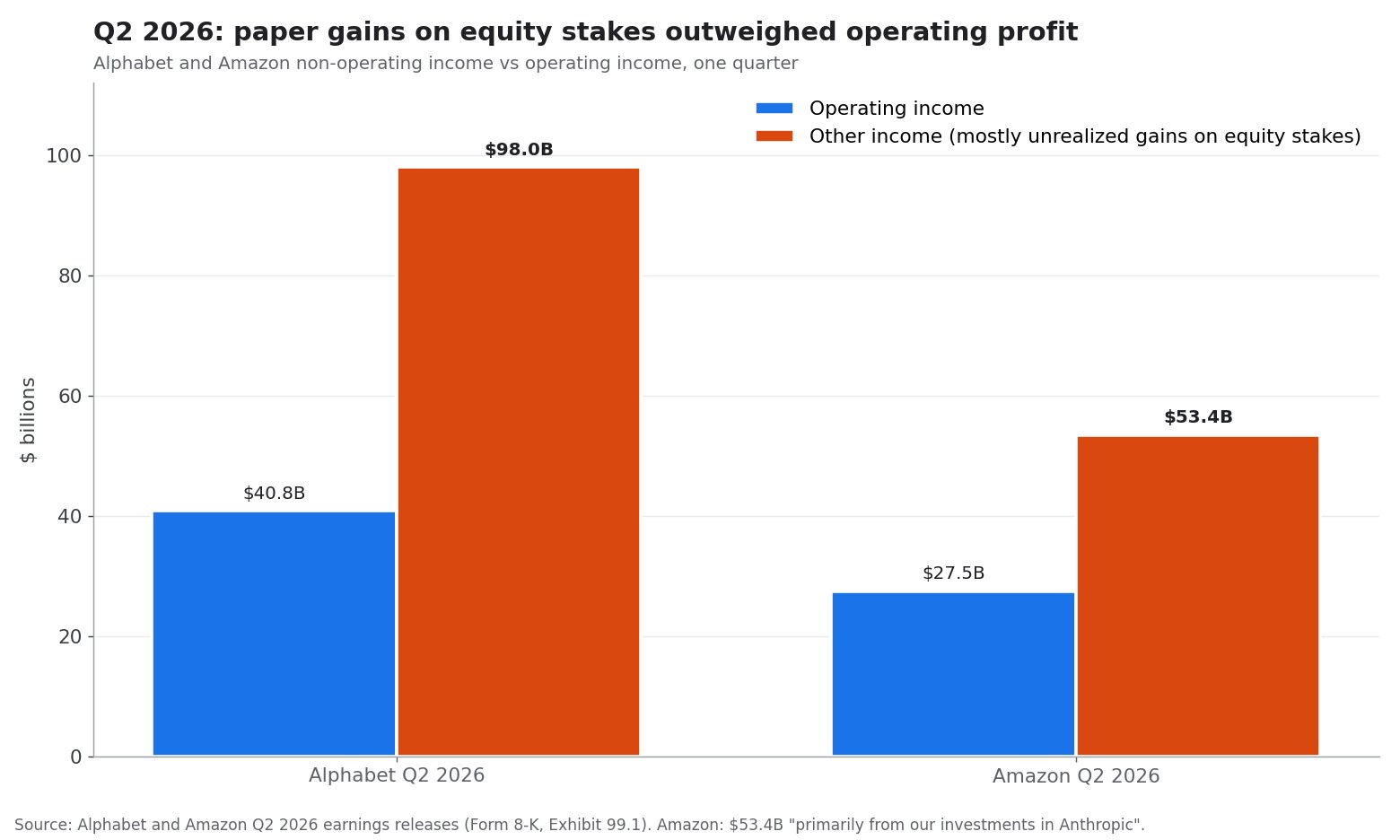
Alphabet's net income available to shareholders rose 298% while its operating income rose 30%. Amazon's net income was more than double its operating income. These are real, disclosed gains, and both businesses are growing quickly. But they are gains on stakes in AI companies that are themselves large buyers of Alphabet's and Amazon's cloud capacity. If private AI valuations fall, the same line can swing the other way.
The risk becomes larger when startups receive massive funding, commit to long-term cloud contracts and then use a significant portion of that funding to purchase cloud services from their strategic partners. The ecosystem may grow rapidly while final-market profitability remains unproven.
A healthy AI market should gradually show:
- More revenue from non-technology industries.
- Higher employee productivity.
- Measurable cost savings.
- Stronger software gross margins.
- Lower inference costs.
- Less reliance on subsidies.
- Broader customer adoption beyond early adopters.
If the industry remains dependent on investors financing companies that buy infrastructure from other technology companies, the boom is more vulnerable to a confidence shock.
Nvidia Proves That Real Demand Exists, But It Does Not Eliminate Risk
The strongest argument against an AI bubble is the performance of Nvidia's actual business.
Nvidia reported fiscal 2026 revenue of $215.9 billion, up 65% from a year ago, while data-center revenue increased 68%, according to its fiscal 2026 annual report on Form 10-K. Operating income rose 60% to $130.4 billion.
Those numbers demonstrate that the AI buildout is not purely imaginary. Customers are buying chips, networking systems and complete accelerated-computing platforms at extraordinary levels.
The same filing also shows how intertwined the ecosystem has become. Nvidia reported $95.2 billion of supply and capacity commitments, substantially all to be paid through fiscal 2027, plus $27 billion of multi-year cloud service agreements, meaning Nvidia itself has committed to rent cloud capacity. The 10-K also warns that "the availability of data centers, energy, and capital to support the buildout of NVIDIA AI infrastructure by our customers and partners is crucial."
Strong supplier revenue does not automatically prove that the entire ecosystem will earn attractive returns. During many technology investment cycles, equipment vendors profit before end users do. The critical question is whether customers can monetize the hardware after purchasing it. For the historical pattern, see NVDA After Earnings: Every Reaction Since 2016 in One Table and Is Jensen Huang Fueling an AI Bubble?
Nvidia investors should monitor:
- Data-center growth after the current Blackwell product cycle.
- Customer concentration among hyperscalers.
- The pace of custom-chip development by Google, Amazon and Microsoft.
- Export restrictions affecting China-related sales.
- Gross-margin sustainability as competition increases.
- Cloud-provider return on invested capital.
- The replacement cycle for AI accelerators.
- Whether any frontier-lab pacing agreement ever includes limits on training compute.
A stock can remain fundamentally strong while experiencing a significant valuation correction if expected growth slows. Nvidia on September 14 was a good example: a record business, and a share price 10.5% below its May high.
Is the Trillion-Dollar AI Stock Boom an Earnings Bubble?
Fidelity strategists Anu Gaggar and Bryan Sajjadi proposed a useful checklist in February 2026, 5 signs of an AI bubble to watch for: earnings growth, earnings quality, valuations versus history, capex sustainability and the interest-rate cycle. Here is how each looks after the events of 2026.
| Signal | What to watch | Reading in September 2026 |
|---|---|---|
| Earnings growth | Whether revenue backs the profits | Strong: Nvidia +65% revenue, AWS +37%, Google Cloud accelerating |
| Earnings quality | Cash flow versus reported earnings | Weakening: large non-operating gains at Alphabet and Amazon; negative free cash flow |
| Valuations | Multiples versus history | Mixed: suppliers de-rated 10–56% from highs; hyperscalers closer to peaks |
| Capex sustainability | Funded from earnings or from debt and equity | Weakening: record bond issuance, a $49.6 billion Alphabet equity raise |
| Interest rates | Liquidity and Fed policy | A key swing factor for long-duration AI stocks |
This framework helps separate a genuine technology revolution from an unsustainable stock-market cycle.
Earnings growth
AI leaders are reporting substantial revenue and profit growth. Nvidia is the clearest example, but cloud businesses and advertising platforms are also benefiting from AI-related demand.
The risk is that the market expects high growth to continue for too many years. A company growing earnings at 40% may deserve a premium valuation; a company growing at 15% while spending heavily may not.
Earnings quality
Not all earnings growth has the same value. Investors should distinguish between:
- Revenue from external customers and revenue from affiliated partners.
- Cash collections and accounting receivables.
- Recurring subscriptions and one-time infrastructure contracts.
- Operating profit and gains on investments in other AI companies.
- Operating profit before and after stock-based compensation.
- Gross profit generated by AI products versus conventional businesses.
Valuation
Some AI stocks remain expensive relative to the broader market, even after multiple compression. Other large-cap technology companies trade at more moderate multiples because their existing businesses generate significant cash flow.
Investors should avoid treating "AI exposure" as a valuation category. A profitable semiconductor leader, a cloud platform, an unprofitable model developer and a power-equipment supplier should not receive identical assumptions.
Capital-expenditure sustainability
Capital spending is sustainable when it produces revenue, lowers unit costs or creates a durable competitive moat. It becomes dangerous when companies must continually increase spending merely to maintain their position.
Key questions include:
- What percentage of capex is directly tied to contracted customer demand?
- What utilization rate is required to earn an acceptable return?
- How quickly does the equipment depreciate?
- Can customers switch to cheaper models or custom chips?
- What happens if electricity or financing costs rise?
Interest rates
AI stocks are long-duration assets because much of their expected value comes from future earnings. Higher interest rates reduce the present value of those earnings and can compress valuation multiples even when business performance remains solid. Rates also now matter directly to the build-out itself, because a growing share of it is financed with debt.
What Could Trigger a Correction in AI Stocks?
A correction does not require the technology to fail. It only requires expectations to move lower.
Potential catalysts include:
A real hyperscaler capex slowdown
If Microsoft, Amazon, Alphabet or Meta signals that capacity is growing faster than demand, investors may lower estimates across the entire AI supply chain. September 14 was a preview of how suppliers and spenders would diverge.
A binding pacing agreement
Amodei's essay is only a proposal today. If frontier developers or governments ever agree on capability limits that include training compute, the demand curve for the largest clusters would flatten.
A major customer cancellation
Large data-center projects often depend on a limited number of anchor customers. A delay or cancellation could affect chip suppliers, construction companies, utilities and landlords simultaneously.
Lower AI pricing
Competition among cloud providers and model companies could reduce prices faster than usage increases. Lower prices are good for customers but may hurt suppliers' margins.
A disappointing productivity payoff
Enterprises may discover that AI improves employee efficiency but does not generate enough measurable profit to support large budgets. Adoption could continue while monetization remains weak.
Regulatory or legal restrictions
AI regulation involving privacy, copyright, safety or national security could delay deployments or increase compliance costs. Export restrictions may also limit the addressable market for advanced chips.
A financing event or a markdown in private AI valuations
If an AI startup, data-center operator or private-credit vehicle defaults, investors may reassess the risk of debt-funded infrastructure expansion. A fall in private AI valuations would also reverse the investment gains now flattering hyperscaler earnings.
Which AI Stocks Are Most Vulnerable?
The most vulnerable companies are not necessarily the ones with the highest AI exposure. They are companies with the weakest combination of balance-sheet strength, customer concentration and proven cash flow.
| Company type | Main strength | Main vulnerability | Sep 14 move (examples) |
|---|---|---|---|
| Leading chip designer | Pricing power and immediate demand | High expectations and cyclical orders | NVDA -3.4%, AMD -4.4%, AVGO -4.8% |
| Hyperscaler | Diversified cash flow and distribution | Massive capex and depreciation | GOOGL +3.2%, META +2.7%, MSFT +2.0% |
| AI model developer | Rapid innovation and user growth | High compute costs and uncertain margins | Mostly private |
| Data-center and GPU-cloud operator | Infrastructure scarcity | Leverage, utilization and power costs | CRWV -6.8%, ORCL -3.7% |
| AI software startup | Potentially high gross margins | Customer churn and crowded competition | Mostly private |
| Power, cooling and server supplier | Necessary infrastructure | Project delays and valuation spillover | VRT -7.7%, SMCI -8.4% |
Investors should also be cautious with companies that use AI language in investor presentations without disclosing material AI revenue. An AI label can raise a stock's valuation even when the technology has little effect on earnings.
A Practical Framework for Analyzing AI Stock Risks
Investors can use the following process to evaluate whether an AI stock is supported by fundamentals.
Step 1: Separate current revenue from future promises
Read the latest annual and quarterly filings. Identify how much revenue is generated by products already in commercial use and how much depends on expected future demand.
Step 2: Compare capex growth with operating-income growth
If capex rises 70% while operating income rises 10%, management must explain how the investment will generate future returns. A temporary gap may be acceptable; a persistent gap is more concerning.
Step 3: Examine cash conversion
Compare net income with operating cash flow and free cash flow. Large differences may result from working-capital movements, stock compensation, customer prepayments or, as in 2026, gains on investments in other AI companies.
Step 4: Test customer concentration
Determine whether a small group of hyperscalers or AI startups accounts for a large share of revenue. Concentration increases volatility when spending plans change.
Step 5: Model a lower-growth scenario
Assume that AI revenue growth falls by half, gross margins decline modestly and capex remains elevated for two additional years. If the stock still appears reasonably valued, the downside may be more manageable.
Step 6: Track management language
Words such as "optimization," "efficiency," "capacity discipline," "prioritization" and now "pacing" may indicate a shift from expansion to return-on-investment analysis. Investors should compare current language with previous guidance.
SimianX AI can support this process by allowing users to combine financial-statement analysis with technical trends, analyst revisions and real-time news sentiment. You can open a live NVDA analysis directly, or review SimianX AI's research platform. The platform's output is informational and should supplement, not replace, professional financial advice.
Bull, Base and Bear Scenarios for the AI Stock Boom
Bull scenario: Monetization catches up with infrastructure
In the bullish outcome, AI becomes a general-purpose productivity layer. Companies deploy agents across customer service, software development, healthcare, finance and manufacturing. Cloud usage continues to grow, inference becomes cheaper and AI software produces recurring revenue. "Pacing the frontier" turns out to mean better evaluation, not less compute.
Under this scenario:
- Hyperscaler capex generates strong cloud and advertising returns.
- Nvidia maintains technology leadership.
- AI applications move from pilots into mission-critical workflows.
- Data-center utilization remains high.
- Productivity gains support broader economic growth.
The stock market could continue rewarding AI leaders, although returns may become more selective.
Base scenario: The technology works, but valuation normalizes
In the base case, AI adoption continues but takes longer than investors expect. Revenue grows, but capital intensity remains high and margins expand slowly.
Under this scenario:
- Infrastructure demand remains strong but less explosive.
- Some AI startups consolidate or fail.
- Hyperscaler stocks outperform weaker speculative names.
- Valuation multiples decline gradually.
- Stock returns depend more on earnings delivery.
This would be a healthy normalization rather than a market collapse.
Bear scenario: Overcapacity and earnings disappointment
In the bearish outcome, AI models become cheaper and easier to replicate, reducing pricing power. Enterprises limit spending after weak returns, while hyperscalers continue receiving new capacity faster than customers can absorb it.
Under this scenario:
- AI infrastructure utilization falls.
- Chip orders are delayed or canceled.
- Data-center operators face refinancing pressure.
- Technology stocks suffer multiple compression.
- Private AI valuations decline sharply, reversing hyperscaler investment gains.
- Capital spending is cut across the ecosystem.
The technology could still be important in the long run, but AI-linked stocks could fall substantially as expectations reset.
FAQ About the 2026 AI Stock Boom
What did the AI CEOs say about slowing down?
On September 12, 2026, Anthropic CEO Dario Amodei published "We Must Pace the Frontier," calling for a slower pace of AI capability gains, embedded third-party evaluators, shared safety standards and eventually international coordination. OpenAI's Sam Altman agreed that "we need to pace the frontier," and Elon Musk wrote "Dario is right." None of them announced cuts to data-center spending.
Why did chip stocks fall while Alphabet and Meta rose?
On September 14, suppliers such as Super Micro, Vertiv, Marvell, CoreWeave and Nvidia fell between 3.4% and 8.4%, because a slower frontier race could reduce future orders. Alphabet, Meta and Microsoft rose because they are the ones paying for the build-out, and slower spending would support their free cash flow.
Has any hyperscaler actually cut AI capex in 2026?
No. In July 2026 Alphabet raised its range to $195–205 billion, Amazon to about $220 billion and Meta narrowed its range to $130–145 billion. Microsoft's calendar-year figure fell to about $175 billion only because of a lease accounting change; management said its investment plans were otherwise unchanged.
Are AI stocks overvalued in 2026?
Some AI stocks appear expensive because prices assume years of exceptional growth and high margins. Others are supported by strong current earnings and cash flow, making the sector highly uneven rather than uniformly overvalued. By mid-September, many AI suppliers were already 25–56% below their 52-week highs.
How can investors identify an AI earnings bubble?
Look for revenue growth that depends on related technology companies, rising capex without stronger cash flow, profits driven by gains on stakes in other AI companies, heavy customer concentration, repeated guidance increases without margin improvement and valuations that require unrealistic long-term assumptions.
Will Nvidia stock continue to benefit from AI spending?
Nvidia remains a major beneficiary while customers continue buying accelerated-computing systems. Its future performance depends on sustained data-center demand, product transitions, competition from custom chips, export restrictions and whether customer returns justify continued spending.
What happens if hyperscaler AI spending slows?
A spending slowdown could pressure semiconductor, networking, construction, power and data-center stocks, while potentially helping the free cash flow of the hyperscalers themselves. The impact would depend on whether the slowdown reflects temporary capacity digestion or a fundamental reduction in AI demand.
Conclusion
The trillion-dollar AI stock boom is not necessarily over, but its next phase will be more demanding. The first stage rewarded companies that supplied scarce chips, cloud capacity and data-center equipment. The next stage will reward companies that prove AI can generate durable, recurring and profitable cash flow.
AI CEOs are not abandoning the technology, and the hyperscalers have not cut a dollar of their 2026 plans. What changed in September is that the leaders of the frontier labs openly questioned the pace of the race, and the market immediately showed which side of the trade it thinks would lose if the race slowed: the suppliers.
The most important indicators to monitor are:
- AI revenue growth from external customers.
- Hyperscaler free cash flow after capex.
- How much of reported profit comes from gains on AI investments.
- Data-center utilization and contract quality.
- Inference costs and pricing trends.
- Customer productivity gains.
- Debt and equity issuance across the infrastructure ecosystem.
- Whether pacing proposals ever turn into limits on training compute.
Investors should avoid treating every AI stock as the same trade. Companies with strong balance sheets, real revenue and disciplined capital allocation are better positioned than highly leveraged businesses that depend on continuous funding.
For ongoing research, SimianX AI can help investors track AI stocks across fundamentals, technical indicators, filings, market-moving news and sentiment. Use multi-source analysis, stress-test optimistic assumptions and consult a qualified financial adviser before making investment decisions.
This article is for informational and educational purposes only. It is not investment, legal or tax advice. Market prices and company guidance change, and investors should verify current data before making financial decisions.
Related Reading
- AI Capex 2026: Big Tech Now Spends 96% of Its Cash Flow
- META Stock After Muse: Can an AI Agent Justify $145B Capex?
- Is Jensen Huang Fueling an AI Bubble? Nvidia's Boom Examined
- NVDA After Earnings: Every Reaction Since 2016 in One Table
- CoreWeave Stock 2026: $100B AI Backlog vs Debt Risk
- Oracle Earnings 2026: OCI, Stargate Backlog & ORCL Stock
- Alphabet Q2 Earnings 2026: Can Gemini, Cloud Justify Capex?
- Amazon Q2 Earnings 2026: Can AWS Justify $200B AI Capex?
- Microsoft Q4 Earnings 2026: Azure Growth vs AI Capex Risk
References
- Dario Amodei — We Must Pace the Frontier (September 12, 2026)
- SiliconANGLE — Sam Altman and Elon Musk back Dario Amodei's call to slow down the frontier
- CNN Business — Anthropic CEO calls for "pacing the frontier" of the AI race
- Axios — AI debt is surging, and a credit ratings agency has concerns (September 11, 2026)
- SEC EDGAR — Alphabet Q2 2026 earnings release (Form 8-K, Exhibit 99.1)
- SEC EDGAR — Amazon Q2 2026 earnings release (Form 8-K, Exhibit 99.1)
- SEC EDGAR — Meta Q2 2026 earnings release (Form 8-K, Exhibit 99.1)
- SEC EDGAR — Nvidia fiscal 2026 annual report (Form 10-K)
- CNBC — Alphabet Q2 2026 earnings and capex guidance
- Fortune — Andy Jassy says Amazon will spend $220 billion this year
- CFO Dive — Microsoft holds the line on AI spending plans
- Tom's Hardware — Big Tech capex to hit $725 billion in 2026
- Tom's Hardware — Big Tech spends more than $1 trillion on AI infrastructure
- Fidelity — 5 signs of an AI bubble to watch for