Inside the Coherent Rally: What the 10-K Says About the AI Optics Trade
On September 16, 2026, Coherent Corp. (NYSE: COHR) closed at $289.93, up 6.92% on 7.5 million shares. Headlines rounded the intraday move — the stock touched $294.56, 8.63% above the prior close — to "8%," and the Coherent stock AI optics outlook became the day's second-order artificial-intelligence trade.
The rally was real. The framing was incomplete.
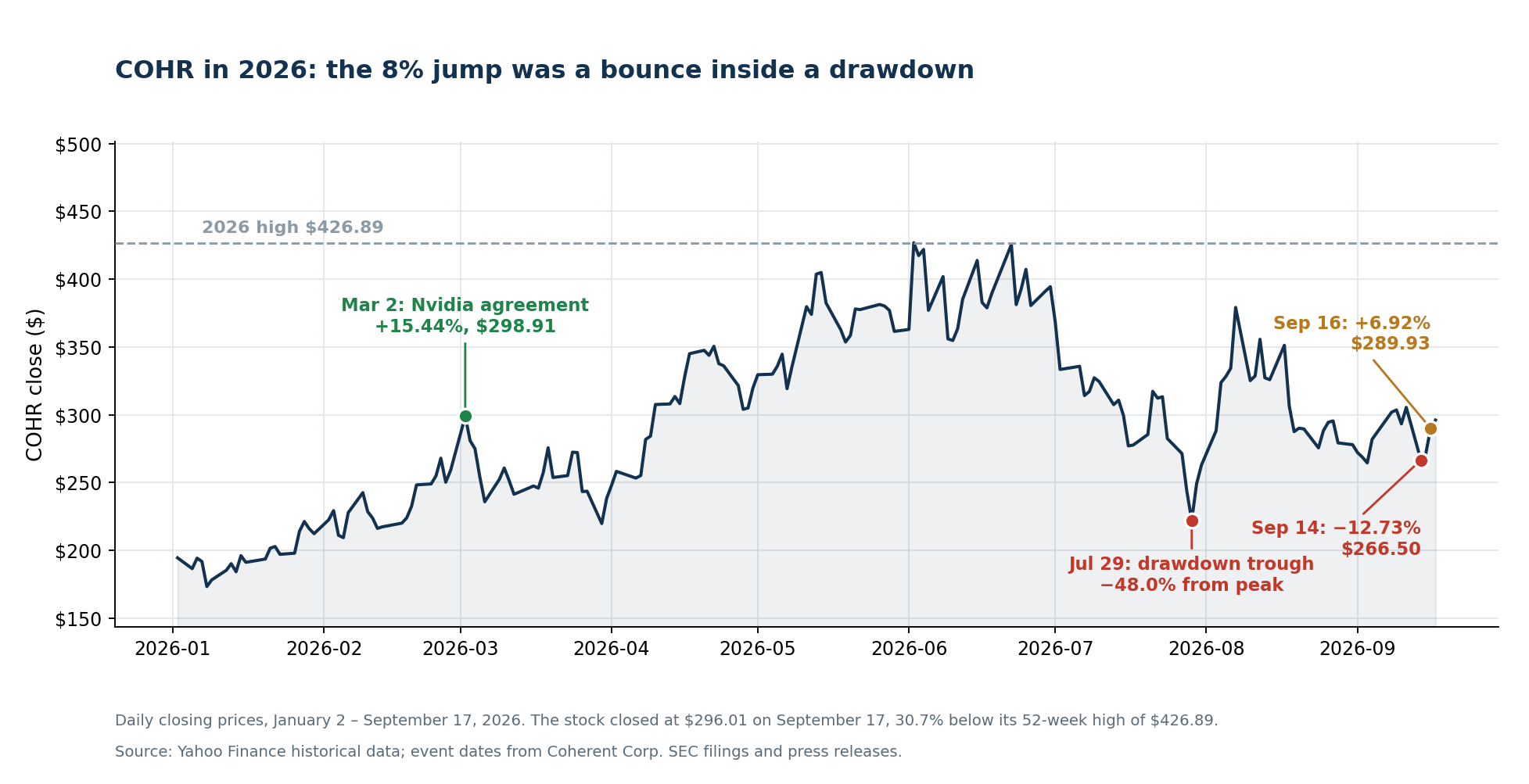
Two sessions earlier, on September 14, Coherent had fallen 12.73% on 9.9 million shares — part of the same repricing of AI suppliers that hit chip stocks while the hyperscalers held up. The optical complex fell with it: Ciena dropped 8.55%, Lumentum 9.92%. The 6.92% move on September 16 did not break the stock out of anything. It recovered part of a three-day hole, and even after a further 2.10% gain on September 17 to $296.01, Coherent was still 30.7% below its 52-week high of $426.89.
That is the first thing the coverage missed. The second is what Coherent filed on August 14, 2026. Its fiscal 2026 Form 10-K contains the numbers that decide this thesis: free cash flow of negative $1.02 billion after three consecutive years between positive $193 million and positive $199 million, a share count up roughly 26% in twelve months, a single customer at 20% of revenue, and an Industrial segment that shrank 10.3% while everyone watched the datacenter line.
None of that makes Coherent a bad company. It is, on the operating numbers, having an excellent year. But it changes what an investor is actually buying at a $56.8 billion market capitalisation. Investors tracking the position can monitor COHR filings, price behaviour and estimate revisions with SimianX AI.
All figures are drawn from SEC filings, company releases and market data through September 17, 2026.
The Four Sessions That Produced the "8% Jump"
The move needs its immediate context. Here is the tape around it.
| Date | COHR close | COHR change | Volume | CIEN | LITE |
|---|---|---|---|---|---|
| Sep 11, 2026 | $305.37 | — | — | — | — |
| Sep 14, 2026 | $266.50 | −12.73% | 9.9m | −8.55% | −9.92% |
| Sep 15, 2026 | $271.17 | +1.75% | 4.3m | +4.60% | +0.47% |
| Sep 16, 2026 | $289.93 | +6.92% | 7.5m | +1.85% | +9.59% |
| Sep 17, 2026 | $296.01 | +2.10% | 4.2m | +4.03% | −0.73% |
Three details matter.
Coherent was not the leader. Lumentum rose 9.59% on September 16, comfortably more than Coherent's 6.92%. For the year to date, Lumentum is up 147.6% against Coherent's 60.4%. If the market were specifically rewarding Coherent's indium phosphide position, it is difficult to see in the prints.
Ciena — the catalyst — faded. Ciena traded 12.22% above its prior close at the September 16 high and finished the day up just 1.85%. The company whose guidance caused the rally gave back roughly five-sixths of its intraday gain before the close.
The whole complex is still below where it started the month. Coherent at $296.01 on September 17 remains below its September 11 close of $305.37.
"The next bottleneck" is a recurring trade in this cycle — it has already been made in grid power and interconnect queues — and each time the question is whether the scarcity outlasts the capacity response.
The "8% jump" was the third day of a partial rebound from a 12.7% single-day decline, in a group where Coherent underperformed its closest peer.
What Kind of Stock This Is
Coherent is routinely described as a volatile stock. The tape lets us be precise about how volatile.
Over the 251 trading sessions in the twelve months to September 17, 2026:
| Volatility measure, trailing 12 months | COHR | CIEN | LITE | NVDA |
|---|---|---|---|---|
| Sessions moving ±5% or more | 85 | 69 | 110 | 8 |
| Share of all sessions | 34% | 27% | 44% | 3% |
| Sessions moving ±10% or more | 19 | — | — | — |
| Annualised volatility | 86% | 72% | 98% | 38% |
| Maximum drawdown | −48.0% | −49.4% | −42.8% | −20.2% |
| Current distance from 52-week high | −30.7% | −43.5% | −13.3% | −7.1% |
One session in three moved at least 5%. Nineteen sessions moved at least 10%. Coherent is more than ten times as likely as Nvidia to post a ±5% day.
The ten largest single-day moves of the past year:
| Date | Move | Date | Move |
|---|---|---|---|
| Nov 6, 2025 | +18.32% | May 11, 2026 | +13.25% |
| Jun 2, 2026 | +17.63% | Aug 18, 2026 | −12.75% |
| Mar 2, 2026 | +15.44% | Sep 14, 2026 | −12.73% |
| Aug 10, 2026 | −14.24% | Aug 4, 2026 | +12.35% |
| Aug 7, 2026 | +13.44% | Jul 30, 2026 | +12.16% |
March 2, 2026 is the largest fundamental move on that list — the day the Nvidia agreement was announced, when the stock gained 15.44%. September 16's 6.92% ranks nowhere near it. The stock's deepest drawdown bottomed on July 29, 2026, 48.0% below its peak.
An investor sizing a position in Coherent is buying an asset with roughly 86% annualised volatility, not a defensive compounder. That is neither bullish nor bearish on its own. It is a fact that should determine position size before any view on optics is formed.
Why the Sector Moved: Ciena's Fiscal 2029 Targets
The September 16 catalyst was external. At its Investor Forum in Ottawa on September 16 and 17, Ciena published fiscal 2029 financial targets:
- Revenue growth of approximately 30% compounded annually from fiscal 2026 through fiscal 2029.
- Adjusted gross margin of approximately 50%.
- Adjusted operating margin of 32% to 35%.
- Free-cash-flow margin of approximately 20%.
Ciena also announced new reportable segments beginning in fiscal 2027 — Optical Systems, Interconnects, Global Services, and Routing and Other.
Those targets are an outside data point confirming that optical demand is not confined to one supplier or one hyperscale customer, which is why Coherent, Lumentum, Corning and Applied Optoelectronics all rose in sympathy. They are also targets, published by a competitor, for a period ending three years out.
The independent forecast is more useful. TrendForce estimates that the AI optical-transceiver market grows from $16.5 billion in 2025 to $26 billion in 2026, up more than 57%, and identifies component shortages as the primary constraint on capacity expansion — naming 2026 and 2027 as the decisive years for establishing a position in the 1.6T supply chain.
Coherent's Own Numbers Are Genuinely Strong
Nothing that follows should be read as arguing the business is weak. Fiscal 2026, which ended June 30, 2026, was the best year in the company's history.
| Fiscal year, $ millions | FY2026 | FY2025 | Change |
|---|---|---|---|
| Revenue | 7,118 | 5,810 | +22.5% |
| GAAP gross margin | 37.5% | 35.2% | +233 bp |
| GAAP operating income | 898 | 290 | +209.7% |
| GAAP operating margin | 12.6% | 5.0% | +762 bp |
| GAAP net earnings attributable to Coherent | 805 | 49 | +1,530.8% |
| GAAP diluted EPS | $4.12 | $(0.52) | from a loss |
| Non-GAAP operating income | 1,457 | 1,037 | +40.5% |
| Non-GAAP operating margin | 20.5% | 17.8% | +262 bp |
| Non-GAAP net earnings | 1,097 | 693 | +58.3% |
| Non-GAAP diluted EPS | $5.61 | $3.53 | +58.9% |
The June quarter was the strongest of the four: revenue of $2,046 million, up 33.8% year over year, GAAP gross margin of 38.5%, GAAP diluted EPS of $1.19 and non-GAAP diluted EPS of $1.74. Guidance for the September 2026 quarter calls for revenue of $2.2 billion to $2.4 billion, non-GAAP gross margin of 39.5% to 41.5%, and non-GAAP EPS of $1.85 to $2.05.
Earnings grew roughly two and a half times faster than revenue. That is real operating leverage, and it is why the stock has a premium multiple at all.
But the growth is one segment
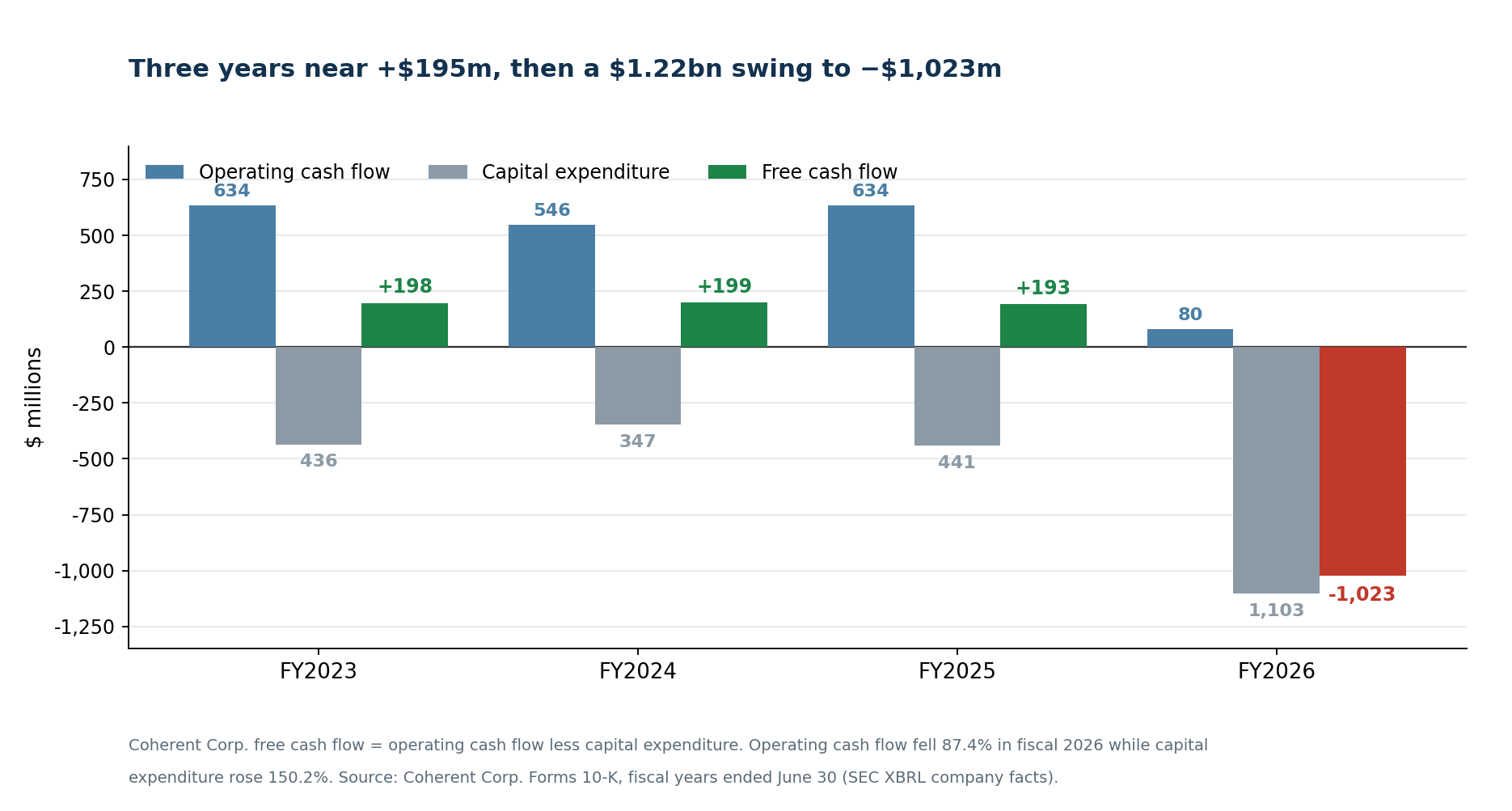
Coherent realigned into two reportable segments effective July 1, 2025. The three-year picture is lopsided.
| Revenue by market, $ millions | FY2026 | FY2025 | FY2024 | FY26 change |
|---|---|---|---|---|
| Datacenter & Communications | 5,274.6 | 3,755.2 | 2,631.4 | +40.5% |
| Industrial | 1,843.6 | 2,055.0 | 2,076.3 | −10.3% |
| Total | 7,118.2 | 5,810.1 | 4,707.7 | +22.5% |
| Datacenter & Communications share | 74.1% | 64.6% | 55.9% | — |
Datacenter and Communications grew 40.5% and now supplies 74.1% of revenue. Industrial shrank 10.3% and has now declined for two consecutive years, from $2,076.3 million in fiscal 2024 to $1,843.6 million in fiscal 2026.
Segment profit tells the same story: Datacenter & Communications contributed $1,329.7 million of the $1,752.5 million total, a 25.2% segment margin, against Industrial's $422.8 million.
This is not a diversified photonics company with an AI kicker. It is an AI optical-components company with a shrinking industrial business attached, and the valuation has to be underwritten on that basis.
The Cash-Flow Break Is the Real Story
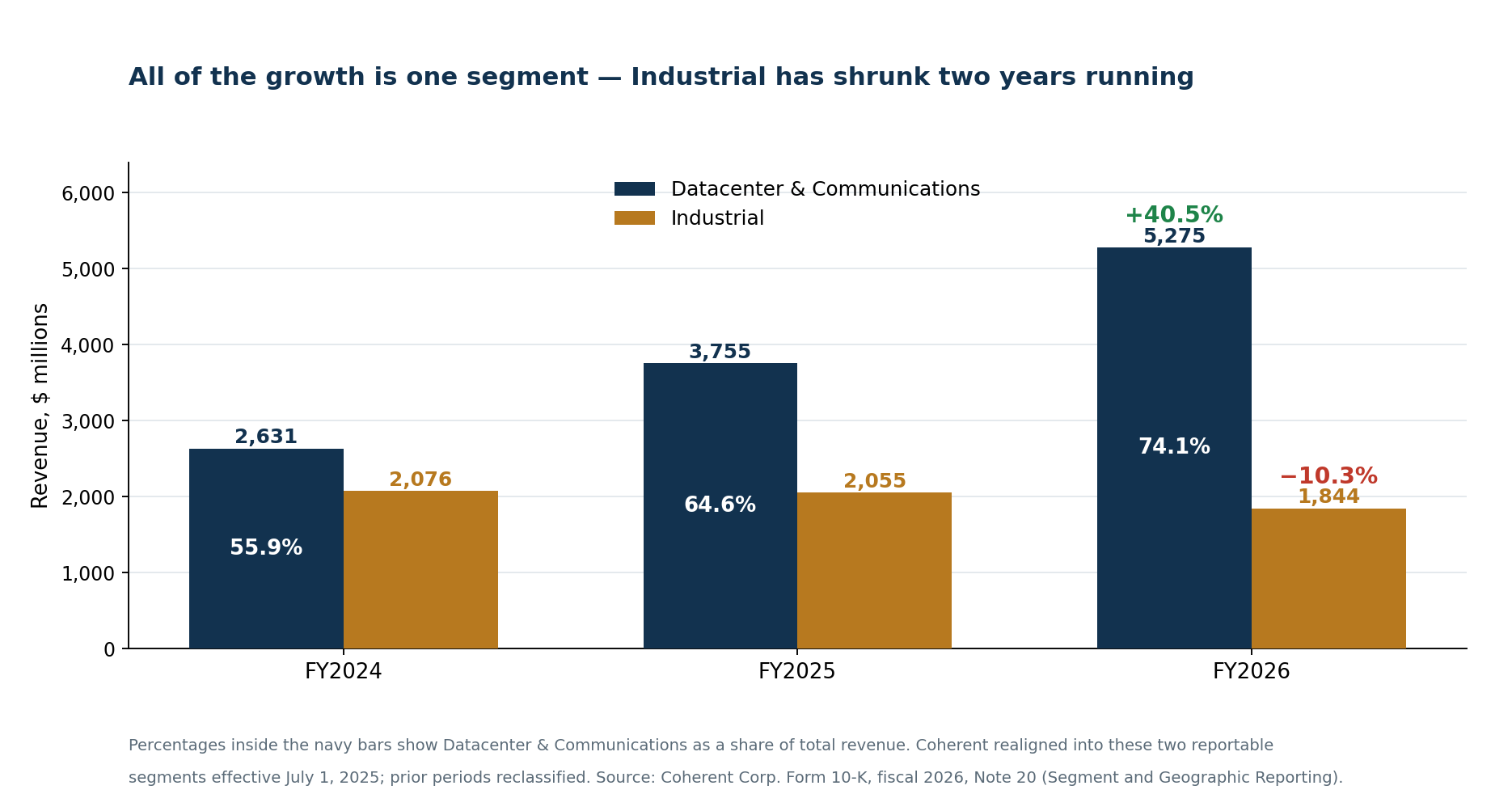
Coherent's income statement and its cash flow statement point in opposite directions in fiscal 2026, and the gap is not small.
| Fiscal year, $ millions | FY2023 | FY2024 | FY2025 | FY2026 |
|---|---|---|---|---|
| Operating cash flow | 634.0 | 545.7 | 633.6 | 79.5 |
| Capital expenditure | 436.1 | 346.8 | 440.8 | 1,102.9 |
| Free cash flow | +198.0 | +198.9 | +192.8 | −1,023.4 |
For three straight years Coherent generated free cash flow between $192.8 million and $198.9 million. In fiscal 2026 it produced negative $1,023.4 million — a $1.22 billion swing in a single year, driven by operating cash flow falling 87.4% while capital expenditure rose 150.2%.
Both halves of that matter. Rising capex on its own would be an investment story. Operating cash flow collapsing from $633.6 million to $79.5 million while GAAP net income rose from $49 million to $805 million is a working-capital story: receivables, inventory and supplier prepayments absorbing the earnings before they become cash.
The company funded the gap externally. Financing activities provided $1,477 million in fiscal 2026, against a $452 million outflow in fiscal 2025 — almost entirely the Nvidia proceeds. Funding an AI buildout from the capital markets rather than from operations is the defining feature of this cycle, and CoreWeave's backlog-versus-debt debate is the most-watched version of it.
This is the same pattern visible across the AI buildout, where reported profit and cash generation have separated; Big Tech now spends 96% of its operating cash flow on capital expenditure. Coherent is a supplier to that buildout, and it is running the same equation one rung down the chain.
What backs the balance sheet
| At June 30, 2026, $ millions | Amount |
|---|---|
| Cash and cash equivalents | 1,162 |
| Short-term investments | 825 |
| Restricted cash (current and non-current) | 606 |
| of which ring-fenced at Silicon Carbide LLC | 604 |
| Available capacity under revolving credit facility | 664 |
| Total debt obligations | 3,222 |
One line deserves emphasis. Of the $606 million of restricted cash, $604 million sits at Silicon Carbide LLC and is restricted for use by that subsidiary alone. It is not parent-company liquidity and should not be counted as such.
The debt is also back-end loaded:
| Fiscal year of maturity | Principal due, $ millions |
|---|---|
| 2027 | 7.9 |
| 2028 | 34.4 |
| 2029 | 93.6 |
| 2030 | 2,135.6 |
| 2031 | 985.9 |
| Total | 3,257.5 |
There is no near-term wall — but $2.14 billion falls due in fiscal 2030, and the refinancing environment then will depend on whether the capacity being built now is generating cash.
The Share Count Nobody Mentioned
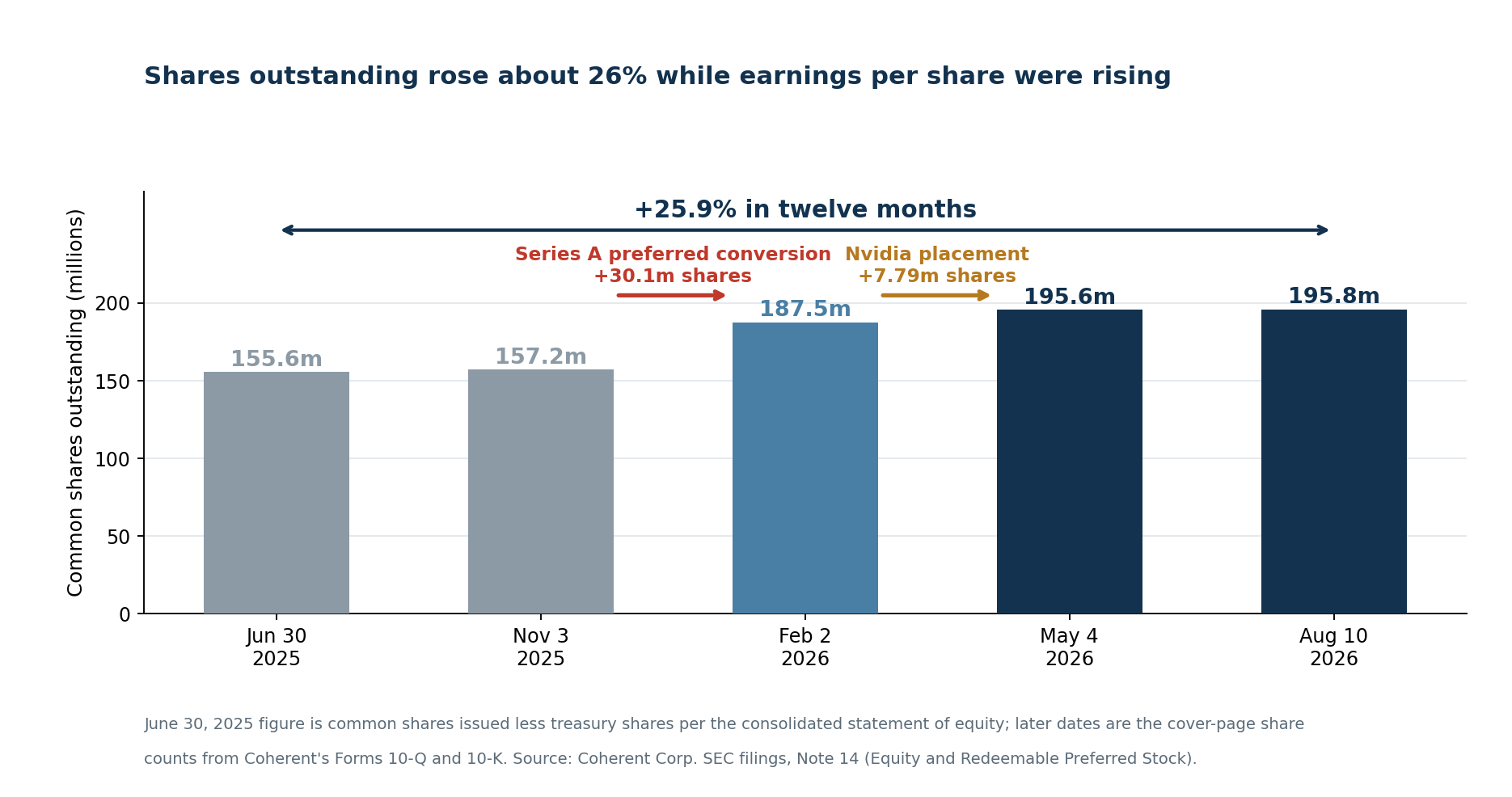
Coherent's earnings per share rose sharply in fiscal 2026. The denominator moved too, and by more than most coverage acknowledged.
| Share count | Date | Shares |
|---|---|---|
| Common outstanding | Jun 30, 2025 | ~155.6 million |
| Common outstanding | Nov 3, 2025 | 157,153,611 |
| Common outstanding | Feb 2, 2026 | 187,481,852 |
| Common outstanding | May 4, 2026 | 195,639,321 |
| Common outstanding | Aug 10, 2026 | 195,832,246 |
That is an increase of roughly 26% in twelve months. Two events account for almost all of it:
- Conversion of Series A preferred stock: 30.1 million common shares issued during fiscal 2026, carrying $2,506.9 million of value out of the redeemable preferred line and into common equity.
- Nvidia's private placement: 7,788,161 shares.
Neither is hidden — both are disclosed in Note 14 of the 10-K — but together they mean per-share results improved despite a materially larger base, and that any future comparison of "EPS growth" has to account for a share count that grew by a quarter.
The Nvidia Agreement, in Its Actual Terms
The Nvidia relationship is the strongest item in the bull case, and the filings describe it precisely.
On March 2, 2026, Coherent entered a multi-year strategic agreement with Nvidia covering advanced optics development, manufacturing capacity and research and development. Per the 10-K, the agreement is non-exclusive and includes a multi-billion-dollar purchase commitment plus future access and capacity rights for advanced laser and optical networking products.
Separately, and on the same day, Nvidia made a $2 billion equity investment:
| Nvidia private placement terms | Detail |
|---|---|
| Shares issued and sold | 7,788,161 |
| Price per share | $256.80 |
| Aggregate gross proceeds | $2.0 billion |
| Structure | Private placement, Section 4(a)(2) exemption |
| Lock-up | Six months from closing — expired |
| Price protection | Six months from execution of the Purchase Agreement |
| Stock reaction on announcement day | +15.44% |
Two provisions deserve more attention than they have received.
The lock-up has expired. The shares were restricted for six months following the March 2 closing. That period has passed, so the position is now transferable. Nvidia has given no indication it intends to sell, but the restriction is no longer there.
Nvidia received price protection. The Purchase Agreement includes a price-protection provision effective for six months following execution. Coherent evaluated it under ASC 815 and ASC 480, determined that it is indexed to the company's own stock and qualifies for equity classification, and disclosed that any additional shares or cash settlement triggered under it would be recorded as an adjustment to equity. In plain terms: Nvidia negotiated downside protection on its entry price, and the mechanism to honour it is potentially more shares.
At $296.01, Nvidia's stake is worth roughly $2.31 billion against a $2.0 billion cost — about 15% above the purchase price. The investment has been a good one for Nvidia, which is a validation of the technology and a reminder of who negotiated the better terms.
The strategic logic remains strong, in the way that Nvidia's other acquisitions and stakes have been: a purchase commitment from the largest AI compute supplier reduces the risk that new capacity finds no buyer. It does not guarantee the return on that capacity, and non-exclusivity means Nvidia can and does work with competing optical suppliers.
Customer Concentration Doubled in a Year
Everyone acknowledges that AI optical customers are concentrated. The 10-K quantifies it, and the trend is steep.
| Customer concentration, % of consolidated revenue | FY2026 | FY2025 | FY2024 |
|---|---|---|---|
| Largest customer | 20% | 10% | 10% |
| Second-largest customer | 12% | — | — |
| Third-largest customer | — | 12% | — |
| Top two combined | 32% | ~22% | — |
The largest customer doubled from 10% of revenue to 20% in one year, and a second reached 12%. Both are primarily Datacenter & Communications. Roughly a third of Coherent's revenue now depends on two buyers, in a segment where those buyers routinely dual-source and design in-house.
Hyperscalers designing their own accelerators change who the optical customer is, as Amazon's chip agreement with Qualcomm showed. Concentration of this kind cuts both ways. It is evidence that Coherent has won the accounts that matter. It is also the reason a single qualification loss or schedule change can move the whole company — and the reason the stock posts nineteen ±10% days a year.
The Geography Complicates the Onshoring Story
Coherent's six-inch indium phosphide platform in Sherman, Texas is central to the investment case, and it is genuine. The 10-K confirms the company expanded the Sherman facility during fiscal 2026 and received a $50 million preliminary memorandum of terms under the CHIPS and Science Act to support it. Coherent operates six-inch InP capacity in the United States and Europe alongside multiple six-inch gallium arsenide VCSEL facilities.
But "U.S. supply-chain resilience" is a partial description of where the assets actually are.
| Long-lived assets, $ millions | Jun 30, 2026 | Jun 30, 2025 | Change |
|---|---|---|---|
| United States | 1,394.8 | 1,092.4 | +$302.4 |
| China | 968.8 | 403.0 | +$565.8 |
| Malaysia | 473.8 | 196.5 | +$277.2 |
| Germany | 189.8 | 189.3 | +$0.5 |
| Vietnam | 119.1 | 65.6 | +$53.6 |
| Sweden | 98.5 | 51.0 | +$47.5 |
| All other non-US | 187.4 | 150.2 | +$37.2 |
| Total non-US | 2,037.5 | 1,055.1 | +$982.4 |
Long-lived assets in China grew by $565.8 million in a single year — more than the $302.4 million added in the United States — and Malaysia grew $277.2 million. Non-US long-lived assets are 59.4% of the total. Of 51,478 employees at June 30, 2026, 44,582 (87%) are in Asia-Pacific against 3,719 in the Americas.
Two related risks follow. China accounted for $813.4 million, or 11.4%, of fiscal 2026 revenue. And in January 2025 Coherent received an inquiry from the Bureau of Industry and Security concerning past product sales to Huawei; the company disclosed that it is cooperating and conducting an internal review, and that it is unable to estimate a range of loss.
None of this is disqualifying. It is simply not the picture implied by a story about a Texas fab.
Where the Bottleneck Actually Sits
The technical argument for optics is sound, and worth stating properly.
Copper links lose signal, consume power and shrink in reach as bandwidth rises. AI clusters split computation across thousands of accelerators that must exchange data continuously; an accelerator waiting on data is idle capital. As systems scale, more links move from copper to optics and each optical port carries more traffic.
| Generation | Aggregate speed | Status |
|---|---|---|
| 400G | 400 Gb/s | Established in cloud and telecom |
| 800G | 800 Gb/s | Expanding rapidly in AI clusters |
| 1.6T | 1.6 Tb/s | Entering volume ramp |
| 3.2T | 3.2 Tb/s | Development and early qualification |
| 6.4T | 6.4 Tb/s | Longer-term architecture |
But "optics is the bottleneck" is too coarse to invest on. The scarce layer moves:
- Indium phosphide lasers. Volume InP is genuinely hard. Coherent's six-inch platform produces more devices per run at higher yields than legacy three-inch lines, and the company plans to double internal InP output and more than double it again during 2027.
- Packaging and assembly. Integrating lasers, modulators, photodetectors, drivers, DSPs and thermal management into smaller modules at tighter tolerances can bind before wafers do.
- Test. A 1.6T module takes longer to test than an 800G one. Test capacity can cap finished output even when components are available.
- Fiber, connectors and switching. High-density fiber, optical circuit switches and network systems each have their own constraints.
The pattern is familiar from the memory side of the same buildout, where high-bandwidth memory became the binding constraint before capacity caught up, and from Micron's supply agreement with Anthropic.
Optics is a bottleneck category, but the scarce asset migrates between wafers, packaging, test and switching as capacity arrives. Coherent's case rests on vertical integration across all of them, not on any one layer staying tight.
TrendForce's identification of component shortages as the binding constraint is consistent with this: the shortage is upstream of the module makers, which is where Coherent's InP position sits — and also where the largest capacity additions are being announced across the industry.
PhotonLink: The Next Company-Specific Test
Coherent will unveil PhotonLink at the European Conference on Optical Communication in Málaga, Spain on September 21, 2026, with presentations from CEO Jim Anderson, CTO and EVP of Optical Components Dr. Julie Eng, and EVP of Semiconductor Devices Dr. Beck Mason, delivered in person and by webcast.
The platform spans the optical signal chain from light generation and beam shaping through transmission, detection and conversion back to an electrical signal at the xPU or switch, and supports co-packaged optics, near-packaged optics and other integration approaches. Coherent expects initial co-packaged-optics revenue in the December 2026 quarter, with optical circuit switching, multi-rail systems and additional thermal products following.
The questions that determine whether the launch matters commercially are narrow:
- Which products ship, rather than sample?
- Are there named customers?
- When does material revenue begin, and at what gross margin?
- Does Coherent supply full systems or components into someone else's?
- How does it compete with Broadcom, Marvell, Lumentum and hyperscalers' internal designs?
A technically impressive launch without commercial specifics will not move a stock priced for execution.
Valuation After the Move
At $296.01 on September 17, with 195,832,246 shares outstanding, Coherent's market capitalisation is approximately $58.0 billion.
| Valuation measure | Figure |
|---|---|
| Share price (Sep 17, 2026) | $296.01 |
| Shares outstanding (Aug 10, 2026) | 195,832,246 |
| Market capitalisation | $58.0 billion |
| FY2026 revenue | $7,118 million |
| Enterprise value / FY2026 revenue (approx.) | ~8.3x |
| FY2026 GAAP diluted EPS | $4.12 |
| Trailing GAAP P/E | ~72x |
| FY2026 non-GAAP diluted EPS | $5.61 |
| Trailing non-GAAP P/E | ~53x |
| FY2026 free cash flow | −$1,023 million |
| FY2027 guidance, Q1 non-GAAP EPS | $1.85–$2.05 |
Annualising the midpoint of first-quarter guidance — $1.95 × 4 = $7.80 — puts the stock near 38 times a naive forward non-GAAP figure, and sell-side estimates assuming continued sequential growth produce lower multiples still. That is the crux: the forward multiple looks reasonable only if the growth embedded in it arrives.
There is no free-cash-flow multiple, because free cash flow is negative.
| Scenario | What has to happen | Implication |
|---|---|---|
| Bear | Capacity additions across the industry outrun demand; the largest customer's orders normalise; operating cash flow stays weak | A ~72x trailing multiple on a stock with 86% volatility compresses quickly |
| Base | 800G and 1.6T ramp as guided; non-GAAP gross margin holds near 40%; working capital normalises and free cash flow turns positive in fiscal 2027 | Premium multiple defensible, but returns come from earnings, not re-rating |
| Bull | PhotonLink, CPO and optical circuit switching produce material revenue; InP capacity stays scarce through 2027; cash conversion inflects sharply | Strategic AI-infrastructure premium sustained |
The Bull Case
- Optical intensity rises faster than data-center spending. Each accelerator generation needs more bandwidth per processor — the same demand curve driving the chip supercycle Nvidia leads.
- The 1.6T ramp is pulling forward while 800G demand continues rather than rolling off.
- Capacity is committed. Management describes fiscal 2027 capacity as essentially booked with orders extending through calendar 2027.
- Six-inch InP is a real manufacturing advantage, with higher yields than three-inch lines and a doubling of output planned.
- Nvidia's purchase commitment and capacity rights reduce the risk that new capacity goes unsold.
- New platforms broaden the market beyond pluggable transceivers into CPO, NPO, optical circuit switching and thermal.
- Margins are expanding — non-GAAP operating margin of 20.5% versus 17.8% a year earlier.
The Bear Case
- Free cash flow is negative $1.02 billion, and the three-year run of roughly $195 million in positive free cash flow ended abruptly.
- Purchase commitments total $11.8 billion — $3.4 billion in fiscal 2027 and $8.4 billion thereafter — which become obligations if customer forecasts slip.
- Two customers are 32% of revenue, with the largest doubling its share in one year.
- The share count rose about 26%, diluting the per-share economics of the growth.
- Nvidia's agreement is non-exclusive and came with price protection, not just capital.
- Industrial revenue is shrinking, down 10.3% in fiscal 2026 and lower than fiscal 2024.
- Capacity expansion could end the scarcity that supports current pricing, as Coherent, Lumentum and Asian suppliers all add lines.
- A BIS inquiry into past Huawei sales is unresolved, with no estimable range of loss, against China at 11.4% of revenue.
Coherent may well be supplying a genuine AI bottleneck. Bottleneck suppliers are not automatically good investments once the price already assumes the scarcity persists.
What to Monitor Each Quarter
Operational: 800G and 1.6T revenue; six-inch InP output and yield; backlog and cancellations; CPO, NPO and optical-circuit-switch revenue; capacity utilisation; customer qualifications.
Financial: GAAP and non-GAAP gross margin; operating cash flow; capital expenditure; receivables and inventory; purchase commitments; net debt; diluted share count.
Commercial: named PhotonLink customers; new long-term supply agreements; customer concentration; average selling prices; evidence of demand beyond Nvidia-linked orders.
A five-step routine:
- Confirm demand — bookings, backlog and revenue growth together.
- Confirm capacity — wafer output, packaging and test expansion.
- Confirm pricing — stable or rising gross margin.
- Confirm cash conversion — operating cash flow improving as factories ramp. This is the one that broke in fiscal 2026.
- Confirm valuation support — estimate revisions rising faster than the share price.
SimianX AI can assemble this into a repeatable process, combining SEC filings, earnings revisions, price behaviour and news sentiment — useful for a stock whose thesis spans compound-semiconductor manufacturing, hyperscaler capital budgets and networking architecture.
Is Coherent Stock a Buy After the Jump?
The honest answer separates the business from the security.
The business is executing well. Revenue grew 22.5%, GAAP operating income tripled, non-GAAP EPS rose 58.9%, and the datacenter segment grew 40.5% to three-quarters of the company. Management has capacity commitments extending through calendar 2027 and a credible manufacturing advantage in six-inch indium phosphide. Nvidia paid $2 billion for a seat at that table.
The security is a $58 billion market capitalisation on $7.1 billion of revenue and negative $1.02 billion of free cash flow, with 86% annualised volatility, a 26% larger share count, a third of revenue in two customers, and a 72x trailing GAAP multiple. It sits 30.7% below its 52-week high after a 48% drawdown that bottomed seven weeks ago.
Investors who believe optical content per accelerator keeps rising, that InP scarcity persists through 2027, and that working capital normalises so cash follows earnings have a coherent thesis — and fiscal 2027 is when that gets tested.
Investors who want to see one quarter of positive free cash flow, named PhotonLink customers, or evidence that the largest customer's 20% share is durable also have a coherent thesis. The September 21 launch and the December-quarter results are the next two checkpoints.
What the September 16 move does not tell you is which group is right. It was a sector-sympathy bounce inside a drawdown, in a stock that moves 5% in a third of all sessions.
FAQ About the Coherent Stock AI Optics Outlook
Why did Coherent stock jump on September 16, 2026?
Coherent rose 6.92% to $289.93 after Ciena published fiscal 2029 targets — about 30% annual revenue growth, roughly 50% adjusted gross margin, 32–35% adjusted operating margin and around 20% free-cash-flow margin — which lifted optical names broadly. Anticipation of Coherent's September 21 PhotonLink launch contributed. Context matters: the stock had fallen 12.73% on September 14, so the move was a partial rebound rather than a breakout.
Is Coherent profitable?
Yes. Fiscal 2026 GAAP net earnings attributable to Coherent were $805 million, or $4.12 per diluted share, against $49 million a year earlier. Non-GAAP net earnings were $1,097 million, or $5.61 per diluted share. However, free cash flow was negative $1,023 million, because operating cash flow fell to $79.5 million while capital expenditure rose to $1,102.9 million.
What exactly is Coherent's relationship with Nvidia?
A multi-year, non-exclusive strategic agreement announced March 2, 2026, covering optics research and development, manufacturing capacity, a multi-billion-dollar purchase commitment and future capacity rights. Separately, Nvidia bought 7,788,161 shares at $256.80 in a private placement for $2 billion gross. The shares carried a six-month lock-up, which has expired, and the agreement includes a six-month price-protection provision that Coherent accounts for within equity.
How diluted are Coherent shareholders?
Shares outstanding rose from roughly 155.6 million at June 30, 2025 to 195,832,246 at August 10, 2026 — about 26%. The two main drivers were the conversion of Series A preferred stock into 30.1 million common shares and the 7,788,161 shares issued to Nvidia.
Are AI optics really the next bottleneck?
Component-level scarcity is real — TrendForce identifies component shortages as the primary constraint on AI optical-transceiver capacity and forecasts the market growing from $16.5 billion in 2025 to $26 billion in 2026. But the binding layer shifts between indium phosphide wafers, packaging, test and switching as capacity is added, so "optics is the bottleneck" is not by itself an investment case.
Is COHR stock expensive?
At $296.01 it trades at roughly 72 times trailing GAAP EPS and 53 times trailing non-GAAP EPS, with no free-cash-flow multiple because free cash flow is negative. Annualising the midpoint of first-quarter fiscal 2027 guidance gives roughly 38 times a naive forward figure. Whether that is expensive depends entirely on whether the guided growth and the cash-flow recovery both arrive.
What is the biggest risk?
Cash conversion. Coherent can grow revenue, hold margins and still disappoint if receivables, inventory and supplier prepayments keep absorbing earnings while capital expenditure stays above $1 billion. The second risk is concentration: two customers at 32% of revenue in a segment that dual-sources by default.
Conclusion
Coherent is a genuinely strong operating story wrapped in a genuinely demanding security.
The operating case is documented: revenue up 22.5% to $7.12 billion, GAAP operating income up 209.7%, non-GAAP EPS up 58.9%, the datacenter segment up 40.5% to 74.1% of revenue, capacity committed through calendar 2027, a six-inch indium phosphide platform that competitors do not have at scale, a $50 million CHIPS memorandum of terms for Sherman, and a $2 billion investment from the most important customer in AI compute.
The security case is equally documented, and less discussed: free cash flow of negative $1,023 million after three years between positive $193 million and $199 million; a share count up about 26%; one customer at 20% of revenue and two at 32%; Industrial revenue down 10.3%; $11.8 billion of purchase commitments; $2.14 billion of debt maturing in fiscal 2030; 59.4% of long-lived assets outside the United States with the fastest growth in China; an unresolved BIS inquiry; and 86% annualised volatility with a 48% drawdown in the past year.
The September 16 rally settled none of it. It was a third-day bounce off a 12.7% decline, triggered by a competitor's three-year targets, in which Coherent underperformed Lumentum.
The thesis will be resolved by four things, in order: whether 1.6T and next-generation revenue scales; whether gross margin holds near 40%; whether record bookings convert into cash; and whether the new capacity earns a return above the cost of the capital — including the equity — used to build it. The third is the one that broke in fiscal 2026, and it is the one to watch first.
Related Reading
- SK Hynix Stock Surges 8%: Is the AI Supercycle Real?
- AI Capex 2026: Big Tech Now Spends 96% of Its Cash Flow
- AI CEOs Hit the Brakes: Chip Stocks Fell, Big Tech Rose
- Nvidia Hugging Face Deal 2026: $12.9B at 86x Revenue
- Amazon Qualcomm AI Chip Deal: 54 Million Shares in Play
- CoreWeave Stock 2026: $100B AI Backlog vs Debt Risk
- NextEra-Dominion 2026 Deal: 110 GW AI Power Bottleneck
- Micron Anthropic Deal 2026: Claude AI Memory Explained
- AI Stock Boom: Nvidia Leads the Chip Supercycle Now
References
- Coherent Corp. — Annual Report on Form 10-K, fiscal 2026
- Coherent Corp. — Fourth quarter and full year fiscal 2026 results (Form 8-K, Exhibit 99.1)
- Coherent Corp. — Fourth quarter fiscal 2026 investor presentation (Exhibit 99.2)
- Coherent Corp. — Nvidia strategic partnership announcement
- Coherent Corp. — CHIPS letter of intent for the Sherman, Texas expansion
- Coherent Corp. — PhotonLink platform to be unveiled at ECOC, September 21, 2026
- Ciena — Fiscal year 2029 financial targets
- TrendForce — Global AI optical transceiver market to reach US$26 billion in 2026
- U.S. Bureau of Industry and Security — Export Administration Regulations
- SimianX — COHR stock fundamentals