How the Amazon Warrants Work: Tranches, Triggers and the Real Share Count
The Amazon Qualcomm AI chip deal has transformed Qualcomm’s data-center ambitions from an interesting roadmap into a commercially validated investment thesis. On September 8, 2026, Qualcomm announced a multi-generation collaboration with Amazon covering customized silicon for artificial-intelligence inference, server technology and advanced optical connectivity.
Amazon also received warrants tied to purchase commitments and future spending that could eventually let it acquire as many as 25 million Qualcomm shares. That structure indicates a deeper relationship than a routine component order—but it does not mean Amazon is replacing Nvidia.
In fact, AWS announced only two weeks earlier that it plans to deploy another two million Nvidia GPUs in 2027 and 2028. Amazon is pursuing a heterogeneous strategy: Nvidia for broad accelerated computing, its own Trainium and Graviton products, and Qualcomm for customized, power-efficient inference and connectivity.
For investors using SimianX AI to monitor QCOM, NVDA and AMZN, the right question is therefore not whether Qualcomm will “kill” Nvidia. It is whether Qualcomm can capture a valuable part of the rapidly expanding AI infrastructure market—and whether that opportunity is large enough to change QCOM’s earnings profile and valuation.
Two things about the announcement are not in the press release, and both change how it reads. The warrant was granted on September 3 — five days before the news — at a strike 4.34% below that day's close. And it is not the only equity Qualcomm has issued to build this business: the Alphawave and Modular acquisitions, which supplied the optical connectivity and the software that the Amazon collaboration depends on, account for another 29 million shares. Together that is roughly 5.1% of the company.
Information and market data in this research are current as of September 9, 2026.
What Did Amazon and Qualcomm Actually Announce?
According to Qualcomm’s official announcement, Qualcomm and Amazon will collaborate across multiple generations of customized silicon designed for large-scale AI data centers.
The agreement has three main components:
- Customized silicon for AI inference: Qualcomm will work with Amazon on chips used to run trained AI models and serve responses to users.
- Advanced data-center connectivity: The companies will collaborate on optical solutions reaching 1.6 terabits per second, with future generations planned.
- Electronic design automation: Qualcomm intends to expand its use of AWS infrastructure and Amazon Bedrock for chip-design workloads, potentially shortening development cycles.
This is important because it gives Qualcomm a hyperscale customer for more than a single chip generation. It also covers both computation and connectivity, two of the most important constraints in modern AI data centers.
However, several important details were not disclosed:
- Qualcomm did not provide a guaranteed revenue figure.
- The companies did not announce shipment dates or production volumes.
- Amazon did not identify the exact AWS services that will use Qualcomm silicon.
- No independently verified performance benchmarks were released.
- The announcement did not say that Qualcomm would replace Nvidia GPUs or Amazon’s Trainium accelerators.
The deal is a major design-win validation, but the financial outcome still depends on purchase orders, deployment schedules, yields, performance and customer adoption.
Understanding Amazon’s Qualcomm Stock Warrants
The accompanying stock warrant is one of the strongest signals that Amazon expects a commercially meaningful relationship.
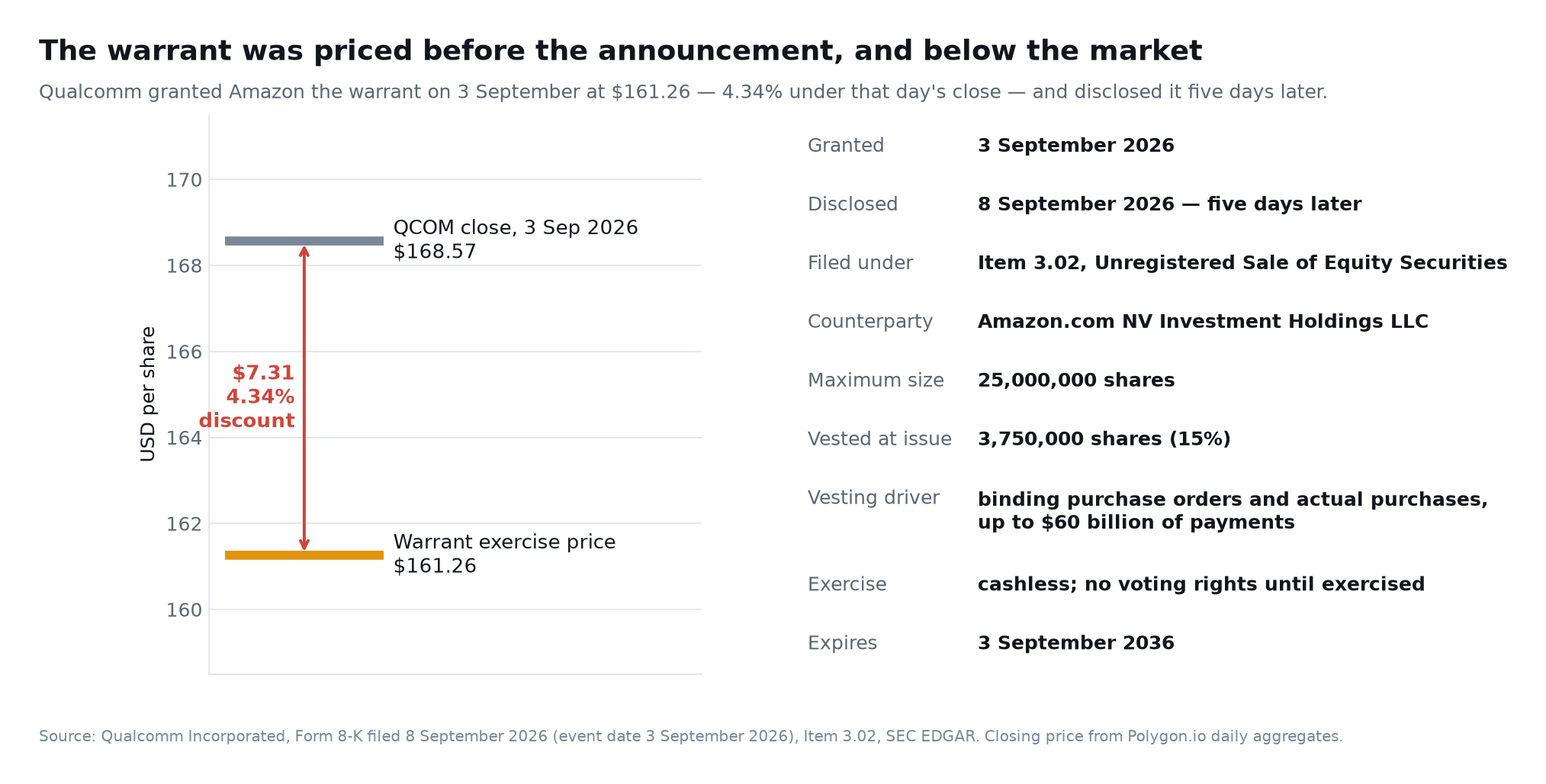
According to Qualcomm’s SEC filing, Amazon received the right to acquire as many as 25 million Qualcomm shares at an exercise price of $161.26 per share. The warrant permits cashless exercise and expires on September 3, 2036.
Two details of that filing are worth pausing on, because neither was in the press release. First, the warrant was granted on September 3, 2026 — five days before the collaboration was announced — and Qualcomm’s closing price that day was $168.57, which means the $161.26 strike was set 4.34% below the market. Second, Qualcomm disclosed it under Item 3.02, Unregistered Sales of Equity Securities, not as a material definitive agreement, and the counterparty on the warrant is Amazon.com NV Investment Holdings LLC, an investment entity, rather than Amazon.com, Inc. itself. The warrant carries no voting rights until exercised.
The shares vest in tranches connected to:
- Execution of specified commercial arrangements.
- Placement of binding purchase orders.
- Actual purchases of Qualcomm server products, technology, systems and manufacturing services.
- Aggregate payments that could reach a maximum of $60 billion during the warrant term.
The SEC filing says 3.75 million shares vested at issuance based on initial purchase commitments.
| Warrant term | Detail | Investment implication |
|---|---|---|
| Maximum shares | 25 million | Potential dilution if fully vested and exercised |
| Exercise price | $161.26 | Gives Amazon long-term exposure to QCOM upside |
| Expiration | September 3, 2036 | Supports a potentially decade-long relationship |
| Initial vesting | 3.75 million shares | Indicates initial commitments already exist |
| Maximum payment threshold | Up to $60 billion | Not a guaranteed contract value |
| Vesting mechanism | Orders, purchases and commercial milestones | Aligns Amazon’s equity benefit with Qualcomm revenue |
The often-repeated description of this as a “$4 billion stake” needs context. Multiplying 25 million shares by the $161.26 exercise price produces roughly $4.03 billion, but that is the aggregate strike-price value—not an immediate payment from Amazon or a guaranteed economic gain.
Potential dilution also matters, and the usual framing understates it. Qualcomm reported 1,050 million shares outstanding as of July 27, 2026 in its fiscal third-quarter 10-Q, so 25 million warrant shares are about 2.4% of the company — not the 2.3% that the prior-year share count implies. But the warrant is not the only equity Qualcomm has issued to build this business, and the section below puts all of it in one place.
What Qualcomm Bought to Get to This Announcement
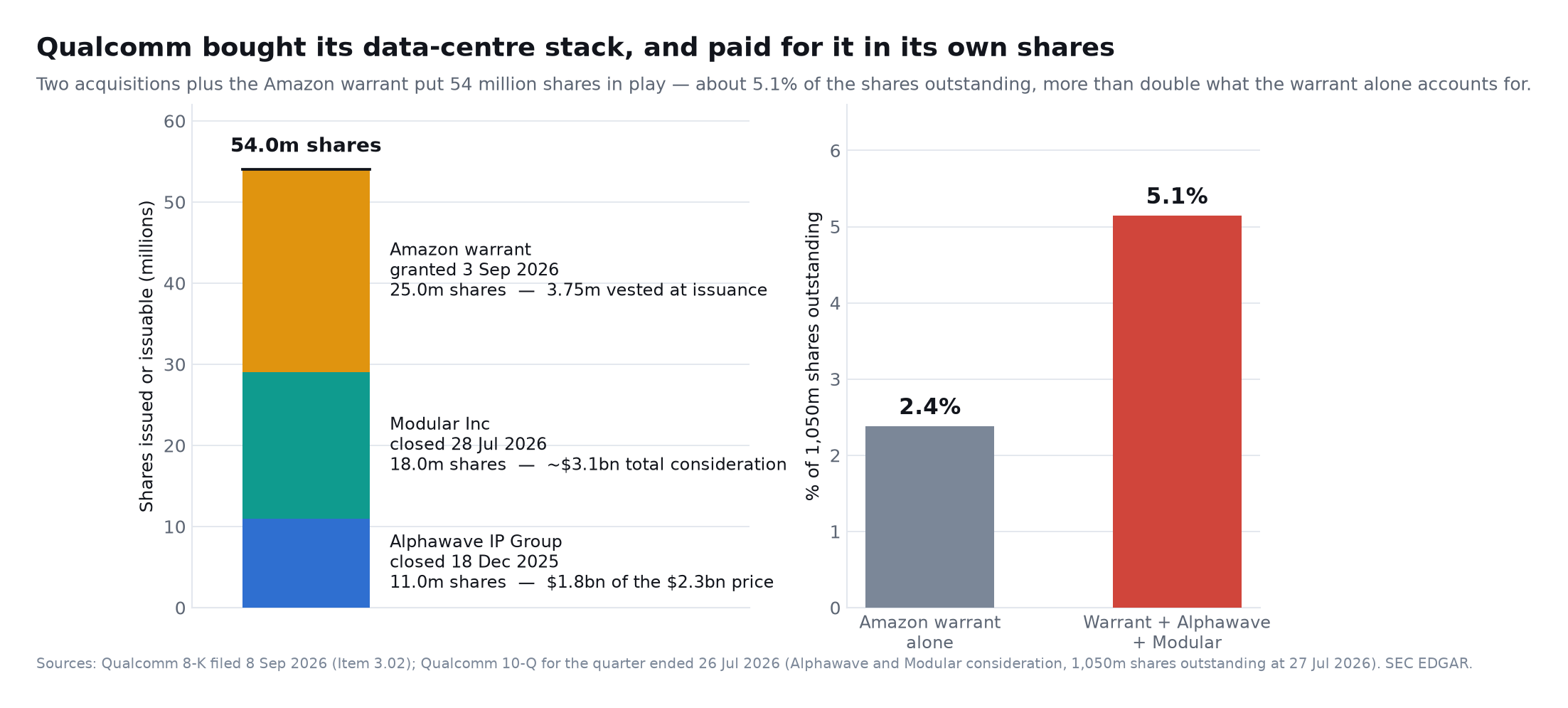
The Amazon warrant is the visible part of a much larger equity bill. Read alongside the warrant 8-K, Qualcomm's fiscal third-quarter 10-Q shows that the company assembled its data-center stack through two acquisitions in the preceding nine months, and paid for both largely in its own shares.
Alphawave IP Group plc closed on December 18, 2025 for approximately $2.3 billion: about $1.8 billion in equity — roughly 11 million shares, including 4 million Exchangeable Shares of a Canadian subsidiary carried at a $746 million fair value — plus $301 million of cash. Qualcomm described the target as a high-speed wired connectivity business acquired to "further accelerate, and provide key assets for, our expansion into data centers."
Modular Inc closed on July 28, 2026 at approximately $3.1 billion, with 18 million shares issued. About 4 million of those shares, carried at roughly $700 million of fair value, went to Modular executives against a four-year service requirement — which is to say a retention package, not purchase consideration. Modular is the AI compiler and runtime company whose technology underpins the software answer to CUDA that Qualcomm's bear case turns on. Qualcomm acquired seven further businesses during the same nine months for a combined $1.1 billion.
| Transaction | Closed | Consideration | Shares issued or issuable |
|---|---|---|---|
| Alphawave IP Group plc | December 18, 2025 | ~$2.3bn ($1.8bn equity, $301m cash) | ~11 million |
| Modular Inc | July 28, 2026 | ~$3.1bn | ~18 million |
| Amazon warrant | Granted September 3, 2026 | Vests against orders and payments up to $60bn | up to 25 million |
| Total | ~54 million |
Against 1,050 million shares outstanding, those 54 million shares are about 5.1% of the company — more than double the figure produced by looking at the warrant on its own.
The connectivity Qualcomm is selling Amazon is the connectivity it bought
The sequence matters more than the total. Qualcomm's September announcement states that the collaboration "will leverage Qualcomm Technologies' advanced SerDes and optical DSP technologies" — and SerDes and optical DSP are precisely the assets Alphawave brought, nine months earlier, in a deal Qualcomm itself justified as providing "key assets for our expansion into data centers."
That is a reasonable way to enter a market, and it is faster than building the capability internally. But it changes what the Amazon announcement evidences. It is confirmation that a hyperscaler will buy recently acquired technology, integrated into a product that has not yet shipped at volume — not confirmation that Qualcomm has developed a durable internal advantage in data-center silicon. The engineering risk that normally sits before a design win has here been moved to after it.
Why Qualcomm Is Entering the AI Data Center Now
Qualcomm built its reputation in wireless communications, smartphone processors, modems and power-efficient system-on-chip design. Those strengths are increasingly relevant to AI infrastructure because inference economics depend on more than raw compute performance.
AI operators care about:
- Tokens produced per watt.
- Tokens produced per dollar.
- Memory bandwidth and capacity.
- Latency for interactive applications.
- Rack density.
- Cooling requirements.
- Networking and optical bandwidth.
- Software portability.
- Total cost of ownership over several years.
Qualcomm believes its experience designing high-performance mobile chips under strict power constraints can transfer into the data center. A smartphone system-on-chip must integrate computing, memory, connectivity and AI acceleration while operating within a tiny power envelope. Data-center racks operate at vastly greater scale, but power efficiency remains a critical economic constraint.
At its June 2026 investor day, Qualcomm introduced the Dragonfly data-center portfolio and established an annual accelerator roadmap:
| Product | Primary purpose | Expected positioning |
|---|---|---|
| Dragonfly AI200 | AI inference accelerator | First major generation in the new roadmap |
| Dragonfly AI250 | Next-generation inference | Higher performance and improved token economics |
| Dragonfly AI300 | Future inference platform | Annual-cadence continuation of the roadmap |
| Dragonfly C1000 | Data-center CPU | Agentic AI, host processing and general compute |
| Qualcomm HBC | High-bandwidth compute technology | Addresses memory bottlenecks |
| Optical DSP and SerDes | Rack and cluster connectivity | High-speed data movement |
| Custom silicon | Hyperscaler-specific designs | Optimized customer workloads |
The official Dragonfly roadmap sets out the C1000 CPU, the AI300 accelerator and a High Bandwidth Compute memory technology that Qualcomm says reduces the energy consumed per token, on an annual release cadence. The release also claims multi-year agreements with leading AI and data-center companies and ecosystem support from more than 35 industry leaders. Detailed performance figures for these parts come from the vendor, and investors should treat them cautiously until independent systems are benchmarked.
Why AI Inference Is the Key Battleground
Training creates a model. Inference runs that model every time a person, application or AI agent submits a request.
Training workloads are enormous but episodic. Inference becomes continuous after applications enter production. Agentic AI can increase the requirement further because one user request may trigger planning, search, tool use, code execution, verification and multiple model calls.
This creates potentially massive demand for specialized inference chips.
Qualcomm does not need to beat Nvidia in every training benchmark. It could build a valuable business by winning selected, predictable inference workloads where customers prioritize cost and power efficiency over maximum flexibility.
Examples include:
- High-volume chatbot responses.
- Recommendation systems.
- Search ranking and retrieval.
- Enterprise AI agents.
- Speech and translation services.
- Computer-vision inference.
- Code assistants.
- Retrieval-augmented generation.
- Small and medium-sized language models.
- Dedicated first-party cloud workloads.
Customized silicon is particularly attractive for AWS because Amazon controls the cloud service, software layer, data-center design and workload scheduling. It can optimize hardware around high-volume internal patterns rather than supporting every possible external application.
Qualcomm’s realistic opportunity is not to duplicate Nvidia’s entire platform. It is to make selected AI inference workloads materially cheaper to operate.
Is Qualcomm the Next Serious Threat to Nvidia?
Qualcomm is now a credible participant, but it is not yet a peer-scale threat to Nvidia. It is also not the only challenger making that argument — AMD has been making a version of it for longer and from a larger data-center base, as we set out in AMD Stock 2026: The AI Chip Comeback Nvidia Can't Ignore.
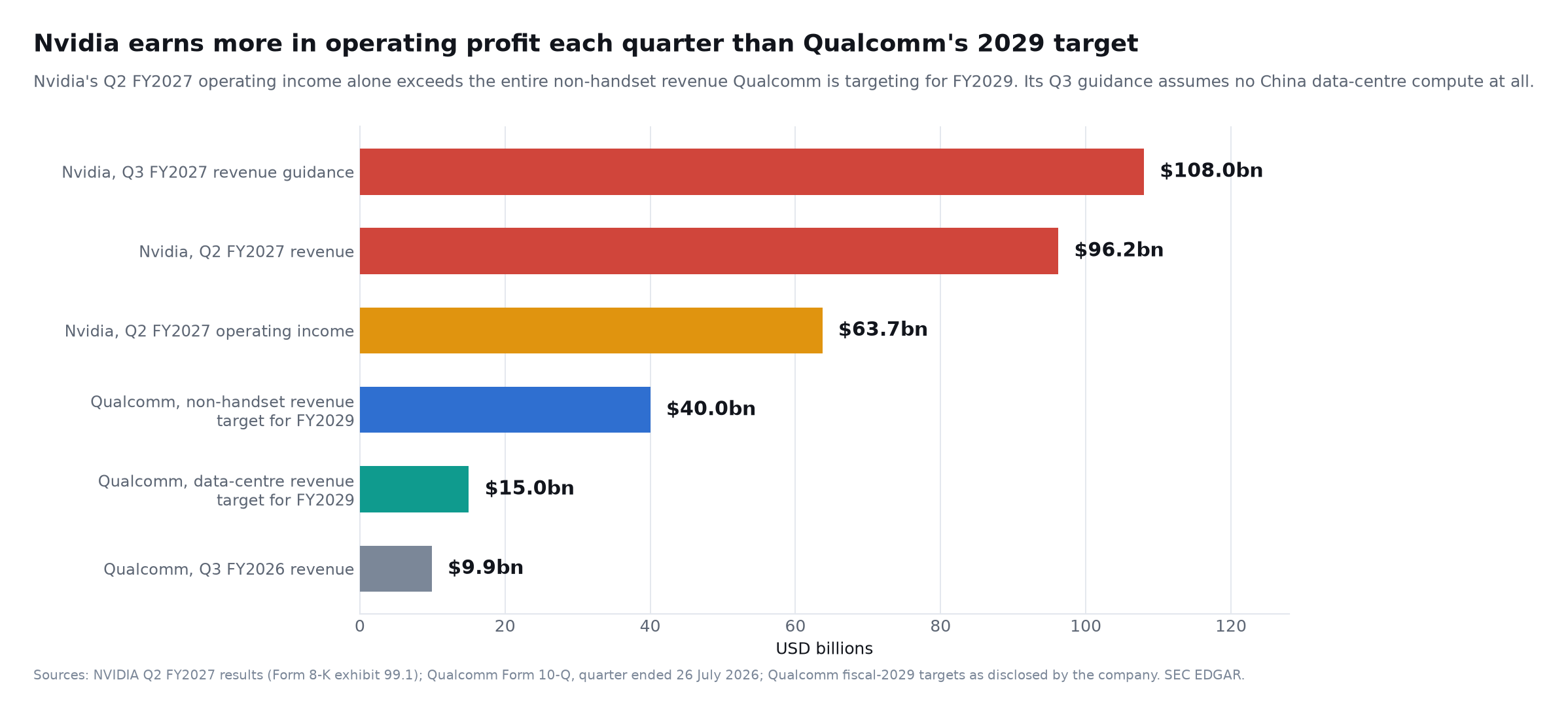
Nvidia reported fiscal second-quarter 2027 revenue of $96.2 billion, including $89.0 billion from data centers. Data-center revenue increased 117% year over year, consolidated gross margin reached 75.0%, and operating income was $63.7 billion in the quarter. Nvidia guided to $108.0 billion of revenue in its third quarter, plus or minus 2%, and stated that the figure assumes no data-center compute revenue from China at all. See Nvidia’s Q2 fiscal 2027 results, filed with the SEC on August 26, 2026.
Those numbers are worth holding next to Qualcomm’s targets rather than its current revenue. Nvidia’s operating income in a single quarter ($63.7 billion) exceeds the entire $40 billion of non-handset revenue Qualcomm is targeting for fiscal 2029, and its third-quarter revenue guidance alone is roughly two and a half times Qualcomm’s trailing-twelve-month revenue. This is not a gap that a design win closes.
Qualcomm’s entire fiscal third-quarter 2026 revenue was $9.9 billion. Even its ambitious fiscal 2029 data-center target of more than $15 billion would equal only a fraction of Nvidia’s current quarterly data-center revenue.
| Competitive factor | Qualcomm | Nvidia |
|---|---|---|
| Core AI position | Emerging inference and custom-silicon provider | Dominant full-stack accelerated-computing platform |
| Data-center scale | Early commercial ramp | Tens of billions of dollars per quarter |
| Primary strength | Power-efficient compute and connectivity | Performance, software, networking and scale |
| Software ecosystem | Developing after Modular acquisition | Mature CUDA and CUDA-X ecosystem |
| Training capability | Not yet proven at Nvidia’s level | Industry-leading frontier-model platform |
| Inference strategy | Specialized, efficient and customized | Broad platform spanning nearly all AI workloads |
| Hyperscaler leverage | Amazon and other multi-generation engagements | Deep relationships across major clouds |
| Main risk | Execution and ecosystem adoption | Custom silicon and customer concentration |
The word threat also needs definition. Qualcomm does not have to cause Nvidia’s revenue to decline to become a competitive threat. It can pressure Nvidia in several narrower ways:
- Capture incremental inference workloads.
- Give AWS negotiating leverage over GPU pricing.
- Reduce Nvidia’s share of future cloud capital expenditure.
- Compete in low-power and memory-intensive use cases.
- Supply custom silicon that never becomes available to Nvidia.
- Challenge Nvidia in optical connectivity or host processing.
AI infrastructure spending is expanding so rapidly that Qualcomm and Nvidia can both grow. The competitive issue is the distribution of future industry profits, not necessarily a zero-sum transfer of existing revenue.
Amazon Is Still Making an Enormous Commitment to Nvidia
The clearest reason not to overstate the Qualcomm announcement is Amazon’s simultaneous expansion with Nvidia.
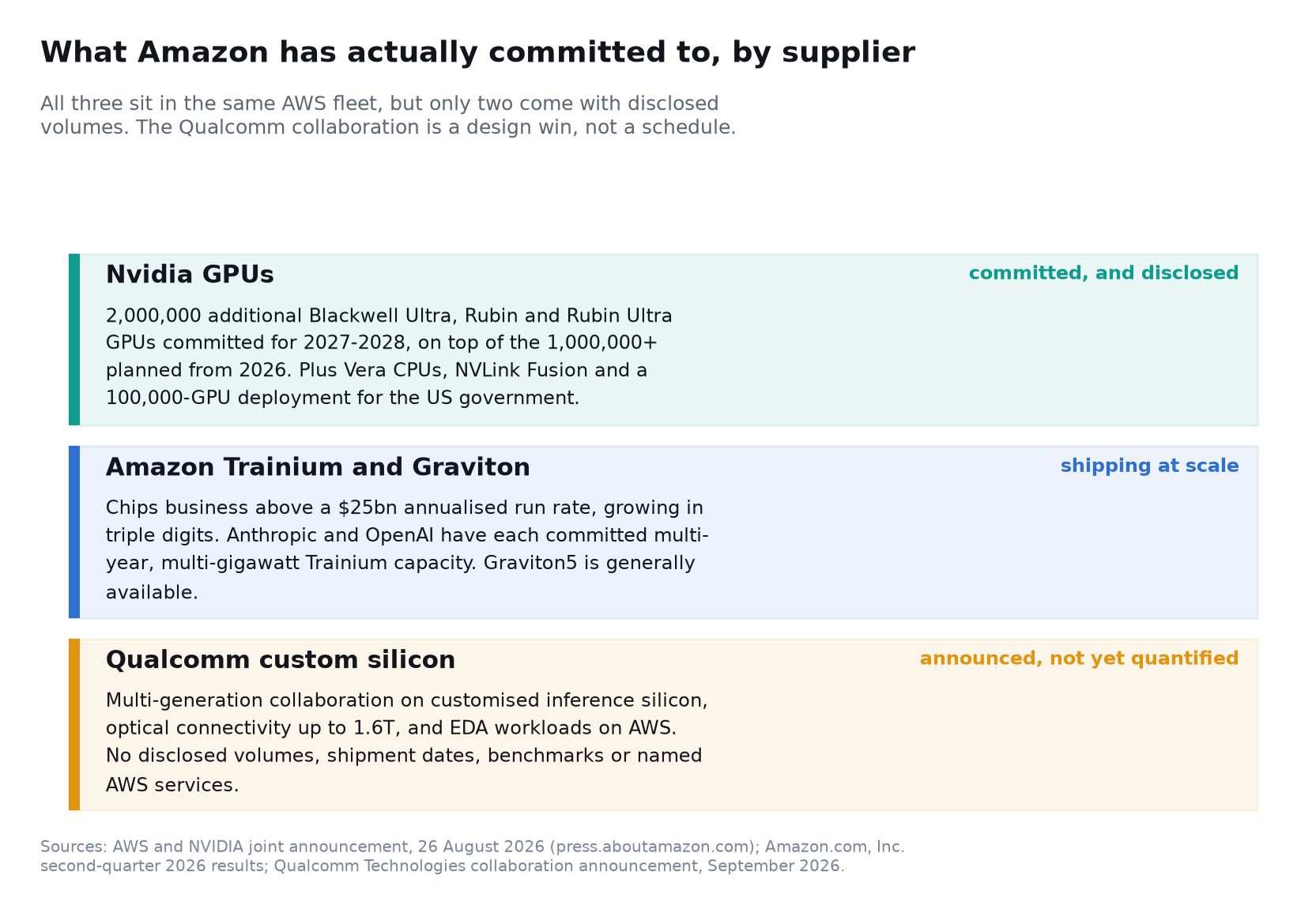
On August 26, 2026, AWS announced plans to deploy two million additional Nvidia Blackwell Ultra, Rubin and Rubin Ultra GPUs during 2027 and 2028. This follows an earlier plan to add more than one million Nvidia GPUs beginning in 2026.
The expanded AWS-Nvidia collaboration also includes:
- Nvidia Vera CPU infrastructure on AWS.
- NVLink Fusion and Nvidia high-bandwidth memory.
- Nvidia networking technology.
- A planned 100,000-GPU AI infrastructure deployment for the U.S. government.
- Nemotron models through Bedrock and SageMaker.
- GPU-accelerated analytics and vector indexing.
- Nvidia’s physical-AI platform for Amazon Robotics.
That is not the behavior of a customer preparing to abandon Nvidia. Amazon is building a portfolio of compute architectures because no single chip can economically serve every workload.
Amazon’s likely chip hierarchy
- Nvidia GPUs: Maximum flexibility, training, advanced inference, robotics and CUDA-dependent workloads.
- AWS Trainium: Amazon-controlled training and inference economics for large customers.
- AWS Graviton: General-purpose and CPU-intensive agentic workloads.
- Qualcomm custom silicon: Specialized inference, server components and connectivity.
- Other merchant silicon: Additional CPUs, accelerators, networking and storage components.
The Amazon Qualcomm AI chip deal therefore validates heterogeneous computing, not Qualcomm supremacy.
Why Amazon Wants Another AI Chip Partner
Amazon’s motivations are strategic as well as technical.
AWS generated $42.2 billion of revenue in the second quarter of 2026, up 37% year over year, while AWS operating income reached $16.6 billion. Amazon said its AI and chip businesses had each exceeded a $25 billion annual revenue run rate. These numbers appear in Amazon’s Q2 2026 results.
Rapid demand is forcing Amazon to spend heavily. On a trailing-twelve-month basis, operating cash flow rose 33% to $161.4 billion, yet free cash flow was an outflow of $7.6 billion, because purchases of property and equipment increased by $66.1 billion year over year. In other words, Amazon is now converting essentially all of a record operating cash flow, and then some, into infrastructure — the spending question we examined in Amazon Q2 Earnings 2026: Can AWS Growth Justify $200B in AI Capex?.
A successful custom chip can improve Amazon’s economics in several ways:
- Lower hardware acquisition cost.
- Reduce power and cooling expenses.
- Improve rack utilization.
- Optimize chips for AWS software and internal workloads.
- Reduce dependence on a single supplier.
- Protect AWS gross margins as AI usage expands.
- Create differentiated EC2 products.
- Strengthen negotiating leverage with semiconductor vendors.
Amazon’s business objective is not to choose a permanent chip winner. It is to deliver the best mix of performance, availability and price while retaining control over its infrastructure economics.
The Incumbent Qualcomm Has to Displace Is Amazon, Not Nvidia
The question in this article's title — is Qualcomm a threat to Nvidia — is the wrong comparison for the deal actually announced. Qualcomm has not been invited into AWS to replace the GPUs Amazon buys. It has been invited into the part of AWS that Amazon currently supplies itself.
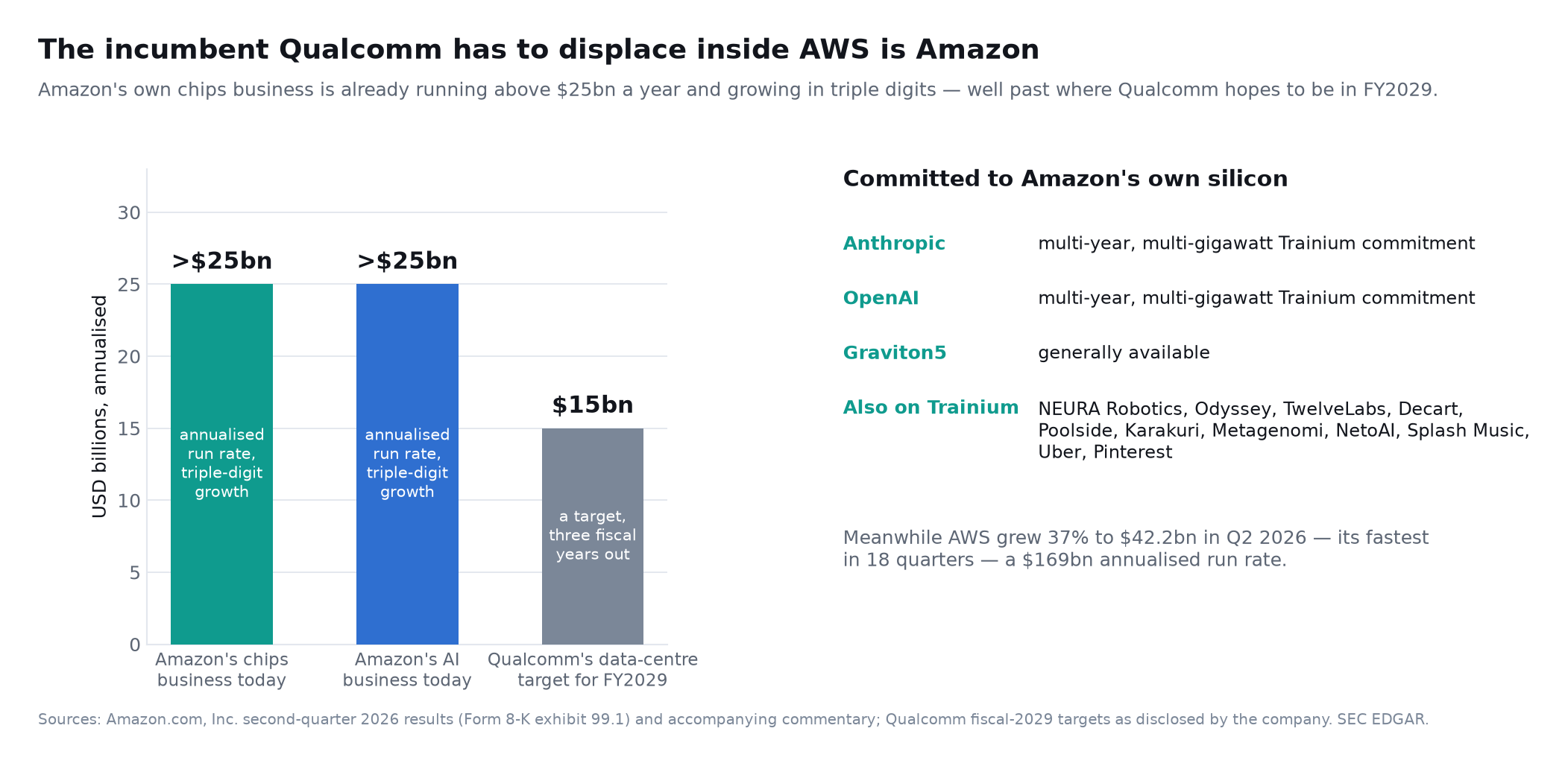
By Amazon's own second-quarter 2026 disclosure, the company's chips business is running above a $25 billion annualised rate, and its AI business is running above a $25 billion annualised rate, both growing in triple digits. Amazon named the customers: Anthropic and OpenAI have each made multi-year, multi-gigawatt commitments to Trainium, alongside NEURA Robotics, Odyssey, TwelveLabs, Decart, Poolside, Karakuri, Metagenomi, NetoAI, Splash Music, Uber and Pinterest. Graviton5 is generally available.
Set that against Qualcomm's stated ambition. Qualcomm is targeting more than $15 billion of data-center revenue in fiscal 2029. Amazon's internal silicon business passed that run rate before the Qualcomm collaboration was announced, and is compounding at triple-digit rates while it does so.
This reframes both the opportunity and the risk:
- The addressable slice is narrower than the headline suggests. Amazon's first preference for high-volume internal inference is Trainium, which it owns outright and can schedule against its own capacity. Qualcomm is competing for what Trainium does not economically cover.
- The customer is also the competitor. AWS designs its own accelerators, its own CPUs, its own networking silicon and its own hypervisor offload. Every Qualcomm part that succeeds inside AWS teaches Amazon how to build the next one.
- But the pie is genuinely enormous. AWS grew 37% to $42.2 billion in the second quarter of 2026 — its fastest growth in eighteen quarters — for a $169 billion annualised run rate, with segment operating income of $16.6 billion against $10.2 billion a year earlier. Even a small, durable share of the silicon behind that would be material to Qualcomm.
The correct read of the warrant follows from this. Amazon did not pay Qualcomm $4 billion; it granted itself the option to participate in Qualcomm's upside if and only if Amazon itself places the orders. Amazon has written itself a call option on its own purchasing decisions, at a strike set below the market, with no obligation attached. That is an unusually favourable structure for the buyer, and it is worth understanding as such before reading it as a vote of confidence.
The Bull Case for QCOM Stock
The Amazon deal strengthens the QCOM bull case in five important ways.
1. It validates Qualcomm’s data-center technology
PowerPoint roadmaps do not guarantee customer adoption. Amazon’s initial purchase commitments and multi-generation structure provide meaningful third-party validation.
A hyperscaler such as AWS imposes demanding requirements for reliability, supply continuity, software integration and total cost of ownership. Passing Amazon’s technical and commercial evaluation increases the credibility of Qualcomm’s broader data-center plan.
2. It creates a path beyond smartphones
Qualcomm has long faced concerns about handset-market maturity, China exposure and Apple’s development of internal modem technology. Data-center revenue could diversify the company into a faster-growing market with larger content opportunities.
Qualcomm’s fiscal 2029 targets include:
- More than $15 billion in data-center revenue.
- $40 billion in total non-handset revenue.
- $10 billion in automotive revenue.
- More than $14 billion in IoT revenue.
- Non-GAAP earnings above $18 per share.
These are management targets, not guarantees. Nevertheless, Amazon makes the data-center target more plausible than it was before the announcement.
3. Custom silicon can produce durable revenue
A successful server product normally involves long design and qualification cycles. Once deployed at scale, replacement is difficult because hardware becomes connected to compilers, data-center layouts, networking and operating software.
The multi-generation language suggests that Qualcomm could participate across repeated AWS upgrade cycles rather than making a one-time sale.
4. Optical connectivity expands Qualcomm’s opportunity
AI clusters require enormous amounts of data to move between processors, memory, racks and buildings. As model sizes and inference traffic grow, connectivity can become as important as the accelerator itself.
Qualcomm’s work on 1.6T optical solutions gives it an opportunity to sell additional high-value technology around the compute platform. That may expand content per deployment and improve customer stickiness.
5. QCOM’s valuation remains far below Nvidia’s market value
QCOM closed at $174.09 on September 8, 2026 — the announcement day — and at $176.40 on September 9, giving it a market capitalization near $185 billion on the 1,050 million shares outstanding. Nvidia closed at $225.73 and $223.67 on the same two days, with a market capitalization around $5.4 trillion, according to contemporaneous QCOM market data and NVDA market data.
The market does not require Qualcomm to match Nvidia for QCOM to generate attractive returns. A credible $15 billion data-center business could materially change Qualcomm’s growth mix and valuation multiple.
How the Market Actually Priced the Announcement
The reaction is frequently reported as a straightforward jump. The intraday record is more informative than the headline.
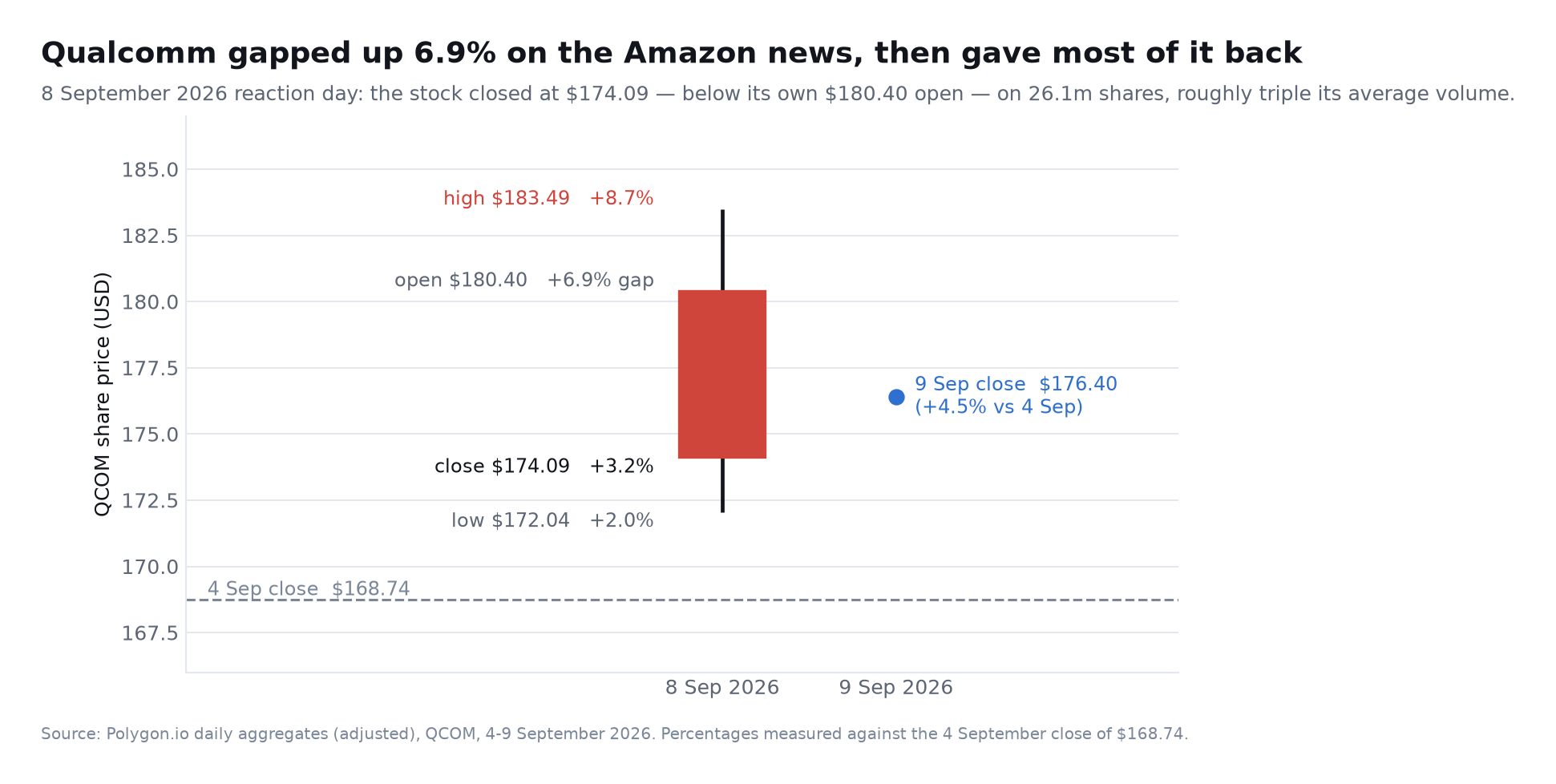
Qualcomm closed at $168.74 on September 4, the last session before the announcement. On September 8 it opened at $180.40 — a 6.9% gap up — traded as high as $183.49 (+8.7%), fell as low as $172.04, and closed at $174.09, a gain of 3.2%, on 26.1 million shares. The stock finished the day below its own opening price: every buyer who acted on the headline at the open ended the session underwater. It closed at $176.40 on September 9.
That pattern — gap, fade, partial recovery — is what a market does when it agrees an announcement is strategically real but cannot yet size the revenue. It is consistent with the filing itself, which discloses milestones and a ceiling but no order book.
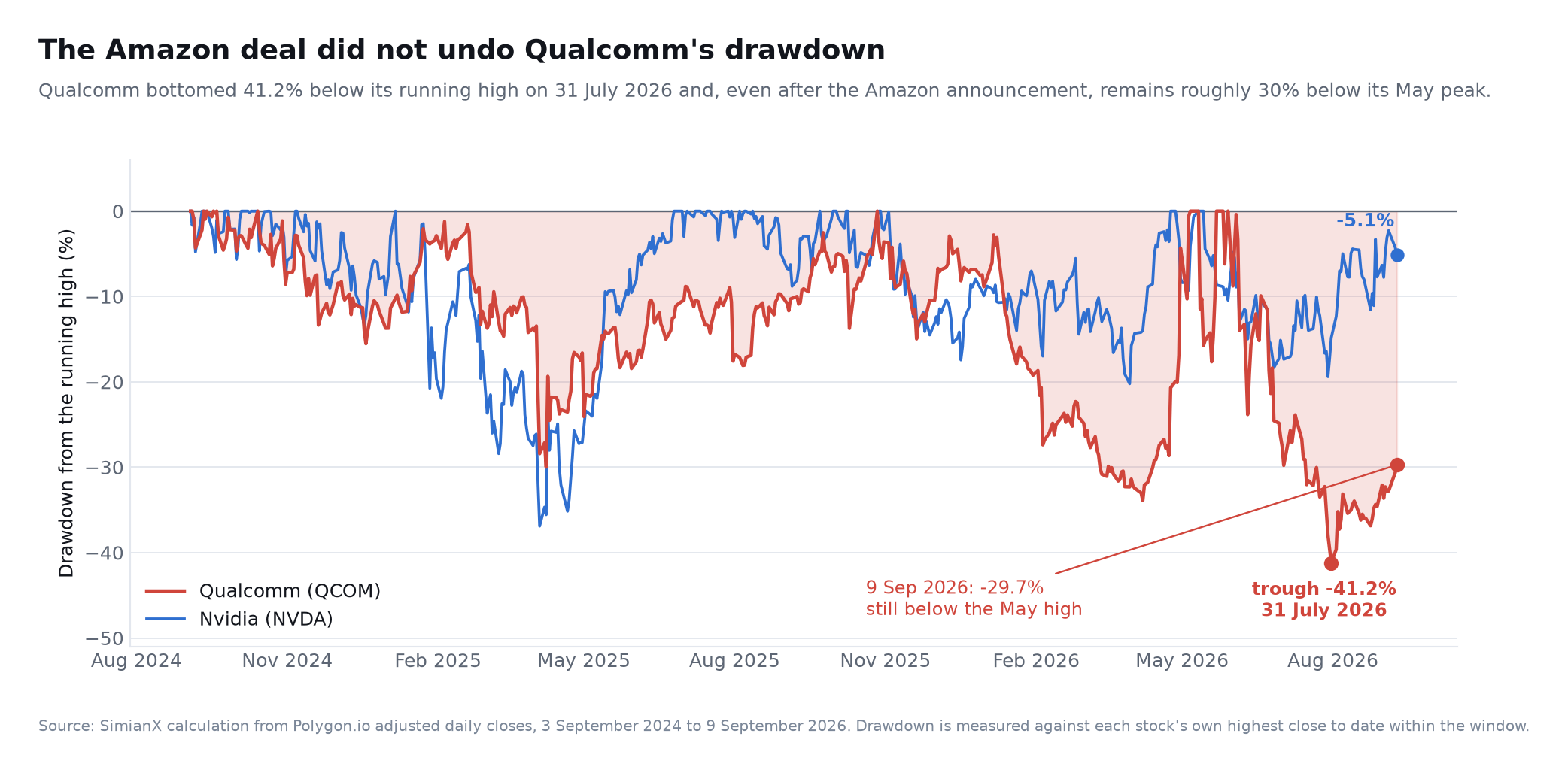
The longer frame matters too. Measured against its own running high, Qualcomm bottomed 41.2% below on July 31, 2026, and even after the Amazon announcement it remains roughly 30% below its May 2026 peak. Nvidia, over the same window, sits about 5% off its high. The Amazon deal has recovered a fraction of a drawdown that a strategic partnership was never going to reverse on its own. For how deep semiconductor drawdowns have historically run, see Semiconductor Bear Markets: Every SOX Crash, 1995-2026.
The financial base the strategy is being funded from
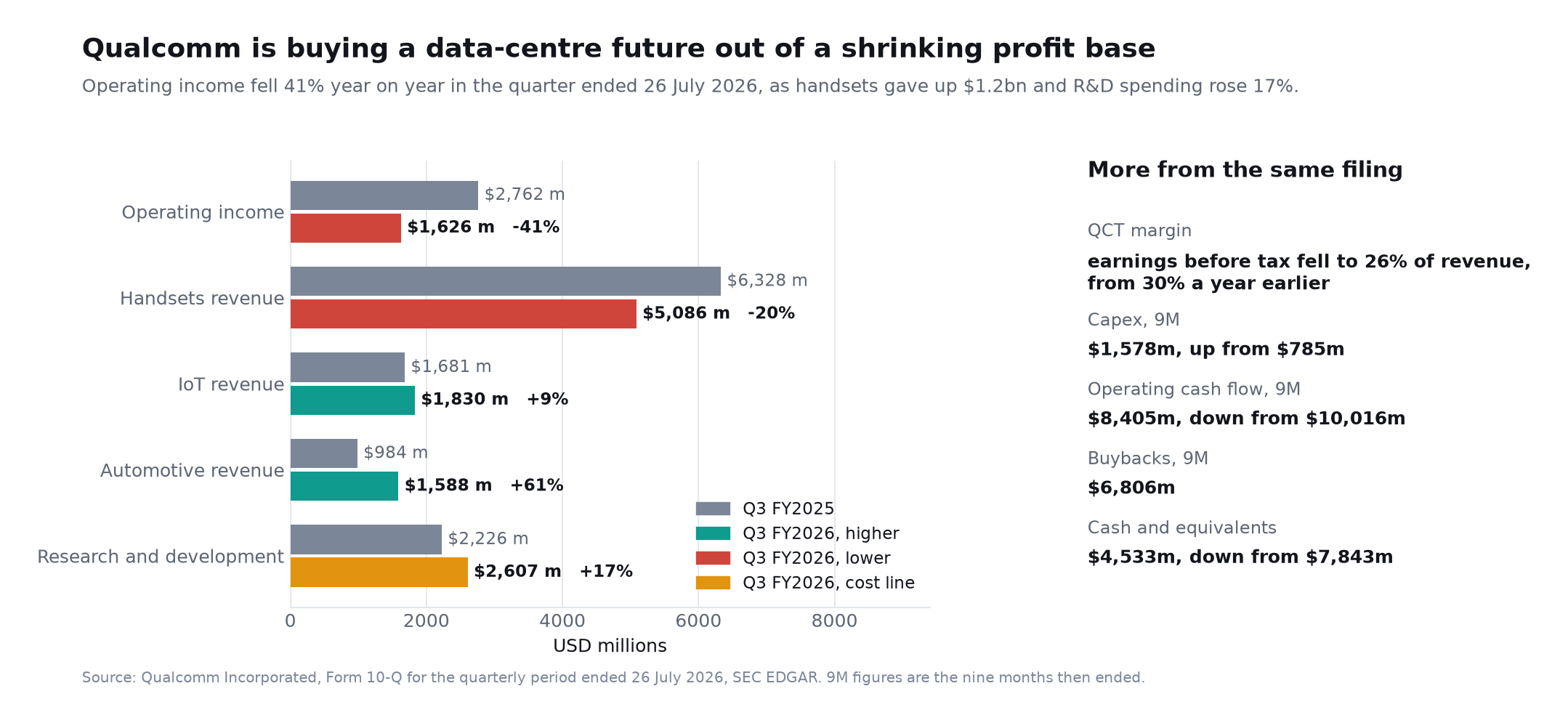
The same 10-Q that discloses the Alphawave and Modular acquisitions also shows what Qualcomm's operating business was doing while it made them. In the quarter ended July 26, 2026:
- Operating income fell 41% to $1,626 million, from $2,762 million a year earlier.
- Handsets revenue fell $1,242 million to $5,086 million.
- Research and development rose 17% to $2,607 million.
- QCT earnings before tax fell to 26% of revenue, from 30%.
- Automotive ($1,588 million, up $604 million) and IoT ($1,830 million, up $149 million) grew, but not by enough to offset handsets.
The nine-month cash figures point the same way: capital expenditure doubled to $1,578 million from $785 million, operating cash flow fell to $8,405 million from $10,016 million, $6,806 million went to buybacks, and cash and equivalents fell to $4,533 million from $7,843 million.
None of this makes the data-center strategy wrong. It does establish the constraint the strategy operates under: Qualcomm is funding a multi-year, capital-hungry expansion out of a profit base that is currently contracting, which is why it has been paying for acquisitions in stock rather than cash.
The Bear Case and What Could Go Wrong
The announcement is strategically important, but investors should not capitalize the maximum $60 billion payment threshold as guaranteed revenue.
Revenue timing remains uncertain
Custom data-center silicon can take years to design, validate and deploy. The Dragonfly C1000 is not expected to be commercially available until 2028, and the Amazon announcement did not disclose when material revenue will begin.
Purchase milestones are not guaranteed sales
The warrant vests against milestones extending up to $60 billion of payments. That figure defines the top end of the incentive structure; it does not mean Amazon has placed a firm $60 billion order.
Software remains Nvidia’s strongest moat
Nvidia’s CUDA platform includes compilers, optimized libraries, networking, model frameworks, debugging tools and a large developer community. Semiconductor performance alone is insufficient if customers face high migration costs or unreliable software — and Nvidia has been buying distribution into that developer layer as well, as we covered in Nvidia's Hugging Face Deal: Buying the AI Developer Funnel.
Qualcomm’s acquisition of Modular may improve its software foundation, but building a production-grade alternative at data-center scale will require sustained execution.
Amazon has strong bargaining power
AWS is not merely a customer. It is a sophisticated chip designer with Trainium, Inferentia, Graviton, Nitro and Annapurna Labs. Amazon can use external partners to fill technical gaps while retaining pricing power and internalizing more value over time.
Concentration may become a risk
If Amazon contributes a large share of Qualcomm’s early data-center revenue, delays or strategy changes at AWS could materially affect QCOM’s targets.
The smartphone business still matters
Qualcomm’s third-quarter fiscal 2026 revenue was $9.9 billion, and its current results remain heavily influenced by smartphones. Operating income in that quarter fell 41% year over year, with handsets alone giving up $1.2 billion. Automotive and IoT are growing, but handset weakness, Apple-related revenue declines and memory-market constraints can still outweigh early AI optimism — and a data-center business large enough to offset them is several years away on the company’s own timetable.
Warrants create dilution
Full exercise of 25 million shares could dilute existing holders. The economic trade-off is favorable only if Amazon-related revenue and profit exceed the cost of that dilution.
A Scenario Framework for Qualcomm’s AI Opportunity
Rather than assigning the full target to today’s valuation, investors can use three scenarios.
| Scenario | Fiscal 2029 data-center outcome | Likely interpretation |
|---|---|---|
| Bear case | $4–7 billion | Delays, limited software adoption and heavy Amazon concentration |
| Base case | $10–15 billion | Successful AWS ramp plus several additional customers |
| Bull case | More than $15 billion | Strong inference adoption, optical wins and broad hyperscaler demand |
Bear case
Qualcomm ships custom components to Amazon, but deployment is delayed and margins are lower than expected. Nvidia maintains overwhelming platform dominance, while Trainium absorbs most AWS custom-silicon demand.
In this scenario, the deal is strategically useful but insufficient to transform Qualcomm’s earnings.
Base case
Amazon deployments ramp across multiple generations, Qualcomm approaches its fiscal 2029 target, and the company adds at least two meaningful data-center customers. Automotive, IoT and licensing continue to generate cash while AI infrastructure improves the growth mix.
This scenario could justify a higher valuation than that of a mature smartphone-chip supplier.
Bull case
Qualcomm proves superior tokens-per-watt economics for agentic inference, wins significant optical-connectivity content and establishes a credible open software ecosystem. Amazon becomes an anchor rather than the only major customer.
Under this outcome, Qualcomm evolves into a diversified computing-platform company spanning edge devices, vehicles, robots and data centers.
How Investors Should Monitor the Amazon Qualcomm AI Chip Deal
Investors should treat the announcement as the beginning of an evidence-gathering process.
Track the following indicators each quarter:
- Data-center revenue disclosure: Look for a separate revenue line or clearer contribution estimates.
- Amazon purchase milestones: Monitor SEC filings for additional warrant vesting or binding orders.
- Product availability: Watch whether AI200, AI250, AI300 and C1000 remain on schedule.
- Independent benchmarks: Prioritize production token throughput, latency, power and total-cost data.
- Software adoption: Monitor supported models, frameworks, developers and cloud services.
- Customer diversification: Look for deployments beyond Amazon.
- Gross margin: Determine whether data-center growth improves or dilutes Qualcomm’s profitability.
- Capital intensity: Track R&D, acquisitions, inventory and working-capital requirements.
- Nvidia response: Watch pricing, inference products, CUDA improvements and custom-silicon partnerships.
- AWS instance launches: Commercial EC2 availability would be stronger evidence than a design announcement.
SimianX AI can assist with this process by combining price action, SEC filings, earnings data, analyst revisions and news sentiment for Qualcomm, Nvidia and Amazon. Its multi-agent format is useful here because the thesis crosses several disciplines: semiconductor technology, financial modeling, cloud capital expenditure and competitive strategy.
Investors should still verify material claims in original filings. AI-generated analysis—including SimianX output—should supplement due diligence rather than replace it.
Is QCOM Stock a Buy After the Amazon Deal?
The deal improves Qualcomm’s long-term investment thesis, but it does not automatically make QCOM attractive at every price.
A disciplined decision should separate three questions:
Is the data-center strategy credible?
After the Amazon announcement, the answer is more credible than before. Initial commitments, multi-generation collaboration and warrant vesting provide commercial evidence.
Is Qualcomm already a major Nvidia competitor?
No. Qualcomm is an emerging inference and custom-silicon competitor. Nvidia remains vastly larger, more profitable and more deeply embedded across the AI software and hardware stack.
Does the opportunity justify QCOM’s valuation?
That depends on the revenue ramp, margins and probability assigned to the fiscal 2029 targets. Investors should avoid paying today for the full bull case before production evidence appears.
One practical approach is to build a scorecard:
| Question | Positive evidence | Warning sign |
|---|---|---|
| Is Amazon ordering at scale? | New binding orders and warrant vesting | No updates after initial announcement |
| Is the roadmap on time? | Samples and commercial systems launch as scheduled | Repeated product delays |
| Is software improving? | More frameworks, models and AWS services | Difficult migrations and poor utilization |
| Are margins attractive? | Data-center growth lifts earnings | Revenue rises but R&D and support absorb profits |
| Is the customer base broadening? | Additional hyperscaler wins | Persistent dependence on Amazon |
| Is Nvidia losing share? | Qualcomm wins production inference workloads | Qualcomm remains limited to experimental systems |
FAQ About the Amazon Qualcomm AI Chip Deal
Did Amazon choose Qualcomm instead of Nvidia?
No. Amazon chose Qualcomm for customized AI inference silicon and connectivity while simultaneously expanding its Nvidia relationship. AWS plans to deploy two million additional Nvidia GPUs in 2027–2028, on top of more than one million previously planned GPUs.
How much is the Amazon Qualcomm deal worth?
The companies did not disclose guaranteed contract revenue. Qualcomm’s warrant filing ties vesting milestones to purchases and payments of up to $60 billion, but that maximum threshold should not be treated as a firm order.
Can Qualcomm AI chips compete with Nvidia GPUs?
Qualcomm may compete effectively in selected inference workloads where power efficiency, latency and total cost matter most. Nvidia retains major advantages in frontier-model training, general accelerated computing, networking and the CUDA software ecosystem.
What does the deal mean for QCOM stock?
It validates Qualcomm’s expansion beyond smartphones and makes its target of more than $15 billion in fiscal 2029 data-center revenue more credible. The stock’s long-term outcome still depends on shipment timing, margins, software execution and additional customers.
Is Qualcomm a serious long-term threat to Nvidia?
Qualcomm is becoming a serious niche and custom-silicon challenger, especially in inference. It is not yet a serious threat to Nvidia’s overall revenue scale or full-stack platform leadership.
Conclusion
The Amazon Qualcomm AI chip deal is one of Qualcomm’s most important strategic wins in years. It validates the company’s power-efficient computing expertise, establishes a multi-generation relationship with a leading hyperscaler and creates a path toward meaningful data-center revenue.
But the headline requires careful interpretation. Amazon is not replacing Nvidia. AWS is simultaneously expanding its Nvidia deployment by millions of GPUs, investing in Trainium and Graviton, and adding Qualcomm as another specialized partner.
The most likely outcome is a heterogeneous AI market:
- Nvidia remains the leading full-stack platform.
- Amazon expands its internal silicon portfolio.
- Qualcomm competes for custom inference and connectivity.
- Customers select architectures according to workload economics.
For QCOM shareholders, Qualcomm does not need to become “the next Nvidia.” It needs to convert the Amazon validation into profitable shipments, hit product deadlines, develop competitive software and win more customers. If it does, data centers could materially reduce Qualcomm’s dependence on smartphones and support a higher long-term valuation.
Related Reading
- Amazon Q2 Earnings 2026: Can AWS Justify $200B AI Capex?
- AMD Stock 2026: $6.7B Data Center Quarter vs Nvidia's $75B
- Nvidia Hugging Face Deal 2026: $12.9B at 86x Revenue
- TSMC Stock 2026: Why Nvidia Still Can't Replace Its Fab
- SK Hynix Stock Surges 8%: Is the AI Supercycle Real?
- Cerebras Stock 2026: AI Chip Boom vs Gross Margin Risk
- Semiconductor Bear Markets: Every SOX Crash, 1995-2026
- Amazon Joins the $3 Trillion Club: The Complete Timeline
Sources
- Qualcomm Incorporated, Form 8-K filed September 8, 2026 (Item 3.02, Amazon warrant) - SEC EDGAR
- Qualcomm Incorporated, quarterly and current reports - fiscal third-quarter 2026 Form 10-Q, Alphawave and Modular consideration, shares outstanding
- Qualcomm announces a multi-generational product collaboration with Amazon - Qualcomm Technologies, September 2026
- Qualcomm unveils its data-center roadmap for the agentic AI era - Dragonfly C1000, AI300 and High Bandwidth Compute, June 2026
- NVIDIA Corporation, Form 8-K filed August 26, 2026 (Item 2.02, second-quarter fiscal 2027 results) - SEC EDGAR
- AWS and NVIDIA to deliver 2 million additional GPUs and next-generation infrastructure - Amazon press centre, August 26, 2026
- Amazon second-quarter 2026 results - AWS revenue, chips and AI run rates, Trainium commitments, capital expenditure
- QCOM market data and NVDA market data - closing prices and market capitalisation
- Polygon.io - adjusted daily aggregates used for the reaction-day and drawdown calculations
Use SimianX AI to follow QCOM, NVDA and AMZN through real-time news, fundamental data, SEC filings and technical signals. Treat the platform as a research aid, independently verify critical information and consult a qualified financial adviser before making investment decisions.