Cerebras (CBRS) in 2026: Framing the Growth-vs-Margin Debate
Cerebras Stock 2026 is one of the most debated AI infrastructure stories in the public market: a newly listed AI chip company riding explosive demand for inference compute while facing serious questions about gross margin, customer concentration, and data center execution. For investors using platforms like SimianX AI, the key is not simply deciding whether Cerebras is “the next Nvidia,” but building a disciplined research framework that weighs growth, profitability, valuation, and risk together.
Why Cerebras Stock 2026 Is Getting So Much Attention
Cerebras Systems entered the public market at a moment when AI infrastructure demand is still expanding rapidly. The company’s core pitch is simple: its wafer-scale architecture is designed to deliver extremely fast AI inference, especially for latency-sensitive applications such as coding assistants, chatbots, agentic AI workflows, and enterprise AI tools.
That matters because the AI market is shifting from pure model training toward high-volume inference. Training is about building models. Inference is about running those models repeatedly for real users. If AI usage keeps rising, inference workloads may become one of the largest compute opportunities in technology.
The central Cerebras investment debate is not whether AI compute demand is real. It is whether Cerebras can convert that demand into durable, high-margin revenue.
Cerebras reported strong first-quarter 2026 revenue growth, signed major commercial relationships, and raised its full-year revenue outlook. Yet the stock also sold off after investors focused on lower near-term gross margin guidance. That contrast creates the core research question: is Cerebras stock in 2026 a growth opportunity, or is the margin risk too high?
The Cerebras Stock 2026 Snapshot
| Research Area | Bull Case | Risk Case |
|---|---|---|
| Revenue growth | AI inference demand is accelerating | Growth may depend on a few large customers |
| OpenAI deal | Multi-year demand visibility | Execution and capacity obligations are complex |
| AWS partnership | Wider distribution channel | Revenue timing may be uneven |
| Gross margin | Long-term scale could improve unit economics | Near-term margin compression may persist |
| Competition | Differentiated wafer-scale architecture | Nvidia, AMD, Broadcom, custom ASICs, and cloud chips remain strong |
| Valuation | Scarce public AI chip pure play | High expectations leave little room for disappointment |
What Makes Cerebras Different From Traditional AI Chip Stocks?
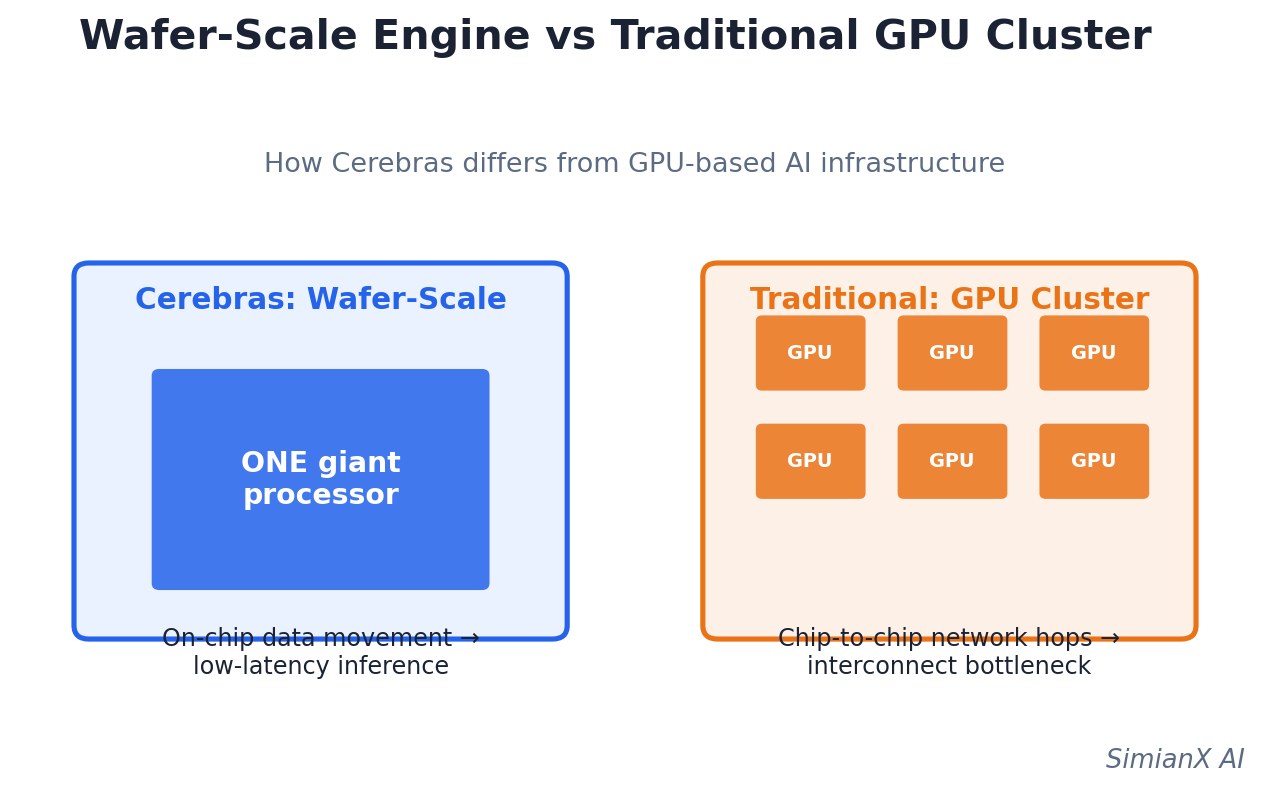
Cerebras is not just another GPU company. Its flagship technology is based on a wafer-scale engine, meaning the processor is far larger than a traditional chip. Instead of packaging many smaller chips together, Cerebras builds a giant processor designed to reduce communication bottlenecks and improve speed for certain AI workloads.
That distinction is important for investors because AI chips are not all competing in the same way. Nvidia dominates the GPU ecosystem because of performance, software, networking, developer adoption, and installed base. Cerebras is trying to win by focusing on speed, simplicity, and large-scale inference performance.
Key Cerebras differentiators include:
- Wafer-scale architecture designed for large AI workloads
- Low-latency inference positioning
- Cloud and on-premises deployment options
- Partnerships with major AI and cloud customers
- A differentiated alternative to GPU-based infrastructure
However, differentiation alone does not guarantee a great stock. A company can have impressive technology and still struggle if manufacturing costs, data center costs, customer concentration, or competitive pressure compress returns.
How Big Is the AI Chip Sales Boom for Cerebras?
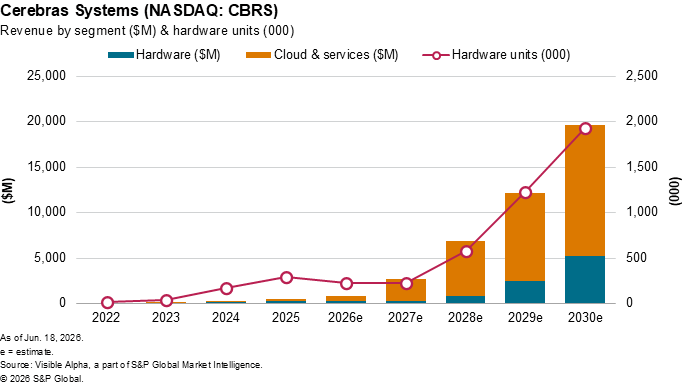
The AI chip sales boom is the strongest part of the Cerebras stock 2026 bull case. The company’s reported first-quarter 2026 revenue showed rapid year-over-year growth, with both hardware and cloud/services contributing. More importantly, the company’s guidance suggested continued growth through fiscal 2026.
For investors, the most important point is that Cerebras is not just selling hardware boxes. It is increasingly building a business around AI inference capacity, cloud access, and service-based compute relationships. That shift could make revenue more recurring over time, but it also changes the margin profile.
Revenue Growth Drivers to Watch
- OpenAI capacity demand
OpenAI’s need for large-scale inference compute could provide multi-year revenue visibility. If Cerebras delivers capacity on schedule, the relationship may become a major proof point for the company’s architecture.
- AWS distribution
A partnership with AWS could help Cerebras reach startups, enterprises, and AI-native companies that already use AWS infrastructure. This may reduce go-to-market friction.
- Enterprise AI adoption
As companies deploy copilots, agents, search tools, and multimodal AI applications, inference demand can rise quickly.
- Developer ecosystem growth
The more developers can access Cerebras through familiar platforms and APIs, the easier it becomes for the company to build workload stickiness.
- Latency-sensitive AI workloads
Coding, real-time chat, agent workflows, and interactive enterprise applications may reward faster inference.
A useful Cerebras stock forecast framework should separate demand growth from profit quality. Revenue acceleration is powerful, but only if the company can scale without destroying margins.
Why Margin Risk Is the Biggest Issue for Cerebras Stock 2026
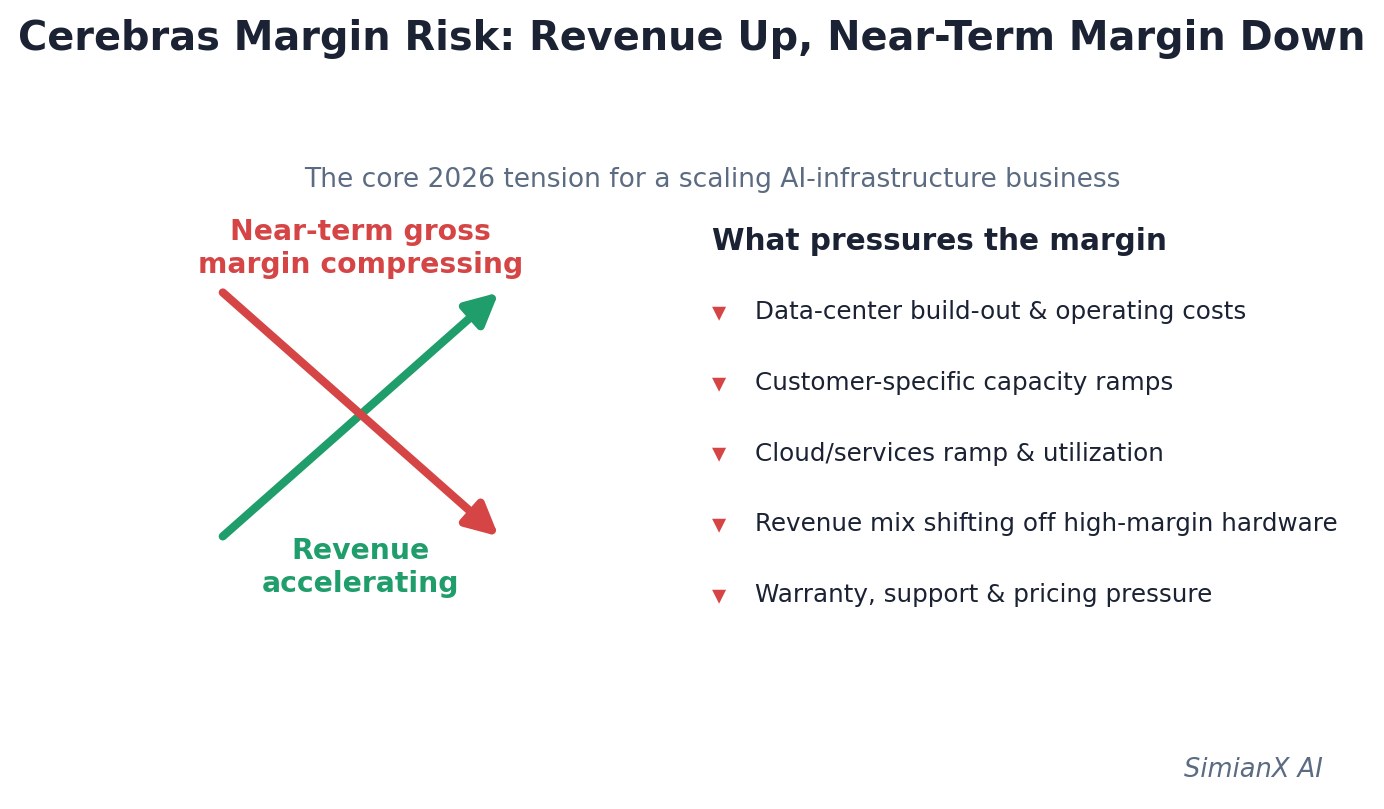
The main concern for Cerebras Stock 2026 is margin risk. After a strong revenue report, investors focused on guidance that implied lower core gross margins in the near term. That matters because AI infrastructure is capital-intensive. Building data center capacity, supporting major customers, and scaling cloud services can create heavy upfront costs.
Cerebras’ business mix is also changing. Hardware sales can have different margin characteristics from cloud and services revenue. If the company shifts toward large service contracts, reported gross margin may fluctuate because of data center pass-through costs, capacity ramp expenses, customer warrants, and equipment deployment decisions.
Margin pressure can come from several places:
- Data center acquisition and operating costs
- Equipment leasing or redeployment
- Customer-specific capacity buildouts
- Cloud service ramp costs
- Warranty and support costs
- Pricing pressure from larger competitors
- Revenue mix shifting away from high-margin hardware
For investors, the question is not whether gross margin moves quarter to quarter. It is whether Cerebras can eventually prove that scale improves margins rather than permanently diluting them.
Is Cerebras Stock 2026 a Buy if AI Chip Sales Keep Growing?
The question “is Cerebras stock 2026 a buy if AI chip sales keep growing?” depends on your time horizon and risk tolerance. A growth investor may focus on backlog, customer demand, and total addressable market. A quality investor may focus on gross margin, free cash flow, and customer concentration. A trader may focus on post-IPO volatility, lock-up expiration risk, and earnings revisions.
The best approach is to build a scorecard rather than rely on a single headline.
Cerebras Stock 2026 Investor Scorecard
| Metric | Why It Matters | Positive Signal | Warning Signal |
|---|---|---|---|
| Revenue growth | Confirms AI chip demand | Growth remains above guidance | Growth slows despite major contracts |
| Core gross margin | Shows profit quality | Margins stabilize or improve | Margin guide keeps falling |
| Cloud/services mix | Indicates business model shift | Recurring revenue grows efficiently | Services revenue grows with weak margins |
| Customer concentration | Measures dependency risk | More customers exceed 10% of revenue | One or two customers dominate revenue |
| Data center capacity | Determines execution | Capacity comes online on schedule | Delays push revenue recognition out |
| Cash balance | Supports expansion | Cash funds growth without heavy dilution | Capital needs rise faster than expected |
| Competitive wins | Validates technology | More hyperscaler or enterprise deals | Customers choose competing chips |
A Practical 5-Step Research Process
- Start with revenue quality
Look beyond headline growth. Ask how much revenue comes from hardware, cloud services, pass-through items, and customer-specific arrangements.
- Track margin bridge explanations
If management says margin pressure is temporary, watch whether future quarters confirm that claim.
- Compare customer concentration over time
Cerebras can become less risky if new customers reduce dependence on a small group of buyers.
- Monitor capacity execution
AI infrastructure revenue often depends on data center availability, power, equipment, networking, and deployment timing.
- Use multi-agent analysis tools
SimianX AI can help investors compare technical indicators, fundamental metrics, market sentiment, and risk factors in one workflow rather than relying on a single narrative.
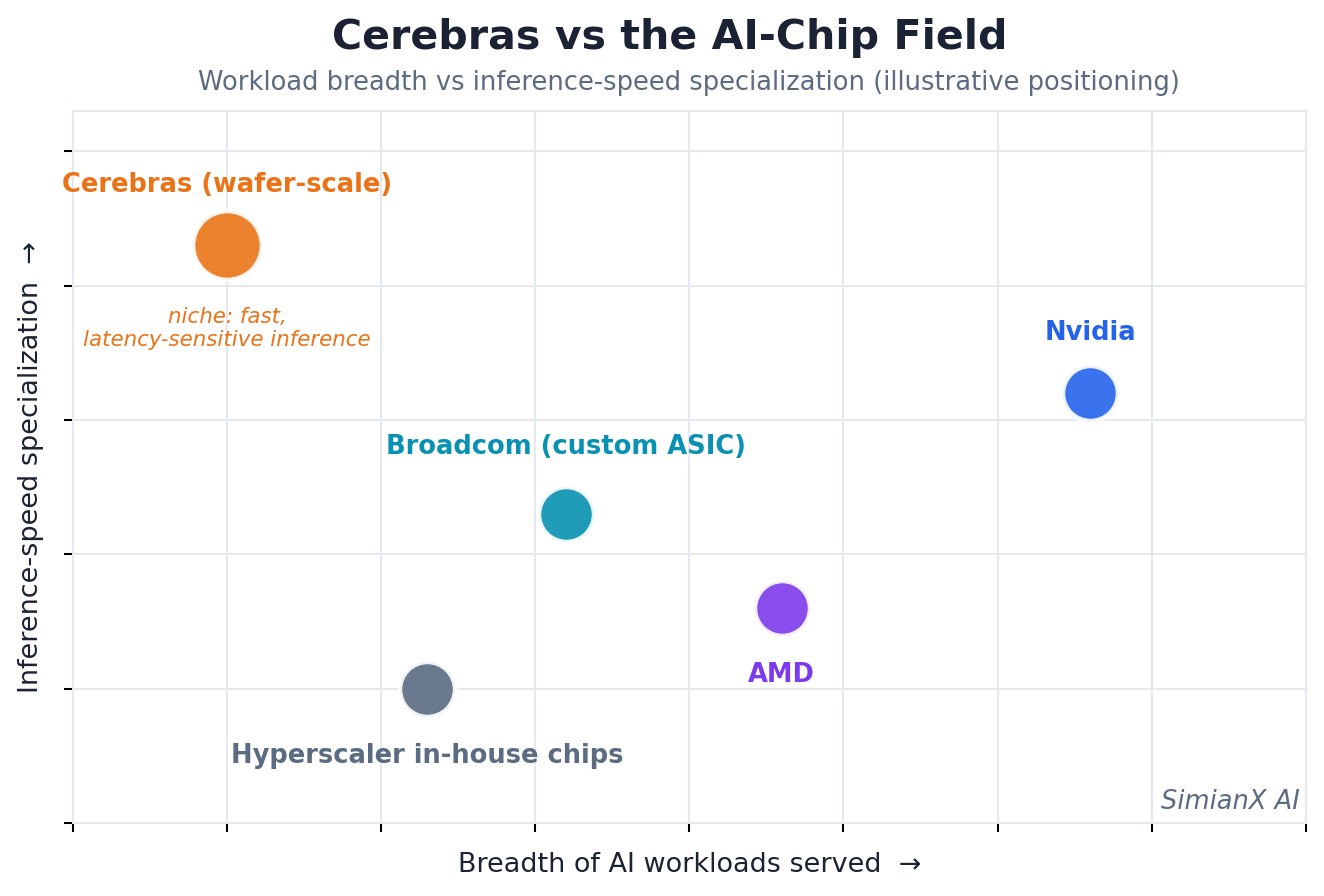
Cerebras vs Nvidia, AMD, Broadcom, and Custom AI Chips
Cerebras is entering a market filled with extremely strong competitors. Nvidia remains the AI accelerator leader, AMD is pushing aggressively into AI GPUs, Broadcom benefits from custom AI silicon relationships, and hyperscalers continue building internal chips.
The key question is whether Cerebras can carve out a profitable niche in fast inference rather than compete head-to-head across every AI workload.
| Company / Category | Strength | Cerebras Relevance |
|---|---|---|
| Nvidia | Dominant GPU ecosystem and software stack | Sets the benchmark for AI infrastructure |
| AMD | GPU alternative with growing AI roadmap | Competes for cloud and enterprise AI budgets |
| Broadcom | Custom ASIC and networking strength | Shows demand for specialized AI silicon |
| Hyperscaler chips | Vertical integration by cloud giants | Could reduce reliance on external vendors |
| Cerebras | Wafer-scale, fast inference positioning | Differentiated architecture for latency-sensitive workloads |
Cerebras does not need to replace Nvidia to succeed. It needs to prove that its architecture is the best answer for enough high-value inference workloads to support a large, profitable business.
What Is Cerebras Gross Margin Risk in 2026?
What is Cerebras gross margin risk in 2026? It is the possibility that the company’s revenue growth comes with lower-than-expected profitability because scaling AI infrastructure requires heavy spending, complex customer obligations, and changing business mix.
This risk is especially important for newly public companies. Post-IPO investors often pay premium valuations for revenue growth, but if margins fall too quickly, the market may re-rate the stock. That is what makes Cerebras such a fascinating case: the business can be fundamentally stronger than before while the stock still declines if expectations were too high.
Key Margin Questions Investors Should Ask
- Are lower margins caused by temporary capacity ramp costs or structural pricing pressure?
- Is cloud revenue becoming more profitable as utilization improves?
- How much pass-through data center cost is included in reported results?
- Can Cerebras reach its long-term gross margin targets?
- Are customer warrants materially reducing reported revenue?
- Does the OpenAI relationship improve scale economics or create dependency?
The best Cerebras stock analysis should treat margin guidance as a central variable, not a footnote.
The OpenAI Deal: Bullish Catalyst or Concentration Risk?
The OpenAI relationship is arguably the most important catalyst in the Cerebras stock 2026 story. On the positive side, it suggests that one of the world’s most important AI companies sees value in Cerebras’ inference capacity. That can validate technology, improve investor confidence, and create long-term revenue visibility.
But the same relationship also creates risk. If a large portion of future revenue depends on OpenAI capacity deployment, then delays, renegotiations, service-level issues, or shifts in OpenAI’s compute strategy could materially affect Cerebras.
OpenAI Deal: Two-Sided Impact
| Factor | Bullish Interpretation | Bearish Interpretation |
|---|---|---|
| Large capacity commitment | Strong demand visibility | High execution burden |
| Working capital support | Helps fund infrastructure buildout | Adds financial complexity |
| Warrant structure | Aligns customer and company incentives | Can dilute economics |
| Latency-sensitive workloads | Validates Cerebras performance | Workload mix may change |
| Multi-year relationship | Supports growth runway | Creates customer concentration |
Investors should avoid simplistic thinking. The OpenAI deal can be both a powerful catalyst and a real risk factor at the same time.

How to Analyze Cerebras Stock With SimianX AI
For a volatile post-IPO AI chip stock, manual research can be overwhelming. News, valuation, filings, earnings guidance, technical price action, and sentiment can change quickly. This is where SimianX AI can help investors structure the research process.
SimianX uses a multi-agent approach to evaluate stocks from different angles, including fundamentals, technical trends, market sentiment, and risk management. For a name like Cerebras, that matters because the bull and bear cases are both credible.
Example SimianX Research Workflow for Cerebras
| Step | Question | What to Review |
|---|---|---|
| 1 | Is revenue growth accelerating? | Quarterly revenue, guidance, customer wins |
| 2 | Are margins stabilizing? | Core gross margin, operating margin, management commentary |
| 3 | Is the stock technically weak or recovering? | Moving averages, volume, support/resistance |
| 4 | Is sentiment improving? | Analyst reactions, earnings headlines, AI chip news |
| 5 | What are the main risks? | Customer concentration, data center capacity, dilution, competition |
A practical prompt for investors might be:
Analyze CBRS using revenue growth, gross margin guidance, customer concentration, competitive position, technical trend, and downside risk.
This type of structured prompt helps prevent a common mistake: falling in love with an AI growth story while ignoring the financial model.
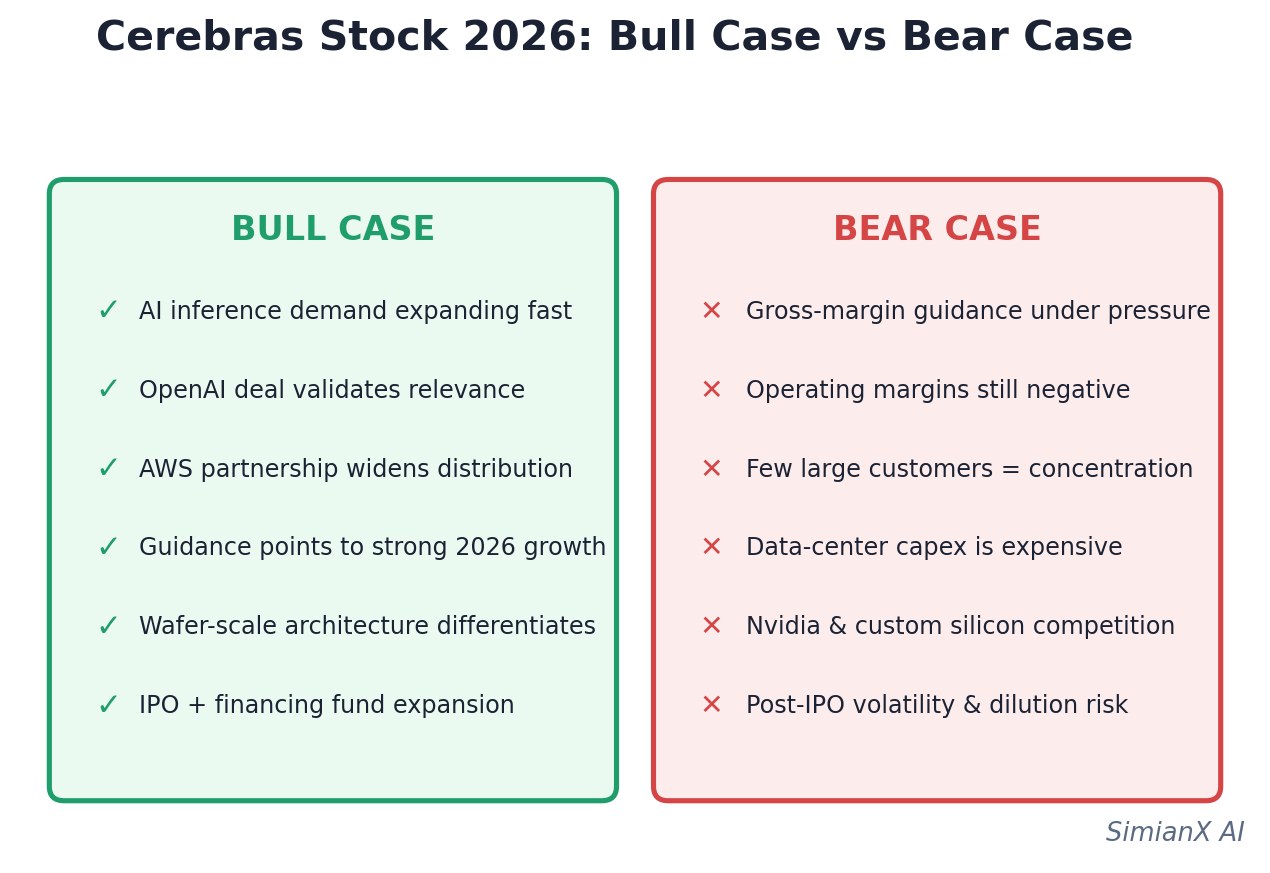
Bull Case for Cerebras Stock 2026
The bull case for Cerebras is based on the idea that AI inference demand is early, massive, and underserved. If Cerebras can prove superior speed for important workloads, the company could become a key infrastructure provider for AI applications that require real-time performance.
Bull Case Factors
- AI inference demand is expanding rapidly
- OpenAI relationship validates commercial relevance
- AWS partnership could broaden distribution
- Revenue guidance suggests strong 2026 growth
- Wafer-scale architecture offers differentiation
- Cash from IPO and financing supports expansion
- Enterprise AI adoption may create new customers
In the bull case, near-term margin pressure is a temporary cost of scaling. Investors who believe this view may see weakness after margin-related selloffs as a potential long-term entry opportunity.
Bear Case for Cerebras Stock 2026
The bear case is not that Cerebras lacks technology or demand. The bear case is that the company may struggle to turn demand into attractive, durable shareholder returns.
Bear Case Factors
- Gross margin guidance is under pressure
- Operating margins remain negative
- Large customers represent a high percentage of revenue
- Data center capacity expansion is expensive
- Competition from Nvidia and custom silicon is intense
- Post-IPO volatility can remain elevated
- Future dilution or financing needs may pressure investors
In the bear case, Cerebras becomes a company with impressive revenue growth but inconsistent profitability, high execution risk, and a valuation that already prices in success.
Cerebras Stock Forecast Framework for 2026
Instead of making a single price prediction, investors should use scenarios. Scenario analysis is especially useful for a newly public AI chip company because outcomes can vary widely.
| Scenario | Revenue Growth | Gross Margin | Customer Risk | Stock Implication |
|---|---|---|---|---|
| Bull case | Growth beats guidance | Margins recover | Customer base diversifies | Multiple expansion possible |
| Base case | Growth meets guidance | Margins remain mixed | Concentration slowly improves | Volatile range-bound trading |
| Bear case | Growth disappoints | Margins fall further | Dependence stays high | Valuation compression risk |
What Would Change the Debate?
The Cerebras stock 2026 debate may shift bullish if the company shows:
- Stronger-than-expected full-year revenue
- Stabilizing or improving core gross margin
- Clear evidence of cloud services operating leverage
- Additional major customers beyond OpenAI, G42, MBZUAI, and AWS
- Better visibility into data center capacity deployment
The debate may shift bearish if the company shows:
- Repeated margin guide-downs
- Delayed OpenAI capacity deployment
- Weak utilization of cloud infrastructure
- Rising capital intensity
- Slowing revenue growth after the IPO excitement fades
FAQ About Cerebras Stock 2026
Is Cerebras stock a good AI chip investment in 2026?
Cerebras stock may appeal to investors seeking high-growth AI infrastructure exposure, but it is not a low-risk investment. The company has strong demand signals, yet margin pressure, customer concentration, and post-IPO volatility make disciplined risk management essential.
What is the biggest risk for Cerebras Stock 2026?
The biggest risk is that rapid AI chip sales growth does not translate into durable profitability. Investors should watch core gross margin, operating margin, data center costs, and the economics of large customer contracts.
How does the OpenAI deal affect Cerebras stock?
The OpenAI deal is a major validation point because it suggests demand for Cerebras’ inference capacity. However, it also increases execution risk because Cerebras must deliver large-scale capacity on schedule while managing costs and service obligations.
Can Cerebras compete with Nvidia in AI chips?
Cerebras does not need to replace Nvidia across the entire AI market to succeed. It needs to prove that its wafer-scale architecture is especially valuable for specific high-value workloads such as fast inference and latency-sensitive AI applications.
How can investors research Cerebras stock more effectively?
Investors should combine financial statement analysis, earnings guidance, competitive research, technical analysis, and sentiment monitoring. A multi-agent platform like SimianX AI can help organize these perspectives into a more balanced stock research workflow.
Conclusion
Cerebras Stock 2026 represents one of the clearest examples of the AI market’s new investment challenge: explosive demand does not automatically equal attractive margins. The company has powerful growth catalysts, including fast AI inference demand, major customer relationships, and a differentiated wafer-scale architecture. At the same time, investors must take margin pressure, customer concentration, data center execution, and competitive intensity seriously.
The best approach is not to chase headlines. Build a repeatable framework, track the numbers quarter by quarter, and compare the bull case against measurable financial progress. For investors who want help analyzing Cerebras and other AI semiconductor stocks from multiple angles, explore SimianX AI and use its AI-driven stock research workflow to make more informed, data-backed decisions.
Related Reading
- AI Stock Boom: Nvidia Leads the Chip Supercycle Now
- AI Chip Stocks Stay Strong: AMD, Intel Drive Data Centers
- Broadcom Earnings 2026: AI ASIC Backlog & AVGO Stock
- Alphabet Nears Nvidia in Market Value as AI Trade Broadens
- Caterpillar Stock 2026: AI Data Center Power Trade
- KOSPI Crash 2026: Korea’s AI Chip Reckoning Explained
- KKR Helix AI Infrastructure: NVDA, VST Power Trade