Copart Buys ACV Auctions: The $1.9 Billion Bet on Digital Dealer Wholesale
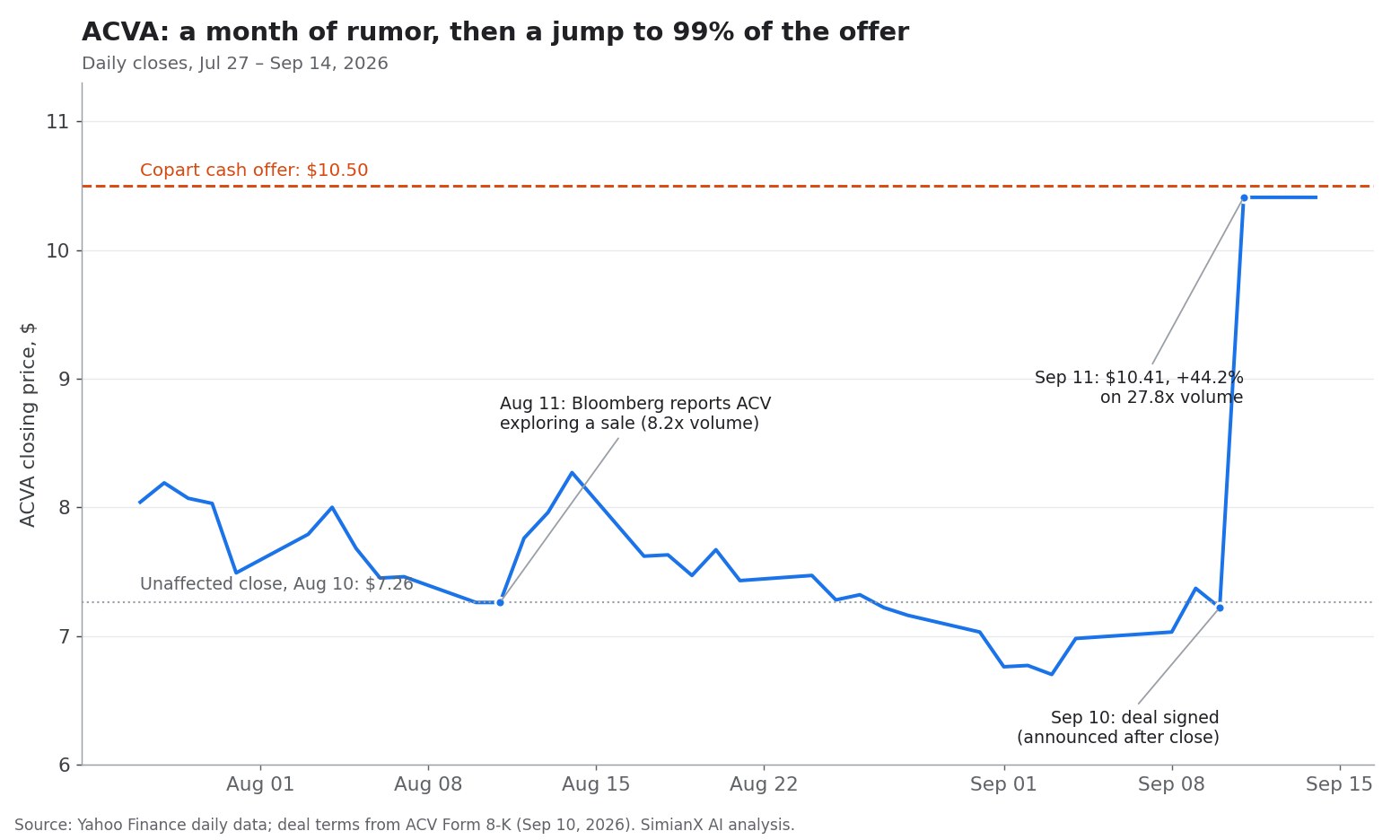
The Copart ACV Auctions deal 2026 turned ACVA from a beaten-down marketplace stock into a takeover situation with a fixed cash value. On September 10, 2026, Copart and ACV announced a definitive agreement under which Copart will acquire ACV for $10.50 per share in cash, an implied equity value of about $1.9 billion, according to the joint press release filed with the SEC. On the next trading day ACVA jumped 44.2% to $10.41 on roughly 28 times its normal volume.
That leaves ACVA shareholders with a simple question and Copart shareholders with a hard one. For ACVA holders, almost all of the value is already in the price: the stock closed 9 cents below the offer. For CPRT holders, the question is whether a company whose own revenue grew just 0.4% in fiscal 2026 can buy its way back to growth with a dealer-to-dealer marketplace that earns a thin 9% adjusted EBITDA margin.
The deal is strategically logical. Copart is the global leader in salvage and insurance total-loss auctions. ACV runs a technology-driven dealer-to-dealer wholesale marketplace, supported by vehicle inspections, transportation, inventory financing, pricing software and condition data. Together they would span the whole life of a used vehicle, from dealer trade-in to wholesale auction, salvage and international resale.
But a strategic narrative is not the same thing as a guaranteed return. Copart says the transaction should be neutral to earnings per share in the first full year of ownership and accretive only from fiscal 2028. Shareholders must wait for the benefits, while Copart takes on integration, execution and market-cycle risk.
SimianX AI can help investors monitor this type of event by combining filings, valuation data, technical indicators, earnings releases and news sentiment in one multi-agent research workflow.
What Exactly Is the Copart–ACV Deal?
The transaction is structured as an all-cash tender offer followed by a merger. The key terms, from ACV's Form 8-K and the merger agreement:
| Term | Detail |
|---|---|
| Price | $10.50 per ACVA share, all cash |
| Implied equity value | About $1.9 billion |
| Premium | About 45% to the unaffected August 10 close ($7.26); about 41% to the 30-day VWAP ending September 9 |
| Structure | Tender offer, then merger of a Copart subsidiary with ACV |
| Conditions | Majority of ACV shares tendered; expiry of the Hart-Scott-Rodino waiting period; customary conditions |
| Financing | Copart cash on hand; no financing condition |
| Break fee paid by ACV | $57.7 million (for example, to accept a superior proposal) |
| Reverse fee paid by Copart | $115.3 million if the deal fails on antitrust grounds (HSR or competition-law injunction, or the HSR condition not met by the end date) |
| Expected close | By calendar year-end 2026 |
| After closing | ACV runs as an independent Copart subsidiary under its current leadership |
Two details stand out. First, the premium is measured against August 10, not September 9. That is because on August 11 Bloomberg reported that ACV was exploring a sale after receiving takeover interest, and the stock traded 8.2 times its normal volume that day. Measured against the price the day before the signing, the premium was about 45% as well, because ACVA had drifted back to $7.22 by then.
Second, the reverse termination fee is twice the size of ACV's break fee. Copart has put $115.3 million on the line that regulators will let the deal through. That is a meaningful signal of confidence, and it is also the clearest sign of which risk both sides considered most important.
ACV reported 169.8 million shares outstanding as of August 3, 2026, which at $10.50 is about $1.78 billion; the roughly $1.9 billion headline also covers equity awards.
The structure sends one more message: Copart is not treating ACV as a minor software acquisition. It is buying a business with its own dealer relationships, marketplace operations, data products and management team, and it has promised to keep that team in place.
Why ACV Auctions Is Strategically Valuable
ACV is not simply an online auction website. It combines a digital marketplace with services that help dealers source, price, transport, finance and manage used vehicles.
Its key offerings include:
- ACV Auctions: Digital dealer-to-dealer wholesale auctions.
- ACV Transportation: Logistics and vehicle movement services.
- ACV Capital: Short-term inventory financing for eligible dealers.
- ACV MAX: Inventory management and profit-optimization software.
- VIPER: AI-powered vehicle imaging and inspection technology for dealers.
- True360: Vehicle inspection and condition-reporting data.
- ClearCar: Consumer trade-in and vehicle-valuation tools.
ACV's technology addresses a persistent problem in used-car markets: dealers must make fast purchasing decisions with imperfect information. A vehicle's condition, mileage, title history, local demand, transportation cost and expected resale price all affect profitability. ACV's inspection and valuation systems try to make those decisions more consistent.
That data layer is what Copart says it wants most. In the announcement, Copart said the two companies together will have "one of the industry's largest vehicle condition datasets," and that ACV's "dealer-focused inspection technology, condition data, and AI-powered valuation tools" will strengthen its own products. ACV brings more than 850 U.S. vehicle inspectors, over 70,000 monthly transactions and more than 22,000 unique buyers in 2025, according to the transaction presentation.
ACV's Recent Financial Profile
ACV entered the transaction with revenue momentum but modest profitability.
For full-year 2025, according to ACV's 2026 proxy statement:
- Revenue of $760 million, up 19% year over year.
- Marketplace and service revenue of $678 million, up 18%.
- 829,276 marketplace units, up 12%.
- Adjusted EBITDA of $59 million.
The second-quarter 2026 results, released on August 10, showed revenue still growing but physical volume stalling:
| Q2 2026 metric | Result | Year-over-year change |
|---|---|---|
| Revenue | $214 million | +10% |
| Marketplace and service revenue | $189 million | +8% |
| Marketplace GMV | $2.7 billion | About flat |
| Marketplace units | 211,472 | About flat |
| GAAP net loss | $8 million | Loss of $7 million a year earlier |
| Non-GAAP net income | $10 million | $12 million a year earlier |
| Adjusted EBITDA | $21 million | $19 million a year earlier |
ACV reaffirmed full-year 2026 guidance of $845–855 million in revenue (up 11% to 13%), $73–77 million of adjusted EBITDA and a GAAP net loss of $44–49 million. Its guidance assumed that "the dealer wholesale market is expected to stabilize in the back half of 2026," and management described "ongoing headwinds in the dealer wholesale market."
These figures reveal an important feature of the business: ACV can grow revenue even when units and GMV are flat, because of higher revenue per vehicle and faster growth in transportation, financing, inspections and software. The quality of that growth matters. Service revenue can be more recurring than auction fees, but it carries different margins and operating demands.
How ACV Compares With the Largest Digital Rival
The dealer wholesale market is dominated by Cox Automotive's Manheim and by OPENLANE (the former KAR Auction Services), both far larger than ACV. The only rival with comparable public disclosure is OPENLANE:
| 2025 | ACV | OPENLANE |
|---|---|---|
| Vehicles sold | 829,276 | Nearly 1.5 million |
| Gross merchandise value | About $10 billion+ | $29 billion |
| Revenue | $760 million | $1.9 billion |
| Adjusted EBITDA | $59 million | $333 million |
Sources: ACV proxy statement and transaction presentation; OPENLANE fourth-quarter 2025 results.
The comparison shows both the opportunity and the gap. ACV is the smaller, faster-growing digital challenger; OPENLANE earns more than five times ACV's adjusted EBITDA. Copart is effectively betting that its capital, buyer network and 250-plus physical locations can close that gap faster than ACV could alone.
The 44% ACVA Surge: What Investors Should Understand
ACVA's jump is an arbitrage reaction, not a fresh market verdict on ACV's standalone potential. When a public company agrees to be acquired for cash, its stock typically trades slightly below the offer. That discount reflects the time until closing, the chance of regulatory delay, the risk that too few shares are tendered, legal complications and the small possibility of a competing bid.
Here is what the market has already priced in:
| Reference point | ACVA price | Versus the $10.50 offer |
|---|---|---|
| Unaffected close, August 10 | $7.26 | Offer is 44.6% higher |
| Close before signing, September 10 | $7.22 | Offer is 45.4% higher |
| First close after the deal, September 11 | $10.41 | 0.9% below the offer |
| September 14 close | $10.41 | 0.9% below the offer |
Source: Yahoo Finance daily closes.
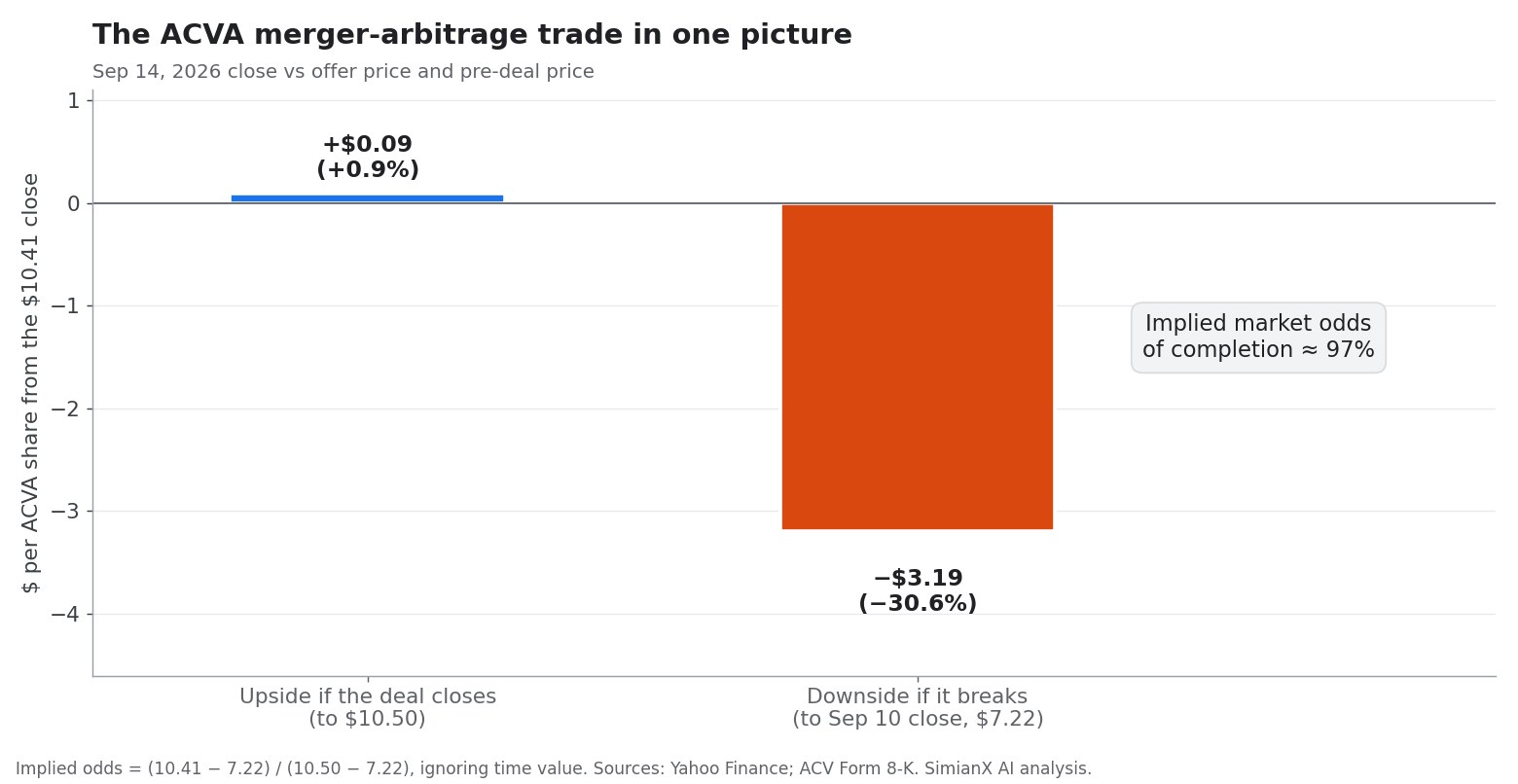
The asymmetry is stark. At $10.41, the gross spread is 9 cents, or 0.9%. If the deal closes by the end of December, that is roughly a 3% annualized return. If it breaks and the stock returns to its pre-deal price of $7.22, the loss is $3.19 a share, about 31%. Solving for the probability that makes those outcomes equal gives an implied completion probability of about 97%, ignoring the time value of money.
That tells you the market is treating the deal as close to certain. Merger-arbitrage investors are being paid very little to take the remaining risk, which is mostly antitrust timing. The $115.3 million reverse fee would soften, but not eliminate, the damage to ACV if regulators blocked the deal.
Copart's Strategic Logic: Buying Growth
The simplest way to understand this deal is to look at Copart's own results, released the same afternoon in its fourth-quarter fiscal 2026 report.
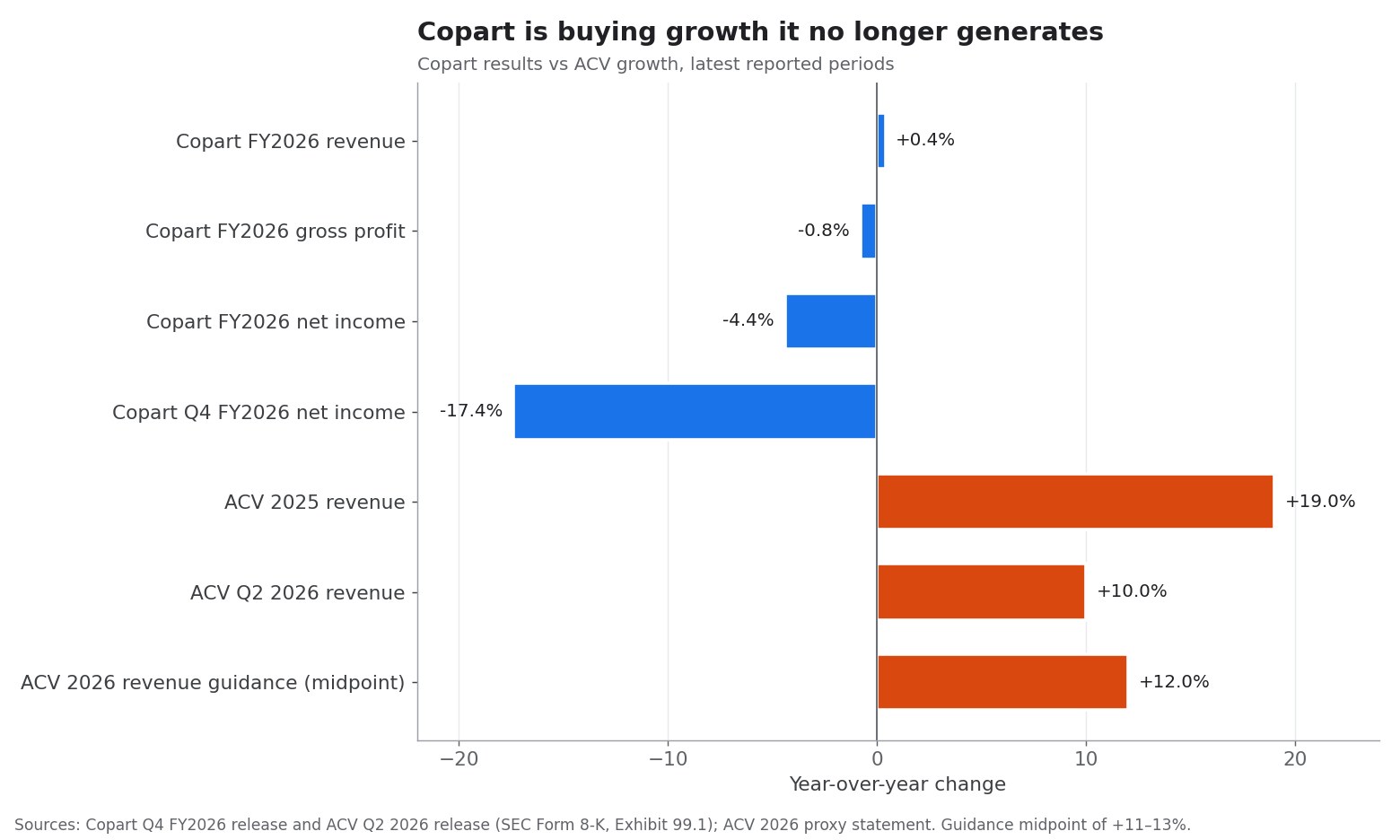
For the year ended July 31, 2026, Copart reported:
| Copart fiscal 2026 | Result | Change |
|---|---|---|
| Revenue | $4.67 billion | +0.4% |
| Gross profit | $2.08 billion | −0.8% |
| Net income attributable to Copart | $1.48 billion | −4.4% |
| Diluted EPS | $1.55 | −2.5% |
| Fourth-quarter net income | $327 million | −17.4% |
| Fourth-quarter diluted EPS | $0.35 | −14.6% |
| Cash plus held-to-maturity securities, July 31 | $4.49 billion | Down from $4.79 billion |
A business that was a reliable compounder for two decades has stopped growing. Copart's stock reflects it: CPRT closed at $31.73 on September 14, roughly half its weekly closing high of $63.84 in May 2025. Fiscal 2026 per-share earnings also benefited from fewer shares outstanding, since diluted weighted shares fell 4.7% in the fourth quarter.
Against that backdrop, ACV offers three things Copart's core salvage business cannot provide on its own.
1. A new growth vector
Copart dominates salvage and total-loss vehicles. ACV gives it an immediate position in dealer-to-dealer wholesale, a market that includes trade-ins, excess inventory, fleet disposals and used-car remarketing. Copart calls the dealer channel "a new growth vector" and says the deal is "expected to accelerate revenue growth."
A vehicle might enter a dealer's inventory as a trade-in, move through a wholesale auction, be transported to another dealer and eventually be sold to a consumer, or end up at salvage after an accident. Copart would gain exposure to more stages of that process.
2. Cross-selling across a larger network
Copart has roughly 1 million members in more than 185 countries and sold more than 4 million units in the last year. ACV has dealer relationships and technology. The combined company could cross-sell:
- ACV marketplace services to Copart's dealer buyers.
- Copart transportation and logistics to ACV customers.
- ACV inspection tools to Copart sellers.
- Copart's international buyer base to ACV inventory.
- Commercial vehicle programs for captives, banks, fleets and lenders.
- Data products across wholesale and salvage channels.
3. Technology and artificial intelligence
ACV uses vehicle data, AI-powered imaging, predictive analytics and inventory recommendations. The strategic value of that technology may exceed its standalone software revenue: better condition data improves pricing, raises buyer confidence and reduces disputes, in dealer wholesale and potentially in Copart's salvage auctions too.
Is Copart Overpaying for ACV?
The $1.9 billion equity value equals roughly:
- About 2.2 times the midpoint of ACV's 2026 revenue guidance.
- About 25 times the midpoint of its 2026 adjusted EBITDA guidance.
- A 45% premium to ACV's unaffected market value.
- About 42% of Copart's $4.49 billion of cash and held-to-maturity securities.
On a revenue multiple, the deal does not look extreme for a growing digital marketplace. On an EBITDA multiple, it looks much more demanding, because ACV's adjusted EBITDA margin is only about 9%. For comparison, OPENLANE's 2025 adjusted EBITDA margin was roughly 17%.
Price is also relative to history. ACVA's monthly closing high after its 2021 IPO was $34.61, and before the takeover interest emerged the stock had fallen 47% over the previous year. Some long-term ACV holders will receive far less than they paid, even at a 45% premium.
Copart may be willing to pay a higher multiple because:
- ACV is growing faster than Copart's mature salvage business.
- ACV provides access to a strategically important dealer channel.
- Copart can reduce duplicated technology, corporate and operating costs over time.
- ACV's platform may raise the productivity of Copart's existing yards and buyer network.
- Copart can put idle cash to work in a related business with a long runway.
The real test is whether the combined company generates incremental cash flow that beats the opportunity cost of $1.9 billion. Copart has not quantified synergies. Until it does, investors should treat "neutral in year one, accretive from fiscal 2028" as the only committed financial target.
Copart's Financial Strength Supports the Deal
Copart can easily afford ACV. It will pay with cash on hand, avoid issuing shares at a depressed valuation and take on no acquisition debt. After paying about $1.9 billion, it would still hold roughly $2.6 billion of cash and securities based on its July 31 balance sheet.
Still, paying cash has an opportunity cost. Copart could have used the funds for:
- Land acquisitions and yard expansion.
- International growth.
- Share repurchases, which at today's depressed share price may look cheap.
- Technology development.
- Smaller acquisitions with faster returns.
The transaction must ultimately outperform those alternatives.
Why ACV Will Remain an Independent Subsidiary
Copart's decision to keep ACV as an independent subsidiary led by chief executive George Chamoun is strategically sensible.
ACV's dealer customers may worry that Copart will use marketplace information to compete against them. Keeping ACV operationally distinct helps preserve trust and reduce disruption. ACV also has its own technology culture, sales processes and product roadmap. Immediate full integration could risk losing engineers, dealers or product velocity.
An independent structure offers several benefits:
- Retention of ACV's management team.
- Less disruption for dealers.
- Continued investment in ACV MAX, VIPER and data products.
- Clearer accountability for operating performance.
- A gradual path toward technology integration.
The disadvantage is that independence can delay cost synergies. Copart may not capture all potential savings quickly if ACV keeps separate systems, staff and operations.
Key Risks in the Copart ACV Auctions Deal 2026
Regulatory and antitrust risk
The deal needs Hart-Scott-Rodino clearance. Copart and ACV describe their businesses as complementary: salvage on one side, dealer wholesale on the other. Regulators may still look at overlaps in online vehicle auctions and at whether combining a dominant salvage platform with a digital dealer challenger reduces competition. The size of the reverse fee shows this is the risk both sides priced most carefully.
Integration risk
Technology systems, customer databases, pricing tools and transportation networks must be connected carefully. A poor integration could create billing errors, service interruptions or dealer dissatisfaction.
Cultural risk
Copart's business is built on scale, physical infrastructure and operating discipline. ACV is a technology marketplace that depends on software development, data science and rapid product iteration. Too much integration could cost ACV its entrepreneurial edge; too little could leave synergies unrealized.
Dealer neutrality risk
Dealers may prefer a neutral marketplace. Copart must reassure ACV customers that their data will not be used in ways that weaken marketplace trust.
Competitive risk
ACV competes with Manheim, OPENLANE, physical auctions and other digital platforms. Rivals may respond with lower fees, better inspections or new tools while the deal is pending.
Used-car market cyclicality
Wholesale volumes and prices depend on interest rates, used-car affordability, inventory levels, off-lease supply, repossessions and consumer demand. ACV's own guidance assumed a stabilizing dealer market in the second half of 2026; a weaker market would hit GMV and financing losses.
Offer failure risk
ACVA shareholders should remember that the $10.50 price is conditional. A failed deal could send the stock back toward its pre-announcement level near $7.
Bull, Base and Bear Scenarios
| Scenario | Main assumptions | Potential outcome |
|---|---|---|
| Bull | Deal closes on time, dealer retention stays high, Copart cross-sells effectively and ACV reaches operating leverage | ACVA holders receive $10.50; Copart returns to growth and earns attractive returns on the $1.9 billion |
| Base | Deal closes near year-end, ACV stays independent and synergies arrive gradually | Moderate revenue lift for Copart and EPS accretion from fiscal 2028, as promised |
| Bear | Antitrust delay, dealer losses, weak wholesale conditions or integration problems | Spread widens, ACVA falls toward $7 if the deal breaks, and Copart earns a lower return on invested capital |
For ACVA merger arbitrage, the key variables are closing probability, timing and downside if the deal fails.
For CPRT shareholders, the key variables are:
- The amount and timing of cost synergies, once disclosed.
- Revenue growth from cross-selling.
- ACV employee and dealer retention.
- Incremental capital expenditure.
- ACV's contribution to operating cash flow.
- The effect on Copart's margins.
- Whether EPS accretion begins in fiscal 2028 as promised.
What Investors Should Monitor Before Closing
A disciplined monitoring checklist should include:
- Tender-offer filings: The Schedule TO and ACV's Schedule 14D-9, including the background of the sale process and whether other bidders were involved.
- Antitrust: Any second request under HSR, which would signal a longer review.
- Tender progress: The number of shares tendered and any extensions of the offer.
- ACV operating data: Dealer activity, marketplace units and GMV in the third quarter.
- Synergy disclosure: Quantified cost savings and revenue targets rather than broad strategic language.
- Copart capital allocation: Whether buybacks continue after the cash outlay.
- The spread: A widening gap between ACVA's price and $10.50 is the market's early warning signal.
- Competitive response: Pricing, dealer incentives and technology investment from Manheim and OPENLANE.
SimianX AI can be used to track ACVA and CPRT together, combining SEC filings, earnings releases, price action, analyst revisions and news sentiment, and you can open a live CPRT analysis directly. Investors should independently verify data and remember that SimianX provides research support, not personalized investment advice.
Can ACVA's 44% Surge Become a New Auto-Tech Powerhouse?
The answer depends on what "become" means.
ACVA itself will no longer be a standalone public stock if Copart completes the tender offer. Shareholders receive cash rather than participating in ACV's long-term upside.
But the combined Copart–ACV business could become a more powerful automotive technology and remarketing platform. ACV contributes dealer relationships, digital wholesale liquidity, inspection and valuation data, transportation and financing services, inventory software and AI-assisted pricing. Copart contributes global auction scale, physical yards, insurance and commercial relationships, international buyers, strong cash generation and the capital to invest through market cycles.
Each company fills a gap in the other's model. However, investors should not assume that a strategically logical deal automatically produces superior returns. It must be judged on measurable outcomes: customer retention, revenue synergies, cost savings, cash flow and return on invested capital.
FAQ About the Copart ACV Auctions Deal 2026
What is the Copart ACV Auctions deal value?
Copart agreed to acquire ACV Auctions for $10.50 per share in cash, an implied equity value of about $1.9 billion. The offer is a premium of about 45% to ACV's unaffected closing price of $7.26 on August 10, 2026, the last trading day before media reports of a possible sale.
Why did ACVA stock surge about 44%?
The stock jumped 44.2% to $10.41 on September 11 because investors repriced it toward Copart's cash offer. The remaining 9-cent gap to $10.50 reflects the time until closing and the risk that the deal is delayed or blocked.
What happens if the deal fails?
If the deal is terminated because of an antitrust injunction or failure to clear HSR review by the end date, Copart must pay ACV a $115.3 million reverse termination fee. ACV would pay Copart $57.7 million if it accepted a superior proposal. ACVA shares would likely fall back toward their pre-deal level near $7.
Is Copart overpaying for ACV Auctions?
The price is about 2.2 times ACV's 2026 revenue guidance but about 25 times its adjusted EBITDA guidance. It looks demanding on profits and reasonable on revenue; whether it pays off depends on synergies Copart has not yet quantified.
When is the Copart ACV acquisition expected to close?
The companies expect to close by the end of calendar year 2026, subject to the tender of a majority of shares, expiry of the HSR waiting period and other customary conditions.
Why is Copart buying ACV now?
Copart's fiscal 2026 revenue grew just 0.4% and fourth-quarter net income fell 17.4%, while ACV is guiding to 11% to 13% revenue growth. ACV gives Copart a faster-growing dealer wholesale business and vehicle-data technology it does not have.
Conclusion
The Copart ACV Auctions deal 2026 is more than a $1.9 billion takeover. It is a bet that vehicle remarketing will become increasingly digital, data-driven and integrated across salvage, wholesale, transportation, financing and retail channels, and an admission that Copart's own growth engine has slowed.
ACVA's 44% surge captured almost all of the value of Copart's offer. At $10.41 against $10.50, the market is pricing roughly 97% odds of completion, leaving arbitrage investors 0.9% of upside against about 31% of downside if the deal breaks. The longer-term question belongs to Copart shareholders: can ACV's dealer network, marketplace technology and vehicle intelligence generate enough incremental cash flow to justify paying about 25 times adjusted EBITDA?
The bull case is real. Copart gains a faster-growing dealer channel, expands its addressable market, adds AI-assisted vehicle-data tools and can cross-sell across a global network. The bear case is equally real. ACV's units and GMV were flat in the second quarter, its margins are modest, and integration could damage the very dealer relationships and technology culture Copart is paying for.
For other large deals we have broken down this year, see Amazon Qualcomm AI Chip Deal: 54 Million Shares in Play and Nvidia Hugging Face Deal 2026: $12.9B at 86x Revenue.
Investors who want to track the transaction, valuation changes and post-announcement market reaction can use SimianX AI to combine fundamentals, technical analysis, SEC filings and real-time news sentiment. The platform can help organize the evidence, but investors should conduct independent due diligence and consult a licensed professional before making financial decisions.
This article is for informational and educational purposes only. It is not investment, legal or tax advice. Market prices and deal terms can change, and investors should verify current data before making financial decisions.
Related Reading
- Amazon Qualcomm AI Chip Deal: 54 Million Shares in Play
- Nvidia Hugging Face Deal 2026: $12.9B at 86x Revenue
- NextEra-Dominion 2026 Deal: 110 GW AI Power Bottleneck
References
- SEC EDGAR — Copart and ACV joint press release (ACV Form 8-K, Exhibit 99.1, September 10, 2026)
- SEC EDGAR — ACV Form 8-K with merger agreement summary and termination fees
- SEC EDGAR — Agreement and Plan of Merger (Exhibit 2.1)
- SEC EDGAR — Copart and ACV transaction presentation (Exhibit 99.2)
- SEC EDGAR — Copart fourth-quarter fiscal 2026 results (Exhibit 99.1)
- SEC EDGAR — ACV second-quarter 2026 results
- ACV Investor Relations — 2026 proxy statement
- SEC EDGAR — OPENLANE fourth-quarter 2025 results
- Bloomberg — ACV Auctions explores sale after takeover interest (August 11, 2026)
- Bloomberg — Copart nears roughly $2 billion deal for ACV Auctions (September 10, 2026)