What a Fourth Carrier Is Actually Worth to a Tower Landlord
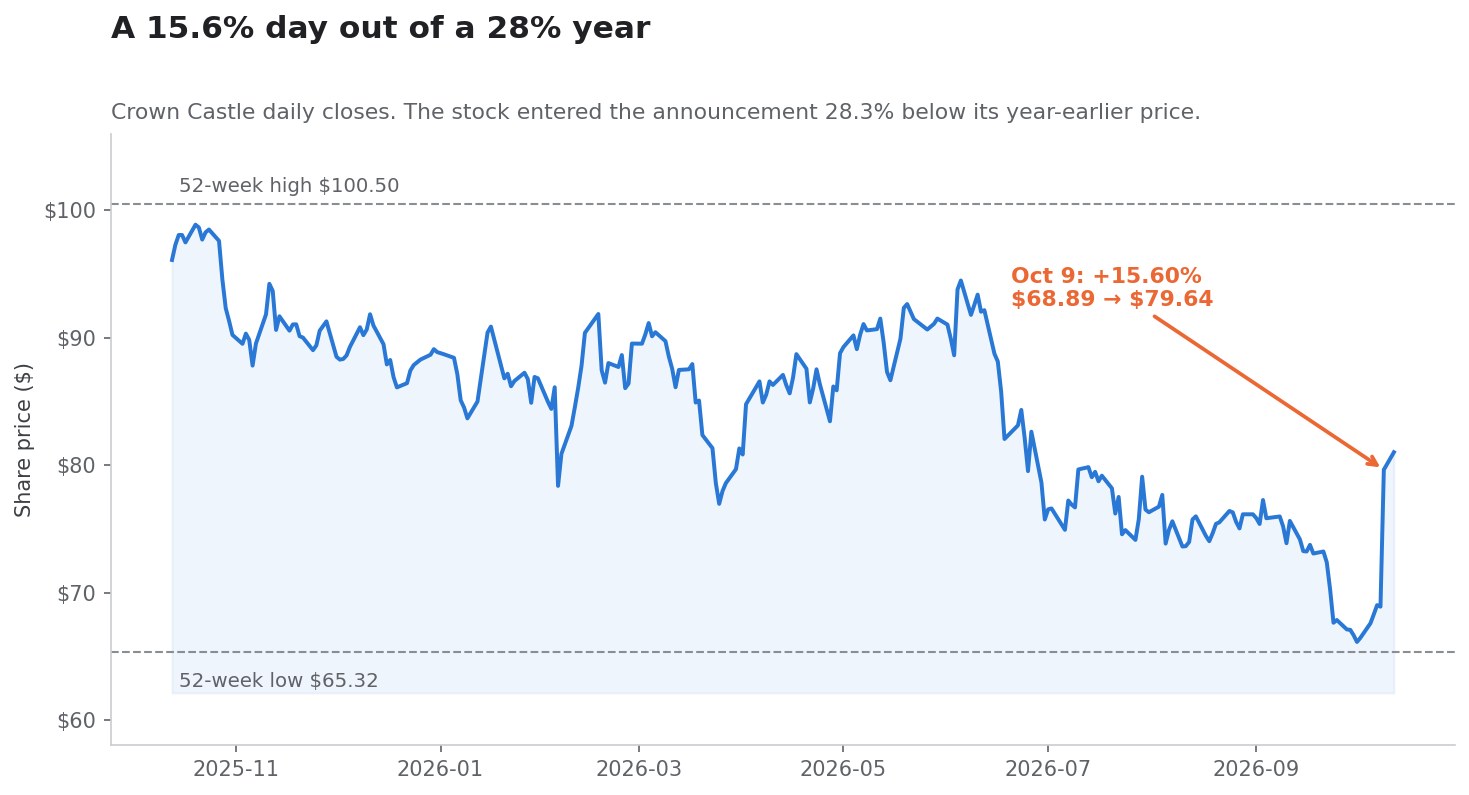
On Friday, October 9, 2026, Crown Castle (CCI) closed at $79.64, up 15.60% from the previous session's $68.89. The catalyst was not a Crown Castle disclosure. It was an announcement by a private company that is not, and has never been, a Crown Castle tenant: SpaceX had agreed to acquire a nationwide 800 MHz spectrum portfolio from Grain Management.
The trade was legible within minutes. If SpaceX builds a terrestrial mobile network, it needs towers. Crown Castle owns roughly 40,000 of them. Therefore Crown Castle is worth more.
What makes this case worth studying is that Crown Castle has run this exact experiment before, with a different protagonist, and the result is on file at the SEC. Between 2020 and 2026 a company called DISH Wireless set out to become America's fourth national carrier, signed a master lease agreement with Crown Castle, built, and then stopped paying. On January 12, 2026, Crown Castle delivered a notice of default and termination. The company now asserts that DISH owes it in excess of $3.5 billion in remaining payments.
So we do not have to speculate about what a fourth carrier is worth to a tower REIT. We can look it up. DISH, at its peak, generated $222 million a year of site rental billings for Crown Castle — 5.7% of the company's prior-year billings base. That is the ledger entry. The question this article answers is how the market's one-day repricing of Crown Castle compares to it.
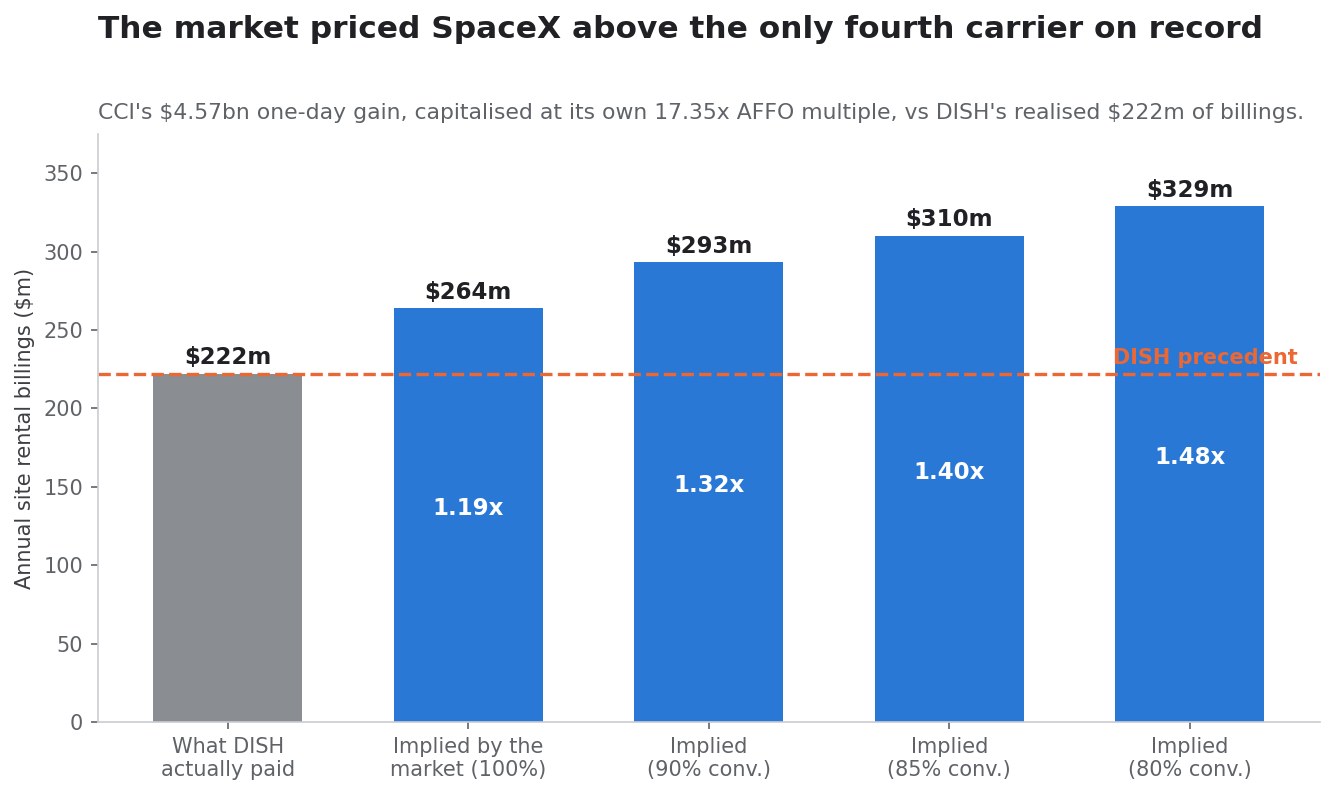
The answer, worked through below: the $4.57 billion the market added to Crown Castle's equity value on October 9 implies roughly $264 million a year of incremental AFFO at Crown Castle's own post-rally multiple — somewhere between 1.2x and 1.4x everything DISH ever paid, awarded in a single session, to a counterparty that has not signed a lease, for a network that does not exist.
For investors who track these situations with SimianX AI, Crown Castle is a clean case study in the difference between an option and a receivable. The companion piece to this one, SpaceX's $8B Spectrum Deal: AT&T, Verizon, T-Mobile Ranked, works the same announcement from the carriers' side of the trade.
The October 9 cross-section: who actually gained
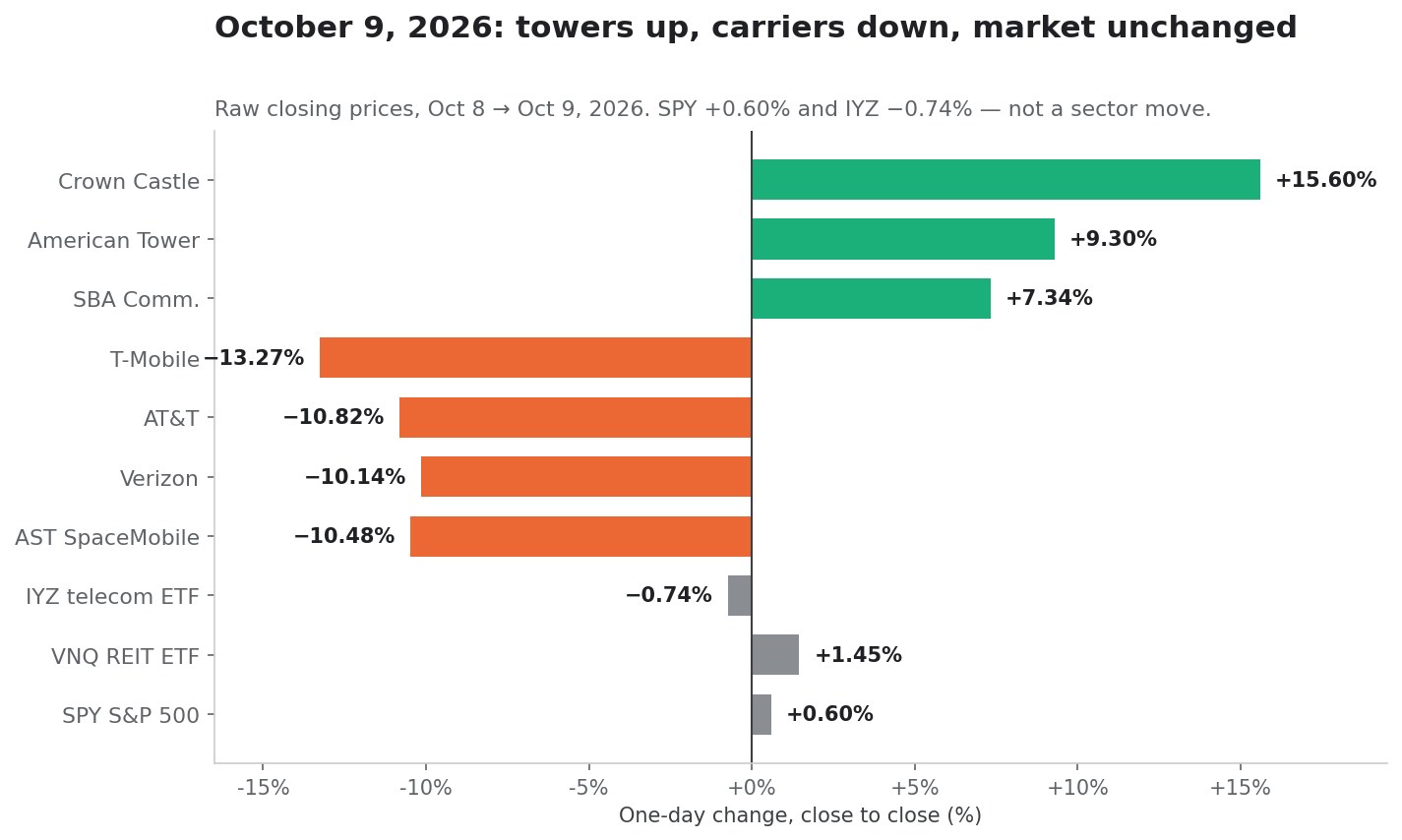
The first discipline in reading a day like this is to measure the whole cross-section rather than the one name in the headline. Below are raw close-to-close moves from October 8 to October 9, 2026. These are unadjusted prices; no dividend adjustment is applied, because none of these six names went ex-dividend on October 9.
| Security | Oct 8 close | Oct 9 close | Change | One-day market-cap change |
|---|---|---|---|---|
Crown Castle (CCI) | $68.89 | $79.64 | +15.60% | +$4.57bn |
American Tower (AMT) | $166.73 | $182.24 | +9.30% | +$7.23bn |
SBA Communications (SBAC) | $170.01 | $182.49 | +7.34% | +$1.32bn |
T-Mobile (TMUS) | $171.31 | $148.58 | −13.27% | −$24.38bn |
AT&T (T) | $24.87 | $22.18 | −10.82% | −$18.43bn |
Verizon (VZ) | $46.35 | $41.65 | −10.14% | −$19.53bn |
AST SpaceMobile (ASTS) | $56.93 | $50.97 | −10.48% | — |
iShares U.S. Telecom ETF (IYZ) | $42.99 | $42.67 | −0.74% | — |
Vanguard Real Estate ETF (VNQ) | $89.35 | $90.65 | +1.45% | — |
S&P 500 ETF (SPY) | $773.93 | $778.57 | +0.60% | — |
Share counts are taken from each company's most recent cover-page disclosure on SEC EDGAR (dei:EntityCommonStockSharesOutstanding, Q2 2026 10-Qs).
Three observations follow immediately.
This was not a sector move
SPY rose 0.60% and IYZ — the telecom sector ETF — fell only 0.74%. The broad market did not care. A handful of individual securities repriced violently inside an otherwise ordinary session. That is the signature of a repricing of specific contractual expectations, not a change in the macro discount rate. Readers interested in how an actual rate shock propagates through bond-proxy equities should compare this session with Warsh Ignores Trump: The Fed's First Rate Hike Since 2023.
The REIT complex did not move; Crown Castle did
VNQ gained 1.45%. Crown Castle gained 15.60%. Whatever happened on October 9 was not "REITs rallied." It was specific to tower economics — and within towers, the dispersion was wide: 15.60% for CCI versus 7.34% for SBAC.
The biggest loser was T-Mobile, and that matters for Crown Castle
TMUS fell 13.27%, the worst of the three carriers. T-Mobile is also Crown Castle's largest tenant, at 40% of 2025 consolidated revenues. The same announcement that was read as creating a possible new Crown Castle tenant simultaneously destroyed $24.4 billion of equity value at Crown Castle's single biggest existing customer. The market judged these two effects to be jointly positive for CCI. That conclusion deserves scrutiny, and gets it below.
The reallocation that did not balance
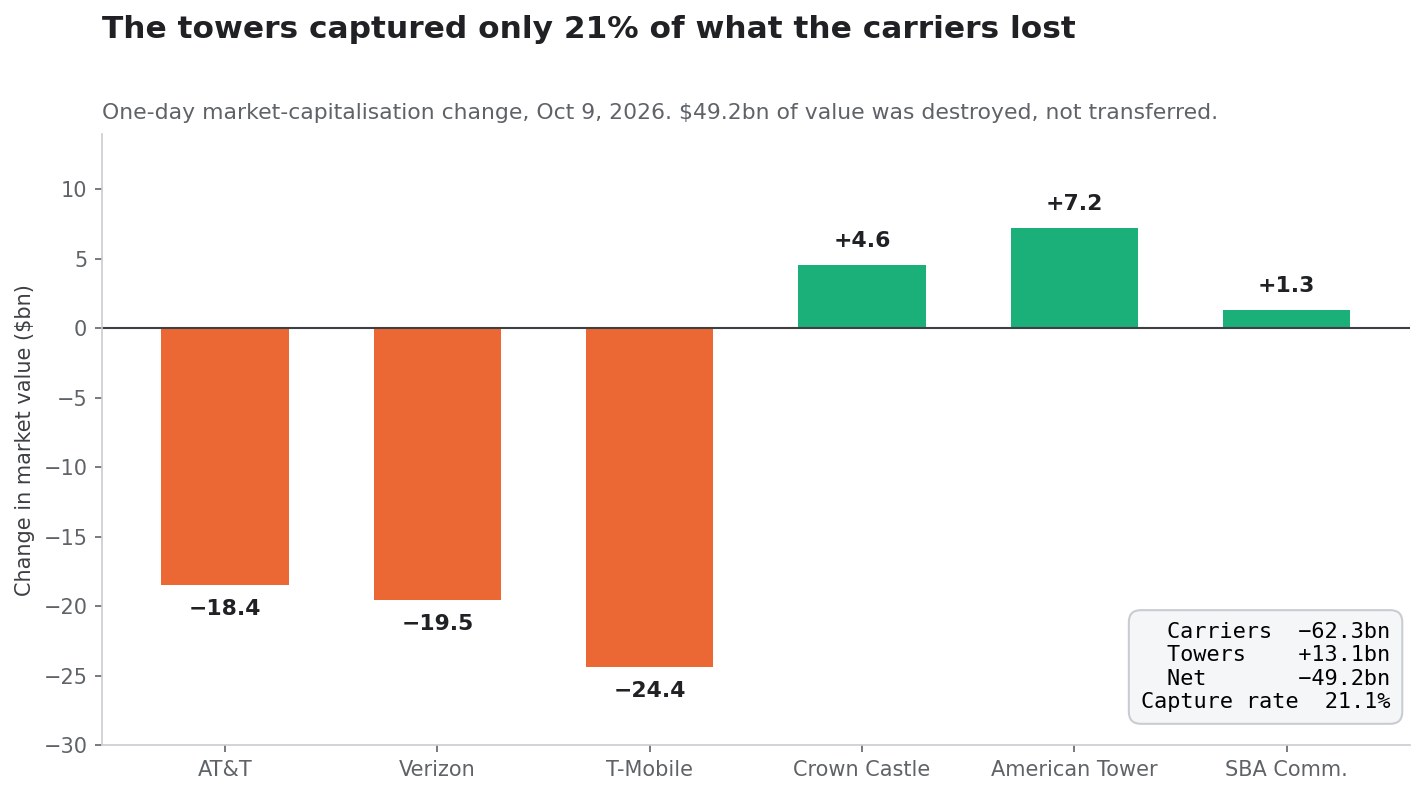
Aggregating the six names with disclosed share counts:
| Group | One-day market-cap change |
|---|---|
Carriers (T, VZ, TMUS) | −$62.34bn |
Towers (CCI, AMT, SBAC) | +$13.13bn |
| Net | −$49.21bn |
The towers captured 21.1% of what the carriers lost. Roughly $49 billion of equity value was not transferred to anybody — it was simply extinguished.
This is the single most useful frame for the "hidden winner" question. If the market genuinely believed that SpaceX's entry was a wealth transfer from carriers to landlords, the two numbers would be closer to symmetric. They are not. The market's actual judgment on October 9 was that SpaceX's arrival destroys more value in American wireless than it creates for American tower owners — by a factor of roughly 4.7 to 1.
A landlord whose tenants are collectively losing $62 billion of market value is not an unambiguous beneficiary, even if a new tenant may eventually appear. That tension runs through the rest of this analysis. The same reaction-day method applied to a very different announcement — where one deal lifted one party and sank the other — is worked through in Accenture Stock +6% on the Dell AI Deal, but Dell Slipped.
The fourth-carrier ledger: what DISH actually paid
Here is the reference table this article exists to provide. Every figure comes from Crown Castle's own filings.
| Item | Amount | Source |
|---|---|---|
| DISH site rental billings, final full year | $222m | FY2026 Outlook, components of change |
| As % of prior-year site rental billings | 5.7% | $222m ÷ $3,923m |
| FY2026 non-renewals from DISH Terminations | −$220m | FY2026 Outlook |
| FY2026 non-renewals from Sprint Cancellations | −$20m | FY2026 Outlook |
| Remaining payments Crown Castle asserts DISH owes | >$3,500m | FY2025 10-K, note 18 |
| Net balance-sheet exposure, unreserved | ~$165m | FY2025 10-K, note 18 |
| Date of default and termination notice | Jan 12, 2026 | FY2025 10-K, note 15 |
The detail of the DISH default is in note 18 of the FY2025 Form 10-K. As of December 31, 2025, Crown Castle carried approximately $50 million in "Receivables, net" and approximately $150 million in "Deferred site rental receivables" relating to DISH, partially offset by about $34 million in deferred revenues and other long-term liabilities. Management expects the net ~$165 million to be recoverable and has taken no reserve against it. It has also stopped recognizing revenue under the agreements.
Read that ledger as a cost of goods sold on the fourth-carrier thesis. Crown Castle spent six years supporting a fourth national carrier. The peak annual revenue was $222 million. The exit was a default, a $3.5 billion claim of uncertain value, an unreserved $165 million on the balance sheet, and a $220 million hole in 2026 revenue that the company is still climbing out of.
Why $222 million is the right benchmark, not a floor
Two objections are worth pre-empting.
First, DISH never completed its network, so $222 million understates what a fully built fourth carrier would pay. True in principle. But DISH did reach a nationwide 5G deployment covering a large majority of the U.S. population before its finances failed, and $222 million is what that produced at Crown Castle specifically. It is the best available empirical observation, not a theoretical ceiling.
Second, SpaceX is vastly better capitalized than DISH, so it could deploy more aggressively. Also true — and it cuts both ways. A better-capitalized entrant is more able to build its own sites, buy its own land, and negotiate from strength on rent. Capital is what lets a tenant avoid being a tenant. DISH leased because it could not afford to own.
What the market priced in a single day
Now the arithmetic that answers the headline question. Each step is shown so it can be re-run with different assumptions.
Step 1 — the equity value added. Crown Castle had 425,455,439 shares outstanding as of August 3, 2026, per the cover page of its Q2 2026 Form 10-Q. The stock rose $10.75.
425,455,439 shares x $10.75 = $4.574 billionStep 2 — the multiple the market itself applied. At the $79.64 close, against management's FY2026 AFFO-per-share midpoint of $4.59:
$79.64 / $4.59 = 17.35x forward AFFOStep 3 — invert it. If the market added $4.574 billion of value and capitalizes Crown Castle's cash flow at 17.35x, the implied incremental annual AFFO is:
$4,574m / 17.35 = $264m per yearStep 4 — convert AFFO back into rent. AFFO is net of site rental cost of operations, SG&A, interest and sustaining capital expenditure. A colocation on an already-built, already-powered tower carries very high incremental margin, but not 100%. Crown Castle's interest expense does not fall because a new tenant arrives. At plausible conversion rates:
| AFFO conversion | Implied incremental site rental billings | Multiple of DISH's $222m |
|---|---|---|
| 100% (upper bound) | $264m | 1.19x |
| 90% | $293m | 1.32x |
| 85% | $310m | 1.40x |
| 80% | $329m | 1.48x |
Step 5 — translate into towers. Crown Castle disclosed in its FY2025 10-K that the average number of tenants per tower was approximately 2.4. Against roughly 40,000 towers, that is about 96,000 tenant leases supporting $4,049 million of FY2025 site rental revenue:
$4,049m / 96,000 leases = $42,177 average annual revenue per leaseApplying that average:
| Scenario | Annual billings | Implied new leases | Share of CCI's ~40,000 towers |
|---|---|---|---|
| What DISH actually paid | $222m | ~5,264 | 13.2% |
| Market-implied (90% conversion) | $293m | ~6,944 | 17.4% |
| Market-implied (85% conversion) | $310m | ~7,353 | 18.4% |
So the October 9 move prices SpaceX as a tenant on roughly 17–18% of Crown Castle's U.S. portfolio — about 1.3 to 1.4 times the footprint DISH achieved — before a single lease has been signed, before the FCC has approved the spectrum transfer, and before SpaceX has said publicly that it intends to lease third-party towers at all.
That is not an argument that the move was irrational. It is a statement of what has to happen for the move to be retained. Put plainly: the bull case now requires SpaceX to be a bigger Crown Castle customer than DISH ever was, and a more reliable one.
The uncomfortable cross-check
There is a second way to sanity-check the number, and it is less flattering. Crown Castle asserts DISH owes it more than $3.5 billion. The market added $4.57 billion to Crown Castle's value in one day on an unsigned prospect. In other words, the equity market assigned more value to a hypothetical SpaceX relationship in six and a half hours than Crown Castle's entire contractual claim against the last fourth carrier — a claim backed by an executed master lease agreement and a termination notice — is nominally worth.
The spectrum's chain of custody
The 800 MHz portfolio at the center of this story has an instructive history, and it runs directly through Crown Castle's income statement.
| Date | Transaction | Consideration |
|---|---|---|
| 2020 | Sprint's 800 MHz licenses pass to T-Mobile via the Sprint merger | — |
| 2021–2023 | DISH contracts to acquire the 800 MHz portfolio, then fails to fund | — |
| 2024 | Assets go to auction after DISH backs out | — |
| Mar 2025 | T-Mobile agrees to sell the portfolio to Grain Management | $2.9bn cash + Grain's 600 MHz licenses |
| Jul 1, 2026 | FCC approves the T-Mobile–Grain swap | — |
| Aug 2026 | T-Mobile–Grain transaction closes | ~14 MHz blended nationwide depth to Grain |
| Oct 8, 2026 | Grain agrees to sell to SpaceX | Terms undisclosed; $8bn reported by the Wall Street Journal |
Reported scope of the SpaceX purchase is 14 MHz of paired spectrum in the 800 MHz band, identified in trade coverage as 817–824 MHz paired with 862–869 MHz. The transaction is subject to FCC approval and customary closing conditions. The transaction details were covered by Light Reading and the T-Mobile–Grain closing was documented by Cleary Gottlieb, which advised on the sale.
Two points matter for a Crown Castle shareholder.
Neither company disclosed a price
The $8 billion figure that anchored every headline on October 9 is a press report, not a filing. SpaceX is private; Grain is a private investment firm. There is no 8-K, no purchase agreement exhibit, no audited consideration. Every per-MHz valuation circulating about this deal — including the ones in the companion article — is explicitly conditional on a number neither counterparty has confirmed.
This is worth stating because secondary coverage of the announcement has already garbled it. At least one outlet ran the headline "SpaceX shares rise on $8 billion spectrum deal." SpaceX has no public shares. There is no SpaceX ticker to rise. The practical consequence of that fact is the entire reason this trade expressed itself through Crown Castle, American Tower and the carriers in the first place: when a private company moves a public market, investors are forced into proxies. That dynamic — and the hazards of trading a private company through a listed one — is the subject of Will SpaceX's IPO Pump or Drain Tesla Stock on June 12?.
This is Sprint spectrum, and Crown Castle is still paying for it
Follow the chain back and the band SpaceX is buying is the former Sprint 800 MHz portfolio. Crown Castle is currently absorbing $20 million a year of "Sprint Cancellations" — non-renewals arising from the T-Mobile/Sprint network consolidation — and has disclosed that these run at roughly 2% of Towers annual site rental revenues each year through 2034. It is simultaneously absorbing $220 million of DISH Terminations, DISH having been the party that was supposed to buy this same spectrum.
Crown Castle has therefore lost roughly $240 million a year of billings as a direct consequence of the ownership history of these licenses. The market's October 9 verdict was that the next owner of them is worth $4.57 billion to the company. Both things can be true. But the asymmetry between the realized losses and the hypothetical gain is the central fact of this investment case, and it is not visible in a one-day price chart.
Crown Castle after the fiber sale
The company that received this windfall is materially different from the Crown Castle of 18 months ago.
On May 1, 2026, Crown Castle closed the sale of its Fiber and Small Cell businesses for $8.4 billion of net proceeds, per CFO Sunit Patel in the Q2 2026 earnings release. The Fiber Business is presented as discontinued operations through April 30, 2026. What remains is a single-segment, pure-play U.S. tower REIT run by President and CEO Chris Hillabrant.
Use of proceeds, from the same release:
- $1.0 billion of share repurchases completed
- More than $7 billion of debt repaid
- 100% fixed-rate debt at quarter-end
- Weighted-average debt maturity of approximately 7 years
- Approximately $4.5 billion of undrawn revolver availability
- A further $2.0 billion available under an unsecured commercial paper program, fully undrawn at June 30
That is a genuinely improved balance sheet, and it is the strongest element of the bull case. It is also why the stock was able to gap 15.6% without a financing overhang.
Q2 2026 actuals
| Metric | Q2 2026 | Q2 2025 | Change |
|---|---|---|---|
| Site rental revenues | $967m | $1,008m | −4.1% |
| Adjusted EBITDA | $675m | $705m | −4.3% |
| Net income | $94m | $291m | −67.7% |
| AFFO | $488m | — | +10% |
| AFFO per share | $1.13 | — | +10% |
| Capital expenditures | $59m | $40m | +48% |
| Dividend per share | $1.0625 | $1.0625 | unchanged |
Note the divergence: site rental revenue, EBITDA and net income all fell, while AFFO rose 10%. The explanation is in the release — lower interest expense and higher interest income from the fiber-sale proceeds. AFFO improved because of the balance sheet, not because of the towers. That distinction matters when AFFO is the denominator of both the valuation multiple and the dividend payout ratio.
FY2026 outlook
| Metric | FY2026 midpoint | FY2025 actual | Change |
|---|---|---|---|
| Site rental revenues | $3,855m | $4,049m | −5% |
| Adjusted EBITDA | $2,690m | $2,863m | −6% |
| Net income | $870m | $444m | +96% |
| AFFO | $1,975m | $1,904m | +4% |
| AFFO per share | $4.59 | $4.36 | +5% |
The full-year AFFO-per-share range is $4.53 to $4.65. Discretionary capital expenditures are guided to $150–250 million. The 96% jump in net income is an accounting artifact of the fiber disposal, not operating improvement; income from discontinued operations is guided to −$360m to −$80m.
The site-rental bridge: +3.4% and −2.7% at the same time
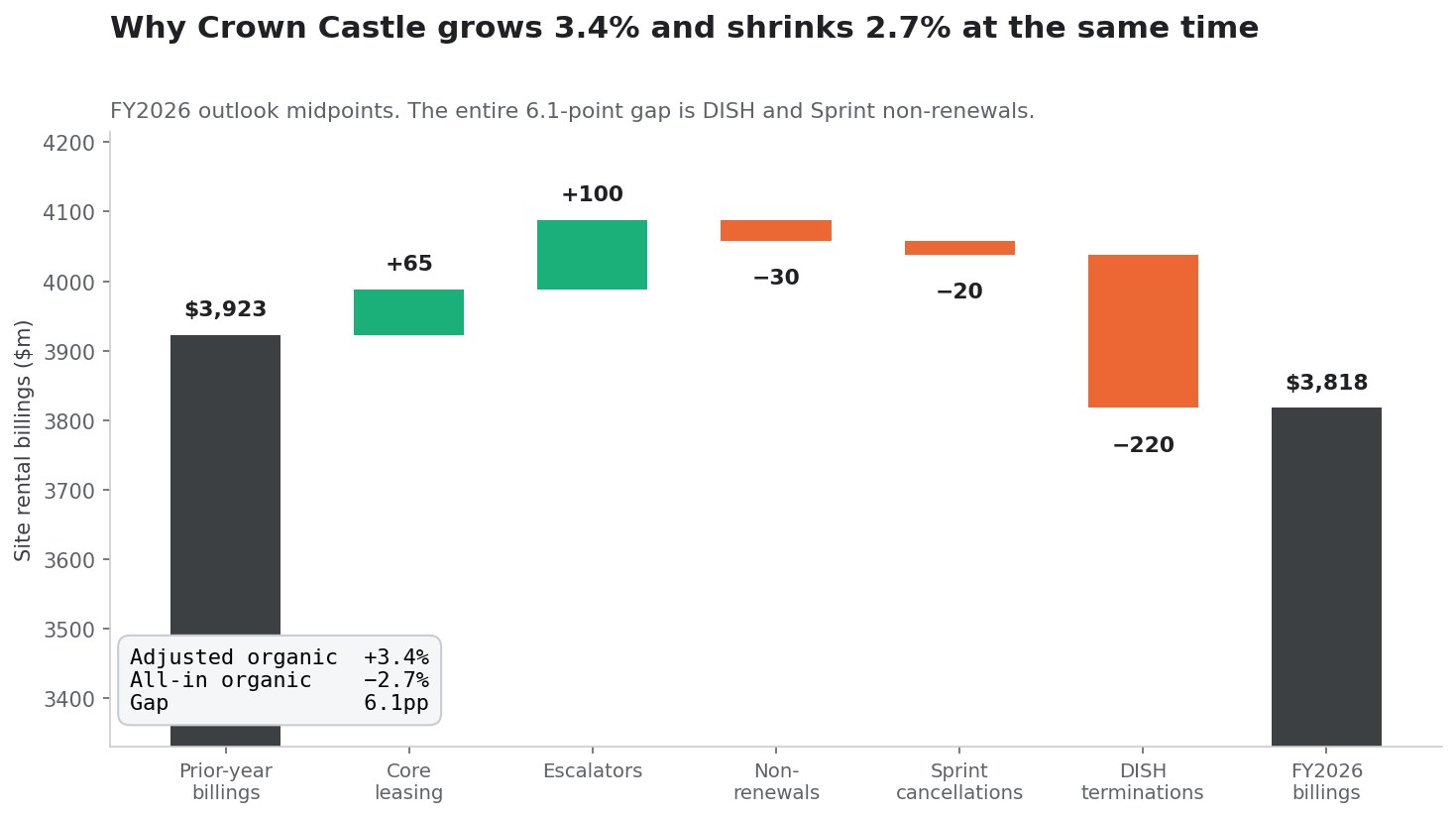
This is the most commonly mis-reported number in Crown Castle coverage, and the one that most changes the investment conclusion. The company publishes two organic growth figures, and they have opposite signs.
From the FY2026 outlook components, in millions:
| Line | Amount |
|---|---|
| Prior-year site rental billings excluding DISH | $3,701 |
| Prior-year site rental billings to DISH | $222 |
| Prior-year site rental billings | $3,923 |
| Core leasing activity | +$60 to +$70 |
| Escalators | +$95 to +$105 |
| Non-renewals | −$35 to −$25 |
| Other billings | — |
| Organic contribution, as adjusted for Sprint and DISH | +$120 to +$150 |
| Non-renewals from Sprint Cancellations | −$20 |
| Non-renewals from DISH Terminations | −$220 |
| Organic contribution to site rental billings (all-in) | −$120 to −$90 |
Expressed as percentages of the prior-year base, the company discloses all three:
- Organic contribution as adjusted, against the base excluding DISH billings: +3.6%
- Organic contribution as adjusted, against the full base: +3.4%
- Organic contribution all-in: −2.7%
The gap between the headline-friendly +3.4% and the all-in −2.7% is 6.1 percentage points, and all of it is DISH and Sprint. Both numbers are honest; they answer different questions. "+3.4%" answers is the underlying tower business growing? — yes, driven by escalators (+$100m) more than new leasing (+$65m). "−2.7%" answers is Crown Castle's revenue growing? — no.
An investor buying CCI for the SpaceX thesis should be clear about which number the thesis has to fix. The adjusted number does not need fixing. The all-in number does, and a new tenant ramping over several years is a slow remedy for a $240 million annual hole that is already in the run rate.
Where the growth actually comes from
Breaking the adjusted organic contribution into its parts, for FY2026 guidance and the two most recent comparable quarters:
| Component | FY2026 outlook | % of base | Q2 2026 | Q2 2025 |
|---|---|---|---|---|
| Core leasing activity | $65m | 1.8% | $15m (1.7%) | $16m (1.7%) |
| Escalators | $100m | 2.7% | $25m (2.7%) | $24m (2.6%) |
| Non-renewals | −$30m | −0.8% | −$7m (−0.7%) | −$7m (−0.7%) |
| Other billings | — | — | +$5m (0.5%) | +$2m (0.2%) |
| Adjusted organic contribution | $135m | 3.6% | $38m (4.2%) | $34m (3.7%) |
Escalators are doing more work than leasing. Contractual rent increases contribute 2.7% of the base; actual new leasing activity contributes 1.8%. This is the quiet structural fact about U.S. tower REITs in 2026: the growth is substantially indexed rent on existing contracts, not new tenant demand. A fourth carrier would change that mix. Nothing else on the horizon will.
Tenant concentration: the 89% problem
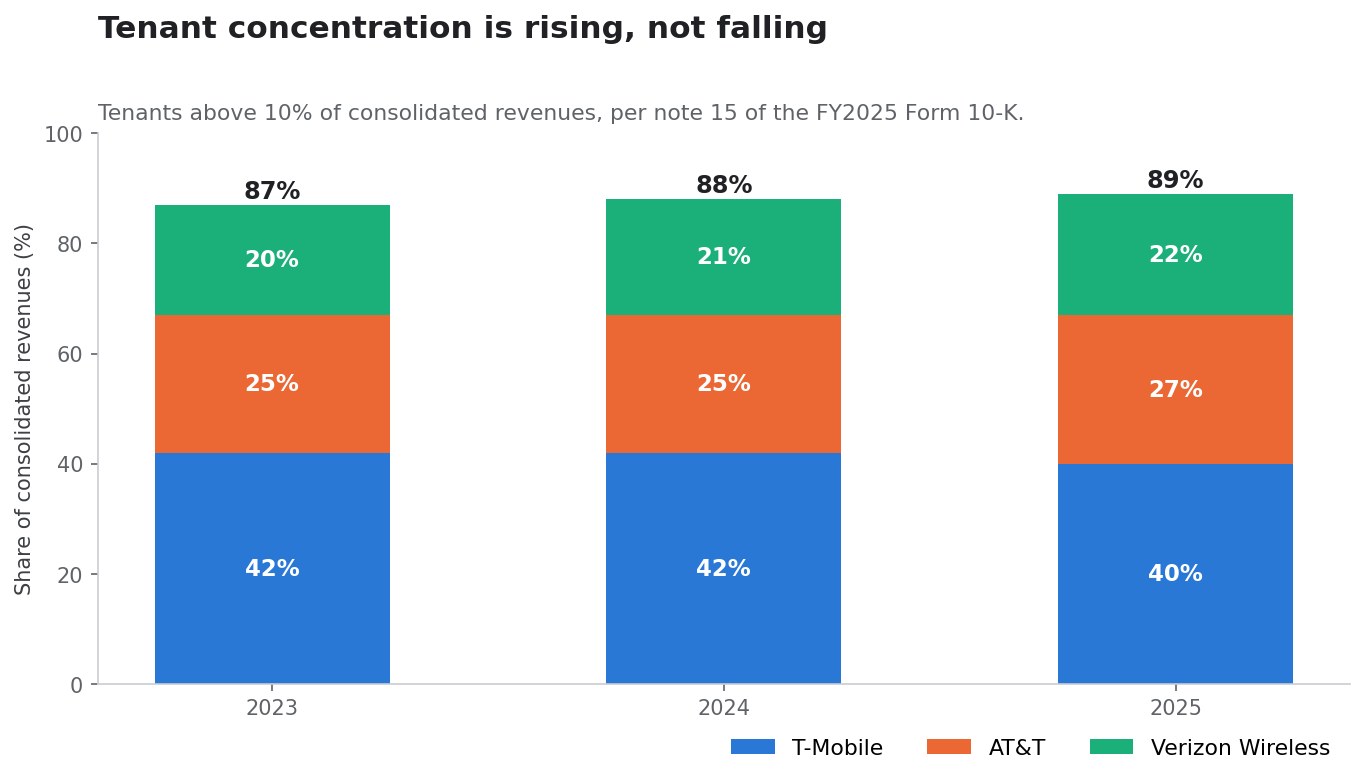
Crown Castle's note 15 discloses every tenant above 10% of consolidated revenues. The table is short.
| Tenant | 2025 | 2024 | 2023 |
|---|---|---|---|
| T-Mobile | 40% | 42% | 42% |
| AT&T | 27% | 25% | 25% |
| Verizon Wireless | 22% | 21% | 20% |
| Total | 89% | 88% | 87% |
Elsewhere in the 10-K the company states that these three tenants accounted for approximately 90% of 2025 site rental revenues, and that site rental revenues were 95% of 2025 net revenues.
Concentration is rising, not falling: 87% → 88% → 89% over three years. That trend is partly arithmetic — as DISH's billings disappear, the Big Three's share of what remains goes up — but the direction is the point. Crown Castle is becoming more dependent on three customers, two of which just lost about a fifth of their market value in a day, and the largest of which lost 13.27%.
Why this is the real SpaceX question
The bull case says SpaceX becomes tenant number four and dilutes this concentration. There is a bear reading of identical facts: a credible new entrant with better spectrum economics gives AT&T, Verizon and T-Mobile a reason to spend less on terrestrial capacity, consolidate sites, share infrastructure, and negotiate renewals harder. Crown Castle's contracts have a weighted-average remaining term of approximately six years excluding tenant renewal options, representing $23.7 billion of expected future cash inflows (exclusive of DISH):
| Year | Contracted amounts |
|---|---|
| 2026 | $3,777m |
| 2027 | $3,810m |
| 2028 | $3,668m |
| 2029 | $2,961m |
| 2030 | $2,778m |
| Thereafter | $6,661m |
| Total | $23,655m |
Note the shape. Contracted revenue is flat through 2028 and then steps down 22% in 2029, from $3,668m to $2,961m. That is when renewal negotiations with the Big Three start to bite in earnest. A SpaceX lease signed in, say, 2028 would arrive precisely when Crown Castle's negotiating position with its existing 89% is weakest — which is an argument for the lease mattering, and also an argument that the counterparty will know it.
Is the dividend safe? Start with the cut that already happened
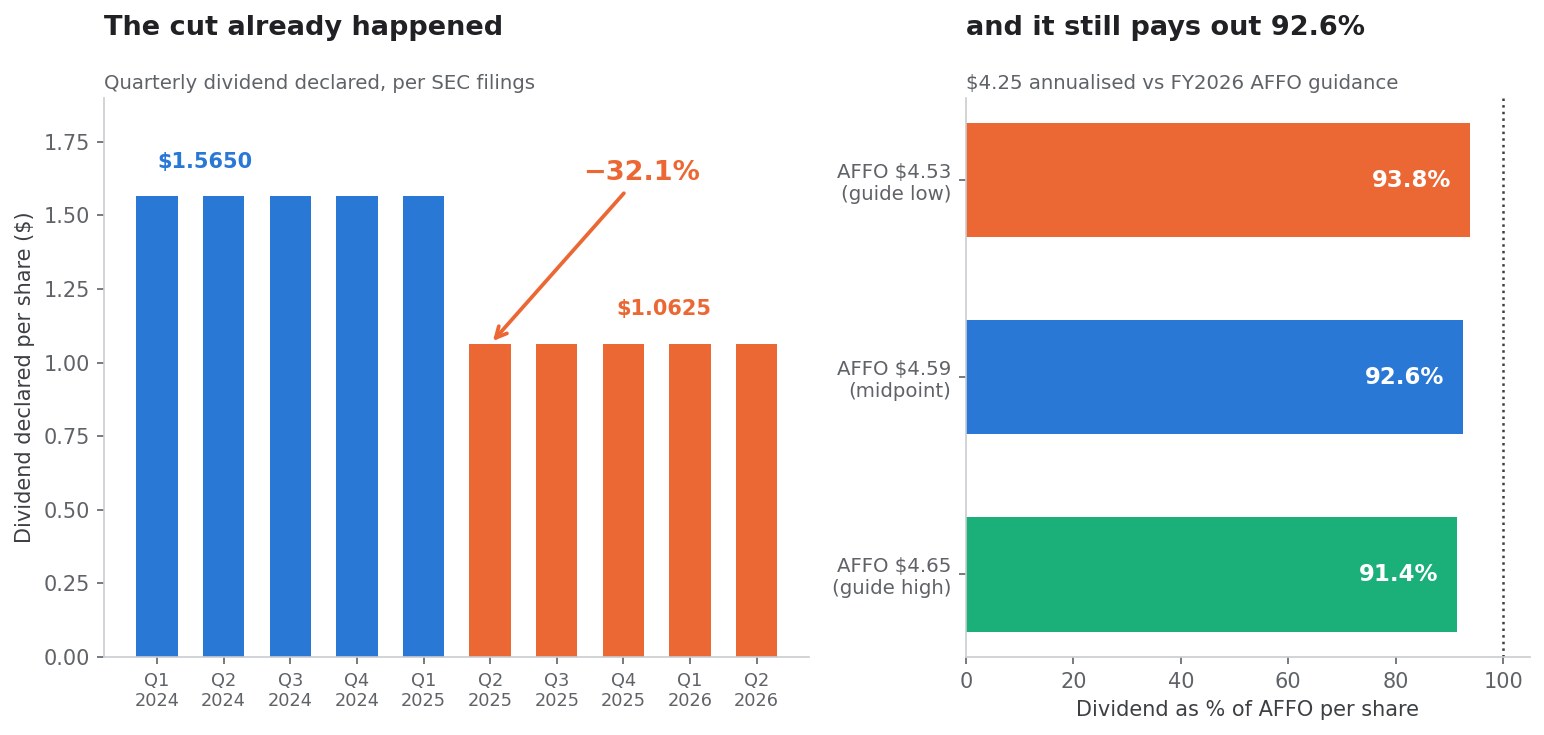
Crown Castle's indicated dividend is $4.25 per share annualized — four quarterly payments of $1.0625. At the October 9 close of $79.64 that is a 5.34% yield; at the October 12 close of $81.01, 5.25%.
Almost every description of this yield omits the fact that makes it interpretable: it is already a post-cut dividend.
| Period | Quarterly dividend declared | Annualized |
|---|---|---|
| FY2024 (each quarter) | $1.5650 | $6.26 |
| Q1 2025 | $1.5650 | $6.26 |
| Q2 2025 onward | $1.0625 | $4.25 |
The reduction from $1.565 to $1.0625 is −32.1%, effective with the second quarter of 2025. Crown Castle did not hold its dividend through the DISH collapse and the fiber divestiture; it cut it by nearly a third. An investor evaluating "dividend safety" in October 2026 is evaluating the safety of the second dividend level, set after the first proved unsustainable.
The payout ratio
Against management's own FY2026 AFFO guidance:
$4.25 dividend / $4.59 AFFO per share = 92.6% payoutAcross the guidance range the payout runs from 91.4% (at the $4.65 high) to 93.8% (at the $4.53 low). For context, REIT distributions are conventionally assessed against AFFO rather than GAAP earnings, because depreciation on long-lived infrastructure makes net income a poor proxy for distributable cash. Even on that more permissive basis, 92.6% is thin. The methodology for interrogating a payout ratio and a leverage ratio together — and the traps in doing it with adjusted numbers — is worked through in Sysco $1B Stock Sale: Pro Forma EPS Falls 23% to $2.83.
What a 92.6% payout leaves no room for:
- Tower upgrades and structural strengthening beyond the guided $150–250m
- Land purchases under towers — a stated strategic priority, and the driver of the 48% capex increase in Q2
- Further debt reduction beyond the fiber proceeds already deployed
- Additional buybacks after the initial $1.0 billion
- Tenant improvement allowances to win a SpaceX deployment
- Litigation costs on the DISH claim
- Any negative surprise in the 2029 renewal cycle
The cash-flow reality
Crown Castle paid approximately $460 million of common dividends in Q2 2026 alone, and $932 million in the first half. Against first-half AFFO, the dividend is covered. It is covered by a margin of roughly 7 cents on the dollar.
Leverage after $7 billion of repayment
The balance sheet is much better than it was, and still not conservative.
From the Q2 2026 supplement, as of June 30, 2026:
| Item | Amount |
|---|---|
| Total secured debt | $1,033m |
| Total unsecured debt | $17,320m |
| Cash, equivalents and restricted cash | $1,254m |
| Net Debt (company definition) | $17,099m |
Carrying-value debt fell from $24,805m at March 31, 2026 to $18,353m at June 30, 2026 — a $6.45 billion reduction in one quarter, funded by the fiber sale.
Leverage, computed two ways:
$17,099m / ($675m Q2 Adjusted EBITDA x 4) = 6.33x
$17,099m / $2,690m FY2026 Adjusted EBITDA midpoint = 6.36x
So roughly 6.3 to 6.4 times net debt to Adjusted EBITDA. For a REIT with 35-year average remaining ground-lease life under its towers and six-year weighted-average tenant contracts, that is defensible. It is not low. Net debt to EBITDA above 6x in a REIT with 89% customer concentration is a meaningful constraint on strategic flexibility — which is exactly the flexibility a large SpaceX deployment might require.
The mitigant is real: 100% of the debt is fixed-rate with a ~7-year weighted-average maturity. Crown Castle has no near-term refinancing cliff and no floating-rate exposure to the policy path. Against a Fed that has resumed hiking, that is a genuine advantage over leveraged peers, and it is the single most underrated line in the Q2 release. Current benchmark rates can be tracked at FRED.
The near-term maturity schedule is manageable:
| Maturity | Issue | Face value |
|---|---|---|
| Jul 2026 | 1.050% Senior Notes | $1,000m (repaid on maturity) |
| Mar 2027 | 2.900% Senior Notes | $718m |
| Mar 2027 | 4.000% Senior Notes | $500m |
| Sep 2027 | 3.650% Senior Notes | $979m |
| Jan 2028 | 5.000% Senior Notes | $977m |
| Feb 2028 | 3.800% Senior Notes | $978m |
Against $4.5 billion of undrawn revolver and $2.0 billion of commercial paper capacity, nothing here is threatening.
Valuation: what 17.4x AFFO assumes
| Measure | At Oct 9 ($79.64) | At Oct 12 ($81.01) |
|---|---|---|
| Price / FY2026 AFFO per share | 17.35x | 17.65x |
| Indicated dividend yield | 5.34% | 5.25% |
| AFFO payout ratio | 92.6% | 92.6% |
| Net debt / Adjusted EBITDA | ~6.3x | ~6.3x |
Where the stock sits in its own range:
- 52-week high: $100.50 — the stock is 20.8% below it
- 52-week low: $65.32 — the October 9 close was 21.9% above it
- Price one year earlier: $96.10; into the announcement at $68.89 that was −28.3%
That last line is the honest context for the rally. Crown Castle did not jump 15.6% from a fair price; it jumped from a price that had already fallen 28% in a year on DISH, the dividend cut and the fiber restructuring. A meaningful share of the October 9 move is mean reversion off a 52-week low, not SpaceX option value. Separating the two is not possible with precision, but the order of magnitude matters: the stock recovered roughly a third of its 12-month decline in one session.
At 17.4x AFFO with a 92.6% payout and 6.3x leverage, the multiple is not demanding for a pure-play U.S. tower REIT with contractual escalators. Nor is it distressed. The price now embeds the SpaceX option explicitly — which means the option can be taken back out.
Can SpaceX actually use Crown Castle towers?
Technically, yes, and without difficulty. Crown Castle's towers are engineered for exactly this: antennas, radio units, power, equipment space and ground space, governed by master lease agreements. Low-band 800 MHz propagates well and penetrates buildings, which is precisely the gap SpaceX says it is addressing — its existing 2 GHz direct-to-device holdings serve open sky far better than building interiors.
Plausible uses of a tower portfolio by a satellite operator building a terrestrial layer:
- Low-band macro antennas for indoor and long-range coverage
- Radio equipment interconnected with the Starlink network
- Supplemental ground capacity in dense urban markets where satellite capacity per unit area is constrained
- Gateway and backhaul interconnection equipment
- Capacity augmentation at stadiums, airports, campuses and transport corridors
The economics of a colocation favor both sides. Once a tower has land rights, structural capacity, power and maintenance, an additional tenant is close to pure margin for the landlord, and far cheaper than greenfield construction for the tenant. With 2.4 tenants per tower on average, Crown Castle has physical and structural headroom on a large part of its portfolio.
So the engineering question is not the constraint. The commercial one is.
Why SpaceX might not need Crown Castle
This is the part of the thesis the October 9 tape ignored.
Crown Castle is one of several suppliers
SpaceX can negotiate with American Tower, SBA Communications, rooftop landlords, private and regional tower operators, utilities, municipalities and electric co-ops. Tower siting is competitive and substantially fungible within a market. A tenant with 14 MHz of nationwide low-band and a credible threat to self-build has unusual leverage over rent.
A satellite-first architecture may need far fewer sites
The strategic logic of buying low-band for a satellite constellation is coverage augmentation, not nationwide macro replacement. If the terrestrial layer exists to fill gaps — indoors, dense cores, interference-heavy areas — the site count required is a fraction of a conventional carrier build. A network designed around satellites that happens to use some towers is a very different revenue event from a fourth carrier that needs 20,000 sites.
SpaceX's demonstrated preference is to own its infrastructure
The company builds its own rockets, its own satellites, its own ground stations and its own launch facilities. Vertical integration is the house style, and it is funded. Assuming it will choose to become a long-term rent payer to a REIT requires evidence, and none has been produced.
The spectrum transfer is not approved
The transaction requires FCC approval. Deployment conditions, buildout milestones and interference rules attached to that approval will shape — and could materially constrain — the terrestrial architecture.
No lease exists
There is no publicly disclosed Crown Castle–SpaceX agreement of any kind as of this analysis. Not a letter of intent, not a master lease agreement, not a mention in management commentary or leasing backlog. Crown Castle owns an option, and an option that has not been struck is not an asset on the balance sheet.
Crown Castle versus American Tower versus SBA Communications
If the thesis is "U.S. tower exposure to a possible fourth carrier," it is worth asking whether CCI is the right instrument.
Crown Castle (CCI) | American Tower (AMT) | SBA Communications (SBAC) | |
|---|---|---|---|
| Oct 9 move | +15.60% | +9.30% | +7.34% |
| Oct 9 close | $79.64 | $182.24 | $182.49 |
| FY2025 revenue | $4,049m | $10,645m | $2,815m |
| Annualized dividend per share | $4.25 | ~$7.16 | ~$5.05 |
| Indicated yield at Oct 9 | 5.34% | 3.93% | 2.77% |
| 52-week high / low | $100.50 / $65.32 | $196.08 / $160.06 | $224.46 / $156.60 |
| Geographic profile | U.S. only | International + U.S. | U.S. + Latin America |
Dividends are derived from each company's reported per-share declarations and dividend payments in SEC filings; SBAC's is annualized from first-half payments and is approximate.
The read-across is clean. Crown Castle is the highest-yielding, most U.S.-concentrated and most beaten-down of the three — which is exactly why it moved most. It is the highest-beta expression of the same thesis. Investors who want tower exposure with less single-country, single-tenant-base risk have alternatives that did not rally as hard and do not carry a 92.6% payout.
American Tower's 3.93% yield against Crown Castle's 5.34% is not a free 141 basis points. It is the price of diversification, a lower payout ratio and no DISH.
The bull case, stated at its strongest
SpaceX becomes a fourth national tenant
If Starlink Mobile leases even 7,000 sites at market rents, that is roughly $295 million of high-margin annual billings — more than DISH ever paid, arriving on a portfolio whose fixed costs are already sunk. Escalators would then compound it for a decade.
The terrestrial layer gets more important as satellite succeeds
The better direct-to-device service becomes, the more subscribers it attracts, and the more capacity it needs where subscribers actually are: indoors and in dense cores. Satellites provide coverage; towers provide capacity. Commercial success for Starlink Mobile plausibly increases, not decreases, its need for ground infrastructure.
Underlying leasing is genuinely positive
Adjusted organic contribution is +3.4%, and the DISH headwind is finite. The $220 million of DISH Terminations is a 2026 event, not a recurring annual deduction. From 2027, the comparison base resets and reported growth should converge toward the adjusted number — without SpaceX contributing anything.
The balance sheet is de-risked
100% fixed-rate debt, ~7-year maturities, $4.5 billion revolver, $2.0 billion commercial paper capacity, $6.45 billion of debt retired in a single quarter. Crown Castle can wait.
The business is finally simple
One segment, one country, one asset class. After years of fiber capital intensity and small-cell complexity, CCI is a legible tower REIT. Legible businesses get re-rated.
The stock is still 20.8% below its 52-week high
Even after a 15.6% day, there is room to the prior range if the thesis is validated.
The bear case, stated at its strongest
The market bought a receivable that does not exist
The entire move rests on an inference about a private company's future capital allocation. $4.57 billion of value was created by a press release about a spectrum purchase from a third party.
The implied requirement exceeds the DISH precedent
The move prices SpaceX at 1.3–1.4x DISH's realized footprint. The last fourth carrier defaulted. The bull case requires a better outcome than the only comparable we have, and the comparable ended in a $3.5 billion claim.
Reported revenue is still shrinking
Site rental revenues: −5% in FY2026. Adjusted EBITDA: −6%. All-in organic billings: −2.7%. No tenant announcement changes 2026 or 2027.
Concentration is getting worse
89% from three tenants, up from 87% two years ago, and the 2029 contracted-revenue step-down is 22%.
The dividend has already been cut once
A −32.1% reduction in 2025, and the replacement dividend consumes 92.6% of guided AFFO. The margin of safety is roughly seven cents on the dollar of AFFO.
A stronger SpaceX may hurt the tenants more than it helps the landlord
The market's own verdict was a $49.2 billion net destruction of value, with towers capturing only 21.1% of carrier losses. Crown Castle's customers are weaker after October 9 than before. Weaker customers negotiate harder and spend less.
Much of the rally was mean reversion
The stock entered the announcement 28.3% below its level a year earlier and 5.5% above a 52-week low. A substantial share of the 15.6% is the unwinding of pessimism, not the pricing of a new tenant — which means it can re-wind without SpaceX doing anything.
AFFO growth came from the balance sheet, not the towers
Q2 AFFO rose 10% on lower interest expense and higher interest income from sale proceeds. That is a one-time step up, not a growth rate. Site rental revenue, EBITDA and net income all declined.
A monitoring framework
The useful question is not "is CCI a buy." It is "which observable evidence would confirm or invalidate this thesis." In order of information value:
- FCC approval of the Grain–SpaceX transfer, and specifically any terrestrial buildout conditions attached to it. Track the docket at fcc.gov.
- Any Crown Castle disclosure naming SpaceX — management commentary, leasing backlog, or a new master lease agreement. Until this exists, the thesis is unfunded. Monitor filings via EDGAR full-text search.
- Core leasing activity, not total revenue. The line to watch is core leasing activity as a percentage of base: 1.8% guided for FY2026. A real fourth tenant shows up there first, before it shows up in revenue.
- The all-in organic number turning positive. Guided at −2.7% for 2026. If 2027 guidance does not converge toward the adjusted +3.4% as the DISH base washes out, the underlying business is weaker than the adjusted figure implies.
- AFFO per share against the $4.53–$4.65 range. The payout ratio and the valuation both hang off this single number.
- The 2029 contracted-revenue step-down. Any renewal announcement with T-Mobile, AT&T or Verizon that extends term or resets escalators is more material to CCI's value than a SpaceX headline.
- DISH claim developments. Recovery on the $3.5 billion assertion, or impairment of the unreserved $165 million, are both real cash events.
- Peer guidance. If American Tower and SBA Communications raise U.S. leasing expectations, the demand is real and sector-wide. If only CCI's stock moves, it was sentiment.
- Re-run the valuation after every move.
price / AFFO per shareanddividend / AFFO per sharetake ten seconds and prevent most mistakes.
Crown Castle's filings are the primary source for every item above: the 10-K, the quarterly earnings releases and supplements, and the FY2026 outlook tables. Live price and signal context for the name sits on the SimianX CCI page, and a multi-agent read on the ticker can be run from the live analysis desk.
Scenarios
| Scenario | What SpaceX does | Incremental annual billings | CCI implication |
|---|---|---|---|
| Bull | Nationwide urban deployment; master lease signed by 2028 | $300m+ | Adjusted organic reaccelerates above 5%; payout falls below 85%; re-rating toward 20x AFFO |
| Base | Selective metro deployment after FCC approval; phased 2028–2031 | $75–150m | Modest upside layered on a −2.7% base; dividend held; multiple roughly unchanged |
| Bear | Self-builds, uses peers, or defers the terrestrial layer | ~$0 | Option value removed; stock retraces toward the $65–70 pre-announcement range |
| Tail risk | Big Three cut capex in response to a credible fourth entrant | Negative | 2029 renewals reset lower; dividend coverage breaks |
The base case deserves emphasis because it is the one the price does not reflect. At $75–150 million of eventual billings, SpaceX is a real but ordinary customer — roughly half of DISH — arriving three to five years out, discounted. That is worth perhaps a third of what the market paid for it on October 9.
Is CCI the hidden winner?
On the evidence: Crown Castle is a plausible winner and a confirmed holder of an option, and those are different securities.
The strongest honest version of the thesis is narrow and worth holding: SpaceX owns satellites and now low-band spectrum; Crown Castle owns 40,000 structurally and legally sited towers with power, ground rights and 2.4 tenants of average loading. There is genuine complementarity, and if a terrestrial Starlink layer is built in American cities, Crown Castle will be in the conversation.
The problem is that the market has already paid for the conversation at a price that exceeds the only historical precedent — and that precedent is a default.
What would make this a Tier-1 holding rather than a headline trade is simple and has not happened: an executed lease, a raise in core leasing guidance, the all-in organic number crossing zero, and a payout ratio with more than seven cents of cover. Until then the defensible position is that CCI is a 5.3% yield with a 92.6% payout, 6.3x leverage, 89% customer concentration and a free option on SpaceX attached — and that the option is now priced closer to fair than to cheap.
Accumulate on weakness toward the pre-announcement range if the dividend holds and churn stabilizes. Do not pay for the option twice.
FAQ
Can SpaceX lease Crown Castle towers?
Technically yes — Crown Castle's towers support antennas, radios, power and ground equipment under master lease agreements, and 800 MHz low-band is well suited to macro siting. But there is no publicly disclosed Crown Castle–SpaceX lease of any kind as of this analysis, and SpaceX has not stated that it intends to lease third-party towers.
How much is a fourth carrier actually worth to Crown Castle?
The only empirical answer available: DISH Wireless, at its peak, generated $222 million a year of site rental billings — about 5.7% of Crown Castle's prior-year billings base — before defaulting in January 2026. Crown Castle's October 9 market-cap gain implies $264 million of incremental annual AFFO, equivalent to roughly $293–310 million of billings, or 1.3–1.4x the DISH precedent.
Is CCI stock a buy after rising 15.6%?
It is no longer cheap and not yet expensive: 17.4x FY2026 AFFO with a 5.34% yield. The honest framing is that the SpaceX option is now in the price. Suitability depends on tolerance for 89% revenue concentration in three tenants, 6.3x net debt to Adjusted EBITDA and a 92.6% AFFO payout ratio.
Is the Crown Castle dividend safe?
The current $4.25 annualized dividend consumes 92.6% of the FY2026 AFFO midpoint, with a range of 91.4% to 93.8%. More importantly, it is already a reduced dividend: Crown Castle cut the quarterly payment from $1.565 to $1.0625 — −32.1% — effective in Q2 2025. It is covered, with roughly seven cents of cover per dollar of AFFO, and no cushion for a negative surprise.
Why did Crown Castle rise more than American Tower and SBA?
Crown Castle is the purest and highest-beta expression of the trade: 100% U.S., tower-only after the May 2026 fiber sale, the highest yield of the three at 5.34%, and the most beaten down — it entered the announcement 28.3% below its year-earlier price and near a 52-week low of $65.32. Mean reversion amplified the thesis.
Did the tower REITs capture what the carriers lost?
No. On October 9, AT&T, Verizon and T-Mobile lost $62.34 billion of combined market value while Crown Castle, American Tower and SBA Communications gained $13.13 billion — a capture rate of 21.1%, leaving $49.21 billion of value destroyed rather than transferred.
Will SpaceX build a nationwide terrestrial network?
Unknown, and the spectrum purchase does not settle it. The transaction requires FCC approval, the price has never been disclosed by either party, and SpaceX's stated purpose is augmenting satellite direct-to-device coverage — which may require far fewer sites than a conventional carrier build.
What is the single number to watch?
Core leasing activity as a percentage of the billings base — guided at 1.8% for FY2026. A genuine fourth tenant appears there before it appears in revenue, guidance or the dividend.
Related Reading
- SpaceX's $8B Spectrum Deal: AT&T, Verizon, T-Mobile Ranked
- Warsh Ignores Trump: The Fed's First Rate Hike Since 2023
- Accenture Stock +6% on the Dell AI Deal, but Dell Slipped
- Sysco $1B Stock Sale: Pro Forma EPS Falls 23% to $2.83
- Will SpaceX's IPO Pump or Drain Tesla Stock on June 12?
References
- Crown Castle Inc. — company website
- Crown Castle — Investor Relations
- Crown Castle FY2025 Form 10-K — tenant concentration (note 15), DISH default and termination (note 18), tenants per tower, contracted revenue
- Crown Castle Q2 2026 earnings release — Q2 actuals, FY2026 outlook, net debt, capital structure
- Crown Castle Q2 2026 quarterly supplement — site rental billings bridge, DISH and Sprint components
- SEC EDGAR full-text search — share counts and filing history
- SEC XBRL company facts API — dividends declared, debt carrying amounts, revenues
- Federal Communications Commission — spectrum transfer approvals and licensing
- FCC — spectrum policy — band plans and buildout conditions
- SpaceX and Starlink — satellite and direct-to-device programs
- Grain Management — seller of the 800 MHz portfolio
- Light Reading — SpaceX on the Grain low-band purchase
- Cleary Gottlieb — T-Mobile completes $2.9 billion 800 MHz sale to Grain Management
- T-Mobile US, AT&T, Verizon — tenant disclosures and investor materials
- American Tower and SBA Communications — tower REIT peers
- AST SpaceMobile — competing direct-to-device operator
- EchoStar — DISH Wireless parent
- Nareit — REIT reporting standards and AFFO conventions
- Investopedia — adjusted funds from operations
- Investopedia — dividend payout ratio
- Investopedia — net debt to EBITDA
- FRED — 10-Year Treasury constant maturity
- NYSE — CCI quote
- iShares U.S. Telecommunications ETF (IYZ)
- Vanguard Real Estate ETF (VNQ)
- SPDR S&P 500 ETF Trust (SPY)
Tools used in this analysis:
- SimianX AI
- SimianX live analysis desk
- SimianX CCI page
- SimianX Crypto Leaderboard
- SimianX stories
- SimianX points and pricing
This article is for research and educational purposes only. It is not personalized investment advice. Prices and market-capitalization changes are computed from unadjusted closing prices for October 8 and October 9, 2026, and share counts from the most recent SEC cover-page disclosures; the reported $8 billion SpaceX–Grain consideration has not been confirmed by either counterparty. REIT investors should review filings, dividend coverage, tenant concentration, leverage and interest-rate sensitivity against their own objectives before buying any security.