Accenture, Dell and the Private AI Trade: Reading the Tape, Not the Press Release
Accenture stock after the Dell private AI partnership is not the simple story the headline suggests. On October 8, 2026, Accenture closed at $208.36, up 5.96% on 12.1 million shares against 5.2 million the session before, hours after it and Dell Technologies announced the formation of the Accenture Dell Business Group.
The collaboration is real and strategically sensible. Accenture will train more than 3,000 practitioners across Dell’s portfolio; Dell supplies AI-ready servers, storage, networking and the infrastructure underneath. The target is enterprises that want agentic AI without handing their data, intellectual property or compliance posture to a public cloud.
But three facts complicate the obvious reading, and none of them appeared in the coverage:
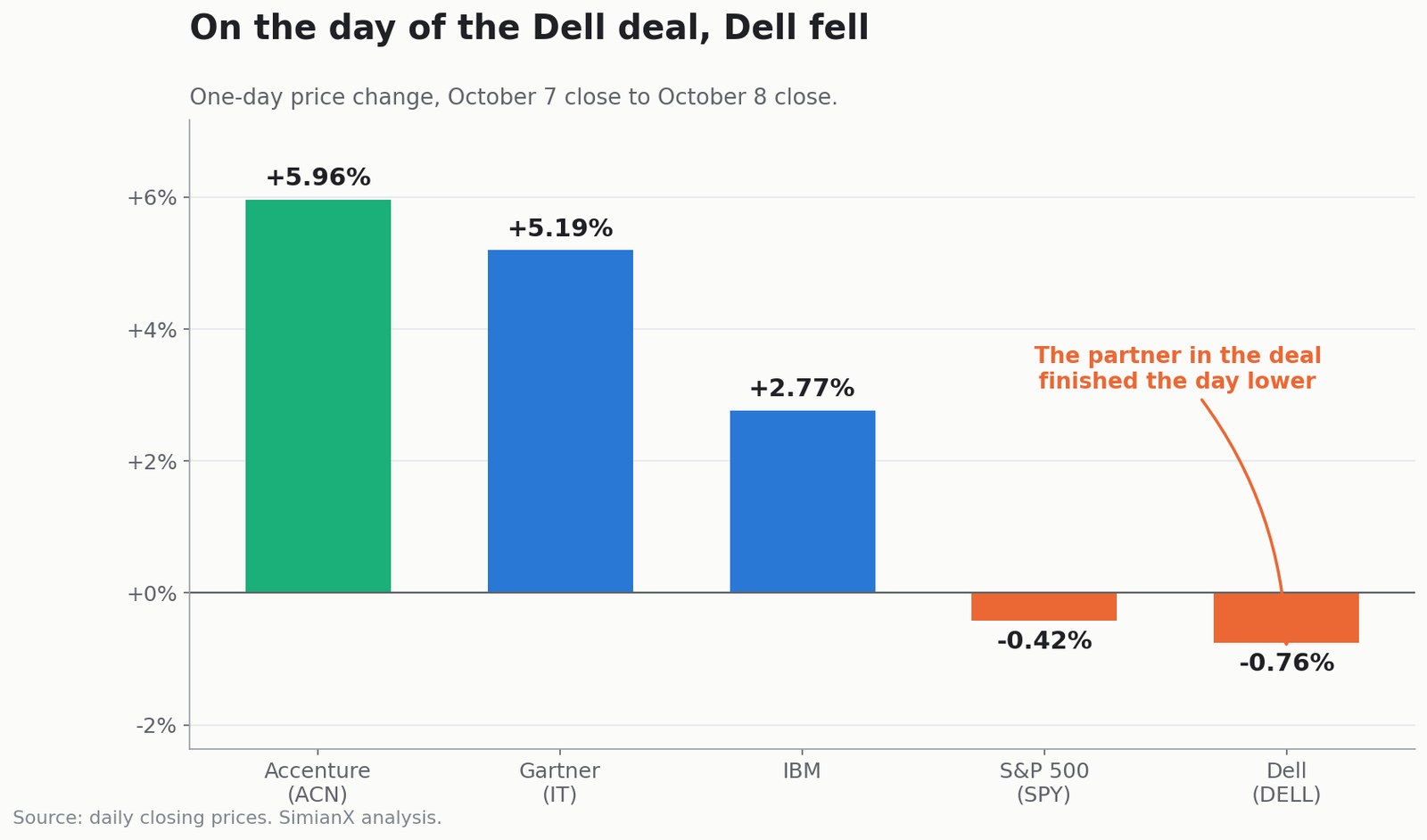
- Dell fell that day. The counterparty to the partnership closed down 0.76% while Accenture rose 5.96%.
- Gartner, which announced nothing, rose 5.19% — and the S&P 500 fell 0.42%. The IT-services complex moved together.
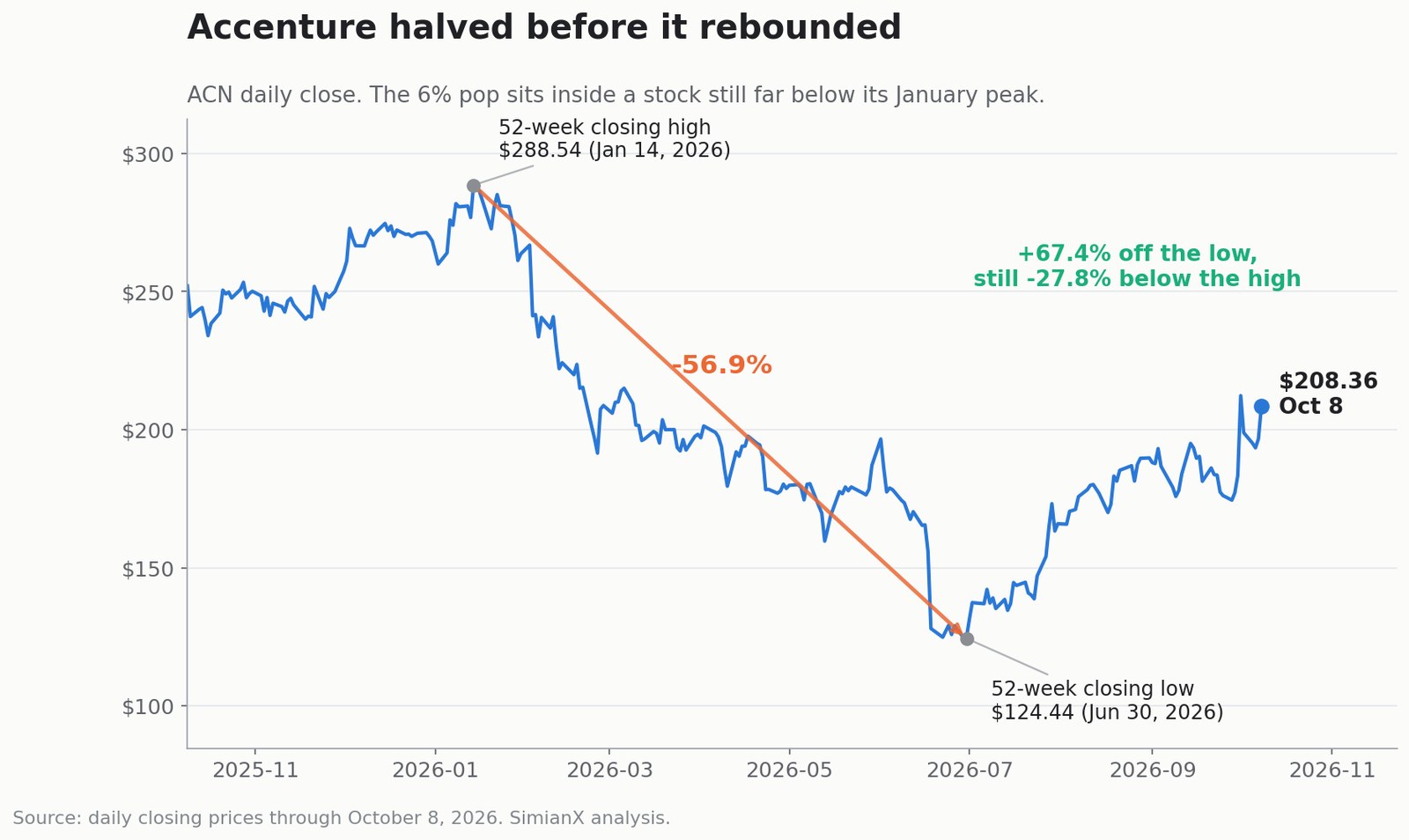
- Accenture is still 27.8% below its January high. The stock peaked at $288.54 on January 14, 2026, fell 56.9% to $124.44 on June 30, and has rebounded 67.4% since. The 6% pop is a late move inside a much larger round trip.
The announcement also disclosed no contract value, revenue commitment, backlog figure, exclusivity provision or margin forecast. Accenture’s own forward-looking-statements section concedes that “the partnership might not achieve its anticipated benefits.”
This analysis works from the signed announcement, Accenture’s fiscal 2026 results and earnings call, Dell’s latest quarterly filing, and the actual tape. Six things the first wave of coverage missed are developed below: the cross-sectional evidence that this was a sector move, the size of the drawdown it sits inside, the scale gap between Dell’s AI business and all of Accenture, the two different stories told by the FY2027 margin guide, the debt that funded the record capital return, and what the guidance implies for organic growth.
The partnership strengthens Accenture’s position in a real market. It does not yet change a single line of the financial model, and the stock that rose on it is still a long way from where it started the year.
All market and financial information reflects data available through the October 8, 2026 close. This article is for educational purposes and is not personalized investment advice.
Did Accenture Stock Really Jump 6% Because of Dell?
The sequence matters. Accenture closed at $196.64 on October 7 and at $208.36 on October 8, a gain of 5.96%. Volume rose to 12.1 million shares from 5.2 million.
The timing coincides with the Accenture Dell Business Group announcement, so it is reasonable to treat the collaboration as a contributing catalyst. It is not reasonable to treat it as the whole explanation.
Accenture had reported fiscal fourth-quarter results only one week earlier. On October 1 the stock rose 15.78% — its largest single-day gain of the past year — after revenue beat the top of guidance and fiscal 2027 guidance landed better than feared.
The full sequence, including the two sessions the early coverage skipped:
| Date | ACN close | Daily change | Context |
|---|---|---|---|
| September 30, 2026 | $183.37 | +3.53% | Positioning into earnings |
| October 1, 2026 | $212.30 | +15.78% | Q4 beat and FY2027 outlook |
| October 2, 2026 | $198.90 | −6.31% | Profit-taking |
| October 5, 2026 | $195.05 | −1.94% | Continued give-back |
| October 6, 2026 | $193.40 | −0.85% | Drift lower |
| October 7, 2026 | $196.64 | +1.68% | Stabilizing |
| October 8, 2026 | $208.36 | +5.96% | Dell partnership announced |
ACN opened at $197.73, traded as low as $193.22, and closed near the session high of $209.06. Intraday demand clearly strengthened.
The cross-section says this was not an Accenture-specific event
The cleanest test of a company-specific catalyst is whether the move was company-specific. It was not.
| Security | October 8 change |
|---|---|
| Accenture (ACN) | +5.96% |
| Gartner (IT) | +5.19% |
| IBM | +2.77% |
| S&P 500 (SPY) | −0.42% |
| Dell (DELL) | −0.76% |
Two observations follow. First, Dell — the other party to the partnership — finished lower. If the market believed the business group was worth billions, it declined to pay Dell for it. Second, Gartner rose 5.19% with no Dell announcement at all, and IBM rose 2.77%, while the index fell. An entire cohort of IT-services and IT-research names re-rated together on a down day for the market.
That pattern is much more consistent with a sector-level repricing — a shift in how investors view AI’s effect on services businesses — than with a single press release. The Dell news plausibly supplied the excuse and set the direction; it did not supply 6% of standalone value.
What the 6% Move Sits Inside
A single-day gain means little without the path that produced it.
| ACN reference point | Level | Date |
|---|---|---|
| 52-week closing high | $288.54 | January 14, 2026 |
| 52-week closing low | $124.44 | June 30, 2026 |
| Peak-to-trough decline | −56.9% | Jan 14 to Jun 30 |
| Rebound from the low | +67.4% | Jun 30 to Oct 8 |
| Still below the peak | −27.8% | as of Oct 8 |
| Worst single session | −17.97% | June 18, 2026 |
Accenture lost more than half its market value in five and a half months, then recovered two thirds of the fall. The question “is ACN a buy after the 6% jump” is really the question “was the 57% derating correct?” — because the market spent the first half of 2026 pricing AI as an existential threat to labor-based IT services, and has spent the second half partially taking that back.
Nothing in the Dell announcement settles that argument. It is a data point in a much larger debate about whether AI expands or compresses the consulting opportunity.
What Did Accenture and Dell Actually Announce?
Accenture and Dell have worked together for more than 20 years. The October announcement formalizes that into a dedicated business group focused on deploying AI inside customer-controlled environments. Julie Sweet, Accenture’s chair and CEO, framed it as helping clients “move from AI ambition to scaled execution to measurable business outcomes.” Michael Dell described it as helping enterprises “move from AI interest to adoption.”
The group combines:
- Accenture’s strategy consulting and industry expertise
- Accenture’s implementation and managed-services capability
- Dell’s AI-ready servers, storage and networking
- Dell AI Factory architectures
- Private, sovereign and neocloud providers
- Open-source and open-weight models with task-aware routing
- Agentic AI accelerators
- Full-lifecycle infrastructure and operational support
Initial target industries are financial services, life sciences, healthcare, manufacturing, industrials, high technology, and government and defense — the sectors where data residency and auditability bind hardest.
The announcement also cites RHAELM, a UK-based AI infrastructure and solutions provider, as a reference customer whose sovereign cloud build is being accelerated by the combination. RHAELM is the company that appeared in Accenture’s January 2026 announcement under the name Sovereign AI (S-AI), alongside Palantir, building Dell- and NVIDIA-powered AI data centers across EMEA. Bradd Lewis is named as chief executive in both releases.
What Was Missing From the Announcement
The release did not disclose:
- Any minimum customer-spending commitment
- Expected annual revenue for either partner
- Bookings or contracted backlog
- The number of committed customers
- Required investment by either side
- Revenue-sharing arrangements
- Exclusivity
- Project-level margins
- A timeline for material financial contribution
Forming a business group improves sales coordination, training and delivery. It does not, by itself, produce revenue. Accenture’s own risk language is explicit that the partnership “might not achieve its anticipated benefits.”
This is the same gap between a headline and a commitment that we traced in the Generac–Amazon agreement, where an $8 billion headline rested on $2.4 billion of actually committed deliveries, and in Akamai’s $11.6 billion Anthropic contract, which required $4.8 billion of spending before the revenue arrived. Here there is no headline number at all — which is, in its way, more honest.
The Dell collaboration strengthens Accenture’s competitive position. It cannot yet be entered into a valuation model as a cash-flow stream.
What Is Private AI?
Private AI refers to AI systems deployed inside infrastructure controlled by an organization or a tightly governed service provider: a company data center, a private cloud, an edge location, a dedicated colocation facility, a sovereign national cloud, or a hybrid of these.
Private AI is not a rejection of the public cloud. Most enterprises will run hybrid architectures in which sensitive workloads stay private while elastic or lower-sensitivity workloads use public capacity.
| Consideration | Private AI | Public cloud AI |
|---|---|---|
| Data control | Greater direct control | Shared-responsibility model |
| Initial cost | Usually higher | Lower upfront commitment |
| Cost predictability | Attractive at steady utilization | Flexible, can escalate at scale |
| Scalability | Limited by owned capacity | Highly elastic |
| Customization | High | Depends on provider |
| Data residency | Easier to define precisely | Depends on regions and terms |
| Hardware refresh risk | Borne by the customer | Borne by the provider |
| Deployment complexity | Higher | Easier to start |
| Best fit | Sensitive, regulated, predictable workloads | Variable workloads and experimentation |
The urgency comes from agency. A chatbot answers questions. An autonomous agent may retrieve confidential records, change a business object, execute code, approve a transaction or call another system. The more authority an agent holds, the more governance matters — and the more attractive it becomes to keep the whole loop inside a controlled boundary.
Why Could Private AI Become a Major Investment Theme?
Four forces support the market, and they are more durable than any single vendor statistic.
1. Data sovereignty is becoming a procurement requirement
Organizations increasingly must control where data sits, which jurisdiction governs it, who may access it, which models process it, whether prompts and outputs are retained, whether proprietary information trains external models, and how automated decisions are audited.
Accenture research cited in its own January 2026 release found that 60% of European organizations planned to increase sovereign AI investment over two years.
2. Inference is moving toward the data
Frontier training stays concentrated among a few well-funded labs. Enterprise adoption is mostly inference. Moving large private datasets to a hosted model creates latency, bandwidth, security and egress-cost problems; sometimes it is simpler to bring the model to the data.
3. Open-weight models expand deployment choice
Enterprises no longer depend solely on a hosted API. In its open-weight model strategy, Accenture describes matching open and proprietary models to each workload and routing between them — a small local model for routine tasks, a specialized model for industry workflows, a frontier cloud model for hard reasoning, a private model for sensitive IP.
4. Predictable utilization can improve unit economics
Public cloud wins on speed to start and elasticity. A stable, high-volume inference workload can eventually be cheaper on dedicated capacity. Dell markets its AI Factory as reducing spend substantially against public model APIs for certain workloads, but any such figure depends on utilization, hardware, energy, model design and depreciation assumptions — vendor arithmetic, not a universal constant.
The principle is sturdier than the percentage: private infrastructure becomes attractive when workloads are sensitive, predictable and consistently utilized. When they are none of those things, it is an expensive way to own depreciation.
Why Is Accenture Positioned to Benefit?
Accenture does not make GPUs or servers. Its opportunity is to be the integration layer between hardware, models, enterprise data and business process.
A private AI deployment typically requires selecting use cases, modernizing data, choosing infrastructure and models, designing governance and security, integrating agents with existing software, redesigning processes, training staff, monitoring model behavior, and operating the environment for years. That list maps almost exactly onto Accenture’s consulting and managed-services businesses.
Client access
Accenture serves approximately 9,000 clients and ended fiscal 2026 with 317 Diamond clients, its designation for the largest relationships. It recorded 141 quarterly client bookings of $100 million or more during the year — a new high.
Ecosystem neutrality
Accenture works with Dell, NVIDIA, Microsoft, AWS, Google Cloud, Oracle, SAP, ServiceNow, OpenAI, Anthropic, Palantir and Databricks, among others. Most enterprises do not want a single-vendor AI strategy, and Accenture earns fees helping them compare, combine and govern competing systems.
In fiscal 2026 its ten largest ecosystem partners represented more than 60% of revenue; bookings tied to eight emerging AI and data partners more than tripled. Dell joins the ecosystem group Accenture plans to discuss annually from fiscal 2027.
AI workforce
Accenture reported nearly 110,000 AI and data professionals at the end of fiscal 2026, against a previous target of 80,000. Employees completed roughly 46 million hours of training; the company spent about $1 billion on learning and development and $1 billion on research and development.
The 3,000 Dell-trained practitioners are about 0.37% of Accenture’s roughly 814,000 people. The number matters less as headcount than as a dedicated go-to-market team pointed at one infrastructure stack.
Does Accenture’s Financial Performance Support the Bull Case?
Accenture entered this from a stronger position than the first half of 2026 implied. From its fiscal 2026 results:
| FY2026 metric | Result | Change |
|---|---|---|
| Revenue | $74.18 billion | +6% USD, +5% local currency |
| Consulting revenue | $36.88 billion | +5% USD, +3% LC |
| Managed Services revenue | $37.30 billion | +8% USD, +6% LC |
| New bookings | $84.54 billion | +5% LC |
| GAAP operating margin | 15.4% | +70 bp |
| Adjusted operating margin | 15.8% | +20 bp |
| GAAP diluted EPS | $13.56 | +12% |
| Adjusted diluted EPS | $13.97 | +8% |
| Operating cash flow | $12.36 billion | +8% |
| Free cash flow | $11.62 billion | +7% |
| Cash returned to shareholders | $11.5 billion | +38% |
Fourth-quarter revenue of $18.68 billion exceeded the top of guidance. Q4 bookings of $22.17 billion produced a 1.2 book-to-bill, with Managed Services at 1.4 and Consulting at 1.0. Nearly 100 additional clients began first-time advanced AI work in the quarter, bringing the fiscal 2026 total above 400.
These figures show AI creating demand. They do not isolate revenue attributable to private AI, and they do not mention Dell.
What Does Fiscal 2027 Guidance Actually Imply?
Accenture guides to 3% to 6% local-currency revenue growth in fiscal 2027, with:
- GAAP operating margin of 15.9% to 16.1%
- GAAP diluted EPS of $14.39 to $14.81
- Operating cash flow of $11.9 billion to $12.7 billion
- Free cash flow of $11.0 billion to $11.8 billion
- At least $9.5 billion returned to shareholders
- Property and equipment additions of $900 million, up from $743 million
- A 5% increase in the quarterly dividend, to $1.71 per share
The organic growth number is the one that matters
Management expects an inorganic contribution of 2% to 2.5%. Subtract that from 3%–6% and the implied organic range is roughly 0.5% to 4%. At the low end, Accenture’s underlying business barely grows.
The margin guide tells two different stories
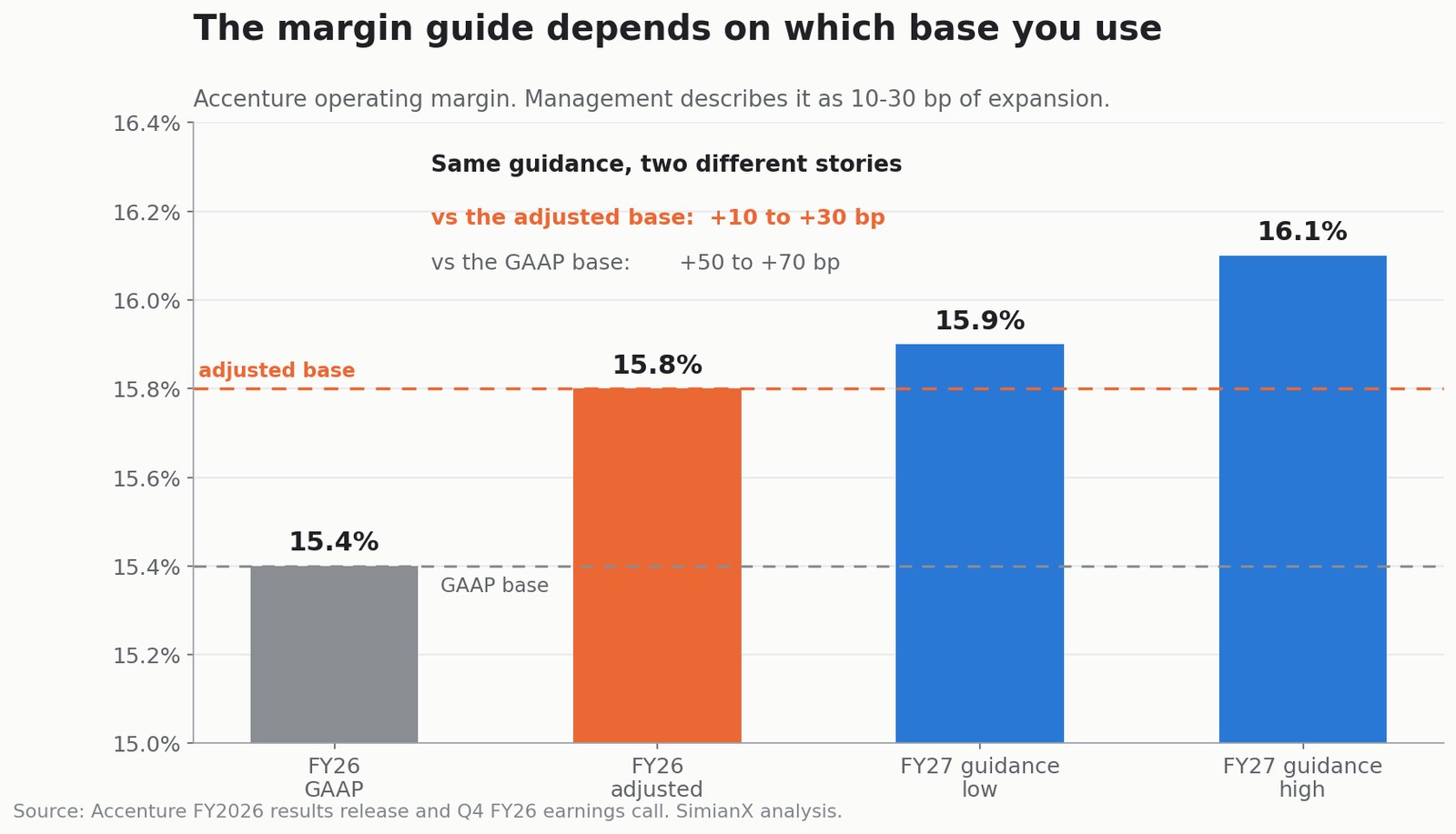
This is where the framing deserves attention. A 15.9%–16.1% operating margin is 50 to 70 basis points above the FY2026 GAAP margin of 15.4% — which sounds like meaningful expansion. Measured against the FY2026 adjusted margin of 15.8%, the same guidance is 10 to 30 basis points.
Julie Sweet used the second framing on the earnings call, and attached a condition to it: pricing in fiscal 2026 was “overall stable,” but “in Q4, we saw lower pricing in many areas of our business,” and the FY2027 guide, “including our 10 basis point to 30 basis point margin expansion, assumes that we’re going to have continued intense competition.”
That is management telling investors the margin guide is close to flat and already prices in pricing pressure.
How Material Could the Dell Partnership Become?
No revenue target was given, so any estimate is illustrative. One way to frame the scale hurdle is hypothetical annual revenue per Dell-trained practitioner. This is not a forecast, and those practitioners will not work full-time on Dell engagements.
| Illustrative revenue per practitioner | 3,000 practitioners | Share of FY2026 revenue |
|---|---|---|
| $200,000 | $600 million | 0.8% |
| $300,000 | $900 million | 1.2% |
| $400,000 | $1.20 billion | 1.6% |
Even a highly productive 3,000-person practice contributes a low-single-digit share of revenue on its own. Its real value would lie in the larger transformation programs it pulls through — strategy, data modernization, cybersecurity, application development, process redesign, training, cloud integration, managed infrastructure and multi-year operations.
The Dell-trained team is best understood as a sales and delivery catalyst, not a reporting segment.
Dell’s Momentum Is Real — and That Is Partly the Problem
Dell arrives with extraordinary AI infrastructure numbers. In its fiscal 2027 second quarter, ended July 31, 2026, Dell reported record revenue of $47.0 billion, up 58%, including:
- $60.9 billion of AI-server orders
- $16.4 billion of AI-server revenue, up 100%
- $95 billion of AI-server backlog
- Infrastructure Solutions Group revenue of $31.8 billion, up 89%
- ISG operating income of $4.78 billion, up 225%
Dell raised full-year fiscal 2027 revenue guidance by $25 billion to $192 billion and lifted its AI-optimized server revenue outlook to approximately $74.0 billion.
That last number deserves a pause. Dell expects to sell about $74.0 billion of AI servers in one fiscal year. Accenture’s entire fiscal 2026 revenue was $74.18 billion.
| Comparison | Dell | Accenture |
|---|---|---|
| Dell FY27 AI-server revenue guidance vs ACN FY26 total revenue | $74.0bn | $74.18bn |
| Dell Q2 AI-server orders vs ACN FY26 total bookings | $60.9bn | $84.54bn |
| Dell Q2 ISG operating income vs ACN FY26 operating income | $4.78bn | ~$11.42bn |
| Dell Q2 AI-server revenue vs ACN Q4 revenue | $16.4bn | $18.68bn |
One Dell product line, in one quarter, books 72% of what Accenture books in a year. Dell’s infrastructure segment earns 42% of Accenture’s annual operating income in a single quarter.
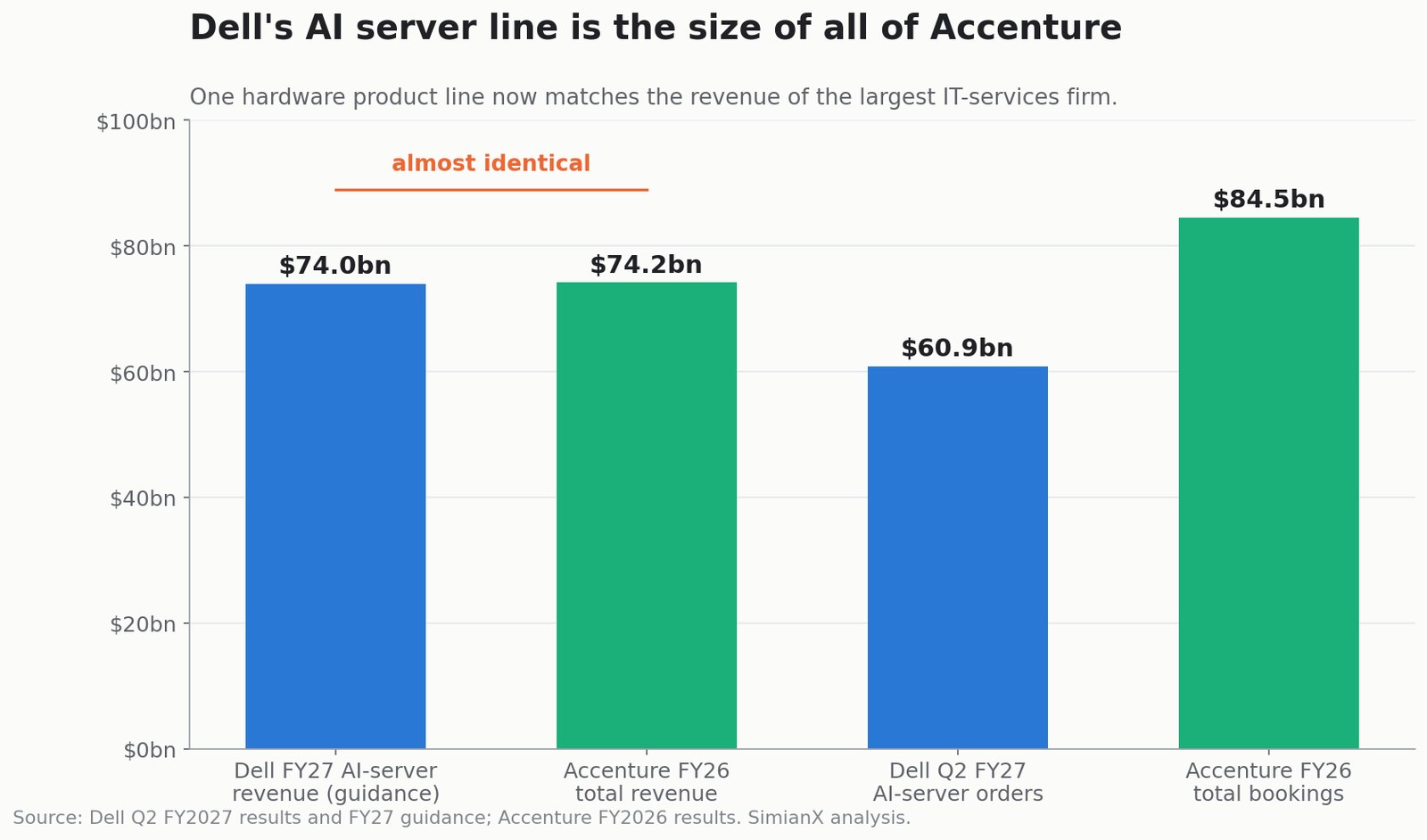
This cuts both ways. It makes Dell a powerful partner with genuine enterprise pull. It also shows where the AI profit pool currently sits — and it is not in the services layer.
The Market Has Already Picked a Side
The clearest evidence is the past year of returns.
| Security | One-year price change |
|---|---|
| Dell (DELL) | +268% |
| S&P 500 (SPY) | +15% |
| Accenture (ACN) | −17% |
| Gartner (IT) | −20% |
| IBM | −21% |
The entire IT-services and IT-research cohort is down roughly a fifth over a year in which the index rose 15% and the leading AI hardware vendor rose nearly fourfold. Investors have been paying for the layer that sells capacity and discounting the layer that sells people.
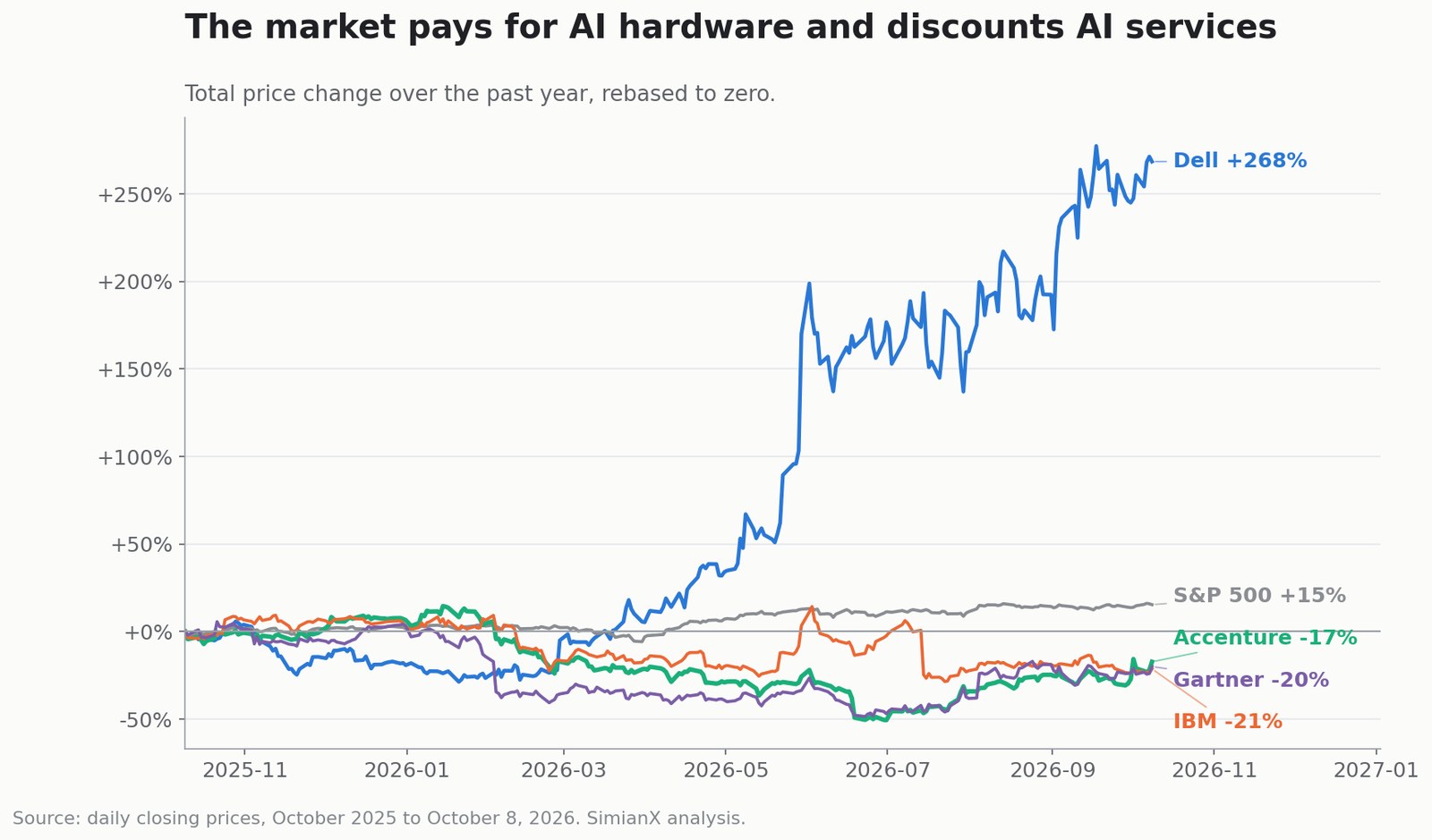
The Accenture–Dell business group joins those two sides together. For Accenture bulls that is the point: it is a route into the hardware boom without buying the hardware. For bears it is a reminder of who holds the pricing power in the relationship.
This rotation inside the AI trade is the same dynamic we examined when AI executives began calling for a slower frontier and chip names fell while large-cap platforms rose. The capital is not leaving AI; it keeps moving between layers.
Is Private AI More Attractive Than Public Cloud AI?
Private AI should not be read as a winner-takes-all replacement. The durable architecture is hybrid.
| Workload | Likely placement |
|---|---|
| Experimental prototype | Public cloud |
| Highly variable short-term demand | Public cloud |
| Large frontier-model training | Hyperscaler or specialized AI cloud |
| Sensitive patient or financial data | Private or sovereign |
| Factory-floor inference | Edge or private |
| Predictable high-volume inference | Private, dedicated or hybrid |
| General employee productivity | SaaS or public cloud |
| Classified government workload | Sovereign, isolated or air-gapped |
| Multi-model agentic workflow | Hybrid |
A private deployment fails economically when it is underutilized, and it can obsolete quickly as chips and models move. Public cloud keeps transferring capacity and refresh risk to the provider.
So the durable thesis is not “private beats public.” It is: enterprise AI will require more architectural diversity, and the companies that can integrate private, sovereign, edge and public systems may capture disproportionate value. That favors Accenture more than any all-on-premises forecast does.
What Is the Bull Case for ACN Stock?
AI creates larger transformation programs
Deploying a model is easy. Redesigning processes, data architecture, controls and workforce around it is not. Accenture participates across that whole lifecycle.
Private AI unlocks regulated budgets
Banks, insurers, pharmaceutical companies, manufacturers and governments have been slow to put sensitive workloads into public AI. Private and sovereign infrastructure can release budgets that compliance previously blocked.
Managed Services can compound
Managed Services generated $37.30 billion in FY2026, grew faster than Consulting, and carried a 1.4 book-to-bill in Q4. Operating infrastructure, monitoring agents, updating models and managing security is recurring work.
The business is genuinely cash generative
FY2026 free cash flow was $11.62 billion on capital expenditure of just $743 million — a fraction of what a cloud or hardware provider must spend. That funds dividends, buybacks and acquisitions.
The valuation is not demanding
At the October 8 close of $208.36, against 605.3 million weighted-average diluted shares, Accenture’s market capitalization was approximately $126.1 billion.
| Measure | Value |
|---|---|
| Price / FY2027 GAAP EPS midpoint ($14.60) | 14.3x |
| Market cap / FY2026 free cash flow | 10.9x |
| Market cap / FY2027 free cash flow midpoint | 11.1x |
| Free cash flow yield (FY2027 midpoint) | 9.0% |
| Market cap / FY2026 revenue | 1.70x |
A 9% free-cash-flow yield on a business with 9,000 clients and $84.5 billion of annual bookings is not an expensive asset.
What Is the Bear Case for ACN Stock?
The bear case is not that Accenture disappears. It is that AI erodes the economics of labor-based services faster than new AI work replaces them.
AI reduces billable hours
If a program that needed 100 consultants now needs 70, the client will eventually ask for a lower price. Management confirmed lower pricing in many areas during Q4.
Clients may keep the productivity gain
More than 65% of bookings are now fixed-price, including outcome-based work. That creates operating leverage when delivery goes well and margin risk when it does not.
Hiring is already slowing because of AI
Headcount rose 5% in fiscal 2026 and revenue per person increased. Asked to reconcile that with agentic delivery, Sweet said Accenture expects to hire in every market next year “but it will be at a lower rate in part due to AI.” A services firm guiding to slower hiring is telling you something about the revenue-per-head model.
Partnerships are not moats
Dell works with other integrators; Accenture works with competing infrastructure vendors. The relationship appears non-exclusive. IBM, Capgemini, Deloitte, Kyndryl, DXC, Infosys and TCS are chasing the same budgets.
Reported growth leans on acquisitions
Accenture deployed $4.9 billion across 17 acquisitions in fiscal 2026 and guides to roughly $5 billion more in fiscal 2027, with 2%–2.5% of FY2027 growth coming from acquired revenue. Goodwill rose to $26.8 billion from $22.5 billion.
The record capital return was partly debt-funded
This is the item the coverage consistently misses. In fiscal 2026 Accenture generated $11.62 billion of free cash flow and returned $11.5 billion — 99% of it — to shareholders, while also spending $4.9 billion on acquisitions.
Returns plus acquisitions totalled $16.40 billion against $11.62 billion of free cash flow, a gap of $4.78 billion. That gap was bridged by a $5 billion debt offering in the fourth quarter. Long-term debt doubled from $5.03 billion to $10.0 billion, and net cash fell from roughly $6.33 billion to $2.72 billion.
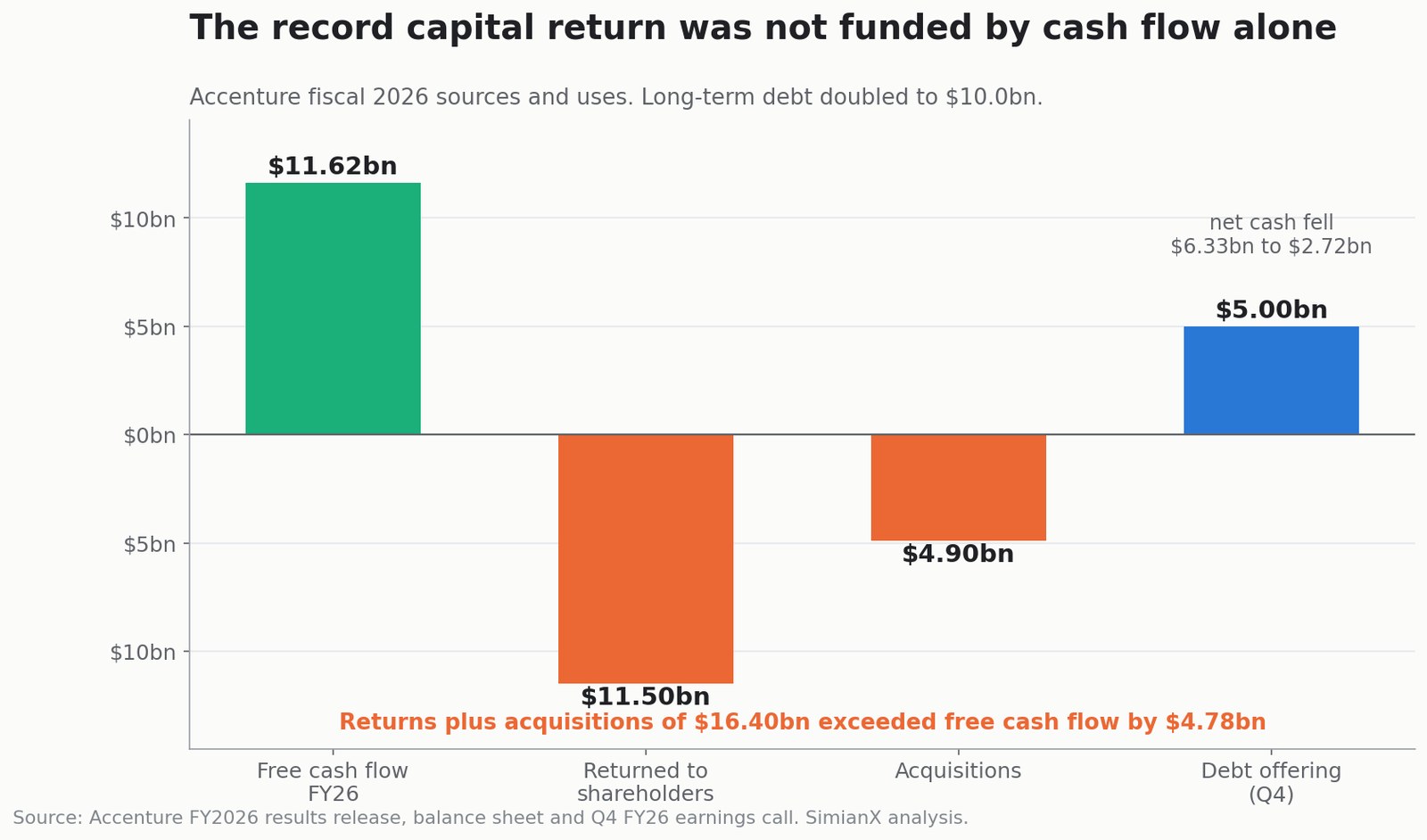
None of this is distress — Accenture remains in a net cash position with investment-grade credit. But “record $11.5 billion returned to shareholders” reads differently once you know the balance sheet moved to make room for it, and FY2027 guidance already promises at least $9.5 billion more.
The rebound has already happened
ACN rose 13.6% in the six sessions from September 30 to October 8 and sits 67.4% above its June low. A good deal of the earnings relief and private AI optimism is in the price.
ACN Valuation Scenario Analysis
Using the $14.60 midpoint of management’s FY2027 GAAP EPS guidance:
| FY2027 P/E | Implied share price | Interpretation |
|---|---|---|
| 12x | $175 | AI compresses pricing; organic growth stays near zero |
| 15x | $219 | Stable mature-company growth with heavy cash returns |
| 18x | $263 | Private AI lifts organic growth and margins hold |
| 21x | $307 | Accenture regains a premium AI-transformation rating |
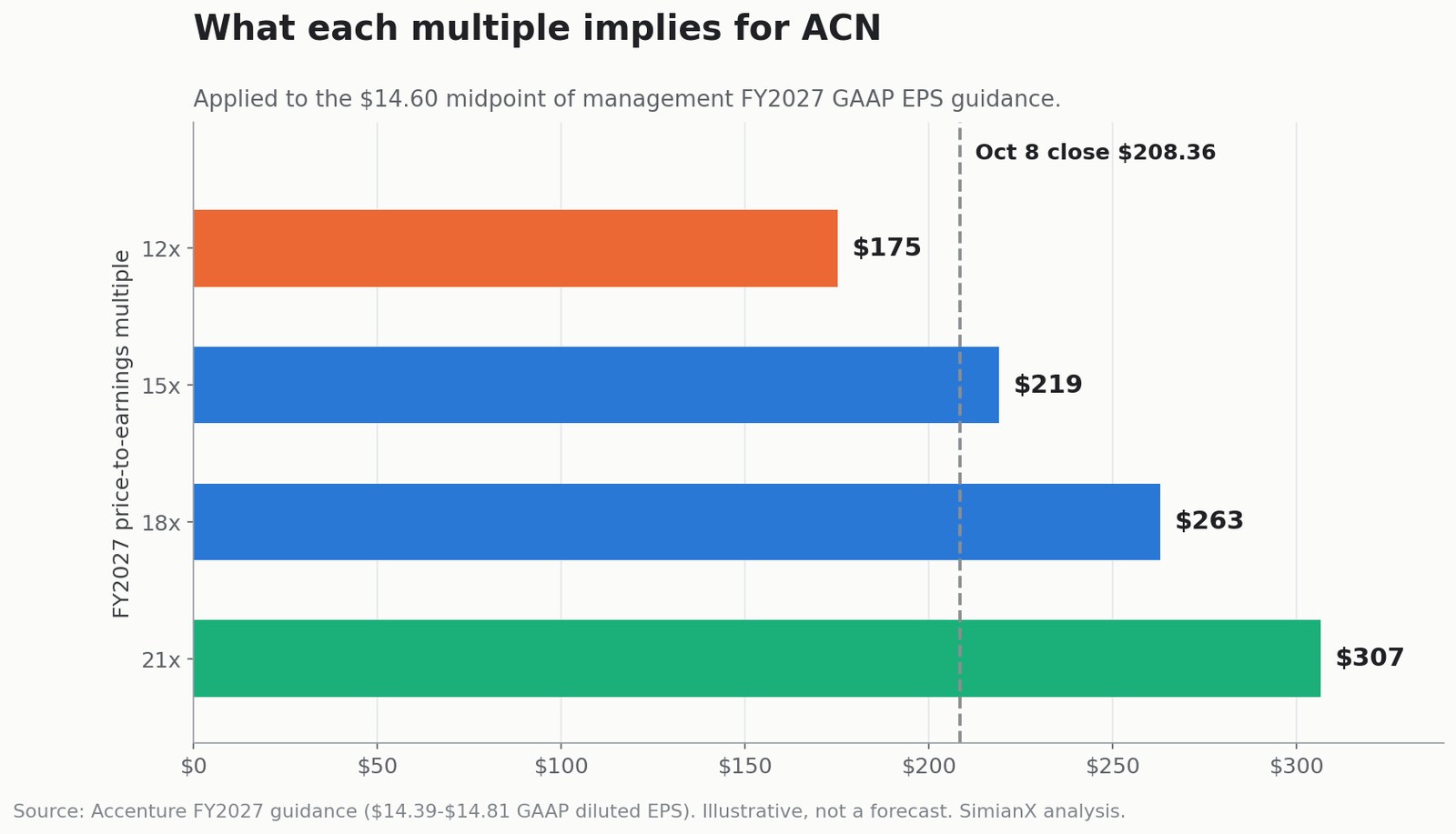
At $208.36 the market is pricing Accenture between the cautious and base cases — roughly 14.3x. Note what that implies: even the 18x case, at $263, would still leave the stock 9% below its January 2026 high. Getting back to $288 requires both multiple expansion and earnings growth.
This analysis holds EPS fixed and ignores acquisitions, currency and macro conditions. It shows that moderate upside does not require a heroic multiple — and that a full recovery does.
Which Stocks Could Benefit From the Private AI Trade?
| Layer | Representative companies | How they benefit | Main risk |
|---|---|---|---|
| Chips and accelerators | NVIDIA, AMD | Accelerator demand | Valuation and supply cycles |
| Servers and storage | Dell, HPE, Supermicro | Enterprise AI infrastructure | Hardware margins, component costs |
| Networking | Broadcom, Arista, Cisco | High-speed interconnect | Customer concentration |
| Consulting and integration | Accenture, IBM, Capgemini | Strategy, deployment, managed services | AI automates billable work |
| Private-cloud software | Broadcom/VMware, Red Hat, Nutanix | Workload orchestration | Licensing and competition |
| Cybersecurity | Palo Alto Networks, CrowdStrike, Zscaler | Securing models, data and agents | Crowded market |
| Data platforms | Snowflake, Databricks, Oracle | Preparing enterprise data | Cloud competition |
| Model providers | OpenAI, Anthropic, open-model ecosystems | Enterprise model adoption | Commoditization, compute cost |
Accenture is the capital-light way to participate: it does not need to put billions of GPUs on its own balance sheet. The trade-off is that its upside is correspondingly less explosive than a successful server or accelerator vendor’s — as the past year demonstrated with some force.
The same discipline applies to adjacent enterprise-software names. MongoDB’s 18% fall showed how quickly the market re-rates a software business when it doubts the AI story, and Meta’s capex debate shows the same scrutiny applied to the buyers of all this infrastructure. Industrial software is converging on the identical question, as Schneider Electric’s $22.6 billion offer for PTC made explicit — that deal, too, pairs Dell AI Factory infrastructure with a services and data layer.
A multi-agent research platform such as SimianX AI can help compare fundamentals, filings and competing interpretations instead of trading the headline:
- SimianX AI — multi-model research and live market analysis
- SimianX Crypto Leaderboard — competing model performance, tracked live
- SimianX Stories — filing-level research across equities and digital assets
What Should ACN Investors Monitor Next?
- Named customer wins through the Accenture Dell Business Group
- Whether management ever quantifies Dell-related or private AI bookings
- Organic revenue growth against the implied 0.5%–4% in FY2027 guidance
- Consulting book-to-bill — Q4 was 1.0; a sustained reading above 1.0 signals returning discretionary demand
- Managed Services growth, where recurring private AI operations would show up first
- Pricing commentary — Q4 already showed lower pricing in many areas
- Revenue per employee, which should rise if AI is working internally
- Operating margin against the 15.9%–16.1% guide, measured off the adjusted base
- Dell practitioner count beyond 3,000
- Regulated-industry production references, which matter more than pilots
- How capital returns are funded — cash flow or further debt
- Acquisition contribution, separating purchased growth from organic demand
Is Accenture Stock a Buy After the 6% Jump?
The valuation is reasonable relative to cash generation. The Dell announcement, on its own, is not a reason to buy.
The case works for investors who believe enterprise AI implementation will require extensive consulting, that private and sovereign deployment unlocks regulated budgets, that Accenture keeps its ecosystem-neutral position, that Managed Services compounds, and that organic growth improves after fiscal 2027.
It does not work for investors who believe AI structurally shrinks demand for consultants, that clients capture the productivity gain, that private AI stays a niche, that acquisitions are masking weak organic growth, or that the rally has outrun the evidence.
The balanced reading: Accenture is a moderately valued, highly cash-generative services company in the middle of an unresolved argument about whether AI is its tailwind or its disruptor. The market priced that argument at −57% in the first half of 2026 and has since taken back two thirds of it. Neither move was driven by a partnership press release.
Frequently Asked Questions About Accenture and Private AI
What is the Accenture Dell private AI partnership?
Accenture and Dell formed the Accenture Dell Business Group to help enterprises deploy AI across private, hybrid and sovereign infrastructure. Accenture provides strategy, integration and managed services; Dell provides AI-ready infrastructure and software. Accenture plans to train more than 3,000 practitioners on Dell’s portfolio.
Why did Accenture stock rise 6% on October 8, 2026?
ACN closed 5.96% higher the day the partnership was announced. But Dell fell 0.76% the same day, Gartner rose 5.19% without any such announcement, and the S&P 500 fell 0.42% — so the move looks substantially sector-driven. It also followed strong fiscal 2026 results on October 1, when the stock rose 15.78%.
Will private AI increase Accenture’s revenue?
It can generate consulting, data modernization, cybersecurity, integration and managed-services work. But Accenture disclosed no revenue target, backlog or customer commitment tied to the Dell Business Group, and has not broken out private AI revenue.
Is private AI cheaper than the public cloud?
For sensitive, predictable, consistently utilized workloads it can be. Public cloud usually remains cheaper for experimentation, variable demand, and organizations that cannot run infrastructure efficiently. Underutilized private capacity is expensive.
How far is ACN below its high?
The 52-week closing high was $288.54 on January 14, 2026. The October 8 close of $208.36 is 27.8% below it, after a 56.9% peak-to-trough decline into the June 30 low of $124.44 and a 67.4% rebound since.
Is ACN stock undervalued after the Dell announcement?
At roughly 14.3x the midpoint of FY2027 GAAP EPS guidance and a free-cash-flow yield near 9%, the valuation is moderate rather than cheap or stretched. The outcome depends on organic growth, pricing, and whether AI proves a net benefit to a labor-based model.
Conclusion: Is Private AI the Next Big Trade?
Private AI has the ingredients of a durable enterprise cycle: sensitive data, regulatory pressure, agentic workloads, open-weight models, predictable inference demand and real concern about cloud costs. The Accenture–Dell partnership is well designed for it. Dell supplies infrastructure; Accenture connects it to data, process, governance and operations.
Accenture enters with genuine strengths — $74.2 billion of revenue, $84.5 billion of bookings, $11.6 billion of free cash flow, nearly 110,000 AI and data professionals, roughly 9,000 clients and a moderate forward multiple.
But the evidence has to come from the financial statements, not the announcement. The deal carries no disclosed economics. FY2027 guidance implies as little as 0.5% organic growth. The margin guide is 10–30 basis points on the adjusted base and already assumes intense competition. The record capital return required a $5 billion debt raise. And the market’s one-year verdict — Dell +268%, Accenture −17% — says investors currently believe the value in enterprise AI accrues to whoever sells the capacity.
The verdict is constructively neutral and evidence-dependent. Private AI may well become a major trade. Accenture is positioned to participate. But the confirmation will arrive in bookings, organic growth and margins — not in another partnership headline, and not in a 6% day the rest of the sector shared.
Use SimianX AI to track ACN through live fundamentals, filings, news and opposing bull and bear readings, and keep testing the private AI thesis against what the financials actually report.
Related Reading
- PTC Stock: Schneider’s $205 Offer Trails the 52-Week High
- AKAM Stock: $11.6B Anthropic Deal Needs $4.8B Before Revenue
- Generac-Amazon Deal: $2.4B Order Behind an $8B Headline
- Why MongoDB Stock Fell 18%: CEO to Meta, 7 Crashes Compared
- AI CEOs Hit the Brakes: Chip Stocks Fell, Big Tech Rose
- META Stock After Muse: Can an AI Agent Justify $145B Capex?
- Is Jensen Huang Fueling an AI Bubble? Nvidia’s Boom Examined
Research Sources
- Accenture and Dell announce the Accenture Dell Business Group
- Accenture fiscal 2026 fourth-quarter and full-year results
- Accenture Q4 fiscal 2026 earnings call transcript
- Accenture open-weight model strategy
- Sovereign AI selects Accenture and Palantir for EMEA AI infrastructure
- Accenture investor relations
- Dell fiscal 2027 second-quarter results
- Dell AI Factory with NVIDIA
- Dell sovereign AI overview
- NVIDIA · Palantir · Microsoft · Oracle
- OpenAI · Anthropic · Databricks
- IBM · Capgemini · Infosys
- ACN historical share prices
- ACN valuation and market statistics