Inside the Generac-Amazon Deal: What the 8-K Commits and What It Only Implies
On September 17, 2026, Generac Holdings (NYSE: GNRC) closed at $207.23, up 18.34% from the previous session, after disclosing a long-term supply agreement with Amazon for backup power generators at Amazon data centers. The number in every headline was $8 billion.
The number in the filing is $2.4 billion.
Both are accurate, and the distance between them is the whole investment question. Generac's Form 8-K, filed September 16, says initial deliveries are expected to total $2.4 billion in 2027 and 2028. The $8 billion is a ceiling on cumulative payments that governs how many warrant shares Amazon eventually earns — not a purchase order.
That distinction has been reported. Four things have not.
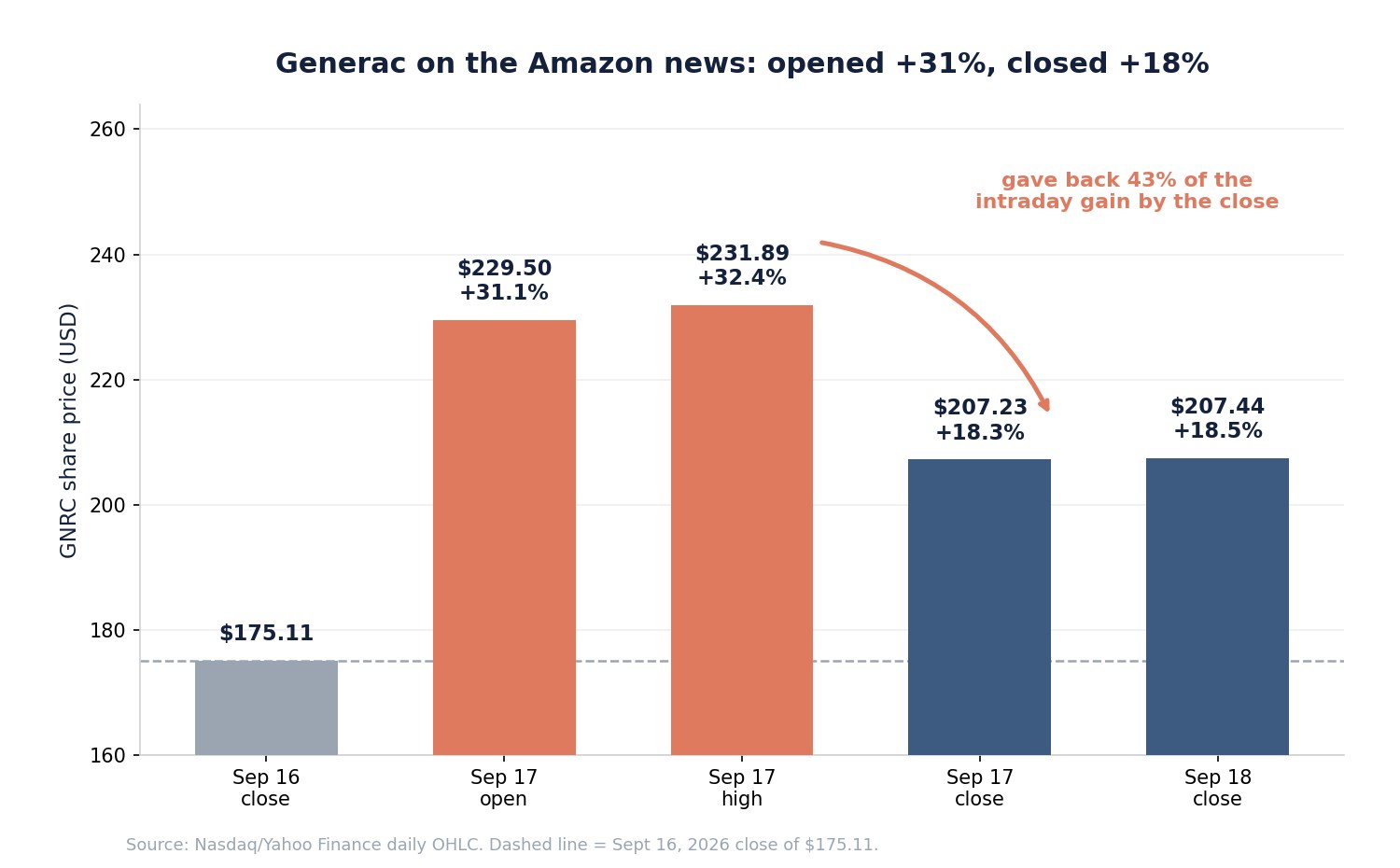
The first is what the tape actually did. Generac opened at $229.50, a 31.1% gap, touched $231.89 intraday, and then gave back 43% of that gain before the close. The second is that the warrant's vesting schedule is redacted in the filed exhibit, so no outsider can model the dilution timetable. The third is that Generac's Residential segment — its historic profit engine — is shrinking, and every dollar of growth is arriving in the lower-margin Commercial & Industrial business that will house the Amazon work. The fourth is that Q2 2026's headline margin contains a $71.1 million tariff refund booked as a reduction of cost of goods sold.
None of this makes the deal bad. It makes it smaller, slower and more conditional than an $8 billion headline suggests. Anyone tracking the position can follow GNRC filings, price behavior and estimate revisions with SimianX AI.
All figures are drawn from SEC filings, company disclosures and market data through September 18, 2026.
The four prices that tell the real story
A single closing percentage hides what traders actually did with this news.
| Moment | GNRC price | vs Sept 16 close | Volume |
|---|---|---|---|
| Sept 16, 2026 close | $175.11 | — | 1.66M |
| Sept 17 open | $229.50 | +31.06% | — |
| Sept 17 intraday high | $231.89 | +32.43% | — |
| Sept 17 low | $202.26 | +15.50% | — |
| Sept 17 close | $207.23 | +18.34% | 8.05M |
| Sept 18 close | $207.44 | +18.46% | 3.04M |
The market's first, unconsidered reaction was to add about a third to Generac's value. By the closing bell it had given back 43.4% of the intraday gain, finishing 10.6% below the high. The following session added 0.10% — the fade was not bought back.
That pattern matters because it is how the market prices a headline it cannot yet underwrite. An immediate +31% is the reaction to "$8 billion." A +18% close is closer to the reaction to "$2.4 billion over two years, plus an option on more."
Two further facts belong beside the celebration. At $207.44 Generac is still 30.0% below its 52-week high of $296.44 — the Amazon news did not take the stock to a new high, it took it back toward the middle of its own range. And GNRC is a genuinely volatile instrument: 29 of the last 251 sessions moved at least 5%, annualized volatility runs near 58%, and the stock drew down 40.8% at its worst point in the past year.
The market's considered answer was +18%, not +31%. The difference between those two numbers is the part of the $8 billion that investors decided not to pay for yet.
What Generac actually signed
The 8-K is short and unusually specific. On September 16, 2026, Generac and Amazon entered a Transaction Agreement under which Generac issued a warrant to Amazon.com NV Investment Holdings LLC, a wholly-owned Amazon subsidiary, and the two companies executed a long-term supply agreement the same day.
| Term | Detail |
|---|---|
| Warrant shares | Up to 1,693,745 |
| Exercise price | $200.9266 per share |
| Vested at signing | 307,954 shares |
| Remaining vesting | Tranches tied to cumulative Amazon payments, up to $8 billion |
| Initial deliveries | $2.4 billion expected across 2027 and 2028 |
| Expiry | On or before September 16, 2033 |
| Exercise method | Cash or cashless, at Amazon's election |
| Registration | Registration rights granted over the warrant shares |
| Exemption | Section 4(a)(2) of the Securities Act |
The structure is the important part. Amazon does not pay Generac for the warrant; Amazon earns it by placing and paying for orders. Vesting is triggered by "aggregate gross payments… received by the Company and its global affiliates," not by orders booked. Dilution therefore cannot run ahead of revenue — which is a genuinely shareholder-friendly design, and the strongest single argument in the bull case.
It is also the same vehicle and the same playbook Amazon has used to take warrant positions in suppliers before, and it rhymes with the equity-linked structure in Amazon's chip arrangement with Qualcomm: the customer secures supply and an equity call at the same time.
One detail deserves noting because it cuts the other way. The exercise price of $200.9266 was set 14.8% above Generac's undisturbed September 16 close of $175.11. Amazon did not get a discount. But the stock closed the next day at $207.23, so the warrants were in the money within 24 hours of being struck — and they run for seven years.
The part of the warrant that nobody can model
Here is the disclosure gap that has gone unmentioned.
The filed warrant, Exhibit 4.1, defines the vesting trigger as follows: the warrant vests "with respect to increments of [\\\*] Warrant Shares, each time at which the Company and/or any of its Affiliates have collectively received aggregate gross payments under the Commercial Arrangements totaling [\\\*]."
Both numbers are redacted. Generac omitted them under Item 601(b)(10)(iv) of Regulation S-K, which permits redaction of immaterial, competitively sensitive terms.
The practical consequence: an investor knows the endpoints — 307,954 shares vested now, 1,693,745 at the $8 billion ceiling — and nothing in between. You cannot say how many shares vest at $1 billion of payments, or $3 billion, or $5 billion. Any dilution schedule you read in a research note is an assumption, not a disclosure.
The redaction also hides the shape of the curve. Vesting could be linear, back-loaded to reward the final dollars, or front-loaded to reward early commitment. Those three possibilities have materially different consequences for when shareholders absorb the dilution.
A second redacted-adjacent detail matters as much. The payments that count toward the ceiling are gross payments net of "Offsets," a term the warrant defines expansively to include taxes, shipping and third-party charges, credits, refunds, penalties, cancelled orders, disputed invoices and other offsets. The $8 billion counter is therefore not "orders placed." It is cash actually received and kept, after cancellations. That is a higher bar than the headline implies, and it is the correct bar for shareholders.
Amazon's 4.999% ceiling
The warrant contains a Beneficial Ownership Limitation set initially at 4.999% of shares outstanding, measured after giving effect to any exercise. Amazon may raise it by written notice, effective only after a waiting period.
That number is not arbitrary. It sits just beneath the 5% threshold that triggers Schedule 13D/13G beneficial-ownership reporting under Section 13(d). The structure lets Amazon hold a real economic interest in its supplier while staying below the disclosure line, and it caps how much of Generac's register Amazon can occupy at any moment without an affirmative step.
For Generac shareholders the cap is mildly reassuring: it forecloses a creeping stake. It does not foreclose influence. A customer that can account for a large share of your growth has leverage whether or not it owns your shares.
What $2.4 billion means to Generac
Against Generac's own financials, the initial order is very large.
| Measure | Amount |
|---|---|
| FY2025 total revenue | $4,209M |
| Amazon initial deliveries, 2027-28 | $2,400M |
| Initial order as a share of FY2025 revenue | 57.0% |
| FY2025 Commercial & Industrial revenue (approx.) | ~$1,800M |
| Shares outstanding (July 31, 2026) | 59,006,361 |
| Market capitalization at $207.44 | $12.2bn |
Spread across two years, $2.4 billion is roughly $1.2 billion a year against a company that sold $4.2 billion of everything in 2025. For a business whose C&I segment ran near $1.8 billion last year, a single customer at that scale is transformational — and concentrating.
That is the honest bull case, and it does not require the $8 billion to materialize at all.
What $2.4 billion means to Amazon
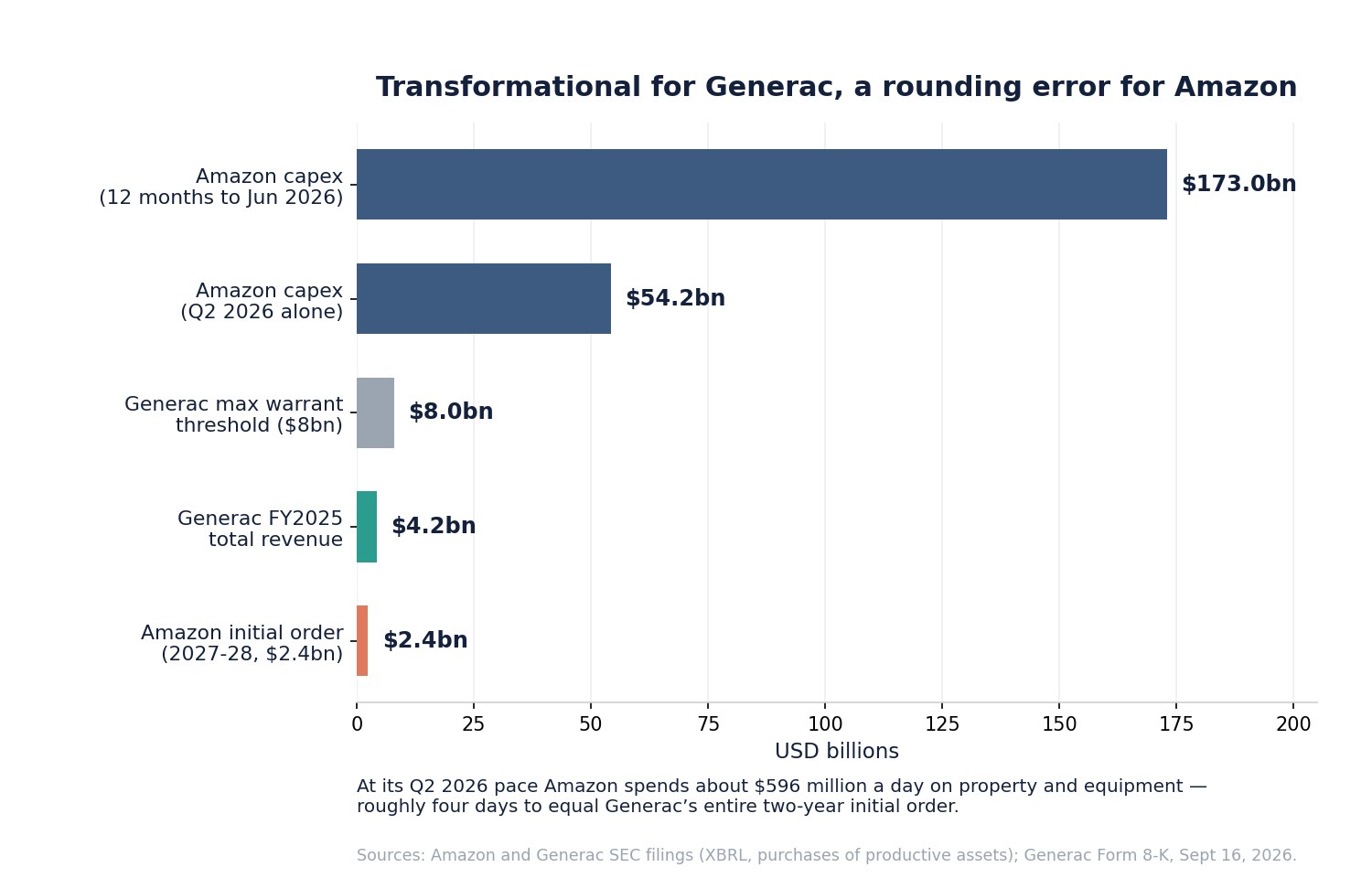
Run the same number from the other side of the table and it nearly disappears.
| Amazon capital expenditure (purchases of productive assets) | Amount |
|---|---|
| FY2025 | $131.8bn |
| Q1 2026 | $44.2bn |
| Q2 2026 | $54.2bn |
| First half 2026 | $98.4bn |
| Twelve months to June 30, 2026 | $173.0bn |
| Generac initial order as a share of that TTM figure | 1.4% |
| The full $8bn ceiling as a share of that TTM figure | 4.6% |
At its second-quarter pace Amazon spent roughly $596 million a day on property and equipment. Generac's entire two-year initial order equals about four days of Amazon capital spending.
This asymmetry is the deal's central fact. It is why the agreement can be genuinely transformational for Generac and genuinely immaterial to Amazon — and why Amazon had the leverage to set terms, take warrants struck above market and redact the vesting schedule. It also explains the risk: a counterparty for whom your entire backlog is a rounding error can reprioritize without much internal debate. The same dynamic runs through Amazon's own capex disclosures, where infrastructure commitments are large enough to move whole supply chains.
Why AI data centers buy backup generators at all
The demand logic is sound and worth stating plainly, because it is the part of the thesis that does not depend on Amazon.
A hyperscale data center cannot tolerate an unplanned outage. Utility power fails, and when it does, uninterruptible power supplies carry the load for seconds to minutes while standby generators start and assume it for as long as fuel lasts. That requirement scales with the facility, and AI training and inference campuses are far denser than the previous generation of cloud halls.
Three characteristics make this a real product market rather than a commodity one:
- Megawatt-class machines. Data-center standby generation is sold in large units, often paralleled into multi-megawatt blocks, with switchgear and controls that must coordinate automatically.
- Emissions and permitting. Standby engines are regulated. Siting, runtime limits and fuel choice interact with local air permits, and compliance work is part of the sale.
- Long lead times. Engines, alternators, enclosures and switchgear all have multi-quarter lead times, which is precisely why a hyperscaler would sign a multi-year supply agreement rather than buy spot.
It is worth being precise about one thing the category does not mean. Backup generators do not power AI continuously. They are insurance, sized to the facility and run rarely. The revenue scales with data centers built, not with tokens processed — which makes this a construction-cycle business, closer to the power and grid constraint than to compute demand itself.
The segment mix problem nobody mentioned
Now the finding that most changes the picture.
Generac reorganized into two reportable segments — Residential and Commercial & Industrial — effective July 1, 2025. The June 2026 quarter looks like this:
| Q2 segment revenue (external) | Q2 2026 | Q2 2025 | Change |
|---|---|---|---|
| Residential | $617.0M | $630.6M | −2.2% |
| Commercial & Industrial | $556.5M | $430.6M | +29.2% |
| Total net sales | $1,173.5M | $1,061.2M | +10.6% |
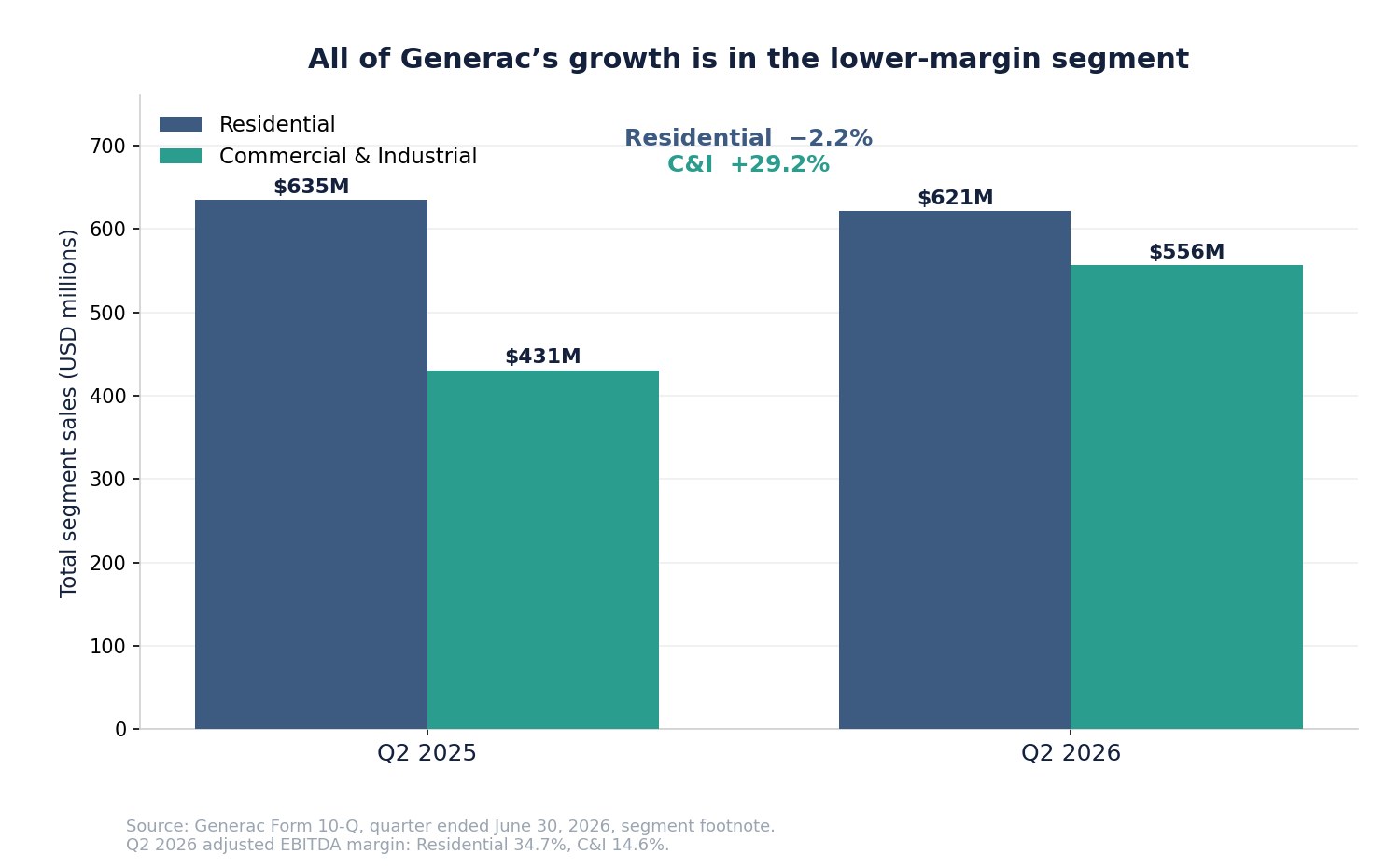
Residential revenue fell. All of Generac's growth — and more than all of it — came from C&I. The first half tells the same story: Residential $1,166.3M against $1,173.7M a year earlier (−0.6%), C&I $1,066.5M against $829.6M (+28.6%).
Now overlay profitability. Adjusted EBITDA margin in the June quarter was 34.7% in Residential and 14.6% in Commercial & Industrial.
So: the high-margin segment is contracting, the low-margin segment is doing all the growing, and the Amazon business will land in the low-margin segment. Revenue mix is shifting toward roughly 15% incremental margins and away from roughly 35% ones.
This does not mean the Amazon deal destroys value. Volume at 15% margins is still profit, fixed-cost absorption improves with scale, and Generac's acquisition of Enercon brought enclosures, controls and switchgear in-house, which raises the value captured per unit. But it does mean that a mix shift of this size is a headwind to consolidated margin that has to be out-earned by volume and vertical integration. "Revenue growth" and "margin expansion" are not the same story here, and the market is currently paying for both.
The tariff refund sitting inside the headline margin
The June quarter's profitability also carries a one-time item that will not repeat.
On February 20, 2026, the U.S. Supreme Court invalidated tariffs imposed under the International Emergency Economic Powers Act and allowed recovery of amounts previously paid. Generac elected loss-recovery accounting under ASC 410-30. Per the Form 10-Q for the quarter ended June 30, 2026:
- Generac received tariff refunds of approximately $61.4 million.
- It recorded a further receivable of approximately $27.7 million deemed probable.
- Approximately $71.1 million was recorded as a reduction of cost of goods sold, with the remainder in inventories.
Management quantified the effect directly: gross margin was 44.5% versus 39.3% a year earlier, and tariff refunds "contributed approximately 6%" of that gross-margin growth.
Strip the refund out and the arithmetic is uncomfortable. Roughly six points off 44.5% leaves about 38.5%, which is below the 39.3% Generac earned in the same quarter of 2025. On the same basis, reported operating income of $210 million becomes roughly $139 million, an operating margin near 11.8% rather than 17.9% — still an improvement on the 10.6% of Q2 2025, but a far more ordinary one than the headline.
Underlying gross margin did not expand in the June quarter. It contracted slightly. The expansion was a court ruling.
2025 was a bad year, and that is the base
Generac's 2026 recovery is real, and it is being measured against a trough.
| Fiscal year | Revenue | Operating income | Diluted EPS | Operating cash flow |
|---|---|---|---|---|
| 2022 | $4,565M | $566M | $5.42 | $59M |
| 2023 | $4,023M | $386M | $3.27 | $522M |
| 2024 | $4,296M | $537M | $5.39 | $741M |
| 2025 | $4,209M | $289M | $2.69 | $438M |
In 2025 revenue slipped 2.0%, operating income fell 46.2%, diluted EPS halved, and operating cash flow dropped 41%. The 2026 comparisons are flattering partly because 2025 was weak.
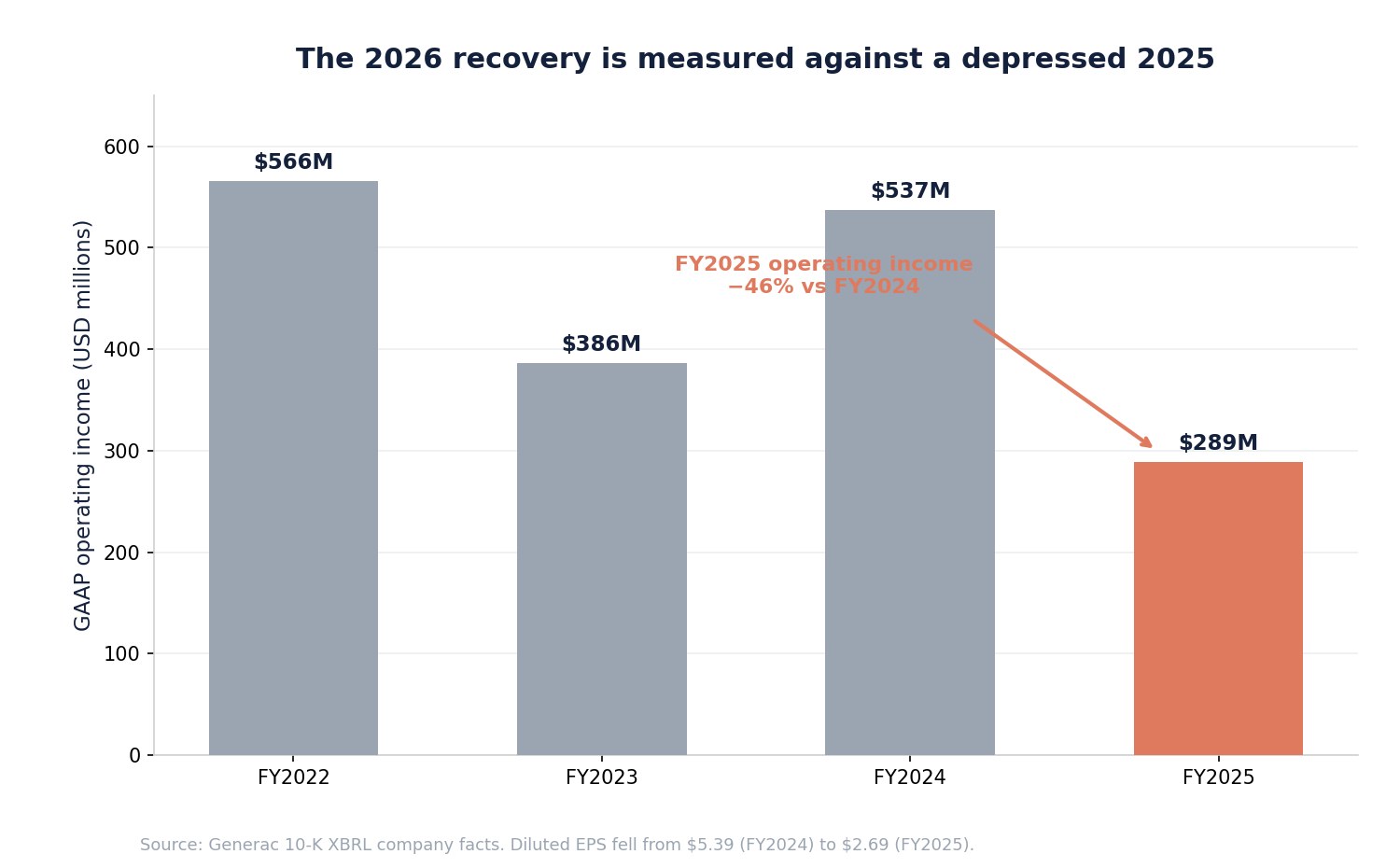
The first half of 2026 genuinely improved: Q1 revenue $1,059M with $117M of operating income, Q2 revenue $1,173.5M with $210M. But roughly a third of that Q2 operating income was the tariff refund, and the year-ago base was the weakest in four years. Both adjustments point the same direction — the operating recovery is real but more modest than the reported percentages.
What the warrant costs shareholders
Dilution here is small, contingent and — unusually — self-funding.
| Dilution measure | Shares | % of 59,006,361 |
|---|---|---|
| Vested at signing | 307,954 | 0.52% |
| Maximum if fully vested | 1,693,745 | 2.87% |
| Intrinsic value at $207.44, vested tranche | ~$2.0M | — |
| Intrinsic value at $207.44, full warrant | ~$11.0M | — |
At full vesting Amazon would own under 3% of Generac, and only after paying Generac $8 billion. Set against a $12.2 billion market capitalization, the warrant's current intrinsic value is trivial; its option value over seven years is not, but it is also not a shareholder cost in any conventional sense — it is a commission on revenue that has to arrive first.
The honest accounting is this: if the $8 billion is ever reached, 2.87% dilution will have been an excellent trade for existing holders. If it is not reached, most of the warrant never vests. The asymmetry runs in shareholders' favor. This is a materially better structure than the equity issuance patterns seen elsewhere in the AI supply chain, including the preferred conversion and placement dilution that reshaped the share count at Coherent.
Generac has to build what it just sold
An order of this size is a manufacturing commitment before it is a revenue line.
Generac has been expanding capacity for large C&I and data-center products, raising research and development spending from $173 million in 2023 to $243 million in 2025, and lifting capital expenditure from $129 million to $170 million over the same period. Serving $1.2 billion a year of incremental hyperscale demand requires more: engine and alternator supply, enclosure and switchgear fabrication, test cells, paralleling controls, field commissioning and service coverage.
Three execution risks follow directly:
- Fixed-cost absorption. Capacity built for one customer becomes operating leverage if orders arrive and a margin drag if they slip.
- Supply chain. Large engines and alternators have concentrated supply bases and long lead times; Generac's own filings flag dependence on a limited number of contract manufacturers and single-source suppliers.
- Working capital. Large project business consumes cash ahead of revenue recognition — the same mechanism that turned record orders into negative free cash flow elsewhere in AI infrastructure.
The competition is not asleep
Generac is not the incumbent in megawatt-class standby generation. It is the challenger.
| Competitor | Position |
|---|---|
| Caterpillar | Long-established data-center standby generation and switchgear |
| Cummins | Large engine and generator franchise with global service |
| Rolls-Royce (mtu) | Strong European and hyperscale presence |
| Kohler | Established industrial generator business |
| Eaton, Schneider, Vertiv | Adjacent power distribution, switchgear and thermal |
The bull argument is that Amazon's selection validates Generac's large-engine capability against exactly these names. The bear argument is that the incumbents have deeper installed bases and service networks, and that hyperscalers deliberately maintain multiple qualified suppliers. A design win is not a moat when the customer's standard practice is dual sourcing — a lesson visible across the AI hardware complex, from memory to accelerators.
What the stock now prices in
At $207.44 with 59,006,361 shares, Generac's market capitalization is about $12.2 billion.
| Valuation measure | Value |
|---|---|
| Share price (Sept 18, 2026) | $207.44 |
| Market capitalization | $12.2bn |
| FY2025 revenue | $4,209M |
| FY2025 diluted EPS | $2.69 |
| Trailing P/E on FY2025 EPS | ~77x |
| H1 2026 diluted EPS | $3.64 |
| 2026 YTD share price change | +47.0% |
| Distance below 52-week high | −30.0% |
| Annualized volatility | ~58% |
The FY2025 multiple is not the right lens — 2025 was the trough. But run the 2026 recovery forward and the stock is not obviously cheap either. The market added roughly $1.9 billion of market value on September 17 for a contract expected to deliver $2.4 billion of revenue — not profit — spread over two years, at C&I segment margins near 15%.
Put differently: at a 15% EBITDA margin, $2.4 billion of revenue is roughly $360 million of incremental EBITDA across two years. The market capitalized that at about $1.9 billion in a single session, before the first unit ships.
That is not necessarily wrong. It is a judgment that the $2.4 billion is the beginning rather than the whole, and that the $8 billion ceiling is a realistic destination. It is precisely the judgment the redacted vesting schedule prevents investors from checking.
The bull case
- The order is real and specific. $2.4 billion of expected deliveries in 2027-28, disclosed in an 8-K, not a press-release aspiration.
- Amazon validated the technology against Caterpillar, Cummins and Rolls-Royce in the most demanding standby application there is.
- Dilution is self-funding. The warrant vests on cash received, net of cancellations, so shareholders only pay if revenue arrives.
- C&I is compounding fast — up 29.2% in the June quarter and 28.6% in the first half, with data-center products named as the driver.
- The ceiling is a real option. If payments approach $8 billion, the revenue implication dwarfs the 2.87% dilution.
- Vertical integration is improving through Enercon, raising captured value per unit.
- The demand backdrop is enormous — $173 billion of Amazon capital spending in twelve months, part of a broader hyperscaler build-out.
The bear case
- $8 billion is a warrant ceiling, not a commitment, and the payments that count are net of cancelled orders and disputed invoices.
- The vesting schedule is redacted, so the dilution timetable cannot be modeled from public documents.
- Residential revenue is declining and all growth is in the segment earning 14.6% rather than 34.7%.
- Q2 gross margin ex-tariff was about 38.5%, below the 39.3% of a year earlier — the expansion was a court ruling, not operations.
- 2025 was a trough year with operating income down 46% and EPS halved; 2026 growth rates flatter against it.
- Customer concentration arrives with the order: one buyer potentially worth more than a quarter of annual revenue.
- Capacity investment is committed before the revenue is, creating fixed-cost risk if hyperscale construction slows, as it did briefly when AI spending discipline came into question.
- The stock still sits 30% below its 52-week high with 58% annualized volatility — this is not a stable compounder.
Generac may well have won a genuinely important contract. Winning an important contract and being correctly priced for it are separate questions.
What to watch each quarter
Contract mechanics: any 8-K or 10-Q disclosure of warrant shares vesting — each tranche is a public signal of cumulative payments received; cumulative payments disclosed against the $8 billion ceiling; whether initial deliveries remain on the 2027-28 schedule.
Operating: C&I revenue growth and backlog; Residential revenue, which needs to stop declining; data-center product revenue if disclosed separately; capacity utilization and new plant milestones.
Financial: consolidated gross margin excluding tariff refunds; C&I segment adjusted EBITDA margin as Amazon volume ramps; capital expenditure; inventories and receivables; free cash flow.
Structural: any change to the Beneficial Ownership Limitation; registration statements covering the warrant shares; additional hyperscale customers, which would convert a concentration risk into a platform.
A five-step routine:
- Confirm the payments, not the orders — vesting tranches are the disclosure that matters.
- Confirm the mix, watching whether Residential stabilizes.
- Confirm the margin on a clean, refund-free basis.
- Confirm the cash, since large project work consumes working capital before it returns it.
- Confirm the valuation support — estimate revisions rising faster than the share price.
SimianX AI can assemble these into a repeatable process linking SEC filings, earnings revisions, price behavior and news tone.
Is GNRC a buy after the Amazon deal?
The honest answer separates the contract from the security.
The contract is a genuine win. A hyperscaler with $173 billion of annual capital spending chose Generac for mission-critical standby power and structured the relationship so that its equity participation only vests as it pays. Generac's C&I business is growing near 30%, data-center products are the stated driver, and the company is investing to serve it.
The security is a $12.2 billion market capitalization that rose roughly $1.9 billion in one session for $2.4 billion of two-year revenue at mid-teens segment margins, in a stock 30% below its 52-week high, with 58% annualized volatility, a declining Residential segment, a margin flattered by a non-recurring tariff refund, and a warrant whose vesting schedule is redacted.
Investors who believe hyperscale construction runs for years, that Generac converts this into additional customers, and that C&I margins improve with scale and vertical integration have a coherent thesis. The 2027 delivery ramp is the test.
Investors who want to see the first vesting tranche disclosed, a clean refund-free margin, and Residential stabilize before underwriting the $8 billion also have a coherent thesis. The next two 10-Qs are the checkpoints.
What September 17 does not tell you is which group is right. It was a one-day repricing that gave back 43% of itself before the close.
FAQ about Generac and the Amazon agreement
Is Amazon committed to spending $8 billion with Generac?
No. The 8-K describes $8 billion as the maximum cumulative level of payments against which warrant shares vest. The disclosed commercial expectation is $2.4 billion of initial deliveries in 2027 and 2028. Payments counted toward the ceiling are also net of offsets including cancelled orders, disputed invoices, credits and refunds.
How much dilution do the warrants create?
Up to 1,693,745 shares against 59,006,361 outstanding, or about 2.87% if fully vested. Only 307,954 shares (0.52%) vested at signing. The rest vests only as Amazon's payments accumulate, so dilution cannot precede revenue.
Why can't the vesting schedule be modeled?
Because it is redacted. The warrant defines vesting in "increments of [\\\] Warrant Shares" for each "[\\\]" of cumulative payments, with both figures omitted under Item 601(b)(10)(iv) of Regulation S-K. Only the endpoints are public.
Did Generac's margins really improve last quarter?
Partly. Reported gross margin was 44.5% versus 39.3%, but management attributed roughly six points to tariff refunds following the Supreme Court's February 2026 IEEPA decision. Approximately $71.1 million was booked as a reduction of cost of goods sold. Excluding it, gross margin was around 38.5% — slightly below the prior-year quarter.
Is Generac now an AI stock?
It is an AI-adjacent construction supplier. Backup generators do not run AI workloads; they insure the facilities that do. Revenue scales with data centers built rather than with compute demand, which makes the exposure real but one step removed — closer to the infrastructure and power constraint than to the chips themselves.
What is the biggest risk?
Mix and concentration together. Growth is arriving in a segment that earns 14.6% adjusted EBITDA margins while the 34.7% segment shrinks, and a single customer may soon represent a large share of revenue. Generac can grow revenue strongly and still disappoint on profit.
Is the stock expensive?
It trades near 77 times depressed FY2025 earnings, which overstates the multiple, and roughly $12.2 billion against $4.2 billion of 2025 revenue. The more useful test is what the September move capitalized: about $1.9 billion of market value for roughly $360 million of potential incremental EBITDA over two years.
Conclusion
Generac won a real contract from a customer that spends more on property and equipment in four days than the entire initial order is worth.
The verifiable facts are these. Initial deliveries of $2.4 billion across 2027 and 2028. A warrant for up to 1,693,745 shares at $200.9266, of which 307,954 vested at signing and the balance vests only against cumulative payments up to $8 billion, net of cancellations — on a schedule that is redacted. A 4.999% beneficial-ownership cap sitting just below the 13D reporting threshold. Expiry in 2033.
And on Generac's side of the ledger: Residential revenue down 2.2% in the June quarter while C&I grew 29.2%; adjusted EBITDA margins of 34.7% and 14.6% in those two segments respectively; a $71.1 million tariff refund inside the reported gross margin, without which margin fell year over year; and a fiscal 2025 in which operating income dropped 46% and diluted EPS halved.
The market's first instinct was +31%. Its considered answer, four hours later, was +18%. The stock remains 30% below where it traded a year ago.
Four things will settle this, in order: whether the 2027-28 deliveries arrive on schedule; whether C&I margins rise as volume scales; whether Residential stops shrinking; and whether the first disclosed vesting tranche shows payments accumulating faster or slower than the market has assumed. The last one is the only true read on the $8 billion, and it will arrive in an 8-K, not a headline.
Related Reading
- Amazon Q2 Earnings 2026: Can AWS Justify $200B AI Capex?
- Coherent Stock: 8% Jump, −$1.02B Free Cash Flow in FY26
- Amazon Qualcomm AI Chip Deal: 54 Million Shares in Play
- TeraWulf Stock 2026: Inside Anthropic's $19B AI Lease
- AI CEOs Hit the Brakes: Chip Stocks Fell, Big Tech Rose
- SK Hynix Stock Surges 8%: Is the AI Supercycle Real?
- AMD Stock 2026: $6.7B Data Center vs Nvidia's $75.2B
- Alphabet Q2 Earnings 2026: Can Gemini, Cloud Justify Capex?
- Every Tech Bubble Since 1929: How AI in 2026 Compares
References
- Generac Holdings — Form 8-K, September 16, 2026 (Items 1.01, 3.02, 9.01)
- Generac Holdings — Warrant to Purchase Common Stock (Exhibit 4.1)
- Generac Holdings — Transaction Agreement with Amazon.com, Inc. (Exhibit 10.1)
- Generac Holdings — Form 10-Q for the quarter ended June 30, 2026
- Generac Holdings — Investor Relations
- Generac Power Systems — company site
- SEC EDGAR — Generac Holdings filing history
- SEC EDGAR full-text search
- Cummins — large engine and generator systems
- Caterpillar — data-center standby power
- SimianX — GNRC stock fundamentals