Berkshire Hathaway After Buffett: What the Handoff Changed, and What the Stock Had Already Priced In
On September 18, 2026, Berkshire Hathaway announced that Warren Buffett had become chairman emeritus, that he would remain a director, and that the board had elected his son Howard G. Buffett as chairman. Greg Abel has been chief executive since January 1, 2026. Susan Decker continues as lead independent director. Berkshire's September 18 announcement and Buffett's letter
Headlines called it the end of an era. The stock called it a Friday.
BRK.B closed at $509.77, up 0.11%, on 12.5 million shares — 2.9 times its 60-day average volume, so plenty of people traded it, but almost nobody repriced it. The S&P 500 tracker SPY fell 0.12% the same day. The handoff had been priced long before it was completed.
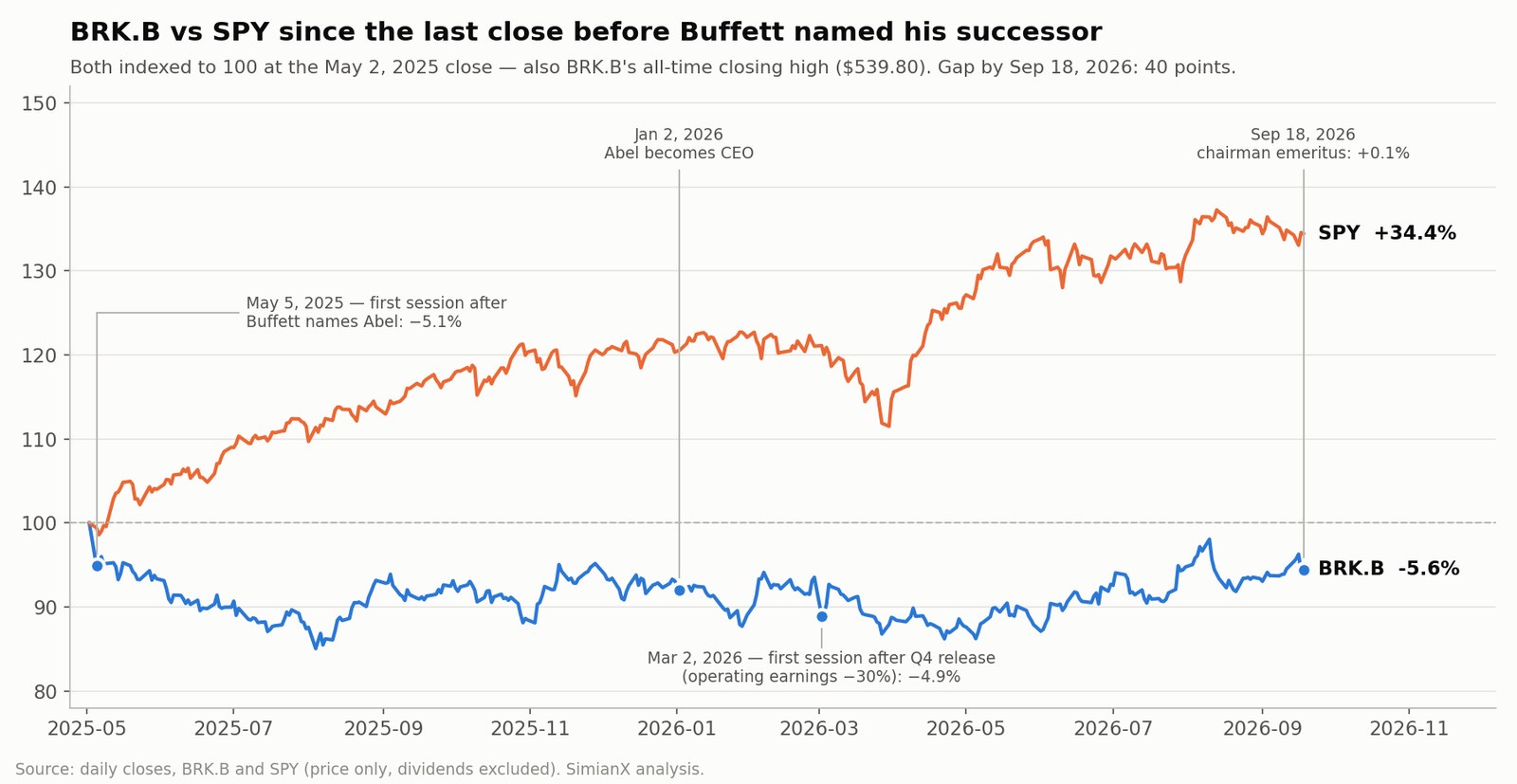
The real verdict came on two earlier days, and it has been running for sixteen months. May 2, 2025 — the last close before Buffett told the annual meeting that Abel should succeed him — was also BRK.B's all-time closing high, $539.80. From that close through September 18, 2026, BRK.B fell 5.6% while SPY rose 34.4%. A 40-point gap is the market's running estimate of what Buffett himself was worth.
This analysis separates what changed from what did not, using Berkshire's own filings: the September release, the Q2 2026 Form 10-Q and earnings release, the Q4 2025 release, and Greg Abel's first shareholder letter. Three findings matter more than the change of titles. Q2's reported +16.3% operating-earnings growth is +5.2% once a $1.2 billion currency swing is removed. GEICO's pre-tax underwriting profit fell 45% in the same quarter. And Abel's first buybacks were executed at about 1.40 times book value. Investors can track BRK.B filings, estimate revisions and price behaviour with SimianX AI.
All figures come from Berkshire Hathaway filings and daily market data through September 18, 2026.
What actually changed on September 18
The headline "Buffett steps down" compresses a transition that took sixteen months and happened in stages.
| Date | Change | What it meant for shareholders |
|---|---|---|
| May 3, 2025 | At the annual meeting, Buffett said he would recommend that Abel become CEO at year-end | The succession became public; the stock repriced on the next trading day |
| January 1, 2026 | Abel became chief executive officer | Operating oversight and capital allocation moved to Abel |
| February 28, 2026 | First results released under Abel: Q4 2025 and Abel's first annual letter | The first earnings test of the new era |
| September 18, 2026 | Buffett became chairman emeritus; Howard Buffett elected chairman | The board-leadership handoff was completed |
| Continuing | Buffett remains a director | His perspective is still available, but he is not the decision-maker |
Berkshire's 2026 proxy statement identifies Abel as CEO from January 1. Buffett's September letter states the division of labour in a single sentence: "Greg runs the company; Howard will guard its culture and values." He adds that Abel "has been making the decisions that matter for some time now."
That distinction matters. Howard Buffett is not the new CEO and not the principal investment manager. He has been a Berkshire director since 1993 and has run the Howard G. Buffett Foundation since 1999. His father describes him as "a policy the shareholders own and hope never to claim against" — a guardian of culture, not a capital allocator.
The market's verdict came on two other days
BRK.B is a low-volatility stock. Its annualised volatility over the past year was about 14.6%, against 12.9% for SPY. Large single-day moves are rare, which makes the few that exist informative.
| Session | BRK.B | Volume vs 60-day avg | SPY same day | What happened |
|---|---|---|---|---|
| April 4, 2025 | −6.91% | 2.8x | −5.85% | Market-wide tariff sell-off — not Berkshire-specific |
| May 5, 2025 | −5.12% | 3.2x | −0.57% | First session after Buffett named Abel as his successor |
| March 2, 2026 | −4.91% | 2.5x | +0.06% | First session after the Q4 2025 release: operating earnings −29.8% |
| September 18, 2026 | +0.11% | 2.9x | −0.12% | Buffett became chairman emeritus |
Two of BRK.B's three worst sessions in two years were Berkshire-specific, and both were about the transition. On May 5, 2025, the stock underperformed SPY by 4.6 points on triple volume. On March 2, 2026 — the first trading day after Berkshire published Abel's first annual results — it fell 4.9% while the index was flat.
By contrast, the day the transition was formally completed produced a move smaller than the stock's normal daily noise. The succession was not news in September 2026. It was news in May 2025, and it was tested in February 2026.
Forty points behind SPY
| Measured from | BRK.B then | BRK.B return to Sep 18, 2026 | SPY return | Gap |
|---|---|---|---|---|
| May 2, 2025 (last close before announcement; all-time high) | $539.80 | −5.6% | +34.4% | −40.0 pts |
| May 5, 2025 (first reaction) | $512.15 | −0.5% | +35.2% | −35.6 pts |
| December 31, 2025 (year-end) | $502.65 | +1.4% | +11.7% | −10.3 pts |
| January 2, 2026 (Abel's first trading day as CEO) | $496.85 | +2.6% | +11.5% | −8.9 pts |
| April 22, 2026 (52-week low) | $465.40 | +9.5% | +7.1% | +2.4 pts |
| August 10, 2026 (52-week high) | $529.42 | −3.7% | −1.5% | −2.2 pts |
SPY figures are price returns; BRK.B pays no dividend, SPY does, so the true total-return gap is slightly wider.
Three observations follow. First, the underperformance is concentrated in 2025, before Abel took over — the market marked down the expectation of a Buffett-less Berkshire before it saw any Abel decisions. Second, since the April 2026 low BRK.B has slightly outperformed. Third, a 40-point gap is not a statement that Berkshire's businesses got worse by 40%. Much of it reflects a strong broad market led by growth stocks that a conglomerate of insurers, railroads, utilities and manufacturers was never going to match — and part of it reflects a premium for Buffett's judgment that has partly left the price.
The leadership structure that replaced one person
Buffett once combined four jobs: chief executive, chief investment officer, chairman and guardian of the culture. They are now split.
| Role | Holder | Source of authority |
|---|---|---|
| Chief executive and ultimate capital allocator | Greg Abel | CEO since January 1, 2026 |
| Equity portfolio | Greg Abel, with Ted Weschler managing about 6% | 2025 annual report |
| Chairman of the board | Howard G. Buffett | Elected September 18, 2026 |
| Lead independent director | Susan L. Decker | Continuing |
| Chairman emeritus and director | Warren E. Buffett | September 18, 2026 |
Abel's letter is explicit: responsibility for equity investments "ultimately resides with me as CEO." Weschler's roughly 6% includes "a portion of the portfolio formerly overseen by Todd Combs."
One governance detail has not been widely noticed. Berkshire's repurchase programme lets the company buy back shares whenever the CEO, "after consultation with the Chairman of the Board," believes the price is below intrinsic value, conservatively determined. From September 18, that consultation runs from Abel to Howard Buffett. The new chairman has a formal role in the single most price-sensitive capital decision Berkshire makes.
Insurance is the foundation — and it weakened in 2026
Berkshire's insurers collect premiums before they pay claims. The money held in between — insurance float — was about $177.5 billion on June 30, 2026, up roughly $1.1 billion since year-end 2025. Float is only valuable when underwriting is profitable; writing underpriced policies to grow it destroys value.
The insurance business shrank in Q2 on both of its earnings lines.
| After-tax, $ millions | Q2 2026 | Q2 2025 | Change | H1 2026 | H1 2025 | Change |
|---|---|---|---|---|---|---|
| Insurance underwriting | 1,731 | 1,992 | −13.1% | 3,448 | 3,328 | +3.6% |
| Insurance investment income | 3,059 | 3,367 | −9.1% | 5,738 | 6,260 | −8.3% |
| Insurance total | 4,790 | 5,359 | −10.6% | 9,186 | 9,588 | −4.2% |
The first-half underwriting comparison looks better only because the first half of 2025 absorbed about $1.1 billion of wildfire losses. The investment-income decline reflects lower interest rates on Berkshire's short-term holdings — which is why the direction of Federal Reserve policy, including the Fed's September 2026 hike, now feeds directly into Berkshire's earnings.
GEICO's underwriting profit fell 45%
Inside the insurance segment, the change at GEICO is the sharpest in the filing.
| GEICO, pre-tax, $ millions | Q2 2026 | Q2 2025 | Change |
|---|---|---|---|
| Premiums written | 11,124 | 11,003 | +1.1% |
| Premiums earned | 11,291 | 11,064 | +2.1% |
| Losses and loss-adjustment expenses | 8,644 | 7,945 | +8.8% |
| Underwriting expenses | 1,653 | 1,298 | +27.3% |
| Pre-tax underwriting earnings | 994 | 1,821 | −45.4% |
| Loss ratio | 76.6% | 71.8% | +4.8 pts |
| Expense ratio | 14.6% | 11.7% | +2.9 pts |
For the first half, GEICO's pre-tax underwriting profit was $2,410 million against $3,994 million, down 39.7%. The 10-Q attributes the loss-ratio increase to higher claims frequency and severity: private-passenger bodily-injury frequency rose in the five-to-seven percent range and bodily-injury severity in the ten-to-twelve percent range. Underwriting expenses rose mainly because of higher commissions and advertising. Put per dollar: for every $100 of premiums earned, GEICO kept about $16.50 of pre-tax underwriting profit a year earlier and about $8.80 now.
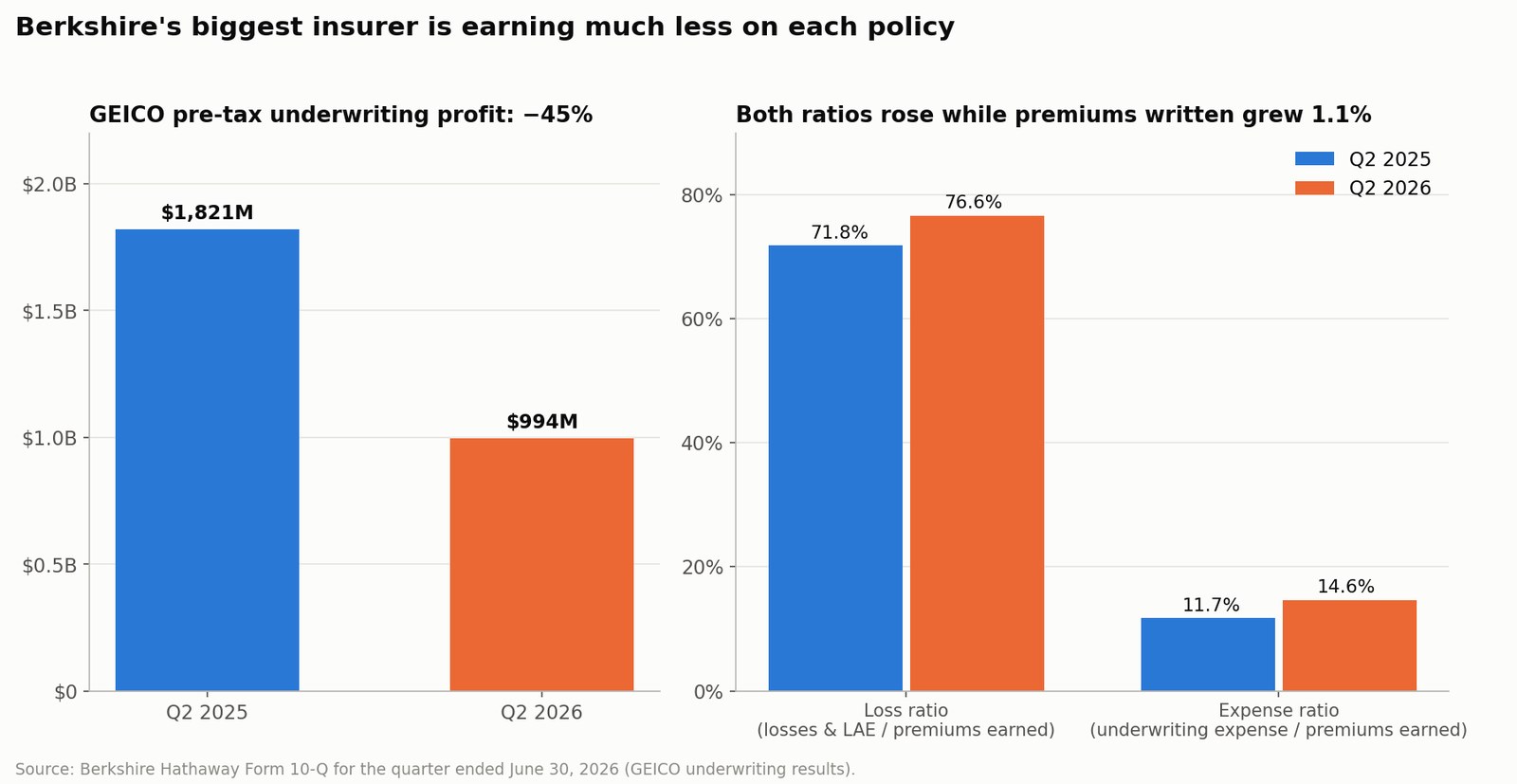
Not everything in insurance went the wrong way. Berkshire Hathaway Primary Group earned $273 million of pre-tax underwriting profit in Q2 against $63 million, and the reinsurance group earned $913 million against $650 million. But GEICO is the largest single underwriting engine, and its combined ratio — losses plus expenses as a share of premiums, a standard insurance yardstick explained by Investopedia — moved from 83.5% to 91.2% in one year while premiums barely grew.
Abel does not need to price every policy. He does need to preserve a culture in which GEICO will give up volume rather than write business at inadequate prices. Whether 2026 is a pricing lag or a competitive squeeze is the most important operating question of his first year.
Operating earnings: the headline and the underlying number
Berkshire asks investors to judge it by operating earnings rather than GAAP net income, which is swamped by stock-market marks. That is the right instinct. Operating earnings still need reading.
| After-tax, $ millions | Q2 2026 | Q2 2025 | Change |
|---|---|---|---|
| Insurance underwriting | 1,731 | 1,992 | −13.1% |
| Insurance investment income | 3,059 | 3,367 | −9.1% |
| BNSF | 1,558 | 1,466 | +6.3% |
| Berkshire Hathaway Energy | 891 | 702 | +26.9% |
| Manufacturing, service and retailing | 4,470 | 3,601 | +24.1% |
| Other | 1,274 | 32 | n/m |
| Operating earnings | 12,983 | 11,160 | +16.3% |
The "Other" line is where the headline growth comes from. It includes foreign-exchange gains and losses on Berkshire's non-U.S.-dollar debt: a $326 million gain in Q2 2026 against an $877 million loss in Q2 2025. That $1.2 billion swing is an accounting translation effect on non-dollar bonds — Berkshire issued ¥272.3 billion of new yen notes as recently as April 2026 — not business performance.
| $ millions | Q2 2026 | Q2 2025 | Change | H1 2026 | H1 2025 | Change |
|---|---|---|---|---|---|---|
| Reported operating earnings | 12,983 | 11,160 | +16.3% | 24,329 | 20,801 | +17.0% |
| FX effect on non-USD debt | +326 | −877 | — | +575 | −1,590 | — |
| Operating earnings excluding FX | 12,657 | 12,037 | +5.2% | 23,754 | 22,391 | +6.1% |
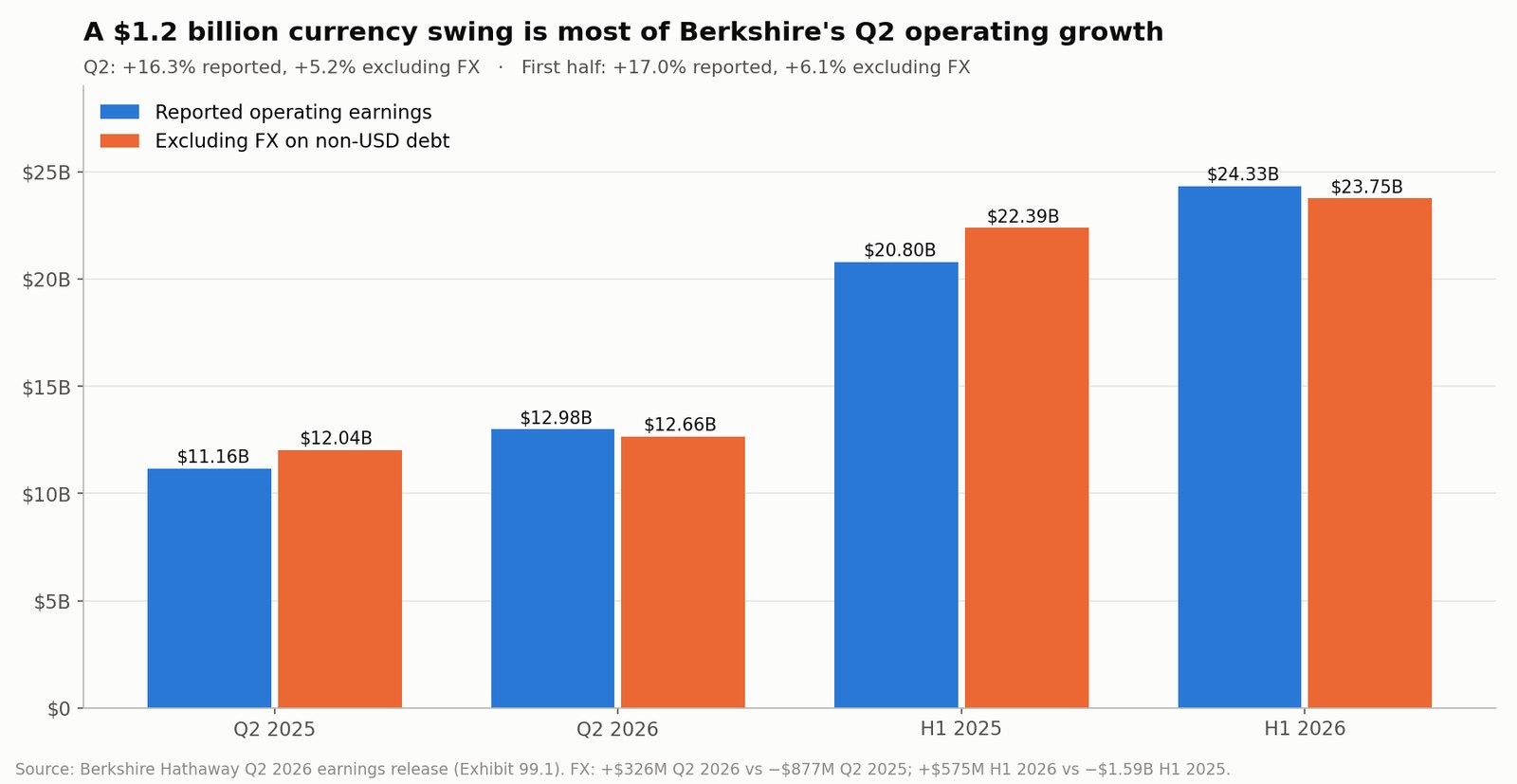
Even the +5.2% includes an acquisition. Manufacturing, service and retailing now contains OxyChem, which Berkshire did not own a year earlier; it earned $149 million pre-tax in Q2 on $1.4 billion of revenue. Strip out currency and the new chemicals business, and Berkshire's underlying operating earnings grew in the low single digits — with non-insurance businesses up and insurance down.
That is a respectable result for a company of this size. It is not the step-change that a +16.3% headline suggests. Note what that implies for the "Other" line itself: excluding FX it was $948 million against $909 million a year earlier — essentially flat. The entire jump in that line came from currency, not from any business.
The first Abel-era report: why March 2 hurt
The worst Berkshire-specific session of the new era followed Berkshire's first release under Abel, published on Saturday, February 28, 2026. Berkshire's Q4 2025 release showed:
| After-tax, $ millions | Q4 2025 | Q4 2024 | Change | FY 2025 | FY 2024 | Change |
|---|---|---|---|---|---|---|
| Insurance underwriting | 1,561 | 3,409 | −54.2% | 7,258 | 9,020 | −19.5% |
| Insurance investment income | 3,072 | 4,088 | −24.9% | 12,513 | 13,670 | −8.5% |
| BNSF | 1,347 | 1,278 | +5.4% | 5,476 | 5,031 | +8.8% |
| Berkshire Hathaway Energy | 691 | 729 | −5.2% | 3,979 | 3,730 | +6.7% |
| Manufacturing, service and retailing | 3,370 | 3,262 | +3.3% | 13,647 | 13,072 | +4.4% |
| Other | 159 | 1,761 | −91.0% | 1,613 | 2,914 | −44.6% |
| Operating earnings | 10,200 | 14,527 | −29.8% | 44,486 | 47,437 | −6.2% |
Those Q4 results covered a quarter Buffett still led, so they are not an Abel scorecard. But they were the first numbers investors saw with Abel's name on the letter, and they showed the same pattern the Q2 filing later confirmed: insurance earnings falling, investment income falling with rates, and the railroad and industrial businesses carrying the growth. BRK.B fell 4.9% on the next trading day.
GAAP net income is mostly noise
Berkshire reported $25.67 billion of GAAP net earnings in Q2 2026, more than double the $12.37 billion a year earlier, or $11.91 per Class B share. Of that, $12.68 billion was after-tax investment gains, including a $10.9 billion rise in unrealised gains on stocks it still holds. Berkshire's Q2 earnings release says, in Buffett-era language retained under Abel, that quarterly investment gains are "usually meaningless."
A price-to-earnings ratio calculated on GAAP earnings is therefore close to useless for Berkshire. A strong stock market inflates it; a weak one crushes it; neither says anything about the railroad, the utilities or the insurers.
What Greg Abel has actually done with capital
Words establish intentions. Transactions establish evidence.
| Transaction | Timing | Price | Notes |
|---|---|---|---|
| OxyChem (from Occidental) | Agreed Oct 1, 2025; closed Jan 2, 2026 | ~$9.4 billion cash | Agreed before Abel became CEO; Occidental kept legacy environmental liabilities |
| Taylor Morrison | Agreed May 31, 2026; closed Jul 24, 2026 | $72.50/share; ~$6.8B equity, ~$8.5B enterprise value | Announced and completed under Abel |
| Share repurchases | H1 2026, mostly Q2 | ~$4.8 billion | First sizeable buybacks of the Abel era |
OxyChem's preliminary acquisition-date values were $10.7 billion of assets, about $7.0 billion of it property, plant and equipment, and $1.3 billion of liabilities. Its Q2 pre-tax earnings of $149 million included incremental acquisition-accounting depreciation and amortisation. Taylor Morrison, according to its completion announcement, will be combined with Berkshire's existing site-built homebuilding operations under CEO Sheryl Palmer.
Taylor Morrison is the first large acquisition that is entirely Abel's. It is a cyclical homebuilder, and its returns will depend on housing demand and mortgage financing conditions that no one in Omaha controls. Because it closed after the quarter ended, Berkshire has not yet disclosed the purchase-price allocation; that arrives with the Q3 filing. The scorecard will take years.
The buyback price test
The Q2 10-Q discloses exactly what Berkshire paid for its own stock.
| Month (2026) | Class | Shares | Average price |
|---|---|---|---|
| April | — | none | — |
| May | Class A | 65 | $716,231.37 |
| May | Class B | 1,458,312 | $476.01 |
| June | Class A | 413 | $733,775.06 |
| June | Class B | 7,139,881 | $487.98 |
Converting Class A shares at 1,500 Class B each, Q2 repurchases totalled about $4.53 billion at an average of roughly $486 per Class B-equivalent share. Class A-equivalent shares outstanding fell from 1,438,223 at year-end to 1,431,693 on June 30, a reduction of 0.45%.
Measured against book value — Berkshire's shareholders' equity of $747.9 billion divided by its share count — the company earned about $348 of book value per Class B-equivalent share on June 30. Abel therefore bought at roughly 1.40 times book. At the September 18 close, the buyback is up about 4.9% and the stock trades at about 1.46 times book. (See Investopedia on price-to-book for the measure's limits: book value understates wholly owned businesses carried at historical cost.)
The programme's rules are simple. Repurchases are allowed whenever the CEO, after consulting the chairman, judges the price below intrinsic value conservatively determined; there is no minimum or maximum; and buybacks may not reduce consolidated cash, cash equivalents and Treasury bills below $30 billion. The May-June buying tells you where Abel put that line in 2026: somewhere above $476-$488 per B share.
The $359 billion capital-allocation question
At June 30, Berkshire's insurance and other businesses held $359.2 billion of cash, cash equivalents and U.S. Treasury bills, net of payables for unsettled purchases. At the September 18 close, Berkshire's market value was roughly $1.09 trillion, so liquidity equalled about 33% of the company's market capitalisation.
Against that pile, Abel's 2026 deployments so far — OxyChem, Taylor Morrison's equity and the buybacks — total about $21 billion, or 5.8% of the liquidity.
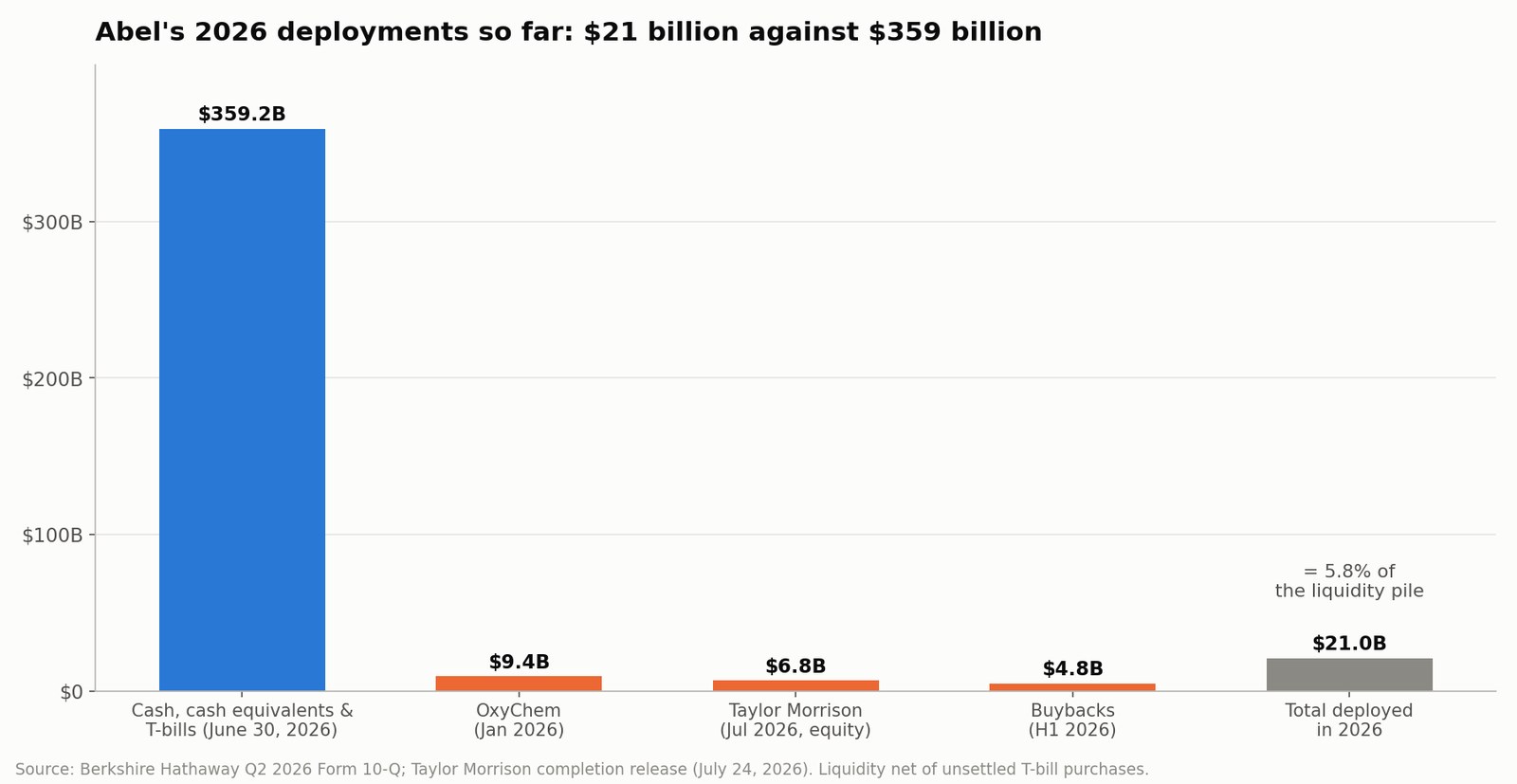
Not all of it is spare. Insurers need large liquidity for claims, and Berkshire deliberately holds enough to survive catastrophes without raising capital. But the balance creates a return problem whenever short-term rates fall, as they did through 2025. The history of every Fed rate-cut cycle since 1980 is, for Berkshire, also a history of its T-bill income.
Abel has four choices:
- Buy entire businesses. Durable cash flows, but few targets are large enough to matter and available at a sensible price.
- Buy public equities. Berkshire can move quickly in a sell-off, but concentration raises mark-to-market volatility.
- Repurchase Berkshire stock. Accretive only below intrinsic value — the May-June purchases at ~1.40x book show his current threshold.
- Hold liquidity. Rational when prices are high; costly if it persists.
Abel's letter keeps the dividend policy unchanged: Berkshire will not pay a cash dividend "so long as more than one dollar of market value for shareholders is reasonably likely to be created by each dollar of retained earnings," and the board reviews the policy annually. Berkshire has not declared a cash dividend since 1967.
A practical capital-allocation test
| Question | Why it matters |
|---|---|
| What is the all-in price, including assumed debt? | Taylor Morrison's $6.8B equity value became an $8.5B enterprise value |
| What sustainable cash flow is being bought? | Peak-cycle earnings make deals look cheap |
| What does it return versus Treasury bills? | Berkshire always has a low-risk alternative |
| Does liquidity survive a severe insurance year? | Resilience is the model |
| Does value per Berkshire share rise? | Bigger total earnings are not the same thing |
The portfolio: an asset and a concentration risk
Berkshire's equity securities had a fair value of $323.8 billion on June 30, 2026, up from $297.8 billion at year-end. The five largest holdings — Alphabet, American Express, Apple, Bank of America and The Coca-Cola Company — made up 66% of that value, up from 65%. Berkshire owned 151.6 million American Express shares, 22.5% of the company.
Two of those five are going through their own debates. Apple is in the middle of a leadership change of its own, analysed in what John Ternus inherits at Apple, and Alphabet's spending question is set out in Alphabet's Q2 2026 capex analysis. For Berkshire shareholders, those are not remote stories — they are a large share of the equity book.
Berkshire also holds equity-method stakes of 27.5% in Kraft Heinz and 26.7% in Occidental, plus about $8.5 billion of Occidental preferred stock. Abel's letter is unusually blunt about the first: "Our investment in Kraft Heinz has been disappointing."
Evaluate future portfolio changes by price paid, rationale and outcome — not by whether a trade resembles a Buffett anecdote.
The risks that could undermine Berkshire after Buffett
Insurance pricing. GEICO's loss and expense ratios both rose in 2026. If claims inflation keeps outrunning pricing, underwriting profit — Berkshire's cheapest source of capital — keeps shrinking.
Wildfire liabilities. PacifiCorp, part of Berkshire Hathaway Energy, had recorded cumulative estimated losses of about $2.85 billion from the 2020 wildfires and the 2022 McKinney Fire through June 30, 2026, had paid about $2.3 billion in settlements, had $572 million of estimated unpaid liabilities, and had posted bonds of $719 million. The 10-Q warns it is reasonably possible that material additional losses will occur.
Capital-allocation mistakes. A poorly priced deal measured in tens of billions could erase years of incremental earnings. Liquidity removes financing risk; it does not guarantee returns.
Size. A company worth about $1.09 trillion cannot compound at the rates Berkshire earned when it was small. Comparing Abel with Buffett's 60-year record is analytically meaningless.
The premium. Part of BRK.B's historical valuation was confidence in one man. The 40-point gap suggests much of that premium has already been removed. That cuts both ways: it is a risk realised, and a lower bar for Abel.
How to value BRK.B after Buffett
A single P/E ratio is misleading for Berkshire. More useful measures:
- Price to book, recognising that book understates wholly owned businesses. At $509.77, BRK.B trades at about 1.46x its June 30 book value of roughly $348 per Class B-equivalent share; Abel's own buybacks were at about 1.40x.
- Normalised operating earnings, excluding FX on non-dollar debt and unusual catastrophe years.
- Sum of the parts: insurers plus float, BNSF, the energy group, manufacturing and retail, the equity portfolio, and liquidity above what insurance requires.
- Intrinsic value per share over time, measured against Treasury yields and alternatives.
| Scenario | What Abel demonstrates | Likely implication |
|---|---|---|
| Bull | GEICO pricing restores margins; disciplined large deals; buybacks below value | The discount to SPY narrows; book multiple re-expands |
| Base | Culture holds; businesses compound in the mid-single digits | Respectable returns, no Buffett-era outperformance |
| Bear | Insurance margins keep falling; expensive acquisitions; weaker governance | Slower per-share value growth; multiple compresses toward book |
The comparison with JPMorgan's 3.2x book premium is instructive: the market pays heavily for high, visible returns on equity. Berkshire's multiple will be set by whether Abel can make its returns more visible, not by whether he sounds like Buffett.
A shareholder checklist for the Abel era
- Operating earnings excluding FX: which segments moved, and were the drivers repeatable?
- GEICO loss and expense ratios: are they falling back toward 2025 levels?
- Insurance float: growing alongside profitable underwriting?
- Liquidity: how much remains after deals and buybacks?
- Deployment: what was bought, at what all-in price, and at what expected return?
- Buyback price: at what multiple of book is Abel buying?
- Portfolio concentration: have the top-five exposures changed, and why?
- Governance: is Abel candid about mistakes, and does Howard Buffett's board challenge large decisions?
SimianX AI combines SEC filings, financial data, technical indicators and news analysis for U.S. stocks. An investor following BRK.B can use it to flag new disclosures, then check important conclusions against Berkshire's own reports.
Frequently asked questions: Berkshire Hathaway after Buffett
Did Warren Buffett retire completely from Berkshire Hathaway?
No. Greg Abel became CEO on January 1, 2026, and Buffett became chairman emeritus on September 18, 2026. Buffett remains a director. Howard G. Buffett is the new chairman. Abel runs the company and is accountable for its major decisions.
How did BRK.B react to Buffett stepping down as chairman?
Barely. BRK.B rose 0.11% on September 18, 2026, on 2.9 times normal volume. The large moves came earlier: −5.12% on May 5, 2025, the first session after Buffett named Abel as his successor, and −4.91% on March 2, 2026, after the first results released under Abel.
How has Berkshire stock performed since the succession was announced?
From the May 2, 2025 close — its all-time closing high of $539.80 — to September 18, 2026, BRK.B fell 5.6% while SPY rose 34.4%, a gap of about 40 percentage points. Since Abel's first trading day as CEO, BRK.B is up 2.6% against 11.5% for SPY.
Did Berkshire's earnings really grow 16% in Q2 2026?
Reported operating earnings rose 16.3%, to $12.98 billion. Excluding foreign-exchange effects on non-dollar debt — a $326 million gain this year against an $877 million loss last year — growth was about 5.2%, and that still includes the newly acquired OxyChem.
What happened to GEICO?
GEICO's pre-tax underwriting profit fell to $994 million in Q2 2026 from $1.821 billion, down 45.4%. Its loss ratio rose to 76.6% from 71.8% on higher claims frequency and severity, and its expense ratio rose to 14.6% from 11.7% on higher commissions and advertising, while premiums written grew only 1.1%.
Is Berkshire buying back its own stock under Abel?
Yes. Berkshire repurchased about $4.8 billion of stock in the first half of 2026, mostly in May and June, at roughly $476-$488 per Class B share — about 1.40 times book value. The CEO decides, after consulting the chairman, which is now Howard Buffett.
Will Berkshire pay a dividend now?
None has been announced. Abel's letter keeps the policy that Berkshire will not pay a cash dividend while each retained dollar is reasonably likely to create more than a dollar of market value, and the board reviews that annually. Berkshire has not declared a cash dividend since 1967.
Conclusion
Warren Buffett's move to chairman emeritus completed a succession, but it did not start one — and the stock treated it accordingly. BRK.B rose 0.11% on the day. The market had already delivered its verdict: a 5.12% drop the session after Buffett named Abel in May 2025, a 4.91% drop after the first Abel-era results in March 2026, and a 40-point underperformance against SPY from the last pre-announcement close, which was also the stock's all-time high.
The businesses Abel inherited are strong but not uniformly so. Q2 operating earnings rose 16.3% as reported but about 5.2% excluding currency. Insurance earnings fell 10.6%, and GEICO's pre-tax underwriting profit fell 45.4%, while BNSF, the energy group and the industrial businesses carried the growth. Liquidity stands at $359.2 billion, about a third of Berkshire's market value, and Abel has deployed about $21 billion of it in 2026, including buybacks at roughly 1.40 times book.
The scorecard for the Abel era is therefore specific: GEICO margins, operating earnings excluding FX, the price of every large deal and every buyback, and per-share value growth over years rather than quarters. Howard Buffett now chairs the board that oversees those decisions — and, under the buyback rules, is the person Abel must consult before Berkshire buys its own stock.
Related Reading
- Tim Cook Steps Down: What John Ternus Inherits at Apple
- Warsh Ignores Trump: The Fed's First Rate Hike Since 2023
- Every Fed Rate-Cut Cycle Since 1980: Stocks, Bonds & Gold
- Alphabet Q2 Earnings 2026: Can Gemini, Cloud Justify Capex?
- JPMorgan Stock 2026: 23% ROTCE vs a 3.2x Book Premium
- Apple iPhone Duo: Can a Foldable Spark an AAPL Supercycle?
- Lululemon Stock Below $100: Broken Brand or Rare Buy?
References
- Berkshire Hathaway — September 18, 2026 release and Warren Buffett's letter
- Berkshire Hathaway — Q2 2026 Form 10-Q
- Berkshire Hathaway — Q2 2026 earnings release (Exhibit 99.1)
- Berkshire Hathaway — Q4 and full-year 2025 earnings release
- Berkshire Hathaway — 2025 annual report and Greg Abel's shareholder letter
- Berkshire Hathaway — 2026 proxy statement
- Taylor Morrison — Berkshire Hathaway completes acquisition
- SEC EDGAR — Berkshire Hathaway quarterly filings
- Federal Reserve — open market operations and policy rate
- SimianX — BRK.B stock fundamentals