
 By Muke
Lululemon Stock Below $100: Is the Brand Broken or Is LULU a Once-in-a-Decade Buy?
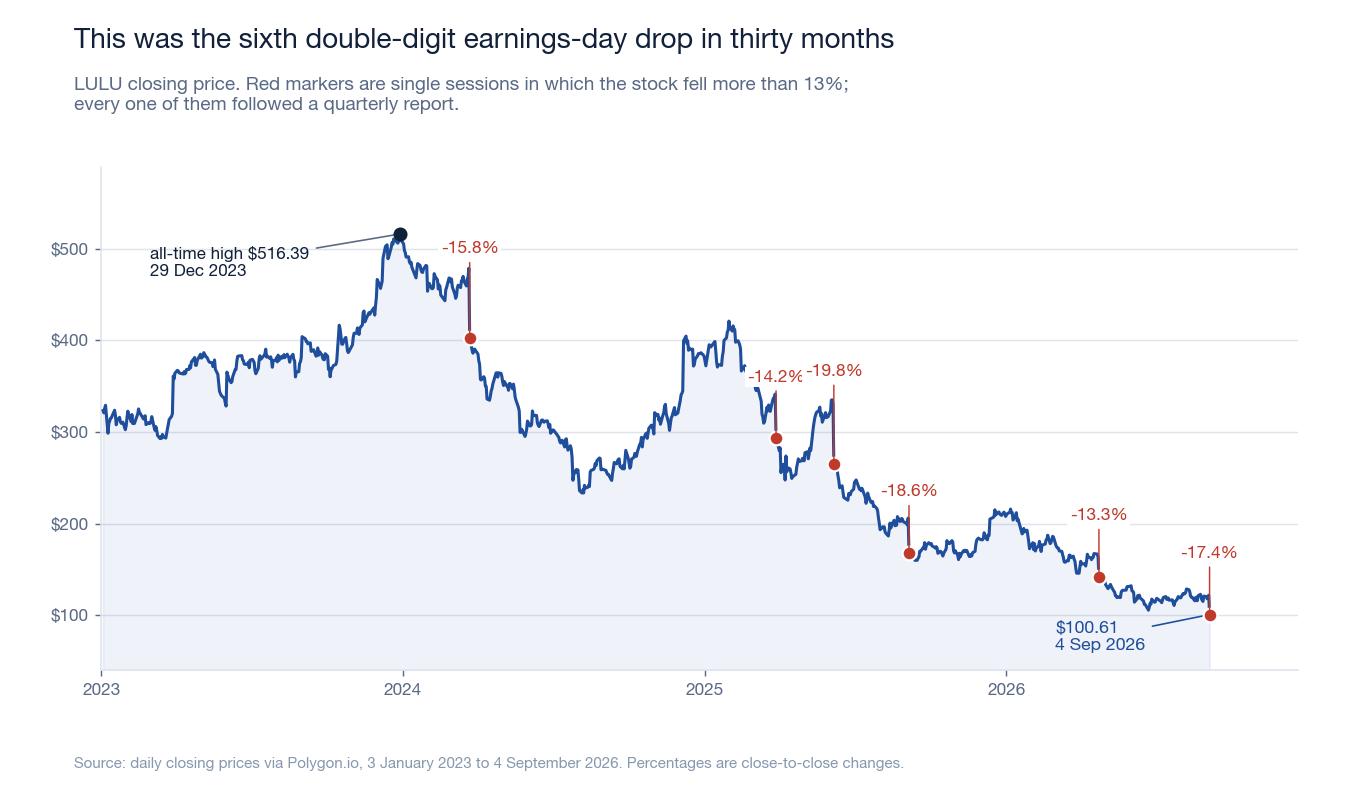
Lululemon stock below $100 was not a fleeting intraday touch on September 4, 2026. LULU opened the session at $98.15, never traded above $103.16, bottomed at $97.99 and closed at $100.61 — a 17.4% fall from the previous close of $121.77 on 37.4 million shares, roughly twelve times its recent daily volume. The low of $97.99 is also the stock's 52-week low.
The drawdowns are precise and worth stating exactly. Against the all-time closing high of $516.39, set on 29 December 2023, the shares are down 80.5%. Against $206.09 a year earlier, they are down 51.2%. And this was not a single catastrophic day — it was the sixth double-digit earnings-day drop in thirty months.
The collapse creates one of the most controversial opportunities in consumer stocks. Lululemon remains profitable, ended the quarter with $1.4 billion in cash and no conventional debt, generated $589 million of operating cash flow in the first half and owns a globally recognized premium brand. Yet sales are contracting, comparable-store performance is deteriorating across regions, competitors are gaining share, and management has cut its full-year guidance twice.
This is no longer a routine growth-stock correction. Investors must decide whether they are looking at:
- A temporarily wounded premium brand capable of rebuilding cultural relevance.
- A mature retailer experiencing a normal cyclical slowdown.
- Or a former category leader entering a permanent decline.
This research examines Lululemon’s latest financial results, product problems, competitive position, international opportunity, leadership transition, valuation and recovery scenarios. Investors can also use SimianX AI to track LULU earnings, valuation changes, technical signals and breaking brand news as the turnaround develops.
The stock is unquestionably cheaper. The difficult question is whether the earnings supporting that cheap valuation are sustainable.
Why Did Lululemon Stock Crash Below $100?
The immediate catalyst was Lululemon’s fiscal second-quarter 2026 report, released on September 3. Revenue, comparable sales and forward guidance all suggested that the company’s problems had moved beyond a temporary slowdown in the United States.
According to Lululemon’s official Q2 2026 results, quarterly revenue declined 4% to $2.416 billion, or 5% in constant currency. Global comparable sales fell 9%, including a 12% decline in the Americas.
Management then forecast:
- Third-quarter revenue of $2.29 billion to $2.32 billion.
- A third-quarter revenue decline of 10% to 11%.
- Third-quarter EPS of only $0.93 to $0.98.
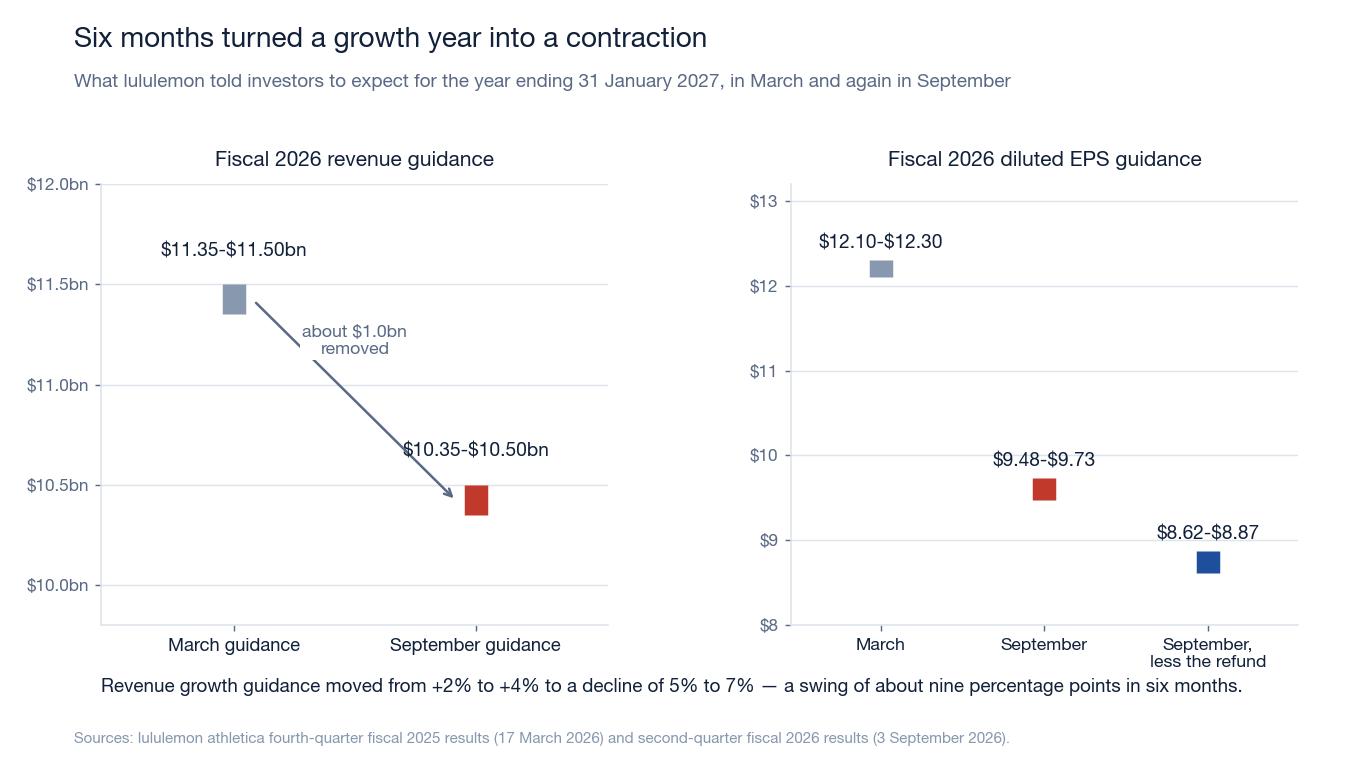
- Full-year revenue of $10.35 billion to $10.50 billion.
- A full-year revenue decline of 5% to 7%.
- Full-year diluted EPS of $9.48 to $9.73.
The new outlook represented a dramatic reversal from March 2026, when management expected revenue of $11.35 billion to $11.50 billion, growth of 2% to 4%, and EPS of $12.10 to $12.30.
| Fiscal 2026 outlook | March guidance | September guidance | Change at midpoint |
|---|---|---|---|
| Revenue | $11.35B–$11.50B | $10.35B–$10.50B | About $1.0B lower |
| Revenue growth | +2% to +4% | -5% to -7% | Approximately 9 percentage points |
| Diluted EPS | $12.10–$12.30 | $9.48–$9.73 | About 21% lower |
| Q3 revenue growth | Not applicable | -10% to -11% | Severe contraction expected |
The shares fell 17.4% on September 4 and closed at $100.61 after touching $97.99 intraday. At that closing price, Lululemon’s market capitalization was approximately $11.1 billion, according to Stock Analysis.
The market was not punishing Lululemon merely for missing one quarterly estimate. It was repricing the probability that the brand’s North American problems are structural.
Q2 2026 Results: The Headline EPS Was Misleading
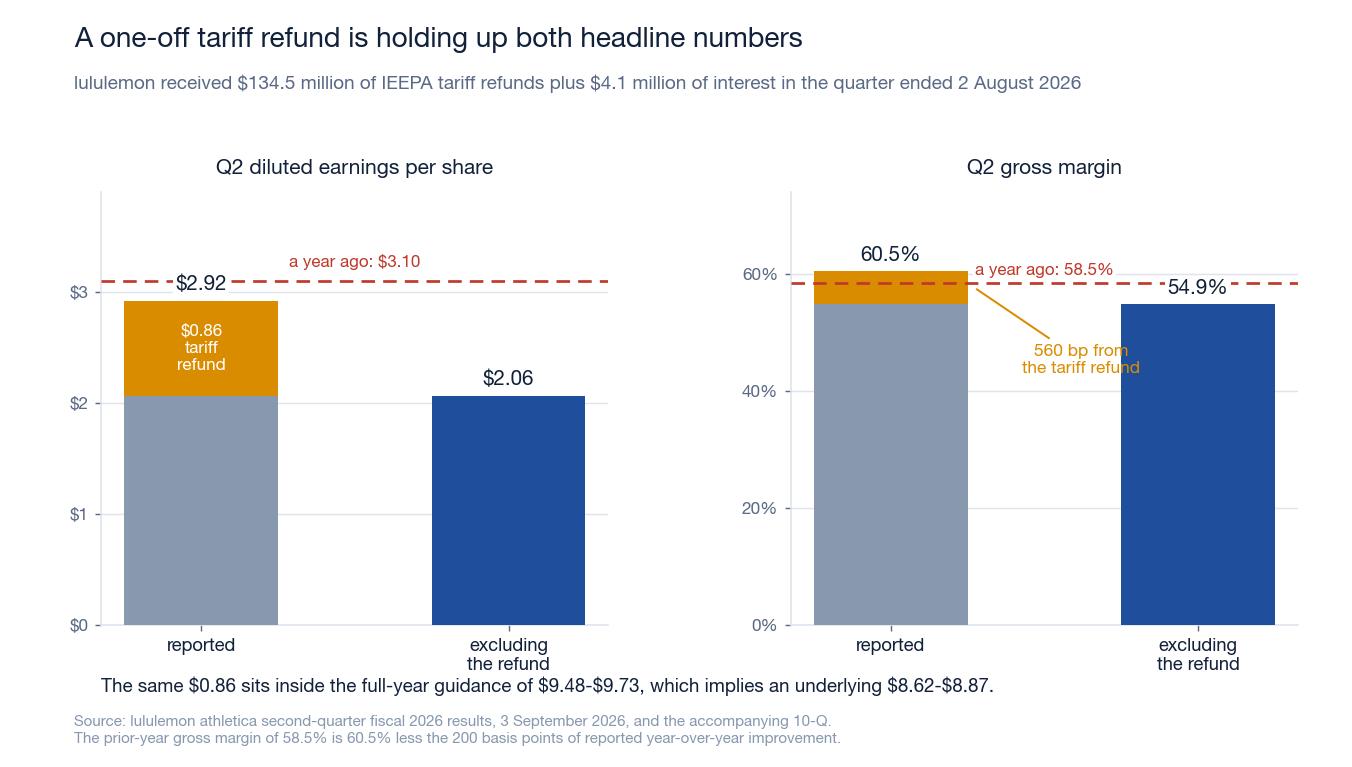
At first glance, Q2 EPS of $2.92 looked respectable. It was only modestly below the $3.10 reported a year earlier and exceeded many pre-report expectations. However, that number contained a large nonrecurring benefit.
Lululemon received:
- $134.5 million of tariff refunds.
- $4.1 million of associated interest.
- A total after-tax EPS benefit of approximately $0.86.
Removing that one-time contribution produces an underlying EPS figure of roughly $2.06, although this simplified calculation should not be treated as a formal non-GAAP measure.
The reported gross margin of 60.5% was similarly distorted. It increased 200 basis points year over year, but the tariff refund contributed approximately 560 basis points. Without the refund, an illustrative adjusted gross margin would have been closer to 54.9%, or about 360 basis points below the prior-year level.
| Q2 2026 metric | Reported result | Important context |
|---|---|---|
| Revenue | $2.416B | Down 4% reported and 5% in constant currency |
| Comparable sales | -9% | -10% in constant currency |
| Gross margin | 60.5% | Tariff refund added 560 basis points |
| Operating margin | 18.8% | Tariff refund added 560 basis points |
| Diluted EPS | $2.92 | Includes $0.86 tariff-refund benefit |
| Net income | $329.2M | Down from $370.9M |
| Inventory | $1.7B | Down 1% in dollars and 7% in units |
| Cash | $1.39B | Down from $1.81B at fiscal year-end |
This distinction matters because the September full-year EPS guidance of $9.48 to $9.73 also includes the $0.86 benefit. Subtracting it implies an underlying range of approximately $8.62 to $8.87 per share.
At a $100.61 stock price, Lululemon therefore traded at:
- About 10.5 times the midpoint of reported fiscal 2026 EPS guidance.
- About 11.5 times the midpoint after removing the tariff-refund benefit.
That valuation is far below the multiples historically awarded to a premium growth brand. But an 11.5-times multiple is only compelling if earnings are near a trough rather than halfway through a prolonged decline.
Is the Lululemon Brand Actually Broken?
A broken stock and a broken brand are not the same thing. Stock prices can collapse because expectations were too high. Brands break when consumers lose interest, product differentiation disappears, pricing power weakens and customer acquisition becomes increasingly expensive.
Lululemon currently shows evidence on both sides.
Evidence that the brand is damaged
The most serious warning comes from comparable sales:
- Americas comparable sales declined 12% in Q2.
- China Mainland comparable sales declined 2%, or 8% in constant currency.
- International comparable sales declined 3%, or 6% in constant currency.
- Global comparable sales declined 9%, or 10% in constant currency.
China was previously viewed as Lululemon’s strongest growth engine. The fact that constant-currency comparable sales also turned negative there undermines the argument that weakness is confined to cautious American consumers.
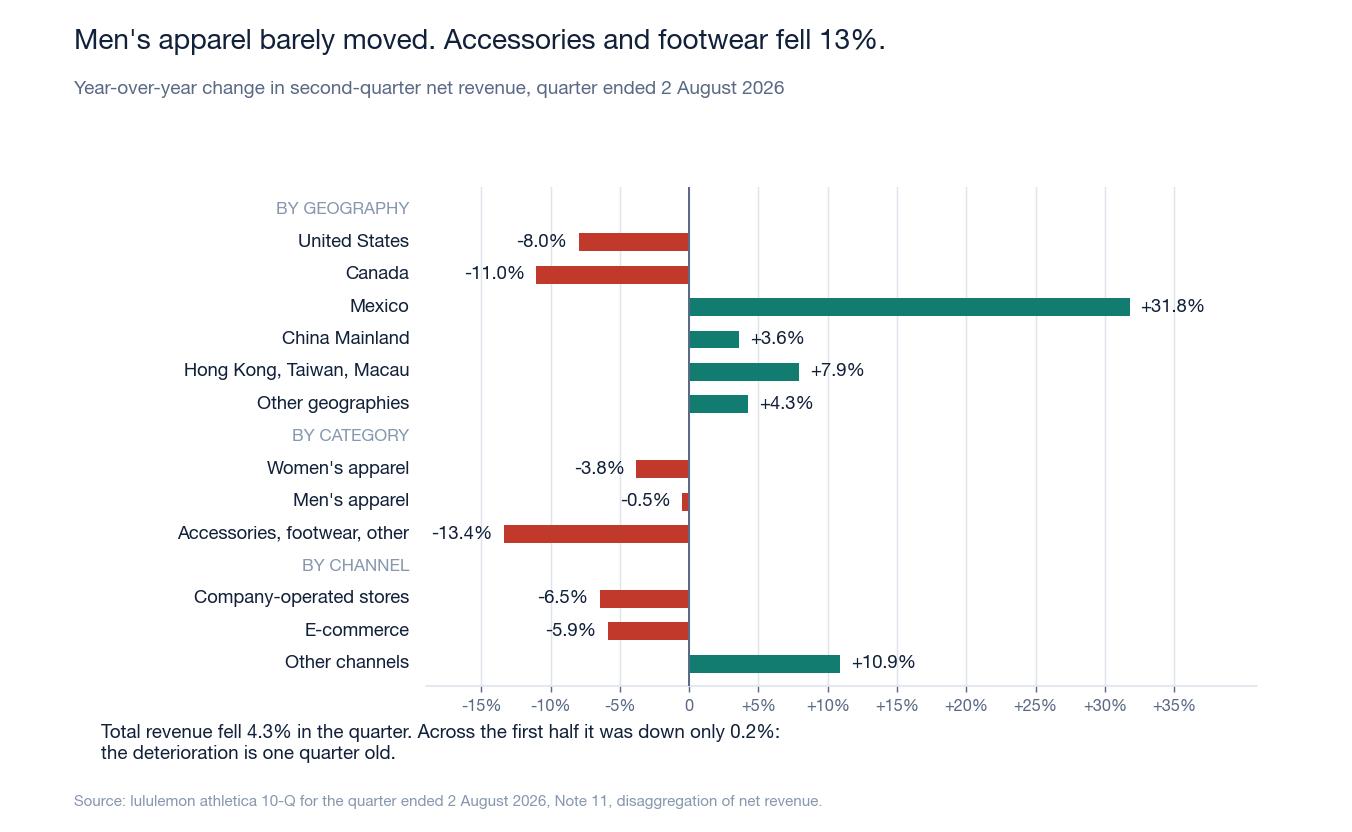
The company's own filings say something more precise than any third-party share estimate, and they say it in three different cuts. The 10-Q disaggregates the quarter's revenue by geography, by category and by channel, and the three views do not agree with each other. 10-Q for the quarter ended 2 August 2026, Note 11
| Q2 2026 revenue, year over year | Change |
|---|---|
| United States | -8.0% |
| Canada | -11.0% |
| Mexico | +31.8% |
| China Mainland | +3.6% |
| Hong Kong, Taiwan and Macau | +7.9% |
| Women's apparel | -3.8% |
| Men's apparel | -0.5% |
| Accessories, footwear and other | -13.4% |
| Company-operated stores | -6.5% |
| E-commerce | -5.9% |
| Other channels (wholesale, license, outlets) | +10.9% |
Three things stand out. Men's apparel was essentially flat. The steepest decline anywhere in the business is accessories and footwear, down 13.4% — the newest categories, and the ones a brand pushes when its core is mature. And the only channel that grew was the one lululemon controls least: wholesale, license and outlet revenue rose 10.9% while its own stores fell 6.5%.
One more number changes the framing entirely. Across the first half, total revenue was down 0.2%. Not 4%. The deterioration is one quarter old.
Evidence that the brand still has value
A truly broken apparel company usually displays several symptoms simultaneously:
- Heavy financial leverage.
- Large inventory growth despite falling demand.
- Constant discounting.
- Negative operating cash flow.
- Store closures and liquidity concerns.
- A collapse in gross profit dollars.
- An inability to fund product development.
Lululemon is not yet in that position. It remains highly profitable, ended Q2 with approximately $1.4 billion in cash, and generated $589 million of operating cash flow in the first half of fiscal 2026. Unit inventory decreased 7%, suggesting management is not blindly accumulating unwanted merchandise.
The company also retains:
- A large direct-to-consumer ecosystem.
- 825 company-operated stores.
- Strong recognition in premium athletic apparel.
- Proprietary fabrics and established product franchises.
- A sizable community of instructors and ambassadors.
- Significant unaided brand awareness.
- A growing footprint outside North America.
The available evidence supports “damaged and culturally weakened,” but it does not yet prove that Lululemon is irreversibly broken.
The Product-Newness Problem
Lululemon built its reputation on product innovation, flattering fits, technical fabrics and a store experience that made premium pricing feel justified. The company’s difficulty is that competitors have narrowed those advantages while consumer preferences have changed.
Customers now have credible alternatives from:
- Alo Yoga.
- Vuori.
- Athleta.
- Nike.
- Adidas.
- On Holding.
- Gymshark.
- Beyond Yoga.
- Numerous private-label and mass-market brands.
Lululemon’s problem is therefore not simply that competitors sell cheaper leggings. Alo and Vuori can charge premium prices while offering newer silhouettes, stronger lifestyle positioning or greater cultural relevance.
Management has acknowledged that consumers want more differentiated products and innovation. The company has been trying to restore historical levels of product newness, shorten development cycles and improve the relationship between product launches, marketing and in-store presentation.
The recovery requires more than producing additional colors of established items. Lululemon needs:
- New hero products capable of attracting first-time customers.
- Better coordination between product development and marketing.
- Faster responses to changes in silhouettes, fabrics and activities.
- Stronger assortments in men’s, running, training and accessories.
- A healthier balance between dependable core items and fashion-oriented newness.
An apparel turnaround can fail if management reacts too aggressively. Chasing trends may alienate core customers, create inventory risk and weaken brand identity. The ideal outcome is to restore innovation without turning Lululemon into an undifferentiated fashion retailer.
Competition From Alo and Vuori Is More Than a Temporary Threat
Lululemon once defined premium athleisure. Today, the category has fragmented into yoga, studio-to-street fashion, running, technical performance, recovery wear and premium casual clothing.
Alo Yoga’s advantage
Alo has built an aspirational fashion-and-wellness identity supported by celebrities, social media, high-profile locations and coordinated apparel sets. It competes particularly well for consumers seeking visual status and trend relevance.
Vuori’s advantage
Vuori initially gained attention in men’s apparel and then expanded into women’s products. Its Southern California positioning and versatile performance-lifestyle clothing address consumers who want comfort without an overt yoga identity.
Vuori was valued at approximately $5.5 billion in a 2024 funding round backed by SoftBank, Norwest and General Atlantic, and had reached roughly 150 stores by mid-2026 with about 30 more planned, according to Cinco Días’ profile of the company.
Why the competitive threat matters financially
Lululemon’s historical valuation depended on more than revenue growth. Investors rewarded its combination of:
- Premium pricing.
- Full-price selling.
- High store productivity.
- Low customer-acquisition dependence.
- Strong gross margins.
- Direct distribution.
- Attractive returns on capital.
If competition forces Lululemon to spend more on marketing and markdowns while growing more slowly, its normalized profit margin will decline. Even if revenue eventually stabilizes, the stock may never regain its former valuation multiple.
Americas Weakness Is the Central Problem
The Americas remain Lululemon’s largest region. That makes the 8% regional revenue decline and 12% comparable-sales decline in Q2 especially damaging.
A 12% negative comparable-sales result is difficult to explain through foreign exchange, new-store timing or accounting noise. It indicates that established stores and digital channels are generating materially less revenue than they did a year earlier.
Several forces appear to be interacting:
- Reduced product newness.
- Lower store and online traffic.
- Negative brand commentary on social media.
- Competition from newer premium brands.
- Consumer resistance to high prices.
- Broader promotional intensity in athletic apparel.
- Possible saturation among core North American customers.
- Organizational disruption during the CEO transition.
The bull case assumes that North American sales stabilize after product and marketing improvements. The bear case assumes that Lululemon has already saturated its most profitable audience and must now spend heavily just to defend a smaller market share.
Why international growth cannot immediately solve the problem
International expansion remains strategically important, but the economics are not identical to those of a mature North American business.
New markets require:
- Store-opening costs.
- Local management and marketing teams.
- Distribution infrastructure.
- Brand-awareness investment.
- Localized product assortments.
- Time to develop customer loyalty.
International revenue can grow while consolidated earnings fall if expansion costs outpace gross profit. Moreover, Q2’s negative international comparable sales show that overseas markets are not immune to brand and product challenges.
China Has Shifted From Catalyst to Question Mark
China Mainland had been the strongest component of the Lululemon bull case, and the size of the reversal is easy to miss. In fiscal 2025 — the year that ended on 1 February 2026 — China Mainland comparable sales rose 20%, or 19% in constant currency, while Americas comparable sales fell 3%. China Mainland revenue grew 29% and Rest of World 16%; combined international revenue rose 22% while Americas revenue declined 1%. 10-K for fiscal 2025
Two quarters later, China Mainland comparable sales are -2%, or -8% in constant currency. That is a swing of roughly 27 percentage points on the constant-currency measure, in the market that was supposed to carry the story.
That pattern reversed sharply in Q2 2026:
| China Mainland metric | Q2 2026 result |
|---|---|
| Reported revenue growth | +4% |
| Constant-currency revenue growth | -2% |
| Reported comparable sales | -2% |
| Constant-currency comparable sales | -8% |
Reported growth was supported by currency movements and new stores. On an underlying comparable basis, existing operations contracted.
This does not eliminate China’s long-term potential. Lululemon still has room to expand in a large athletic and wellness market. But investors should stop treating China as an automatic double-digit growth engine.
China carries its own risks:
- Increasing competition from international and domestic brands.
- Slower discretionary consumption.
- Different fashion cycles and consumer preferences.
- Foreign-brand sentiment.
- Store-expansion execution.
- Currency volatility.
- Geopolitical tension.
The recovery thesis becomes much less attractive if Lululemon must simultaneously repair North America and defend China.
Tariffs Are Painful, but They Are Not the Main Disease
Tariffs and customs changes have affected Lululemon’s supply chain and margins. The company sources products from multiple Asian countries and has historically fulfilled many U.S. e-commerce orders through Canadian distribution centers.
Changes to U.S. tariffs and the de minimis exemption increased costs. In Q1 2026, gross margin fell to 54.2% from 58.3%, with tariffs and markdowns contributing to the decline.
However, tariffs cannot explain:
- A 12% decline in Americas comparable sales.
- Negative constant-currency comparable sales in China.
- Market-share losses to Alo and Vuori.
- Weaker brand sentiment.
- The lack of product newness.
- The full magnitude of the revenue-guidance cut.
Tariffs affect the cost of selling a product. Lululemon’s most urgent problem is convincing customers to want the product.
The Q2 refund also creates analytical noise. The company recovered $134.5 million in previously paid IEEPA tariffs, temporarily lifting gross margin, operating margin and EPS. Investors should separate this refund from recurring operating performance.
Inventory Is Better Controlled Than the Sales Trend Suggests
Inventory is one of the most important indicators in apparel retail. If sales fall while inventory rises rapidly, management may be forced to use promotions that damage both margins and brand equity.
Lululemon ended Q2 2026 with approximately $1.7 billion of inventory:
- Inventory dollars decreased 1% year over year.
- Inventory units decreased 7%.
- Revenue declined 4%.
Unit inventory therefore fell faster than revenue. That is a relatively constructive signal and reduces the probability of an immediate clearance crisis.
The dollar decline was smaller than the unit decline partly because tariffs and product costs increased the carrying value of inventory. Investors should therefore monitor both unit and dollar figures rather than relying on only one measure.
Signs of genuine inventory improvement would include:
- Unit inventory declining at least as fast as sales.
- Lower markdown rates.
- Stable or improving merchandise margins.
- Faster sell-through of new collections.
- Reduced dependence on outlet channels.
- Better alignment between inventory growth and regional demand.
Inventory discipline cannot repair brand desirability, but it can prevent a difficult turnaround from becoming a balance-sheet problem.
Lululemon’s Balance Sheet Provides Time
At the end of Q2, Lululemon had approximately $1.39 billion in cash and $593.7 million of available revolving-credit capacity. The company reported no conventional debt at the end of fiscal 2025, although it has meaningful operating lease obligations associated with stores and facilities.
For the first two quarters of 2026, Lululemon generated:
- $589.3 million of operating cash flow.
- Approximately $312.2 million of simplified free cash flow after $277.1 million of capital expenditure.
- $524.3 million of net income.
- $695.1 million of share repurchases.
The business therefore remains financially viable. It is not facing a near-term liquidity crisis and can continue funding stores, product development, technology and marketing.
But there is an important capital-allocation question: should Lululemon continue buying stock aggressively while the earnings base is shrinking?
The company repurchased:
- $1.2 billion of stock during fiscal 2025.
- Approximately $695 million during the first half of fiscal 2026.
- $330 million, or 2.7 million shares, in Q2 alone.
Q2 repurchases averaged roughly $122 per share—above the post-earnings market price but much lower than historical prices. Repurchases below intrinsic value can create substantial value. Repurchases made before management understands the depth of the turnaround can consume resources that would be more useful for product, marketing or strategic flexibility.
The Buyback Has Cost Shareholders About $2.5 Billion
Most coverage of the crash stops at the earnings miss. The buyback disclosures are the part nobody quotes, and they are the clearest statement of what management believed this business was worth.
Add up every repurchase disclosed since the current authorization began, and the picture is unambiguous. lululemon has bought 18.4 million of its own shares for roughly $4.33 billion, at a weighted average of about $235 a share. Those shares are worth $1.85 billion at $100.61.
| Period | Shares | Cost | Average price |
|---|---|---|---|
| Fiscal 2023 | 1.5m | $558.7m | ~$372 |
| Fiscal 2024 | 5.1m | $1.60bn | ~$314 |
| Fiscal 2025 | 5.0m | $1.20bn | ~$240 |
| 1 Feb – 11 Mar 2026 | 0.9m | $159.6m | ~$177 |
| First half of fiscal 2026 | 4.9m | $695.1m | ~$142 |
| 2 – 28 August 2026 | 1.0m | $118.8m | ~$119 |
| Total | 18.4m | $4.33bn | ~$235 |
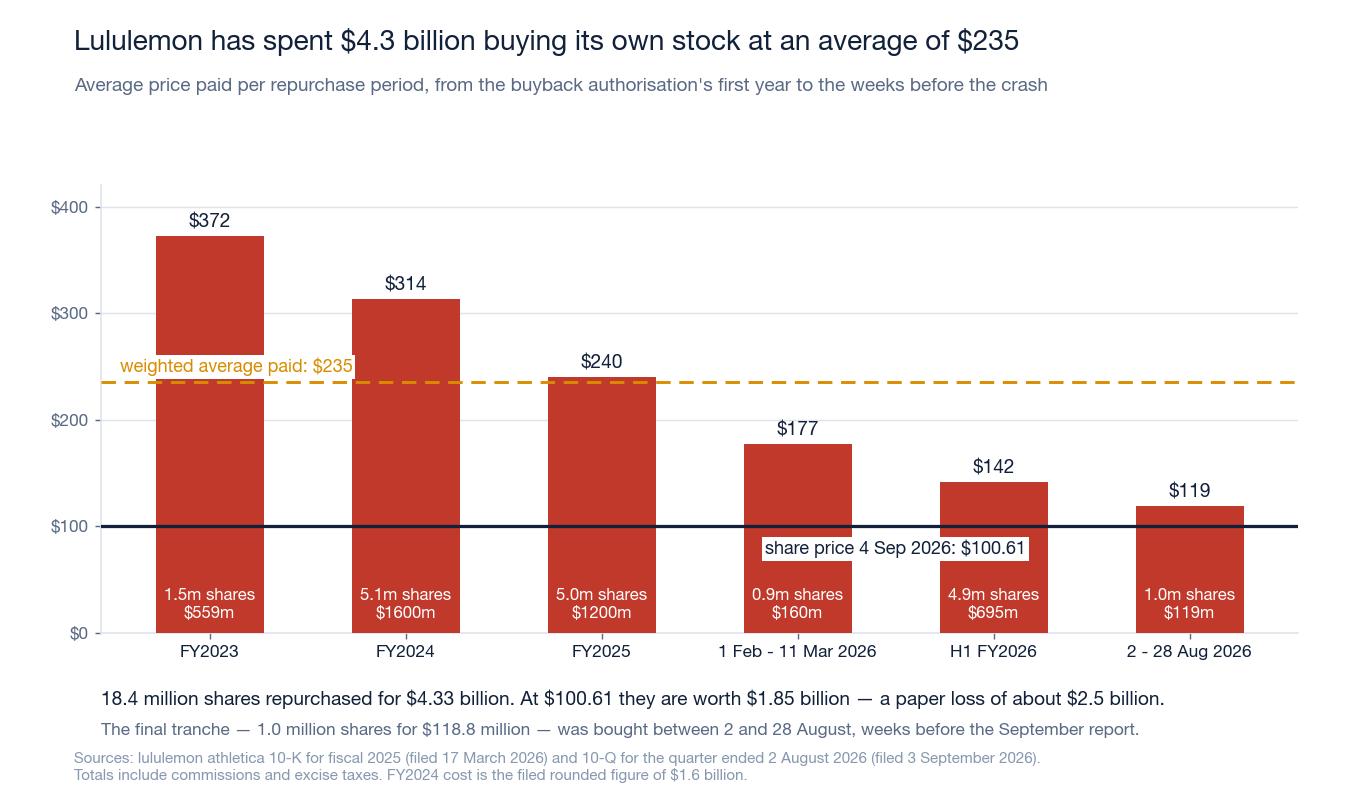
Read the last row again. Between 2 and 28 August — after the quarter closed, before the results were published — the company spent another $118.8 million buying stock at about $119 a share. Nine days later it told the market that full-year revenue would shrink 5% to 7% and cut its earnings guidance by 21%, and the shares closed at $100.61. 10-K for fiscal 2025 · 10-Q for the quarter ended 2 August 2026
None of this is illegal or unusual; repurchases run on pre-set plans and blackout calendars, and management does not get to see the future. But it answers the capital-allocation question directly. $4.33 billion has gone into the stock at an average price more than twice where it now trades, and $712.5 million of authorization remains.
A fair counter-argument exists. The share count is genuinely lower: 110.7 million shares including exchangeable shares as of 28 August 2026, and the 18.4 million retired amount to roughly 14% of what the count would otherwise be, so every future dollar of earnings is spread over fewer shares. Buying at $119 is also a far better decision than buying at $372. The honest way to put it is that the buyback has transferred a lot of cash to departing shareholders at prices the market no longer agrees with, and the remaining owners are the ones carrying that.
For an investor today, this cuts two ways. The $712.5 million still authorised is worth much more at $100 than it was at $300 — and it is the one lever that works immediately, without waiting for product. Whether management uses it aggressively now, having been wrong about price for three years, is one of the more informative things to watch.
The Year Lululemon’s Board Changed Hands
There is a second story running underneath the numbers, and it is entirely on the public record.
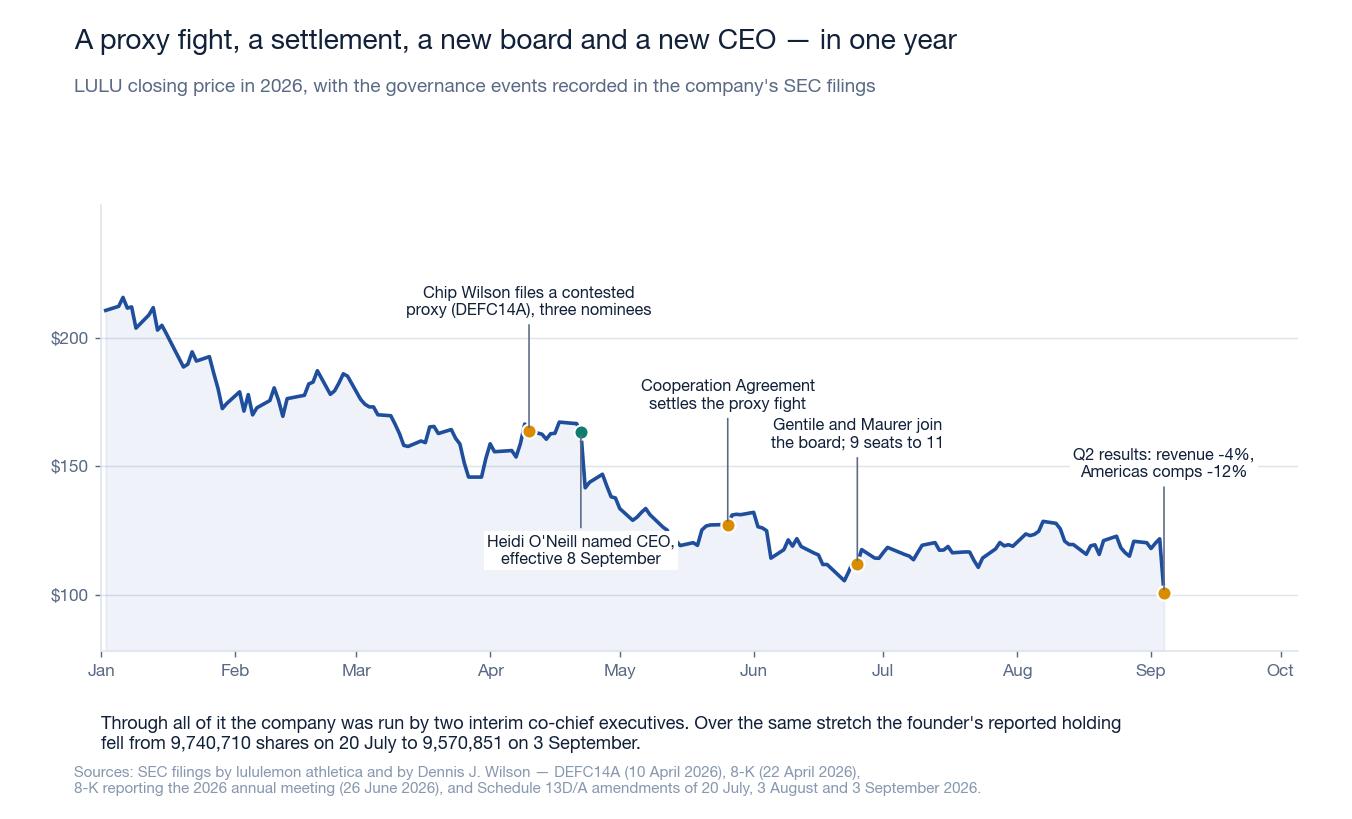
On 10 April 2026, founder Chip Wilson — who with related entities was reported as owning about 8.6% of the company — filed a definitive contested proxy statement, nominating three directors and arguing that changes to the board's composition and to lululemon's governance policies were necessary. His nominees were Laura Gentile, Eric Hirshberg and Marc Maurer. Definitive contested proxy statement, 10 April 2026
Twelve days later the board named Heidi O'Neill chief executive. CEO appointment, 22 April 2026
The contest did not go to a vote. A Cooperation Agreement dated 26 May 2026 settled it, and on 25 June Gentile and Maurer joined the board, which expanded from nine seats to eleven. Both were placed on the Audit Committee and the Corporate Responsibility, Sustainability and Governance Committee. 8-K reporting the 2026 annual meeting
That detail matters more than it first appears. Marc Maurer is the former co-chief executive of On Holding — one of the competitors named in every bear case on lululemon. The company settled a proxy fight by seating an executive from a brand taking its share.
Meanwhile the founder's own reported position has been drifting down. Schedule 13D/A amendments show Dennis J. Wilson's reported beneficial ownership at 9,740,710 shares on 20 July, 9,576,564 on 3 August and 9,570,851 on 3 September — the last filed the same day as the results. The percentage moved 8.6% to 8.4% and back to 8.6% over the same span, because buybacks were shrinking the denominator underneath him.
For an investor the governance picture is genuinely double-edged. On one side: a founder who forced change, two new directors with operating experience in exactly the categories where lululemon is losing, and an incoming chief executive with three decades of brand and product experience. On the other: a company that spent the first half of 2026 fighting its founder, ran two quarters under interim co-chief executives, and cut guidance twice before its permanent leader had started.
The New CEO Is the Most Important 2026 Catalyst
Heidi O’Neill becomes Lululemon’s CEO on September 8, 2026 — four days after the crash, and four and a half months after the board announced her on 22 April. Until then the company has been run by two interim co-chief executives: Meghan Frank, the chief financial officer, and André Maestrini, the president and chief commercial officer. Both of them, not a permanent chief executive, delivered the September guidance cut. Second-quarter fiscal 2026 results
O’Neill brings more than three decades across performance apparel, footwear and sport. Most of that was at Nike, where the company says she helped grow the business from $9 billion to more than $45 billion and oversaw the product pipeline, brand voice and operations; earlier she worked in marketing on Levi Strauss’s Dockers brand. She also sits on the boards of Spotify, Hyatt Hotels and Lithia Driveway.
According to Lululemon’s CEO appointment announcement, O’Neill helped oversee Nike’s global consumer and product organization and worked on shortening product-development timelines and restoring momentum in categories such as running and football.
Her experience aligns with Lululemon’s current problems. Yet investors should not expect an immediate recovery.
A realistic turnaround timeline could look like this:
| Period | What investors should expect |
|---|---|
| First 100 days | Leadership review, talent changes and strategic priorities |
| 6–12 months | Product-pipeline decisions, marketing reset and cost actions |
| 12–24 months | New collections reach stores and customer response becomes measurable |
| 24–36 months | Evidence of sustained comparable-sales and margin recovery |
Apparel supply chains work months in advance. Product created under a new CEO may not materially affect results until fiscal 2027 or later.
What Heidi O’Neill needs to accomplish
- Restore product innovation without abandoning core franchises.
- Rebuild cultural relevance among younger consumers.
- Improve marketing efficiency.
- Clarify the role of men’s, footwear and international expansion.
- Stabilize North American traffic.
- Protect premium pricing.
- Slow unproductive store and expense growth.
- Establish credible and conservative financial targets.
Her appointment is a genuine catalyst, but it is not proof that the turnaround will succeed.
Is LULU Stock Cheap After the Crash?
At $100.61, LULU had a market capitalization of roughly $11.1 billion and traded at approximately 11.5 times the midpoint of underlying fiscal 2026 EPS guidance after removing the tariff-refund benefit.
That multiple looks low relative to Lululemon’s history. It also compares favorably with many premium consumer companies. Yet historical multiples are only relevant if the company can restore historical characteristics.
Why the valuation could be attractive
- The balance sheet is strong.
- The company remains profitable.
- Inventory appears controlled.
- The store base and digital platform have significant value.
- Share repurchases reduce the share count.
- International markets provide long-term optionality.
- A modest sales recovery could create meaningful operating leverage.
- Expectations are now extremely depressed.
Why the low multiple could be a trap
- Revenue guidance implies contraction rather than slow growth.
- Comparable sales are negative in every major region.
- Underlying margins are weaker than reported margins.
- A large fixed-cost base creates operating deleverage.
- Fashion and cultural relevance are difficult to rebuild.
- Competitors are taking measurable share.
- Earnings estimates may still be too high.
- New management may reset guidance again.
A low P/E ratio is not a margin of safety if the denominator is still falling.
Investors should value Lululemon using normalized earnings under multiple scenarios rather than applying a premium multiple to management’s current guidance.
LULU Stock Valuation Scenarios
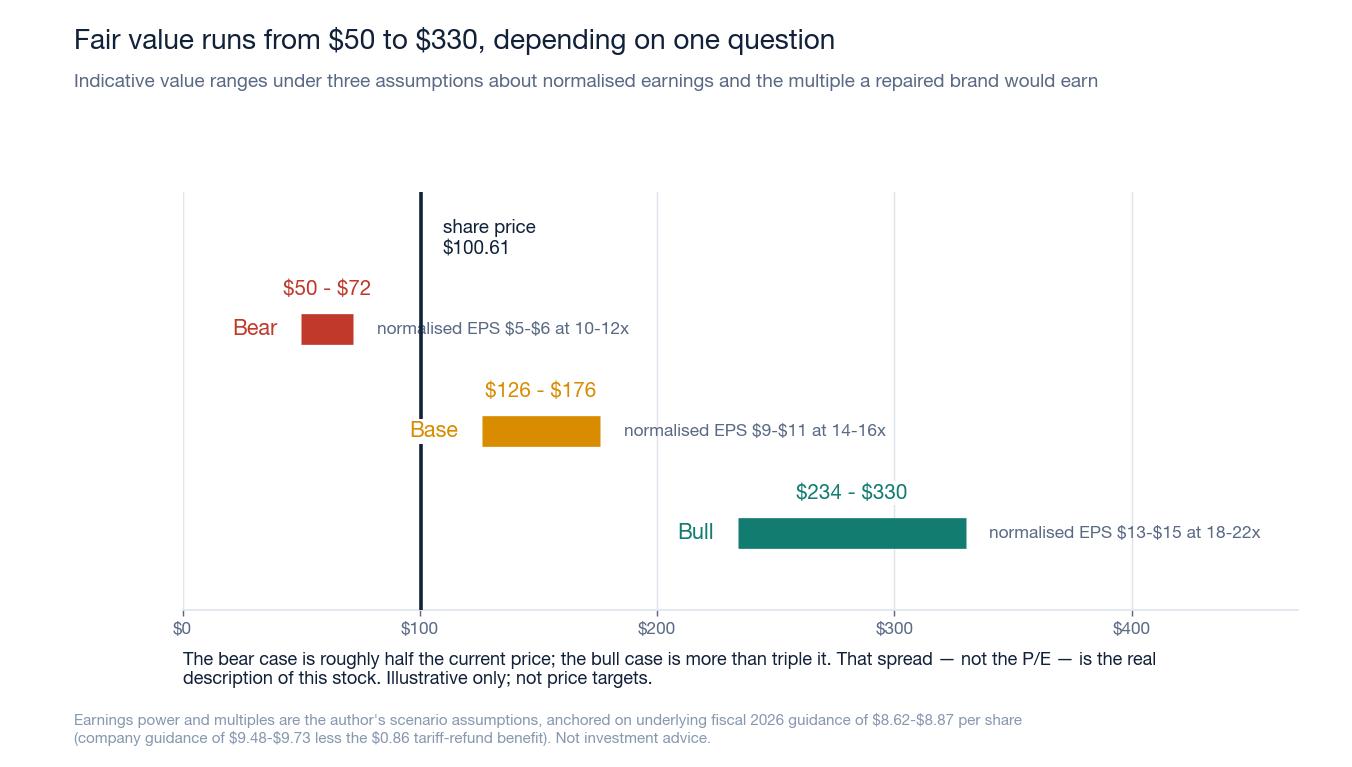
The following scenarios are illustrative, not price targets or personalized investment advice. They demonstrate how sensitive the stock is to assumptions about revenue stabilization and normalized margins.
| Scenario | Long-term operating assumptions | Illustrative EPS power | Illustrative multiple | Indicative value |
|---|---|---|---|---|
| Bear | Revenue continues declining; promotions rise; international growth disappoints | $5–$6 | 10x–12x | $50–$72 |
| Base | Sales stabilize; modest product recovery; margins remain below historical levels | $9–$11 | 14x–16x | $126–$176 |
| Bull | Brand relevance returns; international growth resumes; margins recover materially | $13–$15 | 18x–22x | $234–$330 |
Bear case: Lululemon becomes a value trap
The bear case assumes that Lululemon has lost structural market share and cannot restore its cultural relevance. Americas revenue continues falling, China matures faster than expected, and international expansion requires greater investment.
Lower sales cause fixed costs to consume a larger percentage of revenue. Promotions rise, gross margin falls and normalized EPS declines toward $5 to $6. At 10 to 12 times earnings, the stock could trade between $50 and $72.
Base case: A long but workable turnaround
The base case assumes revenue stabilizes during fiscal 2027, followed by low-single-digit growth. Product improvements prevent further share loss, but Lululemon does not fully regain its former dominance.
Normalized EPS recovers to $9 to $11. A 14-to-16-times multiple implies a value of approximately $126 to $176.
Bull case: The market is extrapolating temporary weakness
The bull case assumes O’Neill successfully rebuilds the product engine, international growth resumes and North American comparable sales return to positive territory. Lululemon protects premium pricing, improves expense productivity and repurchases shares at depressed prices.
EPS eventually reaches $13 to $15. A restored premium multiple of 18 to 22 times could support a value between $234 and $330.
The very wide range is the point: Lululemon’s current value depends more on the durability of its brand than on near-term accounting precision.
Is Lululemon Stock Below $100 a Once-in-a-Decade Buy?
It may become one, but the current evidence is not strong enough to make that conclusion with confidence.
The opportunity resembles a classic high-quality turnaround:
- A historically excellent company experiences an operational crisis.
- Its stock loses the premium valuation.
- Investors extrapolate current weakness indefinitely.
- A strong balance sheet provides time for management to respond.
- Successful normalization creates both earnings recovery and multiple expansion.
However, premium apparel brands are not utilities. Consumer preferences can change permanently. A product that was culturally dominant five years ago does not automatically regain relevance because its stock looks inexpensive.
A once-in-a-decade buying opportunity requires more than a cheap price. Investors need evidence that:
- The core customer remains loyal.
- New products are attracting incremental demand.
- Competitor share gains are slowing.
- Full-price selling remains healthy.
- Comparable-sales declines are bottoming.
- Management can protect margins without underinvesting.
- International growth can resume without excessive capital requirements.
Until several of these conditions improve, LULU should be viewed as a high-risk turnaround at a potentially attractive valuation, not a proven bargain.
What Investors Should Monitor Each Quarter
The most useful turnaround indicators are operational, not promotional statements from management.
1. Americas comparable sales
Improvement from -12% toward a mid-single-digit decline would indicate that the rate of deterioration is slowing. A return to positive comps would be the strongest confirmation of a turnaround.
2. China Mainland comparable sales
New stores can make regional revenue look healthier than underlying demand. Investors should emphasize constant-currency comparable sales rather than reported revenue growth.
3. Full-price sell-through
Strong sell-through would show that new products are resonating without depending on discounts.
4. Inventory units
Unit inventory should remain controlled relative to sales. A sudden inventory build would increase markdown risk.
5. Gross margin excluding unusual items
The Q2 tariff refund made reported margins look stronger. Investors should normalize one-time refunds, restructuring charges and other unusual effects.
6. SG&A productivity
Q2 selling, general and administrative expense increased to 41.7% of revenue from 37.7%. Marketing investment may be necessary, but spending must eventually generate better traffic and conversion.
7. New CEO strategy
Watch for specific decisions involving product leadership, development timelines, store expansion, international priorities and capital allocation.
8. Search, traffic and consumer sentiment
Brand turnarounds often appear in search trends, app engagement, website traffic and social sentiment before they become obvious in reported revenue.
SimianX AI can assist with this monitoring by combining fundamental data, SEC filings, technical analysis and news sentiment. Its multi-agent framework can help investors compare bullish and bearish evidence, although all important figures should still be verified directly against company filings.
A Practical Decision Framework for LULU Investors
Instead of asking whether the stock will rise immediately, investors can separate the decision into business quality, price and timing.
Step 1: Decide whether the moat is impaired or destroyed
An impaired moat can recover. A destroyed moat cannot. Indicators of impairment include temporary product gaps and poor marketing execution. Indicators of destruction include permanent loss of pricing power, sustained customer abandonment and structural margin collapse.
Step 2: Normalize earnings
Do not use the reported Q2 EPS without adjusting for the tariff refund. Begin with the underlying fiscal 2026 EPS range of roughly $8.62 to $8.87, then test additional downside.
Step 3: Demand a turnaround discount
A turnaround deserves a lower valuation than a stable premium compounder. Investors should not assume an immediate return to historical P/E multiples.
Step 4: Use position sizing
Because fair value ranges from potentially below $75 to well above $200 depending on brand recovery, concentration creates substantial risk. A staged position can preserve the ability to respond to new evidence.
Step 5: Establish thesis-breakers
Possible thesis-breakers include:
- Americas comps remain near double-digit negative levels through fiscal 2027.
- China comps continue deteriorating.
- Inventory begins growing faster than sales.
- Promotions permanently damage gross margin.
- New products fail to improve traffic.
- The company exhausts cash through poorly timed repurchases.
- Management again cuts guidance without a credible recovery plan.
This approach turns an emotionally charged stock crash into a measurable investment process.
Key Bull and Bear Arguments
| Bull case | Bear case |
|---|---|
| Globally recognized premium brand | Brand has lost cultural relevance |
| Strong balance sheet and positive cash flow | Earnings and revenue estimates still falling |
| Controlled inventory units | Fixed-cost deleverage is worsening |
| New CEO has relevant product and brand experience | Turnaround products may take years to reach stores |
| International runway remains substantial | China comparable sales have turned negative |
| Valuation is historically low | Low multiple may reflect permanent margin decline |
| Buybacks are more powerful at lower prices | Previous buybacks consumed cash above current value |
| Modest recovery could drive multiple expansion | Alo and Vuori are taking measurable share |
The evidence supports neither extreme with certainty. Lululemon is not financially distressed, but its revenue trends are too weak to call the decline purely irrational.
FAQ About Lululemon Stock Below $100
Why did Lululemon stock crash in September 2026?
Lululemon reported a 4% revenue decline, a 9% drop in comparable sales and a 12% comparable-sales decline in the Americas. Management also reduced full-year revenue guidance to a 5%–7% decline and lowered EPS guidance to $9.48–$9.73.
Is LULU stock undervalued after falling below $100?
It appears inexpensive at roughly 11.5 times the midpoint of underlying 2026 EPS guidance after removing the tariff-refund benefit. However, the stock is only undervalued if earnings stabilize; further revenue and margin deterioration could make the current P/E misleading.
Is the Lululemon brand dying?
The brand is experiencing serious demand, product and cultural-relevance problems, but it remains profitable and globally recognized. Controlled inventory, positive cash flow and a large customer base suggest damage rather than definitive brand failure.
Can new CEO Heidi O’Neill fix Lululemon?
O’Neill has relevant experience in product, marketing and global brand management from Nike. Nevertheless, product-development cycles mean a meaningful operational recovery may require 12–24 months or longer.
How much has Lululemon spent buying back its own stock?
About $4.33 billion for 18.4 million shares since the current authorization began, at a weighted average of roughly $235 a share. At $100.61 those shares are worth about $1.85 billion. The most recent tranche — 1.0 million shares for $118.8 million at about $119 — was bought between 2 and 28 August 2026, days before the guidance cut. $712.5 million of authorization remains.
Who is Chip Wilson and what did his proxy fight change?
Wilson founded lululemon and, with related entities, was reported as holding about 8.6% of the shares. In April 2026 he filed a definitive contested proxy nominating three directors. The contest was settled by a Cooperation Agreement on 26 May, and on 25 June Laura Gentile and Marc Maurer joined the board, which expanded from nine seats to eleven. Maurer is the former co-chief executive of On Holding.
What is the biggest risk to buying LULU stock?
The biggest risk is that the current earnings decline is structural rather than cyclical. If Lululemon cannot restore product differentiation and pricing power, the shares could remain a value trap despite their low valuation.
Conclusion
Lululemon stock’s fall below $100 reflects a genuine deterioration in the business—not merely market panic. Revenue is contracting, Americas comparable sales are deeply negative, China’s underlying growth has reversed, competitors are gaining share and the full-year outlook has been cut dramatically.
At the same time, Lululemon is not a distressed company. It has approximately $1.4 billion in cash, positive operating cash flow, controlled unit inventory, a globally recognized brand and an incoming CEO with relevant experience. Those strengths give management time to attempt a recovery.
But the year also produced two facts that any buyer should weigh. The company has put $4.33 billion into its own shares at an average of about $235, more than twice the current price, and it kept buying into late August. And it spent the first half of 2026 in a proxy contest with its own founder, settling in May by seating two new directors — one of them the former co-chief executive of a competitor — while two interim co-chief executives ran the business.
The most defensible conclusion is that the brand is damaged but not yet demonstrably broken. At approximately 11.5 times underlying fiscal 2026 earnings guidance, the stock offers meaningful upside if sales stabilize. But there is also substantial downside if normalized EPS falls toward $5–$6.
Therefore, LULU below $100 may eventually prove to be a once-in-a-decade opportunity—but investors should not confuse historical cheapness with confirmed value. The strongest evidence would be improving comparable sales, better full-price sell-through, successful new products, controlled inventory and stabilization in both North America and China.
Investors who want to follow those signals can use SimianX AI to monitor LULU fundamentals, filings, market sentiment and technical trends in one research workflow. SimianX is a research tool rather than a registered investment adviser, so verify material information independently and consult a qualified financial professional before making investment decisions.
Related Reading
- PayPal Stock Crashes 13%: TPV +10%, Margin Just +1.5%
- Tim Cook Steps Down: What John Ternus Inherits at Apple
- NVDA After Earnings: Every Reaction Since 2016 in One Table
- PDD Stock 2026: Temu Slows, Revenue Up, Profit Down 15%
- On Holding (ONON) $1B Buyback: 10% of Shares vs Nike's $123M
References
- lululemon athletica — second-quarter fiscal 2026 results
- Form 10-Q — quarter ended 2 August 2026
- Form 10-K — fiscal 2025
- Definitive contested proxy statement — 10 April 2026
- Form 8-K — 2026 annual meeting results
- Form 8-K — CEO appointment, 22 April 2026
- SEC EDGAR — lululemon athletica inc. filing history
- Nike — corporate newsroom
- On Holding — official site
- Vuori — official site
- Alo Yoga — official site