Apple’s First Foldable iPhone Is Here: Can the iPhone Duo Ignite AAPL’s Next Supercycle?
Apple has officially entered the foldable-phone market. On September 9, 2026, the company unveiled the iPhone Duo, a book-style device with a 7.6-inch folding display, a 5.4-inch outer screen and a starting price of $1,999. The announcement immediately revived expectations for an Apple foldable iPhone supercycle and a new growth phase for AAPL.
But investors should distinguish between a successful product launch and a genuine financial supercycle. The iPhone Duo has been announced, yet preorders do not begin until October 16 and retail availability starts October 23. As of September 10, there are no official preorder totals, sell-through figures or customer-satisfaction data.
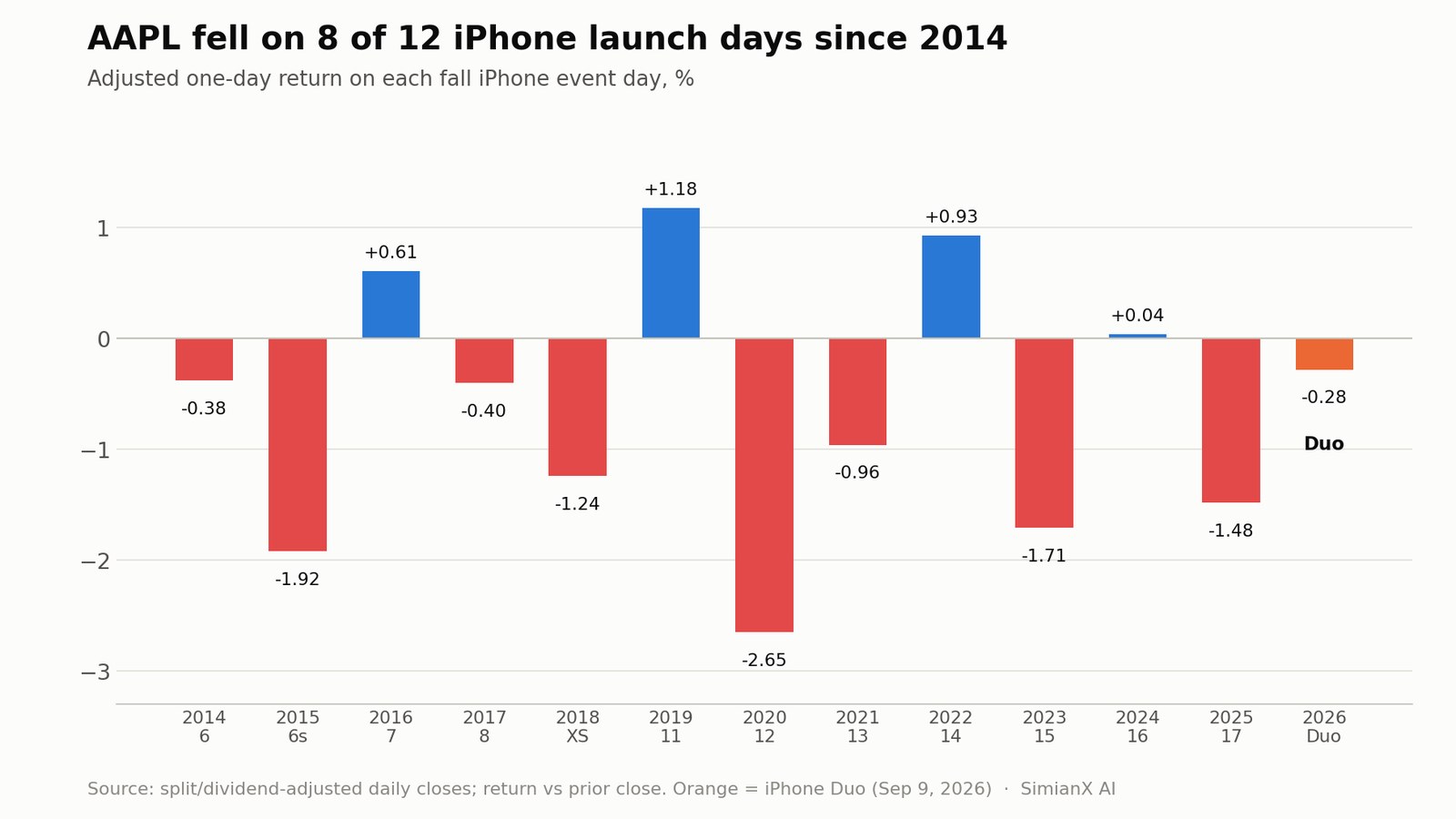
The stock itself was unimpressed. AAPL closed launch day at $315.34, down 0.28%, on 65.6 million shares — about 1.7 times its 20-day average volume. That is not unusual: across the twelve iPhone launch events since 2014, AAPL fell on the event day eight times (see the reference table below).
The evidence supports a more measured conclusion: iPhone Duo could become an important premium product and lift Apple’s average selling price, but one expensive model is unlikely to create a classic supercycle on its own. A broader cycle would require strong Duo demand, continued iPhone 18 momentum, compelling Siri AI experiences, resilient Chinese sales and manageable component costs.
This research examines the product, market opportunity, financial impact, valuation and risks. Investors can also use SimianX AI to monitor AAPL fundamentals, SEC filings, news sentiment and technical signals as actual demand data begins replacing launch-day speculation.
The iPhone Duo Facts Investors Need to Know
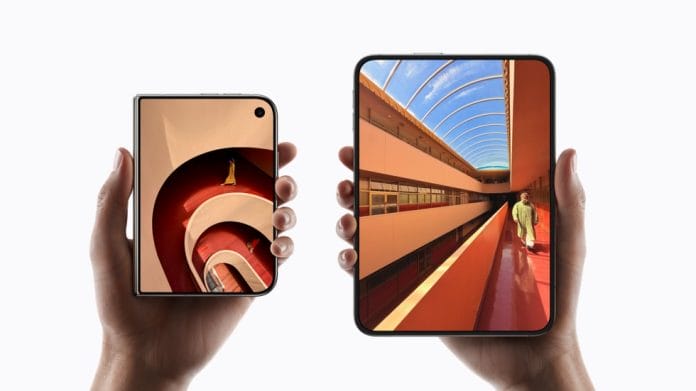
Apple describes the Duo as its first foldable iPhone and, in the words of CEO John Ternus, “the most transformational change to iPhone since the original.” The device opens like a book rather than flipping vertically.
According to Apple’s official iPhone Duo announcement, its principal features include:
- A 7.6-inch folding inner display, 50% larger than the iPhone 18 Pro Max screen.
- A 5.4-inch outer display with 90% of the screen area of iPhone 18 Pro.
- Apple Pencil (USB-C) support, arriving later this year.
- A precision hinge built from more than 100 components.
- Grade 5 titanium construction and an IP68 rating.
- An under-display FaceTime camera and Touch ID in the side button.
- An A20 Pro processor.
- Dual batteries and a custom vapor chamber.
- Two 48MP rear cameras with fold-specific photography modes.
- Apple Intelligence and the new Siri AI.
- Storage configurations from 256GB to 2TB.
- A starting U.S. price of $1,999.
Preorders begin on October 16 in more than 70 countries and regions, with availability on October 23 and another 28 countries and regions on October 30. Apple quotes the Duo at $83.29 per month over 24 months, and its Klarna-provided Apple Upgrade leasing program starts as low as $57.99 per month for eligible U.S. customers. A $79 Duo Case and a $129 Folio with Kickstand launch alongside it.
That financing strategy matters. A $1,999 price looks prohibitive when viewed as a single payment, but premium smartphones are increasingly purchased through installments, trade-ins and carrier promotions. Apple is trying to convert a four-digit retail price into a manageable monthly cost.
The Duo’s most immediate financial advantage is not necessarily volume. It is Apple’s ability to create an entirely new price tier above the Pro Max.
Why iPhone Duo Is Strategically Important
Apple is joining the foldable market years after Samsung, Huawei, Honor, Google and other manufacturers. This appears late from a technology-market perspective, but it is consistent with Apple’s historical approach.
Apple often waits until it believes that hardware reliability, software integration and consumer demand can support a coherent product. It did not invent the digital music player, smartphone, smartwatch or tablet. Instead, it used hardware-software integration, distribution and ecosystem control to expand those categories.
The Duo gives Apple four strategic opportunities.
1. Create a new ultra-premium tier
The $1,999 entry price sits well above a conventional iPhone Pro. Higher-capacity configurations could push transaction values even further. If buyers trade up rather than merely choosing between existing iPhones, Apple can raise iPhone average selling prices without needing proportional unit growth.
2. Give mature iPhone users a reason to upgrade
Modern flagship phones already have fast processors, good cameras and long software-support periods. Incremental annual improvements may not be enough to persuade consumers to replace a functioning device.
A folding screen provides an obvious physical difference. It can attract affluent users who have delayed upgrading because recent iPhones felt too similar.
3. Defend Apple’s position in China
Foldable devices have stronger strategic relevance in China, where Huawei and other domestic brands have established premium foldable portfolios. Apple previously lacked a direct answer.
The Duo closes that portfolio gap. It may help Apple retain high-income Chinese consumers who want a foldable device but prefer iOS, the App Store and Apple’s broader ecosystem.
4. Expand the canvas for services and AI
A 7.6-inch screen creates more room for multitasking, gaming, video, document editing and AI interfaces. Apple has tailored iOS 27 to the Duo, moving the Dock, Lock Screen controls and app navigation to the side and adapting applications across the inner and outer displays.
The long-term opportunity is not just hardware revenue. A larger mobile canvas could encourage greater use of:
- Apple One and iCloud+.
- Apple TV and Apple Music.
- Premium games and App Store purchases.
- Productivity applications.
- AppleCare coverage.
- Apple Pencil and other accessories.
- On-device Apple Intelligence features.
What Counts as an Apple Supercycle?
The term supercycle is used too casually. A new device selling well is not automatically a supercycle.
A true iPhone supercycle normally includes several reinforcing effects:
- A large installed base becomes eligible and willing to upgrade.
- Replacement cycles shorten.
- Former Android customers switch to iPhone.
- Unit sales and average selling prices rise simultaneously.
- Revenue growth persists for multiple quarters.
- Services and accessory revenue follow the hardware sale.
- Analysts raise forward earnings estimates materially.
The launch of the larger-screen iPhone 6 and 6 Plus is the useful historical benchmark. Apple’s fiscal 2015 Form 10-K reported iPhone net sales of $155.0 billion, up 52%, on unit sales of 231.2 million, up 37%, with iPhone ASP up 11% — growth it attributed primarily to strong demand for those two models. That cycle addressed a mass-market preference for larger screens and affected the main iPhone lineup.
The Duo is different. Its $1,999 price initially confines it to the premium end of the market. It may transform the foldable category without transforming Apple’s entire installed base.
The iPhone 6 benchmark, in numbers
| Measure | iPhone 6 cycle (FY2015) | Duo bull case, incremental |
|---|---|---|
| iPhone revenue growth | +52% | ≈ +7% of 9M FY2026 iPhone revenue |
| Unit growth | +37% (231.2m units) | 17m Duo units, largely replacing other iPhones |
| ASP effect | +11% | Positive, via a new $1,999+ tier |
| Breadth | Whole main lineup | One ultra-premium model |
Even the most optimistic Duo scenario in this article adds about $13.6 billion of incremental revenue — roughly 7% of the $196.5 billion of iPhone revenue Apple booked in just the first nine months of fiscal 2026. The iPhone 6 added more than half again to the iPhone business in a single year. That is the scale gap a “supercycle” label has to close.
Therefore, the correct question is not merely, “Will Duo sell out?” Limited supply can make almost any new product sell out. The better questions are:
- Can production scale beyond early adopters?
- Will buyers choose Duo instead of an Android foldable?
- Will existing iPhone owners upgrade earlier than planned?
- How much demand is incremental rather than cannibalized?
- Can Apple preserve attractive margins?
- Will Duo’s success spread to lower-priced models later?
The Foldable Market Opportunity Is Real but Still Small
Foldable smartphones remain a niche within the worldwide handset market. That is both a limitation and an opportunity.
IDC’s August 2026 smartphone outlook forecasts:
| Market indicator | IDC estimate |
|---|---|
| 2026 global smartphone shipments | Just over 1 billion (−16.7%) |
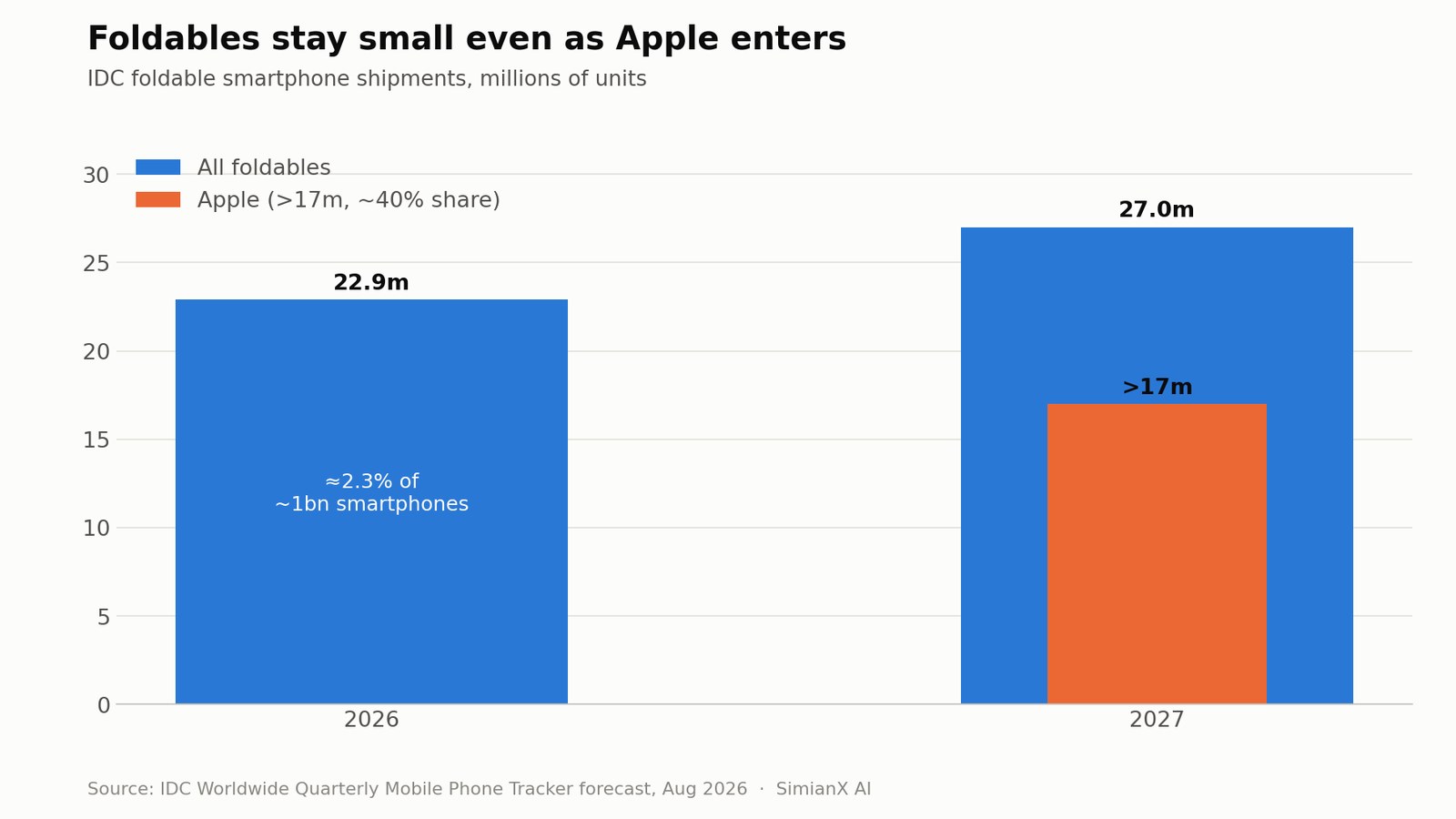
| 2026 foldable shipments | 22.9 million |
| Foldable growth in 2026 | 12.6% |
| 2027 foldable shipments | Approximately 27 million (+18%) |
| Apple foldable shipments in 2027 | More than 17 million |
| Apple’s projected 2027 foldable share | Approximately 40% |
| Apple foldable ASP | More than $2,550 |
| Apple foldable value | More than $45.7 billion |
On these estimates, foldables would represent only about 2.3% of worldwide smartphone shipments in 2026. Even rapid growth would leave the category small compared with conventional smartphones.
Two IDC details deserve more attention than they received on launch day. First, IDC says that without Apple, foldable shipments would have declined at a double-digit rate — Apple is converting a segment that was about to shrink into the fastest-growing part of an industry that IDC expects to post its steepest contraction on record in 2026. Second, IDC assumes an Apple foldable ASP above $2,550, which would give Apple more than half of the category’s total value. That ASP is well above the $1,999 entry price, implying heavy mix toward the 512GB, 1TB and 2TB configurations.
This leads to a crucial distinction:
The iPhone Duo can be a category-changing product without being large enough to create an immediate company-wide supercycle.
Apple’s scale raises the hurdle. A product that generates $10 billion in annual retail value would be enormous for most companies, but Apple generated $364.4 billion of revenue in only the first nine months of fiscal 2026.
AAPL Enters the Duo Cycle From a Position of Strength
The Duo is not being launched to rescue a collapsing iPhone franchise. Apple’s latest reported performance was already strong, as covered in our Apple Q3 2026 earnings analysis.
According to Apple’s fiscal third-quarter 2026 Form 10-Q, results for the quarter ended June 27 included:
| Metric | Fiscal Q3 2026 | Year-over-year change |
|---|---|---|
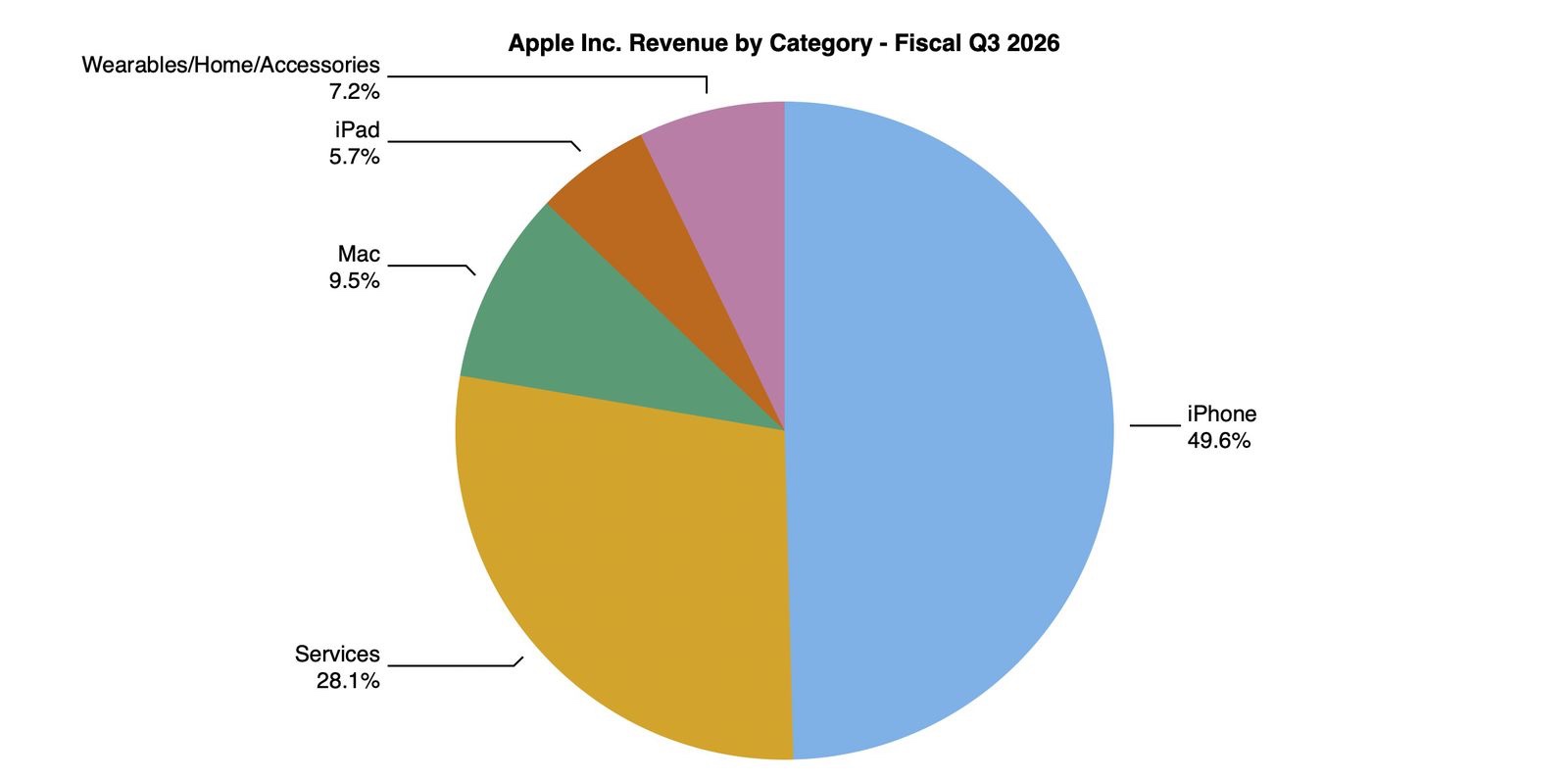
| Total revenue | $109.4 billion | 16% |
| iPhone revenue | $54.3 billion | 22% |
| Services revenue | $30.7 billion | 12% |
| Greater China revenue | $18.8 billion | 22% |
| Diluted EPS | $2.02 | 29% |
| Company gross margin | 50.1% | Up from 46.5% |
| R&D expense | $11.7 billion | 32% |
For the first nine months of fiscal 2026, iPhone revenue reached $196.5 billion, up 22%, while Services revenue rose 14% to $91.7 billion. Apple stated that higher sales of Pro models were the main driver of iPhone growth.
This is particularly relevant for the Duo thesis. Consumers were already shifting toward premium models before Apple introduced its $1,999 foldable. The Duo extends an existing premiumization trend instead of creating one from nothing.
Apple’s financial engine also provides downside protection. During the first nine months of fiscal 2026, it repurchased 215 million shares for $61.8 billion. Services carried a gross margin of 75.6% in the June quarter, compared with 40.1% for products.
However, the 50.1% company gross margin was flattered by one-offs: Apple’s 10-Q attributes the jump in products gross margin primarily to product mix and tariff refunds, partially offset by higher costs, including memory. Investors should not automatically extrapolate that unusually strong margin into fiscal 2027.
How Much Revenue Could iPhone Duo Generate?
No one yet knows actual demand, product mix or channel inventory. Still, an illustrative model helps establish scale.
The following is not company guidance. It uses a hypothetical $1,850 in recognized hardware revenue per unit, below the $1,999 retail price to allow conceptually for channel economics, geographic pricing and mix. Actual reported revenue could differ substantially.
| Scenario | Annual Duo units | Illustrative revenue | Interpretation |
|---|---|---|---|
| Bear | 5 million | $9.3 billion | Supply issues or narrow early-adopter demand |
| Base | 10 million | $18.5 billion | Strong premium niche with gradual scaling |
| Bull | 17 million | $31.5 billion | Approaches IDC’s 2027 shipment outlook |
Note how conservative the $1,850 assumption is against IDC’s own numbers: at IDC’s ASP of more than $2,550, the 17-million-unit bull case would be worth more than $43 billion, not $31.5 billion. The gap between those two figures is mostly storage mix — exactly the part of the Duo story that is still unknowable before preorders open.
Even the bull case needs adjustment for cannibalization. Some Duo customers would otherwise have purchased an iPhone Pro or Pro Max.
Assume, only for illustration, that the average Duo buyer would otherwise have bought a $1,050 iPhone. The incremental hardware revenue per customer would then be closer to $800 than $1,850.
Under that assumption:
- Five million Duo upgrades add roughly $4 billion of incremental revenue.
- Ten million add roughly $8 billion.
- Seventeen million add roughly $13.6 billion.
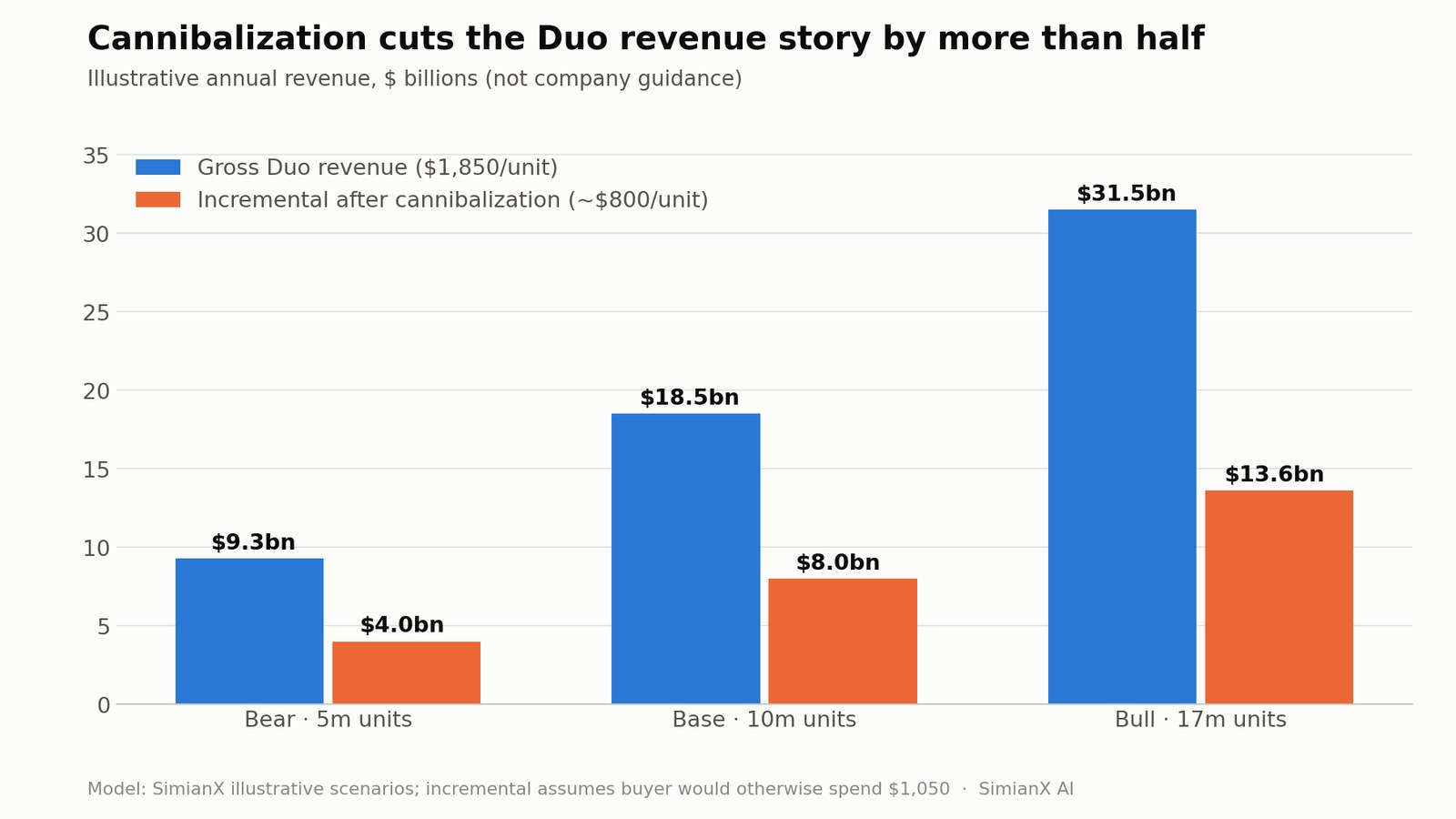
The real benefit could be higher if Duo attracts Android switchers or causes users to upgrade earlier. It could be lower if the device mostly cannibalizes high-storage Pro Max purchases.
Investors should also account for second-order revenue:
- AppleCare adoption may be high because repair risk matters more for foldables.
- Large photo and video files can increase iCloud storage demand.
- The purchase may include a case, folio or Apple Pencil.
- The larger display could increase paid application and media engagement.
- A high-value user may produce years of Services revenue.
The lifetime value of a new ecosystem customer is therefore greater than the initial hardware sale. But those benefits emerge over time and should not be fully credited at launch.
How AAPL Has Traded Around Every iPhone Launch Since 2014
Launch-day price action is a poor guide to whether a product cycle succeeds — and the history proves it. The table below measures AAPL’s split- and dividend-adjusted return on the day of each fall iPhone event, and over the following one month (21 trading days) and three months (63 trading days), measured from the prior day’s close. Volume is shown relative to the 20-day average before the event.
| Event date | Lineup | Event day | +1 month | +3 months | Volume vs 20-day avg |
|---|---|---|---|---|---|
| Sep 9, 2014 | iPhone 6 / 6 Plus | −0.4% | +2.5% | +14.8% | 3.7x |
| Sep 9, 2015 | iPhone 6s | −1.9% | −2.5% | +5.7% | 1.2x |
| Sep 7, 2016 | iPhone 7 | +0.6% | +5.7% | +2.6% | 1.7x |
| Sep 12, 2017 | iPhone 8 / X | −0.4% | −3.1% | +7.3% | 2.8x |
| Sep 12, 2018 | iPhone XS / XR | −1.2% | −4.2% | −24.2% | 1.7x |
| Sep 10, 2019 | iPhone 11 | +1.2% | +6.0% | +25.0% | 1.2x |
| Oct 13, 2020 | iPhone 12 | −2.7% | −3.8% | +5.4% | 1.7x |
| Sep 14, 2021 | iPhone 13 | −1.0% | −5.8% | +17.7% | 1.4x |
| Sep 7, 2022 | iPhone 14 | +0.9% | −5.9% | −7.4% | 1.3x |
| Sep 12, 2023 | iPhone 15 | −1.7% | +0.2% | +7.8% | 1.6x |
| Sep 9, 2024 | iPhone 16 | +0.0% | +2.2% | +10.1% | 1.6x |
| Sep 9, 2025 | iPhone 17 / Air | −1.5% | +8.5% | +16.9% | 1.4x |
| Sep 9, 2026 | iPhone Duo | −0.3% | — | — | 1.7x |
Three patterns stand out across the twelve prior events:
- Event days skew negative. AAPL fell on 8 of 12 launch days, with a mean move of −0.67%. The Duo’s −0.28% is squarely inside the normal range — the market did not treat it as a break from pattern in either direction.
- The first month is a coin flip. The median one-month return was −1.2%, with six declines. Launch-month performance says little about the cycle.
- Three months later, AAPL was usually higher — in 10 of 12 cases, with a median gain of +7.6%. This mostly reflects AAPL’s strong general drift over the period rather than any single product; the two exceptions (2018 and 2022) were both market-wide selloffs.
The iPhone 6 — the one genuine supercycle in the sample — also had an unremarkable −0.4% launch day, but by far the heaviest volume (3.7x). The lesson for Duo holders is that the evidence arrives in the December-quarter report, not on the tape in September.
Can iPhone Duo Ignite AAPL’s Next Supercycle?
The answer is possibly, but only as one component of a broader cycle.
Duo has three characteristics that support a bullish argument:
- It is Apple’s first major iPhone form-factor change in years.
- It establishes a new price tier.
- It gives premium Android foldable users a reason to enter Apple’s ecosystem.
Yet the device also faces three limits:
- Foldables remain a small percentage of the smartphone market.
- Initial 2026 supply may be constrained.
- A $1,999 starting price excludes much of Apple’s installed base.
For a company-wide supercycle, Apple needs the entire fiscal 2027 product system to work together. That includes the iPhone 18 Pro family, Duo, Apple Intelligence, Siri AI, financing, trade-in incentives and Services monetization.
What would confirm the supercycle thesis?
Investors should look for measurable evidence rather than launch enthusiasm:
- Preorder delivery dates extend rapidly across multiple countries.
- Supply increases without eliminating demand.
- Android-to-iPhone switching rises.
- iPhone revenue grows faster than units, indicating higher ASP.
- Greater China maintains growth despite Huawei competition.
- Services growth accelerates alongside the new installed base.
- Apple raises production plans or analysts raise earnings estimates.
- Gross margin remains resilient after tariff refunds stop flattering it.
A launch sellout alone proves little if only a few million units are available.
China May Decide Whether Duo Becomes More Than a Niche
China is one of the most important markets for the Duo because consumers there are already familiar with premium folding phones.
Apple entered the launch with improving Chinese performance. IDC’s China Q2 2026 analysis estimated that Apple’s China smartphone shipments grew 24.4% year over year in the second quarter of 2026, lifting its market share from 13.9% to 18.1%. Huawei remained the leader with a 22.6% share, up from 18.1%, while every other top-six vendor — OPPO, vivo, Xiaomi and Honor — lost share in a market of roughly 66 million units.
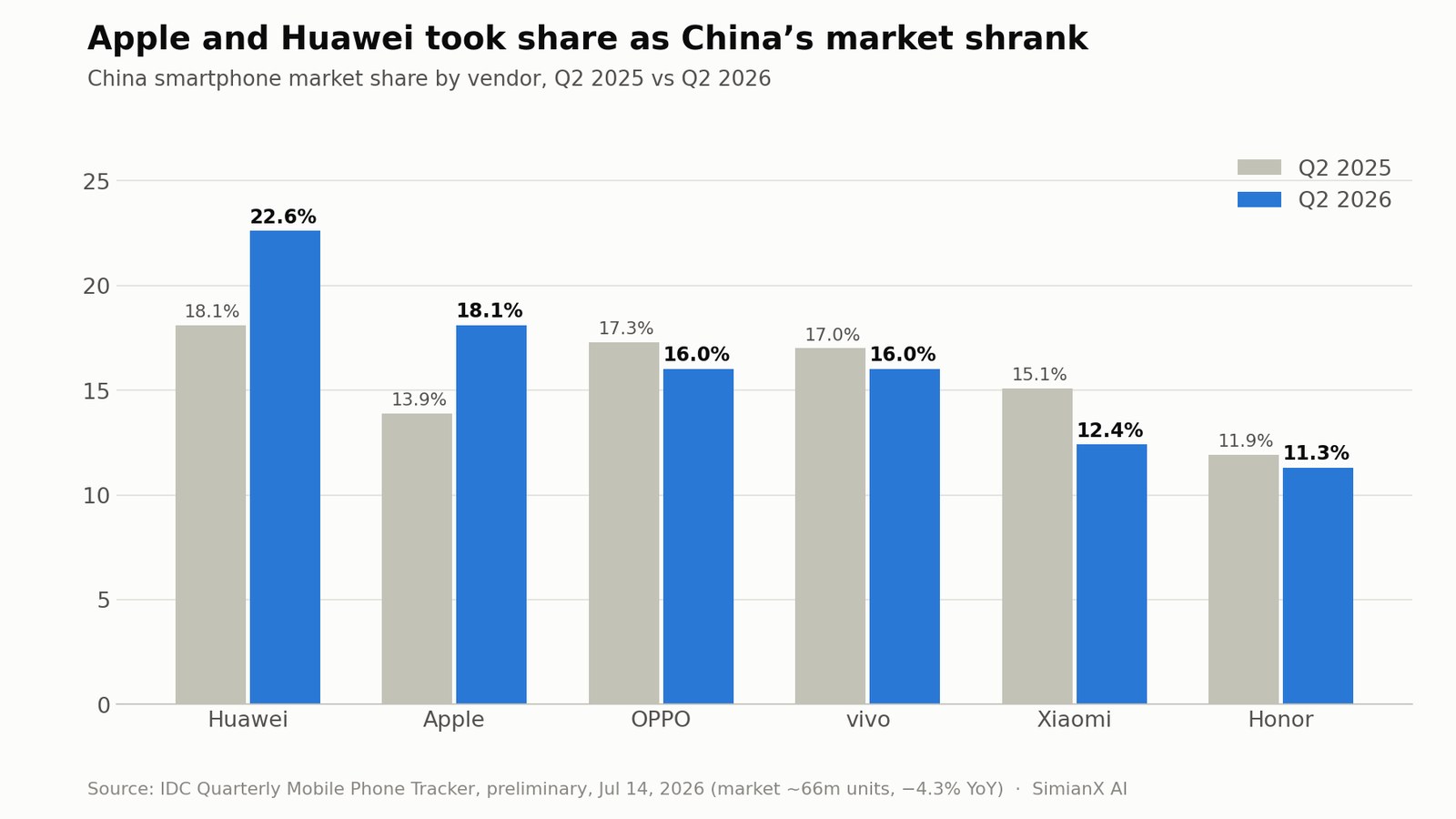
Apple’s reported Greater China revenue also increased 22% in fiscal Q3 2026. Nevertheless, the competitive environment remains difficult:
- Huawei has strong domestic brand loyalty.
- Chinese manufacturers have more foldable-product experience.
- Local brands offer a wider range of designs and prices.
- Government and corporate purchasing policies can influence demand.
- Promotional pricing contributed to Apple’s recent momentum.
- China’s overall smartphone shipments declined 4.3% in Q2 2026, the fifth straight quarterly decline.
The Duo fills a visible portfolio gap, but it must compete on more than brand. Chinese consumers will evaluate the crease, hinge, battery life, weight, camera system, multitasking and local AI capabilities against mature alternatives.
Success in China would strengthen the supercycle argument because it would show that Apple can win share in an established foldable market. Weak Chinese demand would imply that Duo is primarily a wealthy Western early-adopter product.
The Margin Debate: Premium Price Versus Premium Costs
A $1,999 product does not automatically produce a superior margin.
Foldable phones require more expensive components and manufacturing processes:
- Two displays rather than one.
- A flexible OLED panel.
- A precision hinge.
- Additional structural reinforcement.
- A dual-battery architecture.
- More complicated assembly and quality control.
- Higher warranty and repair exposure.
- Potentially lower initial manufacturing yields.
Apple’s purchasing scale and supply-chain expertise are significant advantages. The company may also charge enough to offset the added bill of materials. But investors should wait for reported product-margin evidence.
Memory costs are an additional risk. IDC says NAND and DRAM costs are up more than 300% year over year and expects global smartphone shipments to fall 16.7% in 2026, with memory prices expected to keep rising until at least 2028. Apple’s Q3 filing also acknowledged higher memory costs and warned that component constraints are expected to intensify. The same memory squeeze is what is lifting suppliers such as SK Hynix and Micron — one company’s supercycle is another’s cost headwind.
Duo’s premium positioning offers pricing protection, yet a product-margin squeeze could occur if Apple absorbs component inflation or faces poor manufacturing yields.
The bullish margin case is:
High price + premium storage mix + accessories + AppleCare + Services = attractive lifetime economics.
The bearish margin case is:
Expensive display + hinge + low yields + warranty risk + component inflation = less profit than the retail price suggests.
Siri AI Could Matter More Than the Hinge
Foldable hardware creates initial attention, but software determines whether the format becomes indispensable.
Apple says iOS 27 adapts to the Duo’s two displays and supports multitasking, while the A20 Pro — up to 20% faster in CPU than A19 Pro — drives on-device AI. Siri AI, which Apple previewed at WWDC 2026, also arrives with a new Siri Camera mode.
The strongest use cases could include:
- Summarizing a document on one side while drafting on the other.
- Comparing products, routes or travel plans across applications.
- Editing photos and video on a larger canvas.
- Running contextual AI assistance alongside the current application.
- Using the outer screen for camera previews and shared FaceTime views.
- Taking handwritten notes with Apple Pencil.
If the device merely makes videos and web pages larger, consumers may view it as an expensive novelty. If Apple and developers create workflows that are materially better than on a conventional phone, Duo can become a new productivity category.
This is why an Apple foldable iPhone supercycle may depend more on AI and software than on the folding mechanism itself.
AAPL Valuation Leaves Little Room for an Ordinary Launch
At the September 9 close, AAPL traded at $315.34, giving Apple an approximately $4.6 trillion market capitalization on the 14.59 billion shares outstanding reported in its 10-Q. The shares were valued at roughly 36 times trailing earnings and 34 times forward earnings, according to StockAnalysis market data. The stock sits about 8% below its 52-week high of $344.57 and 4% below its September 3 close of $328.21.
The market is therefore not pricing Apple like a slow-growth hardware company. It already assumes durable ecosystem economics, continued buybacks, Services growth and successful product execution.
The Zacks consensus estimate on September 10 placed fiscal 2027 EPS at $9.54, only about 8% above its fiscal 2026 estimate of $8.85. At $315, that implies a forward multiple of approximately 33 times fiscal 2027 earnings.
A simple valuation sensitivity table illustrates the risk:
| FY2027 EPS scenario | 28x P/E | 32x P/E | 36x P/E |
|---|---|---|---|
| $9.00 | $252 | $288 | $324 |
| $9.50 | $266 | $304 | $342 |
| $10.00 | $280 | $320 | $360 |
| $10.50 | $294 | $336 | $378 |
These are not price targets. They demonstrate that future returns depend on both earnings and the valuation multiple.
At the current valuation, Duo cannot merely be interesting. To drive substantial upside, it must help produce earnings above expectations or convince investors that Apple deserves to retain an unusually high multiple.
A great device does not guarantee a great investment when the stock price already reflects excellent execution.
Bull, Base and Bear Cases for AAPL
| Scenario | Duo outcome | Broader Apple outcome | Investment implication |
|---|---|---|---|
| Bull | Supply scales, demand broadens and Android switching rises | iPhone ASP, Services and China revenue outperform; margins remain strong | Earnings estimates rise and the premium multiple holds |
| Base | Duo becomes a successful premium niche | Some Pro cannibalization; steady Services growth; modest earnings contribution | Good product news but limited valuation expansion |
| Bear | Early demand is narrow or reliability concerns emerge | Component costs rise, China weakens and margins normalize | High valuation becomes vulnerable to compression |
Bull case
The Duo sells strongly through 2027, Apple improves manufacturing yields and introduces lower-priced variants in later generations. The larger display becomes a natural interface for Siri AI. High-income Android users switch, and China responds positively.
In this scenario, Duo is not just a new model. It becomes the foundation of a multiyear product family.
Base case
The Duo sells well among enthusiasts, professionals and wealthy customers but remains a small part of total iPhone units. It raises ASP and ecosystem engagement, although some demand comes from consumers who would have purchased a Pro Max.
This would still be commercially successful, but it would not justify calling fiscal 2027 a classic supercycle.
Bear case
The device encounters hinge, crease, battery or durability complaints. Production remains expensive, and consumers hesitate at the price. Huawei and Samsung maintain stronger foldable positions in key Asian markets.
Under this outcome, Duo resembles a strategic experiment rather than a near-term earnings engine.
Key Risks Investors Should Not Ignore
Cannibalization
A Duo sale is not fully incremental when the buyer would otherwise purchase another premium iPhone. Revenue models that multiply units by $1,999 without a counterfactual overstate the opportunity.
Durability and warranty costs
The most important reviews will come after months of real-world use. Repairs, screen failures or hinge problems could affect both margins and Apple’s quality reputation.
Supply constraints
Scarcity can generate excitement while limiting revenue. Investors need to distinguish demand strength from insufficient production.
China competition
Huawei and other domestic brands possess extensive foldable experience. The Duo must compete in capabilities, not only prestige.
Component inflation
Higher memory, flexible-display and advanced-component costs could pressure product gross margin.
AI execution
Duo’s larger canvas needs compelling software. If Siri AI remains incomplete or geographically restricted, the device may lack a decisive use case.
Services regulation
Apple’s Services business carries much higher gross margins than hardware, but the App Store and iOS remain subject to regulation. Apple’s 10-Q discloses ongoing European Commission investigations under the EU Digital Markets Act, including one into how developers may promote offers to users outside the App Store.
Valuation risk
At more than 30 times forward earnings, AAPL is priced for resilience. A modest earnings disappointment can matter more than strong launch publicity.
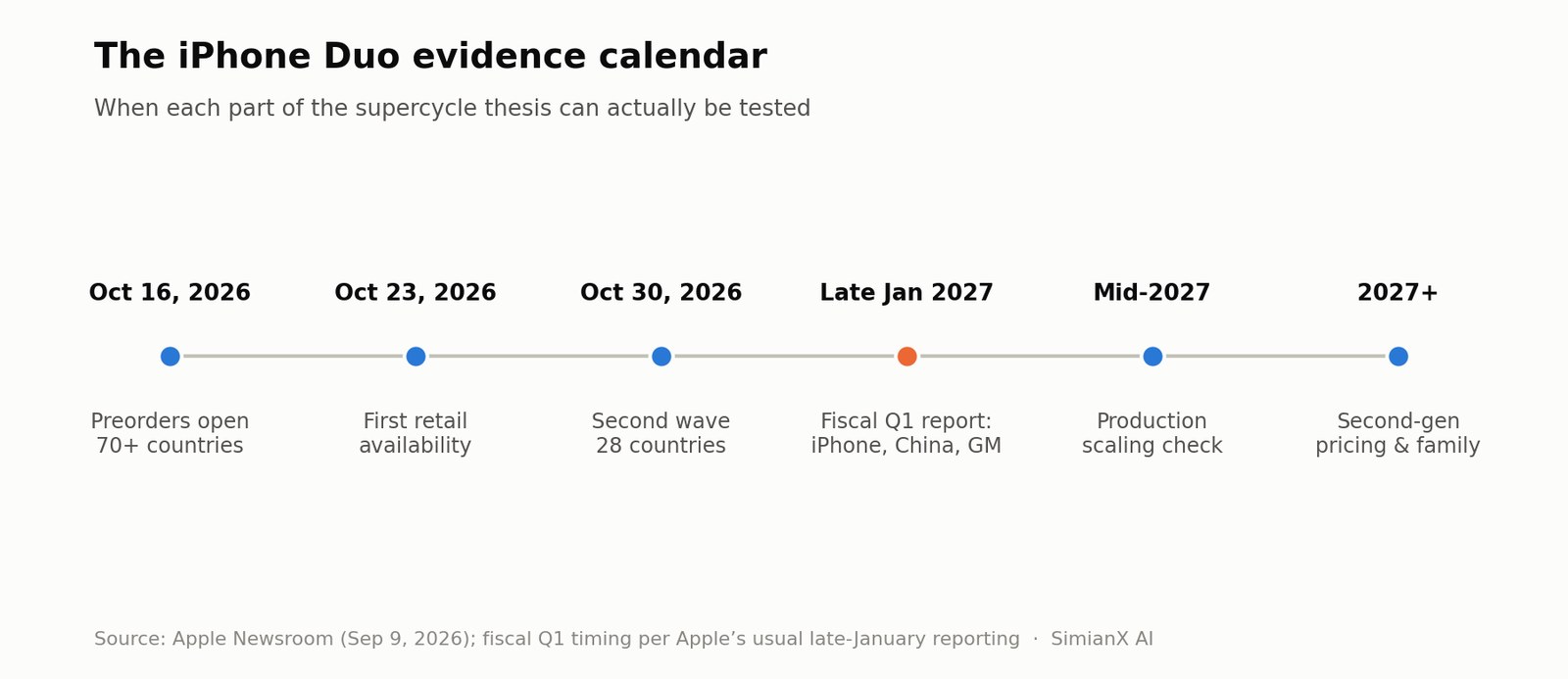
How to Track the iPhone Duo Investment Thesis
Investors should update the thesis in stages.
- Preorder phase: Track delivery delays, geographic availability and configuration mix after October 16.
- Launch phase: Compare independent durability, battery and display reviews after October 23.
- Holiday quarter: Watch channel inventory, promotions and estimated production changes.
- Fiscal Q1 report: Examine iPhone revenue, Greater China sales, product gross margin and management commentary.
- Mid-2027: Evaluate whether demand extends beyond early adopters and whether Apple expands production.
- Second generation: Look for lower prices, improved durability and a broader model family.
Useful indicators include:
- iPhone revenue growth.
- Estimated unit growth versus ASP growth.
- Product gross margin.
- Services revenue per installed device.
- Greater China revenue.
- AppleCare and accessory momentum.
- Supplier yield and capacity reports.
- Analyst EPS revisions.
- AAPL’s forward P/E relative to its history.
SimianX AI can help consolidate these signals through multi-agent analysis of real-time news, fundamentals, SEC filings and technical conditions — you can open a live AAPL analysis directly. It should supplement—not replace—primary-source research and professional financial advice.
FAQ About the Apple Foldable iPhone Supercycle
How much does the iPhone Duo cost?
The iPhone Duo starts at $1,999 in the United States with 256GB of storage, or $83.29 per month over 24 months. Apple also offers 512GB, 1TB and 2TB configurations, plus trade-in and eligible Apple Upgrade leasing options from $57.99 per month.
When can customers buy Apple’s foldable iPhone?
Preorders begin October 16, 2026, in more than 70 countries and regions, and initial retail availability begins October 23. A second wave of 28 countries and regions follows on October 30.
How many iPhone Duo units could Apple sell?
No official forecast has been issued. IDC forecasts more than 17 million foldable iPhone shipments in 2027, about 40% of the foldable market, at an ASP above $2,550. Initial 2026 supply is widely expected to be constrained. These are third-party estimates, not Apple guidance.
Did AAPL stock rise after the iPhone Duo launch?
No. AAPL closed launch day down 0.28% at $315.34 on heavier-than-usual volume. That is typical: AAPL has fallen on 8 of the 12 iPhone launch days since 2014, but was higher three months later in 10 of those 12 cases.
Can iPhone Duo materially increase Apple revenue?
Yes, particularly through higher average selling prices, accessories, AppleCare and Services. However, the incremental benefit is smaller than total Duo revenue because some buyers would otherwise have purchased another premium iPhone.
Is AAPL stock a buy after the iPhone Duo launch?
That depends on an investor’s required return, time horizon and risk tolerance. The business enters the launch with strong growth, but AAPL’s premium valuation already incorporates significant optimism. Investors should compare evidence of Duo demand and earnings revisions with the price they are being asked to pay.
Conclusion
Apple’s first foldable iPhone is real, and it is strategically important. The iPhone Duo gives Apple a new ultra-premium price tier, closes a competitive gap in China and creates a larger mobile canvas for AI, productivity and Services.
Yet the evidence available on September 10, 2026, does not prove that a supercycle has begun. Preorders have not opened, initial supply may be limited and foldables still represent only a small fraction of worldwide smartphone shipments.
The most probable near-term outcome is that Duo becomes a high-value premium niche with meaningful ASP benefits. It can evolve into a broader supercycle if Apple scales production, attracts Android switchers, maintains margins and expands the foldable family to more accessible prices.
For AAPL shareholders, three conclusions matter:
- The product case is stronger than it was before the announcement.
- The immediate revenue opportunity is meaningful but not transformational at Apple’s scale.
- The valuation already demands more than an ordinary product success.
Investors should now move from launch-day excitement to measurable evidence: preorders, production, Chinese demand, iPhone ASP, product margins and fiscal 2027 earnings revisions.
Use SimianX AI to follow those developments through real-time market intelligence, fundamental analysis and SEC data. Always verify critical information independently and consult a qualified financial adviser before making investment decisions.
Related Reading
- Tim Cook Steps Down: What John Ternus Inherits at Apple
- Apple Q3 Earnings 2026: Can Growth Offset AI Delays?
- Apple WWDC 2026: Siri AI & Gemini Impact on AAPL Stock
- SK Hynix Stock Surges 8%: Is the AI Supercycle Real?
- Micron (MU): Why HBM3e Makes It the 2026 AI Memory Play
References
- Apple Newsroom — Apple unveils iPhone Duo (September 9, 2026)
- SEC EDGAR — Apple Form 10-Q for the quarter ended June 27, 2026
- SEC EDGAR — Apple fiscal 2015 Form 10-K
- IDC — Worldwide smartphone market forecast
- IDC — China smartphone market, Q2 2026
- Zacks — AAPL detailed earnings estimates
- StockAnalysis — AAPL market data
- European Commission — Digital Markets Act