
Wie HBM3e-Speicher Microns AI-Bullenargument 2026 trägt
Für den größten Teil von 2023 und Anfang 2024 war Speicher das schmutzige Wort des Halbleiteruniversums. Die DRAM-Preise brachen ein, NAND geriet in tiefe Verluste, und Micron Technology — der einzige US-amerikanische DRAM-Hersteller mit Hauptsitz im Inland — musste zusehen, wie Analysten jedes Quartal die Kursziele senkten. Bis Ende 2025 war dieses Narrativ völlig gekippt. Micron ist nicht mehr „das zyklische Speicherunternehmen". Es ist das dritte Standbein des AI-Hardware-Stacks, neben Nvidia-Rechenleistung und dem Strom-und-Kühlung-Ausbau der Hyperscaler, den wir in unserer NextEra-Dominion-Analyse zum AI-Strom-Engpass behandelt haben.
Dieser Artikel dekodiert, warum MU-Aktien das versteckte AI-Speicherspiel 2026 sind, was HBM3e tatsächlich ist, wie Micron SK Hynix und Samsung Marktanteile abnimmt und wo die Bull- und Bear-Cases beim Übergang in FY2027 landen. Wenn Sie herausfinden wollen, ob Microns jüngster Ausbruch der Beginn eines mehrjährigen Superzyklus oder ein spätzyklisches Blow-off-Top ist, lebt die Antwort in drei Zahlen: HBM-Umsatzmix, Bruttomarge-Trajektorie und CHIPS-Act-Capex.
Der Setup: Vom DRAM-Zyklus-Tief zum AI-Speicher-Superzyklus
Speicher war immer der heftigste Zyklus in den Halbleitern. Der Grund ist strukturell: DRAM und NAND sind Commodities mit einstelligen Lieferantenzahlen, zweijährigen Fab-Bauzyklen und einer Nachfrage, die in 18-bis-24-Monats-Wellen umherspringt. Das Tief 2022–2023 war lehrbuchmäßig — Samsung, SK Hynix und Micron schrieben alle innerhalb von vier Quartalen milliardenschwere operative Verluste, als die Nachfrage von PCs und Smartphones nach COVID einbrach.
Was das Drehbuch zerriss, war AI. Eine einzelne Nvidia H100 GPU verbraucht 80 GB HBM3-Speicher. Eine H200 verbraucht 141 GB HBM3e. Die 2024 angekündigte Blackwell B200-Plattform liefert 192 GB HBM3e pro Paket und war während des gesamten Jahres 2025 speicherbegrenzt. Multiplizieren Sie das mit den Millionen Beschleunigern, die Hyperscaler für 2025 und 2026 bestellt haben, und die Mathematik ist offensichtlich: AI-Infrastruktur ist jetzt der dominante Treiber der DRAM-Nachfrage, und HBM hat strukturell Angebot aus dem Commodity-DDR-Pool herausgezogen.
Microns Geschäftsjahr endet Ende August (FY2026 schließt August 2026). Die letzte Guidance des Unternehmens hat HBM-Umsatz auf einem Pfad von „mehreren hundert Millionen" Anfang 2024 zu einem mehrere-Milliarden-Dollar-Run-Rate bis Ende Kalenderjahr 2025 verortet, mit HBM-Bruttomarge strukturell akkretiv zum Unternehmensdurchschnitt. Dieser eine Satz — HBM ist akkretiv zur Unternehmensbruttomarge — ist die gesamte Bull-These in komprimierter Form.
Was HBM3e tatsächlich ist — und warum Nvidia es braucht
HBM steht für High Bandwidth Memory. Anders als Standard-DDR5-DRAM, das auf flachen Riegeln neben der CPU sitzt, ist HBM 3D-gestapeltes DRAM, das direkt auf demselben Silizium-Interposer wie die GPU montiert ist. Jeder HBM3e-Stack liefert ungefähr 1,2 TB/s Speicherbandbreite — etwa das 10-fache eines High-End-DDR5-Kanals — und verbraucht etwa 30 % weniger Strom pro Bit.
Für einen AI-Beschleuniger, der ein 70-Milliarden-Parameter-LLM ausführt, ist Speicherbandbreite der Engpass, nicht die rohe Rechenleistung. Die Tensor-Kerne der GPU verbringen die meiste Zeit damit, auf das Eintreffen von Parametern aus HBM zu warten. Eine Verdoppelung der HBM-Bandbreite verdoppelt grob den realen Trainingsdurchsatz auf großen Modellen, weshalb Nvidia, AMD und die Custom-Silicon-Hyperscaler (Google TPU, AWS Trainium, Microsoft Maia) alle für ihre 2025-2026-Plattformen auf HBM3e standardisiert haben.
Es gibt nur drei Unternehmen auf der Erde, die HBM3e in großem Maßstab herstellen können:
- SK Hynix — der frühe Marktführer, qualifizierte HBM3e erstmals Anfang 2024 mit Nvidia
- Samsung — der Volumen-Veteran, litt aber durch 2024 unter wiederholten Ausbeute- und Qualifikations-Rückschlägen
- Micron — spät bei HBM3, aber der erste, der 8-hoch HBM3e an Nvidia für die H200 lieferte, und der einzige US-amerikanische Lieferant mit Hauptsitz im Inland
Dieser letzte Punkt macht mehr Arbeit, als es aussieht. Die US-Headquarter-Designation macht Micron zum natürlichen Empfänger von CHIPS-Act-Finanzierung, zum bevorzugten Lieferanten für jeden verteidigungsnahen US-AI-Ausbau und zur risikoärmsten Wahl für Hyperscaler, die sich über Taiwan/Korea-Konzentration in ihren Lieferketten Sorgen machen.
Das HBM-Dreier-Rennen: Hynix, Samsung und Micron
Bis 2024 lautete die konventionelle Weisheit, dass SK Hynix HBM mindestens bis 2026 dominieren würde. Hynix hatte den ersten H100-Design-Win, die erste H200-Qualifikation und das größte Auftragsbuch. Mitte 2025 war der Hynix-HBM-Umsatz etwa das 2,5-fache von Microns und wuchs noch.
Microns Strategie war nicht, Hynix in der Menge zu überbieten. Es war, Samsung in der Qualität zu übertreffen — speziell durch das schnellere und sauberere Erreichen von Nvidias 12-hoch-HBM3e-Qualifikationsfenster. Samsung kämpfte 2024 berüchtigt mit HBM3-Ausbeuten und verpasste mehrere Nvidia-Qualifikationszyklen. Im Gegensatz dazu führte Micron jeden veröffentlichten HBM3e-Meilenstein im Zeitplan oder voraus aus.
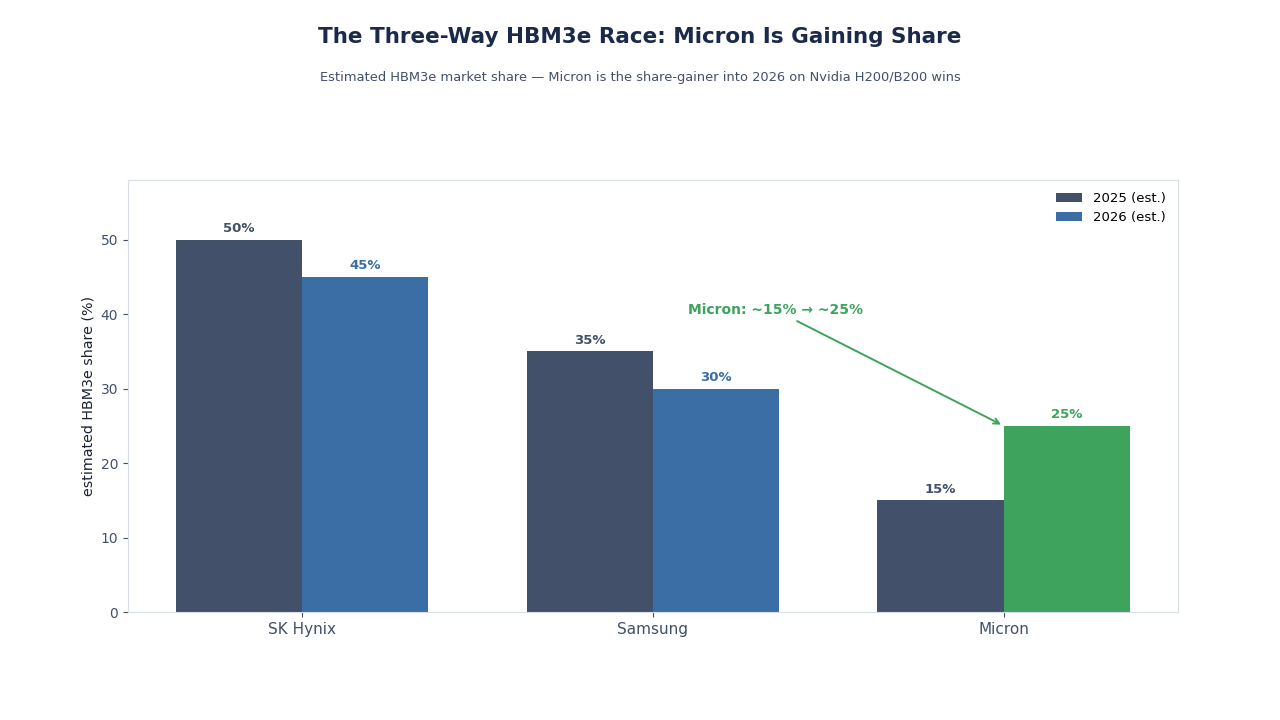
Das Ergebnis beim Übergang in 2026 ist ein Markt, der grob so aussieht:
| Lieferant | HBM3e-Anteil (gesch. 2025) | HBM3e-Anteil (gesch. 2026) | Kundenkonzentration |
|---|---|---|---|
| SK Hynix | ~50% | ~45% | Nvidia, AMD, Custom |
| Samsung | ~35% | ~30% | Gemischt, weniger Nvidia |
| Micron | ~15% | ~25% | Nvidia (H200/B200) |
Eine Bewegung von 15 % zu 25 % Anteil in einem Markt, der selbst 60 % pro Jahr wächst, produziert explosiven inkrementellen Umsatz. Genau deshalb werden die Wall-Street-Konsensschätzungen für Microns HBM-Umsatz immer wieder nach oben revidiert, und MU-Aktien haben sowohl Hynix (KOSPI-notiert) als auch Samsung (KOSPI-notiert) seit Mitte 2025 in Dollar-Terms strukturell outperformt.
Für eine Echtzeit-Lesung, wie die AI-Rally diese Lieferantenverschiebungen verdaut, siehe unseren AI-Rally-Stresstest gegen Nvidia-Ergebnisse und 5%-Treasury-Renditen.
Microns FY2026-Zahlen im Detail: HBM-Umsatz, Margen, Guide
Die Gewinn- und Verlustrechnung erzählt eine klarere Geschichte als der Kurschart. Aus dem FY2024-Tief kommend lief Microns Quartalsumsatz bei etwa 4–5 Mrd. $ mit negativen-bis-flachen Bruttomargen. Beim letzten FY2026-Quartal läuft das Unternehmen jetzt mit einer Quartalsumsatzrate von 10 Mrd. $+ mit Bruttomargen im hohen 30er- bis niedrigen 40er-Prozentbereich — Territorium, das es zuletzt während des 2017–2018-Superzyklus-Peaks besuchte.
Drei Positionen sind für die Verfolgung der AI-Speicher-These Quartal für Quartal am wichtigsten:
- HBM-Mix: HBM als Prozentsatz des gesamten DRAM-Umsatzes. 2024 mit <5 % gestartet, Ende 2025 bei etwa 20 %, auf Kurs für 30 %+ in FY2026.
- Rechenzentrums-Umsatz: jetzt konstant das größte Segment, nachdem es Mobile und PC erstmals in der Unternehmensgeschichte überholt hat.
- Lager-Tage: vom 2023er-Peak über 160 Tagen auf Richtung 100 gerollt, was signalisiert, dass die Nachfrage das Angebot ohne Kanal-Stuffing absorbiert.
Free Cashflow drehte Ende 2024 entscheidend ins Positive und finanziert jetzt sowohl Capex als auch ein leise wieder aufgenommenes Aktienrückkauf-Programm. Der Capital-Allocation-Rahmen des Unternehmens priorisiert explizit HBM-Kapazitätsausbau gegenüber generischer DDR5-Kapazität — eine Disziplin, die die Verluste des letzten Zyklus (insbesondere die chinesischen DRAM-Startups) genau zum falschen Moment aufgaben.
Der CHIPS-Act-Rückenwind: 6,1 Mrd. $ und die Idaho/New-York-Fabs
Im April 2024 kündigte das US-Handelsministerium eine direkte CHIPS-Act-Förderung in Höhe von 6,1 Mrd. $ für Micron an — eine der größten Einzelvergaben im Rahmen des Programms — zur Finanzierung von zwei neuen DRAM-Fabs in Boise, Idaho, und Clay, New York. Der Gesamtprojektwert einschließlich privater Capex liegt bis 2030 bei über 50 Mrd. $, und der New-York-Standort wird voraussichtlich die größte Halbleiterfabrik in der US-Geschichte sein.
Das ist für MU-Aktien aus drei sich verstärkenden Gründen wichtig:
- Subventionierter Capex: Die CHIPS-Förderung gleicht Cash-Capex direkt aus und verbessert Microns Free-Cashflow-Rendite gegenüber dem, was dieselbe Kapazität ohne Subvention gekostet hätte.
- Geografische Diversifikation: Microns bestehende Leading-Edge-DRAM-Kapazität ist stark in Taiwan konzentriert. Der Aufbau von Idaho/NY-Skalierungskapazität verringert das Lieferketten-Risiko für US-Hyperscaler-Kunden bedeutsam — ein Feature, das Hynix und Samsung strukturell nicht bieten können.
- Kundenpräferenz-Aufschlag: Da die US-Exportkontrollen für fortschrittliche Halbleiter nach China weiter angezogen werden, wird ein US-amerikanischer, in den USA gefertigter HBM-Lieferant zum natürlichen Default für föderale, verteidigungs- und sicherheitsbewusste Unternehmenskunden.
Die Boise-Fab zielt auf den ersten Wafer-Out Ende 2026 ab; die New-York-Fab wird bis 2028 hochgefahren. Der CHIPS-Rückenwind ist also nicht nur Bilanzunterstützung — es ist zukünftige Kapazität, die es Micron erlaubt, mehrjährige HBM-Lieferverträge mit Nvidia und den Hyperscalern glaubwürdig zu unterzeichnen, was genau die Art von Verpflichtung ist, die Premium-Preise erzielt.
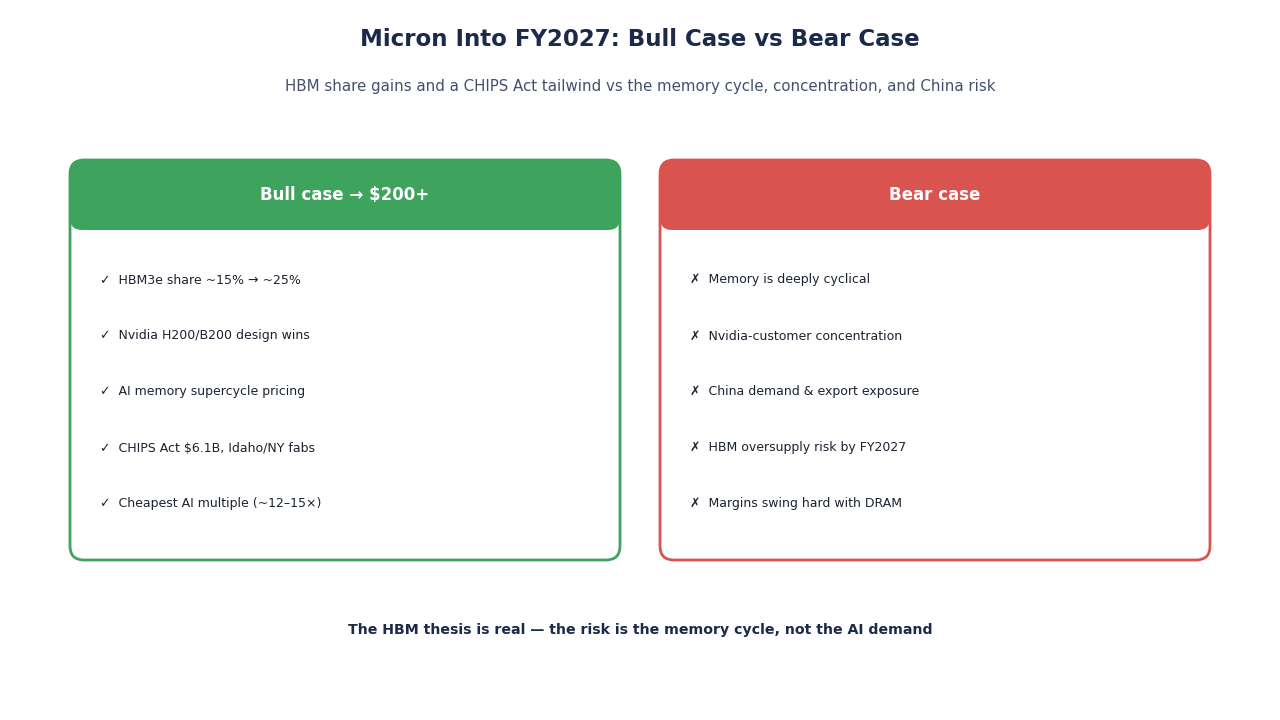
Der Bull Case: Kursziel 200 $+ bis FY2027
Der Bull Case für MU-Aktien ist eine Funktion von vier Hebeln, die sich alle in dieselbe Richtung bewegen:
- HBM-Umsatzwachstum: ein niedrig-zweistelliges Milliarden-HBM-Geschäft in FY2026 steigt Richtung 20 Mrd. $+ in FY2027, wenn Blackwell-Klasse-Plattformen hochfahren.
- Bruttomarge-Expansion: Unternehmensbruttomarge schiebt sich durch 45 % und Richtung 50 %, während der HBM-Mix steigt und 1-Gamma-Node-Ausbeuten sich verbessern.
- Operative Hebelwirkung: Opex flach bis leicht steigend gegen Umsatz, der 30-40 % wächst, was inkrementelle Dollar direkt in operativen Gewinn fallen lässt.
- Multiple-Reratierung: Da Micron zunehmend als AI-Infrastruktur-Aktie statt als reine zyklische Speicheraktie wahrgenommen wird, ist der Markt bereit, ein höheres KGV auf Peak-Zyklus-Gewinne zu zahlen.
Setzen Sie Zahlen drauf: Wenn Micron ~12 $ EPS in FY2027 druckt (Konsens bewegt sich in diese Richtung) und der Markt ein 17–20×-Multiple zuerkennt (immer noch unter Mega-Cap-AI-Peers wie Nvidia, AMD und Dell), landet man bei einem Kursziel von 200–240 $. Deshalb haben mehrere Sell-Side-Häuser 12-Monats-Ziele in diesem Bereich veröffentlicht.
Zum Kontext: Das ist die gleiche Art von mehrjährigem Compounding-Setup, das wir in unserer Analyse von Dells 17-%-AI-Server-Ausbruch abgebildet haben — Micron ist der Speicher-Begleiter desselben AI-Infrastruktur-Trades.
Der Bear Case: Zyklus-Risiken, Konzentration, China-Exposition
Drei Dinge können den Bull Case brechen, und ernsthafte Investoren sollten Positionen mit ihnen im Hinterkopf dimensionieren.
Zyklus-Risiko. Speicher ist immer noch Speicher. Wenn die AI-Capex der Hyperscaler 2027 pausieren — sei es durch einen Makro-Schock, ein LLM-Qualitätsplateau oder eine Welle von Nvidia-Substitut-Custom-Silicon, die billiger eintrifft — kann DRAM-Überangebot innerhalb von 6-9 Monaten zurückkehren. Auf den letzten Zyklus-Peak (2018) folgte ein 70%iger Drawdown im MU-Aktienkurs.
Kundenkonzentration. Ein wachsender Anteil von Microns HBM-Umsatz fließt durch einen Kunden — Nvidia. Wenn Nvidias Preissetzungsmacht komprimiert wird oder Nvidias eigene Bruttomarge durch einen Hyperscaler-Push in Richtung Custom Silicon unter Druck gerät, fließt dieser Druck stromabwärts zur Speicherpreisbildung. Das Unternehmen diversifiziert mit AMD, Google TPU und anderen Custom-Silicon-Wins, aber Nvidia bleibt die dominante Exposition.
China-Exposition. Etwa 10-15 % von Microns Umsatz kamen historisch aus China. 2023 verbot Chinas Cyber-Sicherheits-Regulator Micron aus „kritischen Infrastruktur"-Deployments, und das Unternehmen managt sich seitdem hindurch. Eine breitere US-China-Entkopplung oder eine Taiwan-Krise würde die Lieferkette signifikant umgestalten — zum Besseren oder Schlechteren je nach Szenario. Beide Tails sind es wert, modelliert zu werden.
Für einen analytischen Rahmen zum geopolitischen Aktienrisiko führt unser Aktien-Risiko-Dashboard aus Breadth, Revisions und Spreads durch die AI-Signale, die früh auftauchen.
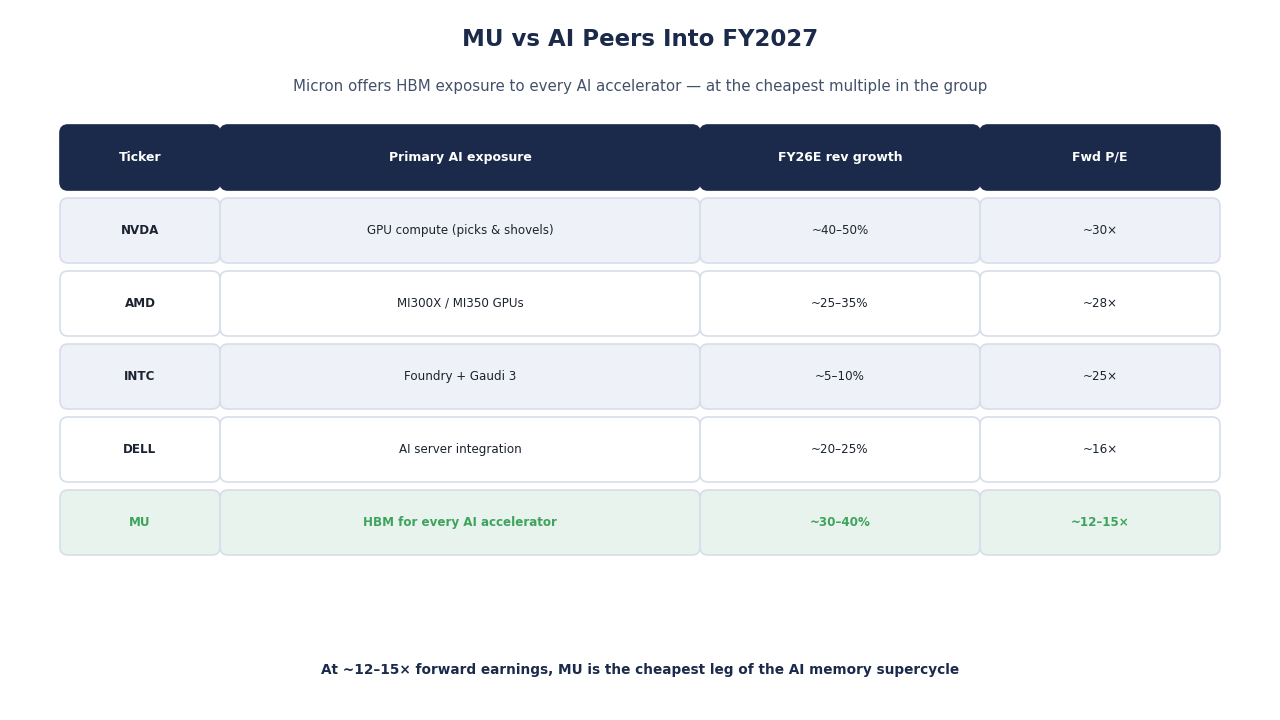
Vergleichstabelle: MU vs. Peers beim Übergang in FY2027
| Ticker | Primäre AI-Exposition | FY26E-Umsatzwachstum | Forward-KGV (gesch.) | Memo |
|---|---|---|---|---|
| NVDA | GPU-Compute (verkauft Schaufeln und Spitzhacken) | ~40–50% | ~30× | Höchste absolute Exposition; reichstes Multiple |
| AMD | MI300X / MI350 GPUs | ~25–35% | ~28× | Entfernte Nummer 2 bei GPU; schließt Lücke |
| INTC | Foundry + Gaudi-3-Beschleuniger | ~5–10% | ~25× | Turnaround-Wette, ausführungsschwer |
| DELL | AI-Server-Systemintegrator | ~20–25% | ~16× | Pass-Through-Marge; Volumen-Spiel |
| MU | HBM-Speicher für jeden AI-Beschleuniger | ~30–40% | ~12–15× | Billigstes Bein des AI-Stacks |
Die Aussage dieser Zeile ist direkt: Auf Forward-Ergebnis-Basis handelt Micron mit dem größten Abschlag unter den bedeutenden AI-Infrastruktur-Pure-Plays, während es echte Kundenüberlappung mit jedem anderen Namen auf der Liste trägt. Deshalb taucht MU in Long-Only-AI-Basket-Strategien immer wieder als die billige Reweight auf.
Wie man SimianX AI verwendet, um den HBM-Zyklus zu verfolgen
Jedes Quartal Earnings-Transkripte zu lesen ist in Ordnung; das über Micron, Hynix (KOSPI), Samsung (KOSPI), Nvidia, AMD, Dell und ein Dutzend Hyperscaler in jedem Zyklus zu tun, ist für die meisten Investoren nicht realistisch. Hier verdient sich SimianX AI seinen Lohn.
Der Multi-Agent-Aktien-Research-Workflow der Plattform kann auf einen einzelnen Ticker — MU — gerichtet und gebeten werden, die Inputs zusammenzuziehen, die den Bull/Bear-Case tatsächlich bewegen: HBM-Mix-Progression Quartal-zu-Quartal, Bruttomarge-Trajektorie, Capex-Kadenz, Kundenkonzentrations-Kommentare aus dem Call und Forward-Guide-Varianz gegenüber Konsens. Sie können die Live-AI-Modell-Rankings auf dem SimianX-AI-Leaderboard lesen und eine Fundamental-Session auf MUs Aktienseite direkt ausführen.
Wenn Sie die Überwachung lieber dem Autopilot überlassen, anstatt vor dem Bildschirm zu sitzen, können die SimianX-Autopilots Micron kontinuierlich gegen die sieben Risiko-Radare aus unserem aktuellen Equity-Risk-Radar-Artikel scoren und nur dann Alerts an die Oberfläche bringen, wenn sich das Bild ändert.
FAQ
Ist Micron eine „AI-Aktie"?
Nicht im reinen Sinn, in dem Nvidia es ist — Micron ist eine zyklische Speicheraktie, die von AI-Nachfrage neu bewertet wurde. Aber weil jeder Nvidia-, AMD- und Custom-AI-Beschleuniger, der 2025-2026 versendet wird, HBM3e von einem von nur drei Lieferanten benötigt, ist Microns Ertragskraft jetzt direkt mit dem AI-Ausbau gehebelt. Behandeln Sie es als das billigste Bein des AI-Infrastruktur-Trades.
Wie unterscheidet sich HBM3e von HBM3?
HBM3e ist der bandbreitenerweiterte Nachfolger von HBM3. Gleiche 3D-gestapelte Architektur, höhere Datenrate pro Pin, leicht verbesserte Stromeffizienz. Die H200 war der erste große Nvidia-Beschleuniger, der mit HBM3e ausgeliefert wurde; Blackwell-Plattformen verwenden größere HBM3e-Stacks. HBM4 ist die nächste Generation und wird voraussichtlich 2026-2027 in Volumen ausgeliefert.
Was ist das größte Risiko für den MU-Bull-Case?
Eine von Hyperscalern getriebene AI-Capex-Pause. Speicherpreise werden am Rand gesetzt, also kann selbst ein 10%iger Cut im HBM-Auftragsfluss die Preise auf der Spot-Seite um 20-30 % komprimieren. Die Leasing-/Vertragspreise, die Micron mit Nvidia gelockt hat, bieten teilweise Isolierung, aber die Aktie handelt immer noch über den Zyklus.
Warum ist Micron billiger als seine AI-Infrastruktur-Peers?
Weil der Markt den alten Speicherzyklus immer noch teilweise einpreist — Investoren sind am 2018er-Peak-to-Trough-Drawdown verankert. Wenn der HBM-Umsatzmix über 30 % des DRAM-Umsatzes steigt und die Bruttomargen strukturell erhöht bleiben, sollte sich dieser Abschlag komprimieren.
Spielt das CHIPS-Act-Geld tatsächlich eine Rolle für die Aktie?
Ja, aber nicht aus dem Grund, den die meisten Retail-Investoren denken. Es sind nicht die 6,1 Mrd. $ selbst — Microns jährliches Capex ist ein Vielfaches davon. Es ist die strategische Positionierung, die der Förderung signalisiert: US-Regierungs-unterstützt, in den USA gefertigt, verteidigungsnahe HBM-Versorgung. Diese Prämie ist es, was in der langfristigen Vertragspreisbildung auftaucht.
Wo kann ich MUs Kurs und Fundamentaldaten in Echtzeit verfolgen?
Auf der SimianX-Micron-Aktienseite, die Ihnen Live-Kurs, Multi-Agent-AI-Analyse und dieselben Fundamental-Signale gibt, die unsere Analysten verwenden. Sie können direkt mit NVDA, AMD und DELL auf äquivalenten Zeitfenstern vergleichen.
Die Micron-Story beim Übergang in FY2027 geht nicht mehr um den nächsten DRAM-Zyklus. Sie geht darum, ob HBM3e und HBM4 Speicher in eine strukturell höher-margige, vertragspreisige AI-Komponenten-Kategorie verwandeln — und ob MU-Aktien der billigste Einstiegspunkt in diese Neubewertung sind. Die Zahlen sagen, dass es so ist. Das Risiko ist, dass Speicher immer einen Weg findet, Sie daran zu erinnern, dass es immer noch Speicher ist.
Für laufende Berichterstattung, während sich der Zyklus entwickelt, betreibt SimianX kontinuierliches Multi-Agent-Research für jeden Namen oben. Beginnen Sie mit unserem AI-Rally-Stresstest für den Makro-Overlay und tauchen Sie dann in MU, NVDA und DELL ein — die Namen, die für diesen Trade am wichtigsten sind.
Verwandte Artikel
- AI Stock Boom: Nvidia Führt den Chip-Supercycle Live Now
- AI Stocks Pullback: OpenAI-Sorgen + Big-Tech-Earnings Live
- NextEra-Dominion 2026: 110 GW AI-Power-Engpass-Deal
- KI-Chip-Aktien Stark: AMD, Intel Treiben Rechenzentren