
Akamai and Anthropic: What the $11.6 Billion Contract Costs, Pays and Risks
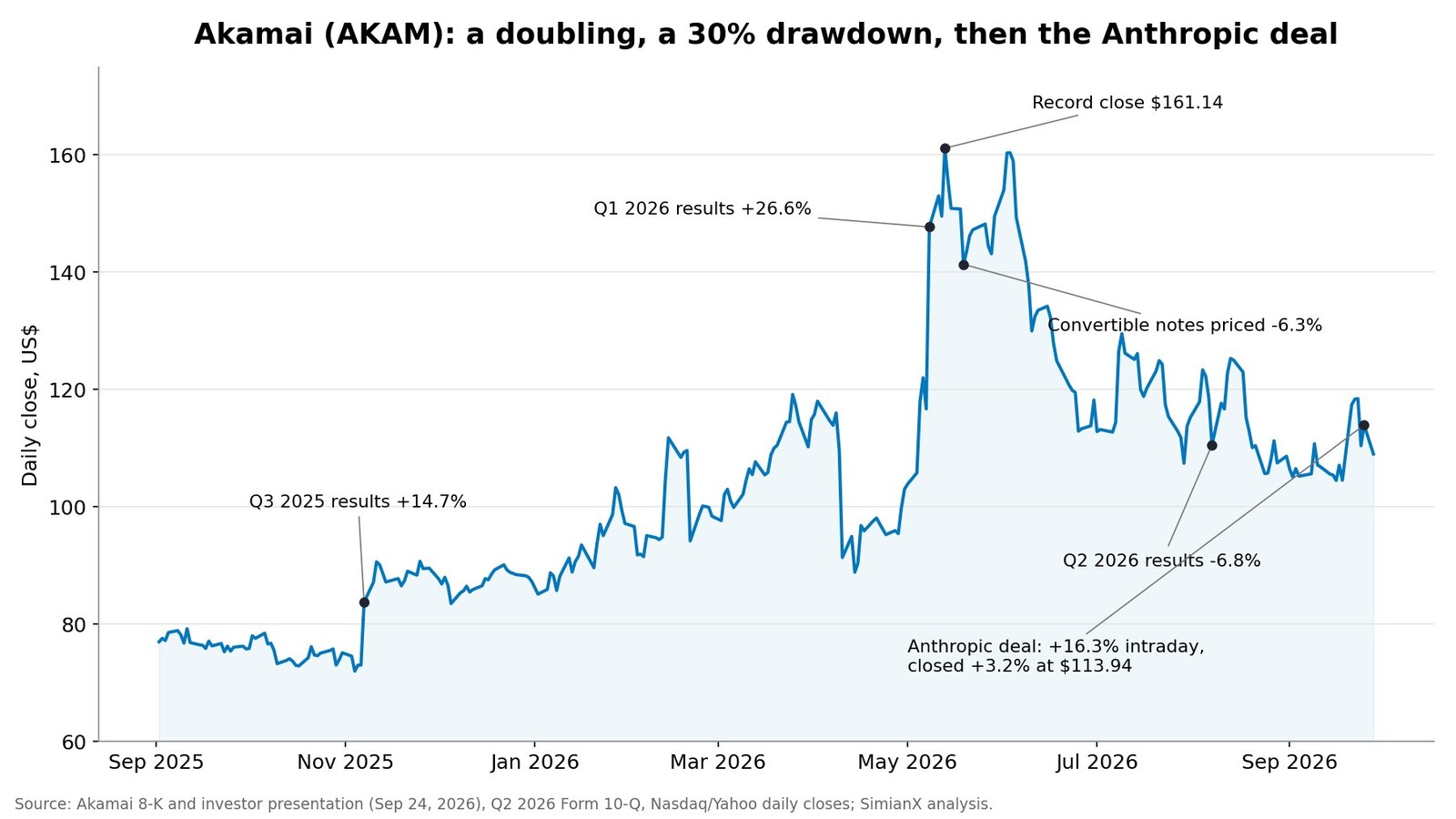
After the close on September 24, 2026, Akamai announced that Anthropic has committed about $11.6 billion over seven years for dedicated cloud capacity, and could expand the deal by up to $9 billion more. AKAM opened the next morning at $125.23, traded as high as $128.46 (+16.3%), and closed at $113.94, up only 3.2%. On September 28 it fell another 4.3% to $108.99. That is below the $110.41 close before the announcement and below the $111.33 strike price of the warrant Akamai gave Anthropic.
The filings explain why the market gave back the whole pop:
- The money goes out long before it comes in. Akamai expects to spend about $5.5 billion building the capacity, $4.8 billion of it by the end of 2027, while the contract produces no revenue in 2026 and only $150–300 million in 2027. The full ~$1.7 billion annual run rate arrives at the end of 2028.
- The deal is larger than Akamai's entire backlog. At June 30, 2026, Akamai's total remaining performance obligations were $7.6 billion. This one customer adds about 1.5 times that.
- The funding is tight. Akamai had about $4.59 billion of cash and marketable securities at June 30. Through 2027 it needs about $4.8 billion for this build plus $1.15 billion to repay convertible notes due on September 1, 2027, before counting its regular capex.
This analysis rebuilds the deal from Akamai's Form 8-K, its investor presentation and its second-quarter Form 10-Q. It adds a capex-versus-revenue timeline, a funding table, the warrant arithmetic, an illustrative return table and a record of how AKAM has traded around big news this year.
Prices are official Nasdaq closes through September 28, 2026. Company figures come from Akamai's SEC filings; return scenarios are illustrative, not forecasts.
Akamai–Anthropic Deal: Key Numbers
| Metric | Figure |
|---|---|
| Contract commitment | ~$11.6B over seven years |
| Possible expansion | Up to ~$9B more (total ~$20B) |
| Project capex | ~$5.5B ($1.7B Q4 2026, $3.1B 2027, $0.7B 2028) |
| Contract revenue | $0 in 2026; $150–300M in 2027; ~$1.7B/year from end-2028 |
| Warrant | Up to 7.74M common-share equivalents (~5%), strike $111.33 |
| AKAM close, Sep 24 (before announcement) | $110.41 |
| AKAM Sep 25: open / high / close | $125.23 / $128.46 / $113.94 (+3.2%) |
| AKAM close, Sep 28 | $108.99 |
| Record close | $161.14 (May 13, 2026) |
| Market value at $113.94 | ~$16.4B (143.6M shares) |
| Cash and marketable securities (Jun 30) | ~$4.59B |
| Convertible notes outstanding | $7.64B |
What Akamai and Anthropic Actually Signed
According to the 8-K, the two companies signed Project Plan 2 and Project Plan 3 on September 18, 2026, under a master services agreement dated May 5, 2026. Akamai provides dedicated cloud computing capacity and managed support, and the press release says the capacity will support Anthropic's "CPU workload demands." Each project plan has an initial seven-year term that starts on its own service start date.
The $11.6 billion is a real contractual commitment, but it has conditions. Anthropic's obligation is "subject to any termination described below and satisfaction of certain delivery and service availability requirements." The termination rights are:
| Who can terminate | When |
|---|---|
| Akamai | An uncured breach by Anthropic (terminating only the breached project plan) |
| Anthropic | A material uncured breach by Akamai |
| Anthropic | A change of control of Akamai in favor of a direct competitor of Anthropic |
| Either party | Bankruptcy, insolvency or a similar proceeding of the other party |
| Anthropic | A material outage, per project plan, "subject to certain conditions" |
The full agreement will be filed with Akamai's Form 10-Q for the quarter ending September 30, 2026, likely with commercial terms redacted. Until then, the right description is a seven-year commitment that depends on Akamai delivering the capacity on time and keeping it running, not $11.6 billion of cash already owed.
The same 8-K discloses two supply contracts signed alongside it:
- Jabil: On September 24, Akamai authorized its contract manufacturer Jabil to buy about $1.7 billion of memory components. Akamai pays Jabil's supplier invoices on receipt, Jabil holds the parts on consignment and buys them back at cost as they are used, and the build request includes provisions on carrying and disposal costs for unused inventory.
- Lenovo: On September 23, Akamai signed a master agreement with Lenovo for hardware, software and services, with a seven-year statement of work. Akamai can terminate for convenience by paying specified costs.
The memory purchase is the reason Q4 2026 capex jumps by $1.7 billion. Akamai is locking in supply ahead of demand, which protects the build schedule but leaves it holding the price and obsolescence risk. For how quickly memory prices have moved this year, see our coverage of the Micron–Anthropic memory deal.
The Timeline: $4.8 Billion Spent Before the First Full Year of Revenue
Akamai's investor presentation lays out the schedule:
| Period | Project capex | Contract revenue | Company note |
|---|---|---|---|
| Q4 2026 | ~$1.7B | None | Secures critical components, including memory |
| FY2027 | ~$3.1B | ~$150–300M | Service starts late Q2 2027; revenue ramps in the second half |
| FY2028 | ~$0.7B | Ramps through the year | Full contracted run rate by end of 2028 |
| Thereafter | None | ~$1.7B per year | Recognized ratably for the rest of the term |
| Total | ~$5.5B | ~$11.6B | "Strong cash conversion and operating margins" |
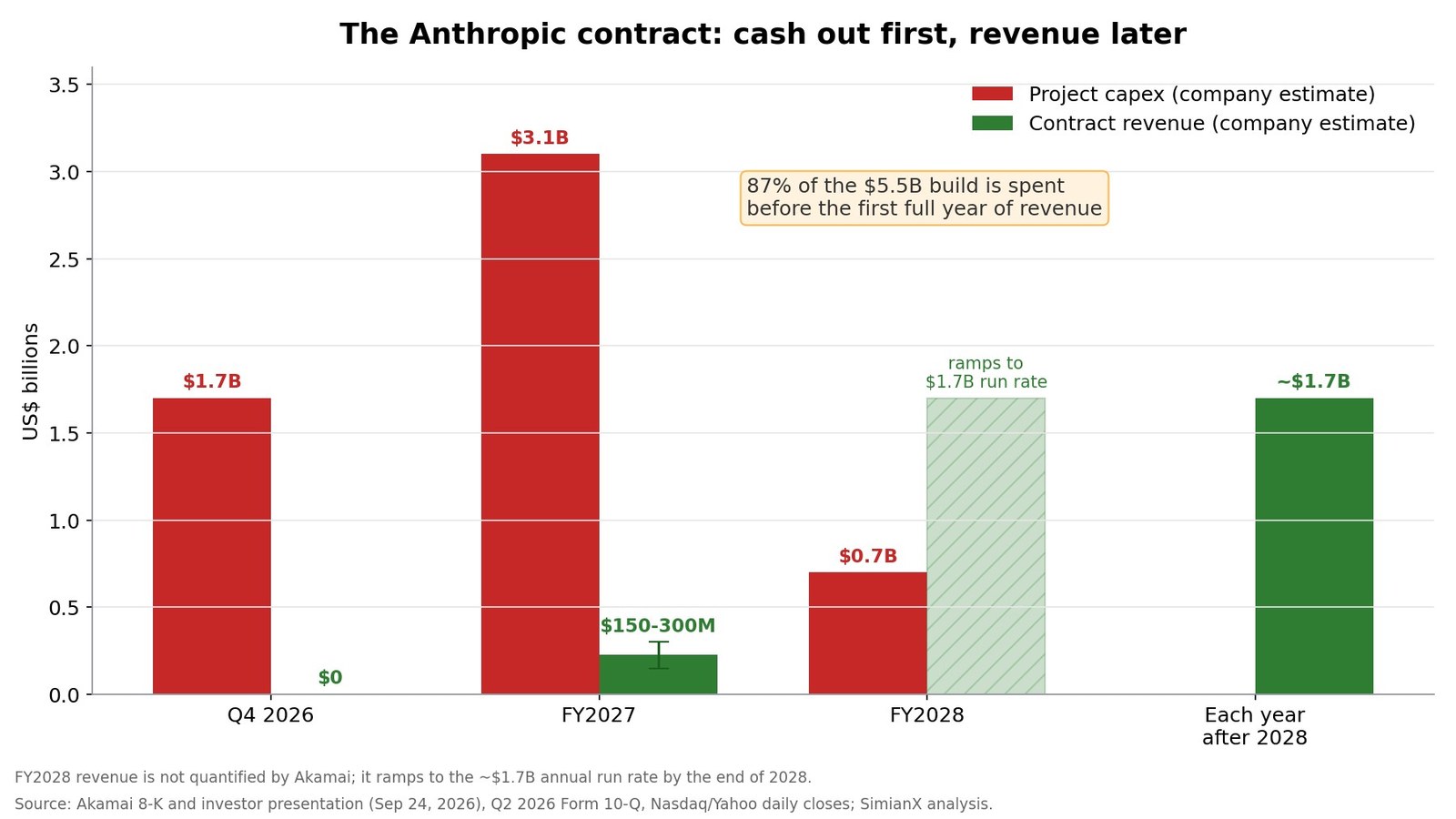
By the end of 2027 Akamai expects to have spent about 87% of the build, $4.8 billion of $5.5 billion, while booking at most $300 million of revenue from it. Depreciation starts when equipment goes into service, which the company says will be "substantially in line with revenue." Reported profits will therefore look better than cash flow during the build. The cash leaves in 2026 and 2027, but the income statement feels it only once the servers are running.
Two further details matter for the accounting:
- The warrant reduces reported revenue. The fair value of the 3.1 million warrant shares expected to vest is treated as consideration paid to the customer. It reduces total revenue and is already reflected in the $11.6 billion figure.
- Power is the physical constraint. Akamai says the previous large cloud contracts plus Anthropic need about 95–105 megawatts of capacity and generate roughly $22 million of revenue per megawatt per year.
How Big the Deal Is for Akamai
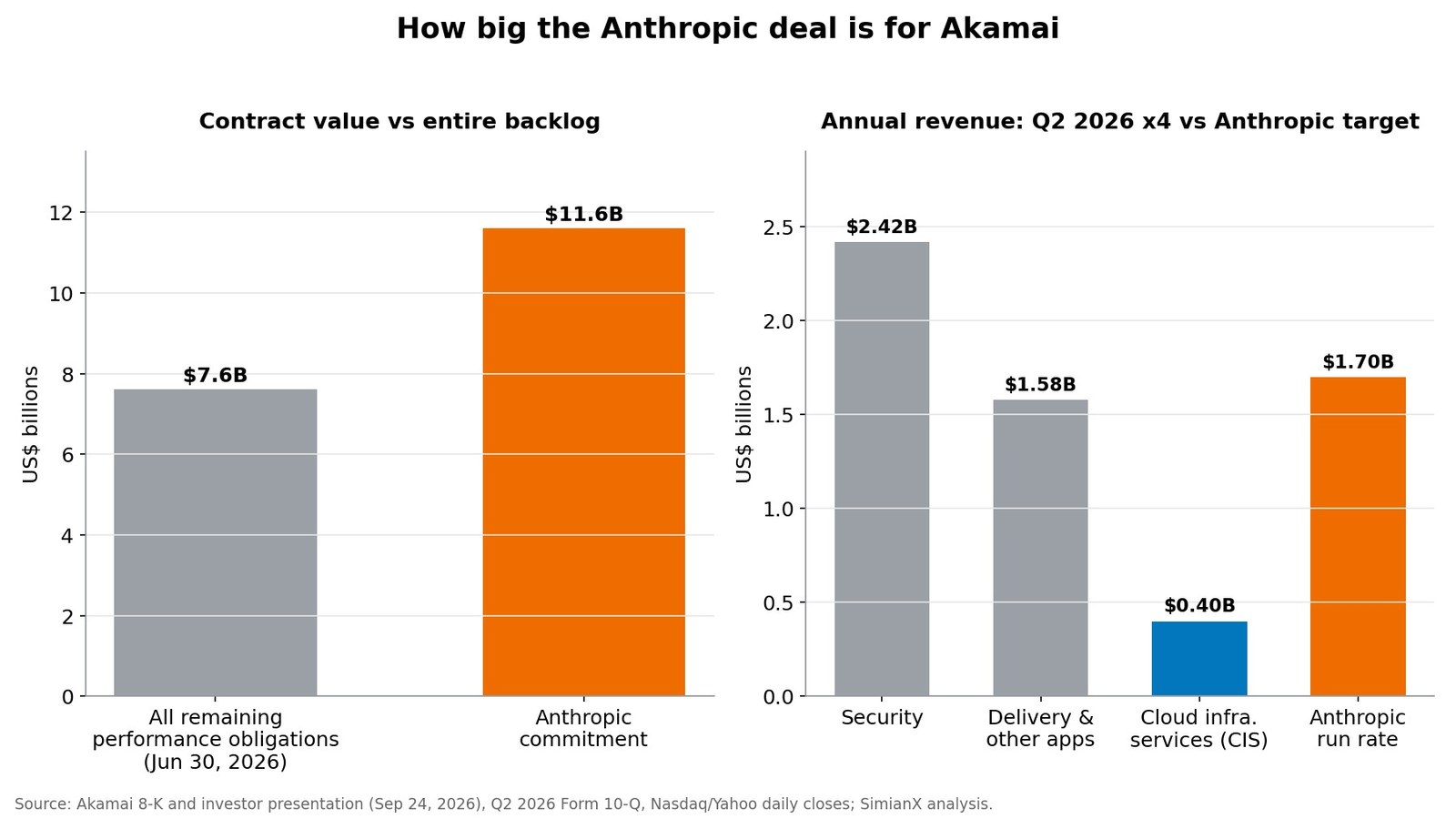
Akamai reported second-quarter 2026 revenue of $1.10 billion, up 5%:
| Category | Q2 2026 revenue | Growth | Annualized |
|---|---|---|---|
| Security | $604.4M | +10% | ~$2.42B |
| Delivery and other cloud applications | $395.9M | −6% | ~$1.58B |
| Cloud Infrastructure Services (CIS) | $99.3M | +39% | ~$0.40B |
| Total | $1,099.7M | +5% | ~$4.40B |
| Anthropic at full run rate | — | — | ~$1.70B |
Measured against those figures:
- At its $1.7 billion run rate, Anthropic alone would be about four times Akamai's current cloud infrastructure business and about 38% of today's total revenue.
- The $11.6 billion commitment is 1.5 times the $7.6 billion of remaining performance obligations Akamai reported across all customers at June 30.
- Including $2.8 billion of other multiyear cloud commitments announced earlier in 2026, Akamai now cites about $14.4 billion of cloud infrastructure contract value.
Akamai's full-year 2026 guidance, given in August and unchanged by the deal, is revenue of $4.445–4.530 billion and non-GAAP EPS of $6.40–7.05. The Anthropic contract adds nothing to 2026 revenue, but it does add $1.7 billion of 2026 capex. Akamai's capex was already running at 32% of revenue in the second quarter.
Can Akamai Pay for It?
| Liquidity at June 30, 2026 | Amount |
|---|---|
| Cash and cash equivalents | $1.48B |
| Marketable securities (current and long-term) | ~$3.11B |
| Total | ~$4.59B |
| H1 2026 operating cash flow | $639M |
| H1 2026 capex and capitalized software | $418M |
| H1 2026 free cash flow (simple) | ~$221M |
| Convertible notes | Principal | Coupon | Maturity |
|---|---|---|---|
| 2027 Notes | $1,150M | 0.375% | Sep 1, 2027 |
| 2029 Notes | $1,265M | 1.125% | Feb 15, 2029 |
| 2030 Notes (issued May 2026) | $1,750M | 0% | May 15, 2030 |
| 2032 Notes (issued May 2026) | $1,750M | 0% | May 15, 2032 |
| 2033 Notes | $1,725M | 0.25% | May 15, 2033 |
| Total | $7,640M |
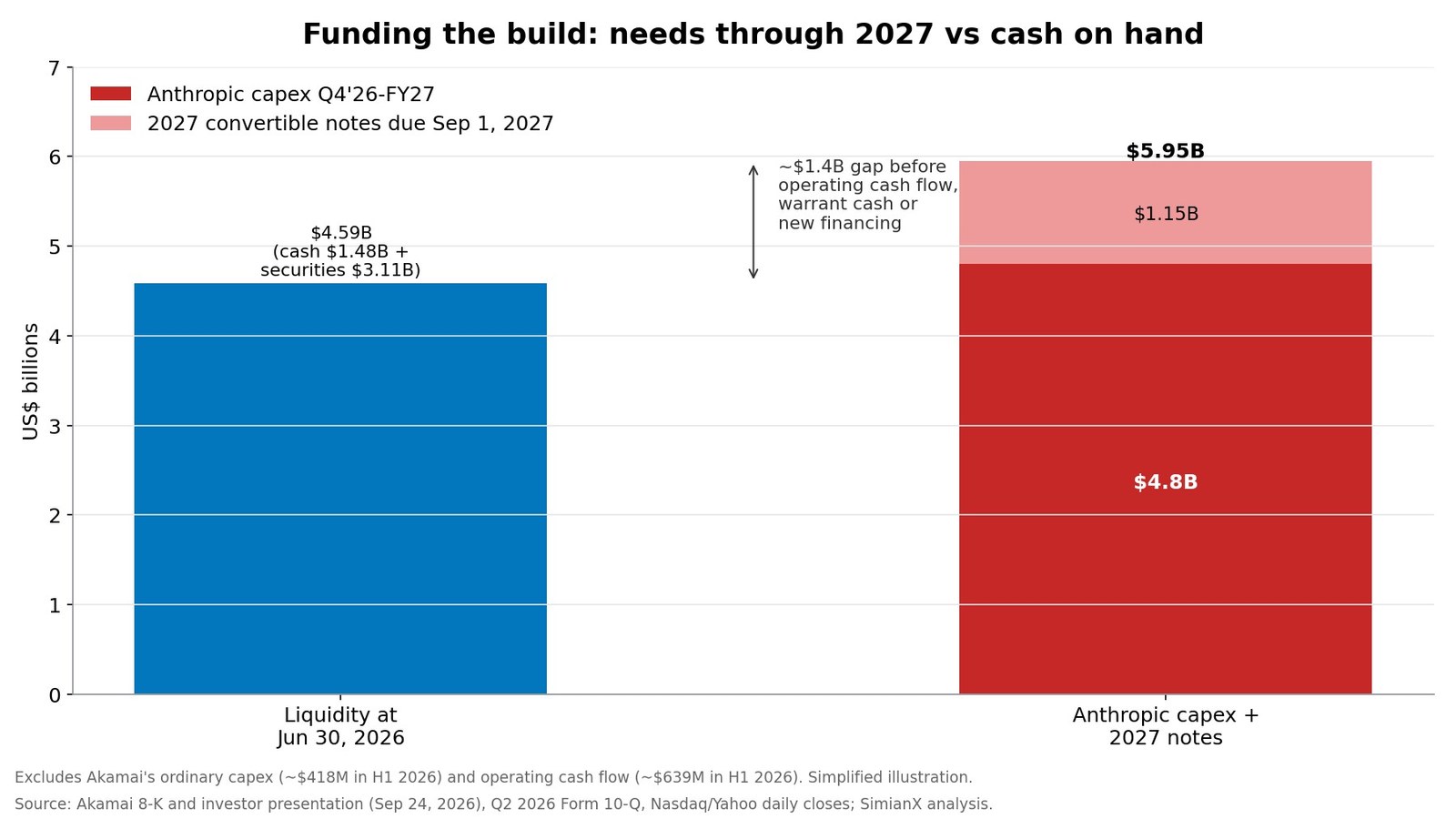
Two uses fall in the same window: $4.8 billion of Anthropic capex from Q4 2026 through 2027, and $1.15 billion of 2027 notes due on September 1, 2027, which lands in the middle of the heaviest build year. Together they come to about $5.95 billion, roughly $1.4 billion more than Akamai's liquidity at June 30, before counting its ordinary capex or its operating cash flow.
Akamai can close that gap in several ways:
- Operating cash flow. It generated $639 million in the first half of 2026.
- Warrant cash. Exercising the first warrant tranche would bring in about $345 million.
- Refinancing. It could refinance the 2027 notes, as it did the 2025 notes.
- Vendor or equipment financing. The Jabil and Lenovo agreements could support this.
What it cannot easily do is keep buying back stock. It repurchased 3.0 million shares for $410 million at an average $134.54 in the second quarter alone, about 23% above the September 28 price. More convertible debt is the most likely lever, and the market's reaction to the last issue is instructive: AKAM fell 6.3% on May 19, the day the $3 billion offering was priced (it was later upsized to $3.5 billion).
The Anthropic Warrant: Dilution, Cash and Revenue
Akamai issued Anthropic a warrant for 387,051 shares of Series B non-voting convertible preferred stock, each convertible into 20 common shares. That is up to 7,741,020 common-share equivalents. The exercise price of $2,226.60 per preferred share equals $111.33 per common share, the 30-day volume-weighted average price before September 18.
| Tranche | Share of warrant | Common equivalents | Vests when | Exercise cash to Akamai |
|---|---|---|---|---|
| 1 | 40% | ~3.1M (~2% of shares) | Anthropic's first payment under Project Plan 3 | ~$345M |
| 2 | 20% | ~1.55M | Each additional $3.0B of committed contract value | ~$172M |
| 3 | 20% | ~1.55M | Another $3.0B | ~$172M |
| 4 | 20% | ~1.55M | Another $3.0B | ~$172M |
| Total | 100% | ~7.74M (~5%) | Full ~$9B expansion | ~$862M |
Three details are easy to miss:
- Exercise must be paid in cash. Every exercise brings money into Akamai: about $345 million for the first tranche and about $862 million if all four vest.
- The preferred shares convert only on transfer. They convert automatically when Anthropic transfers them to someone outside its group, and they carry no votes.
- Dilution depends on the share price. Akamai uses the treasury-stock method. At $108.99 the warrant is slightly out of the money, but every dollar above $111.33 adds diluted shares.
What the Contract Could Earn
Akamai has not disclosed a project margin. The arithmetic below uses only the company's totals and a stated assumption about depreciation.
- Breakeven on capex: The $5.5 billion build is 47% of the $11.6 billion contract. Before taxes, financing and the time value of money, Akamai earns back its capital only if the project's cash operating costs (power, colocation, network, staff) stay below about 53% of revenue over seven years.
- Depreciation weight: If the $5.5 billion is depreciated evenly over the seven-year term, that is about $0.79 billion a year, or 46% of the $1.7 billion run rate.
| Illustrative cash (EBITDA) margin | Annual EBITDA at $1.7B | Operating margin after ~46% depreciation | After-tax return on $5.5B (19% tax) | Lifetime EBITDA vs $5.5B capex |
|---|---|---|---|---|
| 50% | $850M | ~4% | ~1.0% | 1.05x |
| 60% | $1,020M | ~14% | ~3.4% | 1.27x |
| 70% | $1,190M | ~24% | ~5.9% | 1.48x |
| 80% | $1,360M | ~34% | ~8.5% | 1.69x |
Illustrative arithmetic only. It assumes straight-line depreciation over seven years and Akamai's 19% non-GAAP tax rate, and it ignores the ramp, residual hardware value, financing costs and any further expansion.
The table shows why management's phrase "strong cash conversion and operating margins" needs a number. The project only earns an attractive return if its cash margins are high, roughly 70% or more. That is plausible for dedicated capacity sold at about $22 million per megawatt, but it is not yet shown. At a 50–60% cash margin the contract mainly recycles capital.
Why Anthropic Is Buying CPU Capacity From Akamai
The deal is for CPU workloads, not the GPUs and custom accelerators that dominate AI spending. Serving an AI product needs a lot of general-purpose compute around the model. It handles API requests, runs code for agents, calls tools, retrieves data, authenticates users, logs and monitors traffic, and moves data between services. Agentic AI, where one request can trigger many tool calls and code runs, increases that demand.
Akamai brings three things a GPU cloud does not:
- A distributed footprint. Its network spans thousands of points of presence. In March 2026 it launched AI Grid orchestration across 4,400 edge locations, built on NVIDIA AI Grid, to route AI workloads between edge, regional and core sites.
- A developer cloud. Akamai bought Linode in 2022 for about $900 million and built its cloud infrastructure business on it.
- Security. Security is Akamai's largest segment, at $604 million in Q2 2026. That supports application, API and bot protection around the compute it sells.
Anthropic is spreading compute across many suppliers. In April 2026 it committed more than $100 billion over ten years to AWS, covering up to 5 gigawatts. It has also expanded its use of Google Cloud TPUs, signed a $19 billion data-center lease with TeraWulf (see our TeraWulf analysis) and struck a memory supply deal with Micron. Akamai is one supplier among several, not Anthropic's main cloud.
The customer's finances matter because the contract runs to 2034. In May 2026 Anthropic raised $65 billion at a $965 billion valuation and said its run-rate revenue had passed $47 billion. That is a strong counterparty today. It also carries very large commitments to other providers, which is why the AI industry's pace of spending matters to Akamai. We covered that debate in AI CEOs hit the brakes.
How AKAM Traded Around the Deal, and Around Earlier News
| Date | Event | Day move | Intraday high vs prior close |
|---|---|---|---|
| Nov 7, 2025 | Q3 2025 results | +14.7% | +18.1% |
| Feb 12, 2026 | Q4 2025 results | +10.3% | +12.7% |
| May 8, 2026 | Q1 2026 results | +26.6% | +28.3% |
| May 19, 2026 | $3B convertible notes priced (upsized) | −6.3% | −2.0% |
| Aug 7, 2026 | Q2 2026 results | −6.8% | +5.9% |
| Sep 21, 2026 | Rally on AI security headlines | +12.3% | +12.5% |
| Sep 24, 2026 | Day of the after-close announcement | −6.8% | −0.4% |
| Sep 25, 2026 | Anthropic deal reaction | +3.2% | +16.3% |
| Sep 28, 2026 | Follow-through | −4.3% | — |
Volume on September 25 was 31.9 million shares, about nine times the 20-day average. Three things stand out:
- A textbook gap-and-fade. The stock opened up 13%, and sellers used the rest of the day to take it back. We saw the same pattern after Generac's Amazon deal.
- The stock was already on the move. AKAM rose 12.3% on September 21 and then fell 6.8% on September 24, before the announcement.
- Much of the AI story was priced in May. AKAM more than doubled from its $71.97 low in November 2025 to a $161.14 record close on May 13, 2026, after first-quarter results. At $108.99 it is 32% below that peak.
AKAM Valuation Against Edge and AI Cloud Peers
| Measure (at $113.94, Sep 25) | Value |
|---|---|
| Market value | ~$16.4B |
| Enterprise value (+ $7.64B notes − $4.59B cash and securities) | ~$19.4B |
| Price / 2026 non-GAAP EPS guidance midpoint ($6.73) | ~16.9x |
| EV / 2026 revenue guidance midpoint ($4.49B) | ~4.3x |
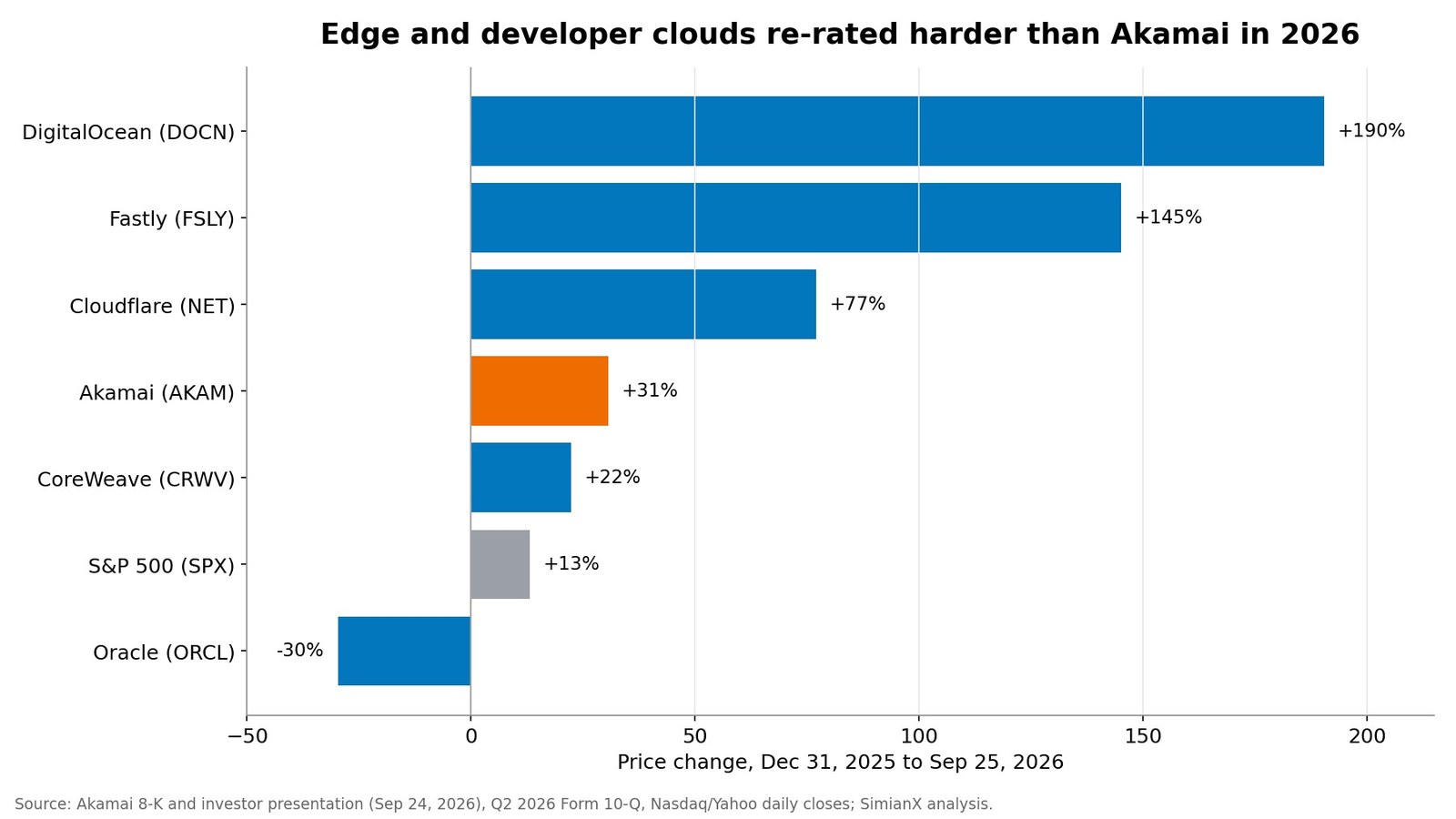
| 2026 share price change | +31% |
Akamai trades at about 17 times this year's guided non-GAAP earnings. The market has been paying far more for edge and developer clouds in 2026: Cloudflare is up 77% this year, Fastly 145% and DigitalOcean 190%. The low multiple partly reflects the shrinking delivery business, but it also shows that the market has not yet accepted Akamai as an AI infrastructure company.
The closest listed comparison for a backlog-funded build is Oracle, down 30% this year. Its contracted backlog grew much faster than the cash to build it, as covered in our Oracle OCI backlog analysis. CoreWeave, the leading AI neocloud, is up 22%. Investors now distinguish between contracts and returns.
The Bull and Bear Case for AKAM Stock
Bull case
- A frontier AI lab chose Akamai's cloud after testing it, which validates a business that was 9% of revenue.
- The contract could add about $1.7 billion a year, taking Akamai's revenue growth from mid-single digits to double digits by 2029.
- The capacity, supply chain and software can be reused for other customers, including the $2.8 billion of other cloud commitments.
- Anthropic can expand the deal by up to $9 billion, and each $3 billion step brings more warrant cash.
- At about 17 times earnings, the stock does not price in much success.
Bear case
- About $4.8 billion is spent before 2028, with $1.15 billion of notes due in the middle of the build.
- The project margin is undisclosed. Below roughly 70% cash margins, returns on $5.5 billion look thin.
- Anthropic would become Akamai's largest customer by far, with termination rights for material outages.
- Legacy delivery revenue is shrinking 6% a year.
- The pre-bought memory and servers carry obsolescence and price risk.
- Further financing, convertible notes or the warrant could dilute per-share returns.
What to Watch Next
- Q3 2026 results and 10-Q (Nasdaq estimates about November 5): the full Anthropic agreement, any redactions, Q4 capex timing and updated 2026 capex guidance.
- Financing: how Akamai funds the build and the September 2027 maturity: new notes, vendor financing or cash.
- Service start in late Q2 2027: any slip pushes revenue into 2028 while capex stays front-loaded.
- 2027 revenue: whether Akamai stays inside the $150–300 million range.
- Margin disclosure: a project gross margin or EBITDA range would settle the return question.
- Warrant vesting: the first tranche vests on Anthropic's first payment; further tranches signal expansion.
SimianX AI reads 8-K exhibits, 10-Q notes and price data in one multi-agent research workflow, so contract headlines can be checked against the capex, debt and dilution behind them. See the AKAM stock fundamentals or start a live multi-agent analysis.
FAQ
What is the Akamai Anthropic deal?
Anthropic committed to pay Akamai about $11.6 billion over seven years for dedicated cloud computing capacity and managed support, focused on CPU workloads. The deal can grow by up to $9 billion more, to about $20 billion. The project plans were signed on September 18, 2026 and announced on September 24.
Why did AKAM stock fall after the Anthropic deal?
AKAM jumped as much as 16.3% on September 25 but closed up just 3.2%, then fell 4.3% on September 28 to $108.99. Investors focused on the $5.5 billion of capex, $4.8 billion of it by the end of 2027, against no 2026 revenue and only $150–300 million in 2027.
When will Akamai earn revenue from Anthropic?
Service is expected to start in late Q2 2027, with $150–300 million of revenue that year. Revenue ramps through 2028 to a run rate of about $1.7 billion a year by the end of 2028, then continues ratably for the rest of each seven-year term.
How much will the Anthropic warrant dilute AKAM shareholders?
The warrant covers up to 7.74 million common-share equivalents, about 5% of shares, at $111.33. About 3.1 million, roughly 2%, vest with the current commitment, and the rest vest in 1% steps for each additional $3 billion of contract value. Anthropic must pay the exercise price in cash, up to about $862 million in total.
Is the $11.6 billion guaranteed?
No. It depends on Akamai meeting delivery and service-availability requirements. Anthropic can terminate for an uncured material breach, a qualifying material outage, a change of control to a direct competitor, or insolvency.
Is AKAM stock cheap after the deal?
At about 17 times 2026 guided non-GAAP earnings, AKAM trades well below edge and developer-cloud peers. Whether that is cheap depends on the undisclosed project margin and on how Akamai finances $5.5 billion of capex and $1.15 billion of notes due in 2027.
Conclusion
The Anthropic contract is a genuine endorsement. A leading AI lab is committing $11.6 billion to Akamai's cloud, and the relationship could reach $20 billion. It also changes what kind of company Akamai is. A software-like security and delivery business becomes a capital-intensive infrastructure operator. It must spend $4.8 billion before the contract produces a full year of revenue, repay $1.15 billion of notes in the middle of the build, and earn high cash margins to get a good return on $5.5 billion.
The market's verdict so far is caution. AKAM has given back the entire announcement pop and trades below both its pre-deal price and Anthropic's warrant strike. The next 10-Q, with the full contract and Akamai's funding plan, will show whether the $11.6 billion comes with the margins to match.
This article is for research and education only and is not financial advice.
Related Reading
- TeraWulf Stock 2026: Inside Anthropic's $19B AI Lease
- Micron Anthropic Deal 2026: Claude AI Memory Explained
- Oracle Earnings 2026: OCI, Stargate Backlog & ORCL Stock
- AI CEOs Hit the Brakes: Chip Stocks Fell, Big Tech Rose
- Amazon Q2 Earnings 2026: Can AWS Justify $200B AI Capex?
References
- Akamai — Form 8-K on the Anthropic agreements, warrant, Jabil and Lenovo (Sep 24, 2026)
- Akamai — press release: $11.6 billion agreement with Anthropic
- Akamai — investor presentation on the Anthropic relationship
- Akamai — Q2 2026 Form 10-Q
- Akamai — Q2 2026 financial results
- Akamai — pricing of upsized convertible notes (May 19, 2026)
- Akamai — AI Grid across 4,400 edge locations
- Anthropic — expanded compute collaboration with Amazon
- Anthropic — Series H funding at $965B valuation
- Anthropic — expanding use of Google Cloud TPUs
- TechCrunch — Anthropic to pay Akamai $11.6 billion
- SEC EDGAR — Akamai filings
- Investopedia — backlog
- Investopedia — treasury stock method
- Investopedia — warrants
- Investopedia — capital expenditure
- Investopedia — convertible bonds
- SimianX — AKAM stock fundamentals