Reading the Schneider Offer for PTC Against PTC’s Own Price History
PTC stock after the Schneider takeover no longer trades on quarterly earnings, product launches or standalone valuation. Since October 5, 2026 it has been a merger-arbitrage security tied to Schneider Electric’s agreement to buy PTC for $205 per share in cash.
The deal values PTC’s equity at approximately $22.6 billion and implies an enterprise value of $23.7 billion. It is a 42.3% premium to the unaffected close and the largest acquisition in Schneider Electric’s history.
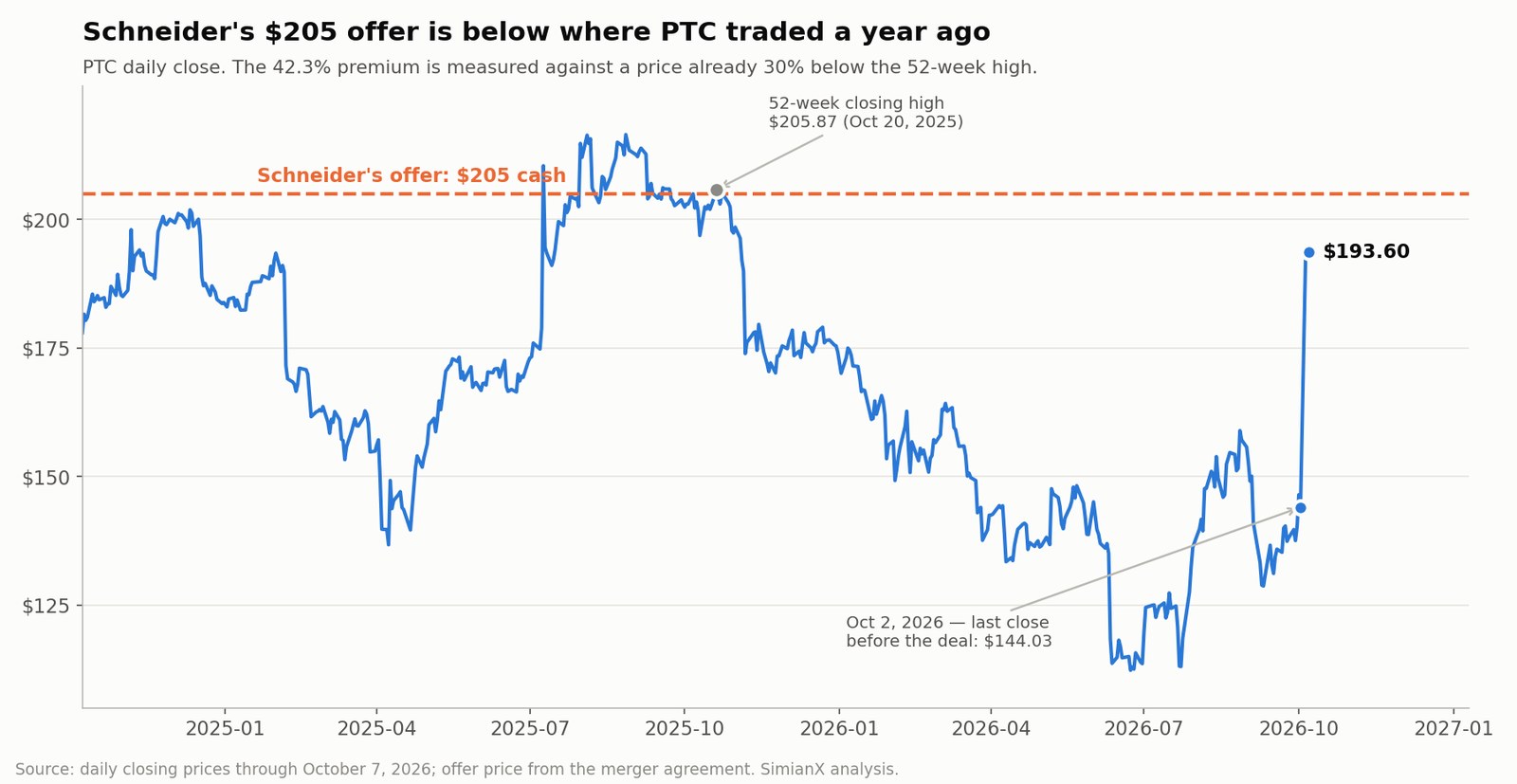
But the premium is measured from a depressed base. PTC closed at $205.87 on October 20, 2025 — its highest close of the preceding 52 weeks. Schneider’s $205 cash offer is 0.4% below that level. Shareholders who bought a year ago are being asked to accept a headline “42% premium” that returns them slightly less than they could have sold for without any deal at all.
PTC shares jumped 33.5% on announcement day and closed at $193.60 on October 7 — still $11.40 below the cash consideration. That gap frames two separate questions:
- Is the remaining spread adequate compensation for regulatory, timing and completion risk?
- Does Schneider’s purchase signal that industrial AI is entering a broader mega-merger era?
This analysis works through both using the signed merger agreement, PTC’s fiscal third-quarter filings and the actual tape — not the press release. Six things the initial coverage missed are developed below: the 52-week high, the break-even probability embedded in the spread, the absence of any reverse termination fee, a one-time gain inflating PTC’s GAAP guidance, a divestiture drag inside the free-cash-flow guidance, and the true size of Schneider’s own share-price punishment.
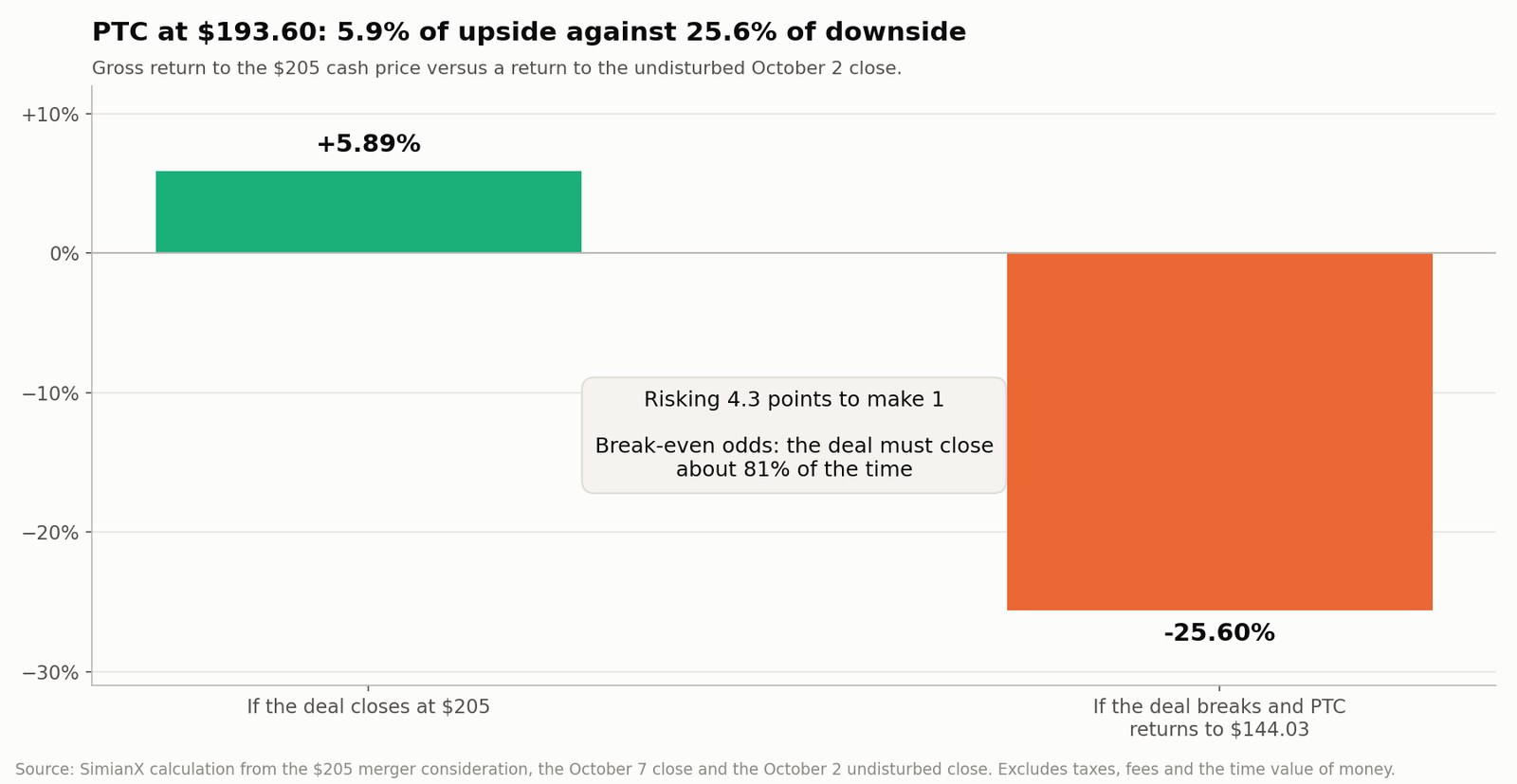
The takeover validates PTC’s strategic position. At $193.60 the stock offers roughly 5.9% of upside against roughly 25.6% of downside — a wager that the deal closes about four times out of five.
This research reflects publicly available information through October 8, 2026. It is informational and is not personalized investment advice.
What Are the Terms of Schneider Electric’s PTC Acquisition?
Schneider Electric and PTC signed their definitive merger agreement on October 4, 2026 and announced it the following day.
According to the companies’ official acquisition announcement and the agreement filed as an exhibit to PTC’s Form 8-K, the principal terms are:
| Transaction item | Announced term |
|---|---|
| Cash consideration | $205 per PTC share |
| PTC equity value | Approximately $22.6 billion |
| Implied enterprise value | Approximately $23.7 billion |
| Premium to October 2 closing price | 42.3% |
| Premium to prior 30-day VWAP | 46.1% |
| PTC’s 52-week closing high | $205.87 (October 20, 2025) |
| Expected closing | By the third quarter of 2027 |
| Initial End Date | April 4, 2027 |
| Fully extended End Date | January 4, 2028 |
| PTC shareholder approval | Majority of outstanding shares |
| PTC termination fee | $700 million in specified circumstances |
| Parent termination fee | None |
| Financing condition | None |
| Bridge facility | $25 billion, fully committed |
| Regulatory approvals | HSR, CFIUS and applicable foreign-investment reviews |
Both boards approved unanimously. PTC’s directors have agreed to recommend the transaction, subject to the customary fiduciary exceptions. On completion, PTC becomes a wholly owned Schneider subsidiary, its shares are delisted from Nasdaq, and eligible holders receive $205 in cash per share.
Is the $22.6 Billion Figure the Full Purchase Price?
The widely reported $22.6 billion is PTC’s equity value. The enterprise value is approximately $23.7 billion, reflecting net debt and related adjustments.
Schneider describes total cash consideration of roughly €22 billion and has secured a fully committed $25 billion bridge facility from Morgan Stanley and Société Générale. The merger itself carries no financing condition.
The permanent financing plan is expected to include:
- Approximately €5 billion to €6 billion of new equity
- Approximately €16 billion to €17 billion of new debt
- Debt issued across several currencies
- A temporary pause in Schneider’s share repurchases during 2027 and 2028
Schneider expects to retain investment-grade ratings in the “A” category, subject to confirmation by the agencies.
The Term That Is Missing: There Is No Reverse Termination Fee
Read the merger agreement itself and one omission stands out. The document defines a “Company Termination Fee” of $700 million payable by PTC in specified circumstances — a topping bid, a board recommendation change, certain failures to close. It defines no corresponding “Parent Termination Fee.” The phrase does not appear in the agreement at all.
This matters more than any other single term for a shareholder deciding whether to hold.
In most large cross-border technology deals facing a serious antitrust or foreign-investment review, the buyer posts a reverse break fee — a payment to the target if regulators block the transaction. It compensates target shareholders for a year of frozen capital, lost strategic optionality and the operational disruption that a failed sale process leaves behind. Here there is none. If CFIUS or the antitrust agencies stop the deal, PTC shareholders receive nothing and the stock reprices on its own fundamentals.
The asymmetry runs one way. PTC can owe Schneider $700 million. Schneider owes PTC zero. The regulatory risk is borne entirely, and uncompensated, by the selling side.
This is the single most important reason to treat the quoted spread as the floor of fair compensation rather than a generous one. A spread of similar width on a deal carrying a $1 billion reverse fee is a materially better risk.
Why Did PTC Stock Soar but Stop Below $205?
PTC closed at $144.03 on October 2, the last session before the announcement. On October 5 it jumped 33.5% to $192.26, trading as high as $196.05 intraday. By October 7 it closed at $193.60.
| PTC price reference | Price |
|---|---|
| 52-week closing high, October 20, 2025 | $205.87 |
| Unaffected closing price, October 2, 2026 | $144.03 |
| Offer price | $205.00 |
| October 5 closing price | $192.26 |
| October 7 closing price | $193.60 |
| Remaining spread at $193.60 | $11.40 |
| Gross upside to offer price | 5.89% |
Two facts sit uncomfortably together. PTC entered 2026 at roughly $175 and was down about 17% year-to-date before the leak-free announcement landed. The “42.3% premium” is real arithmetic against a real unaffected price — and it is also a premium measured from a twelve-month low-water area rather than from anything resembling PTC’s own recent trading range.
The stock does not trade at $205 because the cash is not received until closing. Holders must price:
- Antitrust and CFIUS review risk
- Shareholder-vote risk
- Closing delays and automatic End Date extensions
- Opportunity cost of capital for up to fifteen months
- The possibility of a superior proposal
- The possibility of termination with no reverse fee
- Changes in interest rates and in required merger-arbitrage returns
At $193.60 the gross return to the offer price is:
($205 ÷ $193.60) − 1 = 5.89%
That is a defined return. It is not a riskless one.
What Probability Is the Market Actually Pricing?
The most useful calculation in any cash merger is the one almost no coverage performs: convert the spread into the implied probability of completion.
Two outcomes dominate. The deal closes and the holder receives $205. The deal breaks and the stock reverts toward the unaffected $144.03.
- Gain if it closes: $205.00 − $193.60 = +$11.40, or +5.89%
- Loss if it breaks: $144.03 − $193.60 = −$49.57, or −25.60%
- Risk-to-reward ratio: 4.35 to 1
Set expected value to zero and solve for the completion probability p:
p × 11.40 − (1 − p) × 49.57 = 0
p = 49.57 ÷ (11.40 + 49.57) = 0.813
The market is pricing roughly an 81.3% chance of completion. An investor buying at $193.60 is not “earning 5.9%.” They are accepting a bet that pays off four times in five and loses more than four times the winnings on the fifth.
That is a coherent price for a signed, fully financed, strategically sensible deal with no financing condition. It is a thin price for one that also carries CFIUS exposure in aerospace and defense software, a fifteen-month outside date, and no reverse break fee. The arbitrage is only attractive to an investor whose own estimate of completion odds is meaningfully above 81%.
The same framework, applied to a smaller domestic deal with a tighter regulatory path, produced a very different conclusion in our analysis of the Copart–ACV Auctions transaction, where a 0.9% residual spread implied a 97% completion probability. Comparing the two is the fastest way to see what the market thinks regulatory risk is worth.
Is PTC Stock a Good Merger-Arbitrage Investment?
The answer depends on holding period as much as on probability.
The On-Time Closing Scenario
Buying PTC at $193.60 with a close at $205:
- Dollar gain: $11.40 per share
- Gross return: 5.89%
- Expected holding period: potentially around one year
- Dividend income: PTC pays no meaningful dividend
- Upside beyond $205: only if a superior proposal emerges
The Delayed Closing Scenario
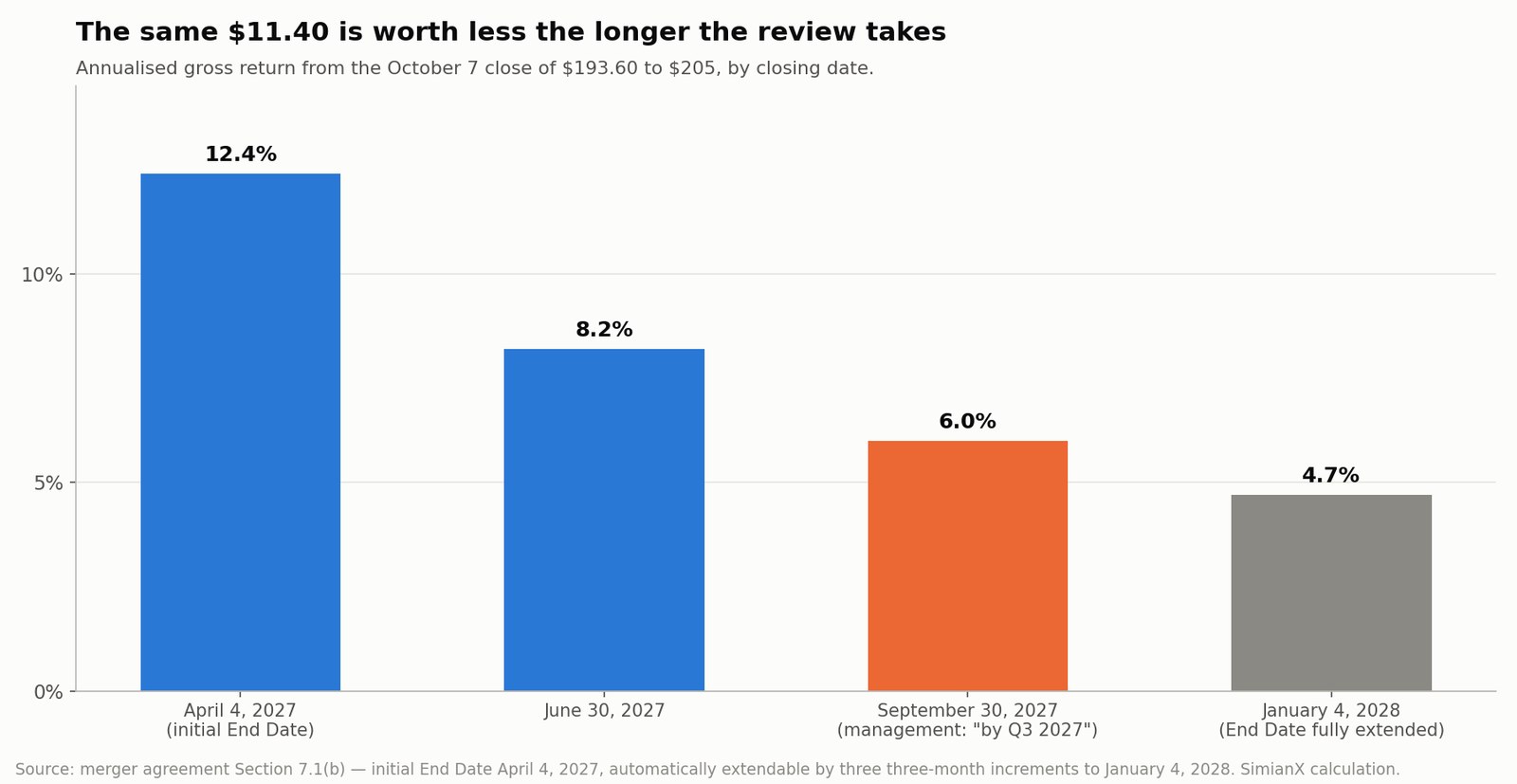
The merger agreement sets an initial End Date of April 4, 2027. It extends automatically in three-month increments while specified regulatory conditions remain outstanding — up to three times. The contractual backstop is therefore January 4, 2028, fifteen months after the announcement.
Management guides to closing “by the third quarter of 2027,” which is already nine months past the initial End Date and implicitly assumes at least two extensions. The same $11.40 compounds very differently depending on when it arrives:
| Illustrative closing date | Holding period from October 7 | Approximate annualized gross return |
|---|---|---|
| April 4, 2027 (initial End Date) | About 6 months | ~12.4% |
| June 30, 2027 | About 9 months | ~8.2% |
| September 30, 2027 (management guidance) | About 12 months | ~6.0% |
| January 4, 2028 (End Date fully extended) | About 15 months | ~4.7% |
These estimates exclude taxes, commissions and the cost of capital. Note the shape of the distribution: management’s own guided date already sits in the lower half, and the company’s stated expectation is not the optimistic case.
The Broken-Deal Scenario
PTC’s unaffected price was $144.03. A return to that level from $193.60 is a loss of:
($144.03 ÷ $193.60) − 1 = −25.60%
The unaffected price is a reference, not a guaranteed floor. A failed sale leaves disruption behind — delayed product decisions, unsettled sales teams, a management team that has publicly agreed the company is worth $205. It can also leave a floor, if the market concludes another buyer might appear.
PTC may be a strategically valuable company, but at $193.60 the stock is primarily a bet on transaction completion — not a conventional undervalued software investment.
How Did the Market Actually React — on Both Sides?
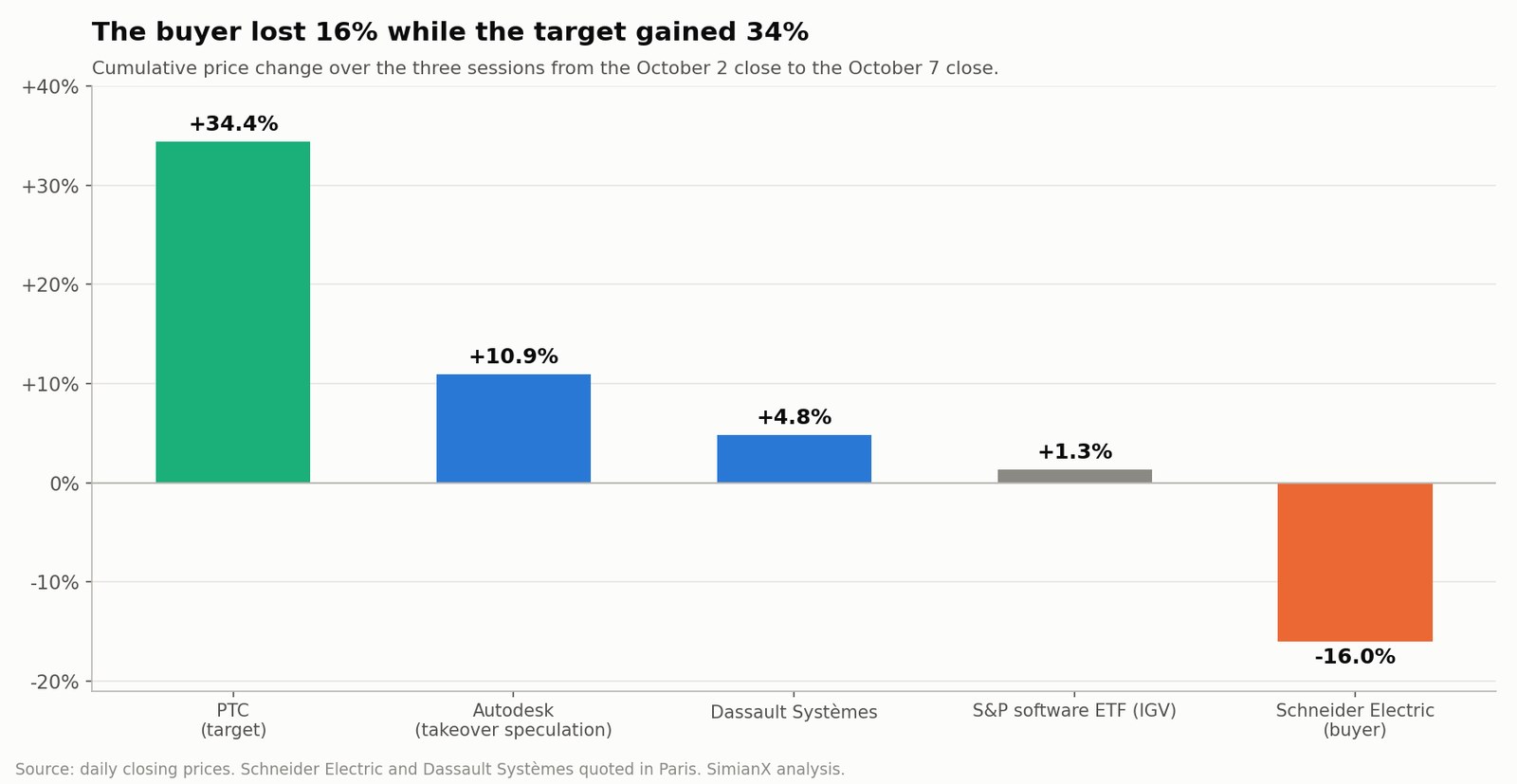
The announcement was read very differently by the buyer’s shareholders and the target’s.
| Security | Cumulative change, October 2 close to October 7 close |
|---|---|
| PTC (target) | +34.4% |
| Autodesk (takeover speculation) | +10.9% |
| Dassault Systèmes | +4.8% |
| S&P software ETF (IGV) | +1.3% |
| Schneider Electric (buyer) | −16.0% |
Schneider’s decline was not the “as much as 10%” widely reported from the opening session. Measured close to close across the three sessions following the announcement, Schneider Electric lost 15.99% of its market value. Against a software sector that rose 1.3% over the same span, that is an unusually severe verdict on a deal the buyer describes as transformational.
Autodesk’s +10.87% against IGV’s +1.3% is the cleanest read of the sympathy trade. The market did not reprice design software broadly; it repriced the one large, independent, plausibly acquirable asset in the category.
This pattern — the headline number celebrated on one side and quietly punished on the other — recurs across large strategic deals. It appeared in reverse in our study of the Generac–Amazon agreement, where an $8 billion headline rested on $2.4 billion of actually committed deliveries. Reading the filing rather than the press release is usually where the difference sits.
What Could Prevent Schneider Electric from Buying PTC?
PTC Shareholder Approval
Holders of a majority of PTC’s outstanding shares must approve the merger at a special meeting.
The 42.3% premium, the all-cash structure and the unanimous board recommendation make approval appear likely. But the 52-week-high comparison gives a determined dissenting holder a genuine argument, and the definitive proxy statement will supply the material that decides the debate:
- The negotiation history and whether other parties were contacted
- Strategic alternatives the board considered
- Evercore’s valuation analysis and fairness opinion
- Management projections supplied to the board
- Interests of directors and executives in the transaction
- The planned timing of the shareholder vote
United States Antitrust Approval
The transaction is subject to review under the Hart-Scott-Rodino Act.
Schneider and PTC occupy adjacent portions of industrial technology. PTC is strongest in computer-aided design, product lifecycle management, application lifecycle management and service lifecycle management. Schneider’s AVEVA business is weighted toward operational, process and energy-management software.
That complementarity supports approval, but regulators may still examine:
- Industrial software market concentration
- Bundling between software and automation hardware
- Interoperability with competing control systems
- Customer data portability
- Access to digital-thread infrastructure
- Whether Schneider could disadvantage rival automation platforms
CFIUS and Foreign-Investment Reviews
PTC is a U.S. industrial software company serving global manufacturers; Schneider is a French buyer. The transaction requires clearance from the Committee on Foreign Investment in the United States.
PTC’s exposure to aerospace, defense, advanced manufacturing and government customers invites additional scrutiny. The agreement also contemplates antitrust and foreign-investment reviews in other jurisdictions.
Large cross-border industrial-software deals do close. Synopsys’ acquisition of Ansys required approvals from several major jurisdictions and ultimately closed with conditions. But “closes eventually” and “closes by the initial End Date” are different outcomes, and the merger agreement’s three automatic extensions tell you which one the drafters expected.
How Strong Are PTC’s Standalone Financials?
Schneider is not buying a distressed company. PTC has high recurring revenue, strong cash conversion and defensible positions in product-development workflows.
In its fiscal third-quarter 2026 results and the corresponding Form 10-Q, PTC reported:
- ARR excluding divested businesses of $2.412 billion
- Constant-currency ARR growth of 9.1%
- Quarterly revenue of $600 million
- GAAP operating margin of 28%
- Non-GAAP operating margin of 41%
- Quarterly operating cash flow of $261 million
- Quarterly free cash flow of $249 million
Reported Q3 revenue declined 7%, distorted by the sale of the ThingWorx and Kepware businesses and by the shortened duration of one large renewal and expansion.
PTC’s Fiscal 2026 Guidance
| Metric | FY2026 guidance |
|---|---|
| Constant-currency ARR growth excluding divestitures | 9%–9.5% |
| Revenue | $2.69B–$2.75B |
| Operating cash flow | Approximately $880M |
| Free cash flow | Approximately $850M |
| GAAP EPS | $8.46–$9.18 |
| Non-GAAP EPS | $7.87–$8.42 |
The Guidance Trap: GAAP EPS Above Non-GAAP
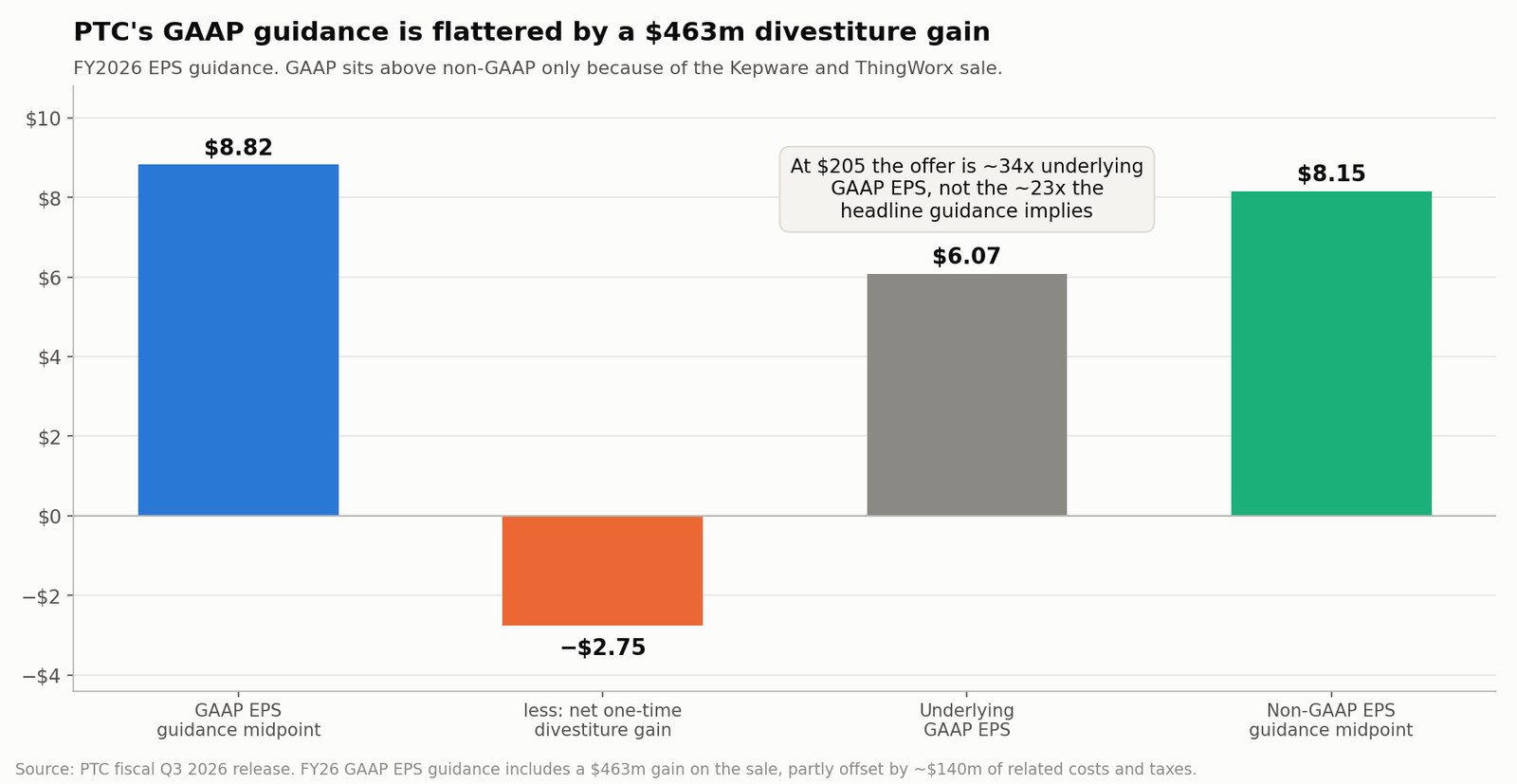
Look at the last two rows again. PTC’s GAAP EPS guidance midpoint of $8.82 sits above its non-GAAP midpoint of $8.15. For a software company carrying heavy stock-based compensation and acquired-intangible amortization, that ordering is close to impossible — unless something one-time is sitting inside the GAAP number.
It is. PTC completed the divestiture of ThingWorx and Kepware to TPG in March 2026, receiving $523 million at closing. FY2026 GAAP results include a $463 million gain on that sale, partly offset by roughly $140 million of related costs and taxes. Net of those offsets the one-time contribution is approximately $2.75 per share.
Strip it out and underlying GAAP EPS is roughly $6.07.
That single adjustment changes how expensive the offer looks:
| Earnings basis | FY2026 EPS | Offer price ÷ EPS |
|---|---|---|
| GAAP guidance midpoint (as reported) | $8.82 | 23.2x |
| Non-GAAP guidance midpoint | $8.15 | 25.2x |
| Underlying GAAP, excluding the divestiture gain | $6.07 | 33.8x |
The headline guidance implies Schneider is paying about 23 times GAAP earnings. On the earnings the business will actually generate next year, it is paying closer to 34 times. Any valuation argument built on the reported GAAP line is comparing the offer to a number that will not repeat.
The Same Distortion Sits in the Cash-Flow Guidance
The $850 million free-cash-flow guidance carries a smaller version of the same problem. It is stated net of roughly $80 million of divestiture-related drag — transaction costs, taxes and the lost contribution of the sold businesses, partly offset by proceeds-related items.
Normalized free cash flow is therefore closer to $930 million, which lowers the transaction multiple from the guided 27.9x to approximately 25.5x. This cuts the other way: on cash flow, the deal is slightly cheaper than the guided figure suggests. The point is not that one adjustment flatters and the other penalizes. It is that neither headline number is the one to value the company on.
The sale narrowed PTC’s focus around its Intelligent Product Lifecycle strategy. The remaining portfolio:
- Creo: computer-aided design
- Windchill: product lifecycle management
- Codebeamer: application lifecycle management
- ServiceMax: service lifecycle management
- Onshape: cloud-native CAD and collaboration
- Arena: cloud-native PLM
- Servigistics: service-parts optimization
- Vuforia: augmented-reality applications
These systems hold the authoritative product data on which industrial AI depends.
Is Schneider Electric Paying Too Much for PTC?
The strategic logic is clear. The valuation is debatable.
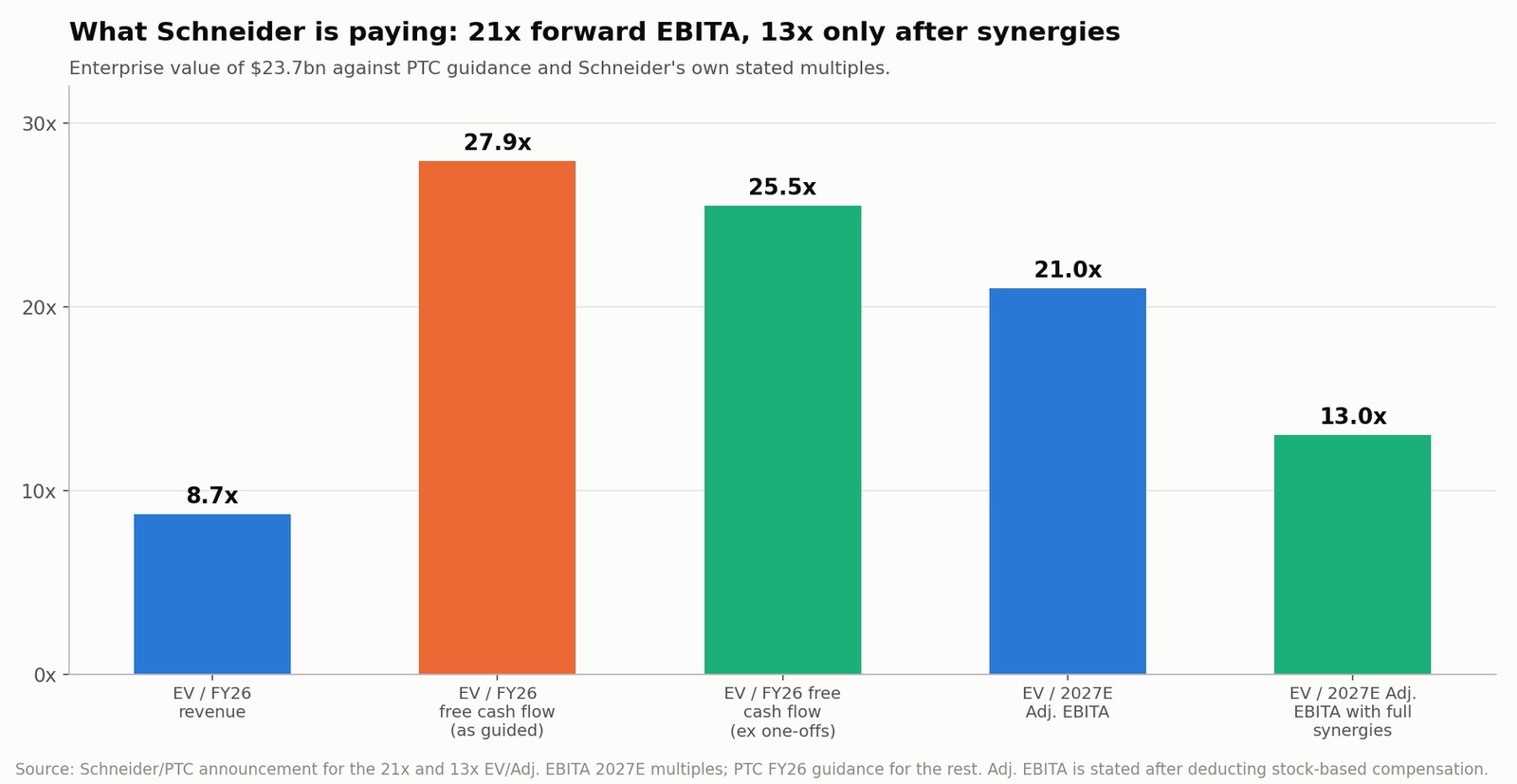
Schneider states that the $23.7 billion enterprise value represents:
- 21 times estimated 2027 adjusted EBITA
- 13 times estimated 2027 adjusted EBITA after full run-rate synergies
Adding PTC’s own guidance fills in the rest of the picture:
| Valuation measure | Approximate transaction multiple |
|---|---|
| EV / FY2026 revenue midpoint | ~8.7x |
| EV / FY2026 free cash flow, as guided | ~27.9x |
| EV / FY2026 free cash flow, excluding one-offs | ~25.5x |
| Offer price / FY2026 non-GAAP EPS midpoint | ~25.2x |
| Offer price / underlying GAAP EPS | ~33.8x |
| EV / estimated 2027 adjusted EBITA | 21x |
| EV / adjusted EBITA with full synergies | 13x |
These are substantial multiples for high-single-digit ARR growth. Schneider is paying for cross-selling, industrial-AI development and control of product-lifecycle data as much as for current cash flow.
Management expects:
- €250 million of annual cost synergies by year three
- Approximately €800 million of revenue synergies
- Low-single-digit adjusted EPS accretion before purchase-accounting effects in the first full year
- Mid- to high-single-digit adjusted EPS accretion with full synergies
- Return on invested capital exceeding the cost of capital by year five
Three qualifications matter.
First, €800 million of revenue synergy is not €800 million of profit. Schneider must win those sales, carry the associated selling and development expense, and apply a realistic incremental margin.
Second, the accretion measure excludes purchase-price accounting. A deal of this size will generate substantial acquired-intangible amortization.
Third, the 13x “post-synergy” multiple is not a price anyone is paying today. It is the price Schneider would have paid if every euro of synergy already existed. The multiple actually transacted is 21x, and the gap between the two is the execution risk transferred to Schneider shareholders — who marked it down 16% within three sessions.
Why Does Schneider Electric Want PTC?
Schneider is assembling an integrated industrial technology stack spanning physical equipment, operational software, engineering data and artificial intelligence.
| Industrial layer | Schneider asset or platform | Main role |
|---|---|---|
| Physical systems | Schneider energy-management and automation equipment | Controls factories, data centers, buildings and energy systems |
| Operations and process data | AVEVA | Models and manages industrial assets and processes |
| Contextualized data and AI | Cognite | Connects operational, engineering and enterprise data |
| Product and engineering lifecycle | PTC | Controls product design, requirements, bills of material and service data |
| Industrial AI applications | Combined platform | Converts trusted lifecycle data into recommendations and automated actions |
Schneider completed its full acquisition of AVEVA in January 2023. In June 2026 it agreed to acquire industrial data and AI company Cognite for $3.1 billion. PTC adds the missing upstream product-development layer.
AVEVA shows how plants and processes operate. Cognite contextualizes data across industrial systems. PTC supplies design intent, engineering requirements, product structures, software requirements and service history for complex manufactured products.
Schneider’s objective is a continuous digital thread across:
- Product design
- Software and requirements management
- Manufacturing preparation
- Factory operation
- Energy consumption
- Maintenance and field service
- Product improvement and redesign
That is what Schneider means by a platform spanning “design and build to operate and maintain.”
Why Is the Digital Thread Important for Industrial AI?
Generic AI systems generate plausible text without understanding the physical consequences of an error. Industrial applications need far stronger grounding.
An AI agent operating in a factory may need to know:
- Which component revision is installed
- Whether a design change has been approved
- What safety requirements apply
- Which supplier produced a component
- How a machine is currently operating
- Whether a service technician holds the required certification
- How an operating change affects energy consumption
- Whether a recommendation violates a regulatory requirement
That information is spread across CAD, PLM, ALM, service, automation and energy-management systems.
PTC’s economic value is therefore not that it added generative AI to its software. It is that PTC controls the trusted product-data foundation used to ground those applications. PTC already embeds generative and agentic capability into Creo, Windchill, Codebeamer and ServiceMax — natural-language product-data search, duplicate-part detection, automated requirements processing, AI-assisted field service. The company’s own AI strategy page frames it the same way.
In industrial markets the scarce asset may not be the language model. It may be the governed engineering context that stops the model making an expensive or dangerous mistake.
Is Industrial AI Entering a Mega-Merger Era?
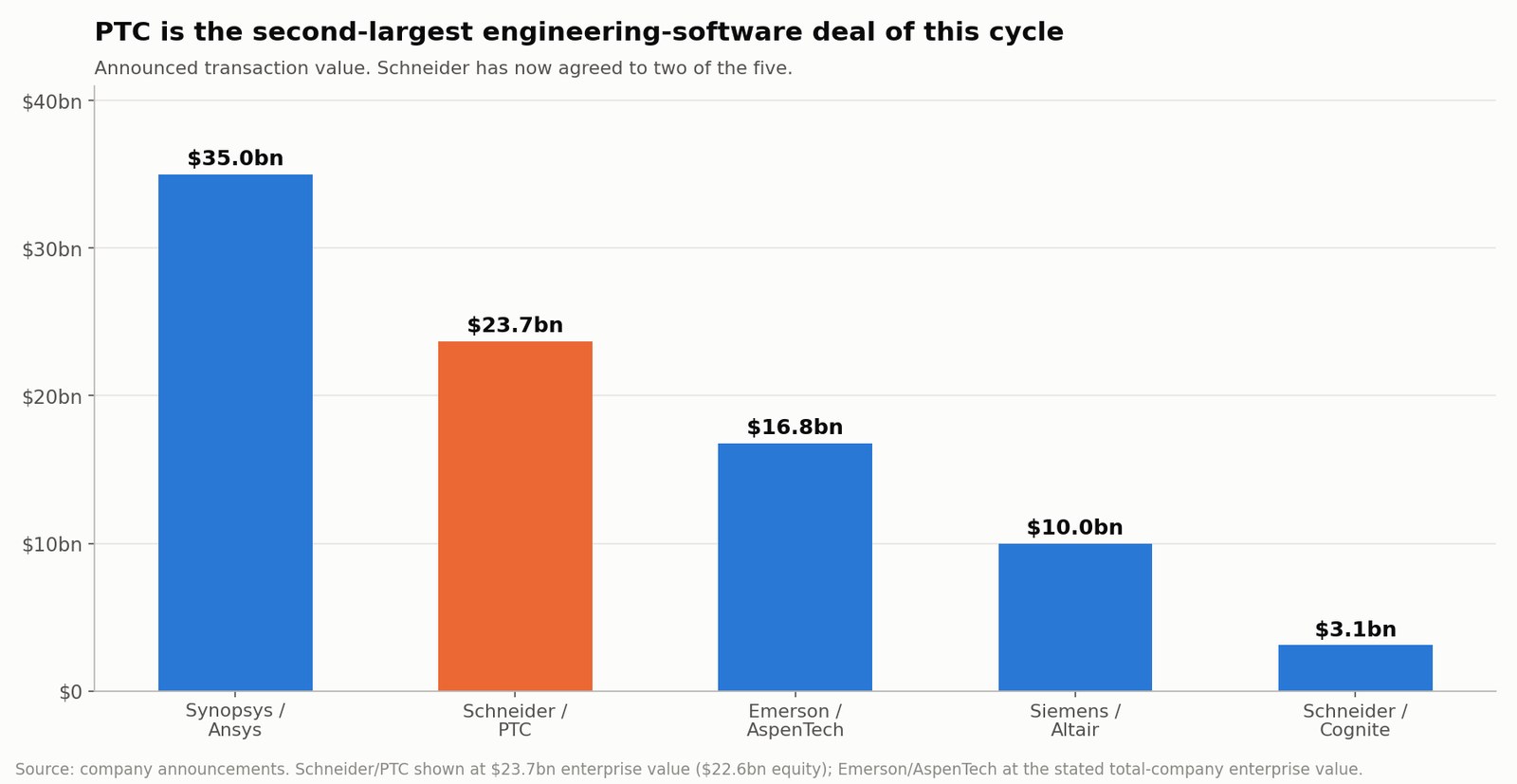
Schneider–PTC is not isolated. It is the second-largest engineering-software transaction of the current cycle.
| Buyer | Target | Announced value | Strategic focus |
|---|---|---|---|
| Synopsys | Ansys | ~$35.0bn | Chip-to-system design and engineering simulation |
| Schneider Electric | PTC | $23.7bn EV / $22.6bn equity | Product lifecycle, digital thread and industrial AI |
| Emerson | AspenTech | $16.8bn total-company EV | Process automation and industrial software |
| Siemens | Altair Engineering | ~$10.0bn EV | Simulation, HPC, data science and AI |
| Schneider Electric | Cognite | $3.1bn | Industrial data contextualization and AI |
Schneider has now agreed to two of the five. Siemens completed its Altair acquisition in March 2025. Synopsys completed its Ansys acquisition in July 2025. Emerson took full ownership of AspenTech in March 2025.
A consolidation era is plainly under way. But calling it an AI acquisition wave oversimplifies what buyers are purchasing. The attractive targets share:
- Mission-critical engineering workflows
- Proprietary industrial data models
- High recurring revenue
- High customer retention
- Deep integration into product-development processes
- Strong switching costs
- Specialized technical expertise
- Cross-selling potential through a larger industrial platform
AI is the accelerant. Recurring revenue, customer relationships and structured data justify most of the price.
Which Companies Could Be Affected by Industrial Software Consolidation?
Autodesk
Autodesk rose 10.87% over the three sessions following the announcement, against 1.3% for the software sector. That is a takeover-speculation move, not a sector re-rating.
Autodesk holds strong positions in architecture, engineering, construction, manufacturing and media. Its customer mix and regulatory profile differ from PTC’s, and a takeover would need an exceptionally well-capitalized buyer.
Dassault Systèmes
Dassault Systèmes competes with PTC through CATIA, SOLIDWORKS, ENOVIA and the 3DEXPERIENCE platform. Its combination of design, simulation and lifecycle software gives it valuable industrial data and real strategic relevance. Its size and ownership structure complicate a full acquisition, but the PTC multiple will influence how investors value the portfolio.
Siemens
Siemens already owns one of the broadest industrial-software portfolios — NX, Teamcenter, Siemens EDA and Altair. Schneider’s move raises the pressure to connect engineering software with automation and operational data.
Emerson, Rockwell Automation and Honeywell
These companies are building software-defined automation strategies. They are more likely to pursue smaller acquisitions in industrial data, simulation, cybersecurity, digital twins and autonomous operations than to attempt another $20 billion-plus transaction.
Private Industrial-AI Companies
Cognite’s $3.1 billion sale showed that private industrial-data platforms can command strategic valuations. Buyers will look for defensible data-contextualization, robotics, digital-thread and physics-informed AI technology.
Investors should still avoid buying every industrial software stock on takeover speculation. The strongest candidates combine financial quality with an asset that fills a specific portfolio gap for a credible buyer. The same discipline applies to semiconductor consolidation, where ON Semiconductor’s $7 billion Synaptics bid was a bet on physical AI rather than on an AI narrative.
A multi-agent research platform such as SimianX AI can help compare fundamentals, current news and SEC disclosures instead of trading on rumor:
- SimianX AI — multi-model research and live market analysis
- SimianX Crypto Leaderboard — competing model performance, tracked live
- SimianX Stories — filing-level research across equities and digital assets
What Are the Biggest Risks for Schneider Electric?
PTC shareholders face closing risk. Schneider shareholders face a much broader set of long-term risks — and have already priced a chunk of them at −16%.
Financing Risk
Schneider expects to issue €5 billion to €6 billion of equity and €16 billion to €17 billion of debt, bridged in the interim by a $25 billion committed facility. The equity dilutes existing holders. The debt raises interest expense and reduces flexibility. Higher market rates before the permanent financing is placed would raise the cost of the transaction further.
Integration Complexity
Schneider must integrate PTC while continuing to develop AVEVA and complete the Cognite acquisition. Together they could form a powerful platform. They could also produce:
- Product overlap
- Confusing sales incentives
- Organizational complexity
- Slower product development
- Employee departures
- Customer concern about roadmap stability
- Difficulty preserving software-company culture inside an industrial group
Revenue-Synergy Risk
The €800 million revenue-synergy target depends on cross-selling, geographic expansion and joint product development. Revenue synergies are harder to realize than cost savings because customers must voluntarily buy the combined products. Large industrial customers often resist vendor concentration and prefer best-of-breed systems.
Interoperability Risk
Schneider repeatedly describes the platform as open and interoperable. It must prove that customers can keep using PTC products with non-Schneider automation systems. If PTC comes to look like a captive extension of Schneider hardware, competitors will attack the installed base.
Return-on-Capital Risk
Return on capital is not expected to exceed the cost of capital until year five, including full synergies. That leaves little room for integration delays, slower software growth, higher financing costs, customer churn, slower AI adoption or weaker cross-selling.
What Should Current PTC Shareholders Do?
There is no single right answer; it depends on taxes, objectives, risk tolerance and alternatives. A disciplined framework has six steps.
1. Calculate the Current Spread
Merger spread = ($205 − current PTC price) ÷ current PTC price
At $193.60 the gross spread is 5.89%. It changes daily. A higher price reduces the prospective return; a lower price raises it but may signal rising completion risk.
2. Convert the Spread into an Implied Probability
Implied probability = downside ÷ (upside + downside)
At today’s prices that is 49.57 ÷ 60.97 = 81.3%. Recompute it whenever the price moves. If your own estimate of completion odds is below the market’s, the position is not worth holding regardless of how the percentage return reads.
3. Estimate a Realistic Closing Date
Management guides to Q3 2027 — already two automatic extensions past the initial End Date. Do not model the earliest possible date. Run an annualized return for each plausible date, including January 4, 2028.
4. Build a Broken-Deal Valuation Range
The unaffected $144.03 is a reference, not a conclusion. A stronger range considers updated ARR, standalone free cash flow of roughly $930 million normalized, comparable software multiples, the broader market, possible alternative bidders and the disruption a failed deal leaves behind.
5. Price the Absence of a Reverse Termination Fee
If regulators block this transaction, no payment flows to PTC holders. Compare the spread you are being offered with spreads on deals that do carry a reverse fee. A 5.9% spread with protection and a 5.9% spread without it are not the same investment.
6. Size the Position for Deal Failure
Size by the loss in the adverse scenario, not the expected gain. An investor seeking $11.40 per share must be able to absorb a decline of roughly $49.57 per share if the deal breaks.
Could Another Company Make a Higher Offer for PTC?
A superior proposal is legally possible. The merger agreement lets PTC’s board consider certain unsolicited proposals where fiduciary duties require it.
Several factors make a topping bid difficult:
- Schneider is already paying a 42.3% premium
- The transaction implies 21x 2027 adjusted EBITA and ~34x underlying GAAP earnings
- Schneider has a genuine strategic fit through AVEVA and Cognite
- A competing buyer would need an enormous financing package
- PTC could owe Schneider a $700 million termination fee
- Other strategic buyers would face equal or greater antitrust concerns
One factor cuts the other way: the $205 price is below PTC’s own 52-week closing high, which weakens the “full and fair value” defense in any shareholder challenge and lowers the bar a rival bidder would need to clear to look credible.
On balance, a higher offer should be treated as optional upside, not the base case.
PTC Stock Scenario Analysis
| Scenario | Possible outcome | Implication for PTC shareholders |
|---|---|---|
| Deal closes early | $205 cash in the first half of 2027 | ~12% annualized from $193.60 |
| Deal closes as guided | $205 cash by Q3 2027 | ~6% annualized from $193.60 |
| Regulatory review causes delay | $205 received late 2027 or January 2028 | ~4.7% annualized and a longer capital lockup |
| Superior bid appears | Offer above $205 | Additional upside, probability appears limited |
| Transaction fails | PTC resumes standalone trading, no reverse fee | Roughly −25.6% toward the unaffected price |
| Terms renegotiated | Cash price or timing changes | Depends on market conditions and the reason |
The key insight: PTC’s operating performance can stay strong while the share price falls, if the perceived probability of closing drops. Once a definitive cash merger is signed, probability and timing dominate traditional valuation.
Is the Deal Bullish for Industrial AI Stocks?
It is bullish for the perceived strategic value of industrial software, but the implications vary by company. It supports higher valuations for businesses holding:
- Product lifecycle data
- Engineering simulation
- Digital-twin technology
- Industrial knowledge graphs
- Cloud-native CAD
- Application lifecycle management
- Industrial cybersecurity
- AI-assisted field service
- Robotics and autonomous-manufacturing software
Investors should still distinguish a valuable industrial-AI platform from a company adding “AI” to its investor deck. The strongest assets solve three hard problems:
- Data context: they understand relationships among products, components, processes and physical assets
- Workflow integration: their software sits inside the daily work of engineers and operators
- Governance: their outputs can be traced, authorized and audited
That is why PTC commands a large premium despite ARR growth closer to 9% than to the rates associated with early-stage AI software.
Final Verdict: Is Industrial AI Entering a Mega-Merger Era?
Yes — but a selective one, centered on trusted industrial data and end-to-end workflows rather than generative-AI branding.
Schneider Electric is paying $22.6 billion for PTC because PTC controls critical product and engineering information across CAD, PLM, ALM and service workflows. Combined with Schneider’s automation equipment, AVEVA’s operational software and Cognite’s contextualized data platform, it could complete a genuine industrial digital thread.
For PTC shareholders, most of that strategic value is already in the price. At $193.60:
- Upside to the $205 offer is 5.89%
- Downside to the unaffected price is 25.60%
- The implied completion probability is 81.3%
- The guided closing date is nearly a year away, with a contractual backstop fifteen months out
- There is no reverse termination fee if regulators intervene
- The offer price is 0.4% below PTC’s own 52-week closing high
- A higher competing offer is possible but should not be assumed
The acquisition is strong evidence for the industrial-AI consolidation thesis. It does not automatically make PTC attractive at every price.
Monitor the merger proxy, the shareholder-vote date, HSR progress, the CFIUS review, Schneider’s equity financing and the cash spread. SimianX AI brings live price movement, SEC filings, news analysis and competing bull-and-bear interpretations into one place for exactly that purpose.
The larger takeaway: industrial AI is moving from isolated software features into a contest for control of the entire product and asset lifecycle. The companies that own trusted engineering data may become the most valuable — and most contested — assets in industrial technology.
Frequently Asked Questions About the Schneider Electric PTC Deal
What will happen to PTC stock after the Schneider Electric merger?
If the transaction closes on current terms, each eligible PTC share converts into the right to receive $205 in cash, without interest and subject to applicable withholding. PTC becomes a wholly owned Schneider subsidiary and stops trading on Nasdaq.
Why is PTC stock below the $205 takeover price?
The gap reflects the time until closing and the risk that regulatory, shareholder or other conditions prevent completion. At the October 7 close of $193.60 the gross spread was 5.89%, which implies the market is pricing roughly an 81.3% probability that the deal closes.
Is $205 a good price for PTC shareholders?
It is a 42.3% premium to the unaffected October 2 close — and 0.4% below PTC’s 52-week closing high of $205.87 set on October 20, 2025. Both statements are true. Which one matters depends on when a shareholder bought.
When will Schneider Electric complete the PTC acquisition?
The companies expect closing by the third quarter of 2027. The merger agreement sets an initial End Date of April 4, 2027 with three automatic three-month extensions for specified regulatory conditions, extending the contractual backstop to January 4, 2028.
What happens to PTC shareholders if regulators block the deal?
PTC shareholders receive nothing. The merger agreement contains a $700 million termination fee payable by PTC in specified circumstances and no reverse termination fee payable by Schneider. Regulatory risk is borne by the selling side without compensation.
Is PTC stock a buy before the takeover closes?
PTC is now primarily a merger-arbitrage position. The return is capped near $205 unless a superior bid appears, and the downside is roughly four times the upside if the deal fails. Compare the annualized spread against closing risk, taxes and alternatives before holding.
Does the PTC acquisition mean more industrial AI takeovers are coming?
It raises the probability of further consolidation, particularly among companies controlling engineering data, digital twins, simulation and industrial workflows. Future deals are more likely to target differentiated platforms than companies relying on an AI marketing narrative.
Related Reading
- Copart ACV Deal 2026: ACVA Jumps 44%, Leaving a 0.9% Spread
- Generac-Amazon Deal: $2.4B Order Behind an $8B Headline
- ON Semiconductor Stock 2026: $7B Synaptics Physical AI Bet
- Nvidia Hugging Face Deal 2026: $12.9B at 86x Revenue
- AKAM Stock: $11.6B Anthropic Deal Needs $4.8B Before Revenue
- Amazon Qualcomm AI Chip Deal: 54 Million Shares in Play
- Caterpillar Stock 2026: AI Data Center Power Trade
Primary Research Sources
- Schneider Electric and PTC transaction announcement
- PTC Form 8-K announcing the merger agreement
- Full Schneider Electric-PTC merger agreement
- PTC fiscal third-quarter 2026 results
- PTC fiscal Q3 2026 Form 10-Q
- PTC completion of the ThingWorx and Kepware divestiture
- PTC industrial artificial-intelligence strategy
- PTC share listing and market data on Nasdaq
- Schneider Electric investor relations and financial results
- Schneider Electric’s proposed Cognite acquisition
- AVEVA industrial software
- Siemens’ completed Altair acquisition
- Synopsys’ completed Ansys acquisition
- Emerson newsroom
- Autodesk · Dassault Systèmes · Siemens
- FTC Hart-Scott-Rodino premerger notification program
- Committee on Foreign Investment in the United States
- PTC historical share-price data