
Why MongoDB Stock Fell 18.5%: The CEO Exit, Seven Crashes and What Comes Next
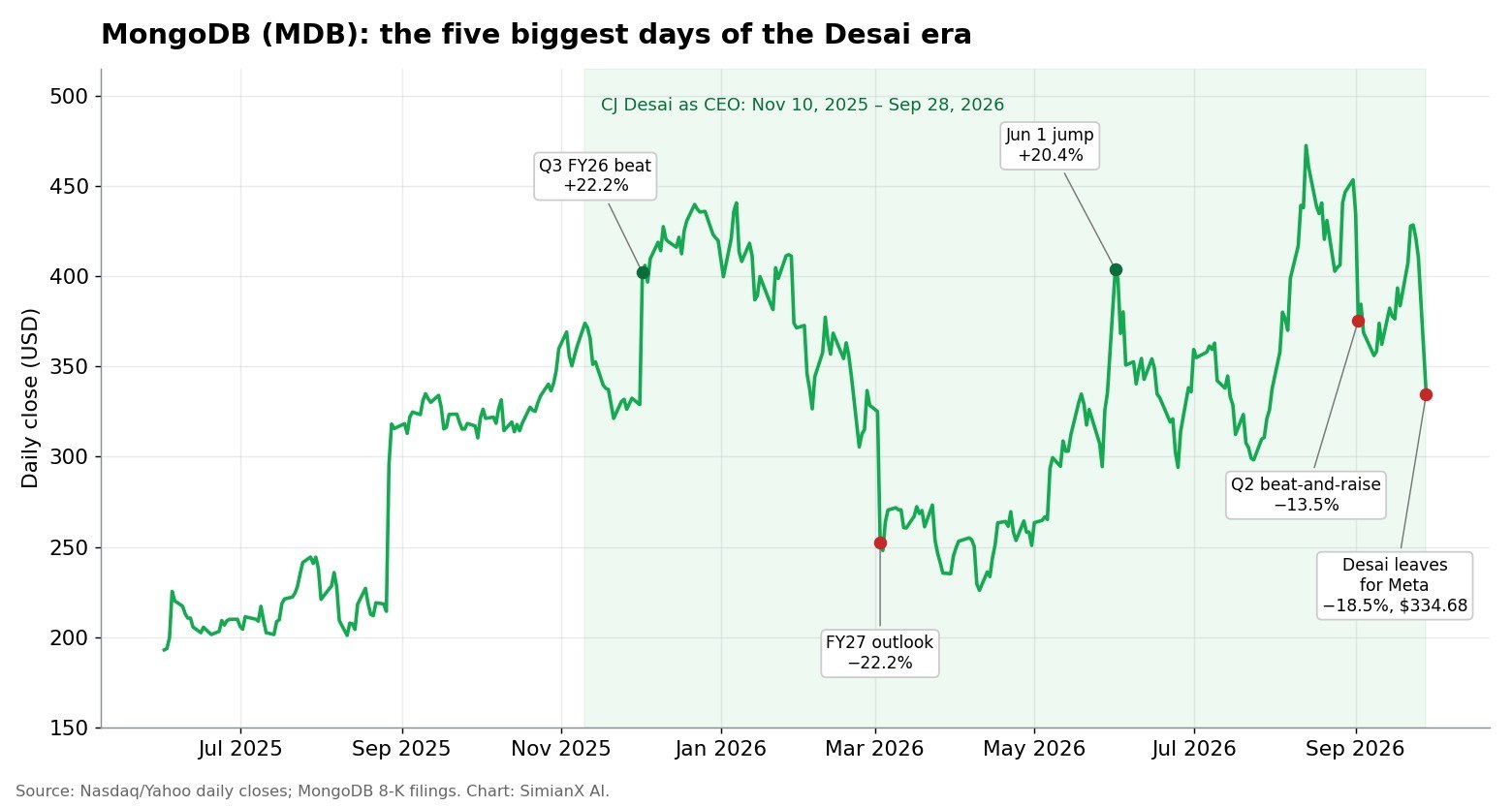
On September 28, 2026, MongoDB said that CEO Chirantan "CJ" Desai had stepped down, effective immediately, to take a senior role at Meta. Former CEO Dev Ittycheria returned as interim CEO. MDB opened at $311.35, fell as low as $300.00, and closed at $334.68, down 18.46% from $410.44. About 17.8 million shares traded, nearly 13 times the prior session's volume. The drop wiped out roughly $6.1 billion of market value.
The filings and the price history show three things:
- This was a MongoDB-only selloff. The iShares Expanded Tech-Software ETF (IGV) fell just 0.55% that day, Snowflake fell 2.33% and Datadog rose 0.21%. The company also reaffirmed its guidance. The market was pricing leadership risk, not a business update.
- It is MongoDB's seventh one-day drop of 15% or more since its 2017 IPO. In all six earlier cases, the first day was not the bottom. The stock fell a further 25% to 58% below its pre-drop close before recovering, which took between 32 and 223 trading sessions.
- Leadership turnover has become a pattern. Desai's exit is the fourth top-level departure in 22 months, after the COO/CFO in December 2024, the long-time CEO in November 2025 and the head of field operations in 2026.
This analysis rebuilds the event from MongoDB's Form 8-K, its second-quarter Form 10-Q and official Nasdaq prices. It adds a crash-and-recovery table from 2017 to 2026, a leadership-turnover timeline, the fiscal 2027 guidance history, a valuation grid and a checklist for the September 29 Investor Day.
Prices are official Nasdaq closes through September 28, 2026. Company figures come from MongoDB's SEC filings. MongoDB's fiscal year ends January 31, so fiscal 2027 runs from February 2026 to January 2027. Valuation scenarios are illustrative, not forecasts.
What Happened on September 28
The 8-K sets out the timeline:
| Date | Event |
|---|---|
| Sep 24, 2026 | Desai tells MongoDB he intends to resign, effective September 28 |
| Sep 26, 2026 | The board appoints Dev Ittycheria as interim president and CEO |
| Sep 28, 2026 | Both changes take effect; MongoDB announces the transition and reaffirms its Q3 and full-year guidance |
| Sep 29, 2026 | Investor Day at Nasdaq MarketSite, 11:00 a.m.–3:15 p.m. ET |
The filing states that Desai's resignation "is not due to any disagreement with the Company." The press release says he is leaving "to pursue a senior role at Meta Platforms." According to CNBC and SiliconANGLE, Desai becomes Meta's chief enterprise platform officer. He will report to Mark Zuckerberg and lead a new Meta Enterprise Platform that sells Meta's AI tools to businesses, starting with its Muse agent, a business agent and a coding tool. We covered what Muse means for Meta's own stock in META Stock After Muse.
Desai was CEO for 322 days, from November 10, 2025 to September 28, 2026. The board chose him after what it called a "comprehensive CEO search" with an executive search firm. It has now hired a search firm again.
| Price data, Sep 28, 2026 | Value |
|---|---|
| Previous close (Sep 25) | $410.44 |
| Open | $311.35 |
| Intraday low | $300.00 (−26.9%) |
| Intraday high | $344.30 |
| Close | $334.68 (−18.46%) |
| Volume | 17.83 million shares (12.9× prior session) |
| Market value lost | ≈ $6.1 billion (on 80.56 million shares) |
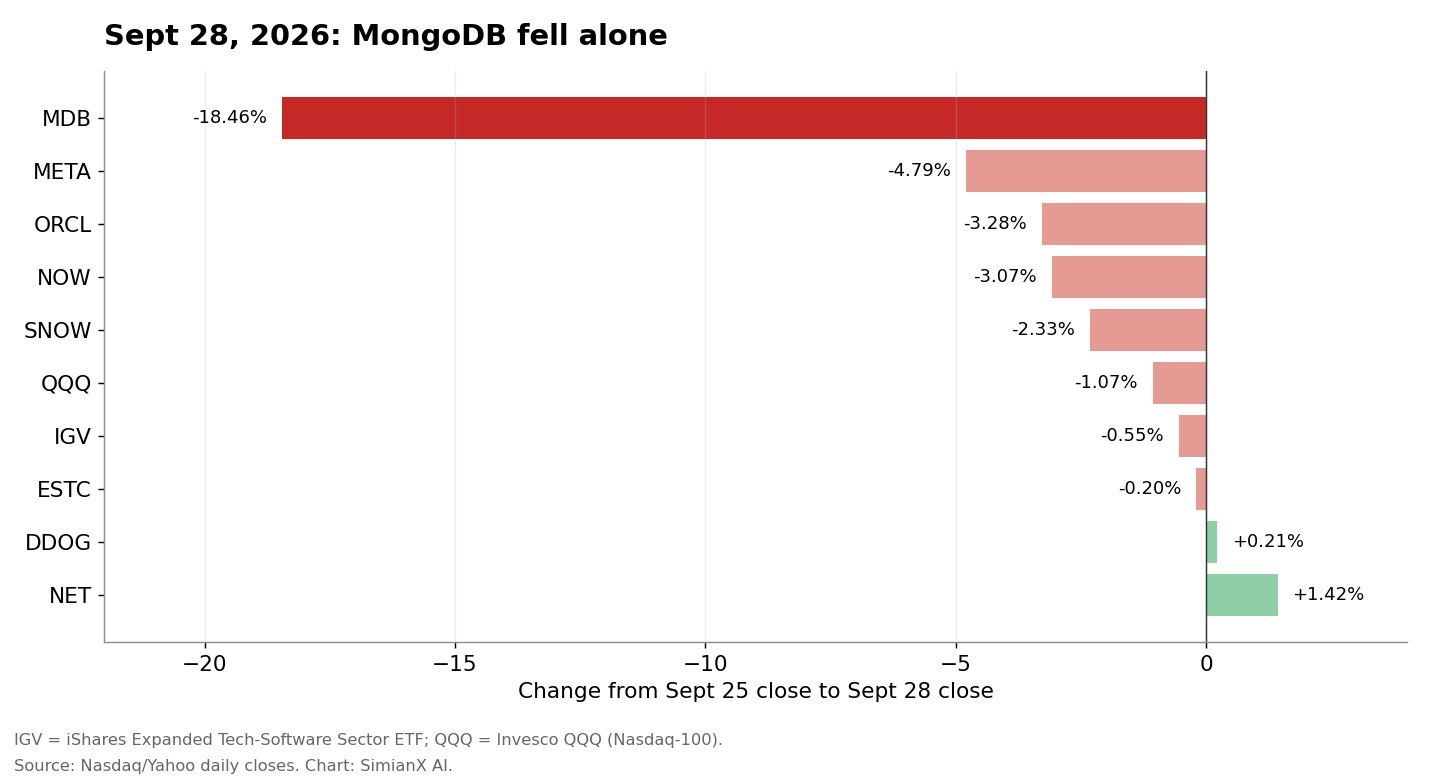
The peer comparison isolates the event. Software as a group barely moved: IGV −0.55%, Nasdaq-100 tracker QQQ −1.07%. Database and infrastructure peers Elastic (−0.20%), Datadog (+0.21%) and Cloudflare (+1.42%, Desai's previous employer) held up. Meta itself fell 4.79%. Its stock had its own drivers that day, so read nothing into it. About 17.9 percentage points of MongoDB's decline are specific to MongoDB.
Every MongoDB Crash of 15% or More Since the 2017 IPO
MongoDB has a long record of sharp one-day selloffs. The table lists every daily close at least 15% below the prior close since the October 2017 listing, what caused it, how far the stock kept falling and how long it took to regain the pre-drop close.
| Drop day | One-day move | Trigger (SEC filing) | Pre-drop close | Low that followed | Further drawdown | Sessions to recover |
|---|---|---|---|---|---|---|
| May 9, 2022 | −15.7% | Broad growth-stock selloff (no company filing) | $299.71 | $223.61 (May 24, 2022) | −25.4% | 32 |
| Sep 1, 2022 | −25.3% | Q2 FY23 results and outlook | $322.86 | $137.35 (Nov 9, 2022) | −57.5% | 188 |
| May 31, 2024 | −23.9% | Q1 FY25 results and outlook | $310.00 | $218.18 (Jun 13, 2024) | −29.6% | 121 |
| Dec 10, 2024 | −16.9% | Q3 FY25 results and COO/CFO resignation | $350.13 | $145.85 (Apr 8, 2025) | −58.3% | 223 |
| Mar 6, 2025 | −26.9% | Q4 FY25 results and FY26 outlook | $264.13 | $145.85 (Apr 8, 2025) | −44.8% | 120 |
| Mar 3, 2026 | −22.2% | Q4 FY26 results and FY27 outlook | $325.01 | $225.95 (Apr 10, 2026) | −30.5% | 53 |
| Sep 28, 2026 | −18.5% | CEO resigns to join Meta | $410.44 | to be determined | — | — |
"Further drawdown" measures the lowest close before recovery against the pre-drop close. "Sessions to recover" counts trading days until a close at or above the pre-drop close. Source: Nasdaq/Yahoo daily closes; MongoDB 8-K filings.
What the record shows:
- The first day was never the bottom. In all six earlier cases, the stock closed lower at some point in the following weeks or months. The median further drawdown was about 38% below the pre-drop close.
- Recovery took a median of about 120 trading sessions, roughly six months. The fastest was 32 sessions in 2022. The slowest was 223 sessions after the December 2024 drop.
- The closest parallel is December 2024. That day combined results with the resignation of COO and CFO Michael Gordon, and it is the only earlier drop tied to an executive exit. The later slide to $145.85 also included the weak March 2025 outlook and the April 2025 market selloff, so it overstates the effect of the leadership change alone.
- Earnings caused most of the crashes. Five of the six earlier drops followed a quarterly report. This one did not: the company reaffirmed its numbers the same morning.
The seven drops cluster in a stock that already moves a lot. That is useful context for anyone treating an 18% gap as automatically "oversold."
Four Top-Level Exits in 22 Months
Viewed alone, the CEO's departure could be a one-off. The filings show a string of senior changes:
| Announced | Executive | Role | Change |
|---|---|---|---|
| Dec 9, 2024 | Michael Gordon | COO and CFO | Resigned, effective Jan 31, 2025 |
| Nov 3, 2025 | Dev Ittycheria | CEO since 2014 | Retired from full-time role; stayed on the board and as an adviser |
| Mar 2, 2026 | Cedric Pech | President, Field Operations | Resigned, effective Apr 15, 2026 |
| Sep 28, 2026 | CJ Desai | CEO since Nov 10, 2025 | Resigned to join Meta |
The March 2026 filing also named a new chief accounting officer from Confluent, and the company's release that month mentioned a "transition to the new CRO." CFO Mike Berry, who joined in 2025, remains in place.
Ittycheria's return lowers the short-term risk. He ran MongoDB for eleven years, took it public in 2017 and grew annual revenue from about $35 million to more than $2.3 billion. He has stayed on the board. But the filing also shows he is a partner and senior adviser at Sequoia Capital, a role he has held since September 2026, and the lead independent director of Datadog. The role is explicitly interim. What investors need to hear is a timeline for a permanent CEO, and whether the next leader comes from inside the company.
What the Business Looked Like Four Weeks Earlier
The operating numbers Desai leaves behind are the strongest in several years. For the second quarter of fiscal 2027 (ended July 31, 2026), per the earnings release and 10-Q:
| Metric | Q2 FY27 | Year-over-year |
|---|---|---|
| Total revenue | $771.8 million | +30% |
| Atlas revenue | $565.9 million | +29% (73% of revenue) |
| Enterprise Advanced and other | $181.2 million | +36% |
| Non-GAAP operating income | $185.9 million (24% margin) | from $86.8 million (15%) |
| GAAP net income | $40.9 million ($0.50 per share) | from a $47.0 million loss |
| Free cash flow | $137.6 million | from $69.9 million |
| Remaining performance obligations | $1.52 billion | +91% |
| Customers | 70,600+ | from 59,900+ |
| Customers above $100K ARR | 2,999 | from 2,564 |
| Net ARR expansion rate | 122% | — |
MongoDB Atlas, the managed cloud database, is still the engine: it grew about 29% and makes up nearly three-quarters of revenue. The balance sheet is clean. MongoDB held $2.41 billion of cash and short-term investments at July 31, had no convertible notes outstanding, and bought back 666,452 shares for $200 million (average $300.10) in the first half. That leaves $399.7 million under its $1 billion authorization.
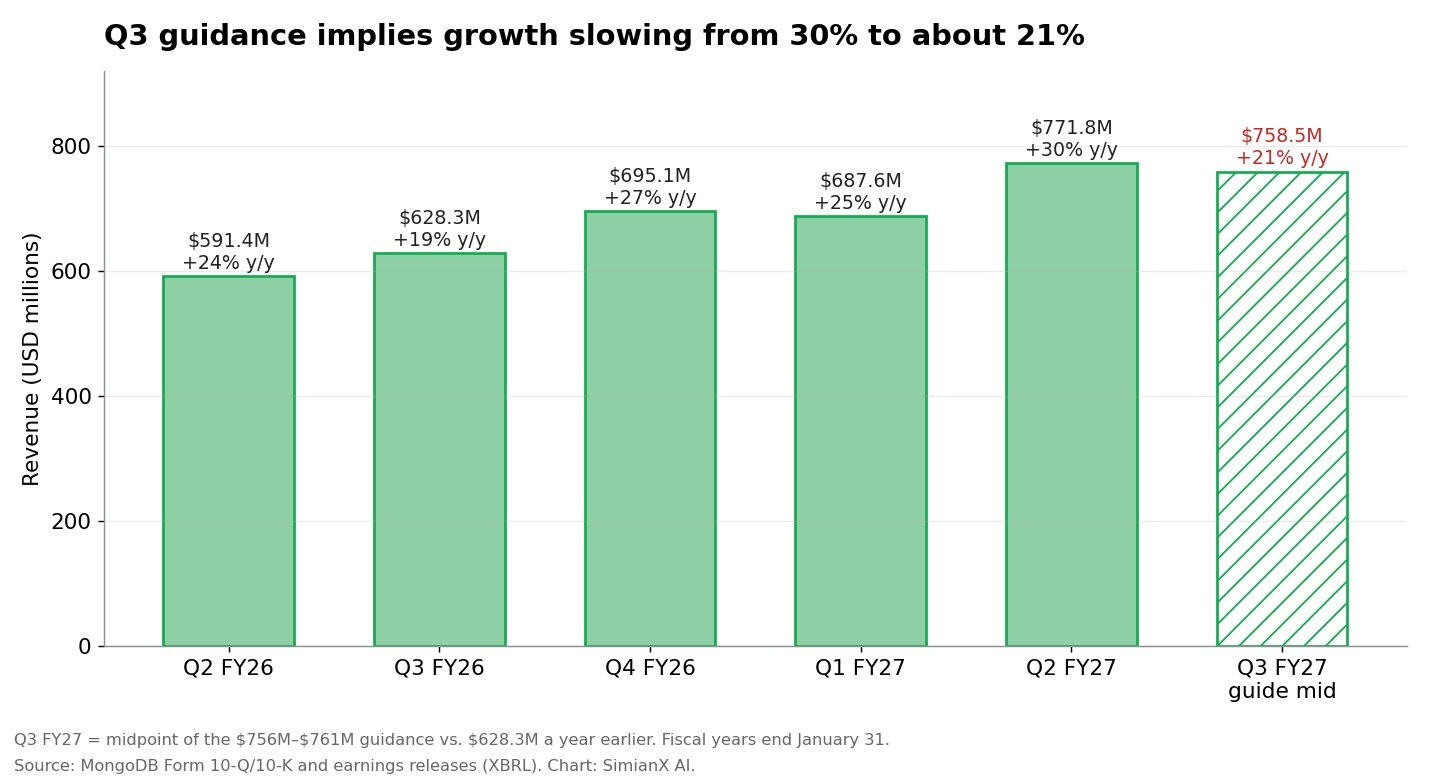
One detail matters for the next few months. Q3 revenue guidance of $756–761 million is below Q2's $771.8 million and implies growth of about 21% against $628.3 million a year earlier. Part of that reflects Enterprise Advanced term licenses, which book much of their revenue upfront and made Q2 unusually strong. MongoDB has also set guidance cautiously: it beat the top of its range by $23.6 million in Q1 and $37.8 million in Q2. A similar beat would put Q3 growth in the mid-20s.
Guidance Went Up; the Stock Went Down
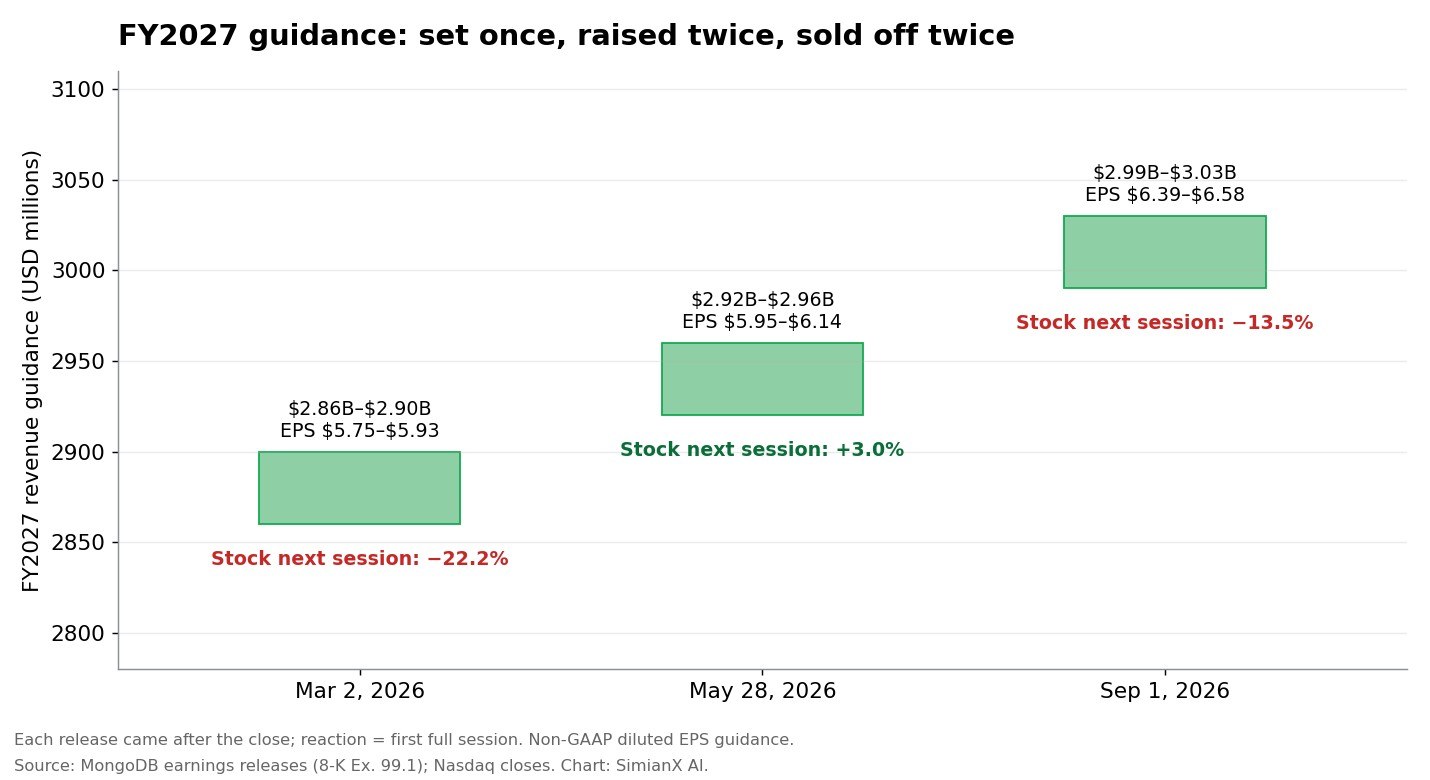
| Release | FY27 revenue guidance | Non-GAAP EPS guidance | Next-session move |
|---|---|---|---|
| Mar 2, 2026 (initial) | $2.860–2.900 billion | $5.75–5.93 | −22.2% |
| May 28, 2026 (raise) | $2.920–2.960 billion | $5.95–6.14 | +3.0% |
| Sep 1, 2026 (raise) | $2.990–3.030 billion | $6.39–6.58 | −13.5% |
| Sep 28, 2026 (reaffirmed) | unchanged | unchanged | −18.5% |
Under Desai, the full-year revenue midpoint rose 4.5%, from $2.88 billion to $3.01 billion, and the EPS midpoint rose 11%. The stock fell on three of the four guidance days anyway. The market's issue is not whether MongoDB hits its numbers. It is how long growth near 30% lasts and how much to pay for it. The fiscal 2027 midpoint implies about 22% growth on fiscal 2026 revenue of $2.46 billion, and Q4 is guided to roughly 14% at the midpoint. That is the bar a new leader will be measured against.
Stock-based compensation is the main gap between GAAP and adjusted profit. The full-year guidance adds back $628.9 million of it, about 21% of the revenue midpoint. Non-GAAP operating income of about $626 million compares with a GAAP operating result of roughly −$18 million at the midpoint.
Is the AI Thesis Intact?
The AI story belongs to the company, not to one executive. The products the bull case relies on are all shipping:
- Voyage AI. MongoDB bought Voyage AI in February 2025 for $160.9 million ($19.5 million in cash plus 484,169 shares), according to the fiscal 2026 10-K. Its embedding and reranking models are now built into Atlas as automated embeddings, a reranking API and the voyage-code-4 model.
- Vector search everywhere. Search and vector search became generally available in self-managed Enterprise Advanced in Q2. This matters for banks and governments that cannot put data in a public cloud.
- Coding agents. The Atlas Managed MCP Server connects coding agents such as Claude Code, Codex and Devin directly to live Atlas data. We looked at the same AI-coding trend at GitLab.
The limit is disclosure. MongoDB does not report AI revenue, Voyage revenue or vector-search usage as separate figures. Management talks about "early momentum with AI use cases." What actually drove Q2 was "core enterprise workloads." So the AI thesis cannot yet be checked in the numbers, and the Investor Day is the obvious place to change that. Competition is also real: PostgreSQL with vector extensions, the hyperscalers' own databases and data platforms such as Snowflake all target the same AI workloads.
Meta hiring Desai says something about Meta's ambitions in enterprise AI. It says nothing, either way, about MongoDB's product position. The larger risk is if senior product or sales staff follow him.
What Is MongoDB Worth After the Drop?
At $334.68 and 80.56 million shares outstanding (per the 10-Q cover), MongoDB's market value is about $26.96 billion. Subtracting $2.41 billion of cash and investments, and with no debt, the enterprise value is about $24.6 billion.
| Measure | Before (Sep 25, $410.44) | After (Sep 28, $334.68) |
|---|---|---|
| EV / FY27 revenue midpoint ($3.01 billion) | 10.2× | 8.2× |
| Price / FY27 non-GAAP EPS midpoint ($6.49) | 63× | 52× |
| Price / FY27 GAAP EPS midpoint ($0.65) | 631× | 515× |
The drop took about two turns off MongoDB's revenue multiple. The grid below turns EV/revenue multiples into implied share prices. Each price equals the multiple times $3.01 billion, plus $2.41 billion of cash, divided by 80.56 million shares:
| EV / FY27 revenue | Implied price | vs. $334.68 |
|---|---|---|
| 6× | $254 | −24% |
| 7× | $292 | −13% |
| 8× | $329 | −2% |
| 9× | $366 | +9% |
| 10× | $404 | +21% |
| 12× | $478 | +43% |
At today's price, the market is paying about 8 times sales. Before the news it paid about 10 times. Getting back to 10 times needs either proof that 25%+ growth can last, or a CEO appointment that removes the uncertainty. The drop-history table above gives a warning: after earlier shocks, the multiple usually compressed further before it recovered.
What to Watch at the September 29 Investor Day
- Long-term targets. Does management give a multiyear revenue growth and operating margin framework? A target above 20% growth with margins still rising would support the 8–10× range.
- AI disclosure. Any number for AI-driven workloads, Voyage usage or vector-search customers would be the first hard evidence for the AI thesis.
- The CEO search. A timeline, and whether internal candidates are being considered. The shorter the interim period, the lower the risk discount.
- Retention. Are the product, engineering and go-to-market leaders staying? A second senior exit to Meta would change the story.
- Capital return. With $2.4 billion of cash, no debt and $399.7 million left on the buyback, a faster repurchase below $335 would be a clear vote of confidence. The company last bought at an average of $324.42 in May–July.
Bull Case vs. Bear Case
| Bull case | Bear case |
|---|---|
| Revenue +30%, 24% non-GAAP margin, FCF nearly doubled | Q3 guidance implies growth near 21% before any beat |
| Guidance reaffirmed the same day; business unchanged | Fourth top-level exit in 22 months |
| Long-time former CEO back with 11 years of context | Interim role, no successor timeline yet, and he also advises at Sequoia |
| $2.41 billion cash, no debt, buyback capacity | Stock-based compensation ≈ 21% of revenue |
| 8.2× sales vs. 10.2× a week ago | Every earlier 15%+ crash kept falling after day one |
FAQ
Why did MongoDB stock drop today?
On September 28, 2026, MDB fell 18.46% to $334.68 after CEO CJ Desai resigned to become Meta's chief enterprise platform officer. Former CEO Dev Ittycheria returned on an interim basis, and the company reaffirmed its guidance.
Who is MongoDB's CEO now?
Dev Ittycheria, who led MongoDB from 2014 to 2025, is interim president and CEO while the board looks for a permanent successor with an executive search firm.
Did MongoDB cut its guidance?
No. It reaffirmed Q3 revenue of $756–761 million and fiscal 2027 revenue of $2.99–3.03 billion, with non-GAAP EPS of $6.39–6.58.
How often has MDB fallen this much in a day?
This is its seventh one-day drop of 15% or more since the 2017 IPO. In the six earlier cases, recovery to the pre-drop close took between 32 and 223 trading sessions.
Is MongoDB stock a buy after the crash?
That depends on your view of growth durability and the CEO search. At about 8× fiscal 2027 sales, the price is roughly back to where it traded before the June rally. History suggests patience: earlier drops did not end on day one.
For live fundamentals and price data, see the MDB stock page. For how other companies handled CEO handovers, see Tim Cook Steps Down.
This article is for research and education only and is not financial advice.
Related Reading
- META Stock After Muse: Can an AI Agent Justify $145B Capex?
- Tim Cook Steps Down: What John Ternus Inherits at Apple
- Snowflake Stock Soars 36% on AI Data Cloud and AWS Deal
- Datadog Stock AI Rally Analysis: What Investors Miss
- BRK.B After Buffett: 16 Months, 40 Points Behind SPY
- Meta Compute 2026: Can Excess AI Capacity Drive Revenue?
References
- MongoDB — Form 8-K on the CEO transition (Sep 28, 2026)
- MongoDB — press release: CEO transition and Investor Day
- MongoDB — Q2 fiscal 2027 financial results
- MongoDB — Q2 fiscal 2027 Form 10-Q
- MongoDB — Q4 fiscal 2026 results and initial FY27 guidance
- MongoDB — fiscal 2026 Form 10-K (Voyage AI acquisition)
- MongoDB — CJ Desai appointed CEO (Nov 3, 2025)
- MongoDB — investor relations: CEO transition
- CNBC — Meta hires MongoDB CEO CJ Desai to lead enterprise unit
- SiliconANGLE — Meta hires MongoDB CEO to lead new enterprise AI business
- SEC EDGAR — MongoDB 8-K filings
- Nasdaq — MDB historical prices
- MongoDB Atlas
- Voyage AI
- Wikipedia — MongoDB Inc.
- iShares — IGV Expanded Tech-Software Sector ETF
- Investopedia — enterprise value
- Investopedia — interim CEO
- Investopedia — non-GAAP earnings
- Investopedia — free cash flow
- Investopedia — share buybacks
- SimianX — MDB stock fundamentals