
Meta Muse and META Stock: Personal AI Agent vs a $145 Billion Capex Bill
META stock after Muse launch presents investors with an unusually consequential question: can Meta Platforms turn its enormous social distribution network into the dominant consumer AI-agent ecosystem?
On September 8, 2026, Meta officially launched Muse, a personal artificial intelligence agent that can browse websites, fill out forms, send emails, book travel, negotiate on a user’s behalf, make purchases and continue working after the user closes the app. Muse is rolling out in the U.S. on iOS, Android and muse.ai, and can also be used directly inside WhatsApp, with support for Meta’s AI glasses coming soon.
This is considerably more ambitious than adding another chatbot to Facebook or Instagram. Meta wants Muse to become an operating layer for a user’s digital life—one that understands goals, remembers preferences and acts across third-party services.
The opportunity is potentially enormous. Meta reported 3.60 billion daily active people across its family of apps in June 2026. Even limited adoption within that network could create a major subscription, commerce or business-messaging platform. But the investment case is not straightforward. Muse requires users to trust Meta with email, calendars, payments and other deeply personal information, while the company is spending unprecedented amounts on AI infrastructure: in the second quarter of 2026, capital expenditures consumed 97.5% of Meta’s operating cash flow.
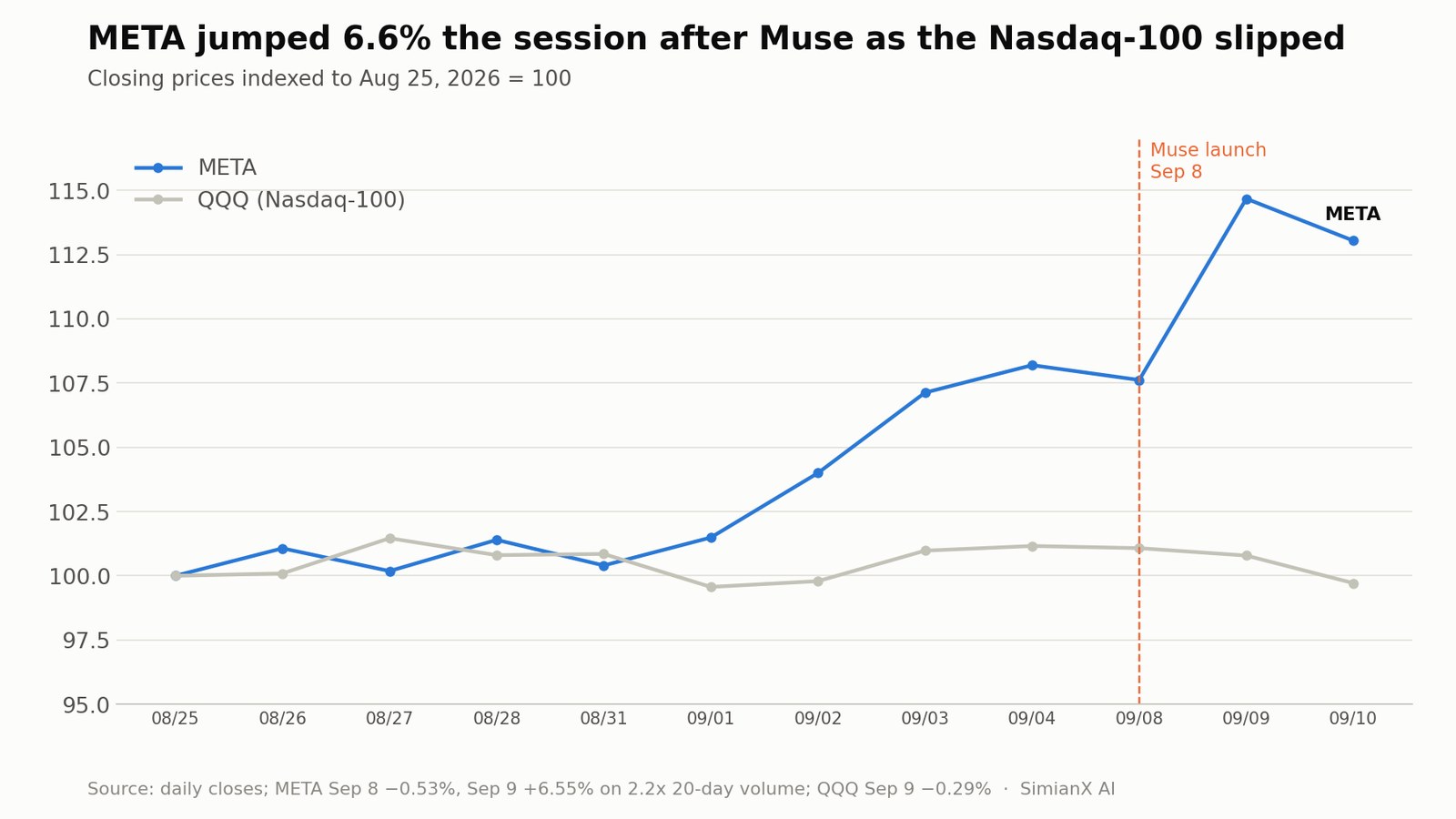
The market’s first verdict was mixed. META slipped 0.5% on launch day, then jumped 6.6% the following session while the Nasdaq-100 fell—yet the shares still sit roughly 18% below their 52-week high of $790.80.
The central question is therefore not whether Muse is technologically impressive. It is whether Meta can convert Muse into enough incremental revenue and strategic value to justify its rapidly rising costs.
This research evaluates Muse’s capabilities, possible business models, competitive position, financial impact, risks and implications for META stock. Investors can also use SimianX AI to monitor Meta’s financial filings, price action, technical indicators and AI-related news as the Muse thesis develops.
What Is Meta Muse?
Muse is an agentic AI system, meaning it is designed to take actions instead of merely producing answers.
A conventional chatbot responds to a prompt and waits for another instruction. Muse can break a larger objective into steps, use tools, browse the internet, coordinate a dedicated browser sub-agent and work in the background. It then returns to the user when something changes or when it needs approval.
According to Meta’s official Muse announcement, the launch version can:
- Send emails, with approval before anything is sent.
- Book travel and handle everyday errands.
- Open a browser and complete forms.
- Negotiate on the user’s behalf—for example, lowering a bill or selling a car for more.
- Turn long-term goals into personalized plans and keep advancing them.
- Remember what matters to the user and act on details mentioned only once.
- Turn a recipe reel saved on Instagram into a grocery list.
- Make purchases after receiving user approval.
Muse is powered by Muse Spark 1.3, part of the model family developed by Meta Superintelligence Labs. Meta says the model is particularly strong at driving a web browser and is “close to state of the art” at resisting prompt injection.
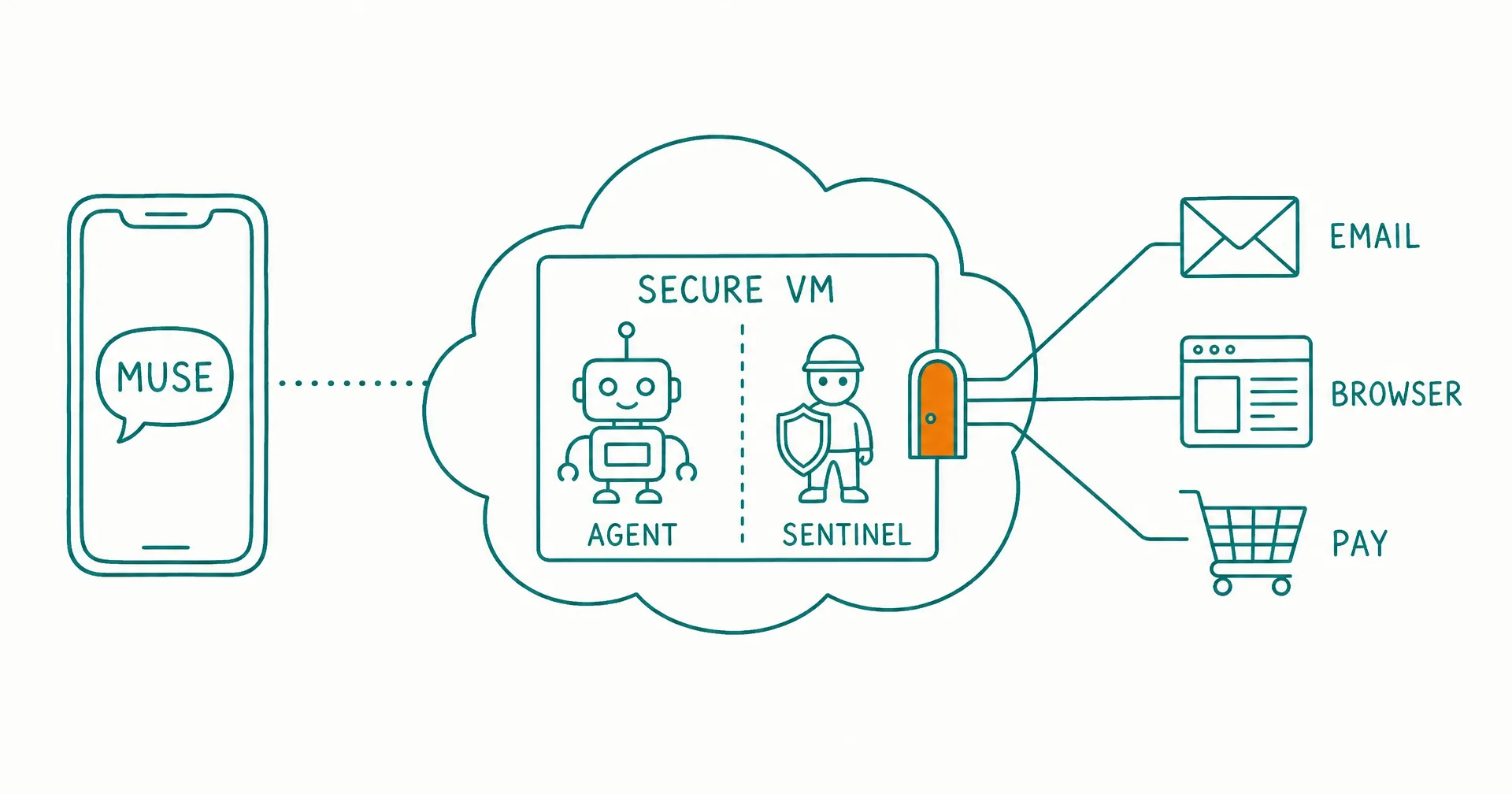
The agent runs inside a persistent cloud environment called Muse Secure VM. Meta says each user receives a dedicated, isolated virtual machine containing a browser, storage and the compute required to complete tasks. A separate agent called Sentinel is the sole permission authority for actions with connected services and for all network traffic leaving the machine.
That architecture matters because a capable agent needs far more authority than a chatbot. It may encounter malicious instructions on websites, misunderstand a request or attempt an irreversible action. Meta’s design assumes that the core agent can make mistakes and places another system between Muse and the outside world.
Muse is not simply a better search box. Meta is attempting to build a trusted transaction and execution layer between consumers, apps and businesses.
Why Muse Matters for META Stock
Muse could strengthen Meta in four related markets:
| Opportunity | How Muse participates | Potential benefit to Meta |
|---|---|---|
| Consumer AI | Personal planning, research and task execution | Subscriptions and higher ecosystem engagement |
| Digital advertising | Moves users from product discovery toward action | Better conversion measurement and advertiser returns |
| Agentic commerce | Searches, compares and purchases products | Transaction fees and commercial partnerships |
| Business messaging | Connects consumers with automated merchant agents | Paid messages, business subscriptions and commerce tools |
Most of Meta’s current revenue still comes from advertising. In the second quarter of 2026, the company generated $59.36 billion of advertising revenue, representing approximately 98% of total quarterly revenue.
Muse does not need to replace that advertising engine to become strategically important. It can strengthen the engine by moving Meta closer to the transaction.
Instagram already influences what consumers want. WhatsApp already connects users with businesses. Facebook Marketplace already supports commercial discovery. An effective personal agent could connect those separate activities:
- A user saves a product or travel video on Instagram.
- Muse interprets the user’s intent and preferences.
- The agent researches options or contacts relevant businesses.
- It compares prices, availability and reviews.
- The user approves a booking or purchase.
- Meta gains better evidence of whether discovery produced a transaction.
This closed-loop process could make Meta’s advertising inventory more valuable. Advertisers generally pay more when a platform can produce measurable sales rather than impressions or clicks alone.
Meta’s Core Business Is Already Growing Rapidly
Investors should avoid treating Muse as a rescue plan for a weak company. Meta’s advertising business entered the launch from a position of considerable strength.
According to Meta’s second-quarter 2026 results (filed with the SEC as Exhibit 99.1 to its July 29 Form 8-K):
| Q2 2026 metric | Result | Year-over-year change |
|---|---|---|
| Total revenue | $60.80 billion | +28% |
| Advertising revenue | $59.36 billion | +27% |
| Ad impressions | — | +14% |
| Average price per ad | — | +12% |
| Family daily active people | 3.60 billion | +3% |
| Operating income | $18.78 billion | -8% |
| Operating margin | 31% | Down from 43% |
| Net income | $15.85 billion | -14% |
| Capital expenditures (incl. finance leases) | $31.08 billion | Up from $17.01 billion |
| Free cash flow | $784 million | Down from $8.55 billion |
The contrast is important. Revenue and advertising demand were exceptionally strong, but profit and free cash flow weakened because spending grew even faster.
Meta’s advertising performance shows that AI is already producing returns through recommendation systems, ad ranking, creative generation and campaign automation. The company’s Q2 earnings materials said ad impressions increased 14% while average ad prices rose 12%.
What the Q2 profit decline actually contained
The 8% drop in operating income looks alarming until you read the line items. Total costs and expenses of $42.03 billion included $2.40 billion of charges related to legal proceedings and $1.18 billion of severance tied to the May 2026 headcount reduction. Add those two items back and operating income was about $22.36 billion, up roughly 9% year over year, for an adjusted margin near 36.8%.
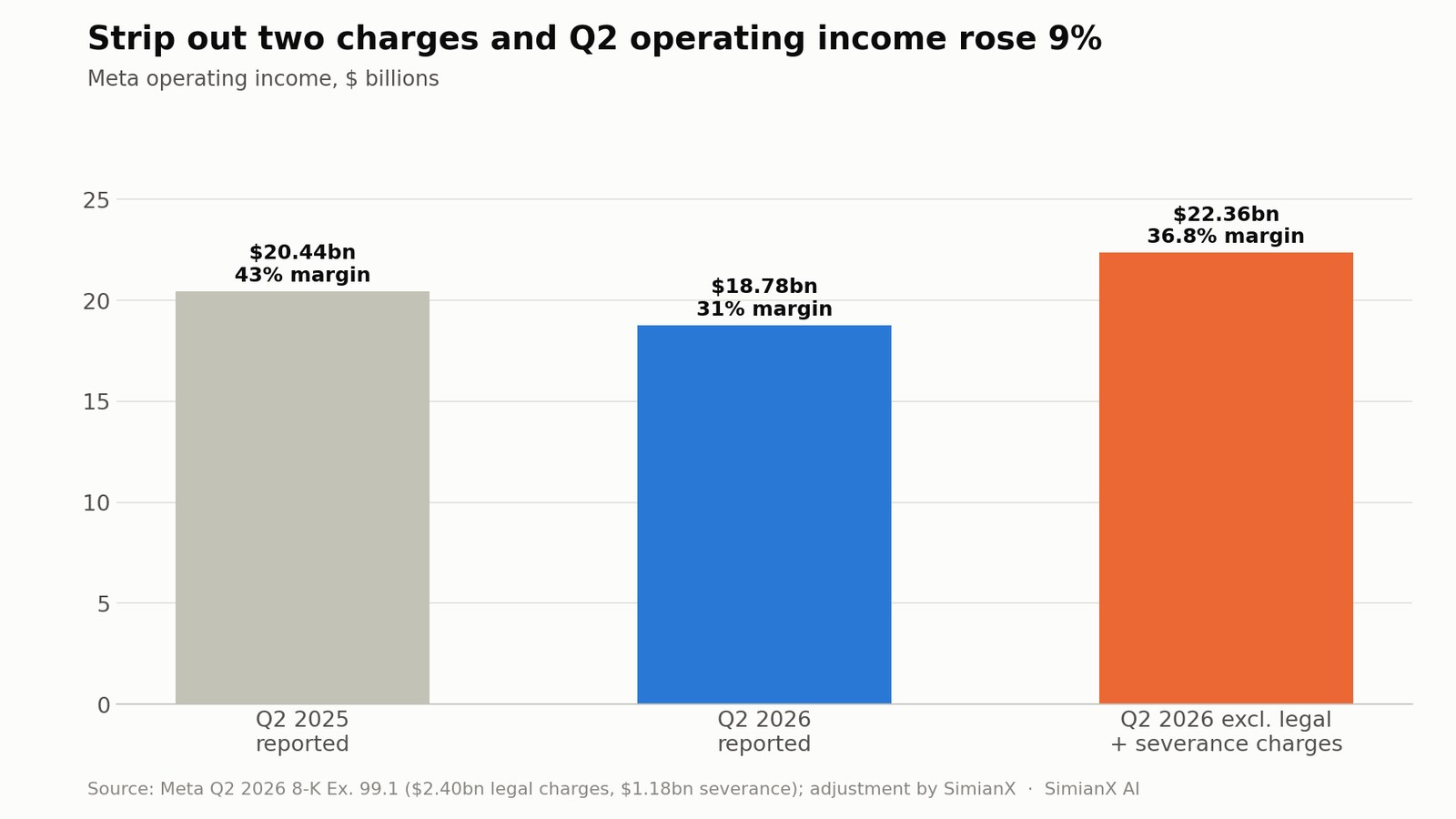
Two caveats keep this from being a clean bill of health. First, the Family of Apps segment alone earned $23.39 billion, still below $24.97 billion a year earlier, because AI infrastructure and compensation costs are rising. Second, Reality Labs lost another $4.62 billion on just $431 million of revenue. Management’s outlook calls for Q3 revenue of $61–64 billion, full-year expenses of $165–169 billion, and 2026 operating income above 2025’s level.
Muse represents a second stage of the AI strategy:
- Stage one: Use AI to recommend better content and advertisements.
- Stage two: Give users AI tools that create and communicate.
- Stage three: Allow an agent to complete tasks and transactions.
- Stage four: Connect personal agents with business agents across Meta’s platforms.
The first stage is already helping the core business. The crucial unknown is whether the later stages will produce attractive returns or simply increase infrastructure costs.
How Could Meta Monetize Muse?
Meta has not provided enough operating data for investors to model Muse as a mature segment. Any revenue forecast is therefore speculative. Nevertheless, there are four credible monetization channels.
1. Consumer subscriptions
Meta says Muse is free for most of what people need, with subscription plans for people who want to do more. A subscription model creates a direct path from adoption to recurring revenue.
Illustrative subscription outcomes show the scale of Meta’s distribution advantage:
| Paying subscribers | Average monthly revenue | Illustrative annual revenue |
|---|---|---|
| 5 million | $20 | $1.2 billion |
| 10 million | $20 | $2.4 billion |
| 25 million | $20 | $6.0 billion |
| 50 million | $20 | $12.0 billion |
These figures are scenarios, not company guidance. They also represent gross revenue before model inference, virtual-machine capacity, customer support, payment fees and distribution costs.
Even 10 million paying users would represent only a small fraction of Meta’s global audience. However, consumer AI subscriptions are competitive, and many users may remain on free plans or subscribe to only one general-purpose AI service.
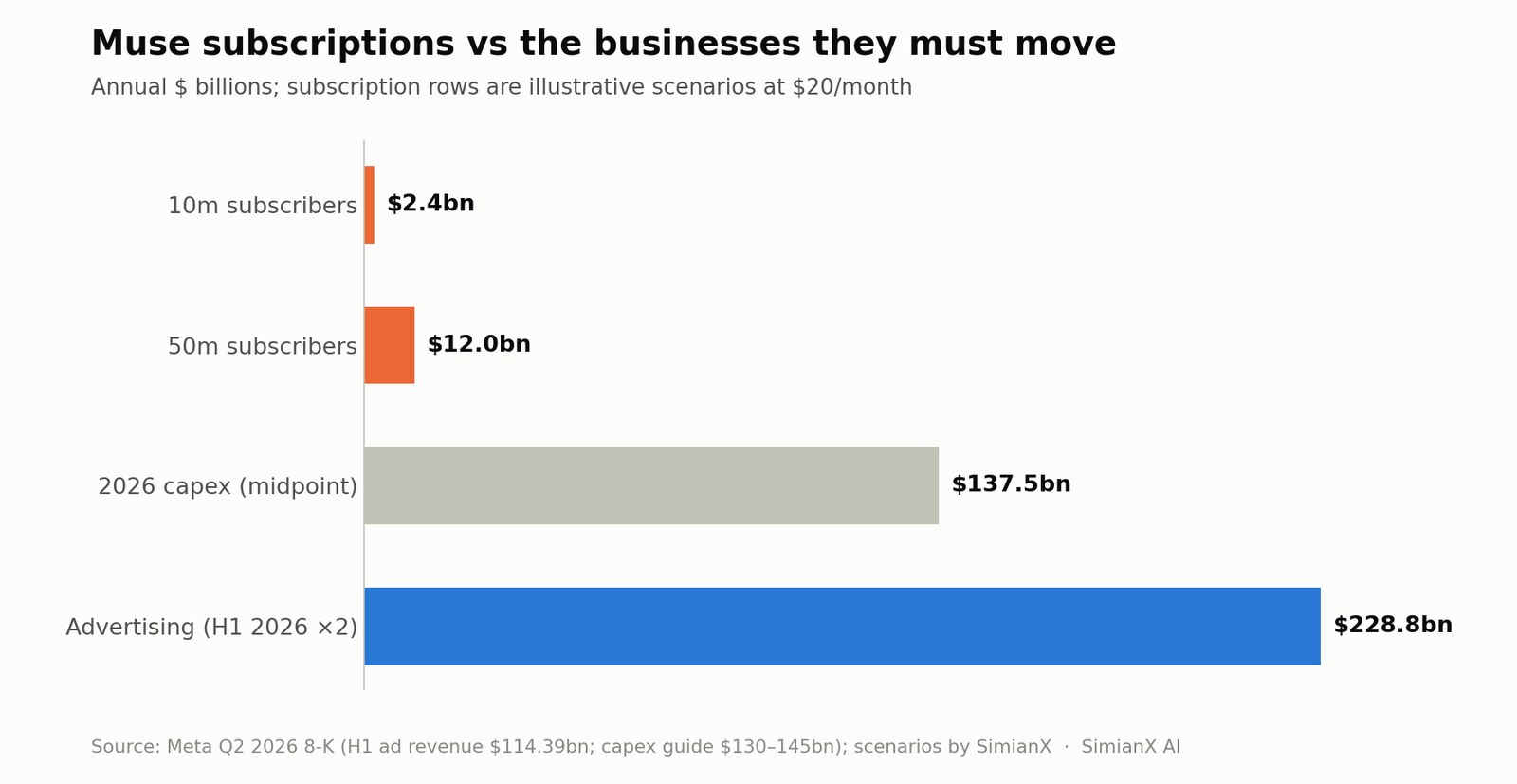
Put in context, even the 50-million-subscriber case would cover less than a tenth of this year’s capex midpoint. That is why the subscription line alone cannot carry the Muse thesis.
2. Advertising improvement
Muse could improve advertising economics without displaying conventional ads inside its conversations.
Meta says Muse does not share users’ conversations or the data in their virtual machine with its advertising systems. That restriction is valuable for user trust, but it limits direct ad targeting based on private agent conversations.
There is a nuance investors should not miss. Meta’s own security write-up acknowledges “legitimate scenarios” where Muse usage can still influence ads: when Muse browses the web it appears as the user’s activity, so a clothing designer whose site Muse visits could later retarget that user on Instagram.
The indirect benefit can still be meaningful. Muse may:
- Increase time spent within Meta’s ecosystem.
- Convert Instagram inspiration into commercial activity.
- Help consumers communicate with advertisers.
- Reduce friction between an ad impression and a purchase.
- Improve conversion measurement with user permission.
- Create more valuable business-messaging interactions.
A relatively small improvement in Meta’s enormous advertising operation could be worth more than several million AI subscriptions. For perspective, Meta generated $114.39 billion in advertising revenue during the first six months of 2026.
3. Agentic commerce
Muse can check out using Link, built by Stripe. According to Meta, Link’s wallet for agents generates a one-time-use card so that the merchant and agent never see the user’s real card details, and Muse is the first AI agent covered by Link’s purchase protections, including coverage for damaged or lost items, price drops and no-fee returns on eligible purchases. Shop Pay and 1Password support are coming soon.
Possible long-term monetization methods include:
- Referral or affiliate fees.
- Merchant commissions.
- Preferred-placement fees.
- Payment-related economics.
- Travel and service-booking fees.
- Premium purchase protection.
- Merchant tools for agent-compatible product catalogs.
Meta must handle this carefully. If Muse recommends products according to the highest commission rather than the user’s interests, trust could deteriorate quickly. Investors should therefore distinguish between user-aligned commerce revenue and a potentially damaging pay-to-play recommendation system.
4. Business AI and messaging
The strongest commercial opportunity may emerge when Muse communicates with AI agents operated by businesses.
Meta has already introduced AI tools for businesses on WhatsApp, allowing merchants to answer customer questions and support sales. The company has also been expanding these capabilities through Instagram, Messenger and Meta Business Suite.
A consumer might ask Muse to find a restaurant, replace a household appliance or arrange a vacation. Muse could then communicate with business agents, compare offers and complete the transaction. Meta would control important parts of both sides of the interaction.
This could support:
- WhatsApp Business subscriptions.
- Paid business messaging.
- AI customer-service tools.
- Lead-generation fees.
- Transaction services.
- Automated advertising campaigns.
- Premium analytics and merchant software.
The largest Muse opportunity may not be selling AI directly to consumers. It may be creating a commercial network where personal agents transact with business agents.
Meta’s Distribution Advantage
OpenAI, Google, Anthropic, Microsoft, Amazon and other companies are developing assistants or agents. Meta’s primary advantage is not necessarily having the best model on every benchmark. It is distribution.
Meta owns Facebook, Instagram, Messenger, WhatsApp and Threads. Its family of apps reached 3.60 billion daily active people in June 2026.
That gives Muse several advantages:
Familiar entry points
Users can communicate with Muse in a format that resembles messaging another person. WhatsApp integration removes the need to establish a completely new behavior.
Rich social context
With permission, Muse can draw on connected services and information that may be useful for planning events, communicating with friends or interpreting saved content.
Direct access to businesses
Millions of companies already maintain a presence on Facebook, Instagram or WhatsApp. Meta does not need to build every commercial relationship from the beginning.
Hardware integration
Meta plans to bring Muse to AI glasses. An agent connected to a camera, microphone and contextual wearable interface could become more useful than a text-only assistant.
Infrastructure scale
Meta can distribute AI inference costs across a global infrastructure footprint and use the same models to improve content recommendations, advertising, business tools and consumer agents—a theme we explored in Meta Compute 2026: Can Excess AI Capacity Drive Revenue?
However, distribution does not guarantee adoption. Microsoft had widespread software distribution for Copilot, Google controls important search and mobile surfaces, and Amazon has deep shopping and payment relationships. Consumers may choose agents based on reliability and trust rather than preinstallation alone.
Muse Security and Privacy: Competitive Moat or Adoption Barrier?
Muse requires access to unusually sensitive information. To book travel or manage a schedule, it may need emails, calendars, account logins, payment authority and knowledge of personal relationships.
Meta’s security architecture includes several notable protections, detailed in its Muse safety and security report:
- Each user’s agent runs in an isolated virtual machine.
- Credentials are stored separately and are never seen by the main agent; passwords are injected into the browser only at the point of need.
- Sentinel independently approves or rejects actions with connectors and all outbound network traffic.
- A “tainted egress” system tracks whether a process has read user data and asks for approval accordingly.
- Actions that move data out of the VM, send emails or make purchases require human approval.
- Incoming web content is labeled as untrusted input, and a separately trained classifier watches for manipulation attempts.
- The Meta bug bounty program now pays up to $300,000 for valid Muse reports, including up to $130,000 for a successful prompt injection that affects one user.
- Meta is developing a confidential VM intended to let outside experts confirm that even Meta cannot access stored data.
These are meaningful engineering measures. Yet Meta explicitly acknowledges that Muse “can and will still make mistakes” and that prompt injection remains an open industry problem.
There is also an important limitation: until the confidential VM ships, the protections against Meta itself are a matter of policy and system design rather than a cryptographic guarantee that outsiders can verify.
This creates a two-sided investment issue.
Bullish interpretation: Meta is treating security as a core product requirement and could establish an industry standard for personal-agent infrastructure.
Bearish interpretation: Users may be unwilling to connect their most sensitive accounts to Meta regardless of the technical safeguards.
The trust challenge is particularly important because of a recent misstep. When Meta launched Muse Image on July 7, 2026, it let people generate images by @-mentioning public Instagram accounts. Three days later, Meta withdrew that feature, saying it had “heard the feedback that this feature missed the mark.” That episode illustrates how quickly a product-design decision can turn into a privacy controversy.
The $130 Billion Question: AI Capital Expenditure
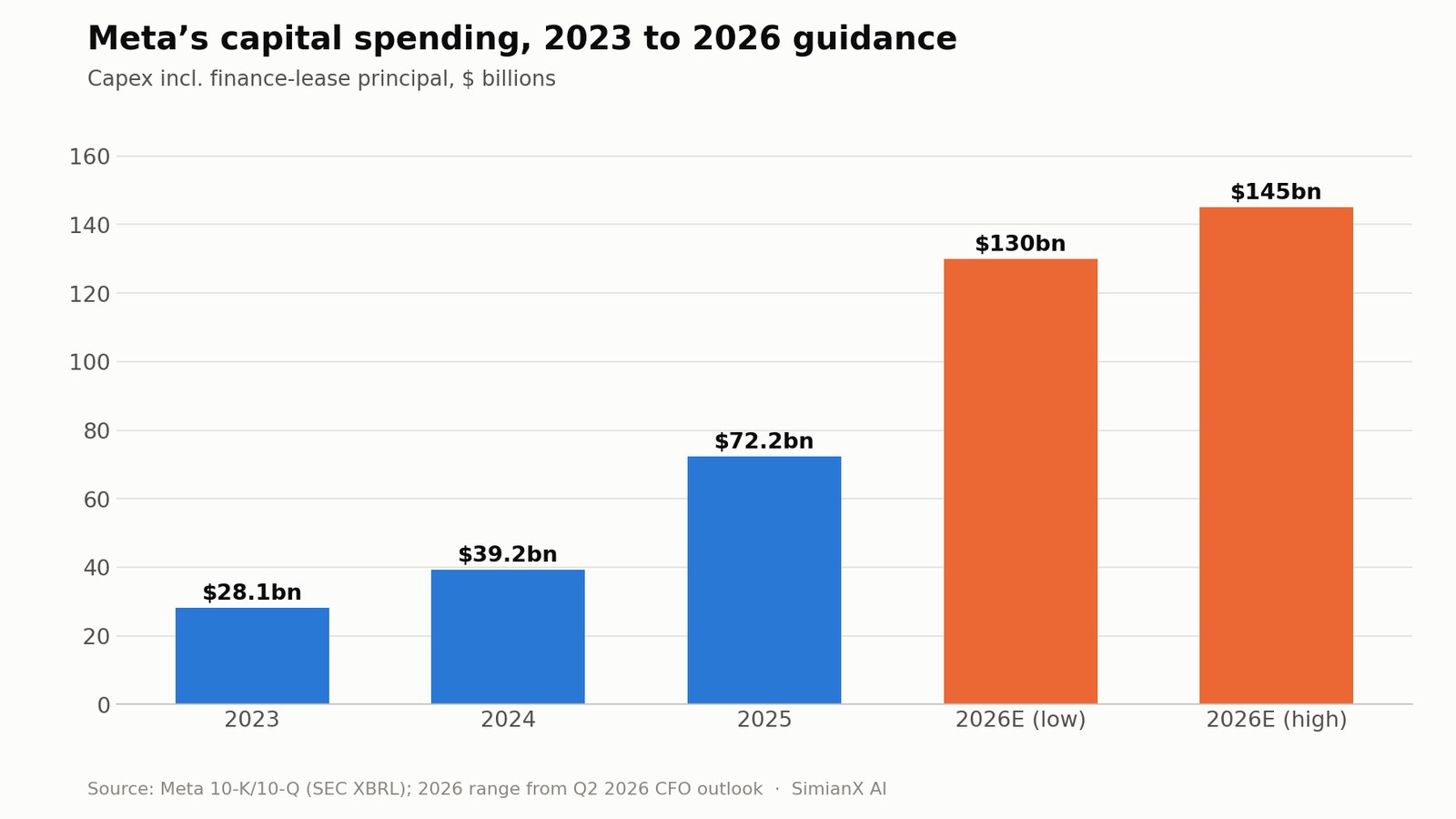
Meta expects 2026 capital expenditures, including finance-lease principal payments, of $130 billion to $145 billion, a range it narrowed from $125–145 billion in July. This is a dramatic increase from $72.22 billion in 2025, which was itself nearly double 2024’s $39.23 billion.
At the midpoint, 2026 capital expenditure would be approximately $137.5 billion—nearly double the previous year and almost five times the 2023 level.
Meta says the spending supports both Meta Superintelligence Labs and the core business. It includes data centers, servers, networking equipment and other infrastructure required for training and inference—the same pattern we tracked across the industry in AI Capex 2026: Big Tech Now Spends 96% of Its Cash Flow.
The investment case depends on whether that infrastructure generates returns across multiple products:
| AI investment beneficiary | Potential return |
|---|---|
| Advertising | Better targeting, ranking, conversion and creative tools |
| Facebook and Instagram | Higher engagement and content quality |
| Meta AI and Muse | Consumer subscriptions and ecosystem retention |
| WhatsApp Business | Paid messaging and business-agent services |
| Developer models and tools | API and software revenue |
| AI glasses | Hardware sales and a new computing platform |
The shared infrastructure is central to the bull case. If the same investment improves a $200-billion-plus advertising business while also supporting Muse, the hurdle for Muse-specific revenue is lower.
Meta’s cash-flow squeeze, quarter by quarter
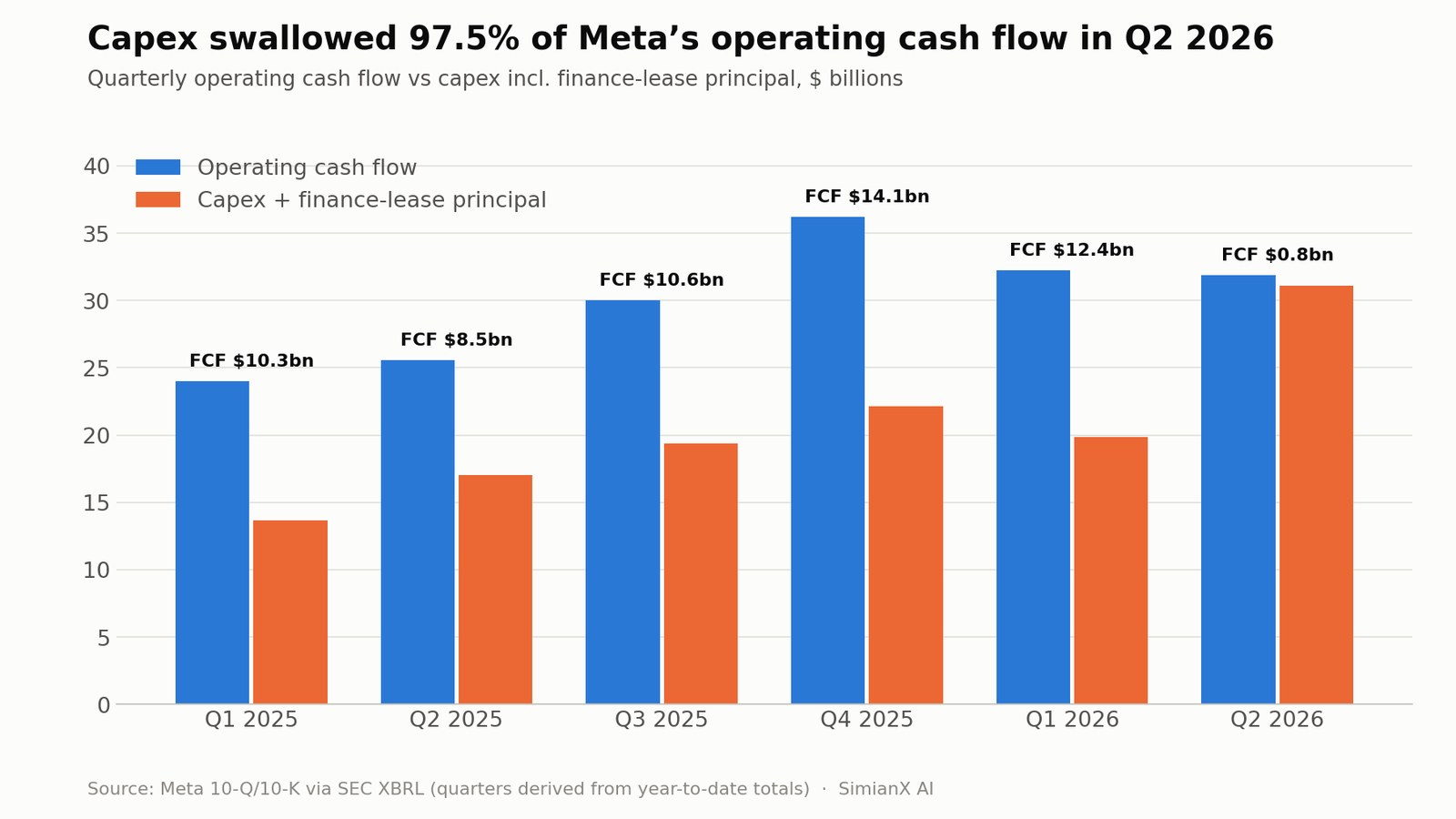
But capital intensity is already affecting cash flow. The table below derives quarterly figures from Meta’s SEC filings (capex includes principal payments on finance leases):
| Quarter | Operating cash flow | Capex + finance leases | Free cash flow | Capex as % of OCF |
|---|---|---|---|---|
| Q1 2025 | $24.03bn | $13.69bn | $10.33bn | 57.0% |
| Q2 2025 | $25.56bn | $17.01bn | $8.55bn | 66.6% |
| Q3 2025 | $30.00bn | $19.37bn | $10.63bn | 64.6% |
| Q4 2025 | $36.21bn | $22.14bn | $14.08bn | 61.1% |
| Q1 2026 | $32.23bn | $19.84bn | $12.39bn | 61.6% |
| Q2 2026 | $31.86bn | $31.08bn | $0.78bn | 97.5% |
Operating cash flow was actually slightly lower in Q2 2026 than in Q1, while capex jumped by $11.2 billion in a single quarter. First-half free cash flow fell to $13.17 billion from $18.88 billion a year earlier despite strong revenue growth. Meta still held $90.26 billion of cash and marketable securities against $83.66 billion of long-term debt at June 30, so this is a margin-of-safety issue rather than a solvency one.
If the $130–145 billion guide holds, the second half of 2026 implies roughly $81–96 billion of further spending—well above the pace of any prior half-year.
Investors must monitor depreciation as well as capital expenditure. Hardware purchased today will create accounting expenses in future periods. Even if capital spending eventually stabilizes, depreciation can continue pressuring operating margins.
How META Traded Around the Muse Launch
The stock’s reaction offers a useful read on how much of Muse the market is willing to price in.
| Date | META close | Daily change | QQQ daily change |
|---|---|---|---|
| Sep 3, 2026 | $610.68 | +3.0% | +1.2% |
| Sep 4, 2026 | $616.77 | +1.0% | +0.2% |
| Sep 8, 2026 (Muse launch) | $613.48 | -0.5% | -0.1% |
| Sep 9, 2026 | $653.69 | +6.6% | -0.3% |
| Sep 10, 2026 | $644.38 | -1.4% | -1.1% |
Launch day itself was quiet, with volume only about 1.2 times its 20-day average. The move came the next session, when META rose 6.6% on roughly 2.2 times normal volume while the Nasdaq-100 slipped—an outperformance of nearly seven percentage points. Even after that jump, the shares remain about 18% below their 52-week high of $790.80 and near the $1.64 trillion market-capitalization mark.
What Would Prove That Muse Is Working?
Downloads and launch-week app-store rankings are insufficient. Investors need evidence of recurring use, economic value and improving efficiency.
The most useful indicators would include:
- Monthly and daily active Muse users.
- Tasks completed per active user.
- User retention after 30, 90 and 180 days.
- Percentage of users connecting email, calendar or payment services.
- Conversion from free to paid plans.
- Subscription revenue per paying user.
- Inference and virtual-machine cost per task.
- Number and value of agent-assisted purchases.
- Growth in business-agent interactions.
- Incremental WhatsApp Business revenue.
- Measurable lift in advertising conversion.
- Security incidents, erroneous actions and refund rates.
Meta may initially disclose only qualitative statements. Investors should be skeptical if management emphasizes total access or trial numbers without retention and unit-economics data.
A practical monitoring process is:
- Track adoption: Determine whether users continue using Muse after initial curiosity fades.
- Track depth: Look for growth in connected services, completed tasks and recurring goals.
- Track monetization: Compare subscription and business-messaging progress with infrastructure costs.
- Track trust: Monitor security incidents, privacy changes and regulatory responses.
- Track capital efficiency: Compare incremental operating profit with capital expenditure and depreciation.
SimianX AI can support this process by bringing together earnings releases, SEC data, technical analysis, analyst revisions and news sentiment—you can open a live META analysis directly. Investors should still verify important figures with Meta’s filings and official disclosures.
META Stock Valuation After the Muse Launch
After the launch, META traded around $644–654, giving Meta a market capitalization of roughly $1.64 trillion, a trailing earnings multiple of about 25 times and a forward multiple around 20 times earnings, according to StockAnalysis market data. These figures change daily and should be checked before making an investment decision.
That valuation does not appear to require Muse to become a massive standalone business immediately. It does, however, assume that Meta can preserve healthy growth and margins while investing aggressively in AI.
A scenario framework is more useful than attaching an arbitrary value to Muse.
| Scenario | Muse outcome | Core business | Spending outcome | Likely stock implication |
|---|---|---|---|---|
| Bear | Weak retention; users resist sharing data | Ad growth slows | Capex and depreciation stay elevated | Multiple contracts as free cash flow disappoints |
| Base | Useful niche product with moderate paid adoption | Ads continue benefiting from AI | Spending produces gradual operating returns | Earnings growth supports a market-like or modest premium multiple |
| Bull | Muse becomes a widely used consumer-agent platform | Ads and messaging gain measurable conversion benefits | Shared AI infrastructure generates strong returns | META receives additional platform and AI optionality premium |
Illustrative bear case
In a bear case, Muse produces limited subscription revenue because users prefer competing assistants or refuse to connect personal accounts. Infrastructure and depreciation expenses continue rising, advertising growth normalizes, and free cash flow remains under pressure.
The danger is not that Meta becomes unprofitable. The danger is that investors lower the multiple assigned to the company because capital requirements become structurally higher.
Illustrative base case
In a base case, Muse gains a meaningful but not dominant user base. Subscriptions become a multibillion-dollar business over several years, while Muse also improves engagement, commerce and messaging.
Meta’s advertising operation remains the principal earnings engine. AI investment supports revenue growth, but operating margins remain below their previous peak because inference and depreciation costs are substantial.
Illustrative bull case
In a bull case, Muse becomes one of the default interfaces through which consumers organize tasks and interact with businesses. Integration across WhatsApp, Instagram, wearables and merchant agents creates a network effect.
Direct subscriptions matter, but the larger value comes from better advertising conversion, paid business interactions and agentic commerce. Meta’s AI infrastructure serves multiple high-return products, allowing operating profit and free cash flow to accelerate after the investment cycle moderates.
The bull case does not require Muse to replace advertising. It requires Muse to make Meta’s advertising, messaging and commerce ecosystem more valuable.
The Main Risks to the Muse Growth Thesis
Consumer trust
Meta’s history with privacy and data use may discourage users from connecting email, calendars, financial information and personal accounts.
Agent errors
An answer generated by a chatbot can be ignored. An incorrect action performed by an agent can cost money, damage relationships or expose private information.
Prompt injection and cybersecurity
Malicious text on a website or in a document may attempt to manipulate an agent. Sentinel and isolated credentials reduce the risk but cannot eliminate it.
Competition
Google has search, Android, Gmail and Maps. Microsoft has Windows and workplace software. Amazon has shopping, payments and logistics. OpenAI and Anthropic have strong direct AI brands. Meta’s distribution advantage is substantial but not exclusive.
Margin pressure
Persistent AI inference, virtual-machine and depreciation costs could reduce the profitability of free or lightly monetized usage.
Regulation
Muse may attract scrutiny involving privacy, automated decisions, consumer protection, competition, financial transactions and AI safety. Regulatory fragmentation could slow international expansion. Q2 already carried $2.40 billion of charges related to legal proceedings.
Monetization conflicts
Using personal-agent data for advertising could undermine trust. Avoiding that data may limit monetization. Meta must find revenue models that align its incentives with the user’s interests.
Capital allocation
Meta is simultaneously funding AI infrastructure, superintelligence research, Reality Labs, wearables and its established platforms. In Q2 2026, Reality Labs generated only $431 million of revenue while recording a $4.62 billion operating loss. Investors must consider the combined burden of these long-duration projects.
Is META Stock a Buy After Muse?
Muse strengthens the strategic case for Meta, but the product is too new to justify an investment decision on its own.
The strongest reasons to own META remain:
- A global user base of 3.60 billion daily active people.
- A highly profitable advertising platform.
- Strong 2026 revenue and advertising growth.
- Underlying operating income that grew about 9% in Q2 once one-off charges are excluded.
- AI improvements already contributing to recommendation and ad performance.
- Multiple paths to monetize WhatsApp and business messaging.
- Distribution advantages across social, messaging and wearable products.
- Muse as a potentially valuable new platform option.
The strongest reasons for caution are:
- Capital expenditures of $130 billion to $145 billion in 2026.
- Free cash flow that fell to $784 million in Q2 as capex consumed 97.5% of operating cash flow.
- Lower operating margins.
- High security and privacy requirements.
- Unproven consumer-agent retention.
- Competition from well-funded technology platforms.
- Regulatory and legal exposure.
- Limited disclosure about Muse-specific economics.
For long-term investors, a rational approach is to value Meta’s established advertising business first and treat Muse as optionality. Paying a large premium for hypothetical Muse revenue would be premature. Ignoring Muse entirely would also miss the possibility that Meta is building a new interface for consumer intent and digital commerce.
FAQ About META Stock and Muse
What is Meta Muse AI?
Muse is Meta’s personal AI agent, launched in the United States on September 8, 2026, on iOS, Android, muse.ai and inside WhatsApp. It can browse websites, complete forms, send emails, book travel, negotiate, make approved purchases and work on longer-term goals in the background.
How will Meta monetize Muse?
Muse is free for most uses, with paid subscription plans for heavier users. Meta can also monetize it through business-agent services, paid messaging, commerce partnerships and improved advertising conversion. The largest opportunity may come from connecting personal agents with businesses across WhatsApp, Instagram and Messenger.
How did META stock react to the Muse launch?
META fell 0.5% on launch day, September 8, 2026, then rose 6.6% to $653.69 the next session on roughly 2.2 times normal volume while the Nasdaq-100 declined. The stock remained about 18% below its 52-week high.
Can Muse become Meta’s next growth engine?
It can, but investors need evidence of retention, paid conversion, task economics and commercial activity. Muse is more likely to become a meaningful growth engine if it strengthens advertising and business messaging in addition to generating subscription revenue.
Is META stock a buy after the Muse launch?
Muse adds long-term upside but does not by itself make the stock a buy. Investors should compare Meta’s earnings growth and valuation with the risks created by enormous capital spending, lower free cash flow, regulation and uncertain AI monetization.
What is the biggest risk facing Meta Muse?
The largest risk is trust. Muse becomes more useful as users give it access to sensitive data and permission to act, but Meta must persuade consumers that the productivity benefit outweighs the privacy, security and error risks.
Conclusion
Meta’s launch of Muse is strategically important because it moves the company beyond AI-generated answers and toward AI-executed actions. Muse can browse, communicate, purchase and manage projects while integrating with the social and messaging platforms billions of people already use.
The product could eventually generate subscription revenue, increase the value of Meta’s advertisements, expand WhatsApp Business and establish Meta as an intermediary in agentic commerce. Its distribution through WhatsApp, Instagram, Facebook and future AI glasses is a genuine competitive advantage.
However, Muse is not yet a proven growth engine. Adoption, retention, unit economics and consumer trust remain unknown. Meanwhile, Meta expects to spend $130 billion to $145 billion on capital expenditures in 2026, and Q2 free cash flow fell to less than $1 billion as investment surged.
The most defensible thesis is therefore balanced: Meta’s core advertising business supports the current investment case, while Muse provides potentially substantial but unproven upside. The bull case strengthens if Muse achieves recurring engagement, paid conversion and business-agent transaction growth without compromising privacy or margins. It weakens if AI infrastructure costs remain high while users refuse to delegate meaningful tasks.
Investors following META stock after Muse launch should monitor quarterly adoption disclosures, subscription progress, business-messaging revenue, advertising conversion, capital expenditure, depreciation and free cash flow. SimianX AI can help track these fundamental, technical and news-driven signals in one research environment.
Muse may become Meta’s next major growth engine—but investors should demand measurable evidence before valuing it as one.
This article is for informational and educational purposes only. It is not investment, legal or tax advice. Market prices and analyst estimates change, and investors should verify current data and consult qualified professionals before making financial decisions.
Related Reading
- Meta Compute 2026: Can Excess AI Capacity Drive Revenue?
- AI Capex 2026: Big Tech Now Spends 96% of Its Cash Flow
- Alphabet Q2 Earnings 2026: Can Gemini, Cloud Justify Capex?
- Amazon Q2 Earnings 2026: Can AWS Justify $200B AI Capex?
- Microsoft Q4 Earnings 2026: Azure Growth vs AI Capex Risk
- AppLovin Stock 2026: Can AI Advertising Keep APP Growing?
- Why MongoDB Stock Fell 18%: CEO to Meta, 7 Crashes Compared
References
- Meta Newsroom — Introducing Muse (September 8, 2026)
- Meta AI Research — Security and safety for AI agents: our approach with Muse
- Meta Newsroom — Introducing Muse Image (updated July 10, 2026)
- SEC EDGAR — Meta Q2 2026 earnings release (Form 8-K, Exhibit 99.1)
- SEC EDGAR — Meta Form 10-Q for the quarter ended June 30, 2026
- Stripe — Link
- Meta Bug Bounty
- StockAnalysis — META market data