 By Marcus Reeve
The $3.3M Options Bet Tying Tesla to SpaceX's IPO
On May 21, 2026, with Tesla closing at $417.85, a single trader walked onto the options chain and spent more than $3.3 million on the belief that the stock would explode to $480 within fifteen trading days. The expiration date was not random. It was June 12 — the exact day SpaceX is scheduled to begin trading on the Nasdaq under the ticker SPCX.
Here is the strange part. On the very same morning, Fortune published a story arguing the opposite case: that the SpaceX listing would drain money out of Tesla, not pump it. One side of Wall Street says the largest IPO in history will siphon capital away from Tesla shareholders. The other side just bet seven figures that the same event sends Tesla ripping higher on the same day.
Two directions. One date. This is a breakdown of five signals hiding inside that single options ticket — and what the bet is really wagering on.
The trade: $3.3M says Tesla rips 15% to $480
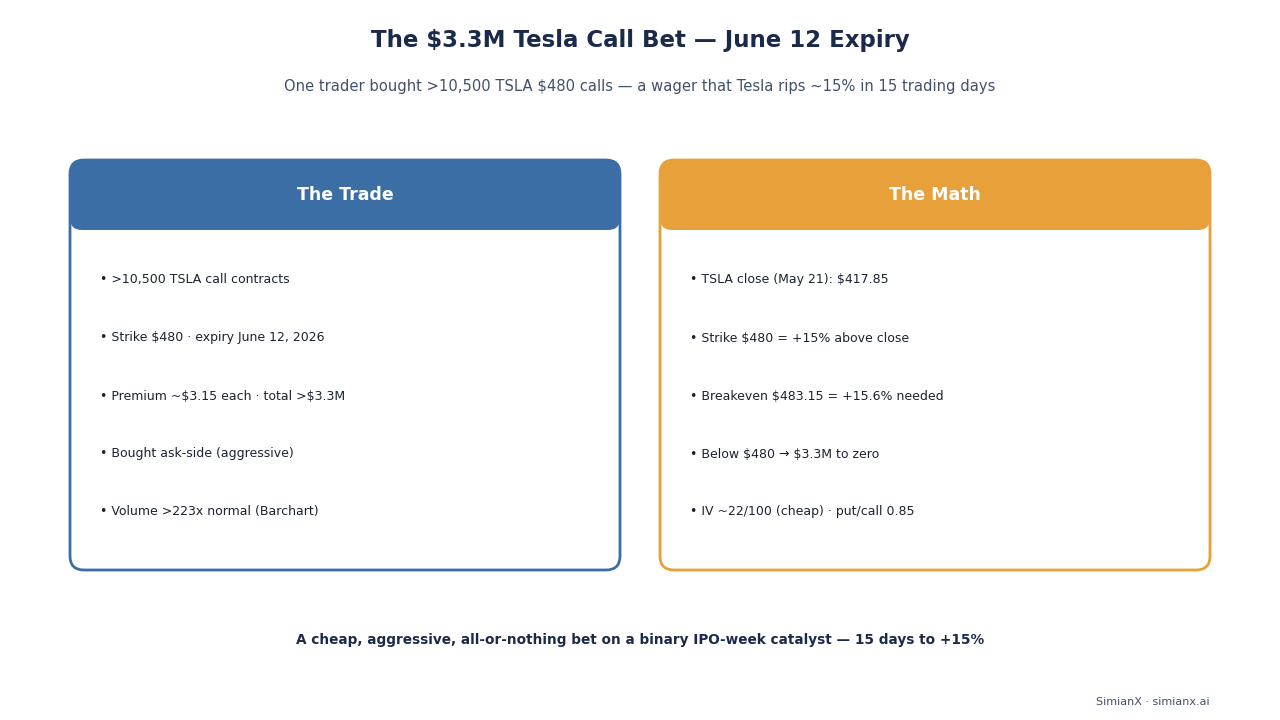
At roughly 12:20 p.m. ET on May 21, more than 10,500 Tesla call contracts hit the tape at the $480 strike, expiring June 12, at a premium near $3.15 each. They were bought on the offer — what traders call ask-side buying, meaning the buyer did not haggle. They wanted in, now.
Do the math. The $480 strike sat about 15% above the $417.85 close. Add the $3.15 premium and the breakeven is $483.15. Tesla had to climb 15.6% in fifteen trading days for this position to clear. Below $480 at expiry, the $3.3 million evaporates to zero. Above it, every additional dollar Tesla gains is worth roughly $1 million to the position.
That is not a reckless number. Tesla's 52-week high touched $498, so $480 is in living memory. And the implied-volatility percentile on Tesla options sat near 22 out of 100 — low. Relative to its own past year, Tesla optionality was cheap, which is exactly when a time-driven catalyst bet makes sense. Barchart flagged volume on the contract running over 223 times normal. The put/call ratio on the chain was 0.85 — more calls than puts — but treat that as noise, not consensus, because market-maker inventory and hedging inflate the call side too.
So someone is paying real money for a 15.6% move in three weeks. To understand why, you first have to understand the case against them.
Signal 1 — The bear case: SpaceX splits Musk's retail army
The Fortune piece leaned on BNP Paribas analyst James Picariello, and his thesis is one sentence: the SpaceX IPO is "splitting" Elon Musk's pro-Musk retail shareholder base in two.
The numbers behind it are uncomfortable. Retail investors own roughly 40% of Tesla. SpaceX, in a move almost unheard of for a mega-IPO, has reportedly reserved around 30% of its offering for retail — buyable on the same terms, at the same time as institutions, through brokers like Robinhood, SoFi, and Fidelity. Thirty percent of a $75 billion raise is about $22.5 billion. The question Picariello forces you to ask: where does $22.5 billion in retail cash come from?
It comes from the same wallets. Tesla retail and SpaceX retail are very nearly the same people — same brokerage accounts, same Musk thesis, same finite pile of cash. The most direct way to fund a SpaceX buy is to sell some Tesla. Joe Gilbert of Integrity Asset Management put it bluntly to Bloomberg: SpaceX "is his new baby at the expense of Tesla."
There is a colder data point underneath. According to Benzinga, Tesla's net retail inflow since SpaceX confirmed its listing intentions last December has been only about $1 million — essentially flat for half a year. That already-weak bid now has to absorb a $22.5 billion competing offer. And retail is only the first wave. Nicholas Colas, co-founder of DataTrek Research, notes that institutional rotation typically takes about three months to show up in price, meaning if capital really drains, June 12 is just the opening — the damage could surface into late summer and the Q3 reporting window.
Colas adds the deepest cut of all: "For Tesla, it has been 90-10 future-to-present value for as long as I've looked at it." Roughly 90% of Tesla's valuation rests on unfulfilled promises — robotaxis, Optimus, FSD, energy. Once SpaceX is public, the market finally has a purer Musk-innovation vehicle. If you only owned Tesla as a proxy for believing in Musk, why keep the detour?
The bear story is complete and coherent. But the person who bet $3.3 million on $480 knows something the bear story ignores.
Signal 2 — The hidden line: Tesla owns 18,990,195 SpaceX shares
Buried in the SpaceX S-1 shareholder list is a name you know. Tesla holds 18,990,195 shares of SpaceX Class A common stock — less than 1% of the company.
How? In January 2026, Tesla agreed to invest $2 billion in xAI. On February 2, xAI merged into SpaceX as a wholly owned subsidiary, and Tesla's right to xAI preferred stock automatically converted into the right to SpaceX Class A shares; the stock was issued in March. Cost basis: $2 billion. Pre-IPO carrying value: roughly $2 billion.
The instant SpaceX trades publicly, that stake gets a market price — and Tesla marks it to market every quarter, with the swing flowing straight through the income statement under current accounting rules. Think of it like a house that appreciates: you don't have to sell, but every quarter you re-state its value on your books, and the gain or loss lands in earnings.
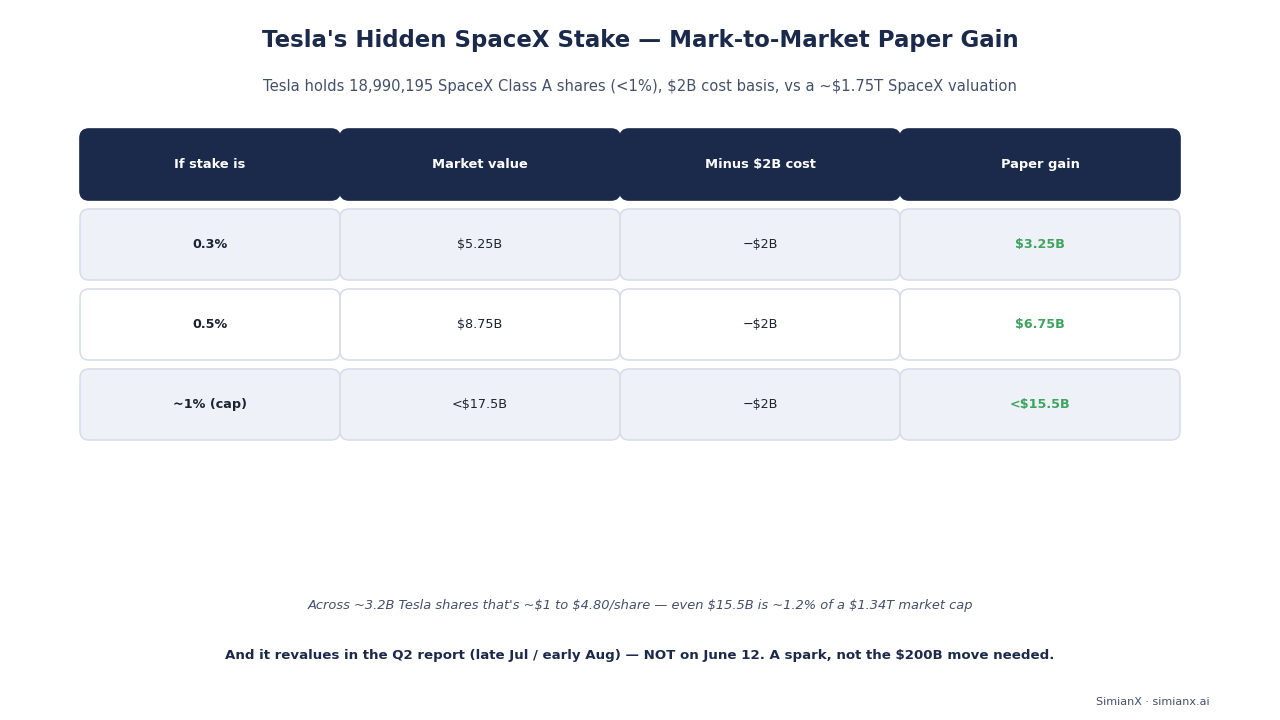
There is a timing wrinkle the option buyer is exploiting. The revaluation does not print on June 12. It shows up in Tesla's Q2 report, around late July or early August. The S-1 only says "less than 1%," so size it across three tiers against a $1.75 trillion valuation:
| Stake | Market value | Minus $2B cost | Paper gain |
|---|---|---|---|
| 0.3% | $5.25B | − $2B | $3.25B |
| 0.5% | $8.75B | − $2B | $6.75B |
| ~1% (cap) | < $17.5B | − $2B | < $15.5B |
Across Tesla's ~3.2 billion shares, that is roughly $1 to $4.80 per share. Sounds underwhelming — and on its own, it is. Tesla's market cap is about $1.34 trillion; even the optimistic $15.5 billion gain is about 1.2% of it. Meanwhile, getting the stock to $480 requires roughly $200 billion of added market cap. A $15.5 billion windfall does not fill a $200 billion hole. So this gain is, at most, a spark — but a spark is all an option needs when it already has cheap volatility and a hard catalyst date.
Signal 3 — Three layers stacked into one ticket
The option buyer is not betting on the earnings line item alone. The market may be pricing the SpaceX IPO into Tesla as a three-layer wager:
- June 12 sentiment. Does the heat of the largest listing in history splash onto Tesla the same day?
- The mark-to-market revaluation. The Q2 windfall above — a calculable, real number on the income statement.
- The merger imagination. If the market starts believing SpaceX and Tesla eventually combine, Tesla's entire valuation framework changes.
The bet is all three at once: sentiment, paper profit, and merger dream, summing to a number with a "4" in front of it. The brutal catch on timing — the Q2 report lands in late July or early August, but the option expires June 12. So the wager is really that the market front-runs all three layers into Tesla's price the moment SpaceX prices, weeks before any of it is confirmed in filings.
For $480 to print, three gates all have to open: SpaceX has to list, the valuation has to be high enough, and the market has to buy Tesla as a SpaceX stand-in. All three, or it expires worthless.
Signal 4 — The Ant Group ghost
This cross-stock proxy trade has been run before. The last time, it was a catastrophe.
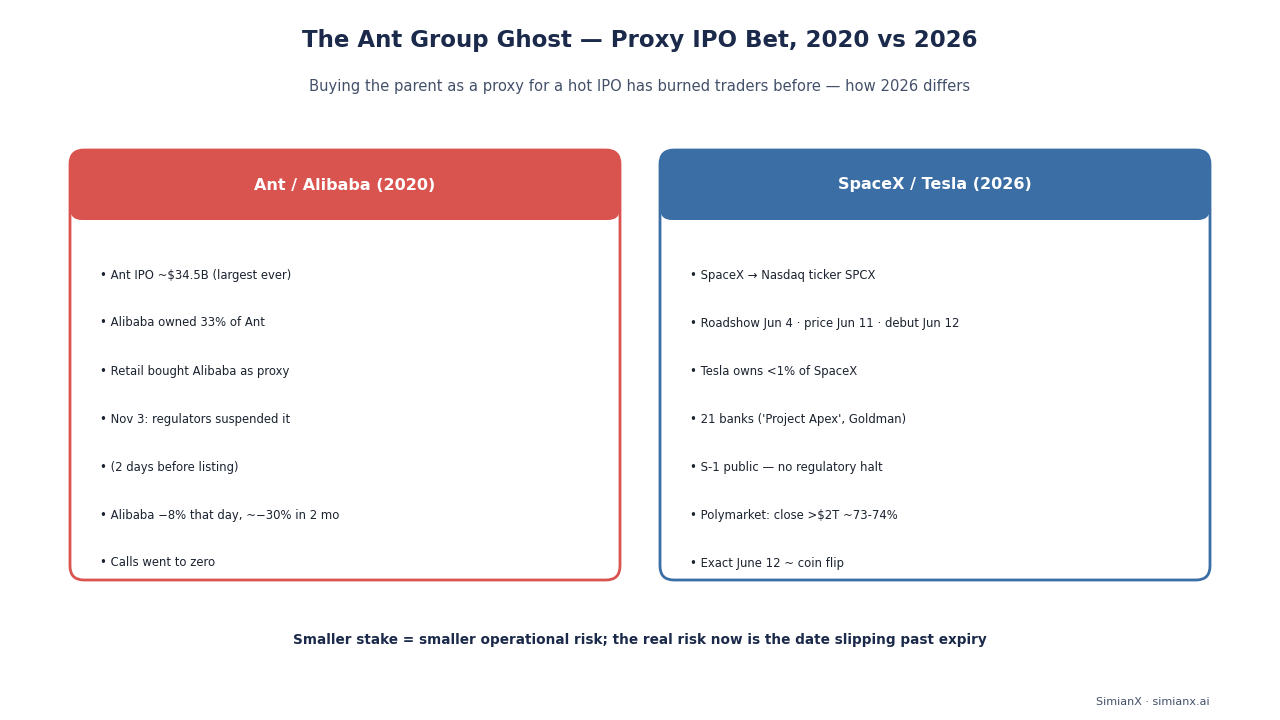
In October 2020, Ant Group was set to list simultaneously in Shanghai and Hong Kong, raising about $34.5 billion in what would have been the largest IPO ever. Ant's biggest shareholder was Alibaba, holding 33% — structurally similar to Tesla and SpaceX today. Retail couldn't buy Ant directly, but they could buy Alibaba, so buying Alibaba became the proxy bet on Ant. Traders piled into Alibaba stock and short-dated calls.
On November 3, 2020 — two days before listing — regulators suspended the Ant IPO. Alibaba fell about 8% on the day and kept sliding toward the low $220s, a roughly 30% drawdown over two months. Every short-dated call betting on the Ant debut went to zero.
But two differences matter this time. First, stake size. Alibaba owned 33% of Ant — Ant's profits flowed straight into Alibaba's fundamentals, so killing the IPO destroyed real long-term value. Tesla owns under 1% of SpaceX; whether SpaceX prints profit barely touches Tesla's core business. For a short-dated option, though, under 1% is plenty — the bet is purely on whether the price jumps on listing day, not on operating earnings flowing through for years.
Second, regulatory risk. Ant was halted by a direct government order. SpaceX's S-1 is public, 21 banks are in the syndicate (code-named "Project Apex") with Goldman Sachs leading the book, and the roadshow starts June 4. On Polymarket, the odds of an IPO in June run high — but the odds of it landing on June 12 precisely are only about a coin flip. The Ant-style hard stop is far less likely here; the bigger risk is simply that the date slips past the option's expiry.
Signal 5 — What the whole market is pricing
June 12 resolves into one of three worlds. One: SpaceX opens strong, closes above a $2 trillion cap, Tesla gets bought as the proxy, and the option lives. Two: SpaceX breaks issue, sentiment chills, Tesla drifts or dips, and the option likely dies. Three: the date slips or the deal is pulled, the Ant ghost returns, and the option loses its catalyst entirely. Only world one wins.
Polymarket puts the first-day close above $2 trillion near 73–74%. That sounds reassuring — but it is only the first gate. Tesla still has to be adopted as a substitute and rally enough — 15% enough. The 73% is SpaceX's odds; the option's odds of paying are meaningfully lower, with two more doors behind the first.
Then there's the merger layer. The market gives a near-term Tesla–SpaceX combination far less than even odds — nowhere near consensus. The foundation isn't nothing: the two are jointly building the "Terafab" chip initiative, and Tesla has booked roughly $890 million in related revenue from SpaceX and xAI since 2023. Ivan Feinseth of Tigress Financial argues investors who hold both are really buying "the whole Musk ecosystem." Ross Gerber of Gerber Kawasaki goes further, telling CNBC it "looks more like SpaceX will be bailing out Tesla by buying them over, calling it a merger" — a "Berkshire Hathaway of AI." But none of that resolves by June 12. The merger is the option's most speculative layer by far.
The three numbers to watch on June 12
If you hold Tesla, three readings tell you which world arrived:
- SpaceX's first-day valuation band — above $2 trillion is the bull trigger; a broken issue is the bear one.
- Tesla's volume — a genuine proxy-rotation shows up as a volume spike, not a quiet drift.
- Tesla's relative performance — is it outrunning the Nasdaq and other high-beta tech names, or just tracking them? Outperformance means the market is voting "SpaceX proxy."
Those three numbers, read together, tell you whether the market decided the SpaceX IPO is good news for Tesla, bad news, or no news at all.
FAQ
Is SpaceX really going public on June 12, 2026?
SpaceX filed its S-1 and is targeting a Nasdaq debut under ticker SPCX, with the roadshow starting June 4 and pricing on June 11 (CoinDesk). Prediction markets see June as highly likely but the exact June 12 date as roughly a coin flip.
How much SpaceX does Tesla own?
18,990,195 SpaceX Class A shares — under 1% — acquired when Tesla's $2 billion xAI investment converted into SpaceX equity after the February 2026 xAI–SpaceX merger.
Will the SpaceX IPO make Tesla stock go up or down?
Both cases are live. The bear case (BNP Paribas, Integrity Asset Management) says retail sells Tesla to fund SpaceX. The bull case says listing-day mania, a mark-to-market windfall, and merger hopes lift Tesla. The market hasn't decided — which is exactly why the options are active.
What happened with the Ant Group precedent?
In 2020, traders used Alibaba as a proxy for Ant Group's IPO; regulators suspended the listing two days out and Alibaba fell ~30% over two months. The structural echo is real, but Tesla's sub-1% stake makes the operational stakes far smaller than Alibaba's 33%.
Track it like a trader, not a fan
The genius and the danger of this $3.3 million ticket is that it compresses sentiment, accounting, and a merger dream into one date. On June 12 it becomes either scrap paper or several million dollars — and the Tesla shares in your account get re-rated the same day, as either SpaceX's shadow or the asset SpaceX drains.
If you want to follow Musk's tangled web with data instead of vibes, watch TSLA on SimianX, compare how the most capable AI models read the same setup on the AI model leaderboard, and let an autopilot track the catalyst calendar so you don't have to. Browse more market breakdowns in the SimianX stories hub.
This article is for information and discussion only and is not investment advice.
Related Reading
- Anthropic IPO and OpenAI IPO: Date, Valuation, Latest Status
- Hype Premium Decay: Why Hot Stocks Often Underperform
- AI vs Human Analysts: Why AI Wins at Stock Research Today
- AI Stock Research for Earnings & News with SimianX