 By Muke
How Fair Isaac Priced Its Own Mortgage Monopoly Out of Existence
On 29 September 2026, Fair Isaac Corporation lost 26.52% of its value in a single session — the worst day in the company's listed history. Two days later it rose 11.69%. Eight sessions after that it rose another 10.85%, closing at $740.00 on 12 October. Those three numbers have been read, almost everywhere, as a story about shock and relief: the regulator broke the monopoly, the market panicked, then investors reconsidered.
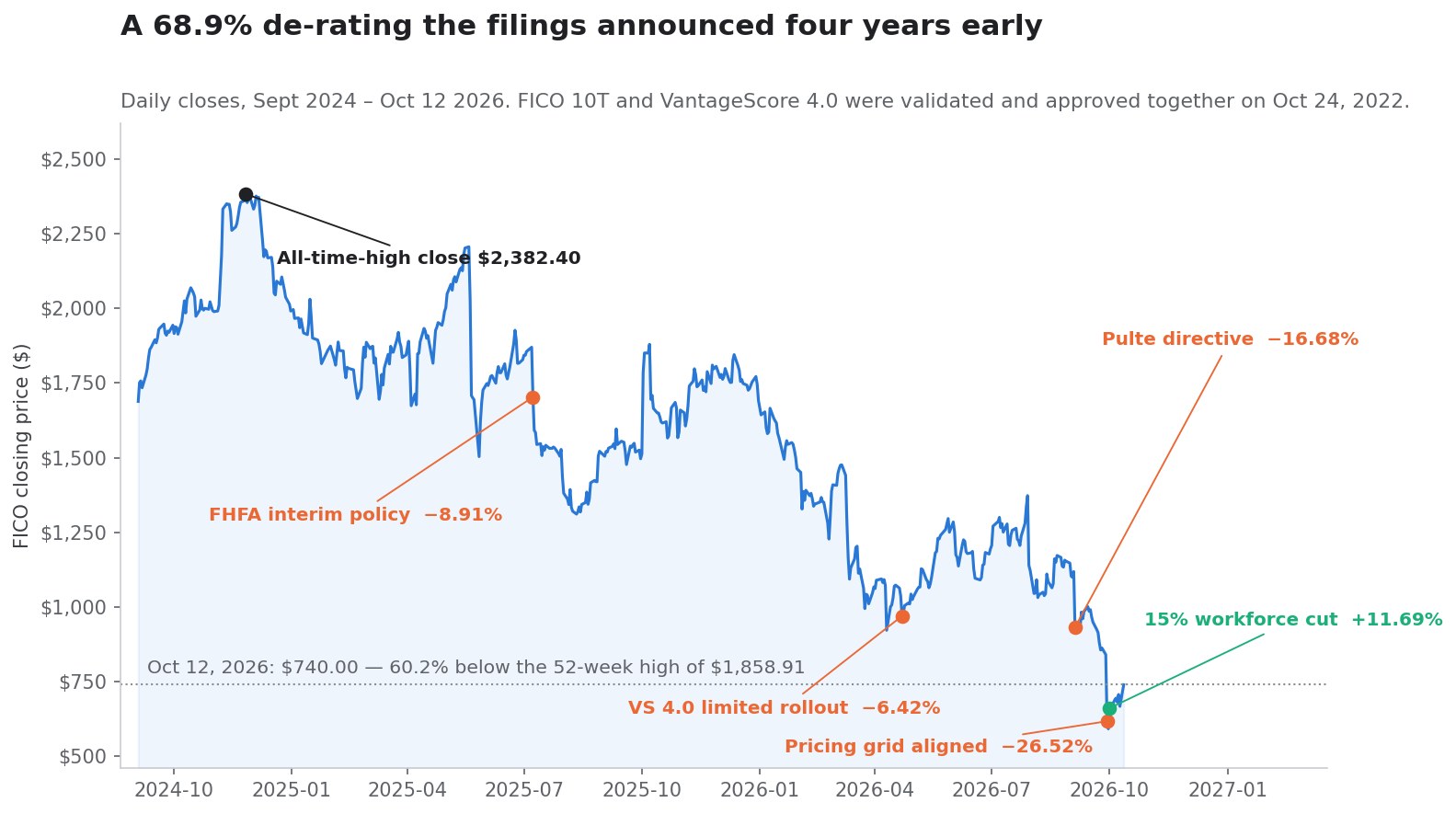
That reading is wrong in a specific and checkable way. The regulator did not break FICO's monopoly on 29 September 2026. It had already been broken — formally, publicly, and in writing — on 8 July 2025, when the Federal Housing Finance Agency published an interim policy permitting lenders to deliver conforming loans scored with VantageScore 4.0. FICO fell 8.91% that day and spent the following fourteen months trading as if nothing had happened, reaching $1,118.93 as recently as 3 September 2026.
What happened on 29 September was not the loss of exclusivity. It was the loss of price. The FHFA aligned the upfront fee grid so that a lender choosing VantageScore 4.0 no longer paid an economic penalty for doing so. Twenty days earlier, when the same agency had removed the last operational barrier and opened VantageScore 4.0 to every approved lender, FICO stock went up 5.35%. The market priced access at plus five percent and price parity at minus twenty-seven.
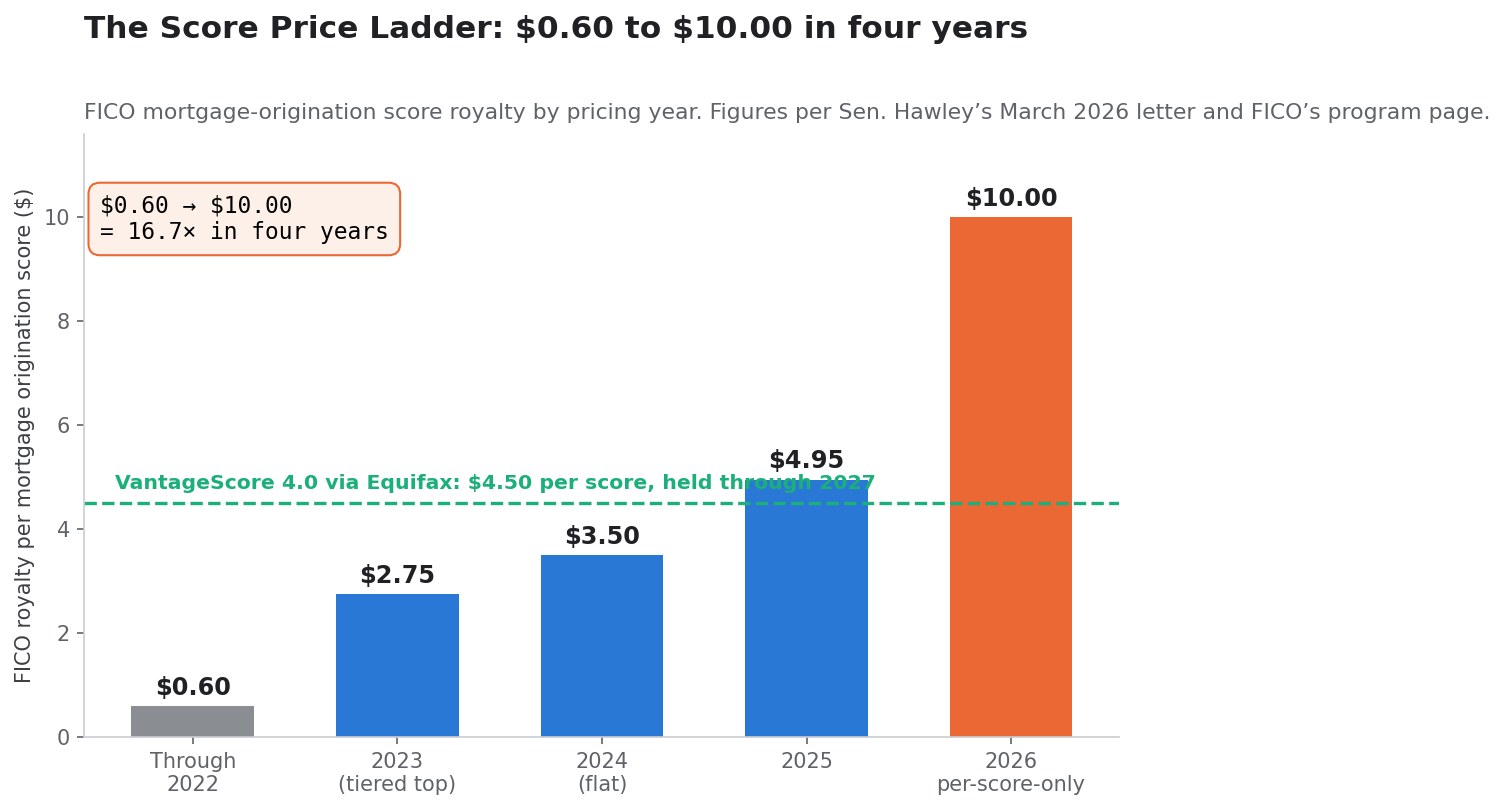
That asymmetry is the whole story, and it is not an accident. Between 2022 and 2026, FICO raised its mortgage-origination score royalty from roughly $0.60 to $10.00 per score — a 16.7-fold increase over four years. Every dollar of that increase flowed almost unimpeded to operating income, because the Scores segment carries about $42 million of quarterly cost against $459 million of quarterly revenue. The increase also did two other things: it made a $4.50 competitor economically rational for the first time in twenty years, and it attracted a United States senator, an antitrust referral, and eventually a regulator willing to level the fee grid.
Then, in the nine months to 30 June 2026, FICO borrowed about $2.53 billion and spent $3.05 billion buying back its own shares at an average delivered cost near $1,409 — against $778 million of operating cash flow for the same period. On 12 October 2026 the stock closed at $740.00.
This article is a reference document, not a trade call. It reconstructs, from primary filings and published rate cards, four things: the complete FHFA notice ledger with FICO's reaction to each milestone; the score price ladder that produced the earnings; the capital-allocation ledger that leveraged those earnings; and the segment arithmetic that determines what a reset in mortgage score economics is actually worth. You can track all of it in real time with SimianX AI, which pulls SEC filings, segment data, and price reactions into one research workflow for FICO.
What actually happened to FICO stock, in order
The September–October 2026 sequence is usually compressed into "the FHFA opened the market and FICO crashed." The filings and the tape show five distinct events with five distinct market reactions. Separating them is the first analytical step, because they carry different information.
3–4 September 2026: the Pulte directive
Late on the evening of 3 September 2026, FHFA Director Bill Pulte directed Fannie Mae and Freddie Mac to allow all mortgage lenders to use VantageScore 4.0, rather than only those with prior written approval. FICO closed at $1,118.93 on 3 September and $932.26 on 4 September — a decline of 16.68%, or roughly $4.03 billion of market value at the company's current share count.
This was the access event. It removed the requirement that a lender obtain written permission before delivering a VantageScore-scored loan to the enterprises. It did not change what either model cost.
9 September 2026: the formal publication
The FHFA's credit-scores policy page dates the formal opening to 9 September 2026, describing it as removing the requirement for prior written approval. By then the directive was five days old and already in the price. FICO closed at $983.19 that session, up 5.35% from $933.30.
A regulator formally dismantling the last administrative barrier to a competitor, and the incumbent's stock rising on the day, is the single most informative data point in this entire sequence. The market had already concluded that access was not the binding constraint.
28 September 2026: Rocket Mortgage moves first
On 28 September 2026, Rocket Mortgage announced that VantageScore 4.0 would become its default credit-scoring model for eligible direct-to-consumer loans delivered to Fannie Mae or Freddie Mac, plus VA and other eligible mortgages, beginning in the fourth quarter of 2026. The company said the decision followed roughly four months of testing across about 1.4 million credit reports pulled under both models during 2026, and that borrowers who saved money saved an average of $1,600 at closing.
Rocket also disclosed what stays on FICO: investment-property and second-home mortgages, home equity products, FHA loans and jumbo loans. Its broker channel, Rocket Pro, will supply both scores. These exclusions matter and are discussed below.
FICO closed at $840.89 on 28 September, down 2.57%.
29 September 2026: the pricing grid
The following session, the FHFA published upfront fee adjustments aligning pricing across Classic FICO and VantageScore 4.0. FICO opened at $668.08 against the prior close of $840.89, traded as low as $595.19, and closed at $617.87 — down 26.52% on volume of 4,914,500 shares, roughly twelve times the prior session's 394,300. The following day it fell a further 4.11% to $592.47, touching $586.05, which remains the 52-week low.
Over the two sessions, FICO's market capitalisation fell from about $18.16 billion to $12.80 billion — a decline of $5.37 billion.
1 October 2026: the workforce reduction
On 1 October 2026, FICO's management committed to a plan of workforce reduction. The company disclosed it five days later in a Form 8-K filed under Item 2.05. The language is worth quoting precisely, because it is the clearest statement management has made about what it thinks the future looks like:
On October 1, 2026, management of Fair Isaac Corporation committed to a plan of workforce reduction by reducing the number of layers in the organization, simplifying the operating structure, optimizing processes and tools, and integrating AI-driven product development. This plan involves the elimination of approximately 15% of positions across the Company.
Affected employees were notified beginning the week of 5 October. The plan is expected to be substantially complete by the end of fiscal Q3 2027, with aggregate pre-tax charges of approximately $27.0 million in fiscal Q4 2026, substantially all of which will be cash.
FICO stock rose 11.69% on 1 October, to $661.75.
The reading the sequence forces
Set those five events side by side and a different narrative emerges from the one in most coverage. The rally on 1 October was not investors deciding the threat was overstated. It coincided exactly with management committing to permanently remove 15% of the company's positions. Those are not opposing signals — they are the same signal read from two sides. The market was repricing a lower-margin future; management was resizing the company for one.
| Date | Event | FICO close | One-day move | Market value change |
|---|---|---|---|---|
| 3 Sept 2026 | Prior close | $1,118.93 | — | — |
| 4 Sept 2026 | Pulte directs GSEs to open VantageScore 4.0 to all lenders | $932.26 | −16.68% | −$4.03bn |
| 9 Sept 2026 | FHFA formally publishes the opening | $983.19 | +5.35% | +$1.08bn |
| 28 Sept 2026 | Rocket Mortgage announces VantageScore 4.0 default | $840.89 | −2.57% | −$0.48bn |
| 29 Sept 2026 | FHFA aligns upfront fee grid across models | $617.87 | −26.52% | −$4.82bn |
| 30 Sept 2026 | Continued de-risking; 52-week low $586.05 intraday | $592.47 | −4.11% | −$0.55bn |
| 1 Oct 2026 | FICO commits to ~15% workforce reduction | $661.75 | +11.69% | +$1.50bn |
| 12 Oct 2026 | Latest close | $740.00 | +10.85% | +$1.56bn |
Market-value changes are computed on 21,597,635 shares outstanding, the figure on the cover page of FICO's fiscal Q3 2026 Form 10-Q as of 17 July 2026.
The FHFA Notice Ledger: every milestone, priced
The FHFA has been modernising the conforming credit-score framework since Section 310 of the Economic Growth, Regulatory Relief, and Consumer Protection Act was enacted in 2018. Every material milestone since has been published on a public policy page with a date. That makes it possible to build something that does not otherwise exist: a complete ledger of regulatory notice against market reaction.
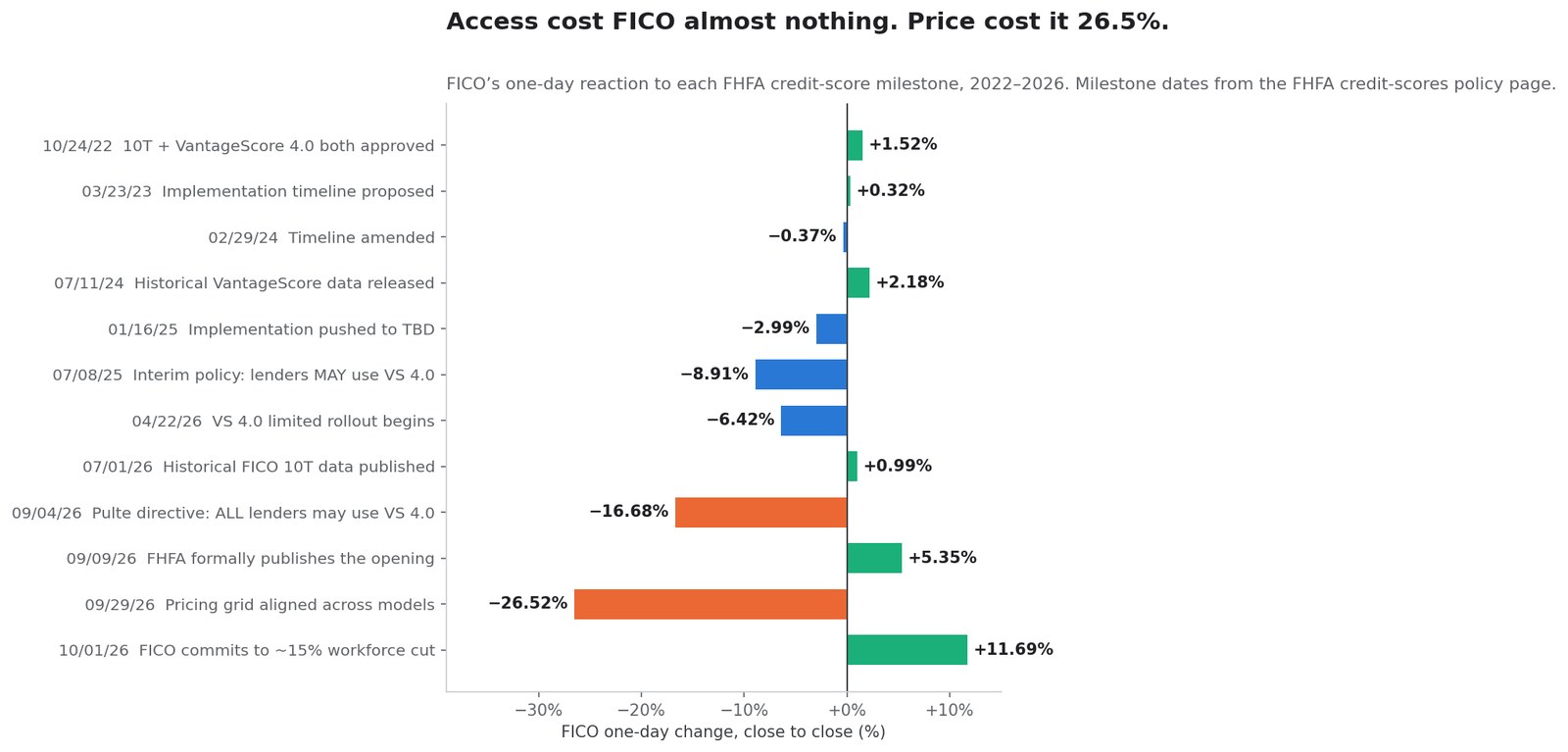
The ledger
| FHFA milestone | Date | What it changed | FICO one-day move |
|---|---|---|---|
| FICO 10T and VantageScore 4.0 validated and approved | 24 Oct 2022 | Both models cleared for potential enterprise use | +1.52% |
| Implementation update and proposed timeline | 23 Mar 2023 | Sequencing published | +0.32% |
| Timeline amended; VantageScore data accelerated | 29 Feb 2024 | Bi-merge aligned to the Classic FICO transition | −0.37% |
| Historical VantageScore 4.0 scores released | 11 Jul 2024 | Lenders could back-test the competitor | +2.18% |
| Implementation moved from Q4 2025 to a date TBD | 16 Jan 2025 | Delay | −2.99% |
| Interim policy: lenders may use VantageScore 4.0 | 8 Jul 2025 | Exclusivity formally ends | −8.91% |
| VantageScore 4.0 limited rollout; 10T added to Selling Guides | 22 Apr 2026 | First practical adoption window | −6.42% |
| Historical FICO 10T data published (Apr 2013–Sep 2025) | 1 Jul 2026 | Supports eventual 10T approval | +0.99% |
| VantageScore 4.0 opened to all approved lenders | 9 Sept 2026 | Prior written approval no longer required | +5.35% |
| Upfront fees aligned across approved models | 30 Sept 2026 | Economic penalty for switching removed | −26.52% |
Milestone dates are as published on the FHFA's credit-scores policy page, last updated 2 October 2026. The 30 September fee alignment was reflected in trading on 29 September; the market reaction is dated to the session in which it occurred.
What the ledger shows
Read the right-hand column as a single series and three facts become unavoidable.
First, FICO 10T has been approved for four years and is still not deliverable. On 24 October 2022, the FHFA validated and approved FICO 10T and VantageScore 4.0 on the same day. As of the policy page's 2 October 2026 update, VantageScore 4.0 is available to all approved lenders and FICO 10T is not currently eligible for delivery. Four years of equal regulatory standing produced one shipped model and one that is not. This is not a detail: FICO's entire bull case rests on 10T eventually arriving, and the ledger shows four years of it not arriving.
Second, the market absorbed every structural notice and repriced on the pricing notice. The nine access, approval, data and timeline milestones between October 2022 and September 2026 produced a cumulative one-day move of roughly −8.3 percentage points across nine sessions — spread over almost four years. The single pricing milestone produced −26.52% in one.
Third, the two largest declines in the whole sequence are both about money, not permission. Minus 16.68% on 4 September, when the Pulte directive threatened mortgage score volume. Minus 26.52% on 29 September, when the fee grid threatened price. By contrast, the six milestones covering validation, approval, data publication and timeline sequencing never moved the stock more than three percent in either direction.
Why access was never the binding constraint
This is not market irrationality. It reflects something structurally true about credit-score distribution.
A lender does not switch scoring models because a model is permitted. It switches when the switch pays. Replacing a score model requires back-testing against historical performance, recalibrating approval cut-offs, rewriting adverse-action reason codes, revalidating under model-risk-management policy, retraining staff, and reconfiguring automated underwriting. Those are real costs, and they are paid once. A per-score fee differential is paid on every loan, forever.
As long as using VantageScore 4.0 carried an upfront-fee penalty at delivery, the one-time switching cost sat on one side of the ledger and a muted recurring saving sat on the other. Remove the penalty and the arithmetic inverts: the switching cost is amortised against a permanent, compounding fee advantage. That is what 30 September 2026 did, and it is why a single pricing notice was worth roughly three times the largest access notice in the ledger.
The Score Price Ladder: $0.60 to $10.00 in four years
The price increase that triggered the regulator is a matter of public record, reported contemporaneously at each step. Assembled in one place, it is the most important table in this article.
The ladder
| Pricing year | FICO mortgage-origination royalty | Structure | Multiple of 2022 |
|---|---|---|---|
| Through 2022 | $0.60 per score | Flat, unchanged for years | 1.0× |
| 2023 | $0.60 – $2.75 per score | Tiered by lender volume | up to 4.6× |
| 2024 | $3.50 per score | Flat for all lenders, tiering scrapped | 5.8× |
| 2025 | $4.95 per score | Flat; notice issued to bureaus 30 Oct 2024 | 8.3× |
| 2026 | $10.00 per score | Per-score-only option | 16.7× |
The $0.60 base and the $10.00 2026 figure are both cited in Senator Josh Hawley's March 2026 referral letter; the $3.50 and $4.95 steps were reported contemporaneously. FICO's own Mortgage Direct License Program page describes the $10.00 figure as the 2025 average credit-bureau price rather than its own royalty — a framing dispute addressed below.
The dispute about the $10
There are two honest ways to describe the $10 figure, and the difference matters.
FICO's framing. The $10 is what tri-merge resellers paid credit bureaus for a FICO score, inclusive of bureau mark-ups. By licensing directly, FICO argues, it removes the mark-up layer: a lender on the performance model pays FICO $4.95, which FICO characterises as roughly a 50% reduction in average per-score fees into the resellers.
The Senate's framing. Senator Hawley's letter describes the wholesale price per score as having risen from $0.60 to $10 over five years, with the 2026 step from $4.95 to $10 adding roughly $500 million a year in industry-wide cost. He cites an 88% operating margin as evidence of a non-competitive market and asked FTC Chairman Andrew Ferguson to open an investigation, having twice previously asked the Department of Justice's Antitrust Division to do so.
Both descriptions can be true simultaneously, because they measure different points in the distribution chain. What is not in dispute is the direction and the magnitude. Whatever layer you measure, the cost of a FICO mortgage score rose by more than an order of magnitude in four years, in a market where the buyer had no alternative.
The margin figure that moved the wrong way
Hawley's 88% is not a critic's estimate. It is FICO's own disclosed Scores segment operating margin for the nine months ended 30 June 2025, as reported in the segment footnote.
In the nine months ended 30 June 2026 — the period after the referral — that margin rose to 90.2%. For the June 2026 quarter alone it reached 90.8%, and FICO's 10-Q states the reason in its own words: the increase was "primarily due to higher business-to-business scores revenue driven by a higher mortgage origination scores unit price."
A company facing an antitrust referral over its pricing raised its margin by two points, told the SEC the reason was the price increase, and raised full-year guidance. Three months later the regulator levelled the fee grid.
Where the ladder leads
Here is the causal chain, stated plainly and sourced at every link:
- FICO raised the mortgage score royalty roughly 16.7× over four years.
- That increase drove Scores revenue up 44.5% in the first nine months of fiscal 2026 and lifted the segment margin to 90.2% — per FICO's own MD&A.
- The increase created enough economic headroom that Equifax could price VantageScore 4.0 at $4.50 and commit to holding it for two years.
- The same increase drew a Senate referral to the DOJ and the FTC.
- The FHFA aligned the upfront fee grid, removing the delivery penalty for the cheaper model.
- FICO's stock fell 60.2% from its 52-week high, and management committed to eliminating 15% of positions.
Each step is independently verifiable. Taken together, they describe a company that monetised a protected franchise hard enough to fund, provoke, and ultimately legitimise its own competition.
What a conforming loan actually costs to score
Headline per-score prices are not what a lender pays. Understanding the real competitive position requires computing the cost on a complete transaction, and this is where FICO's direct-license structure does something subtle that almost no coverage has worked through.
The rate cards
As published on FICO's Mortgage Direct License Program page:
- Classic FICO, performance model: $4.95 royalty per score, plus a $33 funded-loan fee per borrower, per score, charged when a FICO-scored loan closes.
- Classic FICO, per-score-only model: $10.00 per score paid to tri-merge resellers, with no funded-loan fee. FICO describes this as matching the 2025 average credit-bureau price.
- FICO Score 10T, standalone performance model: $0.99 per score, with a $65 funded-loan fee per borrower.
- FICO Score 10T bundled with Classic FICO: free, with no additional funded-loan fee.
And from the competitor: Equifax announced VantageScore 4.0 mortgage credit scores at $4.50 per score, with CEO Mark Begor committing to hold that price for two years, through the end of 2027. Equifax described its price as more than 50% below FICO's 2026 $10 pricing.
The closed-loan arithmetic
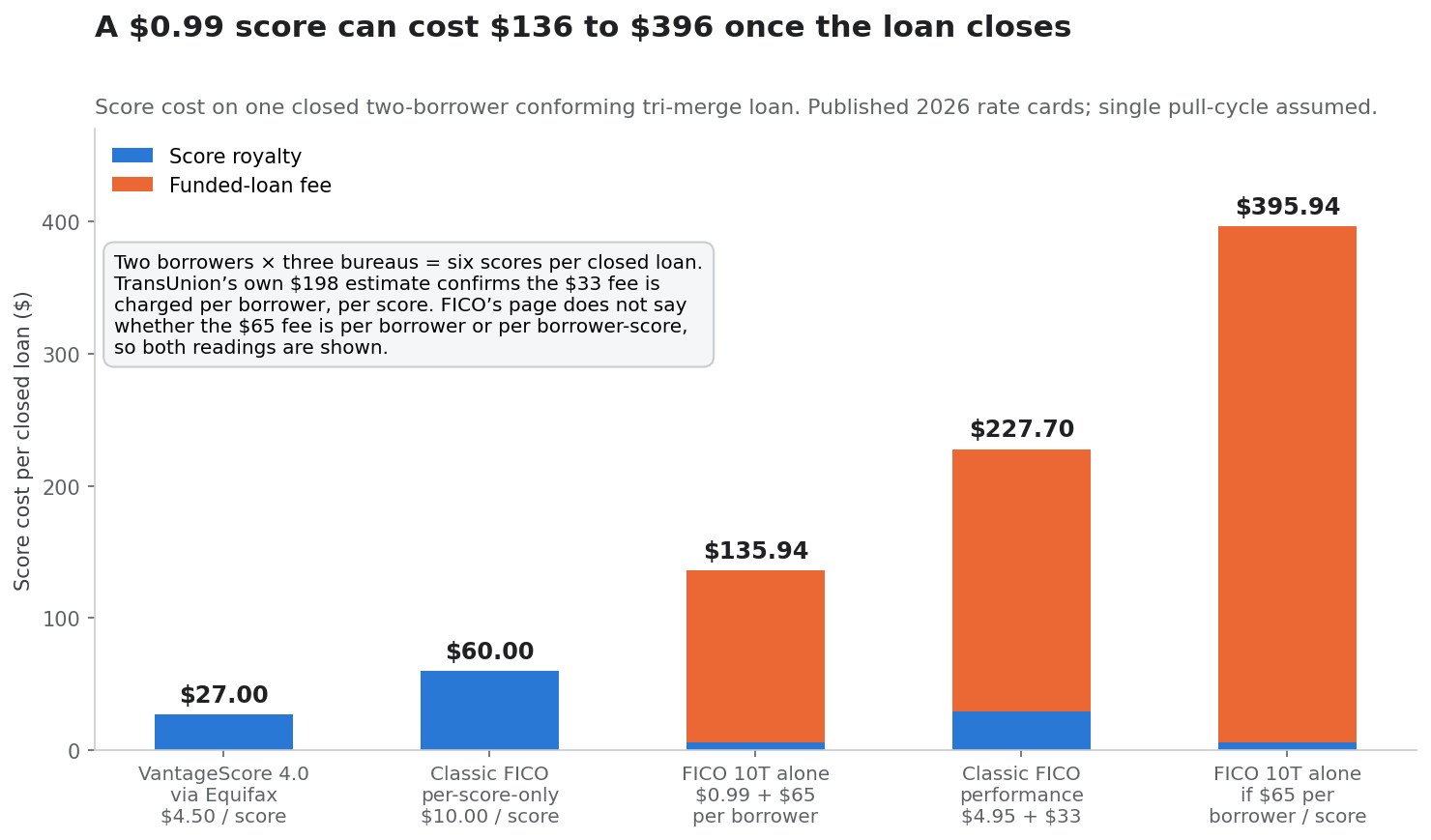
A conforming tri-merge pulls one score from each of the three national bureaus. A two-borrower application therefore generates six scores per pull cycle. Assume a single pull cycle and one closed loan:
| Option | Score royalty | Funded-loan fee | Total per closed loan |
|---|---|---|---|
| VantageScore 4.0 via Equifax, $4.50 | $27.00 | $0.00 | $27.00 |
| Classic FICO, per-score-only, $10.00 | $60.00 | $0.00 | $60.00 |
| FICO Score 10T standalone, $0.99 + $65 per borrower | $5.94 | $130.00 | $135.94 |
| Classic FICO performance, $4.95 + $33 per borrower per score | $29.70 | $198.00 | $227.70 |
| FICO Score 10T standalone, if $65 applies per borrower per score | $5.94 | $390.00 | $395.94 |
The $198 line is not an assumption. TransUnion publicly characterised the funded-loan fee as a "penalty fee" and estimated it at $198 for a couple purchasing a home — which is exactly two borrowers × three scores × $33. That confirms the $33 fee is charged per borrower, per score, and anchors the whole table.
FICO's program page does not state whether the $65 fee attached to the $0.99 10T option is per borrower or per borrower per score, so both readings are shown. Under either, the economics are the same in direction.
Why the $0.99 headline is not a price cut
The direct-license program is routinely described as FICO cutting its price to compete. On a closed loan it does the opposite for the headline option.
A $0.99 score is 90% cheaper than a $10.00 score. But attaching a $65-per-borrower funded-loan fee converts a $60 transaction into a $136 to $396 transaction. FICO's genuinely cheapest option remains the old flat per-score model at $60, and even that is 2.2× the $27 that the same loan costs under VantageScore 4.0 at Equifax's price.
The competitive weapon in the program is not the $0.99 line at all. It is the bundle: buy Classic FICO at $4.95 plus the funded-loan fee, and FICO Score 10T comes free with no additional funded-loan fee. That is a genuine inducement — but it only matters once 10T becomes eligible for delivery, which the FHFA says it is not.
What the structure actually changed
Strip away the headline numbers and the direct-license program did one structural thing: it shifted a portion of FICO's mortgage revenue from a per-attempt fee to a per-closing fee.
That is not a cosmetic difference. Under a per-score model, FICO earns on every credit pull — including the shopping pulls, pre-qualifications, re-issues and applications that never fund. Under the performance model, the large component is collected only when a loan closes. The consequence is that FICO's mortgage revenue becomes levered to origination volume rather than to application activity.
For investors this cuts both ways. In a strong origination market, a closing-weighted fee captures more value per funded loan. In a weak one, it removes the volume cushion that shopping activity used to provide. It also makes FICO's Scores revenue materially more correlated with mortgage rates than it previously was — a sensitivity that did not exist when the company charged $0.60 on every pull.
The asymmetry that made this inevitable
Rocket's testing found that borrowers who saved money saved an average of $1,600 at closing. FICO's entire royalty on a two-borrower tri-merge, at its most expensive 2026 per-score option, is $60. The score royalty is therefore roughly 4% of the quoted saving; the rest is bureau mark-up, reseller margin, re-issue fees and the broader credit-report stack.
FICO's long-standing defence — that its royalty is a small part of overall mortgage closing costs — is, on these numbers, correct. And that is precisely the problem.
A fee too small for a borrower to notice at the closing table is large enough to be most of a $16 billion company's operating profit. Scores was 68.1% of revenue in the June 2026 quarter and 88.3% of segment operating income. The fee is immaterial to the payer and existential to the payee. Any asymmetry of that shape eventually breaks on price, because the party for whom it is immaterial has no reason to defend it and the party for whom it is existential cannot stop raising it.
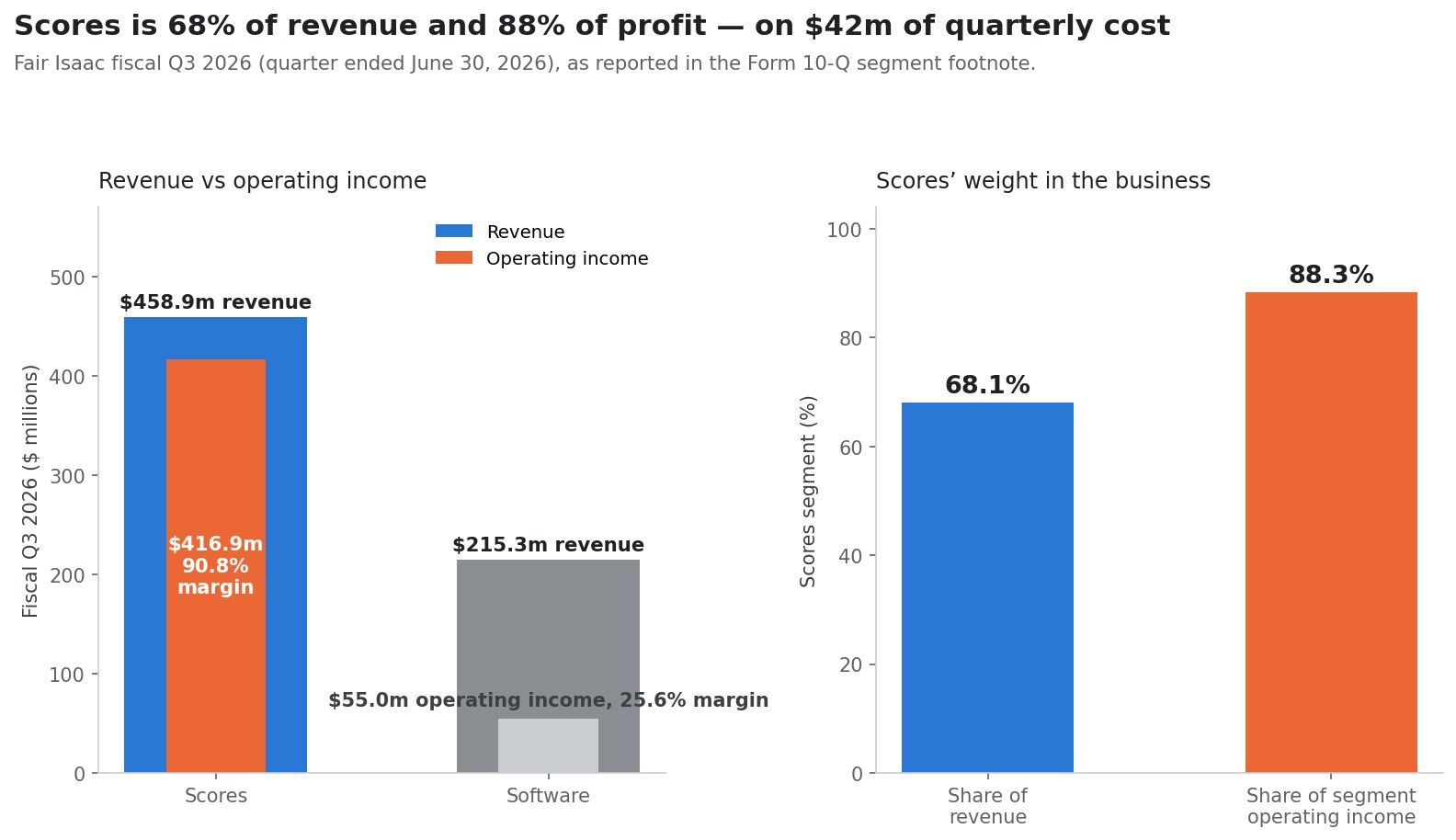
The segment arithmetic: 68% of revenue, 88% of profit
Everything above is only investable if you understand how the two segments actually earn. FICO's segment footnote makes this unusually clear, and the clarity is unflattering.
Scores: 90.8% margin on $42 million of quarterly cost
For the quarter ended 30 June 2026:
| Fiscal Q3 2026 | Scores | Software | Total |
|---|---|---|---|
| Segment revenue | $458,897k | $215,291k | $674,188k |
| Segment operating expense | $(42,011)k | $(160,251)k | $(202,262)k |
| Segment operating income | $416,886k | $55,040k | $471,926k |
| Segment operating margin | 90.8% | 25.6% | 70.0% |
| Share of total revenue | 68.1% | 31.9% | 100% |
| Share of segment operating income | 88.3% | 11.7% | 100% |
Unallocated corporate expense of $56,967k and unallocated share-based compensation of $52,331k reduce the $471,926k of segment operating income to the reported $362,628k of consolidated operating income.
The number to sit with is $42,011k. That is the entire direct and allocated cost of running a business that produced $458.9 million of revenue in three months. The Scores segment is, operationally, a licensing arrangement: the model exists, the bureaus distribute it, and the incremental cost of the next score is close to zero.
This cuts in both directions, and most commentary only takes one.
The optimistic reading: at 90.8% margins, FICO does not need to retain every dollar of mortgage scoring revenue to remain highly profitable. Even a severe revenue reset leaves a business with structurally excellent economics.
The arithmetic reading: at 90.8% margins, there is no cost to cut when revenue falls. A dollar of lost Scores revenue is approximately a dollar of lost operating income. There is no variable cost base to flex, no gross-margin cushion, no operating leverage to work in reverse. Businesses with 25% margins absorb a 20% revenue decline by cutting cost. Businesses with 91% margins simply earn 20% less.
Software: the diversification that is shrinking
The bull case for FICO after the crash leans on the software segment. The segment footnote complicates it.
| Software segment | Q3 FY2026 | Q3 FY2025 | Change |
|---|---|---|---|
| Revenue | $215,291k | $212,106k | +1.5% |
| Segment operating expense | $(160,251)k | $(144,164)k | +11.2% |
| Segment operating income | $55,040k | $67,942k | −19.0% |
| Segment operating margin | 25.6% | 32.0% | −6.4 pts |
Software revenue grew 1.5% while software operating income fell 19.0%, because operating expense grew 11.2%. For the nine-month period the pattern holds: revenue of $639,420k against $618,095k, and operating income of $176,248k against $192,008k — a decline of 8.2%.
The widely quoted platform figures are real but partial. FICO reported Software ARR up 10% year over year at 30 June 2026, consisting of platform ARR up 62% and non-platform ARR down 17%. Dollar-based net retention was 148% for platform software and 82% for non-platform, for a total of 109%.
The 148% is the number that appears in most write-ups. The 109% is the number that describes the whole segment. A company mid-transition from a declining on-premises base to a growing cloud platform legitimately shows both, but an investor sizing diversification must use the consolidated figure — and 109% net retention with falling segment operating income is not a business currently capable of replacing a 91%-margin franchise.
The concentration, stated plainly
Annualising the nine-month figures, the Scores segment generates roughly $1.49 billion of operating income against roughly $0.23 billion from Software. If Scores operating income fell by half, Software operating income would have to rise from about $0.23 billion to about $0.98 billion — a more than four-fold increase — just to hold the total flat.
That is the concentration problem. It is not that FICO is fragile — a business earning 90% margins on an entrenched standard is not fragile. It is that the company's diversification narrative and its earnings reality are a factor of six apart.
The buyback ledger: $3.05bn at $1,409 a share
This is the part of the story that is entirely absent from the coverage of the crash, and it is the part that converts a pricing problem into a balance-sheet problem.
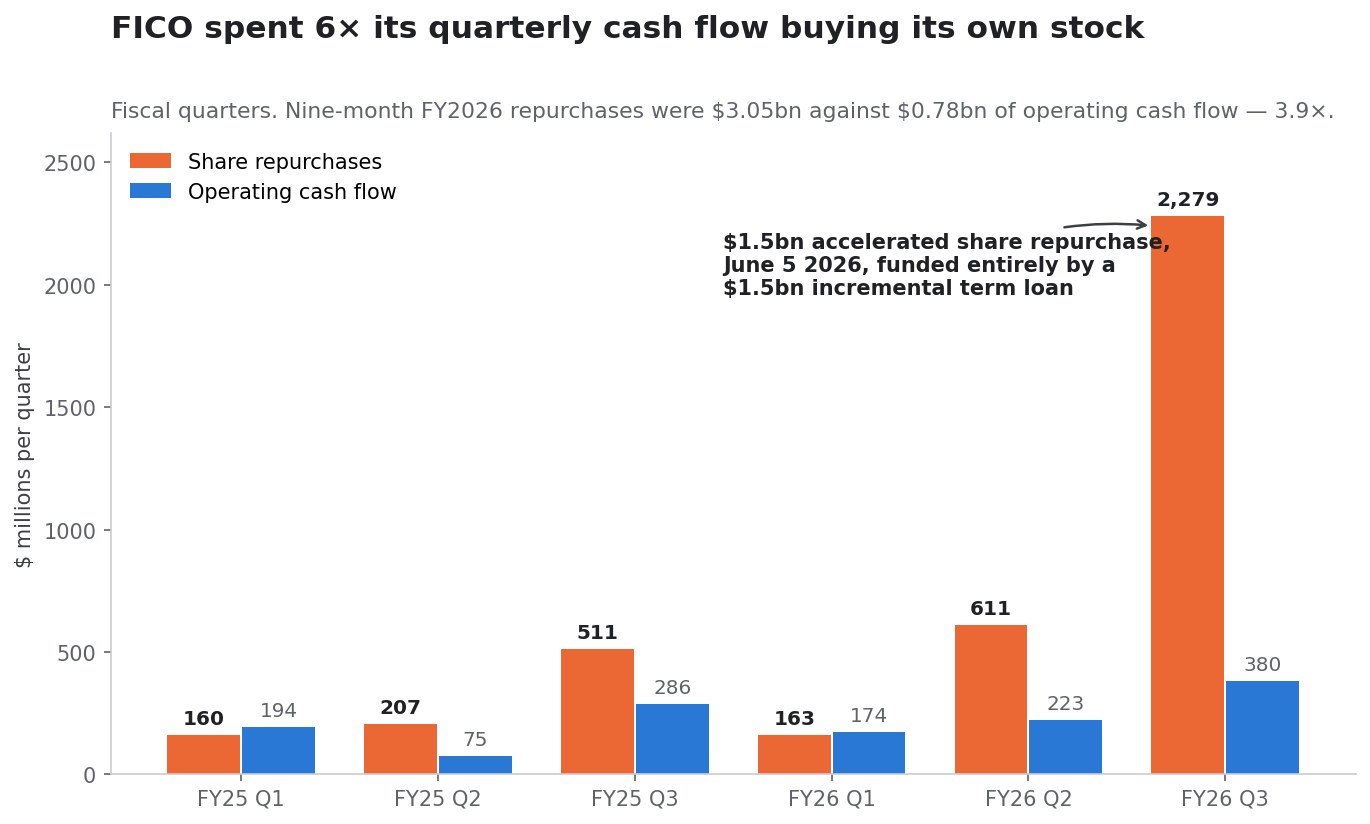
Three authorizations in twelve months
FICO's board approved three successive stock repurchase programs in a single year, each replacing the prior one before it expired:
| Date | Program | Authorized amount | Replaced |
|---|---|---|---|
| June 2025 | June 2025 program | $1.0 billion | July 2024 program |
| February 2026 | February 2026 program | $1.5 billion | June 2025 program |
| June 2026 | June 2026 program | $2.0 billion | February 2026 program |
Each escalation is disclosed in the fiscal Q3 2026 10-Q. The pattern — terminating a program early to replace it with a larger one, three times in twelve months — is a company accelerating into its own share price.
The spend against the cash flow
| Fiscal period | Share repurchases | Operating cash flow | Ratio |
|---|---|---|---|
| FY2025 Q1 | $159.7m | $194.0m | 0.8× |
| FY2025 Q2 | $207.0m | $74.9m | 2.8× |
| FY2025 Q3 | $511.3m | $286.2m | 1.8× |
| FY2025 full year | $1,419.5m | $778.8m | 1.8× |
| FY2026 Q1 | $162.7m | $174.1m | 0.9× |
| FY2026 Q2 | $611.3m | $223.4m | 2.7× |
| FY2026 Q3 | $2,278.9m | $380.4m | 6.0× |
| FY2026 nine months | $3,052.9m | $777.9m | 3.9× |
Repurchases are treasury-stock acquisitions as disclosed in the 10-Q; the cash-flow statement shows $3,045,992k of cash paid for repurchases inclusive of excise tax and the ASR prepayment. Quarterly figures are derived from the cumulative year-to-date disclosures.
A company spending 3.9× its operating cash flow on buybacks over nine months is, by definition, funding them with something other than operations.
The accelerated share repurchase
On 5 June 2026, FICO entered an accelerated share repurchase agreement with Wells Fargo Securities for $1.5 billion of its common stock, disclosed in an 8-K on 8 June. The mechanics, from the 10-Q:
- FICO paid $1.5 billion upfront.
- It received an initial delivery of 1,055,103 shares, valued at approximately $1.2 billion — about $1,137 per share, representing roughly 80% of the total expected.
- The remaining $300.0 million was recorded as a prepayment, with those shares to be delivered at settlement.
- The final share count is determined by the volume-weighted average price of FICO stock over the term of the ASR, less a discount.
- Settlement was expected during fiscal Q4 2026 — the quarter ended 30 September 2026.
That last point produces one of the stranger consequences in this entire episode, covered at the end of this section.
The implied cost, and the mark
Treasury shares rose from 65,093,000 at 30 September 2025 to 67,260,000 at 30 June 2026 — 2,167,000 shares acquired in the nine months, for $3,052,893k of treasury-stock value. That implies an average delivered cost of approximately $1,408.81 per share.
FICO closed at $740.00 on 12 October 2026.
| Nine-month FY2026 buyback | Amount |
|---|---|
| Cash deployed | $3,045,992k |
| Treasury-stock value acquired | $3,052,893k |
| Shares delivered into treasury | 2,167,000 |
| Implied average cost per share | $1,408.81 |
| Closing price, 12 Oct 2026 | $740.00 |
| Mark-to-market change per share | −$668.81 (−47.5%) |
| Mark-to-market change on the position | −$1.449 billion |
That $1.449 billion is 1.86× the company's entire operating cash flow for the same nine months. Had FICO held the $3,045,992k in cash and deployed it at $740.00, the same money would buy 4,116,205 shares — 1.90× what it actually retired.
This is not hindsight criticism of a judgement call. The buyback accelerated through a period in which the FHFA had already published an interim policy ending exclusivity (July 2025), begun a limited VantageScore rollout (April 2026), and published historical FICO 10T data while 10T remained ineligible for delivery (July 2026). The largest single tranche — the $1.5 billion ASR — was executed in June 2026, two months after the rollout began.
The one thing the crash improved
There is a genuine, and genuinely counterintuitive, offset.
Because the ASR's final share count is based on the volume-weighted average price over its term, less a discount, and because that term ran from early June through the expected settlement in fiscal Q4 2026, the September collapse fell inside the measurement window. A lower VWAP means more shares delivered for the same $1.5 billion.
Using daily closing prices as an approximation of the ASR's VWAP: over 5 June to 30 September 2026 the volume-weighted average close was approximately $995, against approximately $1,092 if the final two crash sessions are excluded. On $1.5 billion that difference is roughly 134,000 additional shares — worth about $99 million at the 12 October price.
This is an approximation, not a disclosure. The actual calculation uses intraday VWAP with a contractual discount and adjustments, and the settled figure will appear in FICO's fiscal 2026 Form 10-K. But the direction is certain: the two sessions that destroyed $5.37 billion of market value handed the company roughly $99 million of extra shares on a buyback it had already paid for. Investors should watch for the final ASR settlement disclosure, because it is the one line in the fiscal 2026 10-K where the crash shows up as a credit.
The balance sheet after the buyback
The buyback was not funded from cash. It was funded with debt, and the debt is specific, dated and disclosed.
What was borrowed, and on what terms
20 March 2026 — $1.0 billion of 6.250% Senior Notes due 2034. FICO closed a private offering of $1.0 billion aggregate principal amount of 6.250% Senior Notes maturing 15 September 2034, with semi-annual interest each 15 March and 15 September. Stated use of proceeds: repay borrowings under the credit agreement, fund the redemption in full of $400 million of 5.25% Senior Notes due 2026 issued in May 2018, pay fees, "and for general corporate purposes, which may include repurchases of its common stock."
5 June 2026 — $1.5 billion incremental term loan. A First Amendment to the Third Amended and Restated Credit Agreement provided an unsecured incremental term loan of $1.5 billion maturing 15 May 2028. FICO drew the full amount on 5 June 2026 and, in the 8-K's own words, "will use these proceeds pursuant to the accelerated share repurchase program." Interest is SOFR plus an applicable margin of 1.500% to 2.250%, determined by consolidated leverage ratio. Principal amortises in quarterly instalments of $75 million from 30 September 2026 through 30 June 2027, then $112.5 million thereafter.
The resulting position
| Balance-sheet item | 30 Sept 2025 | 30 June 2026 | Change |
|---|---|---|---|
| Long-term debt, current | $399,541k | $300,000k | −$99,541k |
| Long-term debt, non-current | $2,656,150k | $5,282,389k | +$2,626,239k |
| Total debt | $3,055,691k | $5,582,389k | +$2,526,698k (+82.7%) |
| Cash and equivalents | $134,136k | $248,444k | +$114,308k |
| Net debt | $2,921,555k | $5,333,945k | +82.6% |
| Total stockholders' equity | $(1,745,784)k | $(4,097,135)k | −$2,351,351k |
Book equity was already negative before this cycle — a normal condition for a company that has repurchased stock for years. It is now negative $4.1 billion, and the deterioration in nine months is almost exactly the incremental debt raised.
What the leverage costs
| Interest expense, net | FY2026 | FY2025 | Change |
|---|---|---|---|
| Fiscal Q3 | $59,877k | $32,899k | +82.0% |
| Nine months | $146,462k | $93,765k | +56.2% |
The June 2026 quarter's net interest expense annualises to roughly $240 million. Against annualised Q3 operating income of about $1,451 million, net debt of $5,334 million represents roughly 3.68× EBIT.
That is not a distressed balance sheet. FICO generates substantial free cash flow — $370.3 million in the June quarter alone — and the term loan is prepayable without premium or penalty. But it is a materially different balance sheet from the one that existed a year earlier, and it was built on the assumption that Scores earnings were durable.
The amortisation schedule nobody is modelling
From 30 September 2026, the incremental term loan begins amortising. Four quarterly instalments of $75 million, from 30 September 2026 through 30 June 2027, then $112.5 million per quarter thereafter. That is $300 million of mandatory principal in the first four quarters, rising to a $450 million annual run-rate from the September 2027 quarter, on top of roughly $240 million of annual interest.
Call it $690 million a year of contractual debt service once the step-up applies, against nine-month operating cash flow of $778 million. FICO can comfortably cover this at current earnings. The question is not solvency; it is optionality. The difference between a company with $3.1 billion of debt and one with $5.6 billion going into a revenue reset is how much room it has to invest, acquire, or keep buying stock while the reset plays out.
The 15% workforce reduction, read against the segment data
The 15% workforce reduction is usually reported as cost discipline. Read against the segment footnote it says something more specific.
The arithmetic of the cut
FICO employed 3,876 people at 30 June 2026, up from 3,855 a year earlier. Approximately 15% is about 581 positions. The disclosed pre-tax charge is $27.0 million — roughly $46,400 per eliminated position in severance and related costs.
Where the cost actually sits
Here is the problem with reading the cut as a defence of the Scores franchise. For the nine months ended 30 June 2026:
| Segment | Nine-month operating expense | Share of segment opex |
|---|---|---|
| Scores | $121,189k | 20.7% |
| Software | $463,172k | 79.3% |
| Total segment operating expense | $584,361k | 100% |
| Unallocated corporate expense | $152,411k | — |
| Unallocated share-based compensation | $141,910k | — |
The Scores segment costs about $40 million a quarter to run and produces about $417 million of quarterly operating income. There is nothing meaningful to cut there. Four-fifths of the segment cost base — and the overwhelming majority of the headcount — sits in Software and corporate.
A 15% workforce reduction therefore lands disproportionately on the segment that management has positioned as the diversification engine, the segment whose operating income already fell 19.0% year over year, and the segment that would have to more than quadruple its operating income to offset a halving of Scores.
What the 8-K language actually commits to
The filing does not describe a temporary cost action. It describes "reducing the number of layers in the organization, simplifying the operating structure, optimizing processes and tools, and integrating AI-driven product development," substantially complete by the end of fiscal Q3 2027.
That is a nine-month structural reorganisation committed to on the first trading day after the stock lost 29.5% in two sessions. Companies do not restructure around a temporary scare. The honest reading is that management believes the revenue and margin profile it is building toward is permanently different from the one that produced fiscal 2026.
That reading is more bearish than the stock's 11.69% rally that day implied — and it comes from the company, not from the market.
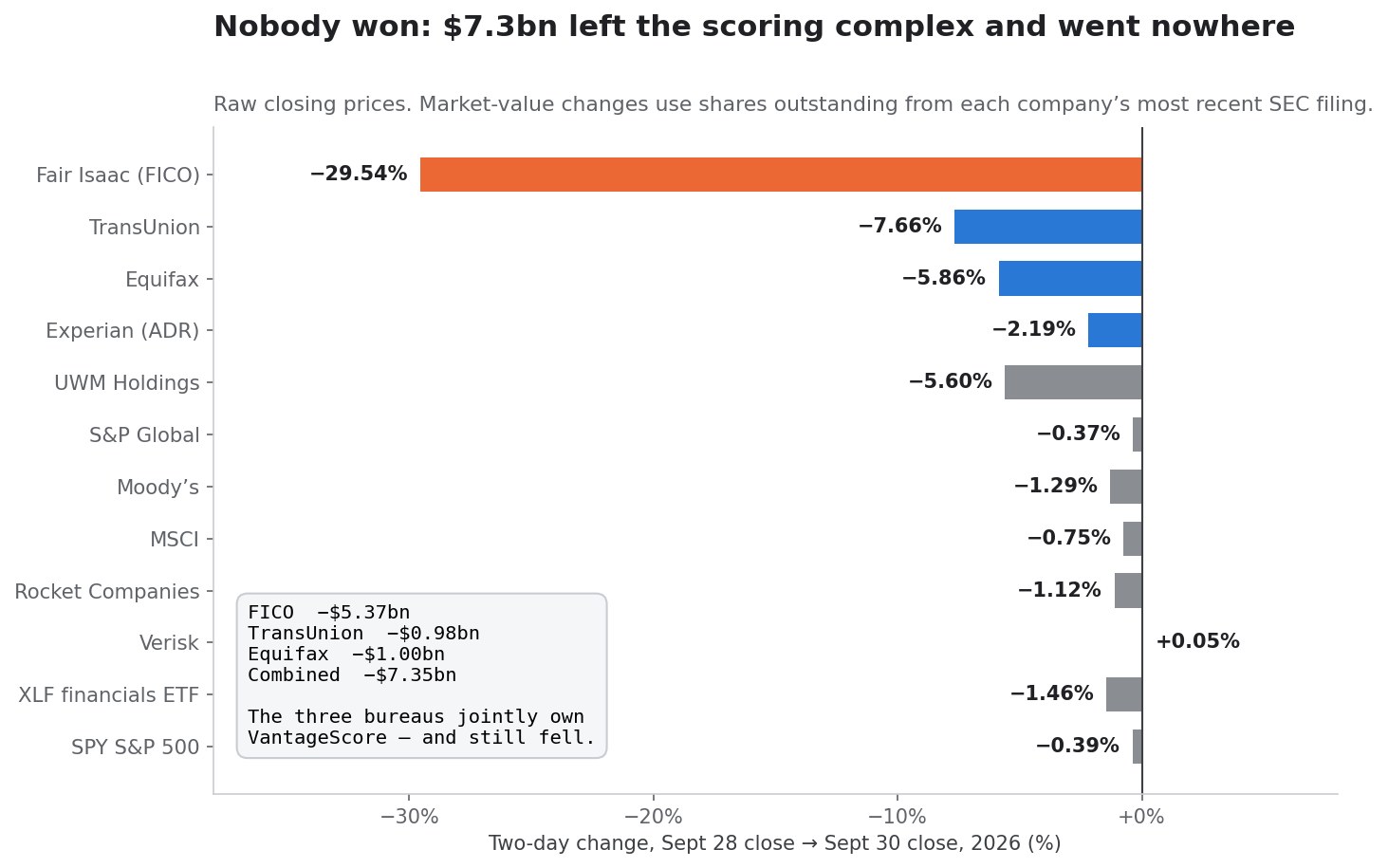
Who actually won? The reaction-day cross-section
The simplest way to test whether an event transfers value or destroys it is to look at who received the money. On 29–30 September 2026, nobody did.
The reaction-day cross-section
| Company | 28 Sept close | 30 Sept close | Two-day move | Market value change |
|---|---|---|---|---|
| Fair Isaac (FICO) | $840.89 | $592.47 | −29.54% | −$5.365bn |
| TransUnion | $66.19 | $61.12 | −7.66% | −$0.977bn |
| Equifax | $145.78 | $137.24 | −5.86% | −$1.003bn |
| Experian (ADR) | $33.38 | $32.65 | −2.19% | — |
| UWM Holdings | $1.25 | $1.18 | −5.60% | — |
| Rocket Companies | $11.64 | $11.51 | −1.12% | — |
| S&P Global | $395.92 | $394.47 | −0.37% | — |
| Moody's | $460.08 | $454.13 | −1.29% | — |
| MSCI | $542.72 | $538.66 | −0.75% | — |
| Verisk | $167.77 | $167.85 | +0.05% | — |
| XLF financials ETF | $54.19 | $53.40 | −1.46% | — |
| SPY (S&P 500) | $765.61 | $762.63 | −0.39% | — |
Market-value changes use shares outstanding from each company's most recent SEC filing: FICO 21,597,635; TransUnion 192,800,000; Equifax 117,484,896. Combined, the three lost $7.35 billion over two sessions, against an S&P 500 that moved −0.39%.
The bureaus own the winner and still fell
This is the finding that reframes the whole event.
VantageScore Solutions LLC was formed in 2006 as a joint venture of Equifax, Experian and TransUnion — a structure described in Equifax's own FY2006 Form 10-K, which dates the announcement to 14 March 2006. The three national credit bureaus jointly own the model that just took share from FICO.
And all three fell. TransUnion −7.66%, Equifax −5.86%, Experian's ADR −2.19%.
If this had been a share transfer — value moving from FICO to a competitor — the competitor's owners would have gained. They lost roughly $2.0 billion between them. The market's verdict was not "FICO's profits move to the bureaus." It was "the mortgage scoring fee pool shrinks, and everyone who collects from it earns less."
That distinction matters enormously for forecasting. A share-transfer event has a floor: FICO's loss is bounded by the share it can lose. A fee-pool compression event has no such floor, because the surviving price is set by competition rather than by whoever holds the remaining volume.
And the payers did not gain either
If the fee pool shrank, the savings should accrue to lenders. Rocket Companies fell 1.12% and UWM Holdings fell 5.60% over the same two sessions — neither rallied.
The explanation is scale. Rocket's own testing put the average saving at $1,600 per closing for borrowers who saved, and that saving largely accrues to the borrower, not the lender. A mortgage originator passes credit-report costs through; a cheaper score reduces the borrower's cash to close, improves qualification rates at the margin, and leaves the originator's economics broadly unchanged.
So the complete accounting of 29–30 September 2026 is: $7.35 billion of market value destroyed across the scoring complex, no listed beneficiary, and a diffuse benefit distributed across American homebuyers at roughly $1,600 a transaction. That is what a regulated price reset looks like in a capital market — and it is a pattern worth recognising, because it is the same shape as the one in Crown Castle's fourth-carrier test, where a sector-wide repricing destroyed far more value than it transferred.
The 2006 precedent FICO already litigated and lost
FICO's competitive problem is not new, and the company has already fought it in court and lost.
VantageScore Solutions was announced on 14 March 2006. Fair Isaac sued, alleging antitrust violations, trademark infringement and false advertising. The joint venture prevailed.
Twenty years later, VantageScore has a consumer-facing distribution footprint through credit-monitoring services, bureau relationships, and a model generation — 4.0 — validated by the FHFA on the same day as FICO 10T. What it did not have, for twenty years, was a reason for a conforming mortgage lender to use it.
What changed was not the model's quality, its approval status, or its distribution. What changed was that FICO raised its price from $0.60 to $10.00 and Equifax answered at $4.50.
That is the lesson the ledger teaches, and it generalises well beyond credit scoring. A competitor that cannot win on product can wait indefinitely for the incumbent to make it competitive on price. For twenty years VantageScore could not beat FICO. It did not have to. It only had to be there when FICO's own pricing made it the rational choice.
What FICO stock is worth at $740
With the mechanism established, the valuation question becomes tractable: what does $740 assume?
The multiples
At $740.00 on 21,597,635 shares, FICO's market capitalisation is $15.98 billion. Adding net debt of $5.33 billion gives an enterprise value of approximately $21.32 billion.
Against FICO's own guidance, raised on 29 July 2026:
| Metric | Updated FY2026 guidance | At $740.00 |
|---|---|---|
| Revenue | $2.53 billion | EV/revenue 8.4× |
| GAAP net income | $850 million | P/E 18.8× |
| GAAP EPS | $36.86 | P/E 20.1× |
| Non-GAAP net income | $979 million | P/E 16.3× |
| Non-GAAP EPS | $42.43 | P/E 17.4× |
Guidance was raised from $2.45 billion of revenue, $825 million of GAAP net income and $35.60 of GAAP EPS. Annualising the June quarter's operating income of $362,628k gives roughly $1.45 billion, for an EV/EBIT of about 14.7×; annualising the nine-month figure gives $1.33 billion and 16.0×.
Those are not expensive multiples for a business with a 70% consolidated operating margin. They are also not cheap if the earnings they are applied to are the peak.
The question the multiples cannot answer
FICO's fiscal 2026 earnings are, by the company's own disclosure, a price-increase story. The relevant question is not whether 20× earnings is cheap. It is which earnings.
Four possibilities:
- A sustainable new baseline. The $10 price survives because tri-merge, MBS securitisation requirements and non-mortgage lending keep FICO volumes intact. Fiscal 2026 earnings are the floor.
- A temporary benefit from pricing ahead of a volume reset. Price rose, volume holds for now, and both normalise once lenders complete their switches. Fiscal 2026 earnings are a peak.
- A final surge before a genuine share shift. Rocket is the first of many. Fiscal 2026 earnings are the top of a cycle that does not repeat.
- A mix. Mortgage score economics reset meaningfully while the non-mortgage franchise — card underwriting, auto, personal loans, small-business credit, bank risk management, insurance analytics, collections and myFICO — remains intact. Fiscal 2026 earnings are partly structural and partly transient.
Scenario four is the most likely and the hardest to price, because it requires separating mortgage Scores revenue from everything else — a split FICO does not disclose.
The stress test that matters
Since no one can know the mortgage share precisely, the honest approach is to stress the Scores segment directly and read the resulting multiple. Starting from annualised consolidated operating income of approximately $1,332 million, against annualised Scores segment operating income of approximately $1,490 million — the segment figure is larger because unallocated corporate expense and share-based compensation sit below it:
| Decline in Scores operating income | Implied total operating income | EV/EBIT at $740 |
|---|---|---|
| 0% | $1,332m | 16.0× |
| −10% | $1,183m | 18.0× |
| −20% | $1,034m | 20.6× |
| −30% | $885m | 24.1× |
| −40% | $736m | 28.9× |
| −50% | $587m | 36.3× |
Read the table in reverse to find what the market is assuming. For FICO at $740 to trade at a 20× EV/EBIT multiple — ordinary for a high-quality analytics business — Scores operating income must not fall by more than roughly 18%. At a 25× multiple the tolerance is about 32%.
So the market's implicit base case is a Scores operating-income decline somewhere in the high teens to low thirties. Whether that is right is the entire investment debate. What it is not is a market pricing FICO for extinction.
The debt amplifies the equity sensitivity
Note what the leverage does to this table. Enterprise value is $21.32 billion, of which $5.33 billion is net debt. A 20% decline in Scores operating income reduces enterprise value proportionally if the multiple holds — but the debt is fixed in nominal terms, so the equity absorbs the entire change.
Run it: at a constant 16.0× EV/EBIT and a 20% Scores haircut, enterprise value falls to roughly $16.5 billion, equity to roughly $11.2 billion, and the share price to about $519 — a 30% decline from $740 on a 20% decline in one segment's profit. That amplification is what the nine-month buyback bought, and it is the practical cost of having converted $2.5 billion of balance-sheet flexibility into retired stock at $1,409. The same arithmetic appears in Lululemon's $4.33 billion repurchase ledger, where a buyback executed near the highs became the dominant explanation for the subsequent equity drawdown.
What the bulls are right about
A reference document that only argues one side is not a reference document. Three things in FICO's favour are genuinely strong and under-weighted in the bearish coverage.
Non-mortgage is most of the franchise and nothing has touched it
The FHFA governs conforming mortgage delivery. It does not govern credit-card underwriting, auto lending, personal loans, small-business credit, bank risk management, insurance analytics, debt-collection decisioning, fraud workflows, or consumer credit monitoring. The FICO Score is used by 90% of top U.S. lenders and is available in more than 40 countries beyond the United States.
Nothing in the 2025–2026 sequence changes any of that. B2C Scores revenue — the myFICO subscription business and royalties on scores sold indirectly to consumers — grew 5% in the June quarter and remains entirely outside the regulatory perimeter.
The securitisation requirement is a real floor
The mortgage-backed securities market continues to demand FICO scores for securitisation purposes. A lender that originates a VantageScore-scored loan still operates inside a secondary market whose conventions, historical performance data and investor expectations are built on FICO. Conventions change slowly, and the change is not within the FHFA's sole gift.
Switching costs are real, and Rocket's own exclusions prove it
Rocket is the strongest possible test case: a large, technologically sophisticated originator that ran four months of parallel testing across 1.4 million credit reports and is publicly aligned with the FHFA Director's push for competition. Even Rocket kept FICO for investment-property mortgages, second homes, home equity, FHA and jumbo loans.
That exclusion list is the bull case rendered concrete. The parts of the mortgage market outside the conforming perimeter did not change, and the lender most motivated to switch did not switch them.
How to monitor FICO stock from here: six steps
A thesis you cannot track is a thesis you cannot hold. Six things determine which scenario above is unfolding, and all six are observable.
Step 1 — Track the unit price, not the headline
FICO's MD&A explicitly attributes Scores revenue growth to unit price. Every subsequent 10-Q will do the same, or stop doing so. The sentence to find in each filing is the one explaining the B2B Scores revenue change. When it shifts from "a higher mortgage origination scores unit price" to "an increase in volume" or, worse, to a decline attributed to price, the reset has begun.
Step 2 — Separate royalties from funded-loan fees
The direct-license program splits FICO's mortgage revenue between per-score royalties and per-closing fees. These behave differently across the origination cycle. Any disclosure that separates them — in the 10-K, the earnings call, or a reseller's own reporting — is more informative than the aggregate.
Step 3 — Watch FICO 10T's delivery eligibility
This is the single highest-leverage binary in the story. The FHFA states that FICO 10T is not currently eligible for delivery and that the enterprises will issue guidance when it becomes available. Approval reactivates the bundle — Classic FICO plus 10T free, no additional funded-loan fee — which is FICO's strongest competitive instrument. Four years of co-approval without delivery eligibility is the base rate; treat any approval as a genuine upside catalyst rather than an expectation.
Step 4 — Read Software operating income, not Software ARR
Platform ARR of +62% and platform net retention of 148% are the figures in the headlines. Software segment operating income fell 19.0% year over year. Both are true. Only one tells you whether the diversification is earning. The same selective-metric problem sits behind the non-recurring item inflating Netflix's trailing P/E. Track segment operating income and total dollar-based net retention of 109%, not the platform subset.
Step 5 — Model the term-loan amortisation
The incremental term loan amortises $75 million quarterly from September 2026 through June 2027, then $112.5 million quarterly. That schedule is contractual and reduces discretionary capital. Model it explicitly against free cash flow before assuming buybacks continue at any pace.
Step 6 — Watch the ASR settlement in the fiscal 2026 10-K
The $1.5 billion ASR settles in fiscal Q4 2026 and the final share count and average price will be disclosed in the annual report. That disclosure tells you two things: the true all-in cost of the largest buyback in the company's history, and how much of a windfall the September crash delivered on the undelivered $300 million tranche.
You can wire all six into an automated watchlist with SimianX AI's stock tools, which track filings, segment disclosures and price reactions together:
- SimianX AI — the research platform
- Live analysis command room — real-time multi-agent analysis of
FICO - Market Pulse — event detection on single names
- Crypto Leaderboard — model-by-model performance tracking
- Points and pricing — how usage works
Bull, base and bear: the scenario table
| Scenario | Core assumptions | Scores OI path | Implied framing |
|---|---|---|---|
| Bear | VantageScore 4.0 becomes default at most large conforming originators; FICO's per-score price resets toward $4.50; FICO 10T stays ineligible; Software operating income keeps declining | −35% to −50% | EV/EBIT re-rates to 24–36× on current EV; equity absorbs the full decline given $5.3bn of net debt; further buybacks constrained by $450m/yr of amortisation |
| Base | Conforming mortgage share shifts meaningfully but non-mortgage, B2C and securitisation conventions hold; price resets partially; Software stabilises | −15% to −25% | EV/EBIT 19–22×; earnings reset without franchise loss; leverage reduces rather than compounds |
| Bull | FICO 10T gains delivery eligibility; the bundle neutralises the price gap; lenders run both models; Software platform growth finally lifts segment operating income | −5% to +10% | EV/EBIT 14–17×; the de-rating from $1,858.91 proves to have discounted a reset larger than the one that occurs |
The bear case does not require FICO to lose its franchise. It requires only that mortgage score economics reset while software fails to compensate. The bull case does not require VantageScore to fail; it requires FICO 10T to ship.
Note what is absent from all three columns: an assumption about whether the stock is "cheap." At 16–20× earnings, FICO is neither obviously cheap nor obviously expensive. The multiple is not the variable. The denominator is.
FAQ
Why did FICO stock crash 26.52% on 29 September 2026?
The FHFA published upfront fee adjustments aligning mortgage pricing across Classic FICO and VantageScore 4.0, removing the economic penalty a lender paid for choosing the cheaper model. The prior session, Rocket Mortgage had announced VantageScore 4.0 would become its default for eligible direct-to-consumer conforming loans from Q4 2026. FICO fell from $840.89 to $617.87 on 4,914,500 shares, roughly twelve times normal volume.
Did FICO lose its mortgage credit-score monopoly in September 2026?
No — it lost it on 8 July 2025, when the FHFA's interim policy first permitted lenders to deliver conforming loans scored with VantageScore 4.0. What changed in September 2026 was pricing, not permission. FICO fell 8.91% on the 2025 policy day and 26.52% on the 2026 pricing day.
How much does a FICO mortgage score cost in 2026?
It depends on the model chosen. Under FICO's Mortgage Direct License Program: Classic FICO is $4.95 per score plus a $33 funded-loan fee per borrower per score, or $10.00 per score with no funded-loan fee. FICO Score 10T standalone is $0.99 per score plus a $65 funded-loan fee per borrower, and is free when bundled with Classic FICO. FICO's royalty was approximately $0.60 per score through 2022.
Is VantageScore 4.0 cheaper than FICO?
On published rates, yes. Equifax prices VantageScore 4.0 mortgage credit scores at $4.50 per score and has committed to hold that price through the end of 2027. On a two-borrower tri-merge closed loan — six scores — that is $27.00 against $60.00 for FICO's cheapest per-score-only option and $227.70 under the Classic FICO performance model.
Who owns VantageScore?
VantageScore Solutions LLC was formed in 2006 as a joint venture of Equifax, Experian and TransUnion, announced on 14 March 2006. Fair Isaac sued the venture in 2006 alleging antitrust violations, trademark infringement and false advertising; the venture prevailed.
Why did FICO buy back $3 billion of stock before the crash?
FICO's board approved three escalating repurchase authorizations in twelve months — $1.0bn in June 2025, $1.5bn in February 2026, $2.0bn in June 2026 — and the company deployed $3.05 billion in the nine months to 30 June 2026 against $778 million of operating cash flow. The largest tranche was a $1.5 billion accelerated share repurchase entered on 5 June 2026 and funded entirely by a $1.5 billion incremental term loan. The implied average delivered cost was approximately $1,408.81 per share.
What is FICO Score 10T and why can't lenders use it?
FICO Score 10T is FICO's newer mortgage scoring model, validated and approved by the FHFA on 24 October 2022 — the same day as VantageScore 4.0. It was added to the enterprises' Selling Guides in April 2026 and its historical data was published in July 2026, but the FHFA states it is not currently eligible for delivery. The enterprises will issue guidance when it becomes available.
Is FICO stock cheap at $740?
At $740.00 FICO trades at roughly 20.1× guided GAAP EPS of $36.86 and about 16.0× annualised operating income on an enterprise value of $21.32 billion. Those multiples are unremarkable for a business with a 70% consolidated operating margin. The question is not the multiple but the earnings: fiscal 2026 results were driven, per FICO's own filings, by a higher mortgage origination score unit price that the regulator has now made optional.
How much did the layoff cost, and how many people?
FICO employed 3,876 people at 30 June 2026. The approximately 15% reduction committed to on 1 October 2026 covers roughly 581 positions, with pre-tax charges of approximately $27.0 million recorded in fiscal Q4 2026 — about $46,400 per position. The plan is expected to be substantially complete by the end of fiscal Q3 2027.
Conclusion: the moat was always priced, not built
Fair Isaac's competitive advantage in mortgage scoring was never primarily the predictive quality of its model. VantageScore 4.0 was validated by the same regulator on the same day as FICO's own newest model. The advantage was that FICO's score was the one the system was built around, and switching was expensive relative to a cheap recurring fee.
FICO spent four years making that fee expensive. Each increase was individually rational — the company had pricing power and used it, and the result was a 90% segment margin and a stock that reached $2,382.40. Cumulatively, the increases dissolved the only thing holding the system in place: the fact that switching wasn't worth the trouble.
Then, with the FHFA's interim policy already fourteen months old and the limited rollout already underway, FICO borrowed $2.5 billion and retired 2.17 million shares at an average cost near $1,409 — a bet that the earnings produced by the price increases were permanent. Nine months later those shares are marked at $740.00, book equity is negative $4.1 billion, and the company has committed to removing 15% of its positions.
None of this makes FICO a bad business. A company earning 90.8% margins on an entrenched standard, with 90% of top U.S. lenders as customers and an untouched non-mortgage franchise, is a very good business trading at an ordinary multiple. The $740 price does not embed extinction — it embeds something like a 20% to 30% reset in Scores operating income, which is a defensible central case.
What the sequence does establish is a named pattern worth carrying into other regulated-franchise situations:
When a protected business monetises its protection faster than the switching cost it relies on, it finances the entry of its own competitor. The regulator's permission is never the binding constraint. Price is.
That pattern recurs. It is the same structure as a tower REIT discovering that its fourth-carrier option was worth less than the market paid for it, and the same structure as a payments incumbent finding that volume growth without margin growth is not a moat. It is worth recognising early, because the ledger that records it is always public — in FICO's case, four years before the price moved.
For a continuously updated view of FICO's filings, segment disclosures, price reactions and the competing interpretations of them, explore SimianX AI. Its multi-agent research tools track the six monitoring steps above automatically and flag when a filing's language changes.
Related Reading
- Crown Castle's Fourth-Carrier Test: SpaceX vs DISH's Ledger
- Lululemon Stock Below $100: Broken Brand or Rare Buy?
- Netflix −4.7%: The $2.8B Warner Fee Inflating Its P/E
- PayPal Stock Crashes 13%: TPV +10%, Margin Just +1.5%
- SpaceX's $8B Spectrum Deal: AT&T, Verizon, T-Mobile Ranked
References
- FHFA — Credit Scores Policy and Implementation Updates — the canonical milestone timeline and current model eligibility
- FHFA — Homebuying Advances Into a New Era of Credit Score Competition — the agency's own framing of the opening
- Fair Isaac Corporation Form 10-Q, quarter ended 30 June 2026 — segment footnote, debt, treasury stock, ASR note, headcount
- Fair Isaac Form 8-K, 6 October 2026 (Item 2.05) — the ~15% workforce reduction and $27.0 million charge
- Fair Isaac Form 8-K, 8 June 2026 — the $1.5 billion incremental term loan and the $1.5 billion ASR
- Fair Isaac Form 8-K, 20 March 2026 — the $1.0 billion 6.250% Senior Notes due 2034
- FICO fiscal Q3 2026 earnings release (Exhibit 99.1) — segment revenue, ARR, retention, raised guidance
- FICO Investor Relations — fiscal Q3 2026 results — the company's own announcement
- FICO Mortgage Direct License Program — the published 2026 rate card
- Equifax counters FICO direct license program with pricing plan — the $4.50 VantageScore 4.0 commitment through 2027
- Senator Hawley asks the FTC to investigate FICO mortgage pricing — the $0.60-to-$10 progression and the 88% margin citation
- FICO raises mortgage score price to $4.95 — the 2025 pricing step, reported contemporaneously
- FICO's stock plunges on credit-score competition fears — same-day reporting of the 29 September session
- Freddie Mac — Credit Score Models and Reports Initiative — enterprise-side implementation guidance
- VantageScore Solutions — model ownership, generations and distribution
- Fair Isaac Corporation SEC filing index — all filings cited above
- FICO historical stock prices — daily closes used in the ledger tables
- Investopedia — Accelerated Share Repurchase — the mechanics of the June 2026 ASR
- Investopedia — Enterprise Value — the valuation measure used above
- Investopedia — SOFR — the benchmark rate on the incremental term loan
- Investopedia — Stock Buybacks — the mechanics and trade-offs of share repurchases
- Investopedia — Volume-Weighted Average Price — how the ASR's final share count is determined
- Investopedia — Net Debt — the leverage measure used throughout
- Investopedia — Economic Moat — the concept this article tests against FICO's pricing record