 By Muke
Reading the Bumble Take-Private as a Ledger, Not a Premium
On the morning of October 13, 2026, Bumble Inc. and Ithaca Holdings issued a joint press release announcing that Bumble would be acquired in an all-cash transaction valuing the company at $1.3 billion, with Class A shareholders receiving $6.05 per share. The release led with a number: a 138% premium to the unaffected closing share price on October 9, 2026. Every headline that followed led with the same number.
The number is accurate. It is also the single least informative fact about the transaction.
A takeover premium is not a property of a company. It is a ratio between two prices, and one of those prices is chosen by whoever writes the press release. Measured against Bumble's closing price on October 9, 2026, the offer is a 138.2% premium. Measured against Bumble's own 52-week closing high — set on October 24, 2025, less than twelve months earlier — the same offer is a 2.9% premium. Measured against the price at which Bumble sold shares to the public in February 2021, it is an 85.9% discount.
Same offer. Same company. Three completely different stories, separated only by the date on the measuring tape.
This article does not argue that $6.05 is too low or too high. It argues that the premium is the wrong instrument. What the filings support instead is a ledger: a set of dated, sourced cash movements and write-downs that explain how a company that raised money at $43.00 a share came to be sold for $6.05, and who received the money along the way. Every figure below comes from Bumble's own filings with the U.S. Securities and Exchange Commission, from the merger agreement filed as Exhibit 2.1, or from daily market prices. Where a number is computed rather than reported, the computation is shown.
Readers tracking the spread as the deal moves toward closing can follow BMBL on SimianX alongside the live filing feed.
What Bumble and Ithaca actually signed
The press release describes a company being bought. The Form 8-K filed on October 13, 2026 describes something more specific, and the specifics matter for anyone holding the stock.
The consideration: $6.05 for Class A, $0.000001 for Class B
Under the merger agreement, each share of Class A common stock outstanding immediately before the effective time — other than dissenting shares, cancelled shares and shares subject to the rollover — converts into the right to receive $6.05 in cash, without interest.
Each share of Class B common stock converts into the right to receive $0.000001 in cash, without interest. That is one one-millionth of a dollar. There were 17 shares of Class B outstanding as of June 30, 2026, so the entire Class B consideration is a rounding artifact worth less than two thousandths of a cent in total.
This is not a slight. Bumble's Class B stock never carried economic rights; it carried votes. Under the dual-class structure established at the initial public offering, a holder of Class B was entitled to votes measured by the number of Opco common units it held, not by the number of Class B shares. The $0.000001 figure is the merger agreement acknowledging, in cash terms, exactly what Class B was: a voting instrument with no claim on value.
The third leg is the one that reconciles the arithmetic. Each common unit of Buzz Holdings L.P. outstanding immediately before the Opco merger converts into the right to receive the excess of the Class A per-share price over the Class B per-share price — that is, $6.05 less $0.000001. Economically, a common unit and a Class A share are paid the same.
Two mergers, not one: the Up-C unwind
The transaction is structured as two simultaneous mergers because Bumble is not a simple corporation. It is an umbrella partnership C-corporation, the structure the IPO prospectus describes as "commonly referred to as an umbrella partnership-C-corporation (or UP-C) structure."
Bumble Inc. sits on top. Beneath it is Buzz Holdings L.P. — referred to in the merger agreement as "Opco" and in the financial statements as Bumble Holdings — which is where the operating business actually lives. Bumble Inc. is the general partner. Other limited partners, the pre-IPO owners, hold common units that are exchangeable one-for-one into Class A shares.
So the merger agreement provides for Oak Merger Sub 1, Inc. to merge into Bumble Inc. (the "Corporate Merger") and Oak Merger Sub 2, LLC to merge into Buzz Holdings L.P. (the "Opco Merger"), with both survivors becoming wholly owned subsidiaries of Ithaca Holdco, Inc. Two mergers are required because there are two layers of equity to buy.
The practical consequence for valuation is that the Class A share count alone understates the company. The draft question many readers will have — why 131.9 million Class A shares multiplied by $6.05 does not come anywhere near $1.3 billion — has a precise answer, and it is in the 10-Q. That reconciliation is in a later section.
Who signed, and who recused
Bumble's board acted on the unanimous recommendation of a Special Committee consisting only of independent and disinterested directors, empowered with full authority to evaluate strategic alternatives. The press release identifies Ann Mather, Chair of Bumble's Board of Directors, as Chair of the Special Committee.
The board then approved the transaction unanimously, excluding Whitney Wolfe Herd, who recused herself from the deliberations and the vote. The press release describes her recusal as a governance formality. The merger agreement explains it as a necessity: Wolfe Herd is not only the seller's founder and chief executive, she is a party on the buyer's side through a rollover agreement, which is addressed later in this article.
The advisers line up with the structure. Goldman Sachs & Co. LLC and Morgan Stanley & Co. LLC served as financial advisers to the Special Committee, per the joint press release, with Davis Polk & Wardwell as its legal adviser. Kirkland & Ellis advised Ithaca, with KKR Capital Markets as capital markets adviser. Wachtell, Lipton, Rosen & Katz advised Wolfe Herd personally. Simpson Thacher & Bartlett advised Blackstone. Four separate sets of counsel for what the headline calls one transaction is itself a description of how many distinct interests had to be reconciled.
The premium depends entirely on the date you measure from
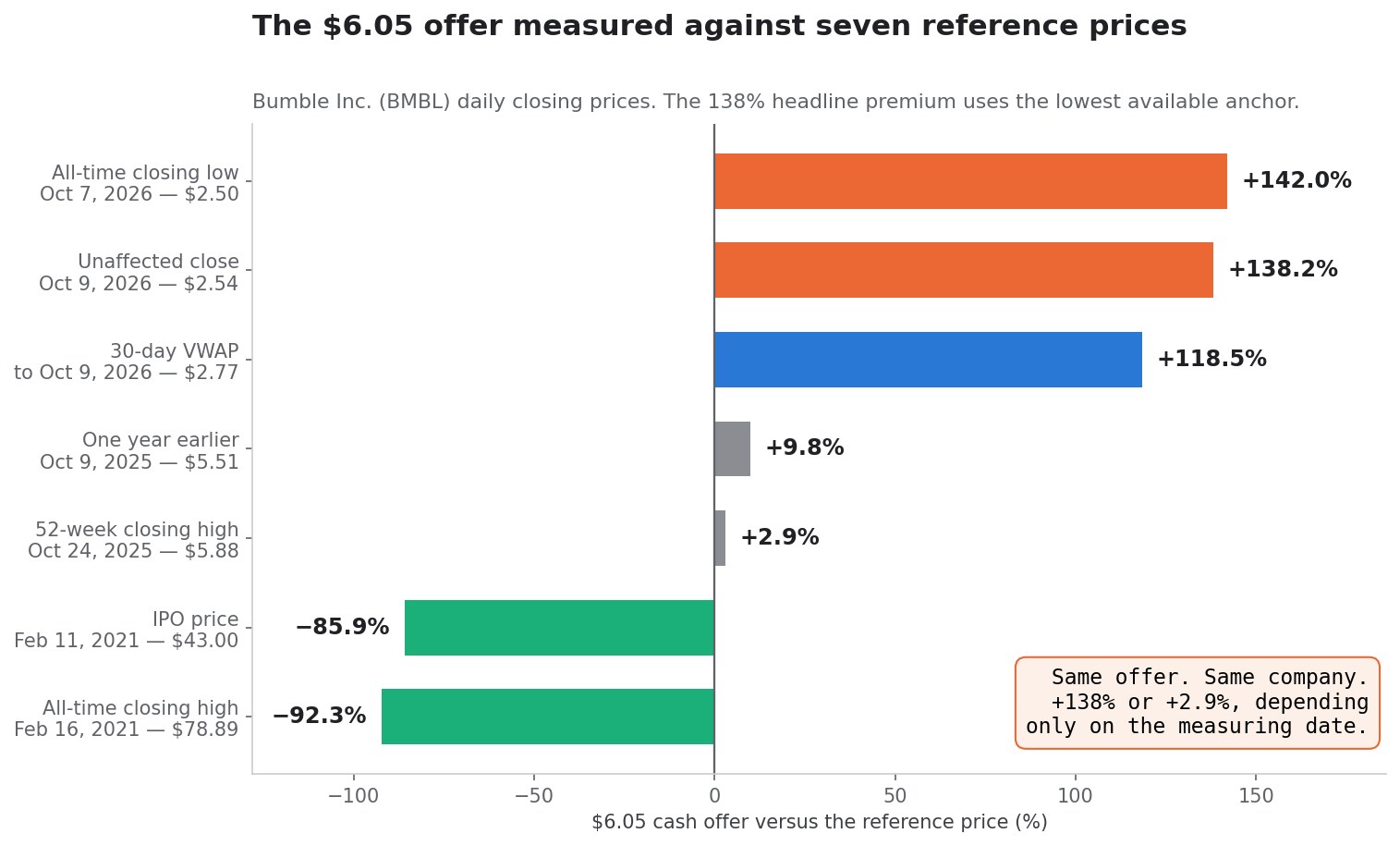
Here is the same $6.05 offer measured against every reference price a reasonable analyst might choose. All prices are Bumble Class A daily closes.
| Reference point | Date | Price | $6.05 versus it |
|---|---|---|---|
| All-time closing low | October 7, 2026 | $2.50 | +142.0% |
| Unaffected closing price | October 9, 2026 | $2.54 | +138.2% |
| 30-day volume-weighted average | to October 9, 2026 | $2.77 | +118.5% |
| Exactly one year earlier | October 9, 2025 | $5.51 | +9.8% |
| 52-week closing high | October 24, 2025 | $5.88 | +2.9% |
| Initial public offering price | February 11, 2021 | $43.00 | −85.9% |
| All-time closing high | February 16, 2021 | $78.89 | −92.3% |
The spread between the largest and smallest premium in that table is 139 percentage points, and nothing about Bumble changed to produce it.
The unaffected close of $2.54
Bumble closed at $2.54 on Friday, October 9, 2026. The merger agreement was dated Monday, October 12. Using the last close before the agreement date as the "unaffected" price is standard practice and is not a criticism.
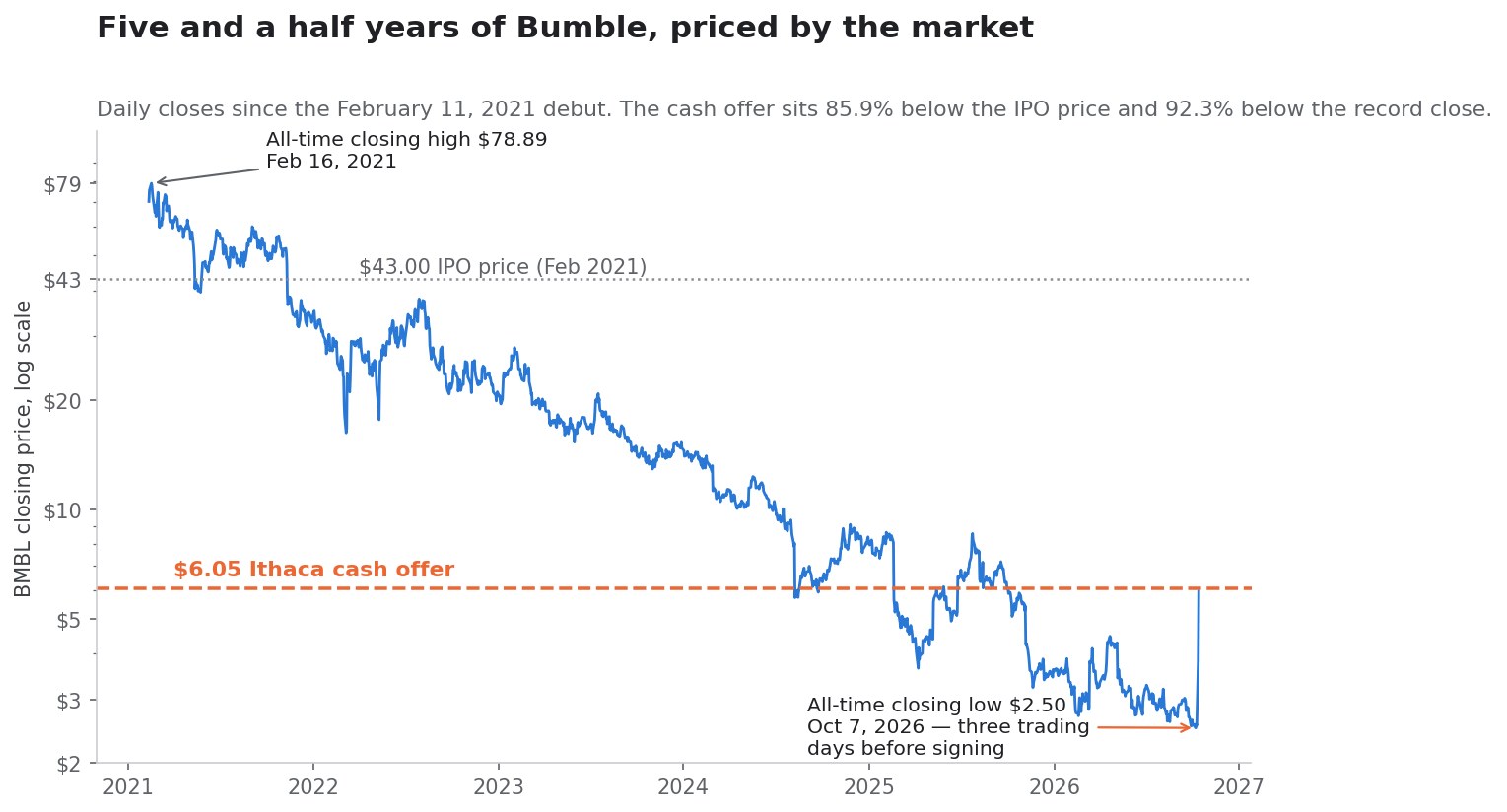
What deserves attention is where that price sat in Bumble's own history. The all-time closing low for Bumble Class A stock — across every trading day since the February 11, 2021 debut — is $2.50, set on October 7, 2026. That is three trading days before the merger agreement was signed. The October 9 close of $2.54 is 1.6% above the lowest price the stock has ever closed at.
A 138% premium calculated from a price 1.6% off an all-time low is a true statement about the premium and a weak statement about value.
The 30-day VWAP of $2.77
The press release also cites a premium of approximately 119% to the 30-day volume-weighted average price as of October 9, 2026. Computing a 30-session VWAP from daily high-low-close typical prices and volumes gives $2.77, implying a premium of 118.5% — within rounding of the company's own figure, which is a useful check that the method matches.
The VWAP premium is lower than the close-based premium for the obvious reason: the stock had been falling into the measurement window. A trailing average over a declining series sits above the final print. That the company disclosed both figures is to its credit; most releases disclose only the flattering one.
One year earlier: $5.51
On October 9, 2025 — exactly twelve months before the unaffected date — Bumble closed at $5.51. Against that price, the $6.05 offer is a premium of 9.8%.
This is the single most clarifying comparison in the table, because it holds the company roughly constant and moves only the clock. Over those twelve months Bumble's revenue fell, its paying users fell, and it wrote off another $169.3 million of assets. But it also refinanced its debt, generated record trailing operating cash flow, and completed a restructuring. A shareholder who bought a year before the deal and holds to closing earns 9.8% over roughly fifteen months, before the spread.
The 52-week closing high: $5.88
Bumble's highest close in the 52 weeks before the deal was $5.88, on October 24, 2025. The offer is 2.9% above it.
This is the comparison a board confronts in a fairness analysis, and it is why the Schedule 13E-3 will be worth reading. A buyer offering 138% over a distressed quote and 2.9% over the stock's own one-year peak is making a statement about timing, not about the business. The same pattern appeared when Schneider Electric bid for PTC at a price that trailed PTC's own 52-week high — a comparison examined in PTC Stock: Schneider's $205 Offer Trails the 52-Week High.
The two trading days that delivered the premium
The widely repeated description of the market's reaction is that Bumble "surged 57%" when the deal was announced. That is accurate for October 13 and omits October 12 entirely.
Monday, October 12: +49.61% on 42.3 million shares
The merger agreement is dated October 12, 2026. The joint press release is timestamped 8:24 a.m. Eastern Daylight Time on October 13, 2026.
On October 12, Bumble Class A opened at $2.54, traded as high as $3.975 and closed at $3.80 — a gain of 49.61% on volume of 42,333,800 shares. The 30-session average volume into October 9 was 2,124,920 shares. October 12 traded at 19.9 times that average.
Tuesday, October 13: +56.58% on 118.2 million shares
On October 13, after the announcement, the stock opened at $5.98, traded in a 6-cent range all day and closed at $5.95 — a further gain of 56.58% on 118,187,900 shares, or 55.6 times the prior 30-session average.
Cumulatively, from the $2.54 unaffected close to the $5.95 October 13 close, the stock rose 134.3%. The $6.05 offer is a 138.2% premium. In other words, by the close of the first public trading day, the market had already captured 97% of the announced premium.
What the volume says
The sequence is worth stating plainly, because it changes what "buying the news" means. Roughly 37 percentage points of the 134-point move happened on October 12 — the day the agreement was signed, before any public announcement. The remaining move happened after.
This article draws no inference about why October 12 traded the way it did, and none is available from the public record so far. The place that answer will appear, if it appears, is the "Background of the Merger" section of the forthcoming Schedule 13E-3, which is required to narrate the negotiation chronology. That section is the single most useful document the transaction will produce, and it has not been filed yet. The pattern of a deal stock closing most of its spread on day one — leaving a thin residual for arbitrageurs — also played out in Copart's acquisition of ACV Auctions, where a 44% jump left a 0.9% spread behind.
Reconciling the $1.3 billion headline
The press release says the transaction values Bumble at $1.3 billion. The merger agreement says Class A holders get $6.05. Those two facts do not visibly connect, and the gap is where most commentary stops.
The as-exchanged share count: 153,109,928
The 10-Q for the quarter ended June 30, 2026 contains the number that closes the gap. Note 10 states:
Assuming the exchange of all outstanding Common Units for shares of Class A common stock on a one-for-one basis under the exchange agreement entered into by holders of Common Units, there would be 153,109,928 shares of Class A common stock outstanding ... as of June 30, 2026.
Reported Class A outstanding at June 30, 2026 was 131,861,482 shares. The difference — 21,248,446 — is the Opco common units held outside Bumble Inc., the units that the Opco Merger buys at $6.05 less a millionth of a dollar.
Equity value: $926.3 million
Multiplying through:
| Component | Shares / units | Price | Value |
|---|---|---|---|
| Class A common stock | 131,861,482 | $6.05 | $797,761,966 |
| Opco common units (non-Bumble Inc.) | 21,248,446 | $6.05 | $128,553,098 |
| Class B common stock | 17 | $0.000001 | $0.00002 |
| Total as-exchanged equity | 153,109,928 | $6.05 | $926,315,064 |
So the equity check is approximately $926.3 million, not $1.3 billion. The figure excludes shares subject to the rollover, which are contributed rather than cashed out, and excludes the treatment of unvested equity awards.
Net debt: $321.0 million
The June 30, 2026 balance sheet shows cash and cash equivalents of $153,958 thousand and long-term debt, net, of $451,041 thousand ($52,176 thousand current plus $398,865 thousand non-current). The carrying value is net of unamortized discount and issuance costs; the outstanding principal under the 2026 credit agreement was $475.0 million.
Using principal, net debt is $475.0 million less $154.0 million, or $321.0 million.
Why Class A times $6.05 never reaches $1.3 billion
Adding the pieces:
| Bridge component | Amount |
|---|---|
| As-exchanged equity at $6.05 | $926.3m |
| Plus: term loan principal | $475.0m |
| Less: cash and cash equivalents | ($154.0m) |
| Implied enterprise value | $1,247.4m |
$1,247.4 million rounds to $1.2 billion, and the press release says $1.3 billion — a gap consistent with including transaction costs, the cash value of vested equity awards, or using a measurement date other than June 30. The point is not the final decimal. The point is that the $1.3 billion headline is an enterprise value, not an equity value, and that roughly a quarter of it is the assumption of Bumble's debt rather than cash to shareholders.
For context: Bumble's total assets on the June 30, 2026 balance sheet were $1,220.2 million. The enterprise value of the transaction is about what the company's entire balance sheet says it owns.
The cash-out ledger: $2.96 billion before the exit
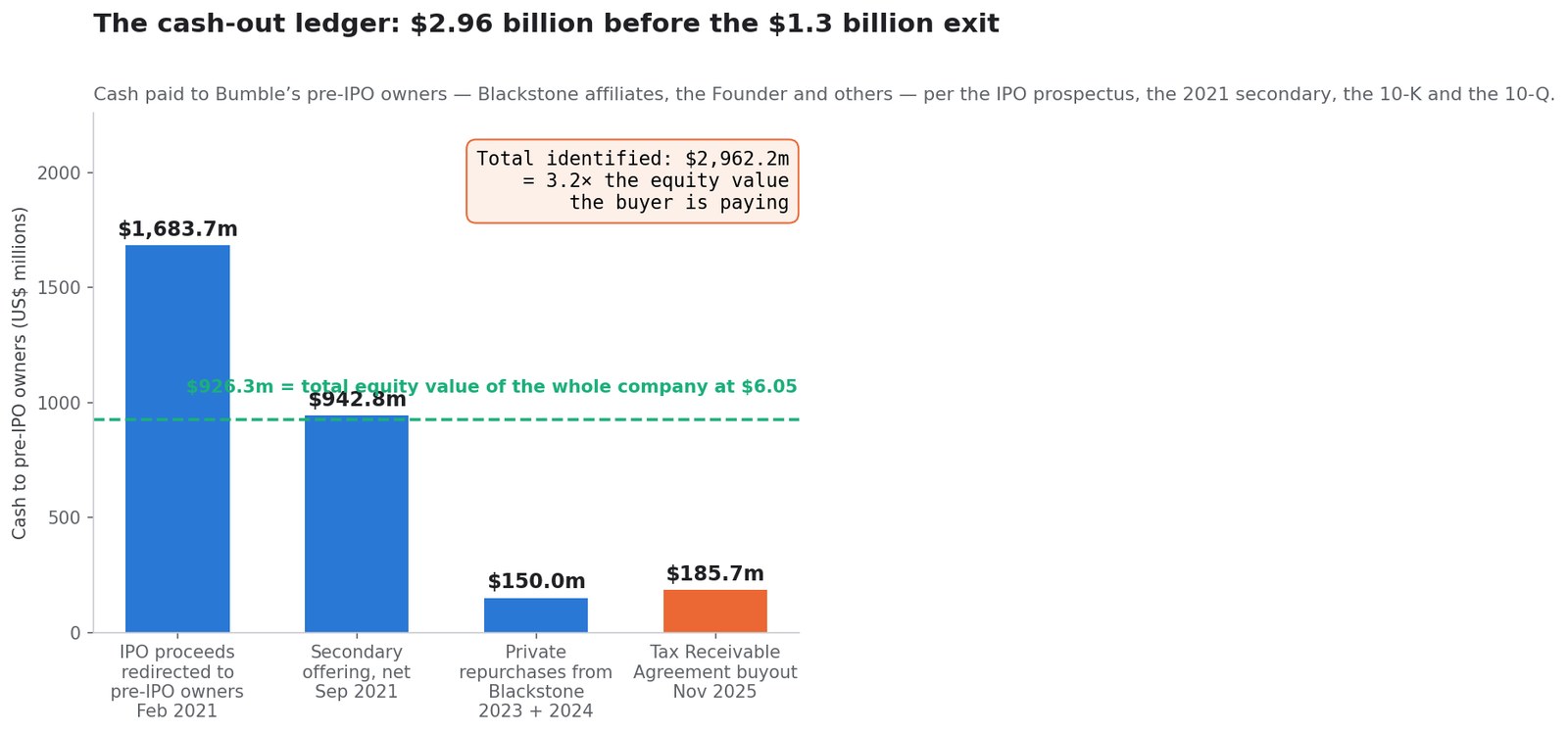
This is the section the premium framing hides. Bumble's pre-IPO owners — affiliates of Blackstone and entities associated with founder Whitney Wolfe Herd, defined in the IPO prospectus as the "Principal Stockholders" — received cash from the public company in four large, separately documented transactions before the take-private was signed.
February 2021: $1,683.7 million of IPO proceeds redirected
Bumble's IPO sold 50,000,000 Class A shares at $43.00 per share, raising $2,150.0 million gross. The prospectus states exactly where it went:
Bumble Inc. intends to use the proceeds (net of underwriting discounts) from the issuance of 9 million shares ($369.6 million) to acquire an equivalent number of newly-issued Common Units from Buzz Holdings L.P. ... which Buzz Holdings L.P. will in turn use to repay outstanding indebtedness under our Term Loan Facility ... totaling approximately $200.0 million ... and approximately $148.3 million for general corporate purposes ... Bumble Inc. intends to use the proceeds (net of underwriting discounts) from the issuance of 41 million shares ($1,683.7 million) to purchase or redeem an equivalent aggregate number of shares of Class A common stock and Common Units from our pre-IPO owners.
Of $2.15 billion raised from public investors, $1,683.7 million — 78.3% — went to the pre-IPO owners. Of the remainder, $200.0 million repaid debt and roughly $148.3 million, or 6.9% of the gross raise, reached the business as working capital, before approximately $21.3 million of offering expenses.
A secondary offering in which existing holders sell is entirely normal and fully disclosed. What is unusual is the proportion. Most of what the public paid at $43.00 was a transfer, not an investment.
This is the structural question every initial public offering poses and few headlines ask: what share of the money raised reaches the business, and what share reaches the people who owned it beforehand? The same arithmetic, applied to a company that had not yet listed, is the subject of Oura IPO Delayed: What the S-1 Shows Behind the $13.5B Ask.
September 2021: $942.8 million from the secondary
Seven months later, with the stock at $55.68, selling stockholders — pre-IPO common unitholders exchanging units into Class A shares — offered 18,000,000 shares at $54.00 under a second prospectus. Gross proceeds were $972,000,000. Underwriting discounts of $1.62 per share totalled $29,160,000, leaving $942,840,000 net at $52.38 per share.
The prospectus states that the company "will not receive any proceeds from the sale of shares of our Class A common stock by the selling stockholders." Every dollar went to the sellers.
December 2023 and March 2024: $150.0 million bought back privately
In December 2023, under the company's existing share repurchase program, Bumble agreed to repurchase approximately 4.0 million Class A shares from Blackstone and Bumble Holdings agreed to repurchase approximately 3.2 million common units from Blackstone, "for an aggregate purchase price of $100 million." That is 7.2 million units at an implied $13.89.
In March 2024, the same structure repeated: approximately 2.5 million Class A shares and 2.0 million common units from Blackstone "for an aggregate purchase price of $50 million" — 4.5 million units at an implied $11.11.
Together: $150.0 million of company cash, paid to one shareholder in privately negotiated transactions, for 11.7 million units at an average of $12.82. The buyer of the whole company is now paying $6.05.
November 2025: the $185.7 million Tax Receivable Agreement buyout
Concurrently with the IPO, Bumble entered a tax receivable agreement obliging it to pay pre-IPO owners 85% of the tax benefits it realized from the IPO-related step-up in basis. It is a standard feature of Up-C structures and a standing claim on future cash.
On November 5, 2025, Bumble entered Amendment No. 1 with Blackstone, the founder and certain other pre-IPO owners. The 10-K states:
The TRA Amendment provided for one-time settlement payments of approximately $186.0 million as consideration for the complete and full termination of the Company's payment obligations ... We made cash settlement payments of $185.7 million to Blackstone, the Founder and certain other pre-IPO owners in connection with the TRA Buyout.
The same filing notes that "immediately prior to the TRA Amendment, Blackstone elected to exchange all of its Common Units for the Company's Class A common stock" — which is visible in the balance sheet, where non-controlling interests fall from $361.6 million at September 30, 2025 to $111.1 million at December 31, 2025.
Total tax receivable agreement cash in 2025 was $194.7 million, comprising the $185.7 million buyout and $8.9 million of ordinary payments.
The total against the exit value
| Date | Mechanism | Cash to pre-IPO owners |
|---|---|---|
| February 2021 | IPO proceeds from 41m shares redirected | $1,683.7m |
| September 2021 | Secondary offering, net of underwriting | $942.8m |
| December 2023 + March 2024 | Privately negotiated repurchases from Blackstone | $150.0m |
| November 2025 | Tax Receivable Agreement buyout | $185.7m |
| Total identified | $2,962.2m |
$2,962.2 million. The equity value of the entire company at $6.05 is $926.3 million. The pre-IPO owners extracted 3.2 times what the buyer is now paying for all of Bumble's equity, and 2.4 times the full $1.2 billion enterprise value, before the take-private was signed.
Eleven months elapsed between the $185.7 million tax receivable buyout and the merger agreement.
What Bumble's own buyback bought
Separate from the payments to pre-IPO owners, Bumble ran an open-market and privately negotiated repurchase programme authorized at $450.0 million. As of June 30, 2026, $50.1 million remained available and all treasury shares had been retired.
Three tranches, 42.8 million units
The 10-K discloses the programme year by year:
| Year | Class A shares | Common units | Total units | Cash, ex-excise tax | Implied average |
|---|---|---|---|---|---|
| 2023 | 7.8m | 3.2m | 11.0m | $157.1m | $14.28 |
| 2024 | 25.1m | 2.0m | 27.1m | $214.4m | $7.91 |
| 2025 | 4.7m | — | 4.7m | $28.7m | $6.11 |
| Total | 37.6m | 5.2m | 42.8m | $400.2m | $9.35 |
There were no repurchases in the first half of 2026.
The average price of $9.35
Across three years Bumble retired 42.8 million units at an average of $9.35. Against the $6.05 takeout, that is a mark-to-deal shortfall of $3.30 per unit, or $141.2 million — about 15% of the equity value the buyer is paying for the entire company.
The $400.2 million spent would have retired 66.1 million units at $6.05. The programme bought 35% fewer units than the same cash would buy at the exit price.
The 2025 tranche at $6.11
The final tranche is the one that stops the eye. In 2025 Bumble repurchased 4.7 million Class A shares for $28.7 million — an implied $6.11 per share. The buyer is paying $6.05.
A company's last buyback executing within six cents of the price at which the whole company is sold a year later is not a scandal. It is a measurement. It says that by 2025 the market price and the eventual private-market clearing price had converged, which is a different claim from "the market was undervaluing Bumble."
What $400 million buys at $6.05
The counterfactual is worth stating carefully, because buyback counterfactuals are easy to overclaim. Had the $400.2 million never been spent, Bumble would have ended June 2026 with roughly $554 million of cash rather than $154 million, and would have had 195.9 million as-exchanged units outstanding rather than 153.1 million.
At the same $1,247.4 million enterprise value, the equity check would be $1,247.4 million less net debt of negative $79 million — approximately $1,326 million across 195.9 million units, or $6.77 per unit. That arithmetic assumes the buyer values the enterprise identically in both worlds, which is an assumption, not a fact. But it frames the order of magnitude: the repurchase programme, executed at an average of $9.35 into a declining price, is plausibly worth more than seventy cents a share to the holders who are about to be cashed out at $6.05. This is the same ledger discipline applied to On Holding's $1 billion buyback, where the share count, not the headline, carried the information.
The impairment ledger: $2.10 billion written off
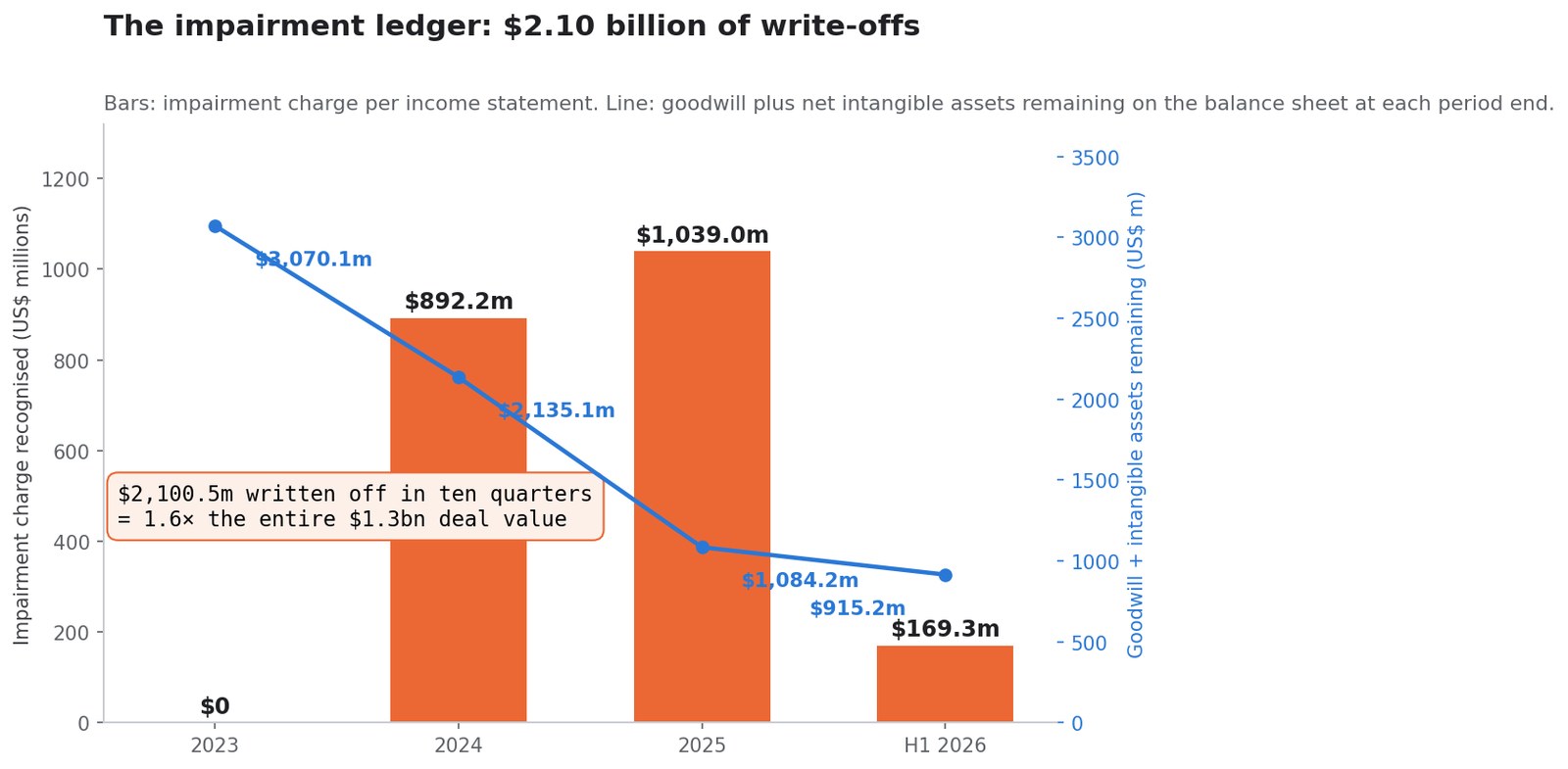
Impairment is a non-cash accounting entry, and it is routinely waved away for that reason. It should not be. An impairment is management and its auditors recording, under oath, that an asset is worth less than the balance sheet claimed. Over ten quarters Bumble recorded more of them than the company is now being sold for.
| Period | Impairment charge |
|---|---|
| Full year 2023 | $0 |
| Full year 2024 | $892.2m |
| Full year 2025 | $1,039.0m |
| Six months to June 30, 2026 | $169.3m |
| Cumulative | $2,100.5m |
$2,100.5 million of write-offs — 1.68 times the $1.25 billion enterprise value of the transaction.
2024: $892.2 million
Bumble reported no impairment at all in 2023, then $892.2 million in 2024, concentrated in the third quarter. The 2024 operating result swung from operating earnings of $53.4 million in 2023 to an operating loss of $700.5 million. Net loss attributable to Bumble Inc. shareholders was $557.0 million, or $4.61 per share.
2025: $1,039.0 million
The following year was larger: $1,039.0 million of goodwill and intangible impairment, split across the second and fourth quarters. Operating loss widened to $805.8 million; net loss attributable to Bumble Inc. reached $693.1 million, or $5.95 per share.
That per-share loss is worth pausing on. In 2025 Bumble reported a loss of $5.95 per share. The company is being sold for $6.05 per share.
The first half of 2026: $169.3 million
The second quarter of 2026 carried a further $169,256 thousand impairment charge, producing a quarterly operating loss of $112.0 million and a consolidated net loss of $127,893 thousand ($110,057 thousand attributable to Bumble Inc. shareholders, or $0.84 per share).
What is left on the balance sheet
The write-downs are visible as a collapse in the carrying value of the two line items they attacked:
| As of | Goodwill | Intangible assets, net | Combined |
|---|---|---|---|
| December 31, 2023 | $1,585.8m | $1,484.3m | $3,070.1m |
| December 31, 2024 | $1,386.2m | $748.9m | $2,135.1m |
| December 31, 2025 | $732.7m | $351.5m | $1,084.2m |
| June 30, 2026 | $603.5m | $311.7m | $915.2m |
Goodwill fell 62% and net intangibles fell 79% in ten quarters. Accumulated deficit at June 30, 2026 stood at $1,459.1 million. Total shareholders' equity including non-controlling interests had fallen to $616.6 million — two thirds of the equity check the buyer is writing.
Bumble's own pay-versus-performance disclosure
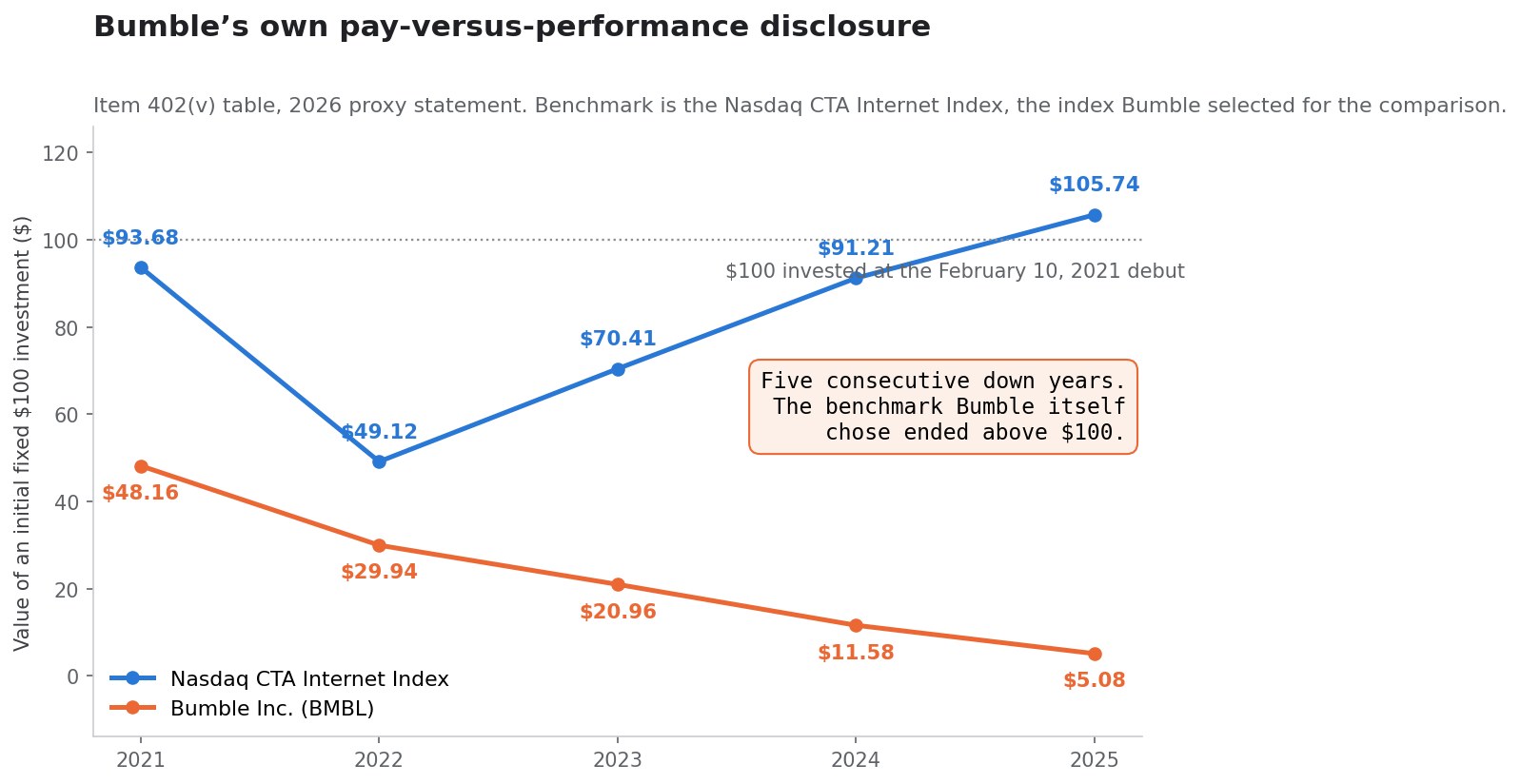
Companies are required by Item 402(v) of Regulation S-K to publish a five-year table showing executive compensation beside the value of a fixed $100 investment, measured against an index the company selects. Bumble filed its table in the 2026 proxy statement. It is the most unsparing document the company has produced.
$100 became $5.08
| Fiscal year end | $100 in Bumble becomes | $100 in the index becomes |
|---|---|---|
| 2021 | $48.16 | $93.68 |
| 2022 | $29.94 | $49.12 |
| 2023 | $20.96 | $70.41 |
| 2024 | $11.58 | $91.21 |
| 2025 | $5.08 | $105.74 |
Five consecutive annual declines. No year up. By December 31, 2025, a $100 investment at the February 10, 2021 measurement date was worth $5.08 — a loss of 94.9%. The implied base price is $70.28, within three cents of Bumble's first-day close, so the $6.05 offer lifts that $100 only to about $8.61. The takeover does not repair the five years; it adds $3.53 to them.
The index Bumble chose ended at $105.74
The benchmark is not an arbitrary choice imposed by a critic. Footnote 8 to the table identifies it as the Nasdaq CTA Internet Index, and notes that it "is the same index we use in our performance graph in the Company's Annual Reports on Form 10-K."
Over the identical measurement period, that index turned $100 into $105.74. The gap at the end of 2025 is 100.66 points — the index finished slightly above where it started and Bumble finished 95% below.
This is the fact that constrains every macro explanation of what happened. Consumer internet as a listed category, measured by the index Bumble itself picked, was approximately flat to modestly positive across the period. Whatever destroyed Bumble's equity value was not the category.
The public float shrank every single year
The proxy table is not the only five-year series Bumble is obliged to publish. Every Form 10-K cover page carries the aggregate market value of common equity held by non-affiliates, measured on the last business day of the second quarter. That series is the public market's own valuation of the portion of Bumble that ordinary investors actually owned.
| As of June 30 | Public float |
|---|---|
| 2021 | $4,371,204,000 |
| 2022 | $2,409,772,587 |
| 2023 | $1,661,183,147 |
| 2024 | $1,002,420,886 |
| 2025 | $479,397,451 |
Five measurements, five declines, each at least 31%. From 2021 to 2025 the float fell 89.0%.
The last line is the one that frames the transaction. The buyer is paying $926.3 million for the entire equity of Bumble — every share, every unit, including Blackstone's stake and the founder's. That is less than the public float alone was worth in June 2024, and roughly a fifth of what it was worth in June 2021.
What executives were awarded over the same years
The same table reports Summary Compensation Table totals. Bumble had two chief executives in the window: Whitney Wolfe Herd, and Lidiane Jones, who served from January 2, 2024 until March 17, 2025.
| Year | CEO 1 (Wolfe Herd) | CEO 2 (Jones) | $100 becomes |
|---|---|---|---|
| 2021 | $1,125,200 | — | $48.16 |
| 2022 | $16,234,030 | — | $29.94 |
| 2023 | $7,031,795 | — | $20.96 |
| 2024 | $6,045,649 | $23,503,322 | $11.58 |
| 2025 | $7,617,828 | $192,046 | $5.08 |
Summary Compensation Table totals for the two chief executives across 2021–2025 sum to $61,749,870. The table also reports "Compensation Actually Paid," the SEC's mark-to-market measure, which for 2021 was $75,084,565 for Wolfe Herd and for 2025 was negative $7,824,988 for Jones, who forfeited $7,674,280 of awards on departure. The negative figures in later years are the honest part of the disclosure: equity-heavy packages marked down with the stock.
The non-CEO named executive officer list is its own signal. For 2025 it comprises five people, three of them identified in the proxy as terminated during that year — a chief financial officer in March, a chief legal officer in April and an interim chief financial officer in August. Bumble ran through three finance chiefs in a single year. Leadership instability of this kind rarely shows up in a premium calculation but reliably shows up in execution, a pattern also visible in MongoDB's chief executive transition.
Is this an industry problem? The peer test
The most common explanation for Bumble's decline is that online dating is structurally broken — swipe fatigue, falling engagement, a generational retreat from apps. The claim is testable, because other dating companies trade publicly over the same window.
Match Group
Match Group, the owner of Tinder and Hinge, closed at $172.13 on February 11, 2021 — Bumble's first trading day — and at $42.36 on October 13, 2026. That is a decline of 75.4%.
So the sector explanation is not empty. A diversified operator with the two largest dating brands in the United States lost three quarters of its value over the same period. Anyone claiming Bumble's problems are purely idiosyncratic has to account for that. The comparison is easiest to run side by side on the MTCH quote page.
Grindr
Grindr closed at $11.05 on February 11, 2021 and at $15.47 on October 13, 2026 — a gain of 40.0%.
Grindr is a dating app. It operates in the same category, faces the same app-store economics and the same questions about engagement durability. Over the window in which Bumble fell 91.4% to the offer price and Match Group fell 75.4%, Grindr rose. "Dating apps are dead" does not survive contact with that number.
What survives the test
Ranking the same window on the same basis:
| Company | Feb 11, 2021 | Oct 13, 2026 | Change |
|---|---|---|---|
| Grindr | $11.05 | $15.47 | +40.0% |
| S&P 500 ETF (SPY) | $390.71 | $778.01 | +99.1% |
| Match Group | $172.13 | $42.36 | −75.4% |
| Bumble (at the $6.05 offer) | $70.31 | $6.05 | −91.4% |
What survives is a narrower and more useful claim: the swipe-based, mass-market, subscription dating model de-rated severely, and Bumble de-rated 16 percentage points worse than the largest operator of that model while a differentiated competitor in the same category appreciated. The category was a headwind. It was not the cause of the last sixteen points, and it does not explain the ledger in the preceding sections at all.
The one structural fact the filings do concede
Bumble's own 10-K risk factors state the industry problem precisely, and more usefully than any commentary:
The dating industry is highly competitive, with low switching costs and a consistent stream of new products and entrants, and innovation by our competitors, such as the use of artificial intelligence, may disrupt our business.
Two things follow. First, "low switching costs" is the company telling investors that brand recognition is not a moat here. A user who leaves costs nothing to leave. Second, and against the prevailing narrative, Bumble's own filings frame artificial intelligence as a competitive threat from rivals, not as a turnaround lever. The 10-K describes Bumble's own AI work in defensive terms — detecting inauthentic profiles, blocking inappropriate content, improving match relevance — not as a new business.
The cash machine nobody wanted
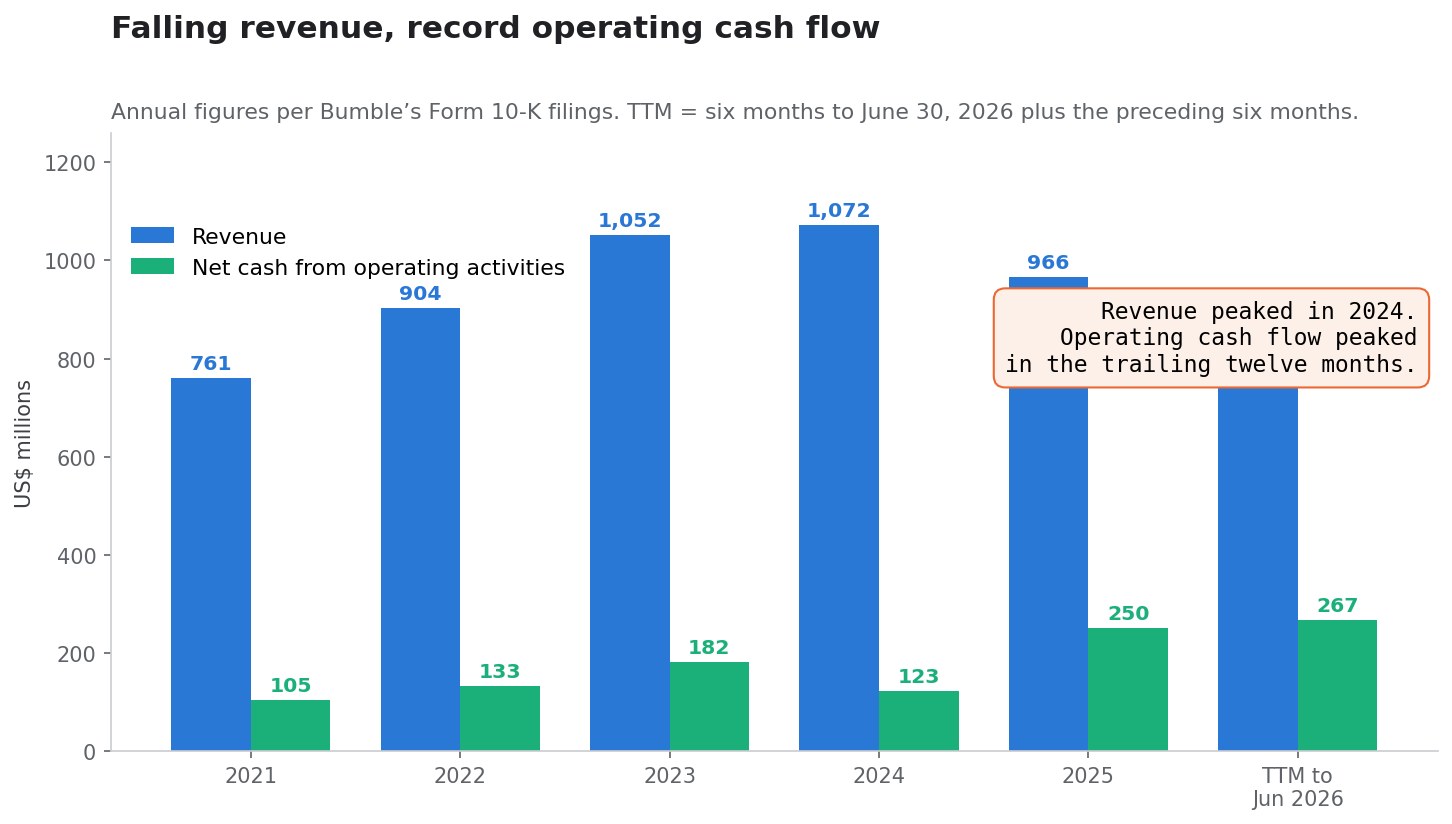
Here is where the standard story about Bumble is most wrong. The company is usually described as a deteriorating business running out of cash. The cash flow statement says the opposite.
Record operating cash flow in a shrinking business
| Year | Revenue | Net cash from operating activities |
|---|---|---|
| 2021 | $760.9m | $104.8m |
| 2022 | $903.5m | $132.9m |
| 2023 | $1,051.8m | $182.1m |
| 2024 | $1,071.6m | $123.4m |
| 2025 | $965.7m | $250.4m |
| Twelve months to June 30, 2026 | $893.2m | $266.7m |
Revenue peaked in 2024 and has fallen 16.6% from that peak. Operating cash flow peaked in the trailing twelve months, at $266.7 million — more than double the 2024 figure and 2.5 times 2021.
The two restructurings did what restructurings are supposed to do. Selling and marketing expense fell from $261.2 million in 2024 to $165.4 million in 2025, a 36.7% cut. The business got smaller and much more cash-generative at the same time.
The paying-user line, and what the company says about it
The operating metric that moves Bumble's revenue is paying users, and it is falling faster than revenue.
| Three months to June 30 | 2026 | 2025 | Change |
|---|---|---|---|
| Bumble App paying users | 2,077.1k | 2,499.8k | −16.9% |
| Badoo App and Other paying users | 1,080.1k | 1,277.4k | −15.4% |
| Total paying users | 3,157.2k | 3,777.2k | −16.4% |
| Bumble App ARPPU | $27.55 | $26.85 | +2.6% |
| Total ARPPU | $21.96 | $21.69 | +1.2% |
A rising average revenue per paying user is usually read as pricing power. The 10-Q does not support that reading. It attributes the increase to "an increase in Total ARPPU, primarily due to favorable fluctuations in foreign currency exchange rates." The monetization line held up because the dollar moved, not because Bumble raised prices successfully.
The company also declines to describe the user decline purely as a failure. Its management discussion frames part of it as deliberate:
As we transition from the completion of the quality reset to our membership base, our primary focus has shifted to improving the member experience through product innovation ... As we address these areas of focus, our revenue and paying users have been, and may continue to be, negatively impacted in the short term.
Both readings deserve to be on the page. A company that deliberately removes low-quality members will shed paying users; a company losing to competitors will also shed paying users; the public filings cannot distinguish them. What the filings do establish is that revenue is concentrated outside the United States — $87.4 million, or 42%, of second-quarter 2026 revenue came from the US, against $123.1 million from the rest of the world.
Revenue per employee
As of December 31, 2025 Bumble had approximately 580 full-time employees, with about 64% in Europe, spanning 14 countries. Against 2025 revenue of $965.7 million, that is $1.67 million of revenue per employee and $432,000 of operating cash flow per employee.
Those are extraordinary figures for a consumer business, and they are the most plausible single explanation for why a holding company whose stated mission is to "apply frontier technology to renew and accelerate businesses" wanted this asset. Ithaca is not buying growth. It is buying a cash-converting subscription base run by fewer than six hundred people.
The multiple the market was paying
At the $2.54 unaffected close, 153.1 million as-exchanged units implied an equity value of $388.9 million and, with $321.0 million of net debt, an enterprise value of $709.9 million.
Against trailing operating cash flow of $266.7 million, the public market was valuing Bumble's enterprise at 2.66 times operating cash flow, and its equity at 1.46 times. Those are multiples normally reserved for businesses expected to stop generating cash entirely.
The multiple the buyer is paying
At $6.05, enterprise value of $1,247.4 million against the same $266.7 million is 4.68 times trailing operating cash flow. Equity of $926.3 million is 3.47 times.
A buyer paying a 138% premium is paying 4.7 times operating cash flow. Both of those sentences are true simultaneously, and only one of them appeared in the headlines. This is the gap that a ledger closes and a premium cannot: the premium measures distance from a price, while the multiple measures distance from the cash the business produces. The same divergence drove the pricing analysis in FICO Stock and the Score Price Ladder.
The April 2026 refinancing was the real signal
If one date explains why Bumble is being sold in October 2026, it is not October. It is April 24, 2026.
SOFR plus 800 basis points
On that date Bumble's subsidiaries entered a new term loan credit agreement providing for a $475.0 million senior secured term loan maturing April 24, 2030, bearing interest at Term SOFR plus 8.00%, or a base rate plus 7.00%. The 10-Q discloses the rate in effect at June 30, 2026 as 11.62%.
The loans it replaced — the 2020 Original Term Loan and Incremental Term Loan — bore 7.18% and 7.68% respectively as of June 30, 2025. Bumble's cost of senior secured debt rose by roughly four percentage points in a single refinancing.
Term SOFR plus 800 basis points is not investment-grade pricing, and it is not ordinary leveraged buyout pricing for a business generating a quarter of a billion dollars of free cash flow. It is the pricing a credit market applies to an asset it expects to shrink.
The $28.5 million original issue discount
The term loan "was issued with a $28.5 million discount." On $475.0 million of face, that is an original issue discount of 6.0% — the lenders funded roughly 94 cents on the dollar. Bumble also incurred approximately $6.7 million of issuance costs on the term loan and $0.7 million on the revolver, and recognized a $1.5 million loss on extinguishing the old facility.
In cash terms: Bumble repaid $590.6 million and received $456.0 million net, closing the difference with balance-sheet cash. That is why cash fell from $175.8 million at December 31, 2025 to $154.0 million at June 30, 2026 despite $130.9 million of operating cash generation in the half.
The amortization schedule and the covenants
The new loan "amortizes in equal monthly installments, with annual amortization of 12.5% of the original principal amount in year one and 15.0% thereafter," and is subject to mandatory prepayments including from excess cash flow.
That is $59.4 million of scheduled principal in year one and $71.3 million per year afterwards, against interest of roughly $55.2 million at the 11.62% rate. Combined first-year debt service of about $114.6 million consumes roughly 43% of trailing operating cash flow — before any excess-cash-flow sweep.
The agreements add a maximum consolidated total leverage ratio of 3.00 to 1.00, stepping down to 2.00 to 1.00 by June 30, 2028, and a minimum liquidity requirement rising from $25.0 million to $50.0 million. Bumble was in compliance at June 30, 2026.
Read together, the April refinancing is a company buying four years of runway at a punitive price, with a covenant schedule that tightens into 2028 and an amortization schedule that claims nearly half its cash flow. A sale six months later is not a surprise. It is the consequence.
The workforce that is not in the headline
Deal coverage treats employees as a post-closing integration risk. At Bumble, most of the reduction already happened.
Two restructurings and two discontinued apps
In February 2024, Bumble announced a plan to cut approximately 350 roles, completed in the third quarter of 2024 at a cost of $20.4 million.
In June 2025, it announced a further reduction of approximately 240 roles, representing approximately 30% of employees, expecting roughly $15.0 million of non-recurring charges through the first quarter of 2026.
In between, it discontinued the Official app in the second quarter of 2025 and sold Fruitz to a third party in July 2025.
Approximately 580 full-time employees
The 10-K's own risk factors describe the result: "During 2025, we experienced significant changes in senior management and reduced our global workforce by approximately 30%." Headcount at December 31, 2025 was approximately 580.
A company that employed roughly 1,170 people before the 2024 plan now runs Bumble, Badoo and BFF with fewer than six hundred. The operating leverage visible in the cash flow statement is this, with a human denominator.
Every option cancelled for no consideration
The merger agreement's treatment of equity awards is where the distributional detail lives, and it is not symmetrical.
| Instrument | Count at June 30, 2026 | Treatment at the effective time |
|---|---|---|
| Stock options | 1,424,216 at a weighted-average exercise price of $17.35 | Cancelled for no consideration, whether vested or unvested |
| Opco incentive units | Time-vesting units with a $43.00 weighted-average participation threshold | Forfeited and cancelled without consideration |
| Vested RSUs | part of 12,363,572 unvested, plus vested awards | Cashed out at $6.05 per underlying share |
| Unvested RSUs | 12,363,572 unvested at June 30, 2026 | Converted to a cash amount, payable only on continued service through the original vesting dates |
| Employee stock purchase plan | — | Terminated at the effective time |
The options are not a controversy — the 10-Q already records their aggregate intrinsic value as zero, noting that "the weighted-average exercise price exceeded the market price as of June 30, 2026." But the incentive units are instructive: their participation threshold was $43.00, the IPO price. The instrument that was supposed to pay Bumble's operators was struck at the price the public paid on day one, and it expires worth nothing.
Meanwhile, vested restricted stock units held by non-employee directors and by the founder and chief executive are cashed out at $6.05 in full. Unvested units held by working employees become a retention obligation. The equity stack is being unwound in a specific order, and it is not alphabetical.
Deal protections: what actually makes this close
Most commentary on this transaction lists financing as the primary risk. The merger agreement says, in one sentence, that it is not.
No financing condition
The Merger Agreement does not contain a financing condition.
Ithaca is obligated to close whether or not its capital arrives on schedule. The equity side is documented: pursuant to an equity commitment letter dated October 12, 2026, Greenoaks Prime Radiant LP agreed to provide equity financing in the aggregate amount set forth therein. The 8-K does not disclose the amount.
The written consent is already delivered
Closing requires adoption of the merger agreement by written consent of the Principal Stockholders. The 8-K reports that this already happened:
Following the execution of the Merger Agreement, the Principal Stockholders executed and delivered to the Company a written consent adopting the Merger Agreement and approving the Mergers ... thereby providing the required stockholder approval for the Mergers. No further action by holders of shares of Company Common Stock is required to complete the Mergers.
There will be no shareholder vote. The press release confirms the consenting parties were "affiliates of Blackstone and Ms. Wolfe Herd." Unaffiliated holders receive an information statement and a twenty-day waiting period, not a ballot. Delaware permits this; Section 228 of the General Corporation Law authorises stockholder action by written consent.
A $102 million parent fee, escrowed by October 19
The asymmetry in the break fees is the clearest statement of who bears risk.
| Fee | Amount | Payable by |
|---|---|---|
| Company Termination Fee | $29,000,000 | Bumble, in specified circumstances |
| Parent Termination Fee | $102,000,000 | Ithaca, on a material uncured breach or failure to close |
The parent fee is 3.52 times the company fee. More importantly, the 8-K states that "The Parent Termination Fee is required to be deposited into an escrow account by October 19, 2026" — six days after announcement. A reverse break fee pre-funded in escrow is a materially stronger commitment than a contractual promise, because it removes the buyer's ability to walk and litigate about solvency.
The $29 million company fee and the no-shop
The company is subject to a customary no-shop provision. Crucially, the fiduciary-out — the right to engage with an unsolicited superior proposal — applied only prior to receipt of the Company Stockholder Approval, and that approval has already been delivered. The window in which a competing bidder could have emerged closed on the day the agreement was signed.
The $29 million company fee survives in one narrow tail: if an acquisition proposal is publicly announced and not withdrawn, the agreement terminates in specified circumstances, and Bumble signs or consummates a deal within twelve months. For practical purposes, the auction is over.
Closing conditions that remain: no prohibiting order; expiry or termination of the waiting period under the Hart-Scott-Rodino Antitrust Improvements Act; certain other governmental clearances; mailing of the Schedule 14C information statement and the passage of 20 days; accuracy of representations; performance of covenants; and no material adverse effect on the company. The End Date is July 12, 2027.
The merger-arbitrage arithmetic
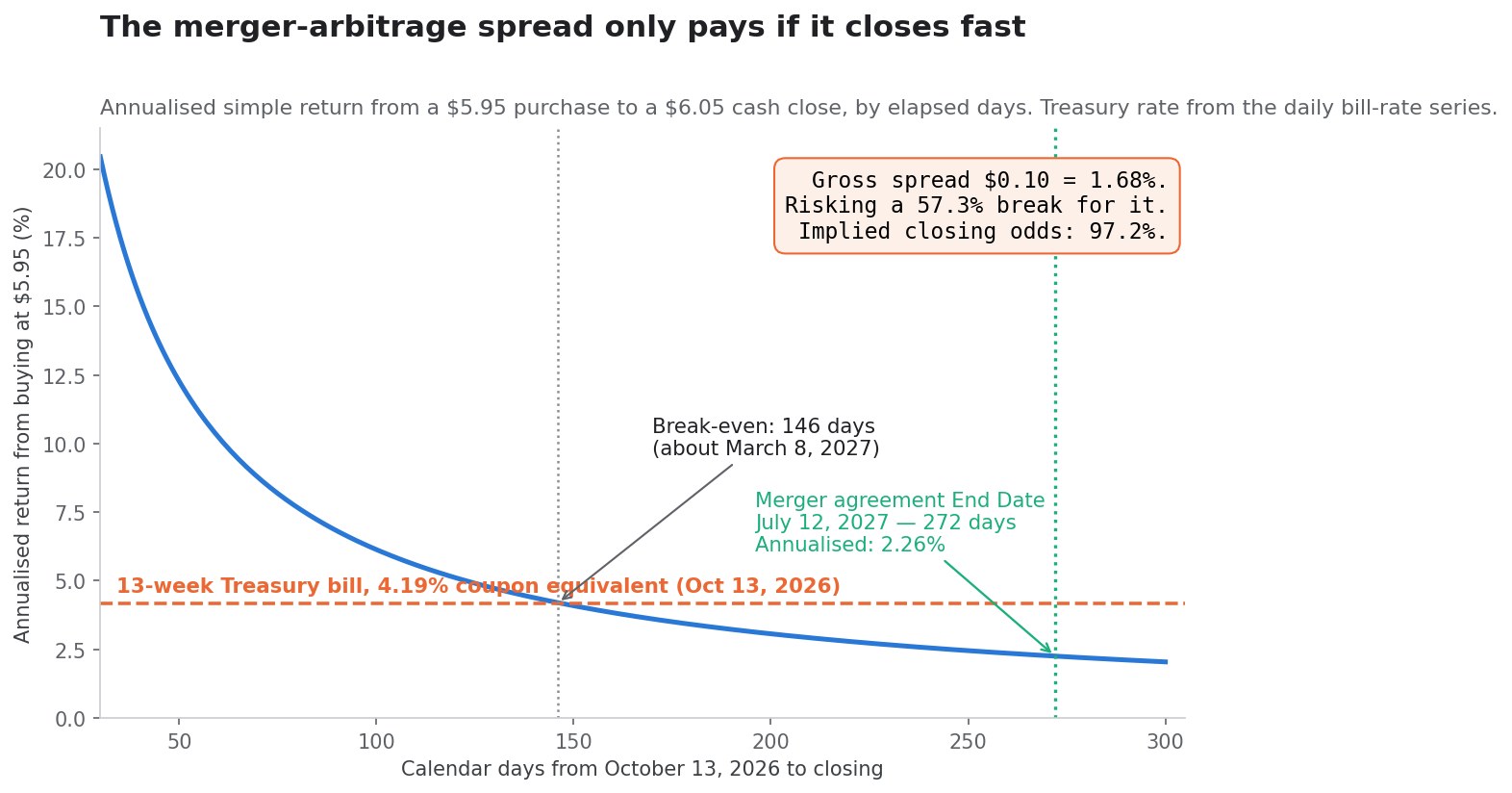
This is where the deal becomes a decision rather than a story. Merger arbitrage is arithmetic, and the arithmetic here is unusually unforgiving.
The spread is $0.10
Bumble closed at $5.95 on October 13, 2026 against a $6.05 offer. The gross spread is $0.10, or 1.681% of the purchase price.
The implied probability of closing
If the deal breaks, the natural reference point is the unaffected price of $2.54. Solving for the probability p that makes the current price a fair expected value:
p × $6.05 + (1 − p) × $2.54 = $5.95
p = ($5.95 − $2.54) ÷ ($6.05 − $2.54) = 97.15%
The market is pricing roughly a 97% chance of completion. Given no financing condition, a delivered stockholder consent and an escrowed $102 million reverse break fee, that is a defensible number rather than complacency.
Annualized return by closing date
The spread is fixed. The return is not, because the return depends entirely on time.
| Closing in | Annualized simple return |
|---|---|
| 60 days | 10.22% |
| 90 days | 6.82% |
| 120 days | 5.11% |
| 146 days | 4.20% |
| 180 days | 3.41% |
| 272 days (the End Date, July 12, 2027) | 2.26% |
The Treasury-bill hurdle
On October 13, 2026 the 13-week Treasury bill carried a coupon-equivalent yield of 4.19%, per the daily Treasury bill rate series.
The spread beats that hurdle only if the transaction closes within 146 days — approximately March 8, 2027. Close any later and a buyer at $5.95 would have done better in a three-month government bill with no deal risk at all. If the merger runs to its contractual End Date, the trade returns 2.26% annualized against 4.19% available risk-free.
Against that, the downside. A break returns the stock toward $2.54, a decline of 57.3% from $5.95. The position risks 57.3% to earn 1.68%, and the return only clears cash if the regulatory and mailing timetable resolves inside five months. That is a legitimate trade for a diversified book priced on closing probability. It is not a trade for anyone who thinks a 1.68% spread is compensation for owning Bumble.
Governance, the supervote clock and what to read next
Ten votes to one, until February 2028
The IPO prospectus established that each share of Class A held by a Principal Stockholder carries ten votes, and each Principal Stockholder holding Class B is entitled to ten votes per common unit held — a structure the prospectus justified as "reducing, during Bumble's initial years as a public company, the board's exposure to pressure that might be brought by activist shareholders."
The structure carried a sunset: seven years from the closing of the offering, or earlier if the parties to the stockholders agreement ceased to hold 7.5% of outstanding Class A on an as-exchanged basis. The offering closed in February 2021, placing the sunset in February 2028.
The merger agreement's End Date is July 12, 2027. On the contractual timetable, Bumble ceases to be a public company roughly seven months before one-share-one-vote would have arrived. That is an observation about sequence, not an allegation about intent, and it is checkable against two dated documents.
The founder is not cashing out
Concurrently with the merger agreement, Wolfe Herd and Beehive Holdings III, LP, an entity affiliated with her, entered a rollover agreement under which Beehive Holdings will contribute Class A shares to Oak Topco, Inc., a wholly owned subsidiary of Ithaca, in exchange for equity interests in Oak Topco. The 8-K is explicit: "Such shares will not be entitled to receive the Class A Per Share Price."
The press release frames this as continuity — "I will remain actively involved with Bumble." The merger agreement frames it as a capital structure: the founder is converting a public-company stake into a private-company stake alongside the buyer, which is precisely why she recused from the board vote and retained her own counsel.
Separately, Blackstone's reported beneficial ownership fell from 22,432,496 shares (Schedule 13D/A, event date June 16, 2026) to 18,664,720 shares (event date September 29, 2026), a reduction of 3,767,776 shares, or 16.8%, across a quarter in which Bumble traded between $2.44 and roughly $4.00. Blackstone's board designee, Jonathan C. Korngold, resigned effective June 30, 2026, a departure the 8-K attributes to his previously announced exit from Blackstone and expressly not to any disagreement with the company. The remaining 18.66 million shares are worth approximately $112.9 million at $6.05.
The related-party map
One further disclosure belongs in any assessment of who was extracting value. The 10-Q's related-party note records that Bumble recognises advertising revenue from and incurs marketing expense with Liftoff Mobile, a company in which Blackstone-affiliated funds hold a controlling interest; purchases moderator services from TaskUs and subscription services from Cvent, both Blackstone-controlled; uses subscription services from NAVEX Global, in which Blackstone funds hold more than 20%; and recognises consulting expense payable to Blackstone Management Partners L.L.C.
The amounts are small — $3.3 million of moderator costs and $0.2 million of marketing costs in the six months to June 30, 2026, against $0.1 million of consulting expense. Nobody is being bled through vendor contracts. But the map is worth drawing, because it shows that the sponsor relationship touched advertising, trust-and-safety operations, software procurement and advisory simultaneously. When an article asks "who captured the value," the answer is rarely a single line item.
Appraisal rights and the filings still to come
Because the merger was approved by written consent rather than a vote, unaffiliated stockholders' principal procedural protection is appraisal under Section 262 of the Delaware General Corporation Law, which allows a dissenting holder to petition the Court of Chancery for a judicial determination of fair value. The statutory notice and deadline mechanics will be set out in the information statement; the text of Section 262 governs.
Three documents will matter more than any commentary:
- The Schedule 13E-3, required for a going-private transaction with affiliates. It must contain the "Background of the Merger," the financial adviser's fairness opinion and the underlying analyses, and management projections. This is where the discounted-cash-flow assumptions, the comparable-company set and any sensitivity analysis will appear, and where the October 12 trading will either be explained or conspicuously not be.
- The Schedule 14C information statement, which starts the twenty-day clock that is itself a closing condition.
- The third-quarter Form 10-Q, which the company has committed to file by November 9, 2026. Because Bumble has cancelled its third-quarter earnings release and conference call, this filing is the only September-quarter disclosure investors will receive, and the paying-user line is the one to read first.
Frequently asked questions about the Bumble take-private
Is the 138% premium real?
Yes, and it is correctly calculated against the October 9, 2026 closing price of $2.54. It is also true that $2.54 is 1.6% above Bumble's all-time closing low, that the same $6.05 is only 2.9% above the stock's 52-week closing high of $5.88, and that it is 85.9% below the $43.00 IPO price. All four statements are simultaneously accurate. The premium describes the starting point, not the business.
Why doesn't the Class A share count times $6.05 equal $1.3 billion?
Because Bumble is an Up-C. Beyond the 131,861,482 Class A shares outstanding at June 30, 2026, there were 21,248,446 Opco common units held outside Bumble Inc. that are exchangeable one-for-one and are bought by the second merger. On an as-exchanged basis there are 153,109,928 units, worth $926.3 million at $6.05. Adding $475.0 million of term loan principal and deducting $154.0 million of cash gives an enterprise value of about $1,247 million — the "$1.3 billion" in the press release.
How likely is the deal to close?
The market is pricing roughly 97%, derived from the $5.95 close against a $6.05 offer and a $2.54 break price. The structural support is unusually strong: there is no financing condition, the required stockholder written consent has already been delivered so no vote can fail, and the $102 million parent termination fee must be escrowed by October 19, 2026. The remaining conditions are regulatory clearance, the twenty-day information-statement period and customary representations.
Is the merger spread worth trading?
Only on a fast close. The gross spread is $0.10, or 1.68%, against a 57.3% decline if the deal breaks. Annualized, it beats the 4.19% 13-week Treasury bill only if closing occurs within about 146 days, roughly March 8, 2027. At the July 12, 2027 End Date the annualized return is 2.26% — below cash. The trade is a bet on timetable, not on Bumble.
Was Bumble actually running out of money?
No. Operating cash flow in the twelve months to June 30, 2026 was $266.7 million, the highest in the company's public history, and 2025's $250.4 million was the previous record. What Bumble was running out of was cheap capital: the April 2026 refinancing priced at Term SOFR plus 8.00% with a $28.5 million discount, carried a 12.5%-then-15% annual amortization schedule, and tightens to a 2.00× leverage covenant by June 30, 2028.
Did online dating kill Bumble?
Partly, and not mostly. Match Group fell 75.4% over the same window, so the category genuinely de-rated. But Grindr rose 40.0% over the identical period, and the Nasdaq CTA Internet Index — the benchmark Bumble selected for its own proxy disclosure — turned $100 into $105.74 while Bumble turned $100 into $5.08. Sector explains part of the decline. The $2.96 billion cash-out ledger, the $2.10 billion of impairments and the $400.2 million buyback at an average of $9.35 explain the rest.
What happens to employee stock options?
Every option is cancelled for no consideration, vested or unvested. At June 30, 2026 there were 1,424,216 options outstanding at a weighted-average exercise price of $17.35, and the 10-Q already carried their aggregate intrinsic value as zero. Opco incentive units, whose time-vesting tranche carried a $43.00 participation threshold, are likewise forfeited without consideration. Vested restricted stock units are cashed at $6.05; unvested units become a cash amount payable only on continued service.
Related Reading
- Copart ACV Deal 2026: ACVA Jumps 44%, Leaving a 0.9% Spread
- PTC Stock: Schneider’s $205 Offer Trails the 52-Week High
- FICO Stock and the Score Price Ladder: $0.60 to $10
- On Holding (ONON) $1B Buyback: 10% of Shares vs Nike's $123M
- Oura IPO Delayed: What the S-1 Shows Behind the $13.5B Ask
References
- Bumble Inc. Form 8-K, October 13, 2026 — merger agreement and terms
- Exhibit 2.1 — Agreement and Plan of Merger, dated October 12, 2026
- Exhibit 99.1 — joint press release, October 13, 2026
- Bumble Inc. Form 10-Q for the quarter ended June 30, 2026
- Bumble Inc. Form 10-K for the year ended December 31, 2025
- Bumble Inc. 2026 definitive proxy statement — pay versus performance
- Bumble Inc. IPO prospectus, February 2021 — use of proceeds
- Bumble Inc. secondary offering prospectus, September 2021
- Form 8-K, June 29, 2026 — director resignation
- Form 8-K, August 5, 2026 — second-quarter 2026 results
- Schedule 13D/A, event date September 29, 2026 — Blackstone holdings
- Schedule 13D/A filing history for Bumble Inc.
- Bumble Inc. investor relations — SEC filings
- Bumble Inc. investor relations home
- Ithaca Holdings — official site
- Greenoaks — official site
- U.S. Department of the Treasury — daily Treasury bill rates
- Federal Trade Commission — premerger notification program
- Nasdaq CTA Internet Index — index overview
- Liftoff Mobile — official site
- TaskUs — official site
- Cvent — official site
- NAVEX — official site
- Investopedia — risk arbitrage
- Investopedia — EBITDA
- SimianX AI — multi-agent market analysis
- SimianX AI Live Command Room
- SimianX AI points and pricing
- SimianX AI stories archive
This article is for informational and educational purposes only. It is not investment, legal or tax advice. Merger transactions can be amended, delayed or terminated, prices can be volatile, and investors may lose money.