
Apa yang dilakukan tiap penutupan pemerintah sejak 1976 pada saham
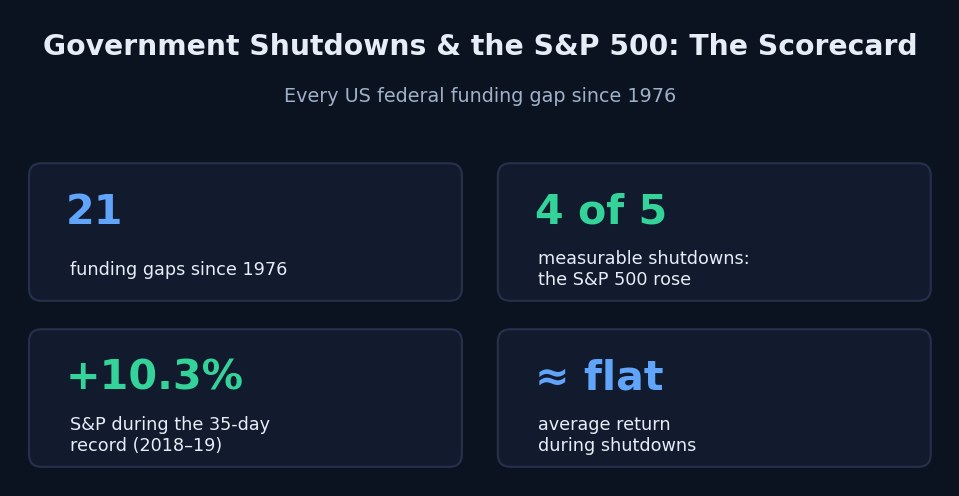
Penutupan pemerintah (government shutdown) terdengar seperti keadaan darurat finansial: kantor-kantor federal padam, ratusan ribu pegawai dirumahkan tanpa bayaran, dan tajuk berita berubah apokaliptik. Karena itu kebanyakan investor terkejut mengetahui bahwa S&P 500 secara rata-rata kurang lebih datar hingga sedikit naik selama penutupan — dan secara andal lebih tinggi setahun setelah penutupan berakhir. Dua penutupan terpanjang dalam sejarah AS, pada 2013 dan 2018–19, keduanya bertepatan dengan pasar yang naik, bukan jatuh.
Inilah referensi lengkapnya: setiap jeda pendanaan federal sejak 1976, berapa lama masing-masing berlangsung, apa yang dilakukan S&P 500 selama jendela itu, empat penutupan yang benar-benar penting bagi pasar, mengapa bursa mengangkat bahu terhadap drama ini, dan apa yang dikatakan data tentang menransaksikan penutupan berikutnya. Angka-angka dibulatkan, metodologi dipaparkan, dan setiap klaim ditambatkan ke catatan resmi.
Bagaimana kami mengukurnya (metodologi)
Sebuah tabel referensi hanya berguna bila aturannya jelas, jadi inilah aturan kami:
- Tanggal dan durasi penutupan berasal dari Congressional Research Service dan catatan historis "jeda pendanaan" federal sejak tahun fiskal 1977. Kami menghitung sebuah jeda sebagai setiap lapse alokasi anggaran, bahkan yang hanya beberapa jam.
- Imbal hasil saham memakai indeks harga S&P 500 (tanpa dividen), diukur penutupan ke penutupan: dari sesi perdagangan terakhir sebelum jeda dimulai hingga sesi pertama setelah pendanaan dipulihkan. Untuk jeda yang tidak mencakup satu hari perdagangan penuh, dampak pasarnya secara konstruksi praktis nol, dan kami menandainya demikian.
- Angka-angka dibulatkan ke sepersepuluh poin persentase dan hanya menggambarkan jendela penutupan itu sendiri — bukan minggu-minggu tarik ulur sebelumnya maupun reli kelegaan sesudahnya.
- Sebuah peringatan penting: jeda pendanaan sebelum 1981 jarang menghentikan operasi. Hingga dua pendapat Departemen Kehakiman pada 1980–81 memaksa lembaga benar-benar merumahkan staf, sebuah lapse alokasi sebagian besar hanyalah urusan administrasi. Jeda-jeda awal ada di tabel demi kelengkapan, tetapi penutupan "sungguhan" pertama yang dikutip kebanyakan analis adalah November 1981.
Menambatkan setiap baris ke aturan penutupan-ke-penutupan yang sama menjaga perbandingan tetap jujur. Sebuah penutupan bukan resesi dan bukan pasar beruang — untuk pandangan khusus-ekuitas itu, lihat referensi pelengkap kami tentang setiap pasar beruang S&P 500 sejak 1929 dan bagaimana S&P 500 berkinerja selama guncangan minyak.
Tabel referensi: setiap jeda pendanaan sejak 1976
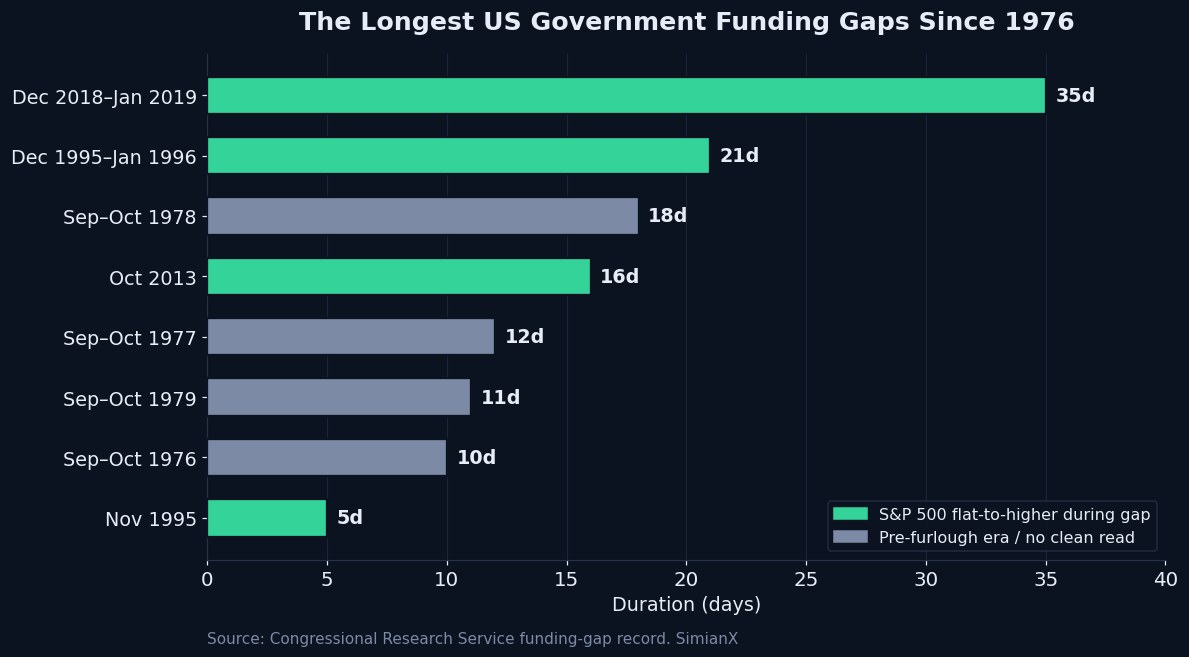
Ada sekitar 21 jeda pendanaan sejak 1976, tetapi hanya segelintir yang berlangsung cukup lama — dan merumahkan cukup banyak pegawai — untuk tercatat di pasar. Tabel berikut mendaftar semuanya; kolom S&P 500 hanya ditampilkan bila jeda mencakup setidaknya satu sesi perdagangan penuh.
| Jeda pendanaan | Presiden | Durasi | S&P 500 (penutupan ke penutupan) | Catatan |
|---|---|---|---|---|
| Sep–Okt 1976 | Ford | 10 hari | t/a | Era sebelum perumahan; tanpa penutupan operasional |
| 1977 (tiga jeda) | Carter | 8–12 hari | t/a | Tarik ulur soal aborsi; lembaga tetap buka |
| Sep–Okt 1978 | Carter | 18 hari | t/a | Jeda terpanjang sebelum 1995; efek minimal |
| Sep–Okt 1979 | Carter | 11 hari | t/a | Era sebelum perumahan |
| Nov 1981 | Reagan | 2 hari | ≈ datar | Penutupan modern pertama dengan perumahan (~241 ribu) |
| Sep–Des 1982 | Reagan | 1 + 3 hari | ≈ datar | Dua jeda singkat |
| Nov 1983 | Reagan | 3 hari | ≈ datar | Sengketa pertahanan dan bantuan luar negeri |
| 1984 (dua jeda) | Reagan | 1–2 hari | ≈ datar | UU kejahatan dan air |
| Okt 1986 | Reagan | 1 hari | ≈ datar | Lapse satu hari |
| Des 1987 | Reagan | 1 hari | ≈ datar | Sengketa bantuan Contra |
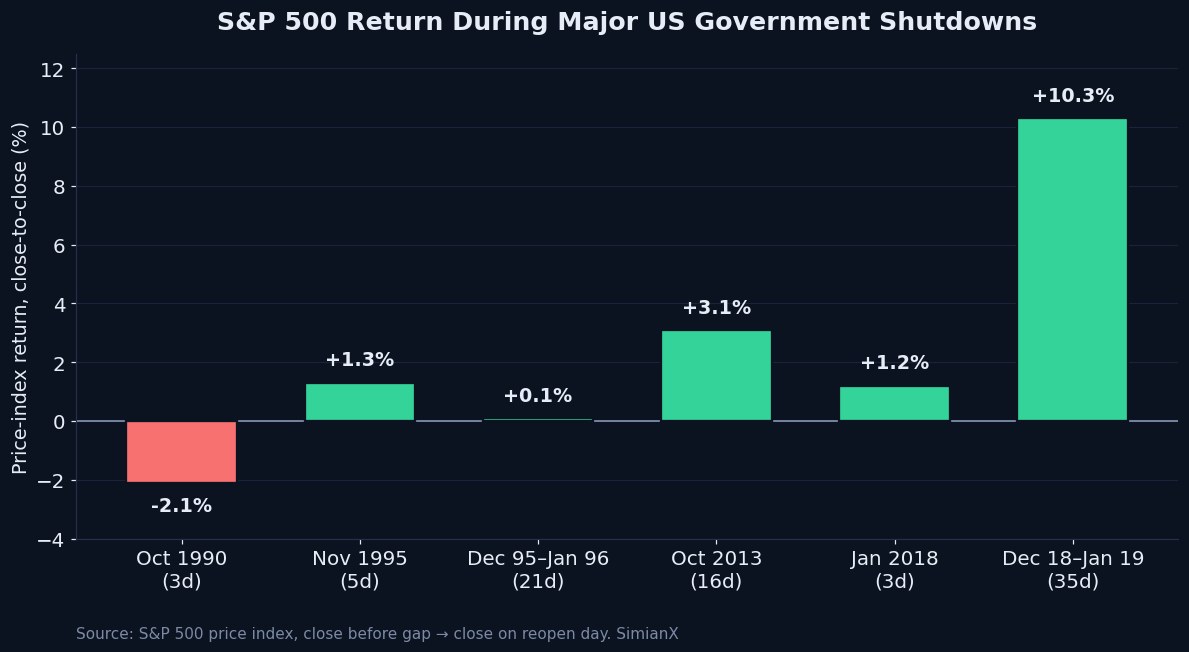
| Okt 1990 | G. H. W. Bush | 3 hari | −2,1% | Akhir pekan Columbus Day; bertumpang dengan beruang 1990 |
| Nov 1995 | Clinton | 5 hari | +1,3% | Perebutan anggaran berimbang, ronde satu |
| Des 1995–Jan 1996 | Clinton | 21 hari | +0,1% | Terpanjang saat itu; pasar praktis datar |
| Okt 2013 | Obama | 16 hari | +3,1% | Tarik ulur plafon utang; pasar naik |
| Jan 2018 | Trump | 3 hari | +1,2% | Sengketa imigrasi di tengah lonjakan |
| Feb 2018 | Trump | ~9 jam | t/a | Lapse semalam; tanpa dampak perdagangan |
| Des 2018–Jan 2019 | Trump | 35 hari | +10,3% | Terpanjang dalam sejarah; bertepatan dengan reli besar |
Polanya sulit dilewatkan. Dari lima penutupan yang cukup panjang untuk diukur, pada empat di antaranya S&P 500 naik, dan satu-satunya penurunan — Oktober 1990 — jauh lebih berkaitan dengan invasi Saddam Hussein ke Kuwait dan sebuah resesi ketimbang dengan lapse tiga hari Columbus Day. Dua penutupan terpanjang dalam sejarah justru menghasilkan dua jendela terbaik.
Empat penutupan yang benar-benar penting
Kebanyakan entri di atas adalah derau statistik — jeda satu dan dua hari yang tak pernah diperhatikan pasar. Empat menonjol, dan masing-masing menceritakan kisah yang sama dari sudut berbeda.
November 1995 dan Desember 1995–Januari 1996 (Clinton, 5 + 21 hari)
Duel anggaran era Gingrich menghasilkan penutupan pertama yang cukup besar untuk mendominasi berita selama berminggu-minggu. Yang kedua berlangsung 21 hari, terpanjang dalam sejarah saat itu. Investor bersiap menghadapi kerusakan yang tak pernah datang: S&P 500 mengakhiri penutupan panjang itu pada dasarnya datar (+0,1%) dan yang pendek naik 1,3%. Lebih penting lagi, 1995 adalah salah satu tahun terbaik dalam sejarah bursa (+34% tanpa dividen), dan penutupan sama sekali tidak menggagalkannya. Pelajaran yang diambil pasar: perebutan anggaran adalah teater politik, bukan guncangan ekonomi.
Oktober 2013 (Obama, 16 hari)
Penutupan 2013 lebih menakutkan karena terjalin dengan tenggat plafon utang — sebuah risiko gagal bayar sungguhan, bukan sekadar lapse otoritas belanja. Para pakar memperingatkan akan terjadi crash. Sebaliknya, S&P 500 naik sekitar 3,1% dalam 16 hari itu dan mencetak rekor tertinggi beberapa hari setelah Kongres membuka kembali pemerintah. Para trader bertaruh dengan tepat bahwa kesepakatan menit terakhir akan tiba, seperti selalu terjadi, dan mendahului reli kelegaan.
Desember 2018–Januari 2019 (Trump, 35 hari)
Penutupan terpanjang dalam sejarah AS juga yang paling memberi pelajaran. Ia mulai pada 22 Desember 2018, di tengah aksi jual brutal kuartal keempat yang membuat S&P 500 hampir masuk pasar beruang. Indeks menyentuh dasar pada 24 Desember — dua hari setelah penutupan dimulai — lalu melesat. Saat pemerintah dibuka kembali pada 25 Januari, S&P 500 telah naik kira-kira 10,3% dari penutupan sebelum penutupan dimulai. Tak seorang pun akan berdalih bahwa penutupan menyebabkan reli itu; intinya justru sebaliknya. Sebuah penutupan berdurasi rekor sepenuhnya tertutupi oleh hal-hal yang benar-benar menggerakkan pasar — kebijakan Federal Reserve dan laba. Penutupan adalah derau; putar balik The Fed adalah sinyalnya.
Mengapa pasar mengabaikan penutupan
Empat alasan struktural menjelaskan mengapa peristiwa yang paling menakutkan terdengar di Washington nyaris tak menggerakkan papan harga:
- Penutupan bukan gagal bayar. Pasar sangat peduli apakah AS membayar utangnya — itu plafon utang, sebuah perebutan tersendiri. Penutupan hanya menjeda belanja diskresioner; pembayaran bunga, Jaminan Sosial, dan sebagian besar program wajib tetap berjalan. Investor tahu bedanya bahkan ketika tajuk berita mengaburkannya.
- Pukulan ekonominya kecil dan dapat dipulihkan. Congressional Budget Office memperkirakan penutupan 35 hari 2018–19 memangkas sekitar 0,02% PDB kuartalan per minggu, nyaris seluruhnya dipulihkan setelah gaji rapel mengalir dan pekerjaan yang dirumahkan dilanjutkan. Efek waktu yang sementara bukanlah resesi.
- Penutupan dapat diantisipasi. Tidak seperti guncangan sejati — pandemi, kegagalan bank, invasi — penutupan ditelegram berminggu-minggu sebelumnya. Saat ia dimulai, risiko sebagian besar sudah terharga, dan pasar menransaksikan penyelesaian, bukan ketegangan.
- Tingkat dasarnya menenangkan. Setiap penutupan dalam sejarah telah berakhir, biasanya dalam hitungan hari, selalu dalam hitungan minggu, dan selalu dengan kesepakatan. Bertaruh pada bencana adalah transaksi yang merugi setiap kali.
Inilah alasan yang sama mengapa pasar akhirnya menembus sebagian besar krisis politik: seperti ditunjukkan referensi kami tentang tahun pemilu presiden dan S&P 500, tahun-tahun yang benar-benar merugi adalah keadaan darurat ekonomi sejati — bukan drama politik yang ditakuti semua orang.
Apa yang memang dipukul oleh penutupan
"Bursa mengangkat bahu" tidak sama dengan "tidak terjadi apa-apa". Penutupan yang berkepanjangan punya efek pasar nyata, meski sempit, yang layak dilacak:
- Kontraktor yang terpapar pemerintah — pertahanan, layanan TI, dan nama-nama yang berorientasi federal — bisa mengalami pembayaran tertunda dan penundaan pesanan. Kontraktor utama besar seperti Lockheed Martin biasanya punya bantalan backlog pesanan, tetapi kontraktor lebih kecil merasakannya lebih cepat.
- Data ekonomi padam. Penutupan dapat menunda laporan ketenagakerjaan, CPI, dan PDB dari Bureau of Labor Statistics dan Departemen Perdagangan. Berdagang membuta di sisi data dapat menaikkan volatilitas jangka pendek sekalipun harga bertahan.
- Perjalanan dan taman — maskapai, perhotelan dekat taman nasional, dan arus penumpang yang bergantung pada TSA — terkena pukulan lokal jika penutupan berlarut, seperti yang dialami pengisian staf kendali lalu lintas udara pada Januari 2019.
- Dolar dan obligasi Treasury dapat goyah jika penutupan merembet ke tenggat plafon utang, saat lembaga pemeringkat mulai bersuara. Perebutan plafon utang 2011 dan 2023 — berbeda dari penutupan — adalah momen yang benar-benar menggerakkan risiko kredit negara.
Intinya: penutupan adalah peristiwa sektor dan volatilitas, bukan peristiwa setingkat indeks. Pasar luas menembusnya; nama-nama tertentu tidak.
Menransaksikan penutupan: apa kata data
Jika tingkat dasar historisnya "datar selama, lebih tinggi sesudah", hal terburuk yang bisa dilakukan investor jangka panjang adalah panik menjual saat melihat tajuk penutupan. Data selalu menghargai kesabaran. Tetapi itu tidak berarti penutupan tanpa peristiwa — dispersi di bawah permukaan (kontraktor turun, reli penyelesaian, lonjakan volatilitas akibat pemadaman data) justru jenis sinyal yang hilang ketika Anda hanya memandang indeks.
Di sinilah analisis sistematis yang digerakkan sinyal membuktikan nilainya. SimianX menjalankan autopilot trading AI yang membaca sinyal teknikal dan momentum secara berkelanjutan alih-alih bereaksi terhadap teks berjalan yang menakutkan, dan ruang komando langsung memungkinkan Anda memanggil ticker mana pun — katakanlah sebuah kontraktor federal melawan ETF S&P 500 — dan mengamati secara waktu nyata bagaimana lebih dari 30 model AI dari enam penyedia memosisikan diri. Dalam sebuah penutupan, ketika tajuk berteriak "krisis" tetapi papan harga berkata "datar", memiliki pembacaan disiplin atas sinyal yang sesungguhnya mengalahkan berdagang berdasarkan emosi. Anda dapat membandingkan bagaimana model menilai setup yang sama di papan peringkat model AI.
Pertanyaan yang sering diajukan
Apakah pasar saham turun selama penutupan pemerintah?
Biasanya tidak. Dari lima penutupan yang cukup panjang untuk diukur sejak 1976, S&P 500 naik pada empat, dan imbal hasil rata-rata selama penutupan kurang lebih datar hingga sedikit positif. Secara historis, pada mayoritas besar kasus, pasar lebih tinggi 6 hingga 12 bulan setelah penutupan berakhir.
Apa penutupan pemerintah terpanjang, dan apa yang dilakukan bursa?
Yang terpanjang berlangsung 35 hari, dari 22 Desember 2018 hingga 25 Januari 2019. S&P 500 naik sekitar 10,3% pada jendela itu — meski reli itu digerakkan oleh The Fed yang dovish dan aksi jual kuartal keempat yang sudah mencapai dasar, bukan oleh penutupan itu sendiri.
Mengapa penutupan tidak meruntuhkan pasar?
Penutupan menjeda belanja diskresioner tetapi tidak menghentikan pembayaran utang, jadi itu bukan gagal bayar. Dampak PDB-nya kecil dan sebagian besar dipulihkan sesudahnya, peristiwanya diantisipasi berminggu-minggu sebelumnya, dan setiap penutupan terdahulu berakhir dengan kesepakatan. Pasar menransaksikan penyelesaian, bukan ketegangan.
Apakah penutupan sama dengan plafon utang?
Tidak, dan perbedaannya penting. Penutupan adalah lapse pada otoritas belanja; plafon utang adalah batas meminjam untuk membayar kewajiban yang sudah ditanggung pemerintah. Tembusnya plafon utang berisiko gagal bayar sungguhan dan merupakan perebutan yang benar-benar menggerakkan pasar — episode 2011 memicu penurunan peringkat kredit AS dan aksi jual tajam.
Saham apa yang paling terpapar penutupan?
Kontraktor federal (pertahanan, layanan TI), nama-nama perjalanan dan pariwisata yang terkait taman nasional dan perjalanan udara, serta apa pun yang bergantung pada data atau persetujuan federal yang tertunda. Indeks luas sebagian besar terisolasi; paparan terkonsentrasi pada sektor-sektor yang berorientasi pemerintah.
Kesimpulan
Penutupan pemerintah itu berisik, mengganggu, dan menyakitkan secara politik — dan nyaris sama sekali tidak relevan dengan di mana S&P 500 diperdagangkan setahun kemudian. Catatan setengah abad ini tidak ambigu: pasar nyaris datar selama penutupan, dua yang terpanjang dalam sejarah bertepatan dengan reli, dan satu-satunya jendela penurunan dalam tabel adalah pasar beruang yang berkostum penutupan. Perebutan pendanaan berikutnya akan menghasilkan tajuk yang sama menakutkannya dan, jika sejarah menjadi panduan, peristiwa-bukan-apa-apa yang sama bagi investor yang terdiversifikasi.
Perlakukan penutupan sebagai kisah sektor dan volatilitas, bukan alasan untuk menjual indeks. Jaga tingkat dasar jangka panjang tetap dalam pandangan, perhatikan para kontraktor dan kalender data alih-alih jam hitung mundur berita kabel, dan biarkan sinyal — bukan teks berjalan — yang menggerakkan transaksi.
Artikel ini hanya untuk tujuan edukasi dan bukan nasihat investasi. Kinerja pasar historis tidak menjamin hasil di masa depan.