
Oil Shocks and the S&P 500: It's the Recession That Decides
In May 2026, Brent crude jumped above $107 a barrel as the conflict with Iran threatened tanker traffic through the Strait of Hormuz. By the third week of June it had round-tripped back near $80 on a ceasefire and an interim U.S.–Iran agreement, and the S&P 500 sat within a whisper of its all-time high. For investors the question is old and recurring: when oil spikes on a Middle East shock, does the stock market crash — or shrug?
The honest answer is "it depends," but it depends on a small number of things you can actually name. This article is a reference table of every major oil shock since 1973, with the verified numbers — how far the S&P 500 fell, how long it took to recover, and whether a recession was underway. The pattern that falls out is the useful part: the size of the oil spike barely predicts the damage. What predicts the damage is whether the shock tips the economy into recession.
The 50-year oil-shock reference table
Each row is a discrete oil shock. "Oil rise to peak" is the approximate move in crude from its pre-shock level to the shock high. "S&P 500 decline" is the peak-to-trough drawdown that bracketed the episode. "Recovery" is roughly how long the index took to reclaim its pre-shock high. "Recession?" flags whether the U.S. economy was in (or entered) an NBER recession during the window.
| Oil shock | Trigger | Oil rise to peak | S&P 500 decline | Recovery to prior high | Recession? |
|---|---|---|---|---|---|
| 1973–74 | OAPEC Arab embargo (Oct 1973) | ~$3 → ~$12 (≈ +300%) | −48.2% | ~5.8 years | Yes |
| 1979–80 | Iranian Revolution; 2nd oil shock | ~$13 → ~$39 (≈ +150%) | −17.1% (1980 dip) | ~4 months | Yes |
| 1990 | Iraq invades Kuwait (Aug 2, 1990) | ~$17 → ~$46 (≈ +90%) | −19.9% | ~4 months | Yes |
| 2008 | Demand/speculative super-spike to $147 | ~$50 → ~$147 (≈ +100%) | −56.8% | ~5.5 years | Yes |
| 2022 | Russia invades Ukraine; Brent $139 | ~$76 → ~$139 (≈ +80%) | −25.4% | ~24 months | No |
| 2026 | Iran conflict; Brent to ~$107, then $80 | ~$80 → ~$107 (≈ +35%) | ~−3% (so far) | n/a | No (so far) |
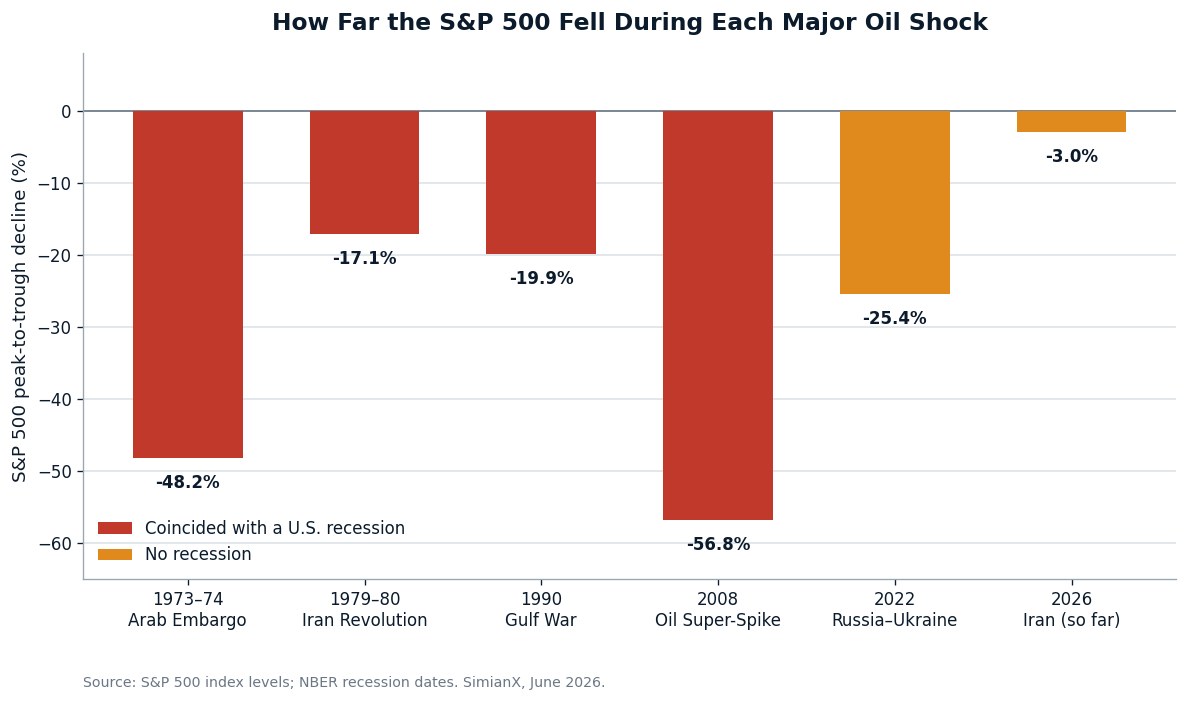
Look at the two worst rows — 1973–74 and 2008. They produced declines of roughly 48% and 57%, the two ugliest entries in the table. Now look at 1990, which had the second-largest oil spike on the list (Kuwait's invasion nearly doubled crude in ten weeks) yet cost the index only about 20% and was fully recovered inside half a year. Bigger spike, smaller wound. The oil move is not the variable that matters most.
What the table is actually telling you
If you rank the shocks by how much oil rose, you do not get the ranking of stock-market damage. The two deepest sell-offs (1973, 2008) bracket the list, while 1990's monster spike produced a shallow, fast-healing dip. The thing the deep declines share is not a bigger barrel — it is that each one coincided with, or fed directly into, a U.S. recession, and in 2008's case a full-blown financial crisis.
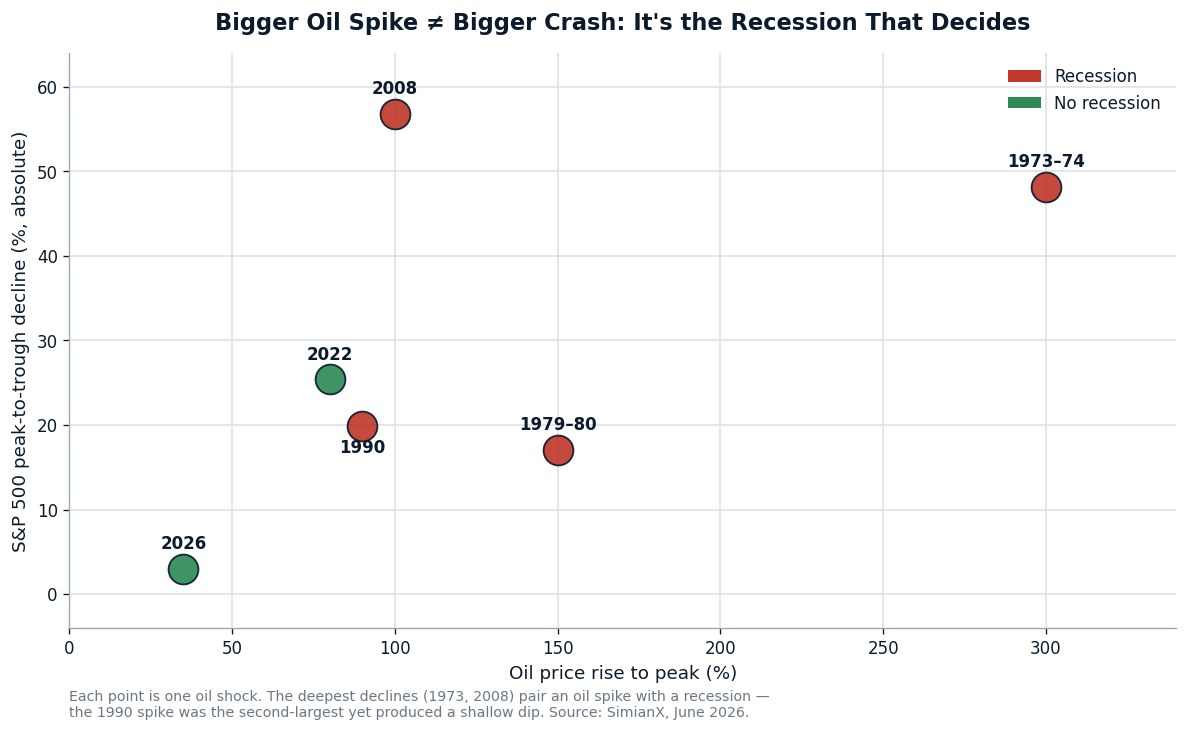
Plotting the spike size against the drawdown makes it obvious: there is no clean upward line. The red points (recession) sit deep no matter where they fall on the oil axis; the green points (no recession) stay shallow. An oil shock is dangerous to your portfolio mainly as a transmission mechanism — it can push an already-fragile economy over the edge into recession, and the recession, not the barrel, is what carves 40–50% off the index. When the economy is healthy enough to absorb the energy tax, stocks wobble and move on. Let's walk each row.
1973–74: the archetype, and the worst
The October 1973 Arab oil embargo quadrupled crude from roughly $3 to $12 a barrel and triggered gas lines across America. But the embargo landed on an economy already sliding into recession and grappling with the end of Bretton Woods, wage-price controls, and accelerating inflation. The result was the deepest oil-era bear market on record: the S&P 500 fell about 48% from its January 1973 peak to the October 1974 trough, and did not reclaim that high — in nominal terms — until 1980. (For the full ranking, see our reference on every S&P 500 bear market since 1929.)
The lesson investors took away — "oil shock equals market crash" — is the wrong generalization from the right event. 1973 was catastrophic because oil was one input into a wider stagflation, not because the embargo by itself was uniquely powerful.
1979–80: the second shock, mostly a Volcker story
The 1979 Iranian Revolution cut Iranian output and, amplified by panic buying, more than doubled crude from about $13 to nearly $39 a barrel over the following year. Yet the equity damage tied specifically to the 1980 oil recession was comparatively mild — the S&P 500's sharp early-1980 dip was roughly 17% and was recovered within a few months.
The deeper bear that followed in 1981–82 is usually mis-attributed to oil. It was overwhelmingly the work of Federal Reserve Chair Paul Volcker, who pushed the policy rate toward 20% to break double-digit inflation. That distinction matters today: tight money, not the barrel, did most of the damage in the early 1980s. Energy names like ExxonMobil and Chevron were among the relative winners of the era precisely because the shock was a price event for them, not a demand collapse.
1990: the cleanest "transient shock" case study
When Iraq invaded Kuwait on August 2, 1990, oil nearly doubled — from about $17 to a peak near $46 — one of the fastest spikes in the table. The S&P 500 fell about 17–20% from its summer high to its October low. And then it was over. As Operation Desert Storm began and it became clear Saudi spare capacity would backfill Kuwaiti barrels, oil collapsed and stocks ripped: the index rose roughly 12% into year-end 1990 and went on to gain nearly 29% in the year after the war's conclusion.
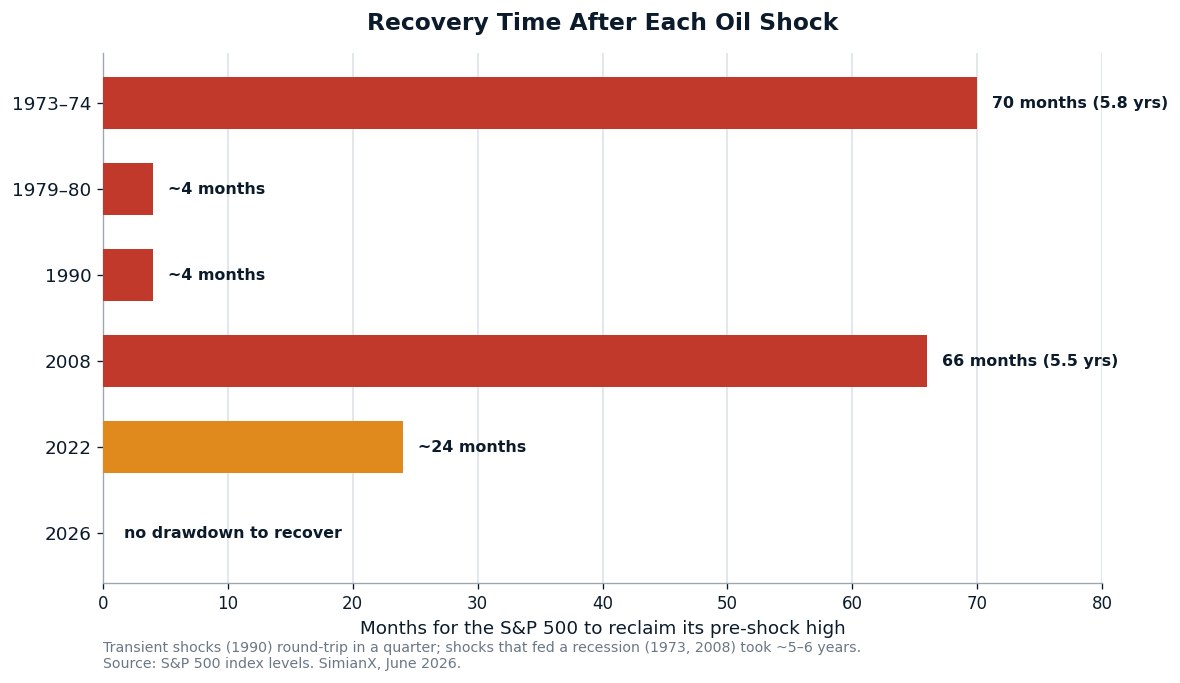
This is the template for an oil shock that does not metastasize: the spike is large but short-lived, the broader economy is sturdy, and the Fed is not forced into a corner. The 1990 recession was real but shallow, and the market recovered in roughly a quarter rather than half a decade. It rhymes with the war-and-markets pattern we documented in 9 of 12 invasions that saw stocks rally — geopolitical fear tends to be a buying opportunity unless it triggers a recession.
2008: the outlier that proves the rule
Crude doubled from about $50 in early 2008 to an all-time high of $147.30 on July 11, 2008. Sixty days later the financial system began to seize. The S&P 500 ultimately fell about 57% peak-to-trough into March 2009 — the worst entry in the table.
But 2008 was not an oil-shock bear in any meaningful sense. The collapse was a banking and housing crisis; the oil spike was a symptom of a late-cycle commodity bubble that burst alongside everything else (crude cratered from $147 to $32 by December). 2008 belongs in the table because it is instructive: it shows that when an energy spike coincides with a credit crisis and a deep recession, you get the maximum drawdown. The barrel was a passenger, not the driver. Recovery took about 5.5 years, comparable to 1973 — and for the same reason.
2022: a spike without a recession
Russia's February 2022 invasion of Ukraine sent Brent to an intraday $139.13, its highest since 2008. The S&P 500 fell about 25% peak-to-trough over the course of 2022 and took roughly two years to make a new high. At first glance this looks like an oil-shock bear — but it wasn't. The U.S. avoided an official recession, and the 2022 decline was driven overwhelmingly by the Fed's fastest hiking cycle in 40 years as it fought multi-decade-high inflation. Oil contributed to the inflation backdrop, but the bear was a rate bear. (We mapped how rate cycles bracket markets in every Fed rate-cut cycle since 1980.)
Notice the seat 2022 takes on the scatter plot: a real drawdown, but green — no recession — and shallower than the recession rows despite a top-three oil spike. Same lesson, modern packaging.
2026: the shock the market has so far absorbed
The current episode is, as of late June 2026, the mirror image of 1973. Brent spiked toward $107 in May on fears of a Hormuz disruption, then surrendered nearly all of it — back to roughly $80 — as a ceasefire held and a U.S.–Iran memorandum moved toward signing. The S&P 500 has held within a few percent of its record high near 7,400–7,600; energy stocks gave back their war premium. By the metrics in this table, 2026 currently looks like a 1990-style transient shock, not a 1973-style structural one.
The real risk to stocks in 2026 is not the oil spike — it is what the spike does to inflation, and therefore to the Fed. At new Chair Kevin Warsh's first meeting the dot plot flipped from cuts to hikes, with most officials now penciling in at least one 2026 increase, largely because of energy-led inflation. That is the channel to watch: if oil stays elevated long enough to keep inflation sticky and force the Fed tighter, the 2026 row could migrate from the green "no recession" zone toward the red one. We broke down that pivot in Warsh's first Fed meeting and the dot-plot flip to hike, and the recession-warning toolkit in our yield-curve-inversions reference table.
The three-factor framework
Across 50 years, whether an oil shock becomes a bear market comes down to three questions:
- Is the spike persistent or transient? A barrel that round-trips in a quarter (1990, 2026 so far) is a scare; a barrel that stays elevated for a year or more (1973, the late-1970s) becomes an embedded tax on growth.
- Is the economy already weak? A shock that lands on a fragile, late-cycle, or already-contracting economy (1973, 2008) tips it over. A shock that hits a healthy expansion (1990, 2026) gets absorbed.
- Can the Fed respond, or is it boxed in? When inflation forces the Fed to tighten into the shock (1980–82, 2022), policy adds to the drag instead of cushioning it. When the Fed has room to ease or hold, drawdowns stay shallow.
Score a shock against those three and you will predict the equity outcome far better than by staring at the oil price. All three lining up the wrong way is what produces a −48% to −57% row. None of them lining up wrong produces a −3% to −20% wobble.
What it means for your portfolio in 2026
History argues against panic-selling an oil spike, and against assuming a high barrel automatically means a crash. The base case after a geopolitical oil shock — when no recession follows — has been a shallow dip and a recovery measured in months. The tail risk is the recession path, and you monitor that with the yield curve, credit spreads, the labor market, and Fed guidance, not with the price of crude alone.
This is also a domain where disciplined, unemotional execution matters, because the worst investor outcomes in oil-shock history came from selling the panic low and missing the snap-back (see how long every bear market took to recover, 1929–2022). If you want to study how systematic strategies navigate exactly these regime shifts without flinching, our AI model leaderboard tracks how dozens of models trade live markets, and the stock autopilots apply rules-based discipline to entries and exits. You can compare the underlying engines on the crypto leaderboard and on pricing.
Frequently asked questions
Do oil shocks always cause a stock market crash?
No. Of the six major shocks since 1973, only the ones that coincided with a recession (1973, 1980, 1990, 2008) produced meaningful declines, and even among those the depth ranged from about −17% to −57%. The 2022 and 2026 spikes did not trigger a recession and produced a moderate dip and a near-miss, respectively.
Why was 2008 so much worse than 1990 when both had huge oil spikes?
Because 1990 was a transient geopolitical spike that hit a sturdy economy and reversed quickly, while the 2008 oil spike coincided with a banking and housing collapse and a deep recession. The recession — not the barrel — set the depth.
How long does the market usually take to recover from an oil shock?
Transient shocks (1990) recovered in roughly a quarter. Shocks that fed a recession (1973, 2008) took about 5–6 years to reclaim the prior high. The variable is again the recession, not the oil price.
Which stocks benefit from an oil spike?
Energy producers such as ExxonMobil, Chevron, and ConocoPhillips tend to outperform when crude rises, because higher prices flow to revenue; airlines, transports, and energy-intensive consumer names tend to lag. Sector leadership, not just the index, is where the oil signal shows up most clearly.
Is the 2026 Iran oil shock dangerous for stocks?
So far it looks transient: Brent round-tripped from ~$107 back to ~$80 and the S&P 500 held near record highs. The forward risk is indirect — if elevated energy prices keep inflation sticky and push the Warsh Fed to hike, that policy tightening, not the oil price itself, is the channel that could turn a wobble into something worse.
Methodology and sources
Oil-price moves are approximate spot/benchmark levels at the start and peak of each episode (WTI/Brent), drawn from the U.S. Energy Information Administration and contemporary reporting. S&P 500 declines are peak-to-trough on index price levels bracketing each shock; recovery is the time to reclaim the pre-shock high in nominal price terms. Recession flags follow NBER U.S. business-cycle dating. The 1979–80 figure isolates the 1980 oil-recession dip; the deeper 1981–82 bear was primarily a monetary-tightening event and is discussed separately. 2026 figures are as of late June 2026 and will evolve. Figures are rounded for a reference table and should be verified against primary sources before citation; this article is educational and is not investment advice.
Related reading
- Every S&P 500 bear market since 1929: duration and recovery
- How long every bear market took to recover, 1929–2022
- Warsh's first Fed meeting: the 2026 dot plot flips to hike
- Yield-curve inversions and U.S. recessions: a reference table
- Buy the invasion? 9 of 12 wars saw stocks rally
Oil shocks feel like the moment the market breaks. The 50-year record says they rarely are — unless they bring a recession with them. Watch the economy and the Fed, not just the barrel.