
 By Muke
Where BTC Could Bottom — and What Confirms a Rebound
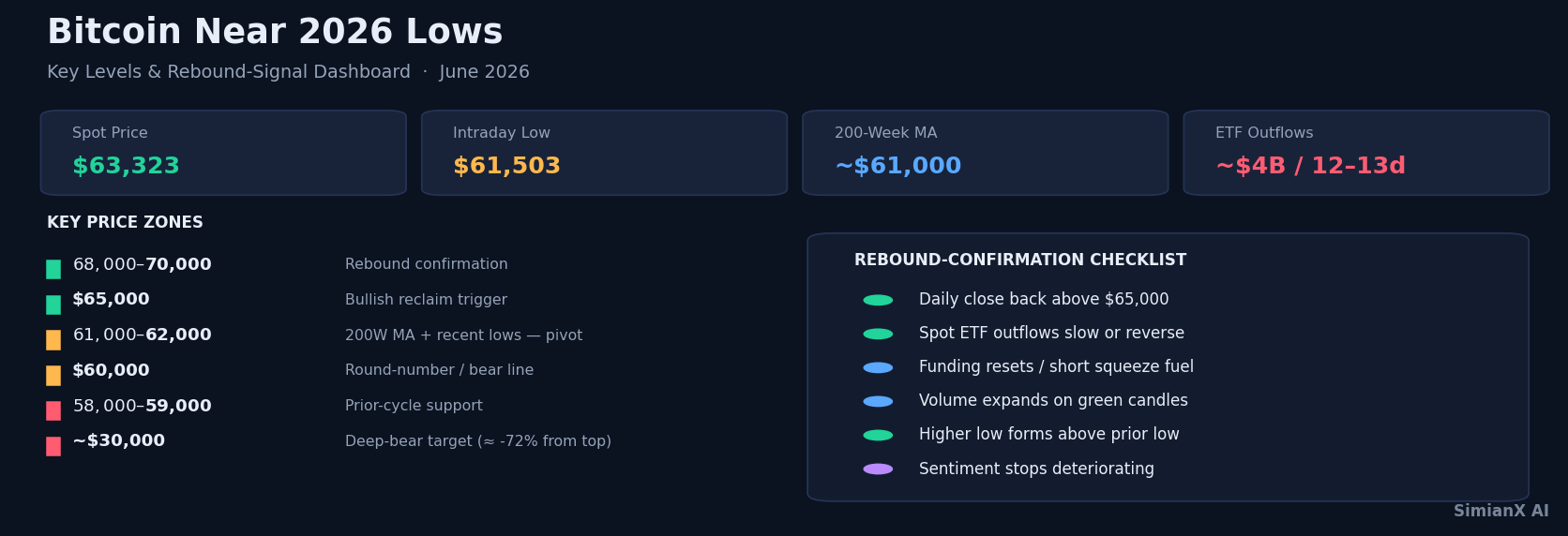
Bitcoin Near 2026 Lows: BTC Support and Rebound Signals has become one of the most important market questions for crypto traders in June 2026. With BTC trading near the low-$60,000s, testing long-term support, and facing pressure from ETF outflows, the market is no longer asking whether volatility is back — it is asking whether this is a breakdown, a base, or the early stage of a rebound. Recent market data shows Bitcoin trading around $63,323, with an intraday low near $61,503, while several reports note that BTC has approached its lowest levels of 2026.
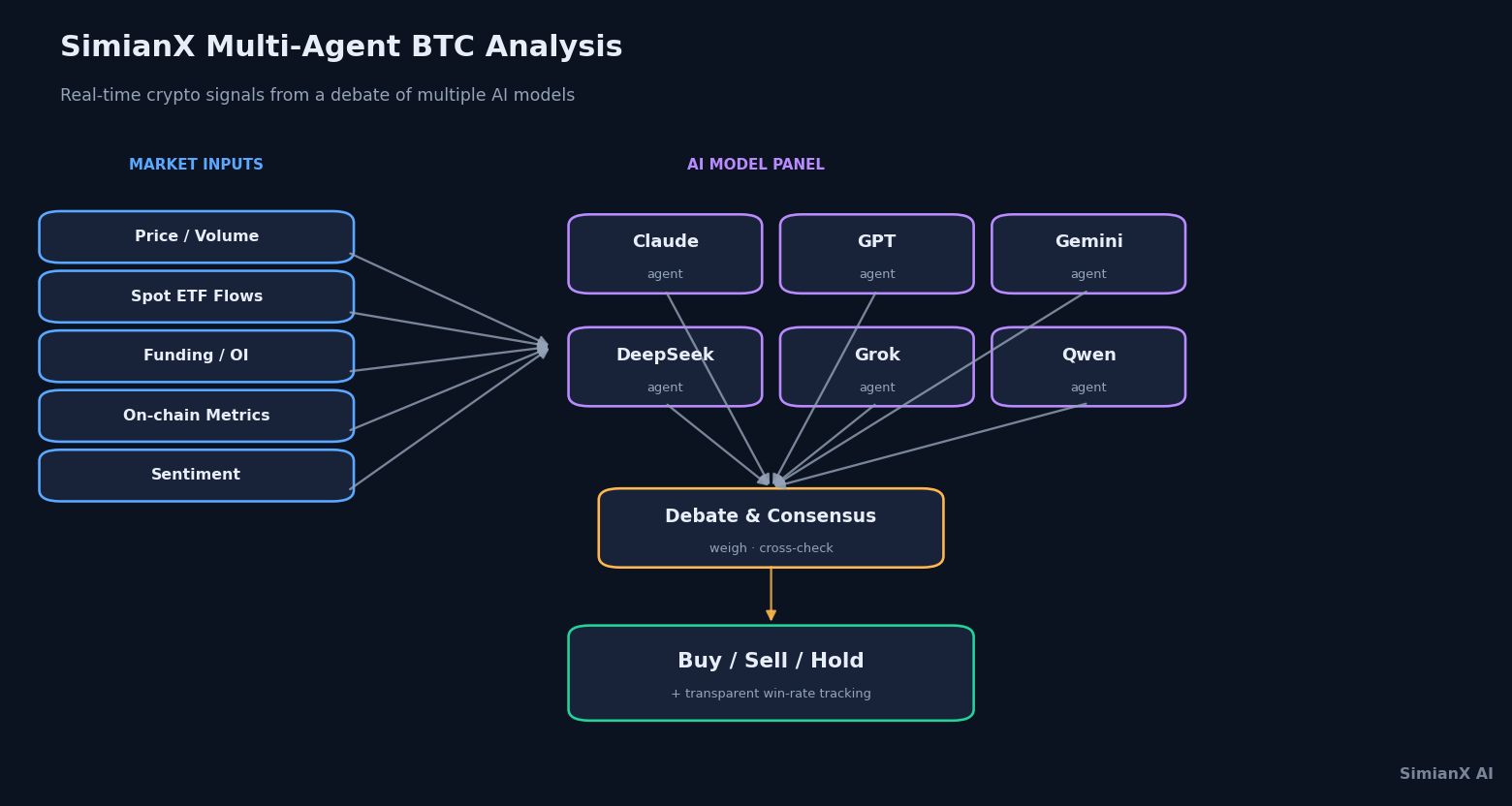
For traders and investors, the answer depends on a disciplined framework: support levels, volume confirmation, ETF flow stabilization, derivatives positioning, macro catalysts, and sentiment recovery. This is where SimianX AI can help market participants move beyond guesswork by using multi-agent AI analysis, real-time crypto signals, and transparent performance tracking. SimianX describes its crypto platform as a live command room where multiple AI models analyze markets, debate signals, and track performance across Bitcoin, Ethereum, Solana, and other assets.
Why Bitcoin Is Trading Near 2026 Lows
Bitcoin’s recent decline is not happening in isolation. It reflects a combination of risk-off sentiment, ETF outflows, institutional repositioning, technical weakness, and rotation into competing market themes such as AI-related equities.
Several recent market reports point to Bitcoin falling toward the $61,000–$64,000 area in early June 2026. MarketWatch reported that BTC traded around $61,500 on June 4 before rebounding toward the $62,700 area, while Investopedia noted that Bitcoin fell below $62,000 and was trading just under $64,000 after a sharp drawdown.
The main pressure points include:
- Spot Bitcoin ETF outflows after a long period of institutional participation.
- Weakening speculative momentum compared with AI and equity market themes.
- Technical retests of prior 2026 support zones.
- Uncertainty around regulation and macro policy.
- Leverage washouts that can exaggerate short-term price moves.
Key takeaway: A Bitcoin selloff near yearly lows does not automatically mean a bear-market continuation, but it does require confirmation before traders assume a durable rebound.
For SEO searchers looking for BTC support and rebound signals, the essential question is not “Is Bitcoin cheap?” The better question is: What evidence would show that sellers are losing control?
Key BTC Support Levels to Watch in 2026
When Bitcoin trades near major lows, support analysis becomes more important than price prediction. Traders should think in terms of zones, not single magic numbers.
| BTC Support Zone | Why It Matters | Signal to Watch |
|---|---|---|
| $61,000–$62,000 | Near recent intraday lows and long-term moving-average discussion | Strong wick recovery, rising volume, reduced forced selling |
| $60,000 | Psychological round-number support | Fast reclaim after breakdown attempt |
| $58,000–$59,000 | Prior-cycle and macro support zone watched by many traders | Capitulation volume followed by daily close above support |
| $65,000 | Short-term reclaim zone | Break and hold above prior breakdown area |
| $68,000–$70,000 | Rebound confirmation area | Higher high plus improving flows |
One widely discussed long-term reference point is Bitcoin’s 200-week moving average, which several market sources recently placed near or above $61,000. MarketWatch also highlighted the 200-week moving average near $61,000 as one potential stabilizing level.
That level matters because long-term moving averages often act as market memory. They are watched by institutional traders, systematic funds, long-term holders, and macro-focused crypto analysts.
However, support is only meaningful when price behavior confirms it. A level is not strong simply because it is visible on a chart. It becomes strong when sellers fail to push through it and buyers repeatedly step in.
What Are the Best BTC Rebound Signals Near 2026 Lows?
The best BTC rebound signals near 2026 lows combine price action, flows, volatility, and sentiment. No single indicator is enough. A stronger setup appears when multiple signals align.
1. Daily Close Back Above a Broken Support Zone
A wick below support followed by a daily close back above it is often a sign of seller exhaustion. For example, if Bitcoin trades below $62,000 intraday but closes back above $64,000 or $65,000, it may show that buyers are defending the low.
The strongest version of this signal includes:
- A sharp intraday flush.
- Higher-than-average spot volume.
- A close above the breakdown level.
- Follow-through buying the next session.
2. ETF Outflows Slow or Reverse
Spot Bitcoin ETF flows have become a key institutional sentiment gauge. Recent reports described a 12- to 13-day outflow streak from U.S. spot Bitcoin ETFs, with outflows reaching roughly $4 billion or more across the period.
A potential rebound signal would be:
- Outflows shrink materially.
- One or more major funds return to net inflows.
- BTC stops falling on bad flow data.
- Price begins rising on neutral or mildly positive ETF data.
That last point is important. Markets often bottom when they stop reacting negatively to bad news.
3. Funding Rates Normalize
Perpetual futures funding can reveal whether traders are crowded long or short, a dynamic explored in Crypto Leverage Radar: Funding, OI, Liquidation AI Signals. When funding becomes extremely negative, it may show that short positioning is crowded. If price then starts rising, short sellers can be forced to cover, creating a short squeeze.
A healthier rebound setup usually includes:
- Lower leverage.
- Neutral or slightly negative funding.
- Open interest reset after liquidations.
- Spot buying leading futures buying.
4. Volume Expands on Green Candles
A low-volume bounce is often just a pause. A high-volume rebound is more meaningful because it shows commitment.
Watch for:
- Higher spot volume on up days.
- Lower volume on pullbacks.
- Strong closes near daily highs.
- Breakout candles above short-term moving averages.
5. Market Structure Shifts From Lower Highs to Higher Lows
Technical traders should look for a transition from a bearish structure to an accumulation structure.
| Bearish Structure | Rebound Structure |
|---|---|
| Lower lows | Failed breakdowns |
| Lower highs | Higher lows |
| Weak bounces | Strong reclaim candles |
| Rising sell volume | Rising buy volume |
| Fear-driven headlines | Stabilizing sentiment |
The first higher low after a major flush is often more useful than the first bounce.
How to Analyze Bitcoin Near 2026 Lows Without Guessing
A practical Bitcoin support framework should combine technical analysis, market flows, sentiment, and risk management. The goal is not to predict the exact bottom. The goal is to avoid emotional trading when volatility is high.
Use this step-by-step process:
- Mark the major support zones. Start with $61,000–$62,000, then $60,000, then deeper zones such as $58,000–$59,000.
- Track daily closes, not just intraday wicks. Crypto trades 24/7, so false breakdowns are common.
- Watch ETF flow data. Persistent outflows can pressure BTC, while stabilization can support a rebound.
- Compare spot and futures behavior. Spot-led buying is usually healthier than leverage-led bounces.
- Monitor news catalysts. Regulatory updates, macro data, and institutional commentary can change sentiment quickly.
- Define invalidation before entry. A trade without a clear invalidation level is speculation, not analysis.
The best traders do not need to catch the exact low. They need a repeatable process for identifying when probability shifts.
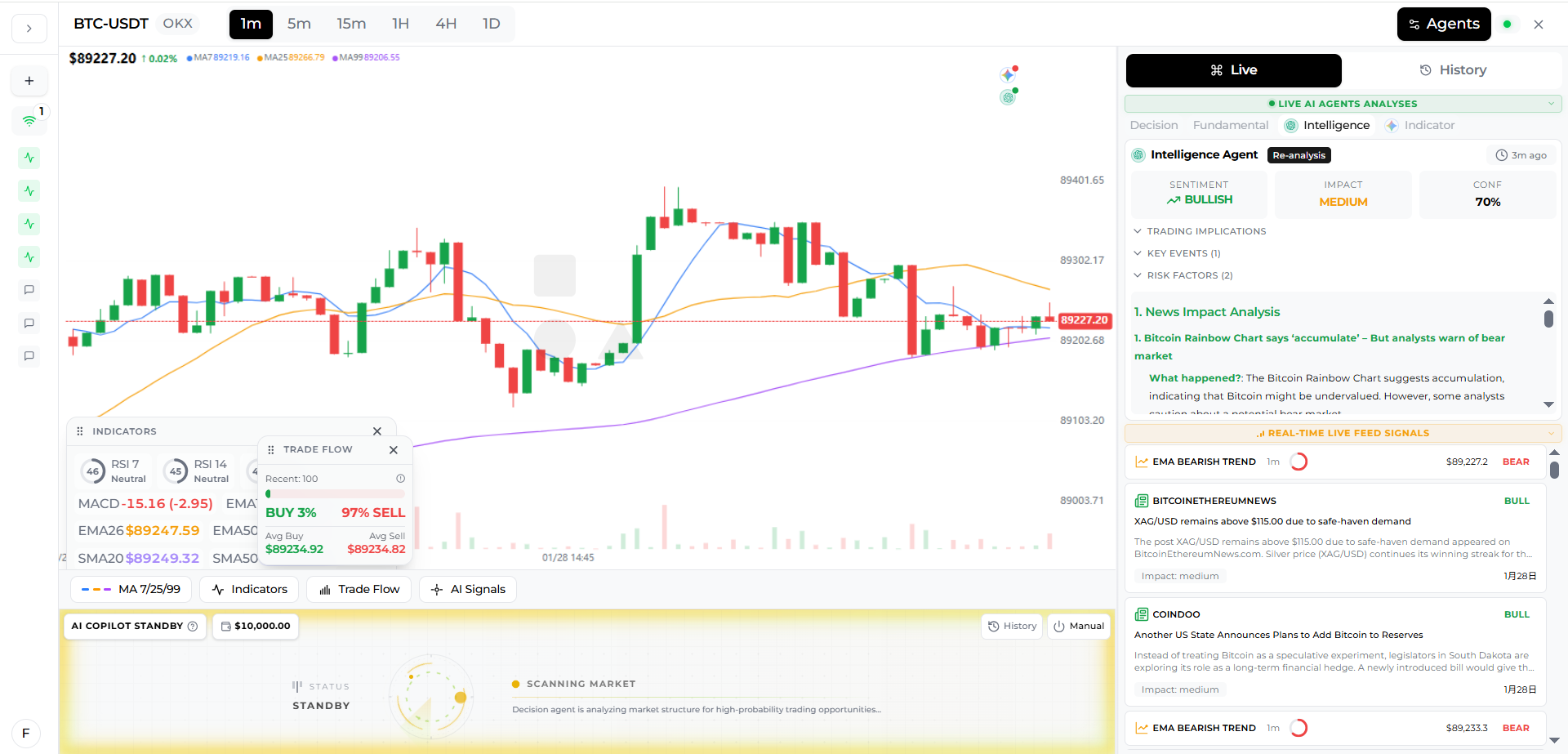
This is also where practical tools matter. SimianX AI’s crypto features include real-time multi-model analysis, six timeframe support, exchange integrations, transparent performance tracking, and live buy/sell/hold signal generation based on technical analysis, sentiment, and on-chain metrics.
BTC Support and Rebound Signals: Bullish vs Bearish Scenarios
A balanced research article should consider both outcomes. Bitcoin near 2026 lows can produce either a reversal or a continuation breakdown.
Bullish Scenario: A Reclaim Above $65,000
A bullish BTC rebound scenario becomes stronger if Bitcoin:
- Holds the $61,000–$62,000 support area.
- Reclaims $65,000 on strong volume.
- Sees ETF outflows slow or reverse.
- Forms a higher low above the recent low.
- Breaks above $68,000–$70,000 with confirmation.
In this case, the low-$60,000s may become a capitulation zone rather than the start of a deeper breakdown.
Bearish Scenario: Clean Break Below $60,000
The bearish case strengthens if Bitcoin:
- Closes multiple daily candles below $60,000.
- Fails to reclaim the 200-week moving average area.
- Sees ETF outflows accelerate.
- Breaks support while derivatives leverage remains elevated.
- Loses correlation with risk-on assets during broader market strength.
A clean break below $60,000 could invite momentum selling, especially from traders who use round-number levels and long-term moving averages as stop-loss references.
Neutral Scenario: Sideways Accumulation
The third possibility is a range. Bitcoin may trade between roughly $60,000 and $68,000 while the market waits for a catalyst.
This kind of base-building can be frustrating, but it is also where strong future moves often develop. During sideways ranges, traders should focus less on prediction and more on range edges, volume behavior, and failed breakdowns.
Why ETF Flows Matter for Bitcoin Rebound Analysis
ETF flows matter because they offer a visible window into institutional demand. When spot ETFs are absorbing BTC, they can create persistent buy pressure. When they are experiencing outflows, they can add pressure to an already weak market.
Recent reports described a long streak of U.S. spot Bitcoin ETF outflows, with billions leaving the products during the selloff.
For rebound analysis, do not simply ask whether ETF flows are positive or negative. Ask whether the trend of flows is improving.
| ETF Flow Condition | Market Interpretation |
|---|---|
| Accelerating outflows | Institutional demand weakening |
| Slowing outflows | Selling pressure may be fading |
| Flat flows | Market may be stabilizing |
| Renewed inflows | Rebound probability improves |
| Inflows plus price breakout | Stronger confirmation |
ETF flow stabilization is not a guarantee. But combined with a technical reclaim, it can become a powerful confirmation signal.
Can AI Improve BTC Support and Rebound Analysis?
AI cannot eliminate market risk, and it should never replace personal judgment or professional advice. But AI can improve the research process by making it faster, more structured, and less emotionally biased.
SimianX’s live crypto command room is designed around the idea that crypto markets move too quickly for one static dashboard. Its platform brings together multiple AI models, including Claude, GPT, Gemini, DeepSeek, Grok, and Qwen, to analyze technical indicators, on-chain metrics, and market sentiment in real time.
For a trader watching Bitcoin near 2026 lows, this can help answer questions such as:
- Is the bounce supported by multiple timeframes?
- Are AI models agreeing or disagreeing on the signal?
- Is sentiment improving or still deteriorating?
- Are technical indicators confirming the rebound?
- Is the market producing a buy, sell, or hold consensus?
The practical benefit is not blind automation. The benefit is structured decision support.
Practical BTC Rebound Checklist for Traders
Before acting on a Bitcoin rebound setup, use a checklist. This reduces emotional decisions during volatile conditions.
Technical Checklist
- Support defended: BTC holds above or quickly reclaims $61,000–$62,000.
- Daily close confirmation: Price closes above a key reclaim level such as $65,000.
- Higher low: Pullbacks stop above the prior low.
- Volume expansion: Green candles show stronger volume than red candles.
- Momentum improvement: RSI, MACD, or moving-average structure begins to stabilize.
Flow Checklist
- ETF outflows slow.
- Spot buying improves.
- Stablecoin liquidity stops contracting.
- Exchange selling pressure fades.
- Futures open interest resets after liquidations.
Sentiment Checklist
- Fear-driven headlines lose impact.
- Social sentiment stops deteriorating.
- Regulatory headlines become less negative.
- Market participants shift from panic to selective accumulation.
Risk Checklist
- Define the entry reason.
- Define the invalidation level.
- Size the position conservatively.
- Avoid overleveraging.
- Review the setup after each daily close.
A rebound signal is strongest when technical confirmation, flow improvement, and sentiment stabilization appear together.
Common Mistakes When Trading Bitcoin Near 2026 Lows
Volatile lows attract both opportunity and mistakes. The most common errors include:
- Buying only because price is down. A lower price is not automatically a better setup.
- Ignoring ETF flows. In 2026, institutional products can influence short-term supply and demand.
- Using too much leverage. Volatility near support can liquidate both longs and shorts.
- Confusing a bounce with a reversal. A true reversal needs structure, not just one green candle.
- Moving stop-loss levels emotionally. Invalidation should be defined before the trade.
- Following one indicator blindly. Strong analysis requires multiple confirmations.
For investors rather than traders, the key mistake is overreacting to short-term volatility without reviewing the long-term thesis. For active traders, the key mistake is entering too early without confirmation.
Bitcoin Support Strategy: Trader vs Investor View
Different market participants should interpret BTC support differently.
| Profile | Main Question | Useful Signal | Risk Focus |
|---|---|---|---|
| Day trader | Can BTC reclaim intraday levels? | 1m–1h momentum and volume | Tight invalidation |
| Swing trader | Is a higher low forming? | 4h–1d structure | Position sizing |
| Long-term investor | Is long-term support intact? | Weekly closes and 200WMA | Time horizon |
| Research analyst | Are flows and sentiment stabilizing? | ETF data, macro, on-chain metrics | Evidence quality |
| AI-assisted trader | Do multiple models agree? | Consensus signals and performance tracking | Signal validation |
SimianX AI is especially relevant for traders who want to compare multiple timeframes and model perspectives instead of relying on a single indicator. Its platform states that users can choose markets and timeframes from 1-minute scalping to daily swing trading, while tracking every signal with transparent win-rate and performance data.
FAQ About Bitcoin Near 2026 Lows: BTC Support and Rebound Signals
What is the strongest BTC support near 2026 lows?
The most watched area is currently around the low-$60,000s, especially the $61,000–$62,000 zone. This area matters because recent intraday lows and long-term moving-average discussions are clustered nearby. A stronger signal would require Bitcoin to defend this zone and reclaim higher levels such as $65,000.
How do I spot BTC rebound signals after a selloff?
Look for a failed breakdown, a daily close back above support, stronger green-candle volume, slowing ETF outflows, and a higher low. A single bounce is not enough. The strongest BTC rebound signals appear when price action, flows, and sentiment improve together.
Are Bitcoin ETF outflows bearish for BTC price?
ETF outflows can be bearish because they may reflect weaker institutional demand or forced selling pressure. However, the trend matters more than one day of data. If outflows slow while Bitcoin holds support, that can become an early stabilization signal.
Can Bitcoin recover if it breaks below $60,000?
Yes, Bitcoin can recover after a break below $60,000, but the setup becomes riskier. Traders would want to see a fast reclaim, strong volume, and reduced sell pressure. Multiple daily closes below $60,000 would make the bearish scenario more credible.
What is the best AI tool for Bitcoin support analysis?
The best AI tool for Bitcoin support analysis should combine real-time data, multi-timeframe analysis, sentiment monitoring, and transparent signal tracking. SimianX AI is built around a multi-agent crypto command room where AI models analyze Bitcoin and other crypto markets in real time, making it useful for traders who want structured support and rebound research.
Bottom Line: How Far Could Bitcoin Fall — or Rebound?
A specific, data-anchored read of the levels above:
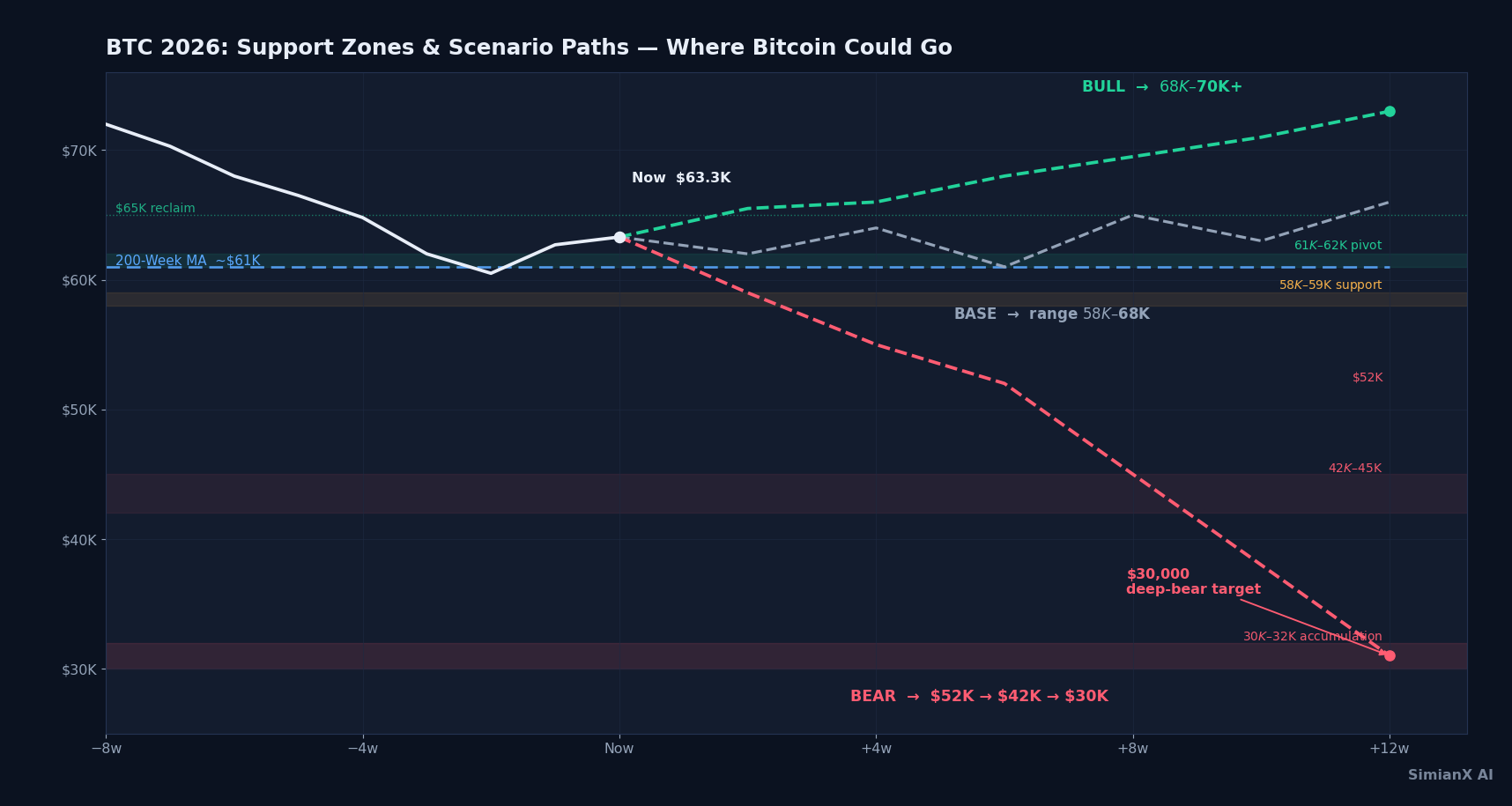
- Base case (most likely while the 200-week MA holds): Bitcoin chops in a $58,000–$68,000 range and builds a base — no trade-altering breakdown, and no confirmed rebound yet.
- Bullish path: A daily close back above $65,000 with slowing ETF outflows opens $68,000–$70,000; a higher low above the recent low would turn the low-$60,000s into a capitulation zone rather than a top.
- Bearish path (where the "$30K" talk comes from): A decisive daily close below $60,000 plus a loss of the 200-week moving average (~$61,000) removes the floor. The measured downside then ladders through $58,000–$59,000 → ~$52,000 → ~$42,000–$45,000, with the deep-bear objective near ~$30,000–$32,000, the prior-cycle accumulation band.
Why $30,000 is the bear number and not a random one: a fall from the roughly $108,000 cycle top to ~$30,000 is about a −72% drawdown — squarely in line with Bitcoin's last two bear markets, −77% in 2022 and −84% in 2018. The chart below places today's test of the 200-week MA inside that four-year, halving-driven cycle.
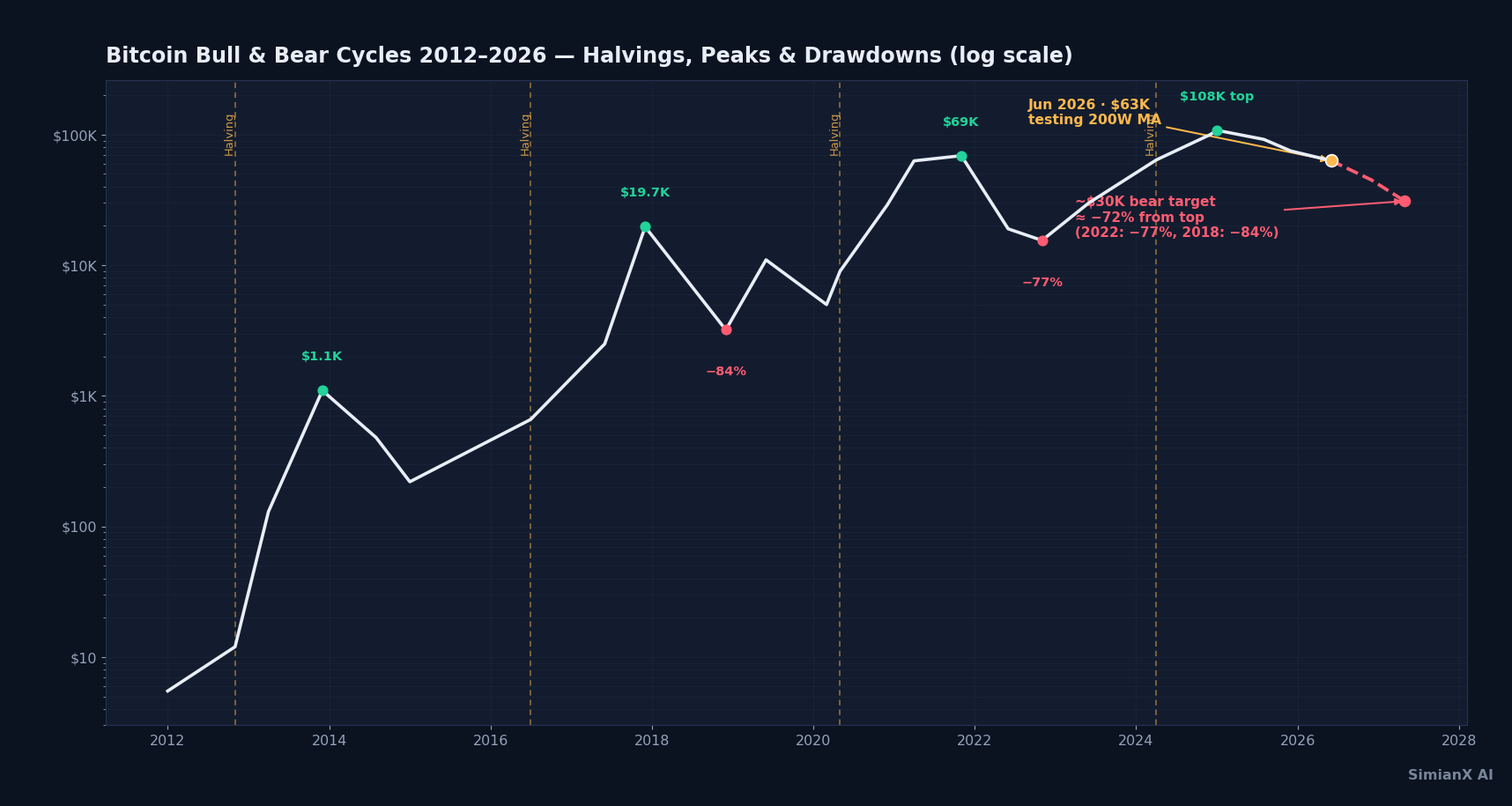
So the honest answer to "where does it go?" is conditional, not a single number: hold $60K and the 200-week MA → basing, then a rebound toward $65K–$70K; lose them decisively → the path opens to $52K, $42K and ultimately the ~$30K cycle-low zone. Trade the level that actually breaks, not the forecast.
Conclusion
Bitcoin trading near 2026 lows has created a high-stakes environment for traders, investors, and crypto analysts. The key is not to guess the exact bottom. The key is to watch whether BTC can defend the $61,000–$62,000 region, reclaim short-term resistance, stabilize ETF-related selling pressure, and build a higher-low structure.
The most important BTC support and rebound signals include daily close confirmation, improving volume, ETF flow stabilization, normalized derivatives positioning, and sentiment recovery. A bullish rebound becomes more convincing above $65,000 and stronger still if Bitcoin can push toward $68,000–$70,000. A bearish continuation becomes more likely if BTC closes decisively below $60,000 and fails to reclaim long-term support.
For traders who want to analyze these signals with more structure, SimianX AI offers a practical way to monitor Bitcoin through multi-agent AI analysis, real-time crypto intelligence, transparent performance tracking, and multi-timeframe signal generation. Use it as a research companion, apply disciplined risk management, and remember that crypto trading carries significant risk. AI signals and market research are informational tools — not financial advice.
Related Reading
- Bitcoin Crash Feb 2026: $60K Bottom or More Pain Ahead?
- How to Trade a Crypto Bear Market: 2026 Survival Playbook
- Crypto Leverage Radar: Funding, OI, Liquidation AI Signals
- Bitcoin Halving Cycles: Complete Returns Reference 2012-2028
- Bitcoin After Every Fed Rate Cut: 2019-2026 Reference
- Bitcoin Dominance Cycles: When Altseason Starts 2017-2026
- SimianX Crypto Live Command Room: AI Copilot for Trading
- 30+ AI Models Ranked Live: Crypto Trade Leaderboard