
Bitcoin by the Quarter, 2013–2026: What 17 Years of Data Show
Bitcoin closed the second quarter of 2026 on June 30 at roughly $58,500, down 14.1% for the quarter after a 22.2% drop in Q1. That makes 2026 only the third year in Bitcoin's trading history — after 2018 and 2022 — to open with two consecutive losing quarters. If you count the 23.2% slide in Q4 2025, the current streak is three straight red quarters, which ties the longest losing streak Bitcoin has ever recorded.
Moments like this are exactly when a full set of Bitcoin quarterly returns is worth more than any hot take. Quarterly data compresses seventeen years of manias, crashes, halvings, and macro shocks into a table you can actually read, and it lets you test the claims flying around this week — "Q4 always saves Bitcoin," "three red quarters never happen," "2026 is 2022 all over again" — against what actually happened. This page is that reference: every Bitcoin quarter since 2013, the averages and medians behind the seasonality talk, and a close look at the only two precedents for the position the market is in right now.
Bitcoin Quarterly Returns: The Complete Table, 2013–2026
The table below shows Bitcoin's price return for every calendar quarter since 2013, the first year with reasonably liquid, continuous exchange pricing. Figures are rounded to one decimal and follow the convention used by public trackers such as CoinGlass; the 2025–2026 figures are computed from quarter-end closing prices.
| Year | Q1 | Q2 | Q3 | Q4 |
|---|---|---|---|---|
| 2013 | +539.0% | −3.9% | +40.6% | +479.7% |
| 2014 | −37.4% | +40.4% | −39.7% | −16.7% |
| 2015 | −24.4% | +7.6% | −10.2% | +81.2% |
| 2016 | −3.1% | +62.1% | −9.4% | +58.2% |
| 2017 | +11.9% | +131.0% | +80.4% | +215.1% |
| 2018 | −49.7% | −7.7% | +3.6% | −42.2% |
| 2019 | +8.7% | +159.4% | −22.9% | −13.5% |
| 2020 | −10.8% | +42.3% | +17.9% | +168.0% |
| 2021 | +102.9% | −40.4% | +25.0% | +5.5% |
| 2022 | −1.5% | −56.2% | −2.6% | −14.7% |
| 2023 | +71.8% | +7.2% | −11.5% | +56.9% |
| 2024 | +68.7% | −11.9% | +1.0% | +47.7% |
| 2025 | −11.8% | +29.8% | +6.4% | −23.2% |
| 2026 | −22.2% | −14.1% | — | — |
A few records worth pinning down, because they get misquoted constantly:
- Best quarter ever: Q1 2013, +539.0%, followed by Q4 2013's +479.7% — both from the year Bitcoin went from about $13 to over $750.
- Worst quarter ever: Q2 2022, −56.2%, the quarter the Terra/LUNA collapse and the Celsius freeze hit back to back.
- Longest losing streak: three quarters, now recorded three times — Q3 2014 through Q1 2015, Q2 through Q4 2022, and Q4 2025 through Q2 2026. Bitcoin has never printed four consecutive red quarters.
- Most extreme single year: 2013, with two quarters above +400%. Nothing since has come within an order of magnitude.
What the Averages Say About Bitcoin Seasonality
Averaging each calendar quarter across the table gives the numbers that power every "Bitcoin seasonality" chart you have ever seen:
| Quarter | Average return | Median return | Positive quarters |
|---|---|---|---|
| Q1 | +45.9% | −2.3% | 6 of 14 |
| Q2 | +24.7% | +7.4% | 8 of 14 |
| Q3 | +6.0% | +1.0% | 7 of 13 |
| Q4 | +77.1% | +47.7% | 8 of 13 |
Two things jump out once you put averages and medians side by side.
First, Q1 is far weaker than its average suggests. The +45.9% mean is almost entirely the work of a single outlier — Q1 2013's +539%. The median first quarter is actually negative (−2.3%), and Q1 has closed red in eight of fourteen years. The market's habit of starting the year badly is real, and 2026 fits it.
Second, Q4 is the only quarter that is strong by every measure. The average (+77.1%) is skewed by 2013 too, but the median is still +47.7%, and the fourth quarter has delivered the majority of Bitcoin's lifetime gains — 2013, 2017, 2020, 2023, and 2024 all closed with monster fourth quarters. That is the statistical backbone of the "Uptober / Q4 rally" folklore. The important caveat: the two most recent bear phases, 2018 and 2022, both saw Q4 decline — and Q4 2025 just joined them at −23.2%. Q4 is Bitcoin's best quarter in bull regimes and offers no protection in bear ones.
Third, Q3 is genuinely the sleepy quarter: a +6.0% average, a +1.0% median, and no quarter above +81% in the whole sample. Summer chop is not a myth.
The Double-Red Open: 2018, 2022, and Now 2026
Only twice before has Bitcoin opened a year with two losing quarters, which makes those two years the only real precedents for the second half of 2026:
| Year | Q1 | Q2 | H1 total | Q3 | Q4 | H2 total |
|---|---|---|---|---|---|---|
| 2018 | −49.7% | −7.7% | −53.6% | +3.6% | −42.2% | −40.1% |
| 2022 | −1.5% | −56.2% | −56.9% | −2.6% | −14.7% | −16.9% |
| 2026 | −22.2% | −14.1% | −33.2% | ? | ? | ? |
2018 was the unwind of the 2017 retail bubble. After peaking near $20,000 in December 2017, Bitcoin spent the whole year deflating, and the second half brought no rescue: a flat Q3 was followed by a brutal −42.2% Q4 when the November hash-war panic hit. The year closed at about $3,700, down 72% overall.
2022 was a macro bear market — the Federal Reserve's fastest hiking cycle in decades — amplified by crypto-native failures: Terra/LUNA in May, Three Arrows and Celsius in June, FTX in November. Again the second half offered no rescue, just a slower bleed: −2.6% in Q3, −14.7% in Q4, and a yearly close near $16,500, down 64%.
The honest takeaway from a two-case sample is limited, but it cuts against the most comforting narrative: in both precedents, the second half of a double-red year was also negative. Anyone promising that a red H1 mechanically produces a green H2 is arguing against the only history we have.
The differences matter too, though. 2026's H1 drawdown (−33.2%) is much shallower than 2018's (−53.6%) or 2022's (−56.9%). The current decline started from October 2025's all-time high near $126,000 and has so far been a repricing, not a cascade of insolvencies — there has been no Mt. Gox, no Terra, no FTX. And the structural bid is different: spot ETFs, corporate treasuries, and sovereign experiments did not exist in 2018 and barely existed in 2022. Whether that cushions Q3 2026 or merely slows the bleed is precisely what makes this quarter worth watching — a fourth consecutive red quarter would be unprecedented in Bitcoin's history.
Why Bitcoin Quarters Cluster: Halvings and Liquidity
Bitcoin's quarterly returns do not arrive at random; they cluster into regimes, and the table makes the two main drivers visible.
The first is the halving cycle. Bitcoin's block subsidy halves roughly every four years (the halving), and every halving so far — 2012, 2016, 2020, April 2024 — has been followed within about eighteen months by a run to new highs: the 2013 double-spike, the 2017 bubble, the 2020–2021 melt-up, and the 2024–2025 advance that peaked at $126,000 in October 2025. The mirror image is that the second year after each halving — 2014, 2018, 2022, and now 2026 — has been the cycle's washout year. The current three-quarter losing streak is uncomfortable, but it is arriving exactly where the four-year rhythm has always put it.
The second driver is global liquidity. Bitcoin's worst clusters coincide with tightening: 2018's quantitative-tightening year, 2022's rate shock. Its best clusters coincide with easing: 2019's Q2 (+159.4%) followed the Fed's dovish pivot, and 2020's Q2–Q4 rode pandemic stimulus. Quarterly returns are, to a first approximation, a leveraged bet on money getting cheaper — which is why traders watching Ethereum, Solana, and the rest of the majors see the same quarterly rhythm with higher amplitude.
How to Use a Quarterly Table Without Fooling Yourself
A reference table is a context tool, not a signal generator. Three rules keep it honest.
Respect the sample size. Fourteen years is fourteen Q1s. Every seasonal claim above rests on a sample a statistician would call an anecdote. Treat quarterly tendencies as weak priors that real-time information should override quickly.
Separate regime from season. The table's clearest lesson is not "buy in October"; it is that bull regimes produce green Q4s and bear regimes produce red ones. Identifying the regime you are in matters far more than the month on the calendar.
Prefer live evidence over folklore. The gap between "Q4 is historically strong" and "Bitcoin will rally this Q4" is where most seasonal trades die. The way to close that gap is to watch how the market — and the models trading it — are actually behaving right now, not how they behaved on average since 2013.
Tracking the Current Quarter in Real Time on SimianX
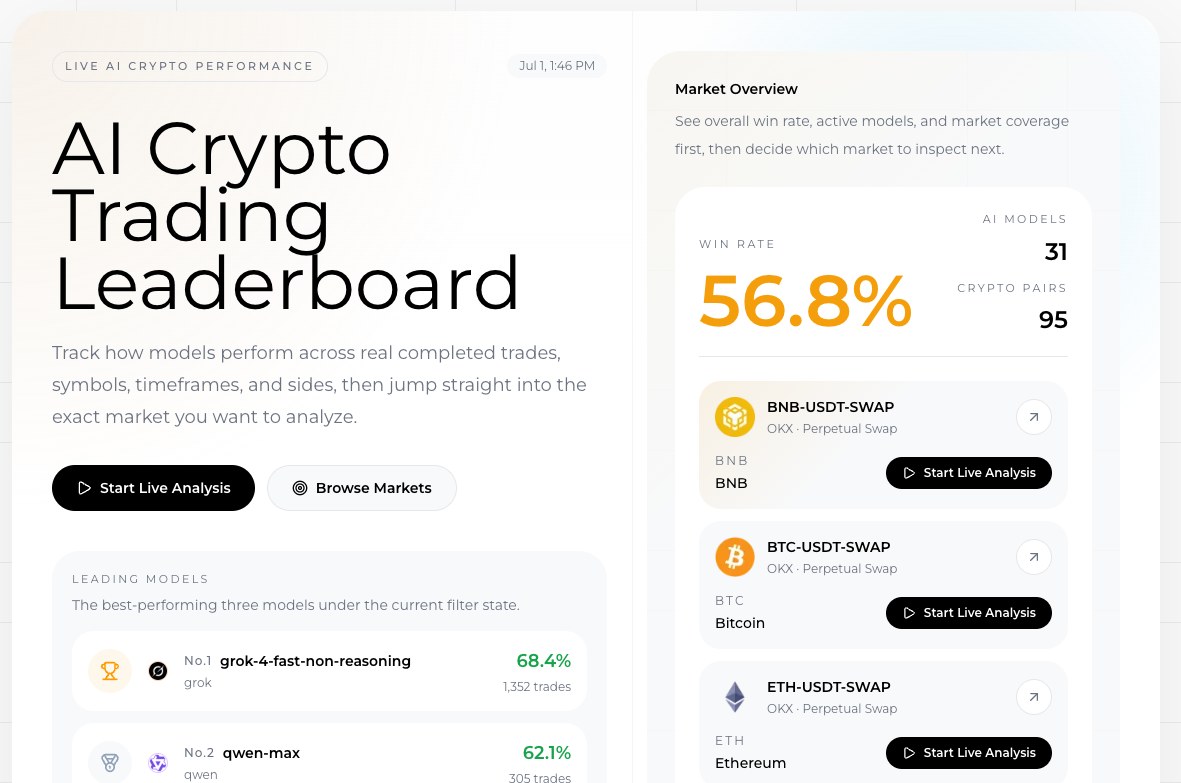
Historical tables tell you where you are; they cannot tell you what to do on Tuesday. For that, SimianX runs a different kind of experiment: more than thirty AI models — from OpenAI, Anthropic, Grok, and others — trade real crypto markets side by side, and the AI crypto trading leaderboard ranks them by live win rate across 95 pairs, updated as trades complete.
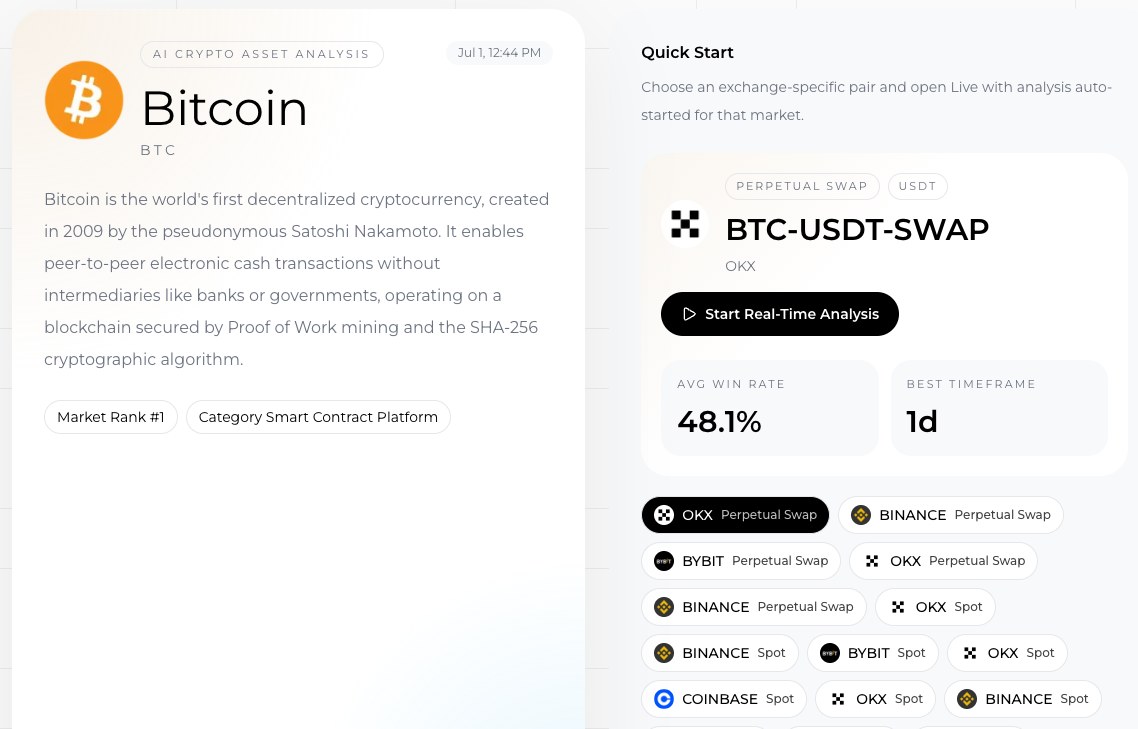
During a losing streak like the current one, the leaderboard becomes a regime detector. When most models' win rates compress toward 50% on BTC pairs, conditions are choppy and trendless; when short-side strategies pull ahead, the downtrend still has sponsorship. You can drill into a single market from the Bitcoin asset page, which aggregates model win rates, best timeframes, and exchange-specific pairs for BTC, or open a live analysis session to watch a model reason through the current chart in real time.
If you would rather delegate the watching entirely, SimianX autopilots let an AI model of your choice monitor markets and execute a strategy continuously — a practical way to stay engaged with a quarter like Q3 2026 without staring at charts, with plans starting free on the pricing page. And if reference tables are your thing, this article has siblings: every major stablecoin depeg in one table and the 20 worst days in S&P 500 history follow the same format in our stories library.
FAQ: Bitcoin Quarterly Returns
What is Bitcoin's best quarter historically?
Q4, by a wide margin. The fourth quarter averages +77.1% with a median of +47.7% and has closed positive in 8 of 13 years. The single best quarter on record, though, was Q1 2013 at +539%.
What is Bitcoin's weakest quarter?
Q3. It averages just +6.0% with a +1.0% median — effectively a coin flip that pays little when it wins. The worst single quarter was Q2 2022's −56.2%, during the Terra/LUNA collapse.
Has Bitcoin ever fallen three quarters in a row?
Yes, three times: Q3 2014–Q1 2015, Q2–Q4 2022, and the current streak of Q4 2025–Q2 2026. It has never fallen four quarters in a row — which is what makes Q3 2026 historically significant.
Is 2026 repeating 2018 or 2022?
The setup rhymes — all three years opened with two red quarters in the washout year of a halving cycle — but 2026's H1 decline (−33.2%) is roughly twenty percentage points shallower than either precedent, and it has not involved a major platform failure. In both 2018 and 2022, however, the second half was also negative.
Where can I watch Bitcoin's current quarter live?
The SimianX crypto leaderboard tracks how 31 AI models are actually trading BTC and 94 other pairs right now, and the BTC asset page aggregates live win rates and timeframes for Bitcoin specifically.
Data compiled from public exchange pricing and quarterly performance trackers, rounded to one decimal. Nothing here is financial advice; past quarterly returns — as the table itself demonstrates — do not predict future ones.