Inside 1,973 AI Trades: How Bots Behave When Crypto Crashes
When Bitcoin drops 10% in an hour, human traders do something painfully predictable: they panic-sell. The stop gets yanked, the position gets dumped at the worst possible price, and the regret arrives right on schedule when the chart snaps back. It is the single most expensive habit in retail trading. So here is the question worth asking in 2026, now that large language models are placing real trades: do AI models panic-sell in a crash, or do they hold their nerve better than we do?
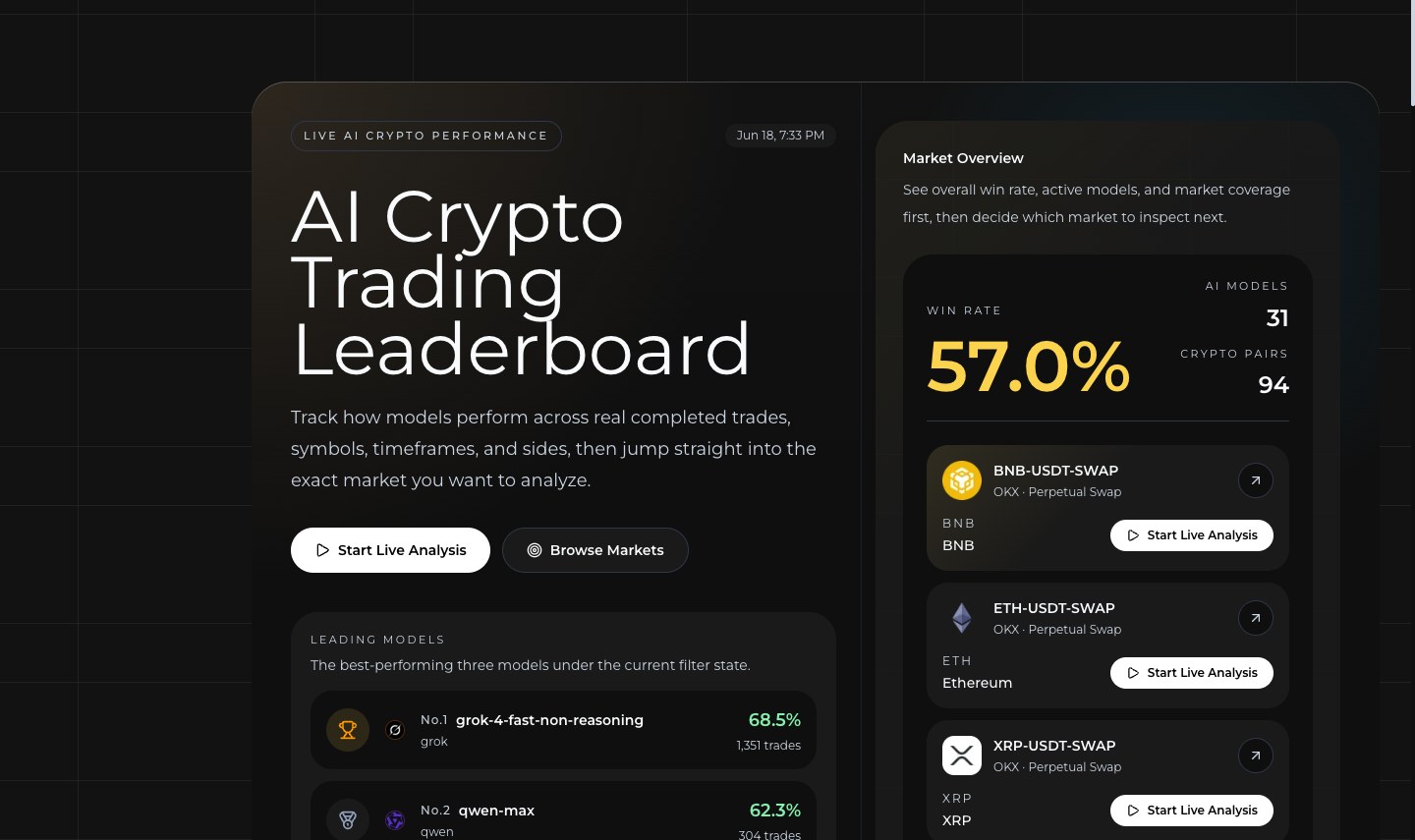
We are in a strange position to answer that. The SimianX crypto leaderboard runs a live arena of 31 active AI trading bots across six providers — OpenAI, Anthropic, Google, xAI's Grok, DeepSeek, and Qwen — each one reading the same market and making its own long/short calls on 94 crypto pairs. Every decision is logged. Every exit is timestamped. So instead of guessing how a model "feels" in a downturn, we can pull the receipts.
This article reads those receipts. We analyzed 1,973 settled AI trade proposals placed between December 2025 and March 2026, across the providers and models with enough history to judge. The findings are not what most people expect — and they say as much about human investors as they do about the machines.
The short answer: machines flinch far less than you do
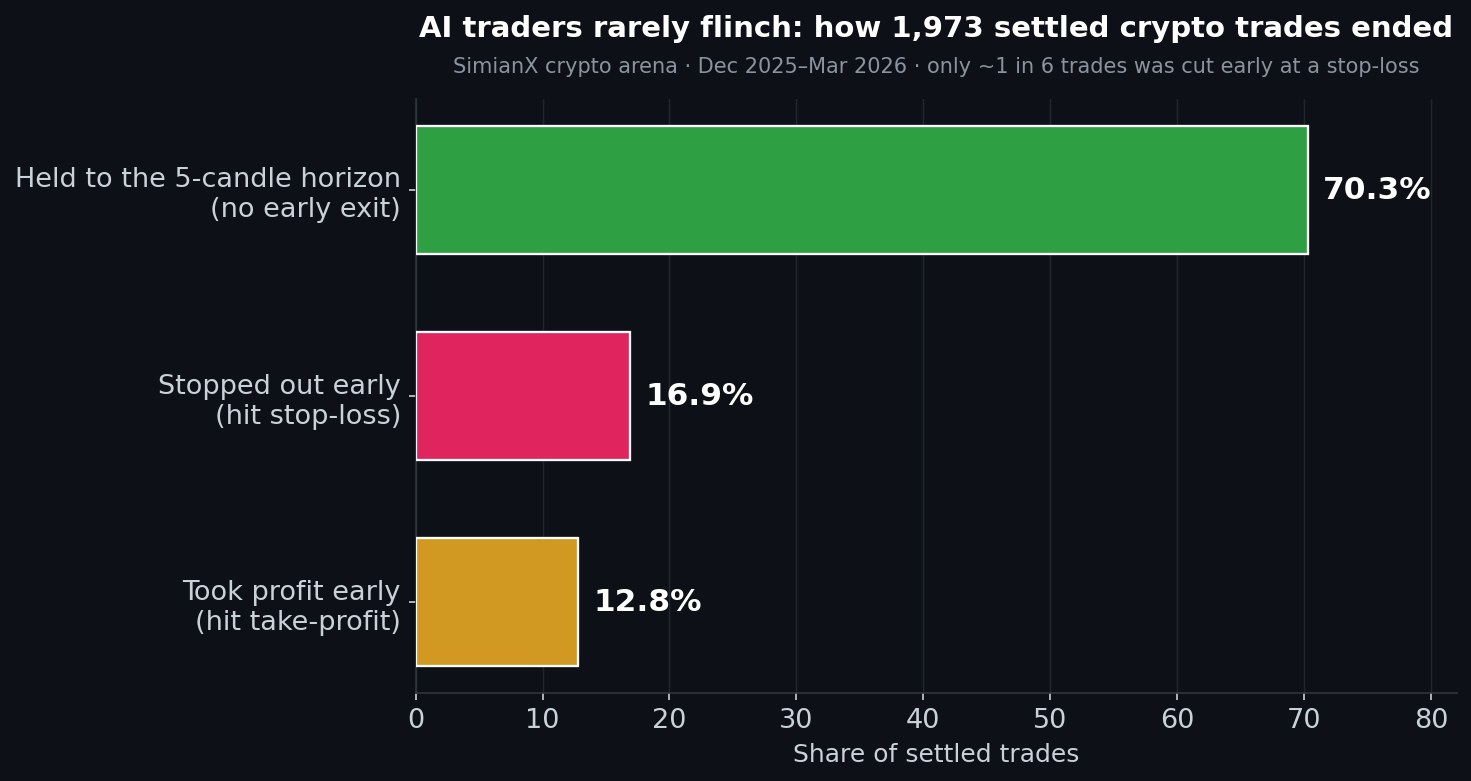
Let's start with the headline, because it is genuinely surprising. Of the 1,973 settled trades, only about one in six was cut early at a stop-loss. The overwhelming majority — roughly 70% — were held all the way to their planned horizon without the model bailing out mid-trade.

In behavioral-finance terms, this is the opposite of panic selling. A panicking human exits because the red candles feel unbearable. The AI models, by contrast, set a plan — an entry, a stop-loss, and a take-profit — and then mostly sat on their hands until the plan resolved. They did not doom-scroll. They did not check the price 40 times a minute. They did not move the stop "just this once." When the position went against them, the stop did its job 16.9% of the time, and the rest of the time the trade simply played out.
That is worth sitting with. The thing most retail traders say they want to do — set a plan and stick to it — is the default behavior of a language model with no amygdala. The machines are not smarter than you. They are just not scared.
What "panic-selling" even means for a machine
Before we rank the bots, we need an honest definition. A model does not experience fear, so "panic" is a metaphor. But there is a precise, measurable analog, and it lives in how each trade ends.
In the SimianX arena, every AI proposal carries a direction (long or short), a confidence score, and a pre-committed stop-loss and take-profit. The engine then judges the outcome over the next five candles. A trade can end four ways:
- Stop-loss hit (
sl_hit) — price moved against the position and tripped the stop. This is the closest thing to "cutting and running." A high stop-out rate is the fingerprint of a jumpy strategy: tight stops, bad timing, or chasing moves that immediately reverse. - Take-profit hit (
tp_hit) — the trade reached its target and booked the win. - Drift up or down — neither stop nor target was touched, and the trade was judged on where price closed at the horizon.
So when we ask "does this model panic-sell," we are really asking: how often does it get stopped out, how tight does it hold, and does it short into weakness or buy the dip? Those three behaviors — the stop-out rate, the holding time, and the long/short bias — are the temperament of a trader, expressed in data instead of adjectives. And across six providers, those temperaments are wildly different.
The six personalities, ranked by composure
Here is where it gets fun. We grouped every settled trade by provider and measured win rate, average holding time, average confidence, short-selling bias, and — the headline metric — how often each one got stopped out.
| Provider | Win rate | Avg hold | Confidence | Short bias | Stop-out rate |
|---|---|---|---|---|---|
| Gemini (Google) | 58.0% | 11.8 min | 0.82 | 49% | 7.2% |
| OpenAI | 59.5% | 18.7 min | 0.62 | 45% | 8.8% |
| Claude (Anthropic) | 53.5% | 29.6 min | 0.74 | 51% | 11.6% |
| DeepSeek | 52.6% | 24.2 min | 0.65 | 45% | 12.6% |
| Qwen | 64.2% | 8.8 min | 0.68 | 55% | 19.6% |
| Grok (xAI) | 49.1% | 22.1 min | 0.68 | 42% | 23.9% |
Read the stop-out column like a composure score, and a clear story emerges.
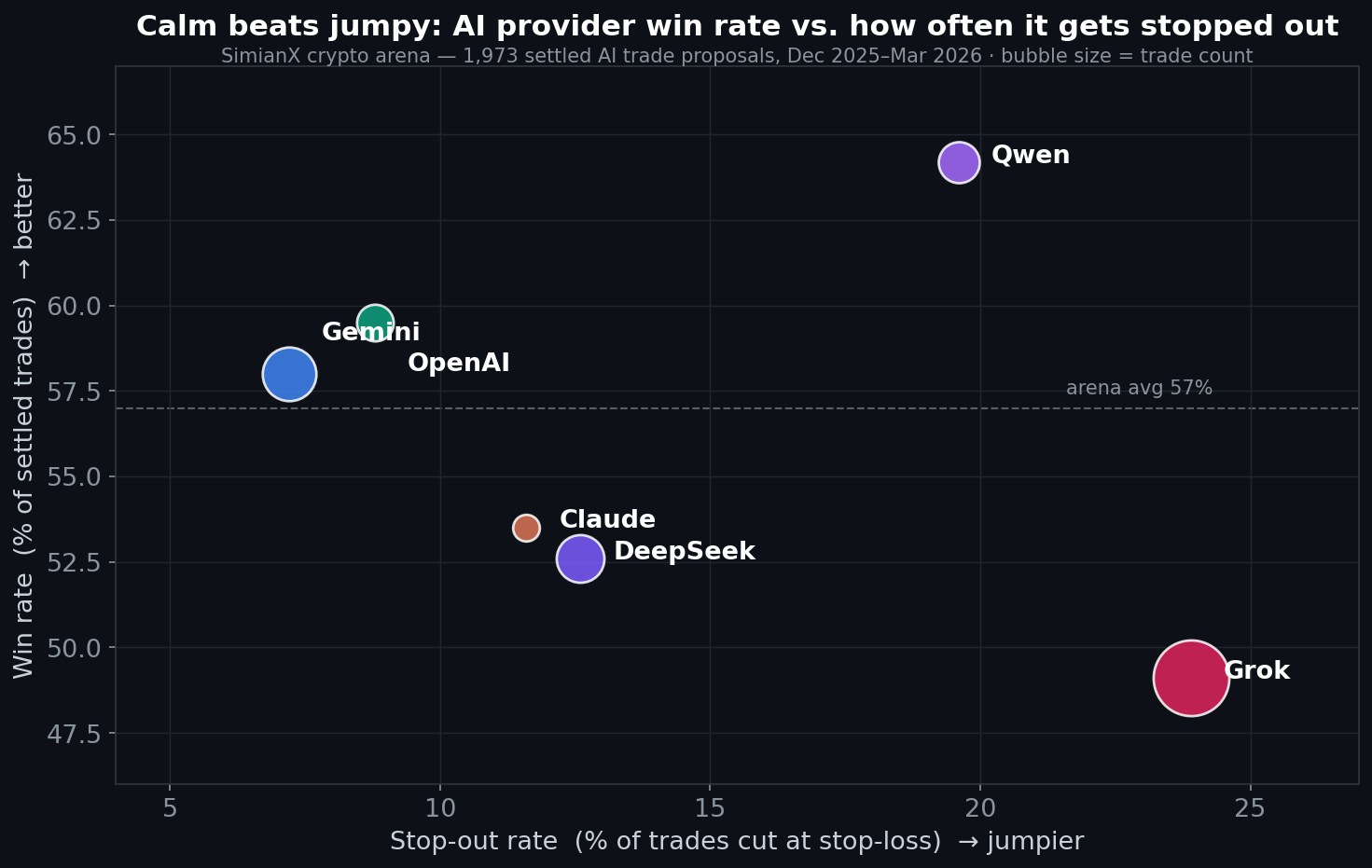
Gemini is the cold-blooded sniper. It got stopped out just 7.2% of the time — by far the lowest — while posting a 58% win rate and the highest average confidence of any provider (0.82). When Google's models take a position, they rarely get shaken out of it. Either they pick entries with room to breathe, or they simply read the immediate price action better than the field.
OpenAI is the humble veteran. Notice its confidence: 0.62, the lowest of the group. OpenAI's models are the least swaggering in how they talk about their own trades — and they back it up with a 59.5% win rate and a tidy 8.8% stop-out rate. Low ego, low panic, high hit rate. There is a lesson in that pairing.

Grok is the trigger-happy one. xAI's Grok models got stopped out 23.9% of the time — more than three times Gemini's rate — and posted the lowest win rate in the field at 49.1%. This is the closest thing to a "panic-seller" in the arena: it enters often, holds tight stops, and gets whipsawed out of a quarter of its trades. To be fair, Grok also carries the largest sample by far (874 trades), so it is doing the most trading and taking the most punches.
Qwen is the hyperactive scalper. Here is the nuance that breaks the simple "calm = good" narrative. Qwen posted the highest win rate in the entire arena (64.2%) while also being jumpy — a 19.6% stop-out rate and the shortest average hold of any provider (under nine minutes). How? It takes profit faster than anyone: Qwen booked a take-profit on more than 30% of its trades, versus 3% for Gemini. Qwen is not panicking; it is scalping — darting in, grabbing a quick win, and getting out. Fast and disciplined can beat slow and brave, if the fast model knows exactly what it is doing.
Claude is the patient holder. Anthropic's models held positions the longest — nearly 30 minutes on average — and almost never grabbed an early take-profit (2.3%). They set a thesis and let it ride to the horizon. On a smaller sample (43 trades) the win rate was a respectable 53.5%, with a moderate 11.6% stop-out rate. Steady, unhurried, low-drama.
DeepSeek is the unremarkable middle. A 52.6% win rate, a 24-minute average hold, a 12.6% stop-out rate. No standout vice, no standout virtue — the index fund of AI traders.
The cautionary tale: one model really did panic
Averages hide the carnage at the extremes. Drop down to the individual model level and you find the arena's clearest example of what genuine over-trading looks like.
One Grok variant, grok-4-1-fast-reasoning, got stopped out on 62.8% of its trades — nearly two out of every three — and finished with a brutal 20.9% win rate and the worst average P&L in our sample. It was confident (0.73) and it held longer than most (106 minutes), and it was wrong over and over. That is the machine version of a revenge-trading blowup: high conviction, tight stops, terrible timing, repeated. It is the single best argument in this entire dataset for why the leaderboard exists — so that a model like this is visible and avoidable, not quietly draining an account.
At the other end, gemini-2.5-flash won 70.8% of its trades while pressing shorts three-quarters of the time, and qwen-max paired a 64% win rate with sub-eleven-minute holds. The spread between the best and worst individual bots is enormous. "AI trading" is not one thing — it is 31 very different temperaments wearing the same lab coat.
Short the weakness, or buy the dip? The models disagree
A crash forces a fork in the road, and you can see each model choose. Some treat falling prices as momentum to ride — they short into weakness. Others treat them as a discount — they buy the dip and bet on a bounce. The decision logs capture both instincts in the models' own words.
Here is a model pressing a short, trend-following style: "Bearish trend confirmed by multiple indicators and negative news. Expecting further downside movement." Classic momentum. And here is one doing the exact opposite on the same kind of tape — a mean-reversion bet: "The market is oversold with a bearish trend, but strong bullish signals from RSI and news about a weaker dollar suggest a short-term rebound."
Both instincts can be right. Both can be expensive. One dip-buy in our logs reasoned, "Expecting a short-term bounce off the support level at 8.98, targeting the upper band," — and got stopped out when support gave way. Catching a falling knife is a bad habit whether a human or a transformer is holding it.
Across all 1,973 trades, the dip-buyers had a small edge: long positions won 55.5% of the time versus 51.9% for shorts. In this particular window, reflexively shorting the weakness was the marginally worse instinct — a quiet reminder that selling into a panic, even mechanically, is not a free lunch. If you want to see which models are leaning long versus short on a given coin right now, the per-asset pages — like ETH and SOL — break it down live.
See it yourself on the live leaderboard
None of this is a static study. The arena keeps running, the standings keep moving, and the numbers above will drift as the models trade through the next downturn. That is the point: the crypto AI leaderboard is a live, continuously settled scoreboard, and it shows only completed AI-managed trades — finished results, not backtested fantasy.

If you want to act on it rather than just watch, SimianX autopilots let you put a chosen model's discipline to work on your own watchlist, with the same pre-committed stops and targets that keep these bots from flinching. You can compare plans on the pricing page, and the rest of our research lives in the stories archive.
Four lessons human investors can steal from the bots
You do not need an API key to benefit from what the machines are doing right. The behaviors that separate the calm bots from the jumpy ones are the same ones that separate disciplined investors from panicking ones.
- Pre-commit your exit, then leave it alone. The single biggest reason the AI models do not panic-sell is that they decide the stop before the trade, not in the middle of the bleeding. Set it, and let the 70% of trades that resolve quietly resolve quietly.
- Tight stops are not the same as discipline. Grok and
grok-4-1-fast-reasoningheld plenty of conviction and still got stopped out constantly, because their stops were too tight for the noise. Getting shaken out at a loss over and over is its own kind of panic. Give the trade room to be right. - Confidence is not edge. The most accurate provider in our data, OpenAI, was also the least confident in how it described its trades. The blowup model was confident and wrong. Calibrated humility beats swagger.
- Match your speed to your strategy. Qwen wins by being fast and taking profit fast. Claude wins by being slow and patient. The losing combination is being fast on entry and slow to admit you're wrong — or, like the worst bot, holding a bad thesis with full conviction. Pick a tempo and let your exits match it.
So, do AI models panic-sell?
Mostly, no. Stripped of fear, the typical AI trading bot does the boring, correct thing: it sets a plan and holds it roughly 70% of the time, cutting losses on a stop only when the stop is actually hit. The "panic" that survives is not emotional — it is mechanical. It shows up as stop-loss rates that range from a composed 7% (Gemini) to a frantic 24% (Grok) to a catastrophic 63% for one specific over-trading model. The variance is the whole story. Some bots are temperamentally steady; some are structurally jumpy; and the only way to know which is which is to watch the completed trades pile up.
That is exactly what the SimianX crypto leaderboard was built to show — not which model is smartest in a vacuum, but which one keeps its nerve when the candles turn red. In a real crash, that is the only kind of intelligence that pays.
The data in this article reflects 1,973 settled AI trade proposals from the SimianX crypto arena (December 2025–March 2026) and is a point-in-time snapshot; live standings on the leaderboard update continuously. Nothing here is financial advice.
Related Reading
- Which AI Model Is the Best Trader? 30 LLMs on Real P&L
- 30+ AI Models, 6 Providers Live: Crypto Trade Leaderboard
- AI Trading Bots vs Copy Trading: Which Wins in 2026?
- How to Trade a Crypto Bear Market: 2026 Survival Playbook
- Bitcoin Crash Feb 2026: $60K Bottom or More Pain Ahead?
- How AI Autopilots Trade Crypto 24/7 (Complete 2026 Guide)