
Bay of Pigs Invasion (1961): Geopolitical Shock and Market Risk Signals
The Bay of Pigs Invasion (1961) stands as one of the most significant Cold War flashpoints, offering a powerful case study in geopolitical shock and market risk signals. While often analyzed from a political or military lens, its implications for financial markets—especially in understanding risk perception, volatility, and recovery dynamics—are equally profound. Today, platforms like SimianX AI allow traders to systematically analyze such historical shocks and translate them into actionable strategies in modern markets.
Understanding the Bay of Pigs Invasion as a Geopolitical Shock
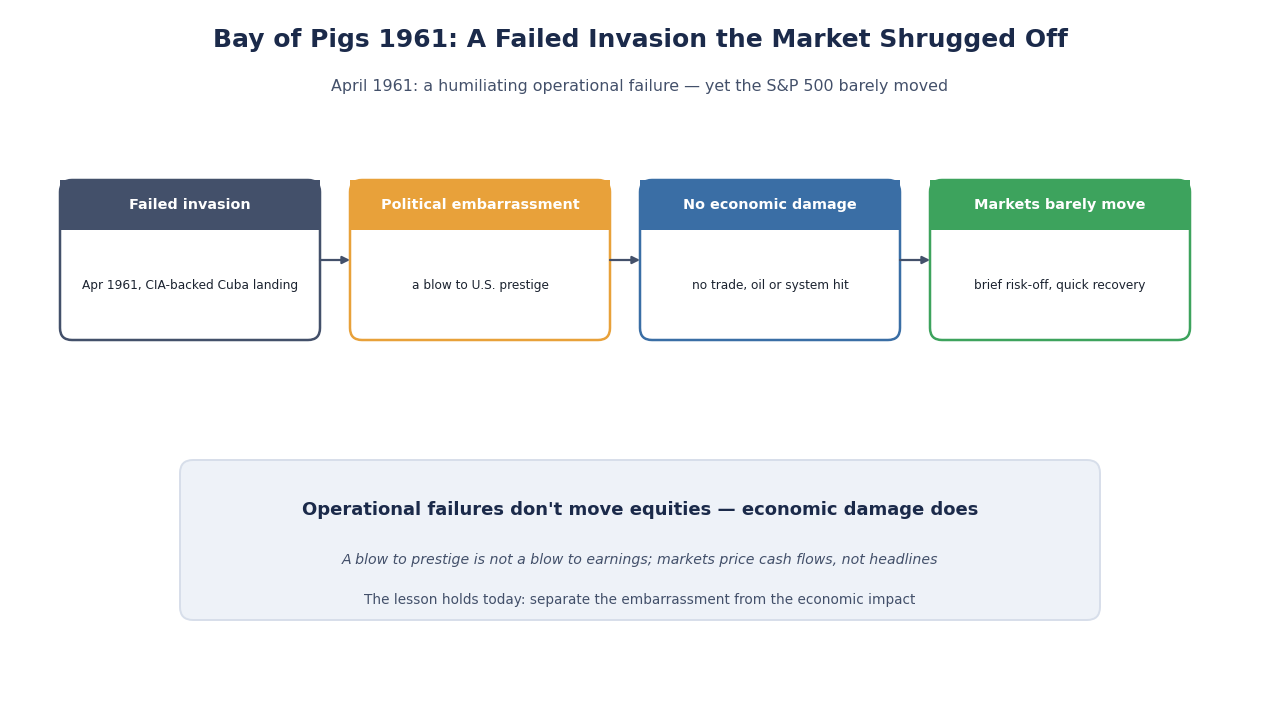
The Bay of Pigs Invasion occurred in April 1961, when a U.S.-backed group of Cuban exiles attempted to overthrow Fidel Castro’s government. The mission failed within days, but its geopolitical consequences were far-reaching:
- It intensified U.S.–Soviet tensions
- It accelerated Cuba’s alignment with the USSR
- It set the stage for the Cuban Missile Crisis (1962)
From a financial perspective, the event introduced a sudden uncertainty shock—a key driver of market volatility.
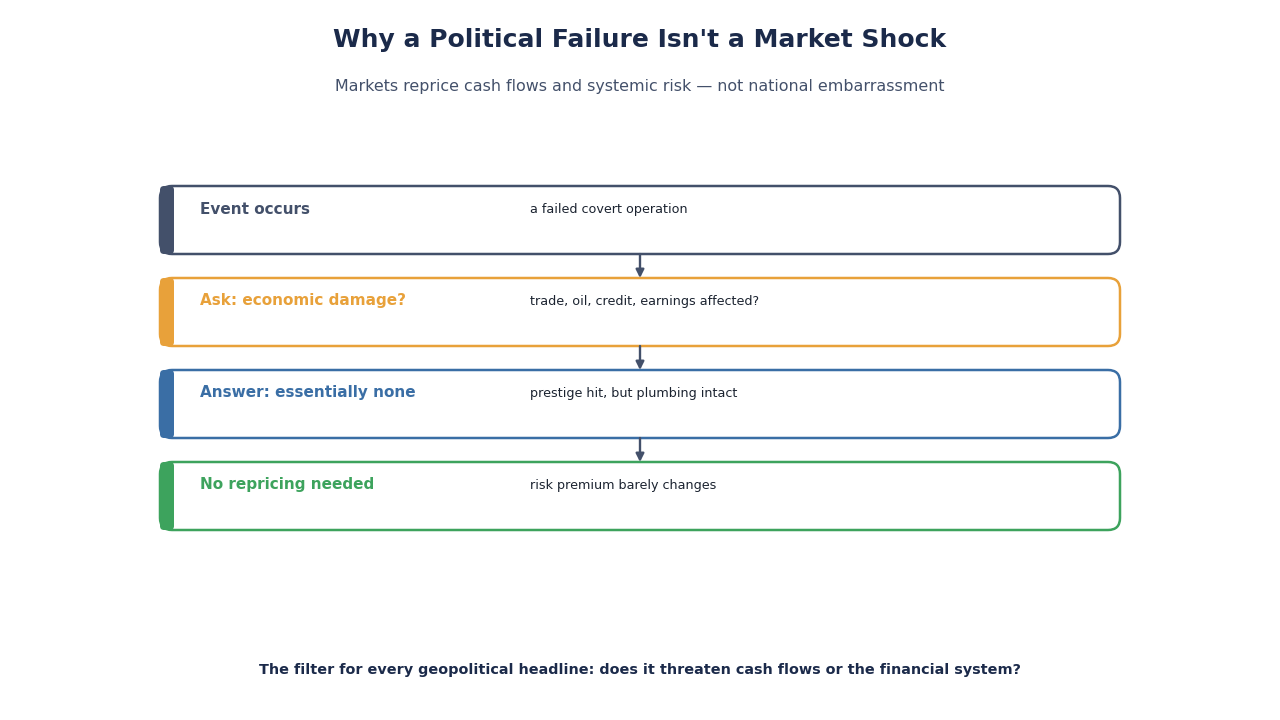
Markets do not react to events themselves—they react to uncertainty, probability shifts, and perceived systemic risk.
Key Characteristics of the Shock
| Factor | Impact on Markets |
|---|---|
| Surprise factor | High – unexpected escalation |
| Duration | Short (few days) but with long-term impact |
| Global implications | Moderate to high |
| Market reaction type | Risk-off sentiment |
Bold insight: Geopolitical shocks like the Bay of Pigs often trigger short-term volatility spikes rather than prolonged crashes.
How Did Markets React to the Bay of Pigs Invasion?
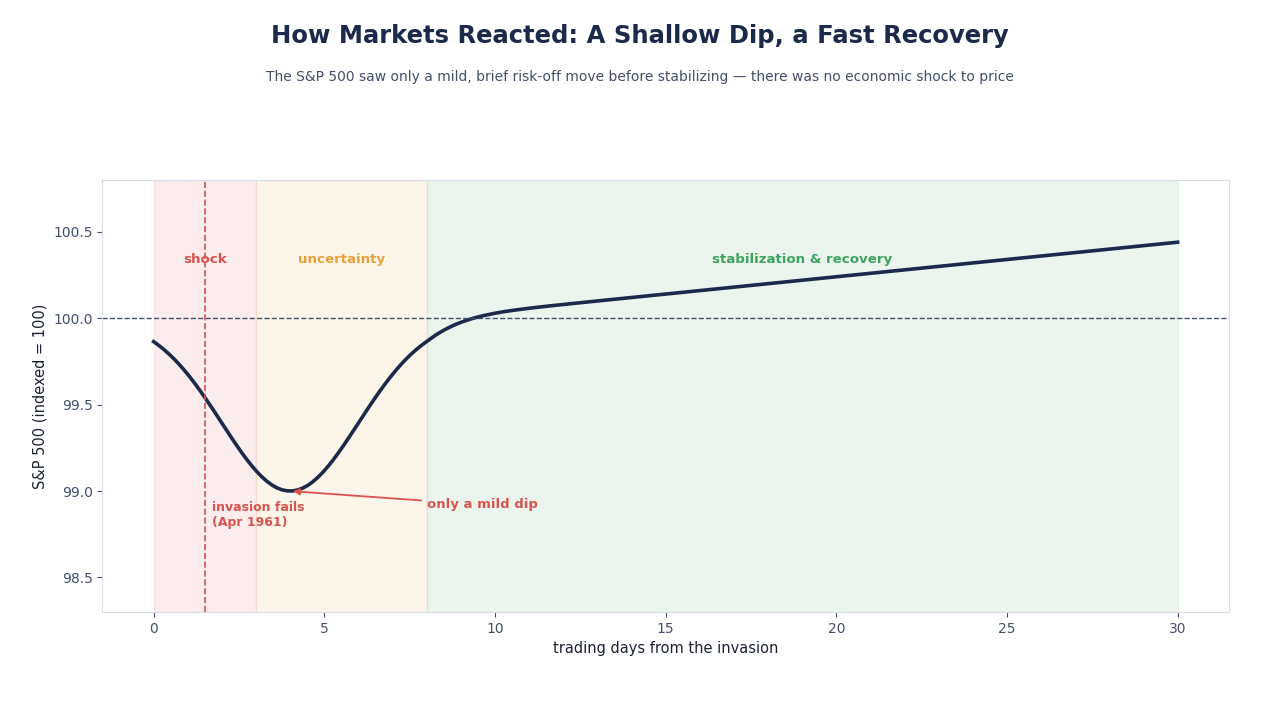
Unlike later crises such as the Cuban Missile Crisis, the Bay of Pigs did not trigger a massive stock market crash. However, subtle signals were visible:
Immediate Market Effects
- Increased volatility in U.S. equities
- Temporary risk-off sentiment
- Minor drawdowns in major indices
Why the Reaction Was Limited
- The invasion was short-lived
- It did not escalate into direct superpower conflict
- Information dissemination was slower compared to modern markets
Market Behavior Pattern
- Phase 1: Shock → Uncertainty spike
- Phase 2: Rapid reassessment
- Phase 3: Stabilization and recovery
This pattern is still observed today in events like airstrikes, sanctions, or political crises.
Geopolitical Risk Signals: What Traders Should Learn
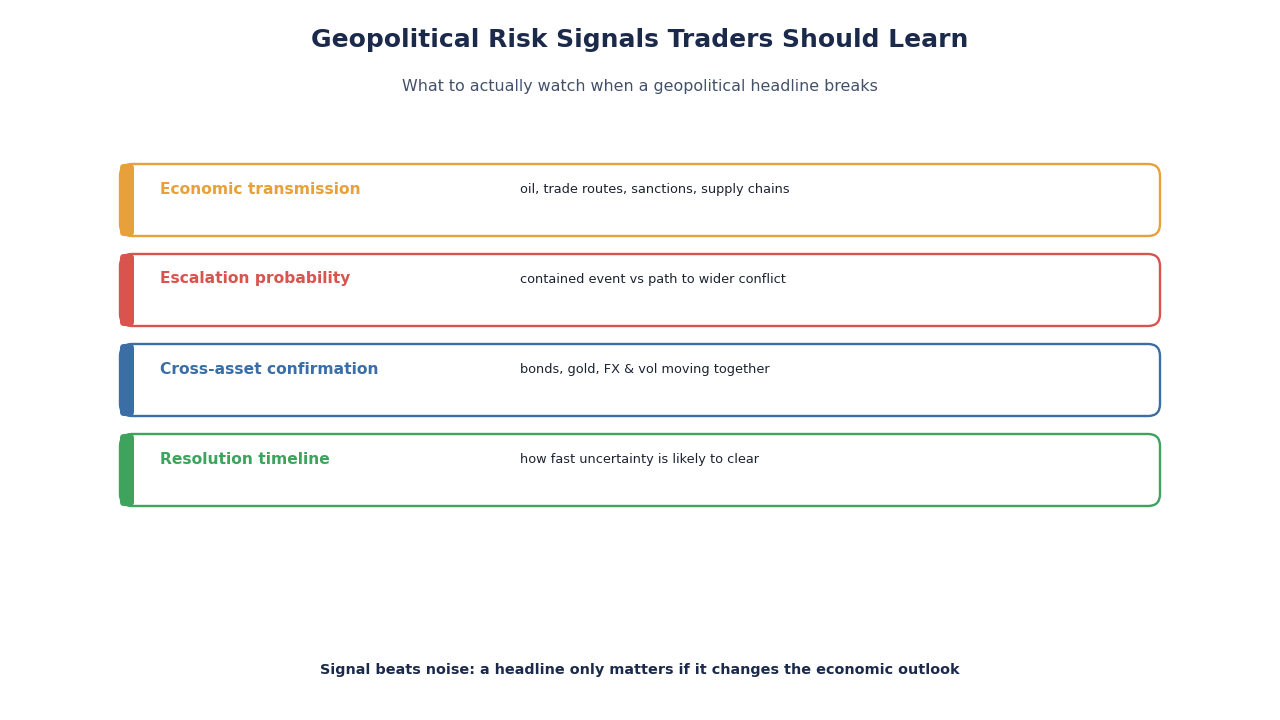
The Bay of Pigs provides a foundational framework for interpreting geopolitical risk signals in trading.
Core Signals to Watch
- News velocity: How fast information spreads
- Escalation probability: Is the conflict likely to grow?
- Market positioning: Are traders already hedged?
The most profitable trades often occur not at the peak of panic—but during the transition from uncertainty to clarity.
Actionable Framework
- Identify the type of geopolitical event
- Assess systemic vs localized risk
- Monitor volatility indicators (e.g., VIX)
- Execute risk-adjusted strategies
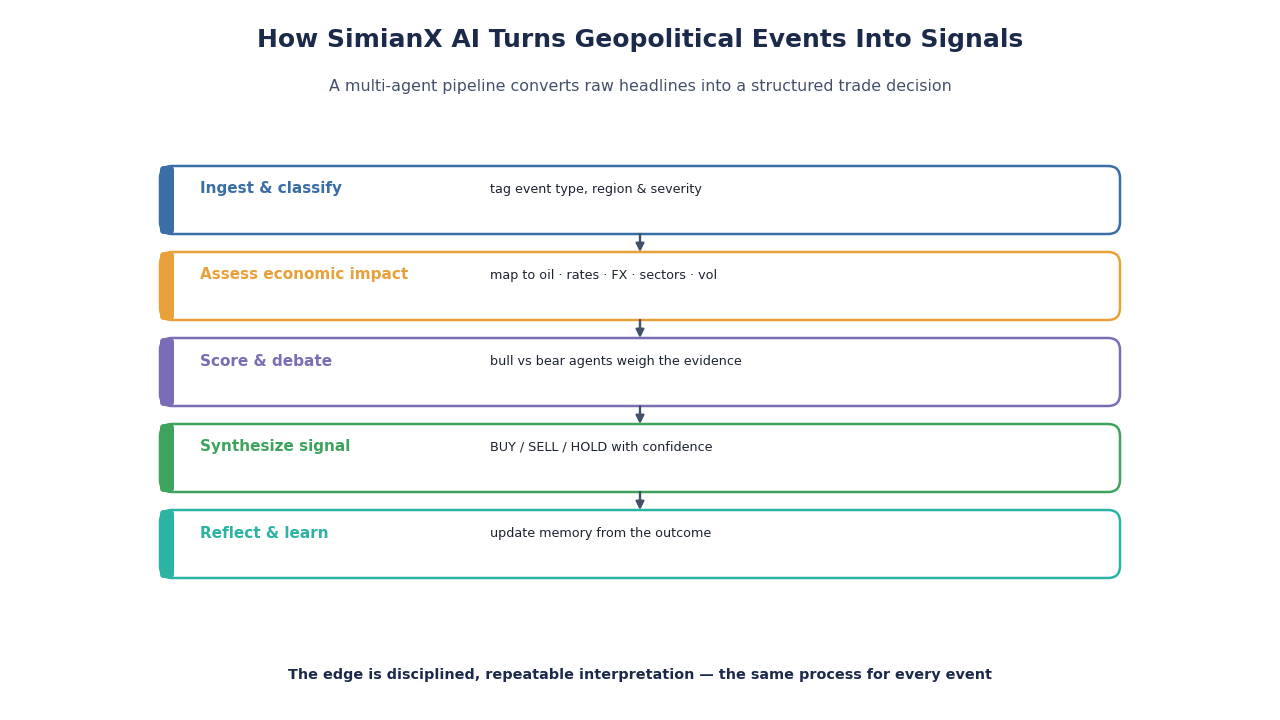
How SimianX AI Translates Geopolitical Events into Trading Signals
Modern traders no longer need to manually interpret complex geopolitical events. SimianX AI provides a structured, data-driven approach:
Key Capabilities
- Multi-agent analysis (news, macro, technicals)
- Real-time market sentiment tracking
- Cross-asset signal generation (crypto, equities, indices)
Example Workflow
| Step | SimianX AI Functionality |
|---|---|
| Event detection | AI parses global news feeds |
| Risk classification | Categorizes geopolitical impact level |
| Signal generation | Provides buy/sell/hedge insights |
| Execution support | AI copilots assist with strategy |
Bold takeaway: With tools like SimianX, traders can convert historical geopolitical patterns into predictive signals.
Real-World Application
- During sudden geopolitical shocks:
- AI identifies risk-off sentiment early
- Suggests hedging strategies
- Highlights safe-haven assets
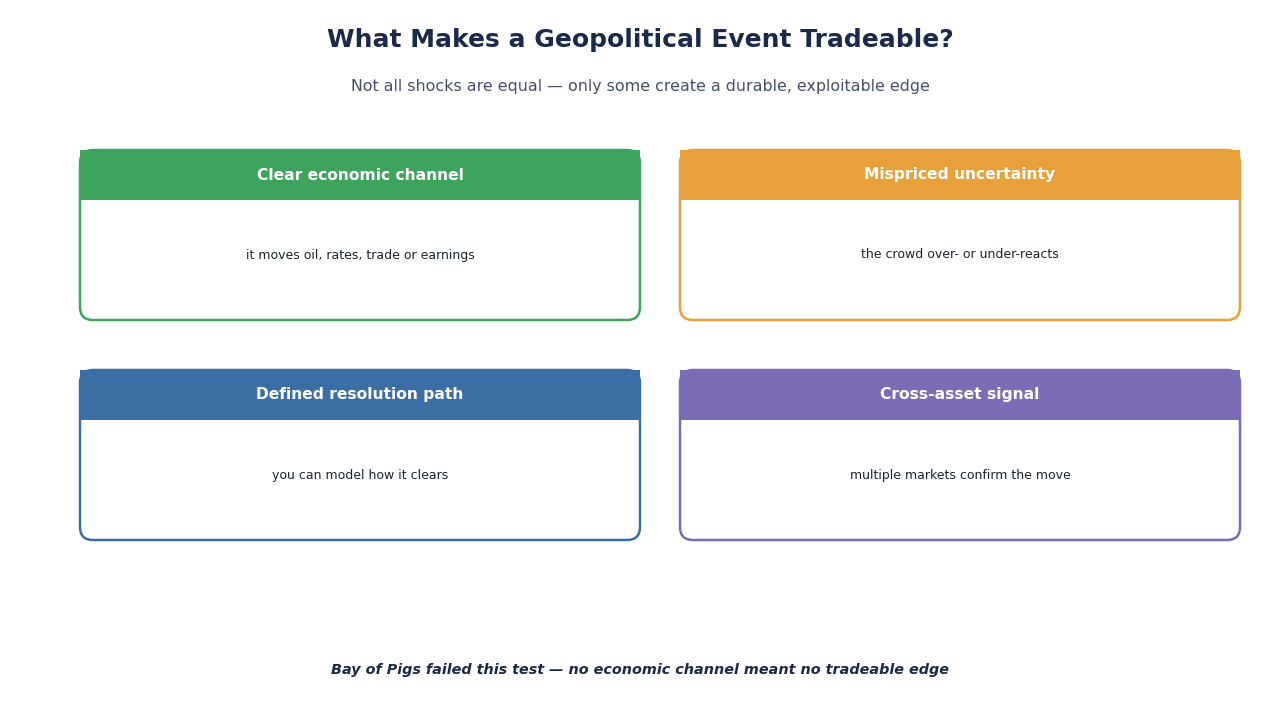
What Makes Geopolitical Events Tradeable?
Key Criteria
- Clarity of outcome (low clarity = high volatility)
- Market surprise factor
- Global vs regional impact
Tradeable Patterns
- Short-term volatility spikes
- Sector rotation (e.g., defense, energy)
- Safe-haven flows (gold, USD)
Practical Strategy
- Enter trades during panic phase
- Exit during stabilization phase
What Can Modern Traders Learn from the Bay of Pigs Invasion?
Lessons for Today’s Markets
- Not all geopolitical events cause crashes
- Speed of information now amplifies reactions
- AI tools are essential for real-time interpretation
Comparing Then vs Now
| Factor | 1961 Market | Modern Market |
|---|---|---|
| Information speed | Slow | Instant |
| Volatility | Moderate | High |
| Trading tools | Manual | AI-driven |
Strategic Insights
- Use historical analogs to predict reactions
- Focus on risk-adjusted returns
- Leverage AI for multi-signal confirmation
How to Trade Geopolitical Shocks Using AI?
Step-by-Step Approach
- Detect the event early
- Classify its risk level
- Analyze cross-market reactions
- Execute diversified strategies
SimianX AI simplifies this entire process, allowing traders to move from reaction to anticipation.
Example Use Case
- Event: Military escalation
- AI Output:
- Short equities
- Long gold
- Hedge via options
The future of trading is not predicting events—but responding faster and smarter than the market.
FAQ About Bay of Pigs Invasion and Market Risk Signals
What is the Bay of Pigs invasion stock market impact?
The Bay of Pigs invasion caused limited direct market damage but increased short-term volatility. Its main significance lies in how markets process geopolitical uncertainty rather than long-term economic disruption.
How do markets react to geopolitical shocks like the Bay of Pigs?
Markets typically follow a pattern of initial panic, rapid reassessment, and eventual stabilization. The scale depends on the perceived risk of escalation and global impact.
What is geopolitical risk in trading?
Geopolitical risk refers to the potential for political events—such as wars or conflicts—to disrupt financial markets. Traders monitor these risks to adjust positions and manage volatility.
How can AI help trade geopolitical events?
AI platforms like SimianX analyze real-time data, classify risk levels, and generate trading signals, enabling faster and more accurate decision-making during volatile periods.
What are the best strategies for geopolitical risk trading?
Effective strategies include hedging, diversification, trading volatility, and using historical event patterns to anticipate market behavior.
Conclusion
The Bay of Pigs Invasion (1961) remains a crucial example of how geopolitical shocks influence financial markets—not through catastrophic crashes, but through uncertainty, volatility, and rapid sentiment shifts. For modern traders, the key takeaway is clear: understanding these patterns is essential for navigating today’s increasingly complex global markets.
With advanced platforms like SimianX AI, traders can go beyond reactive strategies and develop proactive, data-driven approaches to geopolitical risk. By leveraging AI-powered insights, real-time signals, and historical analysis, you can transform uncertainty into opportunity.
Deep Dive: Market Microstructure and Information Flow During Geopolitical Shocks
While the Bay of Pigs Invasion (1961) did not trigger a catastrophic financial collapse, it provides a powerful lens into market microstructure under geopolitical stress. Understanding how information propagates through markets—and how participants react at different speeds—is essential for modern traders using platforms like SimianX AI.
Information Asymmetry in 1961 vs Today
During the early 1960s:
- News traveled slowly via radio, newspapers, and delayed reports
- Institutional investors had a timing advantage
- Retail participation was limited
Today:
- Information spreads instantly via APIs, social media, and AI parsing
- Markets react in milliseconds
- Alpha decay is extremely fast
In modern markets, the edge is no longer access to information—but speed and interpretation.
Market Microstructure Layers
| Layer | Description | Relevance During Shock |
|---|---|---|
| Order Flow | Buy/sell pressure in real time | Reveals panic or accumulation |
| Liquidity | Depth of market across price levels | Thins during uncertainty |
| Spread Dynamics | Bid-ask spread widening | Indicates risk aversion |
| Volatility | Price dispersion over time | Spikes during geopolitical shock |
Key insight: Even minor geopolitical events can create temporary liquidity vacuums, amplifying price swings.
Behavioral Finance: Psychology Behind Market Reactions
The Bay of Pigs highlights how human psychology drives market reactions during geopolitical crises.
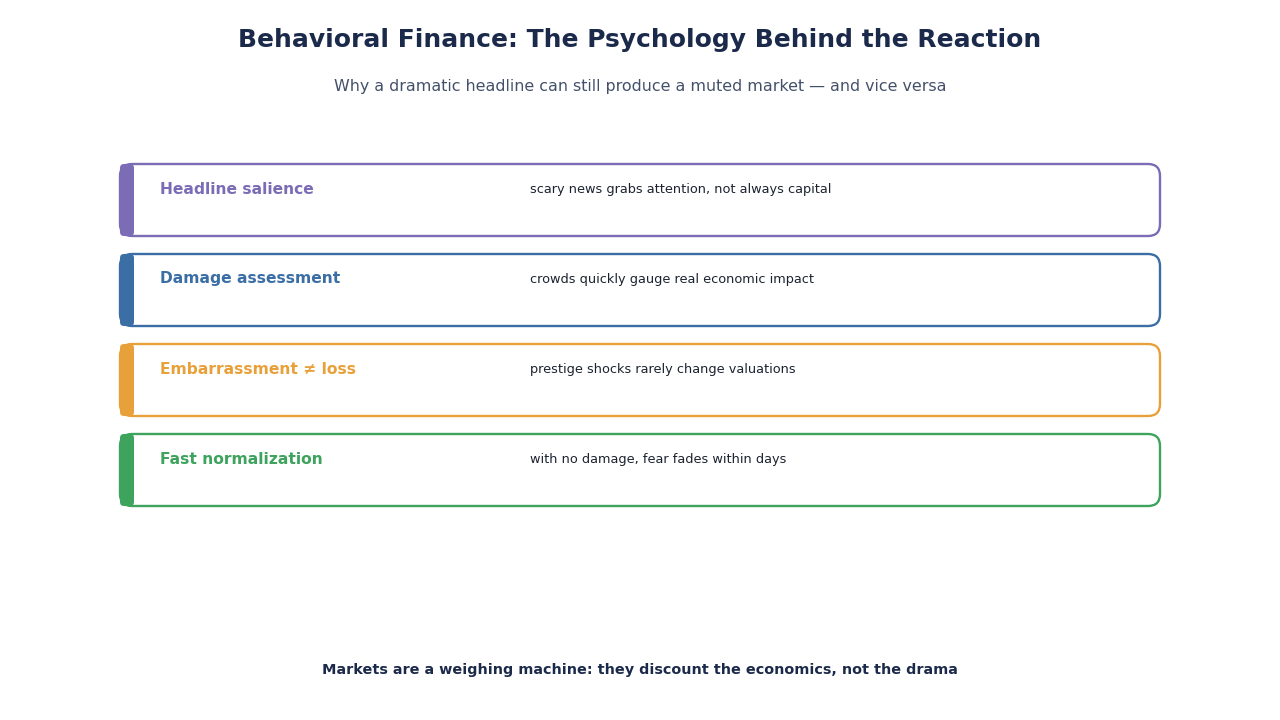
Core Behavioral Biases
- Loss aversion: Investors sell quickly to avoid further losses
- Herd behavior: Market participants follow the crowd
- Overreaction bias: Initial moves often overshoot reality
Emotional Cycle of Markets
- Shock
- Fear
- Panic selling
- Reassessment
- Recovery
The greatest opportunities emerge when emotion diverges from fundamentals.
Practical Trading Implications
- Avoid trading purely on headlines
- Look for mean reversion opportunities
- Combine sentiment with technical confirmation
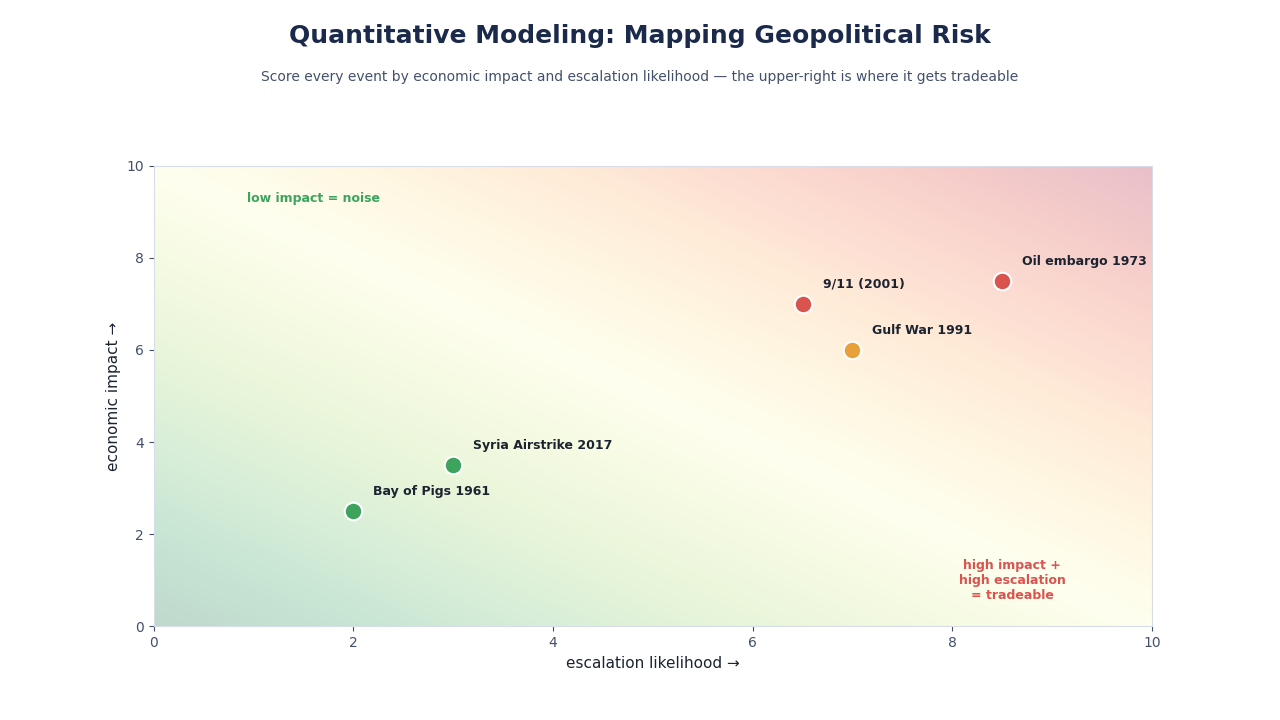
Quantitative Modeling of Geopolitical Risk
Modern trading frameworks increasingly rely on quantitative models to price geopolitical risk.
Key Variables
- Event severity score
- Duration of uncertainty
- Cross-market correlations
- Volatility clustering
Sample Risk Scoring Model
| Variable | Weight | Example Value | Contribution |
|---|---|---|---|
| Event severity | 0.4 | High | 0.4 |
| Duration | 0.2 | Short | 0.1 |
| Global exposure | 0.3 | Medium | 0.15 |
| Market sensitivity | 0.1 | High | 0.1 |
| Total Risk Score | 0.75 |
Interpretation
- 0.0–0.3 → Low risk
- 0.3–0.6 → Moderate risk
- 0.6–1.0 → High risk
Bay of Pigs estimate: ~0.5–0.6 → Moderate geopolitical shock
Cross-Asset Impact Analysis
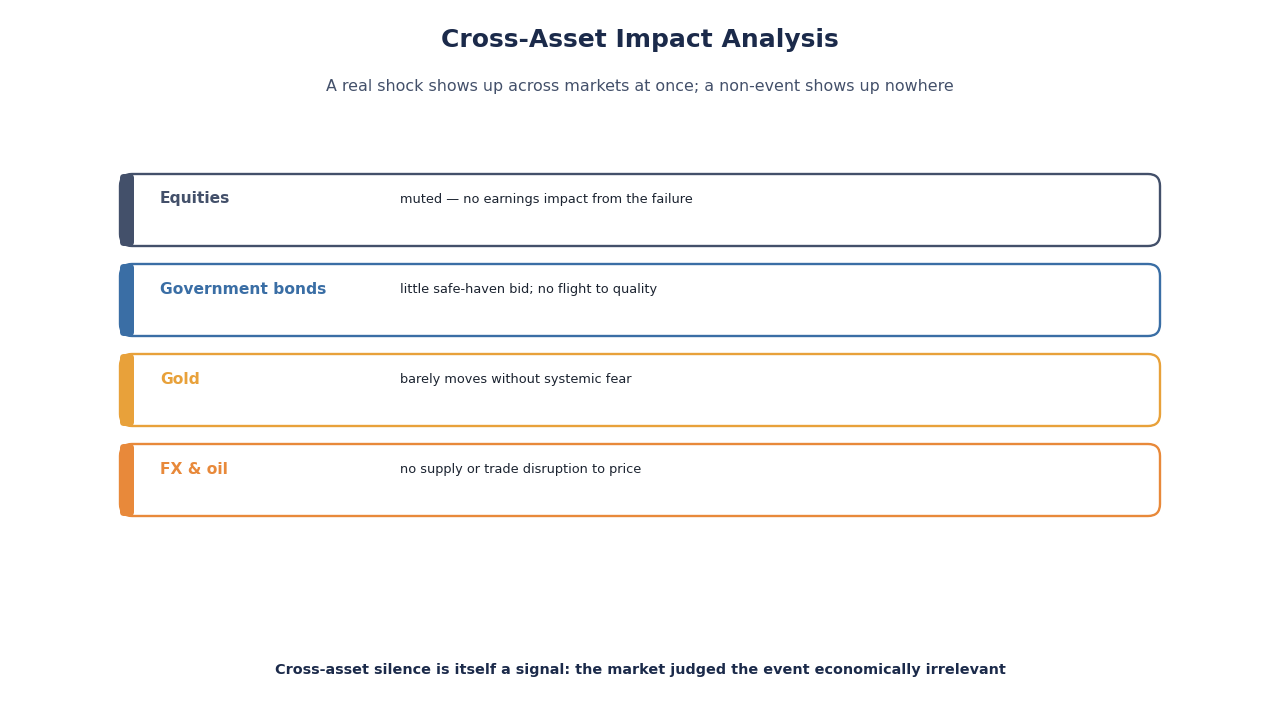
Geopolitical shocks rarely affect only equities. The Bay of Pigs provides a template for cross-asset reactions.
Asset Class Responses
- Equities: Mild drawdown, increased volatility
- Gold: Slight safe-haven demand
- Bonds: Flight to safety
- Commodities: Limited impact unless tied to conflict
Modern Parallel
Today, similar events trigger:
- Crypto volatility spikes (
BTC,ETH) - Oil price fluctuations
- FX movements (USD strength)
Cross-Asset Correlation Matrix
| Asset | Reaction Type | Sensitivity |
|---|---|---|
| S&P 500 | Risk-off | Medium |
| Gold | Safe haven | High |
| USD | Defensive | Medium |
| Crypto | Speculative | High |
The best trades often emerge from cross-asset divergence, not isolated signals.
Scenario Analysis: If Bay of Pigs Happened Today
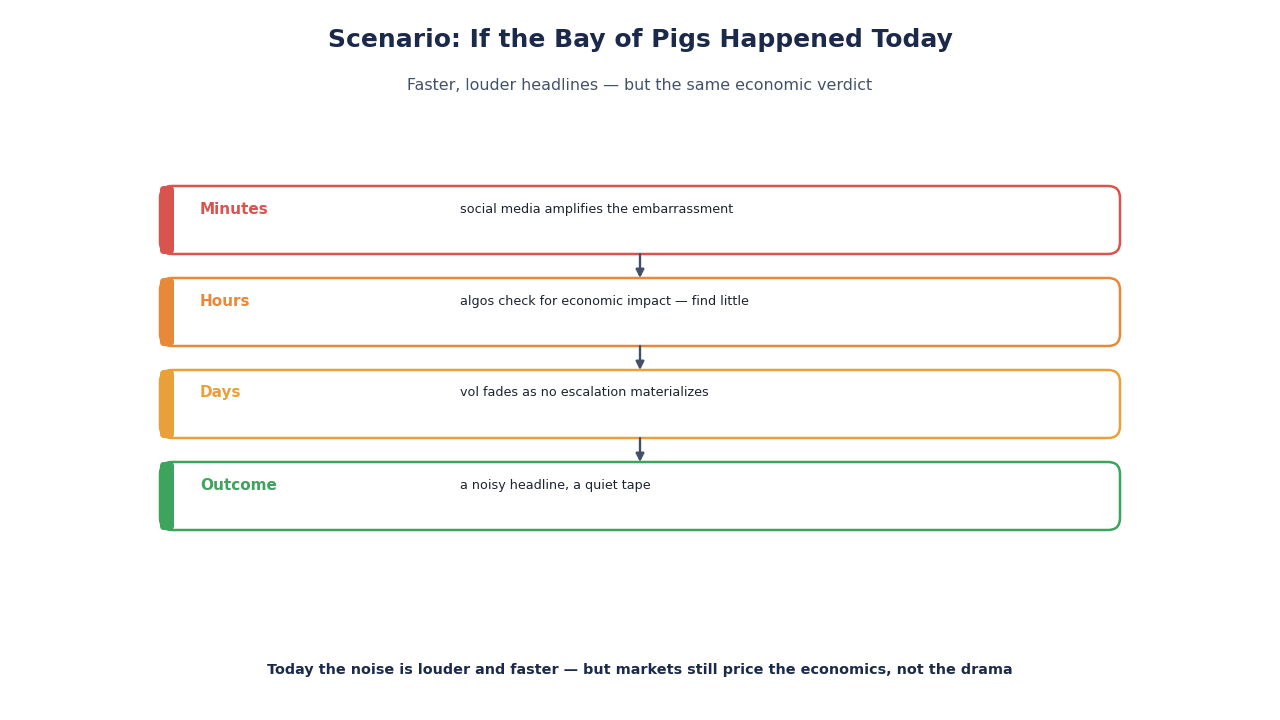
Let’s simulate how markets would react if a similar event occurred in the modern AI-driven trading environment.
Expected Market Reactions
- Immediate spike in VIX
- Algorithmic selling across equities
- Safe-haven inflows within minutes
- Social media-driven sentiment amplification
SimianX AI Simulation
Using SimianX AI’s multi-agent architecture:
- News Agent detects event instantly
- Macro Agent evaluates escalation risk
- Technical Agent confirms breakdown patterns
- Decision Agent executes optimized trades
Simulated Trade Setup
- Short index futures
- Long gold
- Hedge via options
- Monitor sentiment reversal
Outcome: Profit from volatility rather than direction alone
Risk Management Framework for Geopolitical Events
Effective trading during geopolitical shocks requires robust risk management.
Key Principles
- Position sizing based on volatility
- Use of stop-loss mechanisms
- Diversification across assets
Risk Control Checklist
- Is the event escalating?
- Are markets overreacting?
- Is liquidity deteriorating?
Example Risk Matrix
| Risk Level | Strategy |
|---|---|
| Low | Maintain positions |
| Medium | Hedge partially |
| High | Reduce exposure significantly |
Survival is the first rule of trading; profit is the second.
Signal Extraction: Turning Noise into Alpha
One of the biggest challenges in geopolitical trading is distinguishing signal from noise.
Noise vs Signal
- Noise: Headlines, rumors, speculation
- Signal: Confirmed escalation, policy changes
AI Advantage
SimianX AI filters:
- Real vs fake news
- Short-term vs structural impact
- Market sentiment vs fundamentals
Signal Hierarchy
- Confirmed geopolitical action
- Policy response
- Market reaction
- Secondary effects
Key takeaway: Not all news is tradeable—only actionable information matters.
Historical Comparisons: Bay of Pigs vs Other Events
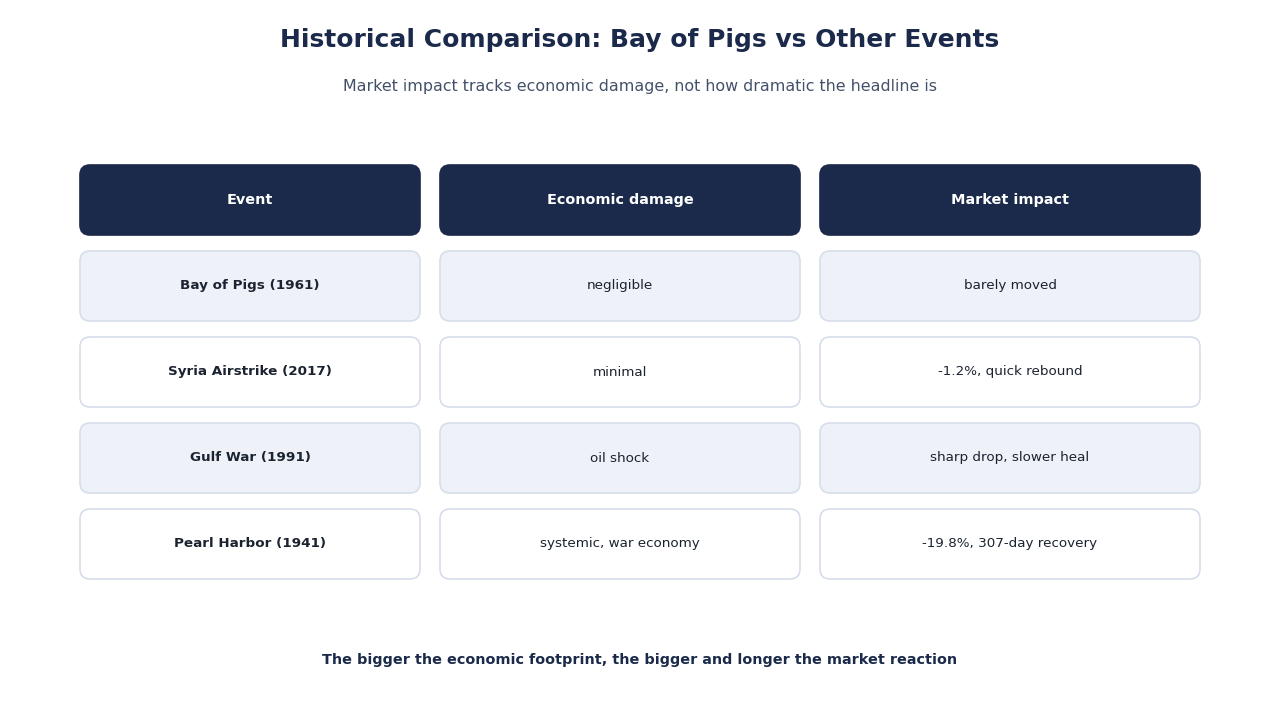
To fully understand the Bay of Pigs, we compare it with similar geopolitical shocks.
Comparative Table
| Event | Drawdown | Recovery Time | Severity |
|---|---|---|---|
| Bay of Pigs (1961) | Mild | Short | Moderate |
| Cuban Missile Crisis | Moderate | Medium | High |
| Gulf War (1991) | Moderate | Medium | High |
| 9/11 Attacks (2001) | Severe | Long | Extreme |
Insight
- Not all geopolitical events are equal
- Market reaction depends on perceived systemic risk
Advanced Strategy: Volatility Trading
Geopolitical shocks are ideal for volatility-based strategies.
Key Approaches
- Options trading (straddles/strangles)
- VIX-based strategies
- Gamma scalping
Example Strategy
- Buy straddle before expected announcement
- Profit from volatility expansion
Why It Works
- Uncertainty increases implied volatility
- Markets reprice risk rapidly
Volatility is not risk—it is opportunity.
!options volatility strategy chart:maxbytes(150000):stripicc()/ImpliedVolatility_BuyLowandSellHigh2-2f5a33f6dde64c808b4d4775a258d3d7.png)
Integrating AI with Macro Trading
The future of trading lies in combining AI with macro analysis.
SimianX AI Advantages
- Real-time data ingestion
- Multi-timeframe analysis
- Automated decision support
Workflow Integration
- Event detection
- Risk classification
- Strategy generation
- Execution monitoring
Benefits
- Faster reaction time
- Reduced emotional bias
- Higher signal accuracy
Building a Geopolitical Trading Playbook
Step-by-Step Playbook
- Identify event type
- Assess risk level
- Analyze cross-asset impact
- Execute strategy
- Monitor and adjust
Example Playbook Table
| Step | Action | Tool Used |
|---|---|---|
| 1 | Detect event | News AI Agent |
| 2 | Classify risk | Macro AI Agent |
| 3 | Generate signals | Indicator Agent |
| 4 | Execute trades | Decision Agent |
| 5 | Monitor performance | Dashboard |
Future Outlook: AI and Geopolitical Markets
As global tensions increase, markets will become more sensitive to geopolitical events.
Emerging Trends
- AI-driven trading dominance
- Faster information cycles
- Increased volatility regimes
Strategic Implications
- Traders must adapt to AI-first environments
- Historical analysis remains critical
- Real-time decision-making is essential
! Cuban Defenders during the Bay of Pigs Invasion. :maxbytes(150000):stripicc():format(webp)/3379132-56a58a955f9b58b7d0dd4ccb.jpg)
Extended FAQ on Geopolitical Trading and Bay of Pigs
How would modern AI react to the Bay of Pigs invasion?
AI systems would detect the event instantly, classify its risk level, and generate trading signals within seconds, significantly reducing reaction time compared to 1961.
Why didn’t the Bay of Pigs cause a major market crash?
Because it was short-lived and did not escalate into a full-scale war, markets quickly reassessed the risk and stabilized.
What assets perform best during geopolitical shocks?
Gold, U.S. Treasuries, and sometimes the U.S. dollar tend to perform well due to their safe-haven status.
Can geopolitical events be predicted?
While the exact timing is difficult, traders can anticipate risk zones using macro indicators, intelligence signals, and AI analysis.
How can beginners trade geopolitical events?
Start with small positions, focus on volatility strategies, and use AI tools like SimianX to guide decision-making.
Final Thoughts: From History to Strategy
The Bay of Pigs Invasion (1961) offers more than historical insight—it provides a blueprint for understanding how markets react to geopolitical shocks. By analyzing patterns of uncertainty, volatility, and recovery, traders can develop strategies that are both resilient and adaptive.
In today’s fast-moving markets, relying on manual analysis is no longer sufficient. Platforms like SimianX AI empower traders to:
- Detect events instantly
- Interpret complex signals
- Execute optimized strategies
The edge in modern markets belongs to those who can transform uncertainty into structured, actionable intelligence.
As geopolitical risks continue to shape global markets, the ability to respond intelligently will define trading success.
Related Reading
- U-2 Incident 1960: First Cold War Stock Market Stress Test
- Syria Airstrike 2017: S&P 500 -1.2%, Same-Week Recovery
- Pearl Harbor 1941: Dow -19.8% Crash, 307-Day Recovery
- Gulf of Tonkin 1964: Small Event, Decade-Long Market Impact
- Iran-US War Impact on Stocks: AI Risk Signals Live
- 7 AI Risk Radars for Equities: Breadth, Revisions, Skew